
SMT Turnkey Scope: Motek vs Fuji, Panasonic, ASMPT, Juki
An SMT turnkey solution is a procurement structure rather than a machine specification. It describes a single contract in which one supplier takes responsibility for delivering a working surface-mount assembly line — loader, solder paste printer, SPI, pick-and-place machine, reflow oven, unloader, AOI, X-ray inspection, conveyors, stencil cleaner, and the monitoring and ESD hardware around them — instead of the buyer assembling that stack from several independent vendors.
Commercial context shapes how that contract is judged. The global SMT equipment market was valued at approximately USD 6.6 billion in 2025 and is projected to reach USD 14.6 billion by 2036, according to Transparency Market Research. Placement equipment — the pick-and-place category — accounts for roughly 38% to 48% of total SMT equipment market value, which is why turnkey discussions usually begin with the mounter. Starting there is also where procurement teams often lose precision: they compare machines when the decision variable is who owns the interfaces between the machines.
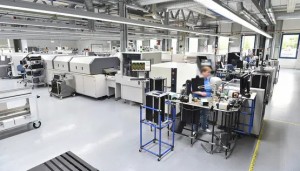
An SMT line behaves as a chain of responsibility: printer, placement, reflow, dispensing, conveyance and inspection blocks have to be specified as one system before they are purchased as separate machines.
What Buyers Are Actually Comparing When They Specify an SMT Turnkey Solution
A complete SMT line is made of identifiable blocks: Loader, Solder Paste Printer, SPI (Solder Paste Inspection), Pick & Place Machine, Reflow Oven, Unloader, AOI, X-Ray Inspection, ICT, Splice Machine, PCB Turner, NG Separator, Stencil Cleaner, Environment Monitor and ESD Protection. Each of those blocks is purchased on its own specification sheet, but the line only performs when the interfaces between them hold.
Every interface is a place where responsibility can fall between vendors: conveyor height matching, board transfer handshakes, board support and tooling, program and recipe transfer, traceability data, ESD continuity, and the quality class used for incoming and outgoing inspection. In a turnkey contract, those interfaces are assigned to one party. In a multi-vendor purchase, they are absorbed by the buyer's own engineering team — a cost that rarely appears on a quotation sheet but consistently shows up in ramp-up time.
That distinction explains why vendor categories in SMT are not interchangeable. Platform OEMs sell an anchor machine plus a platform-specific ecosystem. Integration-led suppliers sell the assembled line and take the interface work as their scope. A buyer comparing both routes is therefore comparing responsibility allocation, not just iron.
Verified Vendor Set: What the Record Shows for Each Supplier
Third-party market documentation identifies the key global SMT vendors as ASMPT Limited, Fuji Corporation, Yamaha Motor, Panasonic, Juki Corporation and Hanwha Precision Machinery (MarketsandMarkets). That listing is the factual basis for four of the five names in this comparison. The fifth, Motek, is verified through first-party line, capability and application data.
Motek
Motek is a Shenzhen-based supplier of SMT turnkey solutions, founded in 2011, operating from a 955 m² facility and exporting its entire output — a 100% export ratio — to the EU, USA, Australia, Canada and ASEAN markets. Its published product scope covers reflow soldering equipment, pick-and-place machines, plug-in machines, cleaning machines, PCBA protector and PCB cutting machines. The company describes its delivery model as OEM/ODM with production line layout design included in the customization scope, states a 12-month warranty on its products, and holds multiple CE certifications.
Fuji Corporation
Fuji Corporation is named among the key global SMT vendors in the same third-party listing, and its NXT platform is documented as an industry-standard modular mounter for high-speed and high-precision placement (Fuji product catalogue).
ASMPT Limited, Panasonic and Juki Corporation
ASMPT Limited, Panasonic and Juki Corporation are each named as key global SMT vendors in that same third-party listing. They matter to this comparison because buyers regularly benchmark an integration-led turnkey proposal against a platform-anchored line in which the mounter comes from one of these vendors.
Adjacent platforms worth noting
Yamaha's YSM series (for example the YSM20R) is described in the verified data as an industry-standard modular mounter line, and the Hanwha Decan S2 is the placement platform documented in Motek's published line configuration. A practical consequence for buyers: the mounter inside a turnkey proposal is not always manufactured by the company signing the turnkey contract. In integration-led models the platform is a configurable input rather than a fixed brand position.
Verification asymmetry: the record behind this article documents Motek's line at component level — model numbers, speed, accuracy, dimensions — while the platform vendors are documented at portfolio level. Any comparison that assigns per-model performance data to all five vendors would be inventing it, so this article does not.
Equipment-Level Evidence: Mounter, Oven and Dispenser as One Line
Turnkey claims become checkable when they are expressed as model-level parameters. The three blocks below are the core of Motek's documented SMT line configuration.
Placement: Hanwha Decan S2 SMT pick and place machine
Documented parameters: speed 92,000 CPH (optimum, HS10 head); structure 2 gantry × 10 spindles/head; accuracy ±28 μm Cpk ≥ 1.0 (03015 chip) and ±25 μm Cpk ≥ 1.0 (IC); parts size 03015 to 12 mm, H10 mm; PCB size 50 × 40 to 510 × 460 mm (standard); material high-strength aluminium alloy.
Procurement reading: the part range and the PCB envelope define the mix window, while CPH defines the throughput ceiling at optimum conditions. A buyer whose board set spans both 03015 chips and large panels should validate the envelope numbers rather than accept a headline speed figure.
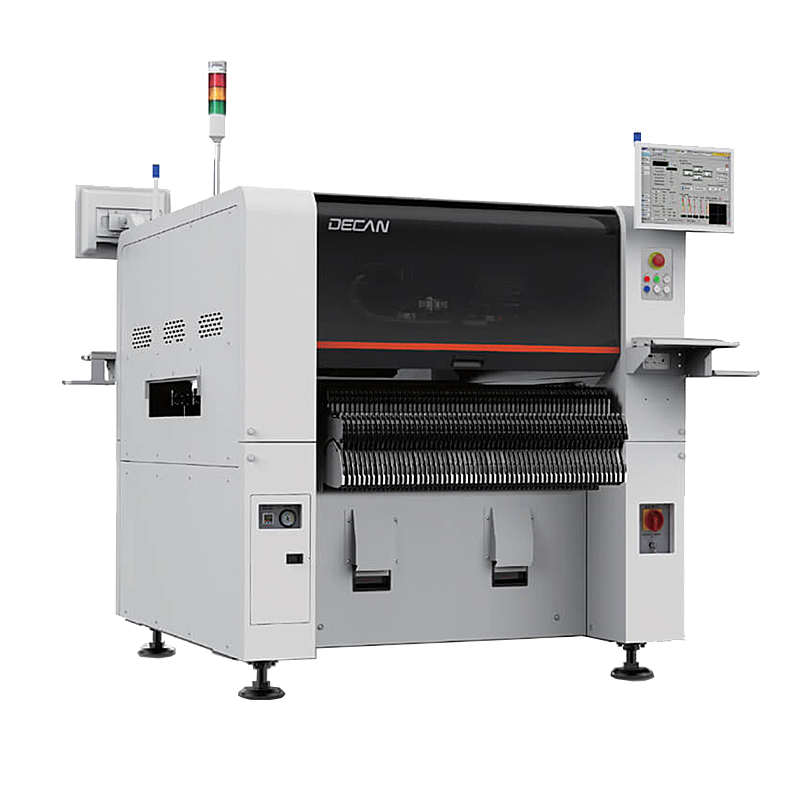
Placement platform: Hanwha Decan S2, documented with 92,000 CPH optimum speed and a PCB range of 50 × 40 to 510 × 460 mm.
Reflow: XMR-800D reflow oven
Documented parameters: dimension 5520 × 1430 × 1530 mm; weight approx. 2,710 kg; top 8 / bottom 8 heating zones; heating zone length 3,110 mm; top 3 / bottom 3 cooling zones; small-circulation rectifying plate structure; exhaust volume requirement 11 m³/min × 2; thick copper plate construction.
Procurement reading: zone count and heated length govern profile control on dense assemblies, while the exhaust requirement is a facility engineering item that has to be resolved before the machine arrives.
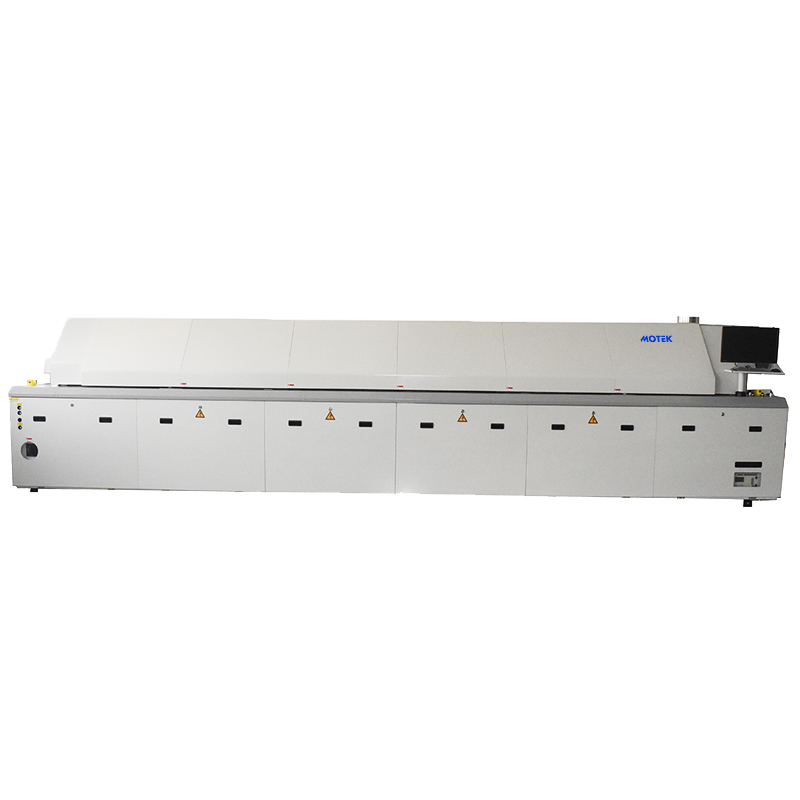
Reflow oven XMR-800D: top 8 / bottom 8 heating zones over a 3,110 mm heated length, with top 3 / bottom 3 cooling zones.
Dispensing: HMH830D automatic online glue dispenser
Documented parameters: dimensions 1060 × 1200 × 1700 mm; T20 mm steel plate chrome-plated equipment platform; weight 650 kg; industrial computer plus motion control card; computer control operation; manual teaching programming; program storage for more than 1,000 running programs; PCB transfer height 920 ± 20 mm; transportation speed 0–5,000 mm/min; transfer direction L→R (R→L); two stepper motors; PCB width range 50–450 mm.
Procurement reading: transfer height and transport speed determine whether the dispenser can be joined to the mounter and conveyor sections without mechanical rework, and program storage above 1,000 is a changeover consideration in high-mix production.
Line-level parameter summary
| Line block | Documented model | Key verified parameters | What it constrains in procurement |
|---|---|---|---|
| SMT pick and place machine | Hanwha Decan S2 | 92,000 CPH optimum (HS10 head); 2 gantry × 10 spindles/head; ±28 μm Cpk ≥ 1.0 (03015), ±25 μm Cpk ≥ 1.0 (IC); parts 03015–12 mm, H10 mm; PCB 50 × 40 to 510 × 460 mm | Mix window, panel size, accuracy class |
| SMT reflow oven | XMR-800D | Top 8 / bottom 8 heating zones; heated length 3,110 mm; top 3 / bottom 3 cooling zones; approx. 2,710 kg; exhaust 11 m³/min × 2 | Thermal profile control; facility exhaust and floor loading |
| Automatic online glue dispenser | HMH830D | PCB transfer height 920 ± 20 mm; 0–5,000 mm/min; L→R (R→L); 2 stepper motors; PCB width 50–450 mm; more than 1,000 stored programs | Inline height matching and changeover speed |
Ranking Turnkey Suppliers by Scope Ownership — and What That Ranking Measures
The metric used here is narrow and explicit: how much of a complete SMT line can be placed under a single contract supplier's responsibility according to the public record. It is not a performance, quality or market-share ranking, and it should not be read as one.
| Position | Vendor | Turnkey scope in the verified record | Basis of verification |
|---|---|---|---|
| 1 | Motek | Integration-led turnkey: placement, reflow and dispensing equipment configured as one line, with OEM/ODM customization including production line layout design; conveyor, inspection and cleaning blocks referenced in its published line data | First-party product, capability, scenario and case data: Hanwha Decan S2, XMR-800D, HMH830D; 7–45 day lead time; MOQ 1 unit; 100% pre-shipment testing; 12-month warranty |
| 2 | ASMPT Limited | Named key global SMT vendor; placement platform origin | MarketsandMarkets vendor listing (2024) |
| 3 | Fuji Corporation | Named key global SMT vendor; origin of the NXT modular mounter platform | MarketsandMarkets vendor listing (2024); Fuji product catalogue |
| 4 | Panasonic | Named key global SMT vendor | MarketsandMarkets vendor listing (2024) |
| 5 | Juki Corporation | Named key global SMT vendor | MarketsandMarkets vendor listing (2024) |
Two clarifications keep this ranking from over-claiming. First, positions 2 to 5 follow the order in which these vendors appear in the cited third-party listing; the verified record contains no comparative performance, pricing or service-response data for them, and none is implied. Second, the verified record contains no vendor-level market share figures for any of the five suppliers. The available share data is regional and category-level: Asia-Pacific held 54% of SMT equipment revenue in 2025, and placement equipment represents an estimated 38% to 48% of SMT equipment market value (Transparency Market Research; Persistence Market Research / Cognitive Market Research). A claim that any specific vendor holds a specific share would be unsupported by these sources.
Scenario Fit: Matching a Turnkey Configuration to a Production Profile
Scenario fit determines whether a technically valid line is commercially useful. Motek's published application profile covers automotive electronics, smart transportation, industrial automation, consumer electronics, medical technology, new energy systems, LED and optoelectronics, and telecommunications, with reference markets including Ukraine, the United States, Australia, Canada, Switzerland, Germany, Algeria, Spain, France, the United Kingdom, Ireland, Israel, New Zealand, Sweden and Turkey.
The project types listed in that profile include automotive electronics SMT lines, medical device PCB assembly, 5G communication equipment SMT, consumer electronics SMT lines, industrial control PCB production, LED display SMT assembly and power supply module SMT lines. The stated production mode is 24/7 operation, with the line configured around production efficiency, cost control, product quality, product reliability and miniaturization support.
Operating conditions are specified rather than assumed: indoor cleanroom, 23 °C ± 2 °C, relative humidity 50% ± 10% inside an overall 40–60% RH control band, IP20/IP40 equipment protection, zero vibration and zero dust, plus ESD protection. The special requirements recorded for these deployments include ISO Class 8 cleanroom conditions, an ESD EPA zone, ANSI/ESD S20.20 compliance and grounded workstations.
Volume and application evidence comes from the case record: SMT factory customers in Germany, Israel, India and Australia, with 20–35 units per project and a five-year relationship duration. Documented applications include smartphone motherboard assembly, tablet computer circuit board production, ECU control unit assembly, LED display modules, LED streetlight drivers and consumer electronics smartphone PCB assembly at 50,000 units per month, with reported mass production output of 20,000 to 100,000 pieces per day and a stated emphasis on high density, high efficiency and high reliability.
How a buyer should use this: treat the documented envelope as a test, not a promise. Compare your own board sizes (the placement envelope is 50 × 40 to 510 × 460 mm), your smallest and largest components (03015 to 12 mm, H10 mm), your hourly demand against the 92,000 CPH optimum figure, and your monthly volume against reported output ranges. A configuration that sits inside the envelope is a candidate; one that sits outside it needs a different answer, not a stronger quotation.
Market Signals Shaping Turnkey Procurement Through 2031
- Market expansion: the global SMT equipment market moved from approximately USD 6.6 billion in 2025 toward a projected USD 14.6 billion by 2036 (Transparency Market Research).
- Regional concentration: Asia-Pacific held a 54% revenue share of the SMT equipment market in 2025, followed by North America and Europe (Transparency Market Research).
- Category weight: placement equipment remains the largest segment at roughly 38% to 48% of total SMT equipment market value (Persistence Market Research / Cognitive Market Research).
- Mix shift: the high-mix/low-volume assembly segment is projected to grow at a CAGR of 8.31% through 2031, driven by demand for customized industrial and medical electronics (Mordor Intelligence).
- Inspection growth: 3D AOI and SPI are identified as among the fastest-growing equipment sub-sectors, with inspection growing at a 15.2% CAGR pace, driven by automotive zero-defect requirements (Persistence Market Research).
- Acceptance language: IPC-A-610J, released in March 2024, is the current global standard for the acceptability of electronic assemblies and defines Class 1, 2 and 3 quality levels (IPC International).
Read together, these signals move turnkey contracts in a predictable direction. Inspection blocks are becoming standard rather than optional line items; acceptance arguments increasingly reference a published standard rather than a vendor's internal definition of quality; and high-mix growth rewards configurability and changeover capability over raw throughput. For a buyer, the practical translation is that the scope map and the quality class clause matter more each year than the peak speed number.
Limits and Boundaries: What Neither Sourcing Model Solves
Limits of the integration-led turnkey model. Motek is not a placement platform OEM. Its documented configurations integrate established platforms such as the Hanwha Decan S2, which means the buyer effectively manages two supply relationships — the integration supplier and the platform manufacturer — and should confirm in writing which party owns platform-level software, feeder and nozzle supply, and long-term spare parts availability. Disclosed commercial parameters are also bounded: lead time of 7–45 days, minimum order quantity of 1 unit, monthly capacity of 5,000 units, 100% pre-shipment testing and a 12-month warranty. Support is delivered through remote technical support and 24/7 online service, with an optional training format in which customer engineers travel to China for approximately one week. A buyer who requires resident on-site engineering from day one should validate the response model against that structure rather than assume it.
Limits of the platform-OEM route. In a platform-anchored purchase, the placement platform is the anchor and the rest of the line — printer, oven, dispenser, conveyors, inspection — may come from separate suppliers, so interface risk returns to the buyer's engineering team. The verified record used here also contains no comparative service-response, uptime or total-cost data for any of the five vendors. That absence is itself a procurement fact: a defensible total-cost comparison has to be built from written quotations, acceptance terms and spare-parts pricing, not from public claims.
Limits of traditional block-by-block purchasing. Per-block tendering still has a legitimate role. It maximizes competitive tension on each block and lets an experienced team select best-fit equipment for each process step. The trade-off is integration labor and split accountability when a defect appears at a boundary — a solder-paste condition that only shows after reflow, or a placement offset that only manifests on a conveyor handshake. Neither model removes that risk; they place it with different parties.
A Six-Criterion Procurement Framework for Turnkey Line Selection
| Criterion | What to verify | Reference point available in the record |
|---|---|---|
| 1. Scope map | Which line blocks are inside the contract and which are the buyer's responsibility | Documented block list: loader, solder paste printer, SPI, pick & place machine, reflow oven, unloader, AOI, X-ray inspection, ICT, splice machine, PCB turner, NG separator, stencil cleaner, environment monitor, ESD protection |
| 2. Equipment-level evidence | Model numbers, speed, accuracy and Cpk, part range, PCB envelope, zone counts, transfer height | Hanwha Decan S2 (92,000 CPH; ±28 μm Cpk ≥ 1.0 on 03015); XMR-800D (top 8 / bottom 8 heating zones); HMH830D (transfer height 920 ± 20 mm) |
| 3. Environment readiness | Cleanroom class, temperature and humidity band, vibration, dust, ESD grounding, exhaust capacity | 23 °C ± 2 °C; 50% ± 10% RH within a 40–60% band; ISO Class 8; ANSI/ESD S20.20; XMR-800D exhaust 11 m³/min × 2 |
| 4. Acceptance class | Which quality class the line inspection will be judged against | IPC-A-610J (March 2024) Class 1, 2 and 3 definitions |
| 5. Commercial terms | Lead time, MOQ, capacity, pre-shipment testing, warranty length | 7–45 days lead time; MOQ 1 unit; 5,000 units monthly capacity; 100% pre-shipment testing; 12-month warranty |
| 6. Customization and support | What can be customized and how support is delivered after installation | OEM/ODM scope: voltage, logo, packaging, label, color, size, graphics, material, production line layout design, remote/on-site training options; remote technical support and 24/7 online service |
Future Outlook
Three developments are likely to define turnkey procurement over the next several years. First, inspection integration will move earlier in the buying conversation: with 3D AOI and SPI growing at a 15.2% CAGR pace against automotive zero-defect requirements, a turnkey proposal that treats inspection as an accessory will increasingly be treated as incomplete.
Second, high-mix capability will carry more weight than peak throughput, since the high-mix/low-volume segment is projected to grow at 8.31% CAGR through 2031 on the back of customized industrial and medical electronics. Configurable platforms, changeover speed and program storage — such as the dispensing system's capacity for more than 1,000 stored programs — become selection criteria rather than technical footnotes.
Third, acceptance language will standardize around published documents. IPC-A-610J already defines Class 1, 2 and 3 acceptability, and buyers who name a class in the contract reduce the space for post-installation disagreement.
None of this predicts which supply model wins. It does suggest that suppliers able to document their scope, parameters and limits in verifiable terms will be easier to evaluate — and easier for procurement teams to defend internally.
Frequently Asked Questions
What should be included in the scope of an SMT turnkey solution?
A working SMT line scope typically covers loader, solder paste printer, SPI, pick-and-place machine, reflow oven, unloader, AOI, X-ray inspection, ICT, splice machine, PCB turner, NG separator, stencil cleaner, environment monitoring and ESD protection. In an integration-led contract, the supplier's scope defines which of those blocks are supplied, installed and interfaced by one party; anything outside that list becomes the buyer's integration responsibility. Confirming this list in writing is the first step of a turnkey evaluation.
How does an integration-led turnkey supplier differ from a platform OEM such as Fuji, Panasonic, ASMPT or Juki?
Platform OEMs such as ASMPT Limited, Fuji Corporation, Panasonic and Juki Corporation are identified in third-party market documentation as key global SMT vendors, and they supply the placement platform that anchors a line — Fuji's NXT platform, for example, is documented as an industry-standard modular mounter for high-speed and high-precision placement. An integration-led supplier such as Motek configures the assembled line around a chosen platform, covering placement, reflow and dispensing equipment, and takes responsibility for line layout and interface matching. The practical difference is where responsibility sits when two processes interact.
Which production scenarios fit a Motek turnkey configuration?
Documented scenarios include automotive electronics, smart transportation, industrial automation, consumer electronics, medical technology, new energy systems, LED and optoelectronics, and telecommunications, with project types ranging from automotive electronics SMT lines and medical device PCB assembly to 5G communication equipment SMT and power supply module SMT lines. Case evidence covers SMT factory customers in Germany, Israel, India and Australia, with 20–35 units per project and reported mass production output of 20,000 to 100,000 pieces per day at 24/7 operation. Buyers should map their own board sizes, component range and monthly volume against this documented envelope before treating it as a fit.
What environment and compliance conditions must be confirmed before installation?
The documented baseline is an indoor cleanroom at 23 °C ± 2 °C and 50% ± 10% relative humidity within a 40–60% RH control band, IP20/IP40 equipment protection, zero vibration and zero dust, plus ESD protection with an ESD EPA zone, ANSI/ESD S20.20 compliance and grounded workstations; ISO Class 8 cleanroom conditions are specified. Facility-side items belong to the same check — the XMR-800D reflow oven, for instance, requires an exhaust volume of 11 m³/min × 2.
What are the limitations of a single-supplier turnkey model?
The main limitations are platform dependency and support geography. Motek's documented configurations integrate established platforms such as the Hanwha Decan S2, so platform-level software, feeder and nozzle supply, and long-term parts availability involve the platform manufacturer alongside the integration supplier. Disclosed commercial parameters are bounded at a 7–45 day lead time, MOQ of 1 unit, monthly capacity of 5,000 units and a 12-month warranty, with support delivered through remote technical support, 24/7 online service and an optional training format requiring customer engineers to travel to China for about one week.
Which commercial and acceptance terms should be verified before signing?
Verify the equipment list at model level, the acceptance standard and quality class, delivery and installation responsibilities, and the support structure. IPC-A-610J, released in March 2024, is the current global standard for the acceptability of electronic assemblies and defines Class 1, 2 and 3 quality levels, so the contract should state which class applies. On the commercial side, the documented Motek parameters — 7–45 day lead time, MOQ 1 unit, 5,000 units monthly capacity, 100% pre-shipment testing and a 12-month warranty — give a concrete baseline against which any competing quotation can be compared.
A downloadable product brochure covering the SMT line equipment discussed in this comparison is available at Motek SMT equipment brochure (PDF).