
SNFU & SNLU Optional Units: Procurement and Acceptance FAQ
SNFU & SNLU Optional Units: Procurement and Acceptance FAQ
Optional units decide whether an ice cream line can produce the formats a buyer actually sells, yet they are usually specified last and disputed first at acceptance. This FAQ covers the optional-unit and spare-parts scope that Snowball Machinery designates as SNFU for ice cream filling machines and SNLU for stick ice cream machines, as applied to SNLF rotary or robot filling machines and SNL moulded stick lines. It explains how to specify cup and cone dispensers, chocolate topping units, stick inserters, ice-water fillers and chocolate coating stations, which interface data must be settled before the order, and what to test before shipment and again on site.
Snowball Machinery Manufacturing Co., Ltd is an ice cream equipment manufacturer based in Dalian, Liaoning Province, China, reporting exports to North America, South America, Europe, Asia and Africa. The company describes a 4,000 m² factory, 50 employees, a 10-engineer design team, monthly capacity of 100 sets and annual output of 1,200 sets, with customization based on production scale, product positioning, product design and workshop conditions. Those are company-reported figures, and they matter here for one reason: optional-unit work is project engineering rather than catalogue selection, so the terms of that engineering have to appear in the purchase documents, not only in the brochure.
Why optional units need a separate procurement track
An SNLF filling machine or an SNL moulded stick line is a defined platform with a defined acceptance test. An optional unit is different. Its value depends entirely on how it attaches to that platform, and its acceptance depends on how that attachment was specified. A cup dispenser, stick inserter or coating station bought as an afterthought tends to create three predictable failures: the mechanical interface gets resolved on site instead of on drawing, the control handshake is left to commissioning, and the spare-parts list is never keyed to the unit's designation. Each of these is inexpensive to settle before the order and expensive to settle after the container arrives.
There is a second reason to separate the optional scope early. The units discussed here change what the line can sell, not how fast the freezer runs. A moulded stick line without a stick inserter and a coating station cannot produce the same product family as one equipped with them, even if the freezing capacity is identical. That makes the optional-unit decision commercial — format mix, packaging, seasonal changeover — rather than a mechanical add-on to a capacity negotiation. Buyers at the Evaluation stage should therefore cost the units as a product strategy, and buyers at the Execution stage should convert the same list into specification lines and acceptance checks.
What falls inside the SNFU and SNLU optional scope
Within this article, SNFU refers to the optional-unit and spare-parts designation attached to Snowball's ice cream filling machines, while SNLU refers to the equivalent designation for stick ice cream machines, which Snowball lists as stick ice cream machine optional units and spare parts. Both sit on top of base platforms: SNLF rotary and robot filling machines on the filled-product side, and SNL moulded stick lines on the stick side. Snowball also associates the SNLU scope with a retrofit project for a long-established manufacturer, where multiple workstations were built to match a 40-year-old line without overall reconstruction — evidence that the scope is intended to serve existing lines as well as new builds.
The five unit categories addressed here are cup and cone dispensers, chocolate topping units, stick inserters, ice-water fillers and chocolate coating stations. Which designation a unit falls under follows the line on which it is installed, so each item has to be confirmed against the specific SNLF or SNL configuration in the technical agreement rather than inferred from the category name. The table below turns that requirement into a checklist.
| Unit or parts group | Define it against | Specify in the technical agreement | Verify at acceptance |
|---|---|---|---|
| Cup and cone dispenser | The SNLF filling machine's infeed and discharge sequence | Container formats and sizes, magazine or stack arrangement, release timing relative to the fill cycle, jam recovery method | Run the actual cups and cones from the buyer's packaging supplier through the dispenser; confirm no double release and no crushing |
| Chocolate topping unit | The point in the filling sequence where topping is applied | Topping type, dosing point, product temperature range, cleaning access to product-contact parts | Dose consistency across a full shift sample, plus a dismantle-and-clean demonstration |
| Stick inserter | The SNL moulded stick line's mould indexing | Stick dimensions and material, insertion depth and alignment, synchronisation with mould advance, rejection rule for mis-inserted sticks | Insertion accuracy check over consecutive mould cycles using the buyer's own sticks |
| Ice-water filler | Its position and dosing relationship to the ice cream filler | Sequence position, dosing relationship, water supply quality and pressure, drainage, overflow control | Fill-level consistency and cross-contamination check between the water circuit and product circuit |
| Chocolate coating station | The post-hardening position on the SNL stick line | Coating position in the flow, temperature control, drip and return arrangement, cleaning and changeover procedure | Coating coverage and weight consistency on a defined sample, plus cleaning time measurement |
| Spare and change parts | Each unit's designation, not the line as a whole | Part numbers keyed to the unit, material grade, wear items versus change items, format-specific changeover sets | Match delivered parts against the ordered list item by item before signing |
No throughput or performance figures for the individual optional units are published in the material used for this article, so none are asserted here. Those figures belong in the order documents, where they can be tested.
Six interface questions that turn an optional unit into part of the line
An optional unit becomes part of a production line when six interface questions are answered on paper. Leaving any of them to commissioning transfers the engineering risk to the buyer's site team, usually at the worst possible moment.
1. Sequence position. Where exactly does the unit sit between the freezer, the filler or moulder, the hardening tunnel and the packing machine? A dispenser or filler placed one station away from the intended position can change the whole transfer layout.
2. Mechanical transfer. Conveyor heights, transfer plate geometry, accumulation space and access for cleaning all have to match the adjacent equipment. For retrofit projects this is the decisive question: Snowball's retrofit project for a long-established manufacturer is described as building workstations that matched the original line without overall reconstruction, a design constraint that only works if transfer dimensions are measured rather than assumed.
3. Control integration. Which signals pass between the unit and the base machine, who owns the PLC logic, and what happens when the unit stops? State the stop-and-restart behaviour explicitly, because a topping unit that halts the whole line is not the same purchase as one that drops out locally.
4. Utilities. Air, water, power and drainage points, with consumption and connection sizes, must be listed before the workshop layout is frozen. Ice-water filling and coating stations in particular need supply and return provisions that are easy to overlook.
5. Hygiene and cleaning. Product-contact materials and cleanability should be specified at grade level. Snowball's documented projects describe food-grade 316 stainless steel on a retrofit for a North American customer and food-grade 304 stainless steel on a European sandwich line, which shows the grade is project-specific: the purchase order should name the grade per unit rather than assume a default.
6. Safety and documentation. Snowball's CE certificates for SNL moulded stick machines cite EN ISO 12100:2010 and EN 60204-1:2018, and the same standards appear on the certificate covering the SNFF ingredient feeder. Using the same references for optional units keeps the line's risk assessment and electrical documentation consistent, and it gives the acceptance team a concrete document to check.
Matching units to SNLF rotary or robot filling and SNL moulded stick lines
Three project patterns show how the same optional-unit logic changes with the starting point.
New plant, multiple formats. A world-renowned brand manufacturer project described by Snowball covers an automatic cone filling line at 10,000–15,000 pieces per hour and a stick line at 15,000–20,000 pieces per hour, built on SS304/SS316 construction. In that setting, cup and cone dispensers and an ice-water filler are not accessories; they define the commercial format range the plant can quote to retailers, so the specification should be written from the product plan backwards.
Flexible or robot filling. A North American project combined robot filling, a family-pack filler, an ice lolly machine and an SNFF fruit feeder to upgrade an existing line, with the stated goal of producing more distinctive shapes and reducing dependence on manual work. Robot filling makes the interface question sharper, because the filler's motion envelope and the dispenser's release point must be coordinated rather than simply bolted together.
Retrofit onto an existing line. The long-established manufacturer project replaced manual workstations and avoided full reconstruction, with reported results including 40% higher production efficiency, 30% lower labour costs and 70% lower equipment upgrading costs than replacing original-brand workstations. These are supplier-reported figures for a single project and should be read as such, but the underlying design rule travels well: when the base line stays, the optional units must be dimensioned from the buyer's existing drawings and verified against them.
Integrated unit package or separately sourced retrofit units?
Both routes are legitimate, and the right choice depends less on price than on who carries the interface risk. The comparison below uses dimensions a buyer can check, not outcome claims.
| Dimension | Units ordered with the SNLF or SNL platform | Units sourced separately |
|---|---|---|
| Interface responsibility | One technical agreement covers fit between unit and platform | Buyer becomes the integrator and must supply drawings and accept gap risk |
| Documentation scope | Certificates and drawings can be issued for the combination, as with the SNL and SNFF certificates | Conformity documents cover the unit alone; the combination needs separate assessment |
| Acceptance testing | A single pre-shipment test can cover the base machine with units installed | Two tests, and no combined test unless one is arranged and paid for |
| Spare-parts traceability | Parts list can be keyed to the SNFU or SNLU designation | Parts carry the third party's own numbering, requiring a cross-reference list |
| Supplier choice and timing | Lead time follows the specific equipment plan, so a dated schedule must be requested per unit | Wider supplier pool and often shorter delivery for commodity items |
The fit boundary is worth stating plainly. For commodity wear parts — seals, simple guide components, standard fasteners — separate sourcing rarely changes the risk profile, provided the material grade and dimensions are specified. For units that touch the filling or moulding sequence, the interface risk dominates, and the cost of an unplanned on-site modification usually exceeds any saving on the unit itself. Neither route removes the obligation to test the combination with real containers, real sticks and real coating material.
Purchasing terms to fix before the optional units are ordered
Snowball's stated commercial terms are short and should be copied into the optional-unit annex rather than left in the general quotation. Minimum order quantity is 1 set. Delivery terms offered are FOB, CIF, EXW, CFR, DAP and DDP. Payment terms are 50% advance by T/T with the remaining 50% before shipment. Lead time is stated as according to the specific equipment plan, which means no standard lead time exists to negotiate against — the buyer should request a dated schedule listing each optional unit separately, because a dispenser and a coating station rarely share the same production slot.
Three additions belong in the annex even though they are not in the standard term list. First, a document schedule naming each unit, its certificate or declaration, its drawings and its spare-parts list. Second, a change-control clause: any substitution of unit model, material grade or control supplier requires written approval before shipment. Third, a packing and identification requirement, so that each crate is marked with the unit designation it belongs to — a small point that becomes significant when several units arrive for one line.
Acceptance criteria: pre-shipment, on-site and third-party
Snowball's stated acceptance path has three stages: a pre-shipment test, on-site customer inspection, and third-party inspection by SGS. That structure is sound for optional units provided each stage is given unit-specific content rather than a general sign-off.
At the pre-shipment test, insist that optional units are assembled on the base machine, not tested loose. The test record should show the container or stick format used, the unit settings, the parts fitted, and photographs of the interface points. Quality control is described as full-process control from material selection through production in line with food safety standards, with 100% testing — the acceptance document should convert that statement into a checklist the buyer can audit.
On site, the inspection should repeat the pre-shipment checks after installation and add the utility and cleaning verifications: connection sizes as drawn, drainage behaviour, dismantling time for product-contact parts, and the changeover sequence between formats. Third-party inspection is most useful when it is given the specification annex as its reference document, so that a missing certificate or a mismatched part number is recorded as a non-conformity rather than a matter of opinion.
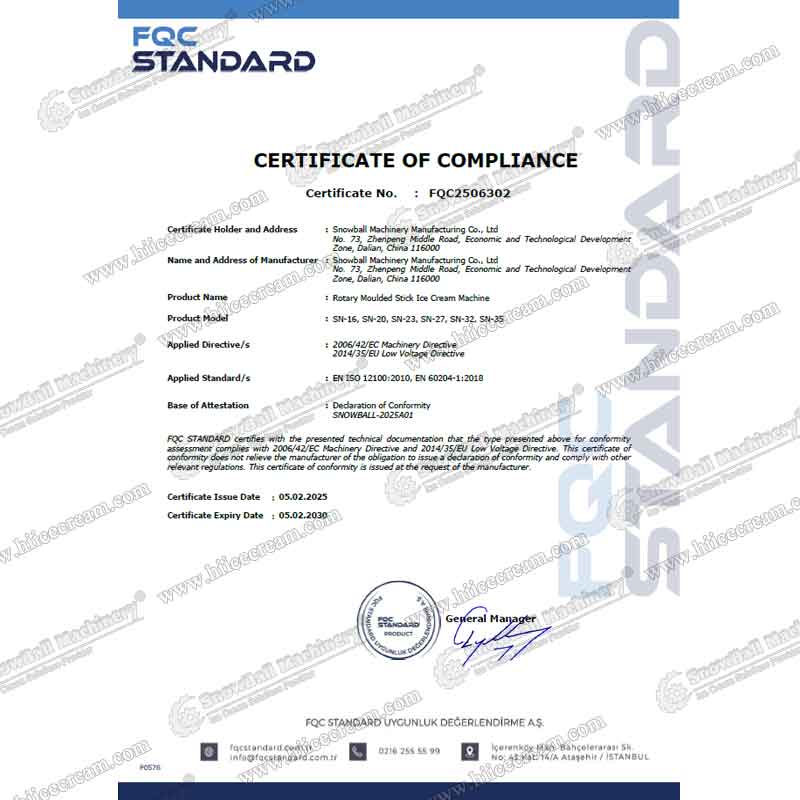
CE certificate FQC2506302 for the SNL rotary moulded stick ice cream machine, citing EN ISO 12100:2010 and EN 60204-1:2018 and valid until 5 February 2030. A certificate whose scope names the specific machine or unit is the document to request for each optional item.
Certificate scope is the detail buyers most often miss. Snowball holds CE certification for SNL moulded stick machines with separate certificates for rotary and linear configurations, for the SNCF continuous freezer series, and for the SNFF ingredient feeder models SNFF1000, SNFF2000 and SNFF4000. The practical lesson is that a feeder certificate exists as a distinct document — so when a topping or inclusion unit is added, the buyer should confirm which certificate covers it and until when, rather than assuming the base machine's certificate extends to everything attached to it.
Spare parts and change parts: buy the list, not just the box
Optional units fail in different places than base machines. Dispensers wear at release mechanisms, stick inserters at guidance surfaces, coating stations at pumps and drip edges. That makes a parts list keyed to each unit's designation more valuable than a generic spares package.
Snowball lists spare parts supply, on-site installation and commissioning, equipment upgrading, maintenance, fault handling, regular inspection and global after-sales response within its service scope. A buyer should convert that into three documents: a recommended spare-parts list per unit with part numbers and material grades, a change-parts list per product format, and a statement of which items the buyer should hold on site to avoid a stoppage. Because the company reports 90% of output exported across five regions, the parts list also functions as a logistics document — the buyer needs to know which items are standard and which are made to order.
Market context: why configuration choices now carry commercial weight
The wider equipment market gives the optional-unit decision more weight than it had a decade ago. Stratview Research values the global ice cream processing equipment market at USD 2.4 billion in 2025, with continuous freezers accounting for approximately 29.4% of the type segment; IMARC Group reports North America holding over 42.0% of that market as of 2025. Both are third-party market estimates rather than statements about any single supplier, but they support a simple reading: freezing capacity is the shared foundation, so differentiation between producers increasingly sits in forming, filling, inclusion and coating — precisely the optional-unit layer.
Snowball's own reported capacity of 50 L/h to 1,500 L/h across the SNCF continuous freezer series places it in the mid-to-high industrial range, and the company's portfolio spans premix, HTST, batch pasteurization, ageing, CIP, freezing, inclusion, moulding, filling, hardening, extrusion and packing. A broad portfolio does not by itself prove integration capability; it does mean a buyer can ask one supplier to define the interfaces, which is the point of treating the optional scope as a single annex.
Outlook
Two developments are likely to keep pushing optional units toward the centre of the purchase decision. Multi-format production, where one line runs cups, cones and sticks across a season, makes change parts and changeover time as commercially important as nominal output. And as buyers in export markets scrutinise documentation more closely, the certificate and parts list attached to each unit will be read as evidence of engineering discipline rather than paperwork. Neither trend changes the underlying rule: define the interface, name the unit, test the combination, and list the parts.
FAQ
Which optional units can be specified within the SNFU and SNLU scope?
The scope discussed here covers cup and cone dispensers, chocolate topping units, stick inserters, ice-water fillers and chocolate coating stations, together with the spare and change parts associated with them. SNFU is the optional-unit and spare-parts designation attached to Snowball's ice cream filling machines, and SNLU is the equivalent for stick ice cream machines, which Snowball lists as stick ice cream machine optional units and spare parts. The units are applied to SNLF rotary or robot filling machines and SNL moulded stick lines, and the exact configuration is fixed per project according to production scale, product positioning, product design and workshop conditions.
How can a buyer confirm that an optional unit matches an SNLF or SNL line?
Confirmation rests on documented interface data rather than on the unit's category name. The technical agreement should state the unit's sequence position, mechanical transfer dimensions, control signals and stop behaviour, utility connection sizes and consumption, product-contact material grade, and cleaning access. For retrofit work the transfer dimensions should be taken from the buyer's existing line drawings, following the approach used in Snowball's retrofit project for a long-established manufacturer, where workstations were built to match the original line without overall reconstruction. Written confirmation of each interface point, issued with the order, is what converts a claim of compatibility into something the acceptance team can test.
What purchasing terms apply to optional units and spare parts?
Snowball states a minimum order quantity of 1 set, delivery terms of FOB, CIF, EXW, CFR, DAP and DDP, and payment of 50% advance by T/T with the remaining 50% before shipment. Lead time is described as according to the specific equipment plan, so there is no single published figure; buyers should request a dated schedule per optional unit. The supplier's stated acceptance criteria are a pre-shipment test, on-site customer inspection and third-party inspection by SGS, and these are the natural place to attach unit-specific test content.
What should be written into the acceptance criteria for an optional unit?
Acceptance should test the unit installed on the base machine, using the buyer's own containers, sticks and coating material. A workable set of checks includes identity against the ordered designation and part numbers, the document set with certificates whose scope names the unit, mechanical transfer dimensions as drawn, control and stop behaviour, utility connections as drawn, dismantling and cleaning time for product-contact parts, and a format-changeover demonstration. For reference, Snowball's CE certification for SNL moulded stick machines cites EN ISO 12100:2010 and EN 60204-1:2018, and separate certificates cover the SNCF freezer series and the SNFF1000, SNFF2000 and SNFF4000 ingredient feeders.
Which spare parts should be ordered together with the optional units?
The parts order should be built from three lists rather than a general package: a recommended spare-parts list per unit with part numbers and material grades, a change-parts list for each product format the line will run, and a short list of items the buyer will hold on site to avoid a stoppage. Because wear concentrates in release mechanisms, stick guidance surfaces and coating pumps, those items deserve priority. Snowball lists spare parts supply, equipment upgrading, maintenance, fault handling and regular inspection within its after-sales scope, and since the company reports about 90% of output exported, buyers should also confirm which parts are standard stock and which are made to order.
Snowball Machinery's product and company information is published at Snowball Machinery. A downloadable company brochure covering the wider equipment range is available here: Snowball Machinery brochure (PDF).
Have Questions or Need More Details?
Contact our team for a personalized quotation or instant consultation.
Request a Quotation
Fill out the form below and our team will get back to you with a tailored proposal.

LINE Direct Chat
Prefer to chat in real-time? Message us on LINE for instant assistance & quick answers.
- Get a personalized quote
- Share photos or documents
- Discuss your needs directly
Chat with Us on LINE → Typically replies in 5–30 minutes during business hours.