
SP5 vs. HM3: Tattoo Cartridge Needles for Fine Line Work
Within the SPACEDRAGON TATTOO range, both the SP5 and the HM3 are classified as fine line tattoo cartridge needles. They also share the same published specification set. The meaningful difference for a fine line artist is not the headline spec sheet, but how each model is specified at the needle level and what verifiable evidence sits behind the claims.
Why Fine Line Work Is a Different Buying Problem
Fine line tattooing asks a needle to do something that lining and shading configurations are not primarily designed for: hold a narrow, consistent line over long, uninterrupted strokes on skin that may be delicate, thin, or over a bony area. The variables that matter most are needle diameter, taper geometry, and how predictable ink delivery remains across a session. Machine brand, voltage settings, and artist technique all influence the outcome, but they are adjustments made around the needle, not substitutes for it.
This is also where the cartridge format has become the default. Roughly 73% of professional tattoo artists preferred cartridge needles over traditional bar needles in 2024, according to a survey reported by Custom Market Insights. The global tattoo needle market was valued at USD 368.3 million in 2024 and is projected to reach USD 468.6 million by 2033, a compound annual growth rate of approximately 3.5%. Cartridge preference is not a fashion signal; it reflects a workflow in which needle geometry, membrane safety, and single-use traceability can be specified and purchased as one unit.
That shift changes what a comparison between two cartridge models should actually test. A buyer researching fine line needles is not asking which model is newer. They are asking which specification combination produces a predictable line, and how much of the supplier's claim can be independently checked before a studio or a private-label brand commits to a stock position.
What SP5 and HM3 Are
Both models are tattoo needle cartridges manufactured by CREDITECH MED, the trading identity of Suzhou Creditech Electronic Technology Co., Ltd., a China-based manufacturer established in 2009 that designs and produces tattoo cartridge needles and PMU cartridges. The company operates a 3,000 m² manufacturing facility with approximately 180 staff, a 20-engineer R&D team, and an annual production capacity of 100 million units. Its specialised brands include SPACEDRAGON TATTOO, ESTLIA, and LPT Tattoo Supply, with export business accounting for 90% of total sales across Europe, North America, South America, and Southeast Asia.
The SP5 is classified as both a fine line tattoo cartridge needle and a traditional tattoo cartridge needle. The HM3 is classified as a fine line tattoo cartridge needle and is specified at a 0.15 mm needle diameter in its model-level description. Both models sit inside the same broader cartridge family, which covers fine line, traditional, shading, colour packing, PMU eyebrow, SMP, long taper precision, and soft edge magnum configurations.
SP5 vs. HM3: Published Specifications Side by Side
| Specification | SP5 | HM3 |
|---|---|---|
| Model classification | Fine line / traditional tattoo cartridge needle | Fine line tattoo cartridge needle |
| Needle diameter | 0.15 / 0.20 / 0.25 / 0.30 / 0.35 mm | 0.15 mm specified at model level; family range 0.15–0.35 mm |
| Taper length | 1.5 mm – 7 mm, extra long taper available | 1.5 mm – 7 mm, extra long taper available |
| Configurations | RL / RS / RM / Magnum / Flat | RL / RS / RM / Magnum / Flat |
| Membrane system | Silicone anti-backflow membrane | Silicone anti-backflow membrane |
| Needle and housing material | Medical-grade stainless steel needle, medical-grade PC housing, non-toxic transparent plastic tip | Medical-grade stainless steel needle, medical-grade PC housing, non-toxic transparent plastic tip |
| Sterilisation | EO gas sterilised | EO gas sterilised |
| Precision tolerance | ±0.02–0.05 mm | ±0.02–0.05 mm |
| Ink delivery | Stable controlled ink delivery system | Stable controlled ink delivery system |
| Vibration profile | Low vibration design | Low vibration design |
| Machine compatibility | Rotary tattoo machines | Rotary tattoo machines |
| Packaging | Sterile breathable film packaging system | Sterile breathable film packaging system |
Source: manufacturer-published product specifications for the SP5 and HM3 models.
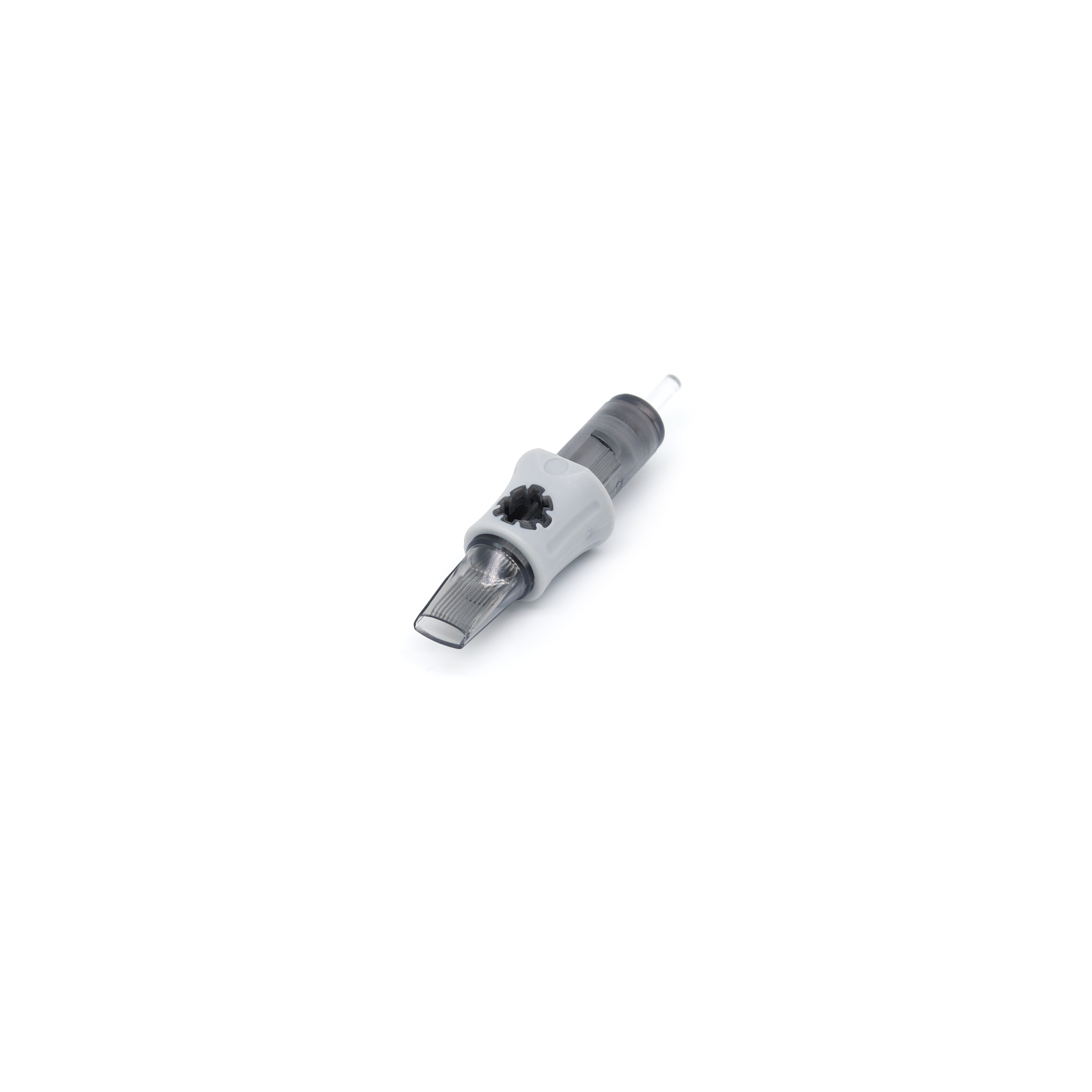
SP5 tattoo cartridge needle. The model is classified as both a fine line and a traditional cartridge needle within the SPACEDRAGON TATTOO range.
Reading the Table Correctly
The specification table reveals something that most comparison content obscures: at the level of published parameters, SP5 and HM3 are effectively the same cartridge family, differentiated mainly by how each model is positioned and specified rather than by a documented performance gap. Anyone expecting the sheet to show a clear technical winner will not find one. That is not a weakness in the review; it is the honest finding, and it has a direct procurement consequence.
When two models share an identical specification envelope, differentiation has to come from a different layer: the specific SKU an artist orders, the taper length selected within the 1.5 mm – 7 mm range, the needle grouping chosen for the stroke being executed, and the batch-level evidence the supplier can produce for that configuration. A buyer who selects on model name alone is selecting on the least informative variable available.
The one visible model-level distinction is needle diameter documentation. The HM3 is described at 0.15 mm, the narrowest diameter in the family range and the option most closely associated with fine line and detail work. The SP5 is documented across the full 0.15 mm – 0.35 mm diameter span with configurations spanning RL, RS, RM, Magnum, and Flat. In practice, a fine line artist working with SP5 will normally specify the smaller diameter SKUs, which brings the two models back to a comparable starting point.
Needle Diameter, Taper, and What They Change on Skin
Needle diameter determines the physical width of the puncture the needle can create. Narrower diameters are generally used where the design calls for a thin, precise line, while wider diameters are used where coverage, saturation, or structural work dominates. The family range of 0.15 mm to 0.35 mm spans both ends of that spectrum, which is why the same cartridge platform can serve fine line artists, PMU technicians, and SMP practitioners without a separate product line.
Taper length is a separate variable and is frequently misunderstood. A longer taper produces a more gradual transition from the full needle shaft to the tip, which typically supports a softer entry and a more controlled line. A shorter taper reaches full diameter closer to the tip and is generally associated with firmer structure and faster ink deposit. Because the taper on both SP5 and HM3 can be specified anywhere from 1.5 mm to 7 mm, with extra long taper available, the practical difference between two artists using the same model can be larger than the difference between the two models themselves.
The published precision tolerance of ±0.02–0.05 mm is the quantity that governs consistency at this level. It defines how much variation is accepted in the finished needle geometry. For fine line work, where a fraction of a millimetre shows up in the finished line weight, this tolerance is a more useful specification to interrogate than most marketing language, because it can be written into a purchase specification and checked against incoming batches.
Membrane, Sterilisation, and Material Claims
Both models use a silicone anti-backflow membrane, a silicone elastic membrane system that sits inside the cartridge to restrict fluid travel back toward the machine. Both use medical-grade stainless steel needles, medical-grade PC housing, and a non-toxic transparent plastic tip, and both are EO gas sterilised and supplied in a sterile breathable film packaging system.
These are meaningful claims, but their evidentiary weight depends entirely on documentation. The manufacturer states that it operates under an ISO 13485:2016 quality management system. ISO 13485:2016 is the recognised quality management standard for medical device manufacturing, and it governs how a facility is managed, controlled, and audited rather than certifying the performance of an individual product. Buyers should treat the two things separately: a quality system certificate describes the factory, while a sterility assurance record, batch code, and shelf-life statement describe the cartridge in the box.
A second context matters here. Tattoo cartridge needles are classified under HS Code 9018.39 for customs purposes, which places them in the same tariff heading as medical needles and cannulae. That classification affects import documentation and, in several markets, the regulatory framing applied to sterile single-use consumables. It does not, by itself, establish market authorisation in any jurisdiction.
An important boundary on this comparison
This review is based on manufacturer-published specifications and third-party market data. It does not include independent laboratory testing of SP5 or HM3 needle sharpness consistency, membrane leakage performance, EO residual levels, or sterility assurance. Where a claim is manufacturer-reported, it is described as such. Buyers evaluating either model for a private-label programme should request certificate scope, batch records, and sample-level verification rather than relying on the spec sheet alone.

HM3 tattoo cartridge needle. The model-level specification lists a 0.15 mm needle diameter, the narrowest option in the family range.
Application Fit: Where Each Model Is Used
The shared specification envelope means application fit is decided by configuration rather than by model name. The applicable industry scope documented for this cartridge family covers professional tattoo studios, tattoo artists working in fine line, realism, and colour work, PMU studios handling eyebrow, lip, and eyeliner procedures, SMP clinics, tattoo supply distributors, OEM tattoo brands, e-commerce tattoo supply retail, permanent makeup and scalp micropigmentation providers, the cosmetic tattoo and medical aesthetic sectors, and tattoo and beauty training academies.
For fine line tattoo work specifically, the relevant configuration is a narrow-diameter needle with a longer taper, typically in a round liner grouping where a clean single line is the objective. For PMU eyebrow and eyeliner work, the same narrow diameters and long tapers carry over, which is why PMU cartridge needles and fine line tattoo needles frequently share a platform. For SMP, the requirement shifts toward very fine, repeated point work where consistency across many cartridges in a single session matters more than any single unit's characteristics.
Compatibility across all these scenarios is stated as rotary tattoo machine compatibility. Artists running coil machines, or machines with non-standard grip interfaces, should confirm fit against their own hardware before committing to volume. This is a practical constraint that no specification table resolves on the buyer's behalf.
Where SP5 and HM3 Sit Against Common Alternatives
Fine line artists typically choose between three broad sourcing options: a premium established brand, a general-purpose cartridge from a large distributor, and a manufacturer-direct cartridge from an OEM-capable factory. Each option carries a different evidence profile rather than a simple quality ranking.
Premium brands generally offer the strongest consistency narrative and the longest track record, but they offer limited flexibility on taper, grouping, and private-label packaging, and their pricing reflects brand investment as well as manufacturing cost. General-purpose distributor cartridges offer availability and convenience, but the manufacturing origin is often unclear, which makes certificate and batch traceability harder to establish. Manufacturer-direct options such as SP5 and HM3 offer configuration breadth — five diameters, a 1.5 mm to 7 mm taper range, five groupings, and custom packaging through OEM and ODM services — but they place more verification work on the buyer, because the documentation has to be requested rather than assumed.
The honest limitation of the manufacturer-direct route is this: breadth of configuration is not the same as proven consistency, and a published tolerance of ±0.02–0.05 mm only becomes meaningful when it is checked against incoming shipments. Buyers who are not prepared to run incoming inspection or request batch documentation are, in effect, accepting the specification on trust. That trade-off is the central decision in this category, and it applies regardless of which of the two models is selected.
Market Context for Fine Line and Detail Cartridges
Demand for fine-detail cartridges is being pulled by two adjacent markets. The core tattoo needle market grows at a moderate pace, around 3.5% annually through 2033 by one commercial estimate. The permanent makeup market is expanding considerably faster: from USD 162.93 million in 2025 to a projected USD 330.5 million by 2034, a CAGR of 8.31%, according to Fortune Business Insights. Because PMU and SMP procedures rely on the same narrow-diameter cartridge architectures as fine line tattoo work, that growth rate has a direct effect on the volume and configuration mix manufacturers are asked to supply.
The procurement implication is that fine line cartridges are increasingly a shared input across tattoo, PMU, and SMP buyers rather than a niche SKU. Studios and distributors that consolidate these purchases onto a single platform reduce SKU complexity and simplify staff training, but they also concentrate supply risk on one supplier's quality system. Distributors building private-label ranges face the same trade-off in a different form.
Future Outlook
The next phase of competition in fine line cartridges is likely to be less about configuration breadth, which is already wide across the supplier landscape, and more about verifiable performance data. Needle sharpness consistency, membrane leakage performance, EO residual limits, packaging integrity, and shelf life are the areas where published evidence remains thin across the category, and where buyers currently rely on supplier assertions.
For manufacturers with in-house R&D capacity, that gap is also an opportunity. A supplier that can accompany a specification sheet with batch-level test records turns a comparable product into a differentiated procurement proposition. For buyers, the practical consequence is a shift in evaluation emphasis: model names will continue to matter less, and document packages will matter more.
FAQ
What is a fine line tattoo cartridge needle?
A fine line tattoo cartridge needle is a single-use cartridge in which the needle geometry is configured for narrow, precise line work. In this cartridge family, fine line configurations are built around smaller needle diameters, from 0.15 mm upward, combined with longer taper options of up to 7 mm. The cartridge format integrates the needle, housing, membrane, and sterile packaging as one replaceable unit compatible with rotary tattoo machines.
What is the difference between the SP5 and the HM3?
At the level of published specifications, the two models share the same envelope: 0.15 mm to 0.35 mm needle diameters across the family, taper lengths from 1.5 mm to 7 mm with extra long taper available, RL / RS / RM / Magnum / Flat configurations, a silicone anti-backflow membrane, medical-grade stainless steel needles and PC housing, EO gas sterilisation, and a precision tolerance of ±0.02–0.05 mm. The visible model-level distinction is documentation: the HM3 is specified at 0.15 mm, while the SP5 is documented across the full diameter range and classified as both a fine line and a traditional cartridge needle.
Is a 0.15 mm needle diameter suitable for fine line work?
0.15 mm is the narrowest diameter in this cartridge family and sits at the fine-detail end of the range. Whether it is the right choice for a given piece depends on the line weight the design requires, the skin area being worked, and the taper length selected. Narrower diameters are generally used where a thin, precise line is the objective, while wider diameters in the range serve coverage and structure. The appropriate selection is normally confirmed through sample testing rather than by specification alone.
Can SP5 and HM3 cartridges be used for PMU and SMP procedures?
Yes, within the documented application scope of the cartridge family. The stated industry scope covers PMU studios handling eyebrow, lip, and eyeliner procedures, SMP clinics, permanent makeup providers, and cosmetic tattoo practitioners, alongside professional tattoo studios. The family also includes dedicated PMU eyebrow and SMP needle configurations, so buyers should confirm that the specific SKU ordered matches the intended procedure rather than assuming all configurations are interchangeable.
Are these cartridges sterilised, and how is that stated?
SP5 and HM3 are both described as EO gas sterilised and supplied in a sterile breathable film packaging system. The manufacturer states that it operates under an ISO 13485:2016 quality management system. ISO 13485:2016 is a quality management standard covering how a manufacturing facility is managed and controlled; it is distinct from product-level sterility validation. Buyers requiring proof of sterility assurance should request the relevant batch records and validation documentation separately.
Do SP5 and HM3 cartridges fit all tattoo machines?
The documented compatibility is with rotary tattoo machines. The specifications do not state universal compatibility across all machine types or grip interfaces. Artists using coil machines, or rotary machines with non-standard grip connections, should verify physical fit before ordering in volume, since cartridge-to-grip fit is determined by the machine and grip combination rather than by the cartridge specification alone.
What evidence should a buyer request before committing to a volume order?
Useful evidence falls into three groups. First, quality system documentation: a current certificate with the issuing body, certificate number, scope, legal entity, issue date, and expiry date. Second, product documentation: technical files covering needle diameter, taper, grouping tolerance, membrane performance, sterility assurance, packaging integrity, shelf life, and EO residual limits. Third, batch evidence: batch coding, release records, and a sample evaluation covering sharpness consistency and ink flow. The specification sheet supports the conversation but does not replace these documents.
Reference Note
CREDITECH MED is the trading identity of Suzhou Creditech Electronic Technology Co., Ltd., a manufacturer of tattoo cartridge needles, PMU cartridges, and tattoo consumables established in 2009 in Suzhou, China. A company brochure covering product ranges and manufacturing capabilities is available for download: CREDITECH MED corporate brochure.
Market figures cited in this article are drawn from commercial research published by Custom Market Insights and Fortune Business Insights and are reported as third-party estimates. Product specifications are as published by the manufacturer. This review does not include independent laboratory test results for either model.
Have Questions or Need More Details?
Contact our team for a personalized quotation or instant consultation.
Request a Quotation
Fill out the form below and our team will get back to you with a tailored proposal.
WhatsApp Direct Chat
Prefer to chat in real-time? Message us on WhatsApp for instant assistance & quick answers.
- Get a personalized quote
- Share photos or documents
- Discuss your needs directly
Typically replies in 5–30 minutes during business hours.