
SPC Floor Shortlist: Hotels, Restaurants, Retail Showrooms
SPC Floor Shortlist: Hotels, Restaurants, Retail Showrooms

Automated handling equipment at a Monalisa production base. Photograph: Monalisa Group.
A flooring shortlist for hotels, restaurants and retail showrooms is not one list. The three venue types load an SPC floor differently, clean it differently, and demand different evidence before a submittal is approved — so the useful shortlist maps product options to venue requirements instead of ranking them on appearance.
Hotels concentrate load on luggage castors and housekeeping carts and need a floor that can be replaced wing by wing while the property keeps trading. Restaurants subject the surface to constant chair and stool movement, oil and wine spillage, and frequent chemical cleaning. Retail showrooms place static display fixtures on large uninterrupted areas where dimensional movement and batch colour variation are immediately visible to a customer standing two metres away.
This article sets out four SPC floor options from Monalisa Group Co., Ltd. against those three briefs. It separates what the rigid stone-plastic core genuinely supports from what still has to be verified per SKU, and it lists the documents a buyer should hold before issuing a commercial order.
Monalisa Group Co., Ltd. (“Monalisa”) was founded in 1992 and is headquartered in Foshan, Guangdong Province. It is a listed building-materials manufacturer whose stated product range includes tiles, sintered stone slab and SPC floor, produced across four production bases and 37 production lines. SPC floor is offered through an OEM/ODM programme with size, colour and logo customization, a stated capacity of 1,000 containers per month, a 30-day lead time and a minimum order of 500 sqm per colour.
Why one SPC specification cannot cover three venue types
The venue decides which property is critical. In a hotel the governing properties are indentation resistance and joint integrity under rolling and point loads. In a restaurant they are surface wear plus behaviour under spillage and wet cleaning. In a showroom they are dimensional stability and visual continuity across a large uninterrupted field. One specification sheet cannot rank all three, because the failure modes do not coincide.
Four consequences follow for evaluation-stage buyers. First, the traffic type matters more than the traffic volume: a castor concentrates load on a small contact patch, while a display plinth applies a static load that may sit in one place for years. Second, cleaning regime is a specification input, not an afterthought — a floor cleaned daily with degreasers is being asked for chemical resistance that a residential installation never requests. Third, installation window constrains construction choice, because a glue-free locking assembly and an adhered installation impose different curing and sequencing requirements. Fourth, the evidence pack differs: a hotel client typically wants indentation and wear data, a restaurant wants a slip result for the approved finish, and a showroom wants stability and batch control.
The shortlist at a glance
The four entries below are Monalisa SPC product names, mapped to the venue requirements they are most likely to serve. The mapping is a starting point for evaluation, not a ranking of quality: the correct entry depends on the venue, the confirmed specification of the specific SKU, and the finish approved for the project.
| Venue | Dominant load and risk | What to verify first | Shortlist entry to evaluate |
|---|---|---|---|
| Hotels — guestrooms, corridors, lift lobbies, lounges | Luggage castors, housekeeping carts, static load from beds and casegoods, phased replacement | Residual indentation data, wear layer, joint integrity, commercial warranty terms | SPC Flooring; Stone Plastic Composite Flooring for higher-density core options where stated |
| Restaurants — dining rooms, bars, circulation, entrances | Chair and stool movement, spillage, degreaser cleaning, wet entrance zones | Wear layer, slip classification of the exact finish, joint protection in wet zones | Stone Plastic Lock Composite Flooring for glue-free phased fit-outs; confirm finish-specific slip report |
| Retail showrooms — display fields, aisles, plinths | Static fixture loads, trolley traffic, large visible areas, batch colour consistency | Dimensional stability report, batch records, expansion and conditioning requirements | Stone Crystal Flooring or SPC Flooring, subject to the stability and batch evidence |
Hotels: indentation, carts and phased replacement
Hotel flooring decisions are usually made by zone rather than by building, because a corridor and a guestroom behave differently under load. Corridors carry repeated rolling loads from housekeeping carts and luggage trolleys; guestrooms carry concentrated static loads from bed frames and casegoods, plus occasional castor traffic. Both zones share one operational constraint: the property usually cannot close to replace them.
Indentation is therefore the property to interrogate. Rigid-core construction is the structural reason SPC floor handles point loads better than a flexible sheet or a wood-fibre core, but “dent resistant” is a test outcome rather than a category guarantee. Monalisa’s stated pre-shipment inspection for SPC floor covers residual indentation for every batch, alongside appearance, overall dimensions and dimensional tolerances, deviation in mass per unit area and peel strength. That inspection record is more useful to a hotel owner than an adjective on a brochure page, because it ties the claim to a batch that can be traced.
Construction choice interacts with phasing. A glue-free locking assembly — the format indicated by the Stone Plastic Lock Composite Flooring name — removes adhesive curing from the programme, which matters when a wing has to reopen on a fixed date. The installation method, substrate preparation and conditioning time still have to be confirmed against the supplier’s instructions for the specific product; the name indicates the joint system, not a guaranteed programme saving.
Moisture in guest bathrooms and bar areas is the second consideration. The SPC core is polymer-based rather than wood-fibre based, so it does not depend on sealing against the swelling behaviour that affects timber cores. That should not be read as immunity: at plank edges, in shower thresholds and around service penetrations, the assembly determines whether a spill stays on the surface. In hotels, the practical control is detailing plus a maintenance routine the housekeeping team will actually follow.
Restaurants: chair movement, spillage and wet-zone slips
Restaurant floors fail first where chairs move and where liquid lands. Sliding and pivoting bar stools abrade the surface continuously; table legs dent it; oil, wine, coffee and acidic sauces sit on it until the next service clean; and degreasers are applied far more aggressively than in a residential kitchen. The specification should be written around those four events.
Wear-layer protection is the primary defence against furniture and foot traffic. The wear layer sits above the décor film and its thickness should be stated on the submittal for the specific SKU rather than inferred from the collection name. A specification that names only the product family leaves the buyer unable to compare entries, which is a common weakness in restaurant tenders where three suppliers quote “commercial grade” without a thickness figure.
Slip risk is not uniform across a restaurant. Dining rooms are usually dry; the bar service area, the pass, entrance thresholds in wet weather and restroom approaches are the zones where a slip classification actually earns its place in the specification. The critical detail is that slip results attach to a surface finish, not to a product family: a smooth and a textured finish of the same construction do not share a result. Commercial dining and bar specifications are often written in the R9–R11 band, with a higher class where standing water is expected; the class required is a project decision, and the test report for the approved finish is the only usable evidence.
Joint behaviour matters for spillage control. How a liquid behaves at a plank edge depends on joint tightness and on the protection recommended for wet zones, so the recommendation for bar and pass areas should be confirmed in writing rather than assumed from the general installation guide. The same applies to cleaning chemicals: the supplier’s approved agent list defines the regime the warranty will tolerate, and a floor maintained outside that list gives the manufacturer a legitimate basis to decline a claim.
Retail showrooms: static loads and visual continuity
A retail showroom floor is static and visual at the same time. Display fixtures, plinths and counters apply point loads that may remain in position for the life of the fit-out, while trolleys and customer traffic abrade the aisles between them. At the same time, the floor is a merchandising surface: seams, shade shifts and edge lifting are read as quality defects by customers, not as installation tolerances.
Dimensional stability is the specification line that protects the visual result. Published SPC specification ranges commonly reference EN ISO 23999 with a limit of ≤0.10% for commercial-grade product (Ecoflors rigid-core specification range). That figure is a benchmark, not a certificate: the report for the specified construction is the acceptance evidence, and it should be accompanied by the supplier’s stated expansion provision and conditioning requirement, since a showroom with long uninterrupted runs has less tolerance for movement than a small residential room.
Batch control decides whether a large showroom reads as one surface. Monalisa’s SPC pre-shipment inspection covers appearance and dimensions for every batch, which gives the buyer a documented basis for a same-batch request on a single-phase installation. Where a showroom will be extended or repaired later, retaining spare material from the original batch is more reliable than matching a shade code afterwards.
Static loads need a specific check. A display plinth transfers load through a small footprint over years, and no rigid-core plank should be specified for that condition without confirming the tested load case and providing protective distribution under heavy fixtures. This is the point where a showroom brief diverges most sharply from a hotel corridor brief, even though both are “commercial” projects.
What the rigid stone-plastic core does — and what it does not
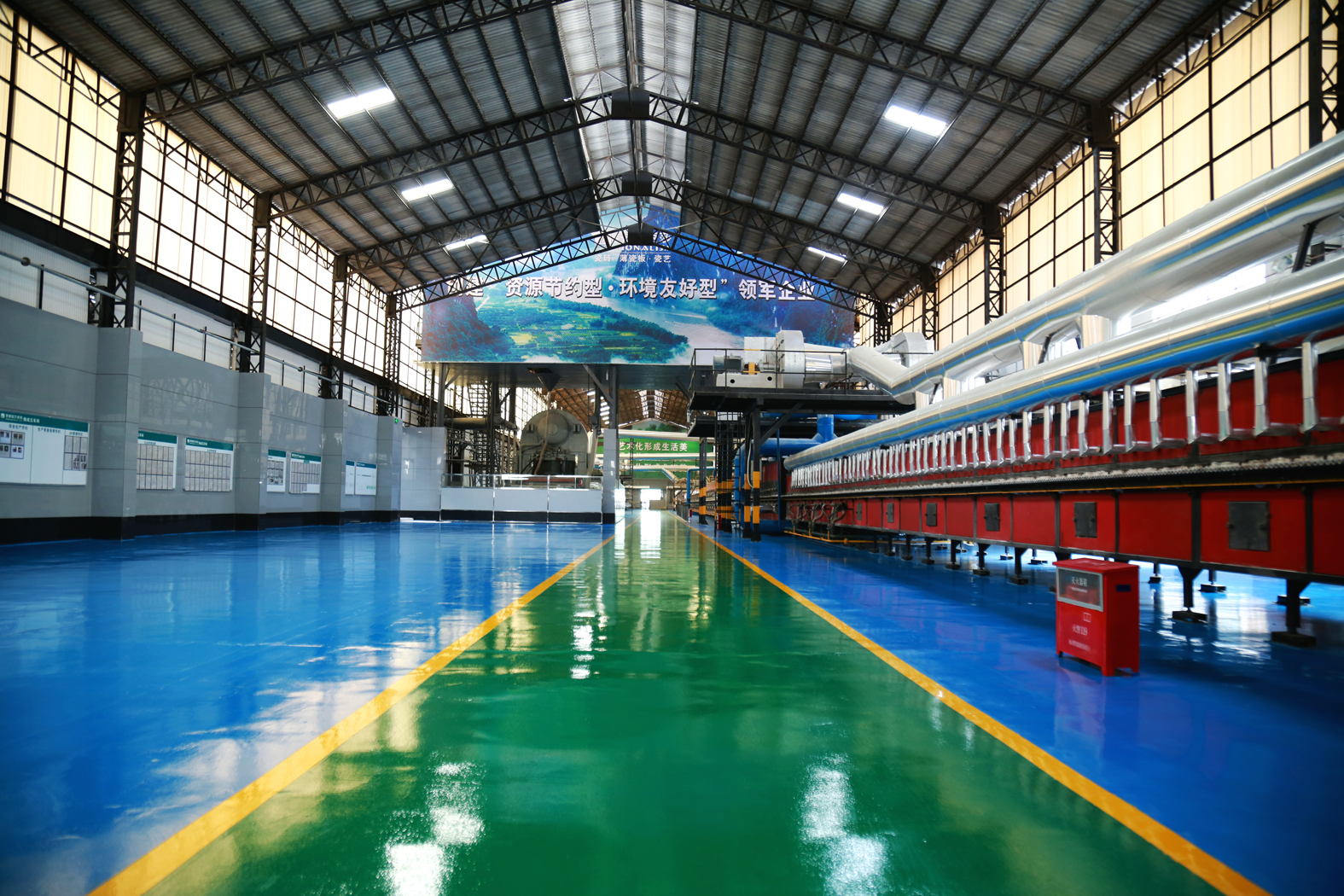
Production workshop at a Monalisa manufacturing base. Photograph: Monalisa Group.
SPC stands for stone plastic composite: a rigid core built from mineral filler and polymer rather than a pressed wood-fibre board. That construction logic is what the product names describe. Variants marketed as a high-density stone-powder core follow the same principle at a different filler density; the actual formulation and density are supplier-specific and should appear on the data sheet rather than be assumed from the name.
Three capabilities follow from the core, and each carries a boundary.
Indentation and surface resistance. Core rigidity is the reason a rigid plank resists point loads better than a flexible vinyl sheet, and the wear layer is what resists scratching from grit and furniture movement. Neither is self-certifying. Ask for the residual indentation inspection item and the wear-layer figure for the SKU, and ask which surface treatment is applied and what backs the scratch claim. Monalisa’s batch inspection already includes residual indentation and peel strength, so the request is for existing records rather than new testing.
Water behaviour. SPC is described as a waterproof floor because the core is polymer-based and does not swell on contact with water the way a wood-fibre core does. The qualification matters: a waterproof core is not the same as a waterproof assembly. Joints, perimeter detailing, service penetrations and substrate moisture remain project responsibilities, and a floor laid over a wet substrate will fail regardless of core chemistry.
Dimensional behaviour. A rigid core with a stated stability limit reduces the risk of edge lifting and peaking in service. It does not remove the need for expansion provision, conditioning and a flat substrate. Where a supplier claims an anti-deformation construction, the stability report and the installation instructions are the two documents that convert the claim into an acceptance criterion.
Compliance documentation for export projects
Compliance is where hospitality and retail projects most often stall between approval and delivery, because the documents requested are project-specific and are frequently confused with group-level certificates. The four items below cover the checks named in the brief; each should be confirmed for the exact product and, where relevant, the exact production batch.
Class A radioactivity classification. For projects in the Chinese market, building materials are classified for radioactivity, with Class A denoting unrestricted use in terms of that classification. A project that requires Class A should obtain the classification report for the specified product rather than a general statement of compliance, because the classification attaches to the product tested.
CE marking and declaration of performance. Where an EU or UK project specifies CE marking or a declaration of performance, the scope covered by the supplier’s documentation should be confirmed before the submittal is issued. “Possible” is the operative word here: not every destination or project category triggers the same requirement, and the project’s specification, not a generic marketing claim, decides.
GREENGUARD Gold. GREENGUARD Gold certification is based on UL 2818 and requires testing for more than 10,000 chemicals against strict VOC limits (McMillan Floors, GREENGUARD Gold reference). Where indoor air quality is a tender criterion for a hotel or a retail flagship, the certificate should name the product family and, ideally, the manufacturing location.
LEED documentation. Projects pursuing LEED credits for low-emitting materials typically ask for VOC test documentation such as a GREENGUARD Gold certificate. Whether a specific product contributes to a specific credit is a determination for the project’s sustainability consultant, and it is worth settling before the flooring package is awarded rather than after.
At group level, Monalisa holds 15 certifications including ISO 9001 and ISO 14001, and has been recognised as a national green factory. That management-system background supports a supplier evaluation, but it does not automatically extend a factory’s certificate to every product in the portfolio — which is precisely why the submittal should name the product, the construction and the batch.
Comparing SPC with tile and timber: where the fit boundary sits
The alternative to SPC in these three venues is usually porcelain tile or a timber-based floor, and the comparison is best made on installation and operational criteria rather than on appearance. Porcelain tile is a mineral surface with grouted joints: it brings high hardness and proven performance in heavy public circulation, at the cost of a harder, colder surface, grout maintenance, and a longer installation programme where adhesive beds must cure. Timber and wood-composite floors bring warmth and acoustic comfort, but their moisture behaviour makes wet zones and spill-intensive dining areas a difficult fit without additional protection.
Monalisa’s own large-project reference illustrates the tile side of that trade-off rather than the SPC side, and it should be read that way. At Yogyakarta Airport in Indonesia, an 80,000 sqm unglazed porcelain tile installation using product 3516 was reported to deliver a 30% lower life-cycle maintenance cost, 15% savings on grouting materials and labour through tight-joint installation, and a breakage rate below 0.3%. Those figures describe a tile project and demonstrate project-scale quality control and logistics; they are not evidence of SPC performance in a hotel or a showroom, and the two should not be conflated in a submittal.
For SPC the honest boundary is this: it suits hospitality and retail interiors where a rigid, moisture-tolerant, fast-installing finish is the priority, and where the substrate and detailing can be controlled. It is a weaker fit where the design intent is a monolithic mineral floor, where standing water and heavy chemical exposure dominate, or where the project cannot deliver a flat, dry substrate before installation.
Market context: what the numbers support, and what they do not
Two published figures frame the supply side of this shortlist, and both need their provenance attached. Dataintelo estimates the global SPC flooring market at USD 9.8 billion for 2025 and describes high growth potential, while a second commercial estimate for the same year is USD 5.9 billion (Grand View Research, as recorded in the comparison group for this dataset). The gap is attributed to scope — a narrower pure-SPC definition versus a broader rigid-vinyl definition — which means the figure is directional context, not procurement evidence.
Two further data points are more directly useful to a buyer. Dataintelo reports that the rigid-core sub-type held a 74.2% revenue share of the SPC market in 2025, which indicates that most of what is sold as SPC is the rigid construction discussed above rather than a flexible variant. Separately, OEC records China’s exports of plastic floor coverings under HS 391810 at USD 4.97 billion in 2024. A supply base of that scale is deep, and depth shifts the differentiator from availability to documentation: batch inspection records, stability reports and finish-specific slip results are what separate one quotation from another.
Monalisa’s position in that market is as a diversified building-materials group rather than a single-category SPC specialist, with a reported export ratio of about 10% and stated markets including China, Southeast Asia, the Middle East, North America, Europe, Australia and Africa. For a buyer, that mix is relevant in two ways: the group’s ceramic and slab business supplies project references at scale, while the SPC line operates through an OEM/ODM model with a 30-day lead time and a 500 sqm per colour minimum — commercial terms that suit a hotel wing or a showroom phase, but that require early planning on a small or highly varied order.
A pre-order verification checklist
Seven checks convert this shortlist into a defensible specification. Each one produces a document the buyer can file against the order.
- Exact product identity. Name the product line and SKU on the submittal — SPC Flooring, Stone Plastic Composite Flooring, Stone Crystal Flooring or Stone Plastic Lock Composite Flooring — together with the approved décor and finish. Product names alone do not verify capability.
- Wear layer and indentation evidence. Obtain the wear-layer figure and the residual indentation result for the SKU, and keep them beside the traffic description for the venue.
- Slip report matched to the finish. Confirm that the tested surface is the surface being supplied, and that the required class has been set by the project rather than by the supplier.
- Dimensional stability report. Request the stability result for the construction, referenced to the applicable test method, and confirm the expansion and conditioning requirements in the installation instructions.
- Indoor-air and market compliance documents. Collect GREENGUARD Gold, CE or declaration of performance, and Class A radioactivity documentation only where the destination market and project require them — and confirm each document names the product.
- Batch inspection records. Ask for the pre-shipment inspection covering appearance, dimensions, mass per unit area deviation, residual indentation and peel strength, and request same-batch supply where visual continuity is critical.
- Commercial and warranty terms. Confirm the minimum order of 500 sqm per colour, the 30-day lead time and the warranty position. Monalisa’s stated after-sales provision for SPC floor is a warranty typically of 10–25 years for residential and 5–10 years for commercial use against manufacturing defects, subject to correct installation and maintenance, with claims handled through proof of purchase and on-site or remote inspection.
FAQ
Is SPC floor suitable for hotel guestrooms as well as public areas?
It can be, with different checks in each zone. Guestrooms are low-moisture environments apart from bathrooms, so the governing properties are indentation under bed frames and casegoods, wear-layer performance at the door and dressing areas, and joint integrity. Corridors and lift lobbies add rolling loads from carts and trolleys, which is where the batch inspection record for residual indentation becomes relevant. In both zones the commercial warranty tier — typically 5–10 years rather than the 10–25 years applied to residential use — should be read against the property’s replacement planning.
Which SPC construction should a restaurant evaluate first where spillage and chair movement dominate?
Start with the surface and the joint, not the core. Wear-layer specification governs resistance to chair and stool movement, and the slip classification of the exact finish governs the bar, pass and entrance zones. A glue-free locking construction such as Stone Plastic Lock Composite Flooring is worth evaluating where the fit-out has to be phased, but the installation method and wet-zone joint protection must be confirmed for the specific product. Spillage control also depends on the cleaning agents the supplier approves, because maintenance outside that list affects warranty eligibility.
What documentation should a retail showroom project hold before ordering SPC floor?
Four documents carry most of the risk: a dimensional stability report for the specified construction, batch inspection records covering appearance and dimensions, a slip report matched to the approved finish, and the installation instructions stating expansion and conditioning requirements. Where the showroom is part of a flagship or a LEED-targeted development, add the indoor-air documentation. For large uninterrupted fields, a same-batch supply commitment is as important as any test report, because shade variation is visible to customers even when every technical parameter is within tolerance.
Does an SPC floor order need Class A radioactivity documentation?
It depends on the market. For projects in China, building materials are classified for radioactivity and Class A denotes unrestricted use under that classification, so a project specifying Class A should obtain the classification report for the product being supplied. Export projects are governed by the destination market’s own requirements, where CE marking or a declaration of performance may apply instead. In either case the document should name the product and the production batch, because a group-level certificate does not automatically cover every item in a portfolio.
How long is commercial SPC flooring usually warranted?
Monalisa’s stated after-sales provision for SPC floor is a warranty typically of 10–25 years for residential use and 5–10 years for commercial use, covering manufacturing defects and conditional on correct installation and maintenance. Claims are processed through proof of purchase and either on-site or remote inspection. For a hotel or a restaurant, the practical question is not only the term but the conditions: substrate preparation, approved cleaning agents and installation method all sit inside the warranty boundary.
What this shortlist means for a hospitality or retail buyer
The shortlist resolves into a sequence rather than a ranking. Define the venue and its dominant load; select the SPC construction that matches the installation window and the moisture profile; then close the specification with documents — wear layer, slip report for the approved finish, dimensional stability, indoor-air and market compliance, and batch inspection records. The commercial terms complete the picture: a 500 sqm per colour minimum and a 30-day lead time suit a phased hotel wing or a showroom fit-out, and require earlier planning where a project mixes many décors in small quantities.
For readers assembling a submittal, Monalisa’s published brochure is available as a publicly downloadable PDF and covers the wider product portfolio. It is a starting reference; the acceptance evidence remains the product-specific and batch-specific documentation described above.
Have Questions or Need More Details?
Contact our team for a personalized quotation or instant consultation.
Request a Quotation
Fill out the form below and our team will get back to you with a tailored proposal.
WhatsApp Direct Chat
Prefer to chat in real-time? Message us on WhatsApp for instant assistance & quick answers.
- Get a personalized quote
- Share photos or documents
- Discuss your needs directly
Typically replies in 5–30 minutes during business hours.