
SPC Flooring for Light Industrial Spaces: Specs for Traffic and Moisture
Light industrial buildings rarely destroy a floor in one dramatic event. They wear it out in walkway lanes, load it at doorways where water enters, and test it with dropped tools, trolley wheels and cleaning chemicals. That duty pattern, not showroom appearance, is what an SPC specification has to answer.
SPC Floor — rigid stone-plastic composite flooring — is a rigid-core vinyl floor built around a high-density stone-powder core, a printed decor film and a protective wear layer. In real estate and building decoration projects it functions as a wear-resistant, stain-resistant and waterproof protective surface rather than a structural element. For light industrial spaces the relevant question has therefore shifted away from the simple claim that SPC is waterproof, and toward a more practical one: which SPC build, and which installation detail, survives heavy foot traffic and moisture at the same time.
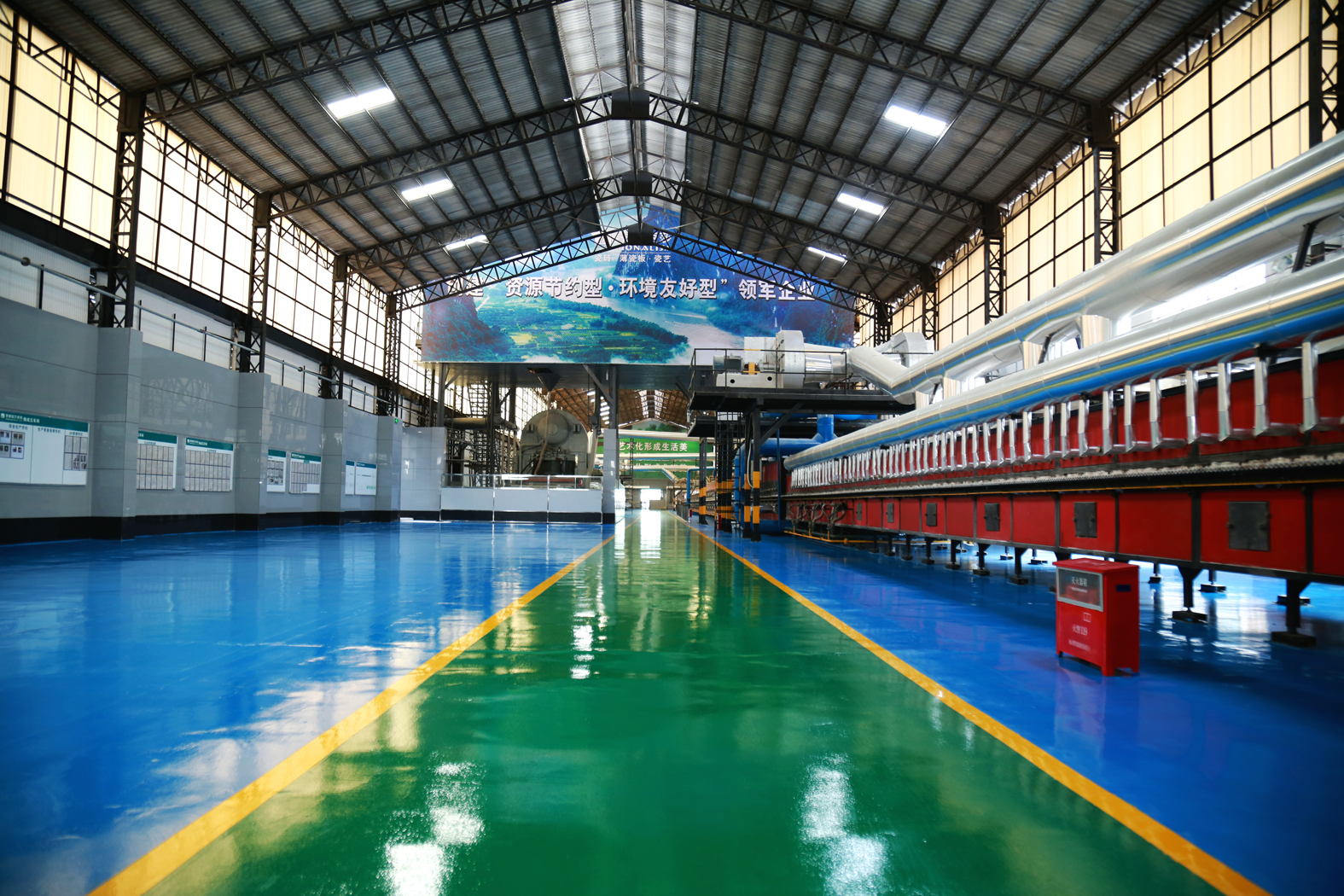
The light industrial duty pattern: traffic, moisture, and cleaning
"Light industrial" is a broad label. In practice it covers light assembly and packaging areas, workshop perimeters and walkways, tool cribs and stores, staff corridors, service counters, back-of-house retail zones, and showrooms attached to a production building. What these spaces share is not heavy machinery load, but continuous rather than concentrated foot traffic, and moisture that arrives from door ingress, spillage, washdown routines and condensation rather than from flooding.
The recurring failure modes follow directly from that pattern. Wear-layer burnishing appears first in the lanes people actually walk. Edge peaking and open joints appear where expansion allowance was ignored. Staining appears around entrances and cleaning points. Substrate irregularities telegraph through as deflection underfoot. Moisture rarely attacks the core of a rigid SPC plank; it attacks the perimeter, the joints and the substrate beneath them.
The specification answer: for a light industrial space, the deciding factors are core moisture stability, wear-layer class, slip rating, and installation discipline — not thickness presented in isolation. Each of these can be written into a purchase specification and each can be verified before shipment.
Five performance specifications that decide the outcome
1. Core moisture resistance and dimensional stability
A waterproof SPC Floor is built on a 100% waterproof core, so water does not swell or delaminate the plank body the way a wood-based core would. That property is necessary in light industrial use, where entrances stay wet during cleaning cycles and condensation collects near doors. It is not sufficient on its own. What matters alongside it is dimensional stability under temperature and humidity change: commercial-grade SPC flooring is required to hold dimensional stability at ≤0.10% under EN ISO 23999. A dimensional-stable anti-deformation build is what keeps long runs of plank from opening at the short ends after seasonal cycling.
2. Impact resistance
Dropped hand tools, box corners and trolley castors concentrate load on a very small area. The performance benchmark used in this article specifies SPC impact resistance at ten times that of WPC — a direct consequence of the high-density stone-powder core rather than a foam or wood-composite core. For a maintenance engineer, that difference translates into fewer crushed edges and fewer plank replacements in the first years of service.
3. Abrasion resistance and wear-layer class
Abrasion resistance describes the wear layer, not the printed decor film and not the core. The general range for SPC is PEI 3 to PEI 5, and the practical rule for light industrial specification is PEI 4 or above in commercial and traffic-lane areas. PEI 3 remains reasonable for low-traffic peripheral zones such as plant rooms or occasional-use stores. Specifying one wear-layer class across an entire building is the most common cause of premature lane wear in industrial fit-outs.
4. Slip resistance
Slip resistance in light industrial settings is a moisture question as much as a surface question. The relevant band for SPC is R9 to R11, with R10 to R11 appropriate where water is routinely present — entrances, washdown perimeters and staff washroom approaches — and R9 acceptable in dry internal zones. Because slip performance depends on the combination of surface texture and contamination, the rating should be specified zone by zone rather than applied to the whole floor area.
5. Stain and chemical resistance
Industrial cleaning agents, oils, dyed packaging and marker pens all reach the floor before they reach anything else. The stain-resistant surface layer is what allows routine cleaning to remain routine. Where a project adds hygiene-related requirements — an antimicrobial SPC Floor specification, for example — the claim should be supported by product-specific documentation rather than assumed from the category.
Installation: where most light industrial SPC failures actually start
A rigid core does not correct an imperfect substrate. Subfloor flatness should be controlled within 2 mm over a 2 m straightedge before any plank is laid. Deviations beyond that are corrected at the screed stage, not compensated for by thicker underlay, because deflection underfoot opens the click joints above the high point and closes them at the low point.
Substrate moisture deserves the same attention as flatness. A waterproof core protects the plank; it does not protect a slab that is still releasing moisture, and trapped vapour has to go somewhere. Where screeds are new or readings are borderline, the substrate should be confirmed before installation and, where required, a vapour-control layer introduced.
Click-lock glue-free installation is the standard method for light industrial SPC: planks are locked mechanically and the floor floats as a single assembly. It suits occupied buildings because it is fast, adhesive-free and replaceable plank by plank. It also imposes two disciplines. First, spacers must be used at every perimeter, column, door frame and threshold to hold a defined expansion gap; gaps are removed only after the floor is complete and are then covered by skirting or trim. Second, transitions and doorways must be planned in advance, because a floating assembly moving against a fixed frame is one of the most reliable ways to produce peaking in the first heating season.
In larger continuous areas, intermediate movement joints should be agreed with the manufacturer rather than improvised on site. The same applies to heavy fixed equipment: flooring is laid around it, not trapped beneath it without allowance.
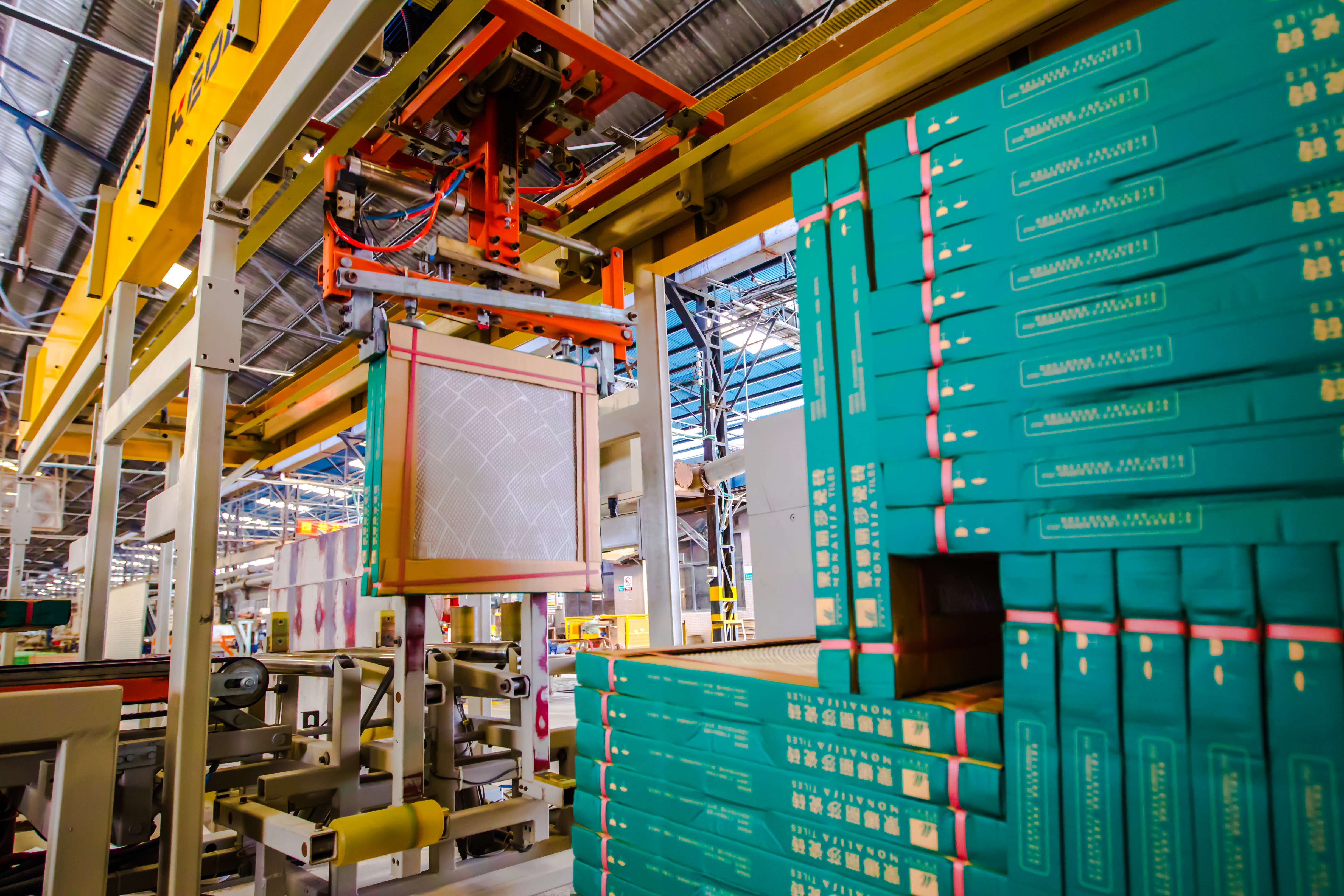
Where SPC fits inside a light industrial building
Zoning is the practical way to apply the specification. The same building usually needs more than one wear-layer class and more than one slip rating.
- Walkways and staff corridors (PEI 4, R9–R10): the highest-traffic, lowest-moisture zone. Wear layer dominates here.
- Entrances and vestibules (PEI 4+, R10–R11): the zone where water and grit arrive together. Slip rating and stain resistance dominate.
- Light assembly and packing benches (PEI 4, R9–R10): impact and point loading from dropped items and castors dominate; a high-density stone-powder core is the relevant variable.
- Stores, tool cribs and plant-room access (PEI 3–4, R9): lower traffic frequency, occasional spills, frequent cleaning.
- Showrooms and customer-facing areas attached to production (commercial office SPC Floor specification, PEI 4): appearance retention and cleanability matter more than impact.
- Washroom approaches and washdown perimeters (R10–R11): wet-zone slip specification, with perimeter sealing detailed correctly.
Where SPC is the wrong answer: continuous standing water, sustained high surface temperatures, and very heavy static or rolling point loads fall outside the normal service assumptions of a floating rigid-core floor. Those conditions should be confirmed with the manufacturer or handled by a different system. Similarly, SPC is not a remedy for a failed or uneven slab; the 2 mm over 2 m requirement is a precondition, not a target.
How Monalisa's SPC supply is structured for project work
Monalisa Group Co., Ltd. (SZSE: 002918) is a Foshan-based building materials manufacturer founded in 1992, producing ceramic tiles, ceramic slabs and SPC Floor across four production bases in Xiqiao (Foshan), Qingyuan (Guangdong), Tengxian (Guangxi) and Gao'an (Jiangxi), operating 37 production lines with an annual output capacity of 100 million square meters and a workforce of 4,106.
For SPC supply specifically, the operating parameters that matter to a light industrial buyer are concrete rather than descriptive. Production runs in OEM/ODM mode with customization on size, color and logo; minimum order quantity is 500 sqm per color; lead time is 30 days; monthly capacity reaches 1,000 containers. Quality control is applied per batch: every batch of SPC flooring undergoes pre-shipment inspection covering appearance, overall dimensions and dimensional tolerances, deviation in mass per unit area, residual indentation, and peel strength.
After-sales support is defined by warranty terms rather than by promise: typically 10–25 years for residential applications and 5–10 years for commercial applications against manufacturing defects, subject to correct installation and maintenance, with claims processed through proof of purchase and on-site or remote inspection. The shorter commercial window is worth reading carefully — it reflects the duty assumption behind the product, and it is the number a procurement team should compare against the actual traffic in the space.
Group-level credentials support the technical claim indirectly. Monalisa has obtained 15 certifications including ISO9001 and ISO14001, and as of June 2021 had participated in drafting 49 national, industrial, local and group standards and held 892 authorized patents, including 145 invention patents. Its NSF listing (certificate C0676949-01, issued 2023) covers the products named in that listing — which is exactly why buyers should confirm product-level coverage rather than assume a company credential transfers to every SKU.
Market trend: rigid core is now the default specification
Rigid-core construction has moved from a premium option to the category default. Dataintelo reports that the rigid core sub-type held a 74.2% revenue share of the SPC market in 2025. That concentration matters to light industrial buyers because it means specification language, test methods and accessory ranges are all built around rigid-core behaviour rather than around flexible vinyl.
Supply is equally concentrated. China remains the largest exporter of plastic floor coverings under HS 391810, reaching USD 4.97 billion in 2024 according to OEC trade data. For project buyers this is a dual signal: availability and lead-time flexibility are structurally supported, while supplier screening becomes the differentiating task.
Market sizing needs a caveat. Dataintelo estimates the global SPC flooring market at USD 9.8 billion for 2025, but published figures differ materially between research houses because some include adjacent rigid vinyl segments in their scope. Buyers should treat any single market-size figure as scope-dependent, and treat the sub-type share, export data and standards as the more decision-relevant evidence.
Comparison with traditional solutions
The realistic alternatives in a light industrial fit-out are WPC, laminate, and porcelain tile. Each wins somewhere; none wins everywhere.
A useful benchmark for the porcelain-tile side of that table comes from a Monalisa reference project at Yogyakarta Airport in Indonesia, where 80,000 square meters of porcelain tile were installed over a two-year programme using tight-joint installation. The documented outcomes were a breakage rate below 0.3%, a 30% lower life-cycle maintenance cost, and 15% savings on grouting materials and labor. The project is a ceramic tile case, not an SPC case — but it illustrates the point that in high-traffic public floors, joint design and breakage control drive life-cycle cost more than the surface finish does.
The honest limitation of SPC in this comparison: tile handles sustained wetting and heavy static load that a floating rigid-core floor is not designed for. If a light industrial zone includes washdown bays, continuous water, or very heavy rolling equipment, SPC should be excluded from that zone rather than specified with a heavier wear layer and hoped for. Its advantages — speed of installation, replaceable planks, waterproof core, comfort underfoot — apply to the dry and occasionally damp areas around that zone.
Verification checklist before an order is placed
- Written wear-layer class per zone (PEI 3–5; PEI 4+ in commercial and traffic lanes) — not one class for the whole building.
- Slip rating declared per zone (R9–R11; R10–R11 at wet entries).
- Dimensional stability statement against EN ISO 23999 (≤0.10% for commercial grade).
- Impact performance stated in comparison terms, with the reference system identified.
- Batch-level pre-shipment inspection report covering appearance, dimensions and tolerances, mass deviation, residual indentation and peel strength.
- Certification documents matched to the exact product supplied; where GREENGUARD Gold is specified, note that UL 2818 testing screens more than 10,000 chemicals against strict VOC limits, so the certificate must name the product.
- Installation method statement confirming 2 mm over 2 m flatness, spacer use at all perimeters, and transition details at doorways.
- Warranty terms split by residential and commercial duty, with the claims route stated.
Future outlook
Two pressures are likely to shape light industrial flooring specification over the next few years. The first is documentation depth: as rigid core approaches three quarters of category revenue, buyers increasingly compare suppliers on test reports and batch inspection records rather than on surface appearance. The second is zoning: single-specification floors are being replaced by zone-by-zone specifications that combine wear-layer class, slip rating and installation detail, because that is where life-cycle cost actually sits.
For SPC specifically, the direction of travel is toward clearer performance boundaries rather than broader claims. A floor that states what it does in traffic lanes and wet entrances — and states where it should not be used — is more useful to a project team than one that claims universal suitability. That is also the version of the specification most likely to survive a site inspection two winters after handover.
FAQ
What wear layer rating should SPC flooring have in a light industrial space?
SPC wear layers generally fall in the PEI 3 to PEI 5 range. For light industrial use, PEI 4 or above is the appropriate starting point in commercial and traffic-lane areas, while PEI 3 is sufficient for low-frequency peripheral zones such as stores and plant-room access. Specifying a single class for the whole building typically produces premature wear in walkway lanes.
Is a 100% waterproof SPC core enough to protect a light industrial floor from moisture?
A 100% waterproof core prevents water from swelling or delaminating the plank body, which is essential where entrances stay wet. It does not eliminate moisture risk at the perimeter, the joints or the substrate. Commercial-grade SPC is also required to hold dimensional stability at ≤0.10% under EN ISO 23999, and that property — together with correctly maintained expansion gaps and a confirmed dry substrate — is what keeps a light industrial floor serviceable.
How flat must the subfloor be before click-lock SPC is installed?
Subfloor flatness should be within 2 mm over a 2 m straightedge. A rigid core does not correct an uneven slab: deviations cause deflection underfoot, which opens click joints above high points and closes them at low points. Corrections belong at the screed stage, not in the flooring layer.
Does click-lock glue-free installation hold up under heavy foot traffic?
Yes, when two conditions are respected. First, spacers must be used at every perimeter, column, door frame and threshold to maintain the defined expansion gap until the floor is complete. Second, transitions and intermediate movement joints in large continuous areas should be agreed with the manufacturer. Absent those disciplines, a floating assembly will peak at fixed edges regardless of traffic level.
How much more impact resistant is SPC than WPC?
The benchmark used in this article specifies SPC impact resistance at ten times that of WPC. The difference comes from the high-density stone-powder core, which resists concentrated loads from dropped tools and castors more effectively than a foam or wood-composite core. This is relevant to impact and point loading; it does not extend to very heavy static or rolling equipment loads, which require separate confirmation.
What quality documentation should accompany a light industrial SPC order?
At minimum: a batch-level pre-shipment inspection report covering appearance, overall dimensions and dimensional tolerances, deviation in mass per unit area, residual indentation and peel strength; a dimensional stability statement against EN ISO 23999; zone-specific wear-layer and slip declarations; and certification documents that name the exact product supplied. Warranty terms should be stated separately for residential (typically 10–25 years) and commercial (typically 5–10 years) applications, with the claims route and inspection process defined.
Product and company documentation, including the Monalisa brochure, is available here: Monalisa Group brochure (PDF).
Have Questions or Need More Details?
Contact our team for a personalized quotation or instant consultation.
Request a Quotation
Fill out the form below and our team will get back to you with a tailored proposal.
WhatsApp Direct Chat
Prefer to chat in real-time? Message us on WhatsApp for instant assistance & quick answers.
- Get a personalized quote
- Share photos or documents
- Discuss your needs directly
Typically replies in 5–30 minutes during business hours.