
SPC Stone Wall vs Aluminum Composite: A Test-Driven Comparison for Commercial Interiors
A commercial lobby wall is not chosen on appearance. It is chosen on a set of claims a project team can verify before the purchase order is signed: fire classification, water resistance, surface durability under repeated cleaning, flatness across a full-height span, and what happens at the joint after two years of luggage and trolley traffic. Two material families appear in almost every one of those conversations — SPC stone-plastic composite wall panels and aluminium composite panels — and they are usually compared on the wrong basis.
The short answer: for interior lobby, corridor and washroom walls, a rigid SPC board such as LONGTE LT-SW is specified for water resistance, surface durability and a full-height 1220 × 2800 mm panel format. Aluminium composite panel is specified where folded corners, tight radii and exterior exposure matter more than a mineral-filled core. Neither replaces the other, and in both cases the deciding evidence is a document rather than a sample chip.
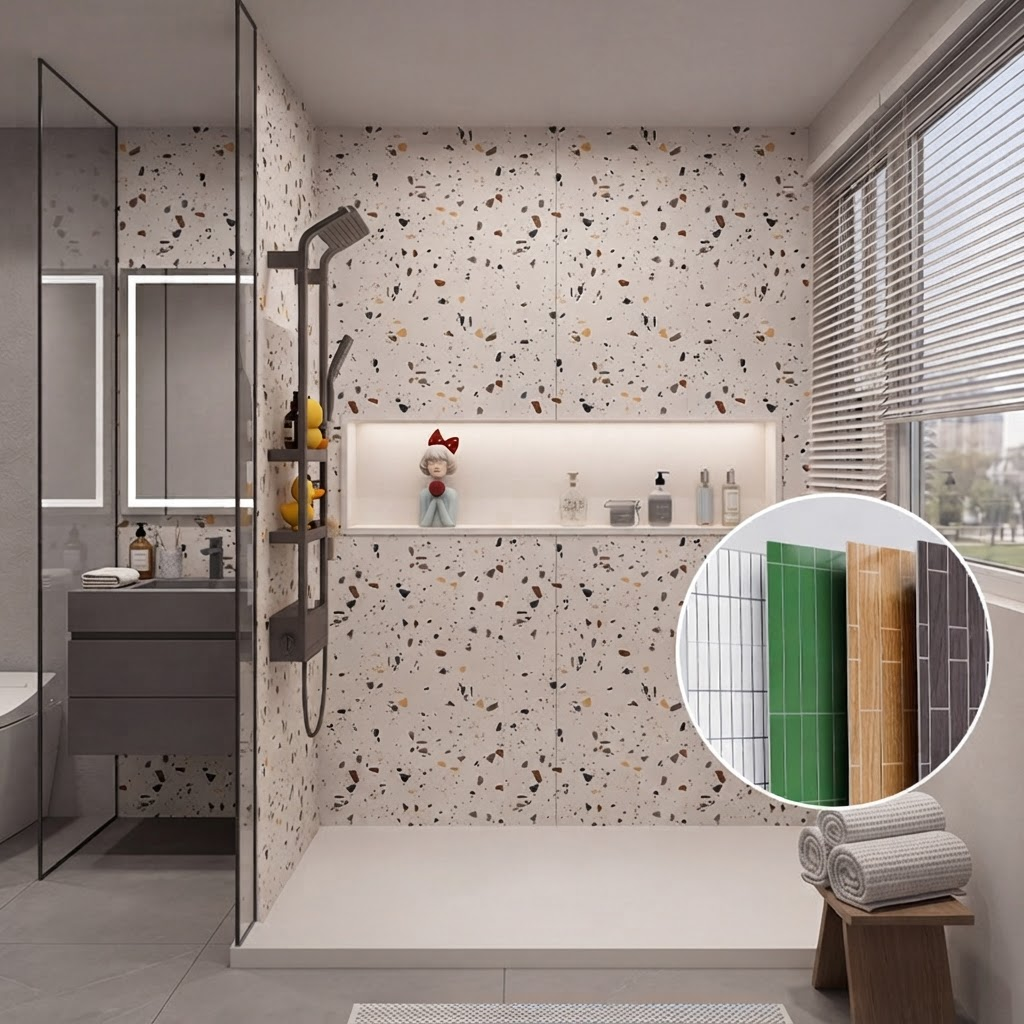
LT-SW SPC stone-plastic composite wall panel — a rigid mineral-filled board supplied at 1220 × 2800 mm and 4 mm thickness for hotel, bathroom and commercial interiors.
LONGTE is the brand of Haining Longtime Industry Co., Ltd., a building-materials manufacturer founded in 2003 in Haining, Zhejiang, China. The company operates approximately 80,000 m² of manufacturing space with 220 employees and a 12-engineer R&D team, exports about 85% of its output, and serves markets including the USA, UAE, India, the Philippines, Colombia and South America through six manufacturing hubs across Asia.
Two Materials, Two Engineering Logics
LONGTE LT-SW (customizable) is a rigid stone-plastic composite wall panel. Its construction is limestone powder, PVC and a UV surface layer, supplied at 1220 × 2800 mm and 4 mm thickness, with declared wear resistance, 100% waterproof performance, an anti-scratch surface and a B1 fire rating. The stated application range covers bathrooms, kitchens, hotels and commercial interiors.
An aluminium composite panel is a different structure entirely: two thin aluminium skins bonded to a core. The core is the variable that decides almost everything a specifier cares about. Polyethylene cores and mineral-filled, fire-retardant cores behave very differently under fire test, and a supplier statement such as fire-rated ACP only becomes meaningful when it names the core type, the panel thickness and the standard behind the classification.
That difference explains why the two products are frequently mis-compared. An SPC wall panel is a finished decorative surface panel with a mineral-filled core. ACP is a metal-skinned sandwich whose main engineering advantage is that it can be routed and folded into three-dimensional detail. One is judged on what it resists; the other is judged largely on what shape it can be formed into.
Rigidity and the 1220 × 2800 mm Format
Panel format is where LT-SW has a clear, checkable advantage in lobby work. A 2800 mm board covers a floor-to-ceiling lobby wall in a single drop, which removes a horizontal joint line that would otherwise sit at eye level. Fewer joints mean fewer sealant lines to maintain, fewer places for cleaning residue to collect, and a flatter visual plane across the wall.
Rigidity, however, is not something to settle by comparing nominal thickness. Four millimetres of mineral-filled SPC and four millimetres of aluminium composite are not the same structure. In SPC, stiffness comes from the limestone-powder filler loading and the density of the PVC-bound core. In ACP, stiffness is a function of aluminium skin thickness, alloy and core density. A buyer who compares the number four is comparing nothing.
The practical boundary here matters. LT-SW is a rigid interior board. It does not cold-form around a tight radius, it cannot produce a folded, joint-free corner the way routed ACP can, and it is not positioned as an exterior facade cladding. Where a lobby design calls for a curved reception drum or a wrapped column, ACP retains an advantage that SPC cannot answer without trims or a different components strategy.
B1 Compliance: What the Claim Proves and What It Does Not
B1 is a fire-performance class defined within national classification schemes, and it is the class most often requested for interior wall finishes in commercial projects. It is not a universal label. In China, B1 is defined within GB 8624; in the European market, the reference framework for commercial wall panels is EN 13501-1, where a B-s1, d0 result — limited smoke production and no flaming droplets — is commonly the target. A B1 statement and an EN 13501-1 classification are related in intent but are not interchangeable, and neither should be converted into the other on a datasheet.
LONGTE declares a B1 fire rating for LT-SW. The declaration is the starting point, not the evidence. What a project team should actually request is the classification report that substantiates it, and the report has to match the way the panel will be installed: the tested thickness, the substrate, whether the panel was tested with adhesive or mechanical fixing, and whether the classification applies to the panel alone or to a complete wall assembly.
For aluminium composite, this is where specifications most often go wrong. A fire-rated ACP claim is tied to a specific core. A polyethylene-core panel and a mineral-filled fire-retardant-core panel can carry the same product name and deliver completely different results. Asking for the certificate without asking which core it refers to is how a compliant-looking submittal ends up failing at commissioning.
Water Resistance, Cleaning and High-Traffic Wear
LT-SW carries a declared 100% waterproof performance, combined with a wear-resistant and anti-scratch surface. In lobby, corridor and public washroom applications this matters more than it sounds. The relevant stress is not a single spill; it is years of daily mopping, trolley wheels, luggage edges, cleaning chemicals and condensation from a climate-controlled envelope running at high occupancy.
Two clarifications keep the specification honest. First, a waterproof panel is not a waterproof wall assembly. Water ingress in service almost always happens at the trims, the sealant lines and the penetrations around sockets and signage, not through the face of the board. Second, the durability claim should be read through the surface system: the UV layer and its adhesion to the core determine how the panel resists staining and abrasion, and that is a coating question, not merely a substrate question.
Aluminium composite panels are not inherently unsuitable for wet areas — the aluminium skins tolerate moisture well. The exposure points are the cut edges and the core, which need sealing, and the suitability of a polyethylene core in a continuously damp zone, which should be confirmed rather than assumed. In both cases, the detail drawings decide the outcome.
Where the two materials diverge most clearly is in wet-room specification. Bathroom and kitchen walls are inside LT-SW's stated application range, which means the panel is positioned for shower surrounds, vanity backdrops and service-core walls rather than only for dry decorative surfaces.
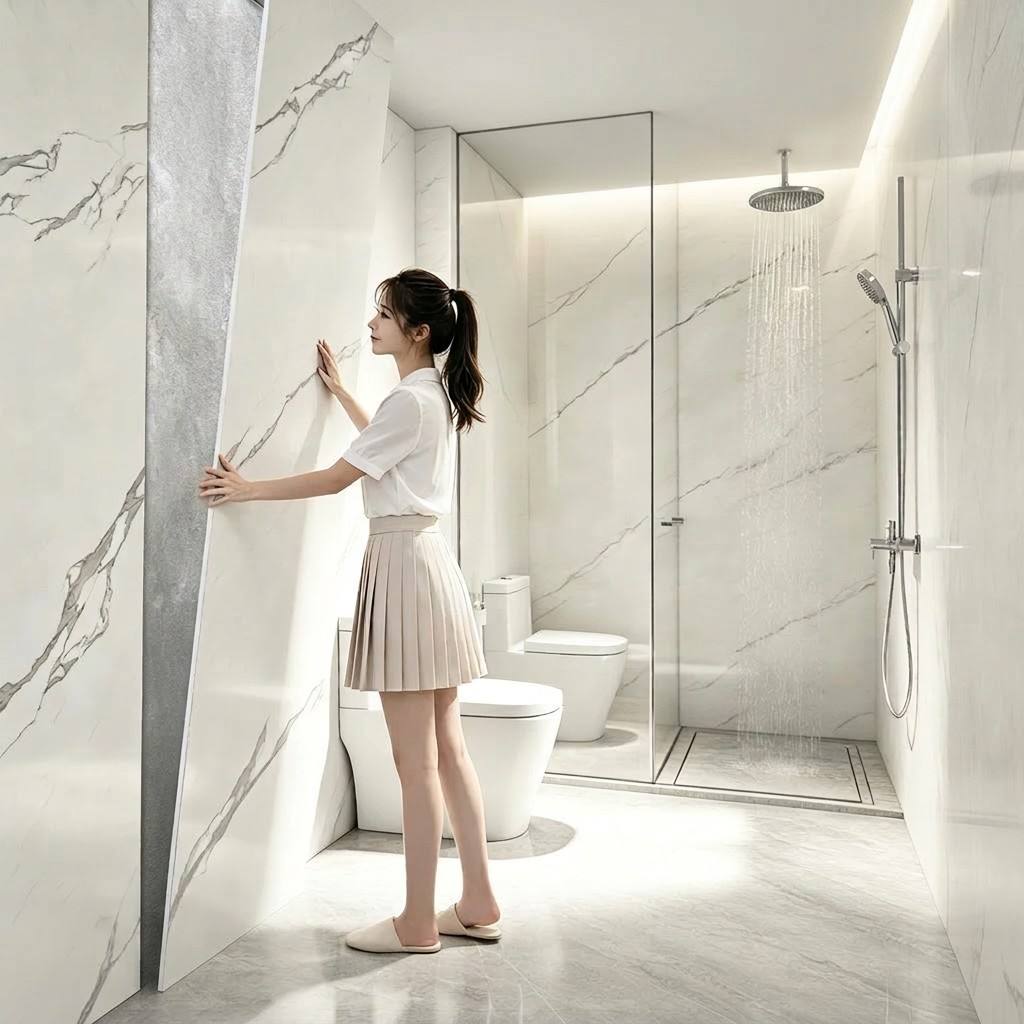
Surface and core detail of the LT-SW stone-plastic composite panel: limestone powder and PVC core with a UV surface layer, declared wear-resistant, anti-scratch and 100% waterproof.
Where Each Material Actually Fits: Lobby and Commercial Scenarios
Hotel and commercial interiors are the scenario where this comparison is decided in practice. LONGTE's product positioning places LT-PM and LT-BC in hotel decoration generally, LT-WG in hotel lobbies, and LT-SW in hotel lobbies and bathrooms — with LT-PU reserved for exterior facade work such as villas and restaurants. In other words, the SPC stone wall panel sits inside the wet and high-traffic half of the building, not on the envelope.
That division is useful for procurement. A lobby refurbishment typically needs a durable, wipeable, full-height interior finish for the reception backdrop, lift lobby walls, corridor linings and public restrooms. ACP typically appears on the exterior canopy, the soffit, the signage surround, the curved column and the entrance portal — surfaces where folding and weather exposure are the design drivers. Specifying one material across both zones is usually a compromise in one direction or the other.
LONGTE's hospitality track record illustrates the compliance side of this. A UAE villa developer and luxury interior fit-out company took 6,000 m² of PU faux stone panel and 4,000 m² of acoustic slat panel for a villa community and a five-star hotel, covering villa exterior feature walls, hotel lobby areas and executive suite acoustic walls. The project passed Dubai Civil Defense fire testing and led to a three-year exclusive frame agreement. In the SPC category specifically, a US building-material distributor has run five or more years of continuous supply at roughly 15 × 40HQ containers per year, expanding from three SKUs to more than twenty, on a product line positioned around 100% waterproof SPC and PVC panels meeting US IAPMO and ASTM standards.
Side-by-Side: LT-SW vs Generic Aluminium Composite
The table below compares a declared LT-SW specification against generic aluminium composite practice. The ACP column deliberately contains no numbers: core type, skin thickness and classification vary by product, and any figure quoted without a datasheet would be a guess rather than a comparison.
| Comparison dimension | LONGTE LT-SW (declared) | Generic aluminium composite | Evidence to request |
|---|---|---|---|
| Core construction | Limestone powder + PVC + UV layer | Two aluminium skins bonded to a PE or mineral-filled FR core | Material datasheet naming the core or resin system |
| Panel format | 1220 × 2800 mm, 4 mm | Varies; confirm available sheet sizes per thickness | Stock sheet list with tolerances |
| Fire class | B1 declared | Core-dependent; FR core required for higher classes | Classification report naming thickness, core and fixing method |
| Water exposure | 100% waterproof declared | Skins moisture-tolerant; edges and core require sealing | Water absorption data plus edge-sealing detail |
| Surface durability | Wear-resistant, anti-scratch declared | Coating-dependent | Abrasion and stain resistance results |
| Formability | Rigid; flat surfaces, trims at corners | Routable and foldable for corners, radii and column wraps | Corner and edge detail drawings |
| Intended use zone | Bathroom, kitchen, hotel, commercial interior | Exterior cladding and interior features | Written intended-use statement |
| Repair logic | Panel replaced as a unit | Panel or skin replaced | Spare-panel and batch-matching policy |
| Sample and trial | 1 piece free sample; 1 × 20GP mixed container trial; 500 m² for custom design | Supplier-specific | Written quotation with MOQ conditions |
| Lead time | 7–15 days stock; 25–40 days custom; 45–60 days large project | Supplier-specific | Dated production schedule |
LT-SW values reflect LONGTE's declared product data. Aluminium composite entries describe general material behaviour and must be verified against the specific product datasheet.
How to Run the Comparison Before You Order
A test-driven comparison does not require a laboratory. It requires a written request list and a willingness to reject submittals that answer a different question. The sequence below works for both materials.
- Fix the wall build-up first. Substrate, fixing centres and joint detail determine flatness and fire performance more than the panel does. Get both suppliers to respond to the same wall section.
- Request the fire classification report by project thickness. Confirm the tested thickness, the tested substrate and whether adhesive or mechanical fixing was used.
- Ask for water and surface test data, not adjectives. Water absorption or immersion results, abrasion results, and stain or chemical resistance against the cleaning agents the facility will actually use.
- Check the intended-use statement. An interior panel should not be sent to an exterior elevation, and an exterior cladding should not be justified on interior performance alone.
- Order a physical sample. LONGTE provides 1 free sample piece, and the trial-order route is a 1 × 20GP mixed container; custom design starts at 500 m². Mixed containers let a project team test two or three finishes in one shipment.
- Ask how quality is controlled between batches. LONGTE's stated process is 100% incoming raw-material inspection, in-process checks every two hours, and 100% finished-goods visual and dimensional inspection, with third-party pre-shipment inspection by SGS, BV or TUV available on request.
- Confirm the after-sales terms in writing. The company states free technical consultation, 24-hour response, installation video guides, claim handling within seven days and a five-year quality warranty on major products.
- Plan the replacement logic. A rigid mineral board is replaced panel by panel; confirm that spare panels from the same production batch are held, because a later batch may not match exactly.
Market Signal: Why Verification Is Becoming the Buying Basis
The commercial wall-finish category is large and still expanding. Dataintelo estimates the global wall panel market at USD 32.4 billion in 2025, projected to reach USD 43.7 billion by 2033, with Asia-Pacific accounting for roughly 42.3% of global share in 2025. Estimates for the total market do vary considerably between sources because product definitions differ, so the direction of growth is more reliable than any single figure.
What that growth changes is the nature of the buying question. As the number of available finishes and suppliers increases, differentiation shifts from availability to verifiability. A buyer comparing an SPC stone wall panel against aluminium composite is no longer asking which product exists — both do — but which product can produce a classification report, a water performance figure and a batch-consistency record that survive a consultant's review.
Outlook
For interior commercial work, the most likely direction is consolidation around assemblies rather than panels. Fire classification is already moving toward whole-wall assessment in stricter markets, and water performance is increasingly judged on the joint and trim detail rather than the board face. Suppliers who can document a complete interior system — panel, fixing, trim, sealant and substrate requirement — will be easier to specify than suppliers who can only document a surface.
The complementary trend favours metal-composite systems on the envelope. Folded corners, curved features and weather exposure remain ACP territory, and nothing in the current material set suggests SPC boards will displace them there. The practical conclusion for a project team is not to pick a winner between the two, but to place each material where its evidence is strongest: SPC stone-plastic board for wet, high-traffic interior walls, aluminium composite for formed and exterior detail.
FAQ
Can an SPC stone wall panel be used in a hotel lobby?
Yes. LONGTE positions the LT-SW stone-plastic composite panel for hotel and commercial interiors, with hotel lobbies and bathrooms named among its application areas. The 1220 × 2800 mm format allows a full-height wall covering without a horizontal joint, and the declared wear-resistant, anti-scratch surface suits areas with repeated cleaning. Suitability still depends on the substrate and fixing layout for the specific wall.
What does a B1 fire rating mean, and how should it be verified?
B1 is a fire-performance class defined within national classification schemes, such as GB 8624 in China. The European reference framework for commercial wall panels is EN 13501-1, where a B-s1, d0 result — limited smoke and no flaming droplets — is commonly targeted. Verification requires the classification report for the exact thickness, substrate and fixing method being installed, not a general statement that the material is fire-rated.
Is a 4 mm SPC panel rigid enough for a 2.8 m wall?
Stiffness in an SPC board comes from the limestone-powder filler loading and core density, not from nominal thickness alone. A 4 mm SPC panel and a 4 mm aluminium composite panel are different structures and cannot be compared by that number. The reliable test is a wall-section review: substrate specification, fixing centres and flatness tolerance measured after installation.
How does SPC compare with aluminium composite in bathrooms and other wet areas?
LT-SW carries a declared 100% waterproof performance and lists bathroom and kitchen among its applications. Aluminium composite skins tolerate moisture, but cut edges and the core require sealing, and the suitability of a polyethylene core in continuously damp conditions should be confirmed rather than assumed. In both materials, water ingress in service is usually a joint, trim or penetration issue rather than a face-of-panel issue.
Which material suits curved or exterior features?
Aluminium composite is routable and foldable, which allows folded corners, column wraps and curved features that a rigid board cannot form without trims. LONGTE's own product positioning keeps LT-SW within interior applications such as bathrooms, kitchens, hotels and commercial spaces, and reserves exterior facade use for a different product line. Curved and exterior geometry therefore remains a genuine boundary for SPC wall panels.
What is the minimum order for a project trial?
LONGTE states a minimum of 1 piece for a free sample, a trial order of 1 × 20GP mixed container, or 500 m² for a custom design. Lead times are quoted at 7–15 days for stock items, 25–40 days for custom orders and 45–60 days for large projects. A mixed trial container allows several finishes to be evaluated in one shipment.
Have Questions or Need More Details?
Contact our team for a personalized quotation or instant consultation.
Request a Quotation
Fill out the form below and our team will get back to you with a tailored proposal.
WhatsApp Direct Chat
Prefer to chat in real-time? Message us on WhatsApp for instant assistance & quick answers.
- Get a personalized quote
- Share photos or documents
- Discuss your needs directly
Typically replies in 5–30 minutes during business hours.