
STM vs. Metso, Sandvik, Terex & Kleemann: A Crusher Buyer's Comparison Framework
Industry Reference — Crusher Procurement & Supplier Evaluation
STM vs. Metso, Sandvik, Terex & Kleemann: A Crusher Buyer's Comparison Framework
Crusher buyers rarely lose money because they picked the wrong logo. They lose it because the shortlist was built on brand familiarity instead of production fit, commissioning quality, and the continuity of wear parts and service across the life of a plant. This article sets out a four-dimension comparison framework — technology R&D, market share, customer service, and industry solutions — and applies it to five suppliers that increasingly appear in the same tender documents: Henan Centbro Machinery (STM) Equipment Co., Ltd alongside Metso, Sandvik, Terex, and Kleemann.
Why Crusher Procurement Has Become a Multi-Brand Comparison
The crusher market is large enough that no single supplier profile fits every project. The global crusher market was estimated at USD 6,751.19 million in 2024 and is projected to reach USD 12,710.1 million by 2035, according to Market Research Future. Zion Market Research values the narrower stone crushing equipment market at approximately USD 5.06 billion in 2024, while Fact.MR has placed a comparable measure near USD 4.9 billion for 2025 — a divergence that reflects differences in product scope, such as machinery only versus complete plants and screeners.
That divergence matters to buyers for a practical reason: when market definitions differ, market share claims differ too. A supplier can look dominant under one scope and mid-sized under another. The correct response is not to discard market data but to read it as directional and to anchor the final decision in project-specific evidence.
Three structural shifts explain why global majors and Chinese manufacturers now sit in the same evaluation matrix:
- Regional demand gravity. Asia Pacific is the largest and fastest-growing region for crushers, and China's crusher market alone was estimated at USD 827.02 million in 2024 (Market Research Future).
- Mobile and portable growth. The global mobile crusher and screener market was valued at USD 4.59 billion in 2024, with a projected CAGR of 7.32% through 2035 (Market Research Future) — a segment where configuration flexibility matters more than catalogue size.
- Equipment-type concentration. Jaw crushers are estimated to account for approximately 46% of the crushing equipment product segment by 2026 (Fact.MR), and within the jaw category the single toggle type held 62.4% of product-type share in 2025 (Dataintelo). Buyers are therefore comparing a small number of configurations across a wide supplier field.
The Four-Dimension Framework
A defensible crusher comparison answers four questions rather than one. Each dimension has a different evidence base, and each one fails in a different way when it is skipped.
| Dimension | What it actually measures | Evidence a buyer can request |
|---|---|---|
| Technology & R&D | Whether the supplier engineers its own machines and can match crushing chamber, stroke, and drive design to your material | Design documentation, R&D staffing, reference installations on comparable rock types |
| Market share | Supply continuity, spare-part ecosystem maturity, and secondary-market liquidity — not plant fit | Published market studies with stated scope, installed-base references |
| Customer service | Who commissions the line, who trains the operators, and who carries the maintenance relationship after handover | Commissioning scope in writing, service network map, wear-part lead times |
| Industry solutions | Whether the supplier delivers a single machine or an integrated crushing, sand-making, grinding, and drying line | Line design drawings, equipment scope list, process and acceptance criteria |
Framework applied in this article to STM, Metso, Sandvik, Terex, and Kleemann.
Dimension 1 — Technology R&D: Breadth Versus Depth
Technology R&D in crushing is not measured by how many models appear in a catalogue, but by whether the supplier controls the design of the crushing chamber and the machine structure. A reseller cannot adjust a chamber profile when feed material turns out to be more abrasive than the sample suggested.
Henan Centbro Machinery (STM) Equipment Co., Ltd is a Chinese mining equipment manufacturer founded in 1982 and based in Zhengzhou's National High-tech Development Zone, operating an 8,000 m² production facility with a dedicated R&D team of 20 engineers. Its in-house range covers the main crushing principles rather than a single type: European Jaw Crusher, Impact crusher, Spring Cone Crusher, CS Symons Cone Crusher, Multi Cylinder Hydraulic Stone Cone Crusher, VSI Impact Sand Making Stone Crusher Machine, and Hammer Crusher, supported by Ball Mill, Three Ring Mill, Vibrating Feeder, Sand Washing Machine, Belt Conveyor, and Rotary Dryer.
That breadth matters most at the two ends of a project. At the front end, it allows a buyer to match reduction stage to material hardness instead of forcing one crusher type across the whole flow. At the back end, it allows crushing to be combined with sand making, grinding, and thermal drying in one equipment scope — the practical definition of a Crusher Stone Drying Production Line.
The global majors, including Metso, Sandvik, Terex, and Kleemann, operate at a different order of R&D scale. Metso's Aggregates business segment reported annual revenues exceeding USD 3.1 billion in 2025, according to a Dataintelo research report — a figure that reflects multi-decade engineering programmes, global test facilities, and deep application libraries. For a buyer, the honest reading is this: global majors generally hold the advantage in fundamental research and in highly specialised applications, while a mid-sized manufacturer can be faster and more flexible in configuring a specific line. Neither position substitutes for the other.
What to verify in practice
- Whether the chamber design is documented for your feed material, not only for a generic specification.
- Whether the supplier can quote the full reduction chain — primary, secondary, tertiary, and sand making — from one engineering source.
- Whether crushing, drying, and grinding equipment are designed to work as one line, including heat and material handling interfaces.
Dimension 2 — Market Share and What It Does (and Does Not) Tell You
Market share is the dimension most often misused in procurement. Metso Outotec, Sandvik, and Terex Corporation are identified as top global manufacturers, collectively holding approximately 30–35% of the jaw crusher market share in 2024, according to a Dataintelo industry analysis. Kleemann, a German manufacturer widely associated with mobile crushing and screening plants, is typically evaluated through its specialist position rather than through that combined share figure.
What that share figure genuinely signals is continuity: a large installed base supports spare-part availability, technical documentation, and the secondary market value of equipment. Those are legitimate procurement concerns, especially on multi-year infrastructure programmes.
What it does not signal is fit. A supplier holding a dominant share of a global category can still be the wrong choice for a specific limestone or granite line if its standard chamber configuration, delivery format, or commercial terms do not match the project. Share is a portfolio-level statistic; a crushing line is a site-level decision.
STM's position in this comparison is different by design. The company operates with a 100% export ratio and serves Russia, the Middle East, Mexico, Africa, and other overseas regions. It is a manufacturer-exporter rather than part of the global top-tier share group, and buyers should treat that as a positioning fact to be priced in, not a claim to be compared directly with aggregate market share.
Dimension 3 — Customer Service: The Dimension That Decides Uptime
Crusher service has three distinct phases, and suppliers differ in which ones they actually own: pre-delivery engineering support, installation and commissioning, and lifecycle maintenance. The third phase determines total cost of ownership, but the second phase determines whether the line ever reaches design output.
STM maintains an experienced and skilled sales service team and a comprehensive sales service network. After purchase, the company assigns professional after-sales service engineers to the site for installing and commissioning the machine until the customer can operate it. For a buyer transitioning from evaluation to execution, that commitment converts a quotation into a defined handover responsibility: the supplier is accountable for an operating plant, not for a delivered crate.
Long-term service relationships are also evidenced rather than claimed. A 10-unit project in Russia was completed within 10 years, which illustrates a multi-unit, multi-year supply and support relationship in one of STM's stated export markets. Buyers assessing long-term risk should ask for exactly this kind of record: repeat orders from the same customer, in a comparable operating environment.
Global majors approach the same problem through branch density and dealer networks, which can be decisive in regions far from any manufacturing base. The trade-off is structural: larger organisations typically route service through layered channels, while a mid-sized manufacturer may provide more direct access to the engineering team that configured the line. Neither model is universally superior — the deciding variable is where your site is, and how fast you need a wear part.
A service verification checklist
- Is installation and commissioning included, and what is the defined completion condition?
- Is operator training part of the handover, or a separate commercial item?
- What are the stated lead times for critical wear parts and for the main shaft or bearing assemblies?
- Which regions does the supplier's service network actually cover, in writing?
Dimension 4 — Industry Solutions: From Single Machine to Integrated Line
The fourth dimension separates suppliers that sell equipment from suppliers that deliver a production process. Aggregate producers, mining operations, and infrastructure contractors usually need the process.
STM's solution scope is organised around complete lines rather than isolated units: Stone Crusher Production Line, Crusher Stone Sand-Making Production Line, Stone Crusher and Grinding Production Line, and Crusher Stone Drying Production Line. That last category is where the portfolio extends beyond conventional crushing — a drying stage is required when subsequent processing demands controlled moisture, and STM manufactures the drying equipment (Rotary Dryer) alongside the crushing and grinding equipment in the same scope.
Mobility is covered through Tyre Type Mobile Crusher and Crawler Mobile Crusher configurations, which serve Portable Stone Crusher applications where fixed foundations are impractical. This is the fastest-growing configuration category globally, with the mobile crusher and screener market projected at a 7.32% CAGR through 2035 (Market Research Future).
Compliance sits inside this dimension. ISO 21873-2:2019 specifies safety requirements and verification for mobile crushers used in rock crushing and construction recycling, published by the International Organization for Standardization. Buyers of mobile or portable units should confirm which standard the machine is designed and verified against, and should not assume that a general quality certificate covers machine-specific safety requirements.
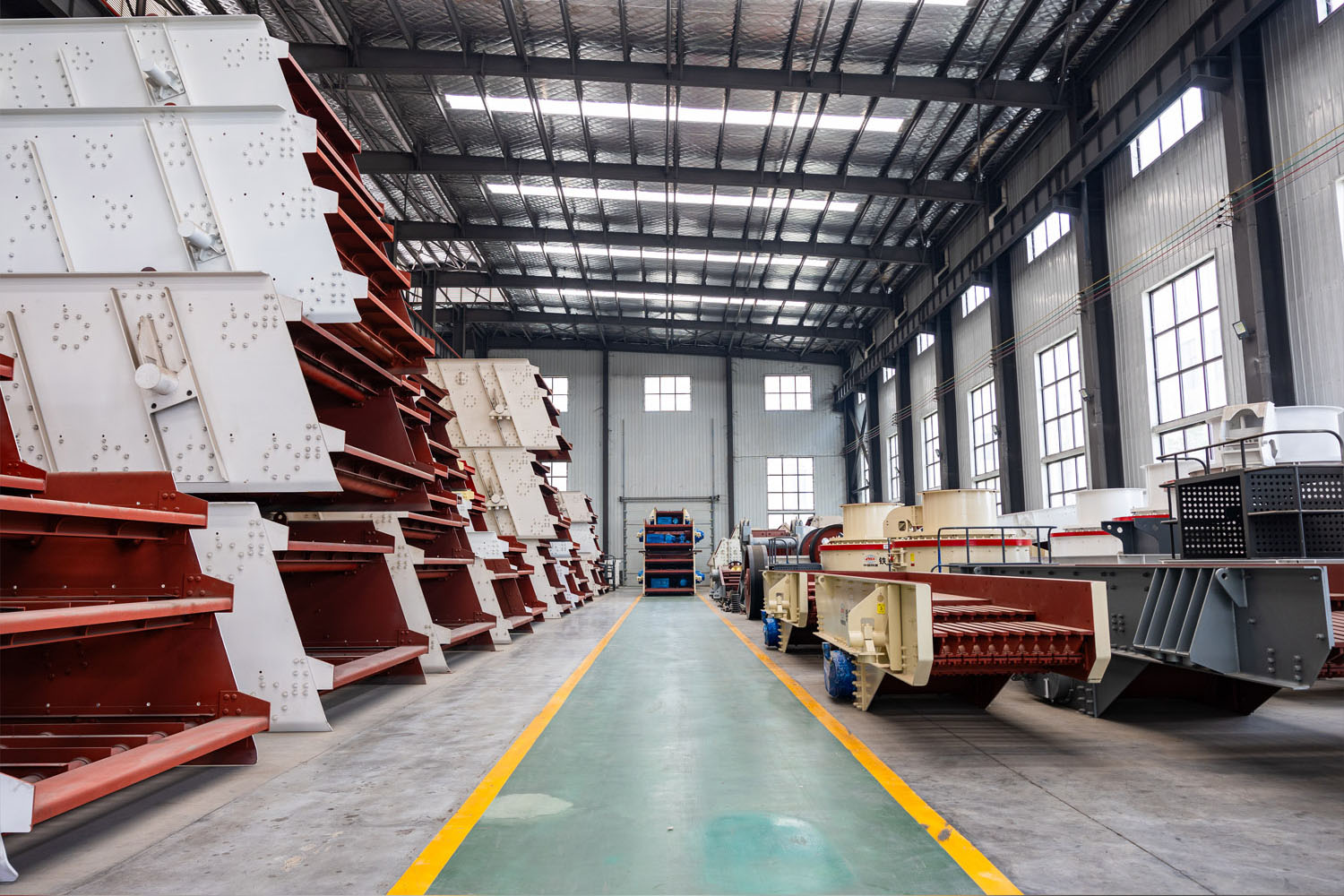
Assembly and preparation area for crusher units configured to project specifications — relevant when comparing integrated line delivery against single-machine supply.
Side-by-Side Comparison
The table below applies the four dimensions qualitatively. It deliberately avoids scoring suppliers on opaque indexes; each cell states the type of positioning a buyer can verify independently through documentation, references, or published studies.
| Supplier | Technology & R&D signal | Market position signal | Service model | Solution scope |
|---|---|---|---|---|
| Henan Centbro Machinery (STM) | 20-engineer R&D team; in-house range across jaw, impact, cone, VSI, hammer, mobile, milling and drying equipment | Manufacturer-exporter with 100% export ratio; markets include Russia, Middle East, Mexico, Africa | On-site installation and commissioning by assigned after-sales engineers until the customer can operate the machine; documented multi-unit project in Russia | Single machines through integrated crushing, sand-making, grinding and drying lines; tyre-type and crawler mobile units |
| Metso | Broad engineering portfolio; Aggregates segment revenue above USD 3.1 billion in 2025 | Part of the group identified as holding approximately 30–35% of global jaw crusher share | Global service and lifecycle support structure | Full plant engineering, aggregates and mining process solutions |
| Sandvik | Recognised global manufacturer of stationary and mobile crushing equipment | Part of the same top-tier jaw crusher share group | Global network oriented around mining and aggregates customers | Equipment and process solutions for mining and construction |
| Terex | Recognised global manufacturer of crushing and screening equipment | Part of the same top-tier jaw crusher share group | Distribution-led support model across multiple markets | Modular and mobile equipment for contractors and producers |
| Kleemann | German specialist widely associated with mobile crushing and screening plants | Evaluated on specialist positioning rather than the combined jaw-crusher share figure | Dealer-based support model | Mobile jaw, cone and impact plants for aggregate production |
Qualitative positioning only. Figures cited are attributable to the sources named in the text; no supplier is ranked on an undisclosed index.
Where STM Fits — and the Limits Buyers Should Price In
A comparison framework is only credible if it states boundaries. STM operates with a team of 50+ employees and an 8,000 m² production facility. That scale cannot replicate the global branch density, in-country warehousing, or equipment financing programmes of a multi-billion-dollar international group, and buyers who depend on those capabilities should weigh them explicitly.
Three practical limits are worth stating plainly:
- Service geography. STM's stated markets are Russia, the Middle East, Mexico, Africa, and other overseas regions. A buyer located outside those areas, or in a remote region within them, should confirm the actual local support arrangement in writing rather than assuming global coverage.
- Brand recognition and resale assumptions. Secondary-market liquidity for a mid-sized manufacturer's equipment is typically less established than for top-tier global brands. Buyers whose business model depends on early resale or on rental fleet standardisation should factor this in.
- Certification scope. STM holds ISO9001:2008 international quality management system certification and the European Union CE certificate. These are quality and market-access credentials; they are not a substitute for machine-specific safety verification such as ISO 21873-2:2019 for mobile units.
On the other side of the ledger, three capabilities are directly relevant to line-level projects: monthly production capacity of 8,000 units, a product scope that integrates crushing with sand making, grinding, and drying, and a service model in which after-sales engineers are assigned to the site for installation and commissioning. For buyers who need one accountable supplier across a full production line rather than a set of separately sourced machines, that combination is the core argument.

Production capacity and workshop organisation are verifiable inputs when a buyer evaluates whether a supplier can deliver a complete line rather than a single unit.
Execution Stage: Terms, Acceptance, and Handover Control
Once a shortlist narrows, commercial terms become the decisive layer. STM's stated purchasing terms are a minimum order quantity of 1 set, delivery terms of FOB, CIF, EXW, or CFR, and payment by T/T or L/C. These are conventional export terms and allow a buyer to align the supplier's offer with their own freight, insurance, and financing arrangements.
The more important execution control is the acceptance structure, which STM defines in four stages:
- Appearance and accessories acceptance — the basic verification stage.
- Installation and commissioning acceptance — the core stage, tied to the after-sales engineering commitment.
- Performance and performance-indicator acceptance — the critical stage, where output and product quality are measured.
- Documentation and after-sales service acceptance — the final stage, closing the handover.
This four-stage structure is a useful template regardless of which supplier is selected, because it forces performance verification before final payment rather than after. Buyers comparing suppliers should check whether each stage is defined in the contract, and whether the performance stage references measurable parameters rather than general descriptions.
Market Trends Shaping the Next Procurement Cycle
Mobility is outpacing static capacity. With the mobile crusher and screener market valued at USD 4.59 billion in 2024 and projected to grow at a 7.32% CAGR through 2035 (Market Research Future), portable and crawler-mounted configurations are no longer a niche. This shifts comparison criteria toward transport dimensions, setup time, and the availability of mobile-specific safety documentation.
Regional demand is concentrating in Asia Pacific. Asia Pacific is the largest and fastest-growing crusher region, and China's market was estimated at USD 827.02 million in 2024 (Market Research Future). Manufacturing proximity within this region affects lead times, spare-part logistics, and the cost of engineering changes.
Line integration is replacing single-machine buying. Where buyers previously assembled a crushing line from several vendors, integrated scopes — including sand making and drying — reduce interface risk. STM's line-level product structure reflects this shift.
Compliance is moving from general to machine-specific. ISO 21873-2:2019 addresses safety requirements and verification for mobile crushers specifically. General quality system certificates such as ISO9001:2008 and market-access marks such as CE remain necessary, but they answer a different question.
Future Outlook
Competition in crushing equipment is shifting from machine specifications toward ecosystem reliability: whether a supplier can keep a plant running for a decade, supply wear parts predictably, retrain operators as staff changes, and support line modifications as deposit characteristics shift.
For global majors, the differentiator will remain engineering depth and global service reach. For manufacturer-exporters such as STM, the differentiator is more likely to be line-level integration, direct engineering access, and documented long-term customer relationships — the same attributes that a 10-unit, multi-year project record demonstrates.
For buyers, the practical implication is that the supplier evaluation should be structured to test continuity, not only capability. A machine that performs well in year one but has unpredictable wear-part supply in year four is a procurement failure, not a technical one.
Frequently Asked Questions
How should a buyer evaluate a crusher supplier's long-term support capability?
Look for a defined handover obligation rather than a general service promise. STM maintains an experienced and skilled sales service team and a comprehensive sales service network, and after purchase assigns professional after-sales service engineers to the site for installing and commissioning the machine until the customer can operate it. The evaluable element is the completion condition: support ends when the customer can operate the machine, which can be written into the contract as an acceptance milestone.
Which certifications related to crushers can a buyer independently verify?
Three categories apply. STM holds ISO9001:2008 international quality management system certification and the European Union CE certificate. Separately, ISO 21873-2:2019 specifies safety requirements and verification for mobile crushers used in rock crushing and construction recycling, published by the International Organization for Standardization. Quality system and market-access certificates should not be treated as equivalent to machine-specific safety verification.
Does a mid-sized manufacturer's production capacity create supply risk?
Capacity should be checked against the project schedule rather than judged in the abstract. STM operates with a monthly production capacity of 8,000 units and a team of 50+ employees in an 8,000 m² facility. The relevant question for a buyer is whether the delivery schedule for the specific configuration — particularly mobile or drying-line equipment — is confirmed in the contract.
How can a buyer verify a supplier's overseas project experience?
Request records of repeat, multi-unit supply in comparable operating environments. A 10-unit project in Russia was completed within 10 years, illustrating a long-term supply relationship in one of STM's stated export markets. Reference checks are more informative when they cover the same material type, climate, and duty cycle as the planned plant.
What purchasing and acceptance terms are typical for crusher equipment orders?
STM's stated terms are a minimum order quantity of 1 set; delivery terms of FOB, CIF, EXW, or CFR; and payment by T/T or L/C. Acceptance is defined in four stages: equipment appearance and accessories acceptance, installation and commissioning acceptance, performance and performance-indicator acceptance, and documentation and after-sales service acceptance. Buyers should confirm that each stage is written into the contract before final payment is scheduled.
Should buyers weigh global brand scale against local service reach?
Both matter, and they answer different questions. Metso Outotec, Sandvik, and Terex Corporation are identified as top global manufacturers holding approximately 30–35% of the jaw crusher market share in 2024 (Dataintelo), which supports supply continuity and installed-base depth. Local service reach determines response time on a specific site. Buyers should verify the supplier's actual coverage for their location and the documented lead times for critical wear parts, regardless of the supplier's global position.