
SWRO, BWRO or WWRO? A 5–50+ MLD Desalination Buyer Framework
Between 5 and 50+ MLD, desalination stops being a technology question and becomes a configuration question. Four inputs settle most of it before any vendor conversation begins: feedwater chemistry, end use, site conditions, and the operating horizon a buyer is prepared to defend.
Two market markers explain why this band is under active re-evaluation. Global installed desalination capacity passed 100 million m³/day in 2024, according to the IDRA Desalination & Reuse Handbook 2024–2025. Seawater reverse osmosis accounts for more than 60% of installed capacity worldwide (Credence Research, 2025). Grand View Research values the global desalination market at approximately USD 21.3 billion in 2025, rising to about USD 23.2 billion in 2026. Capacity is no longer the constraint — configuration fit is.
This framework covers the three reverse osmosis families a 5–50+ MLD buyer will actually be offered — SWRO, BWRO and WWRO — plus the customized configurations that sit above them, and the deployment forms (containerized, skid-mounted, or civil-built) that determine how the plant is delivered and expanded.
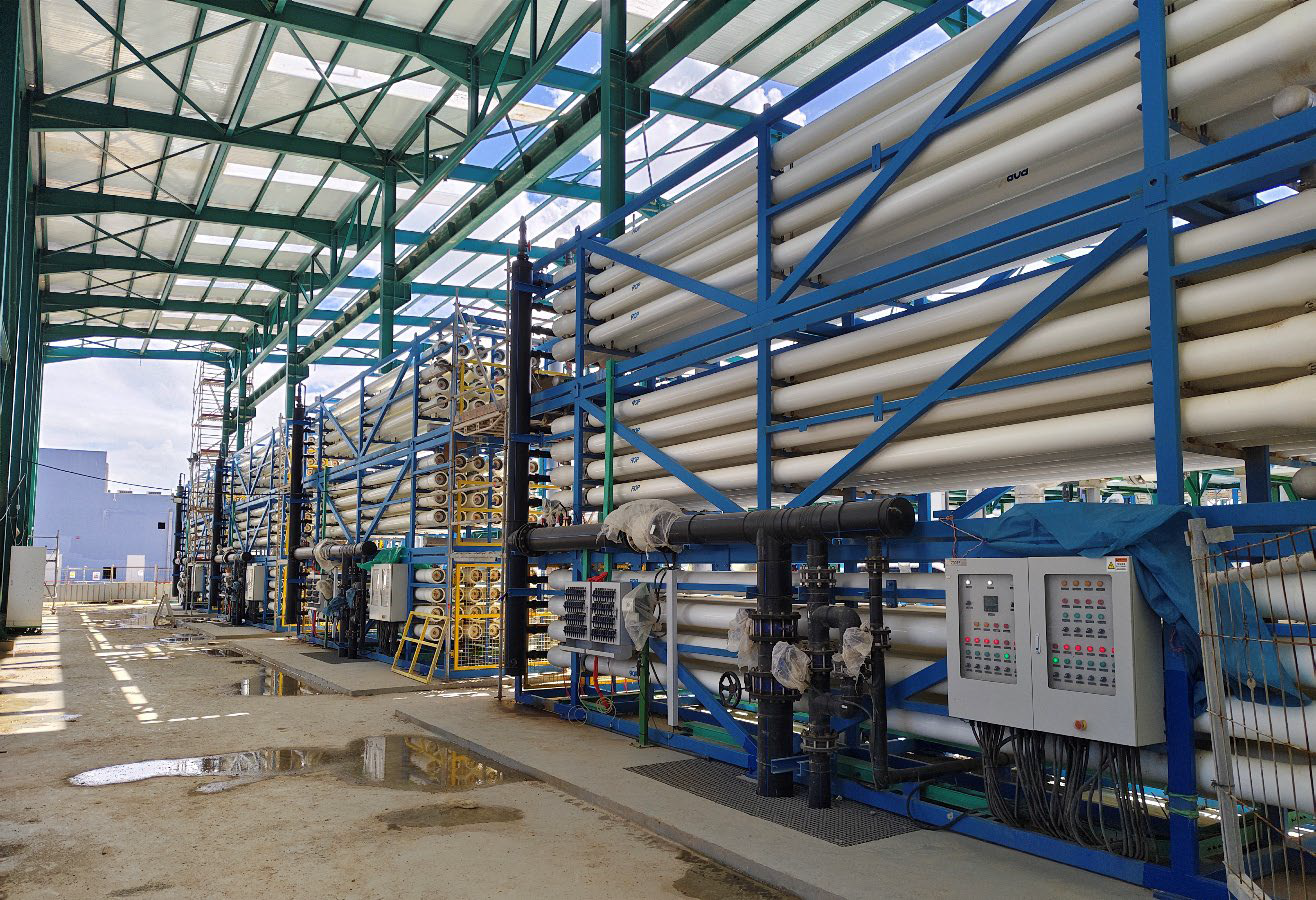
What each configuration is actually designed to treat
The three families are not interchangeable, and the difference is measurable at the intake. The specifications below are the published feedwater envelopes for the corresponding reverse osmosis lines.
| Configuration | Feedwater it is designed for | Typical 5–50+ MLD role |
|---|---|---|
| SWRO — Seawater Reverse Osmosis | Salinity 20,000–45,000 mg/L TDS; 5–35 °C; turbidity below 20 NTU; COD below 10 mg/L | Municipal drinking water, coastal and island supply, industrial process water where seawater is the only source |
| BWRO — Brackish Water Reverse Osmosis | Salinity 2,000–5,000 mg/L TDS; 5–35 °C; turbidity below 5 NTU; COD below 10 mg/L | Agricultural irrigation, boiler make-up, inland process water, sites without a seawater intake |
| WWRO — Wastewater Reverse Osmosis | Municipal or industrial wastewater; capacity and pre-treatment defined by the effluent stream rather than a fixed salinity band | Industrial recycling and reuse, typically integrated with clarification, ultrafiltration or nanofiltration |
Across all three families, the product-water envelope published for QT ENVIRO-TECH systems is consistent: salinity (TDS) below 500 mg/L, pH 6–8, and turbidity below 0.2 NTU. That consistency is deliberate — it means the choice between SWRO and BWRO is made at the feed end, not at the product end.
The six inputs that decide the configuration
Evaluation-stage buyers who narrow configuration using the following six inputs usually converge on one or two defensible options before pricing begins.
| Decision input | What it rules in or out | Boundary to check |
|---|---|---|
| 1. Feedwater source and salinity | Technology family — SWRO, BWRO or WWRO | Oil and grease; the published SWRO feed specification is below 0 mg/L, so hydrocarbon contamination must be resolved upstream |
| 2. End use and product-water specification | Post-treatment and polishing stages | Boiler or turbine duty needs stages beyond reverse osmosis |
| 3. Capacity band | Single unit, multi-unit fleet, or skid-based design | Standard container bands end at defined thresholds |
| 4. Site conditions | Materials, corrosion class, logistics | Coastal exposure and temperature range drive material selection |
| 5. Deployment model | Containerized, skid-mounted, or civil-built | Modularity does not cover intake, outfall, power or brine handling |
| 6. Operating horizon and evidence | Supplier shortlist and service scope | References must match feedwater, climate and duty |
1. Feedwater chemistry sets the technology family
Salinity is the first filter. A feed at 20,000–45,000 mg/L TDS is SWRO territory. A feed at 2,000–5,000 mg/L TDS is BWRO territory, which is why brackish sources inland are almost never specified with seawater membranes. WWRO is defined by the availability of an effluent stream rather than by a salinity number.
The parameters around salinity matter just as much. The published SWRO feed window allows turbidity up to 20 NTU, COD up to 10 mg/L, ferrous and manganese up to 0.1 mg/L each, and oil and grease below 0 mg/L. BWRO tightens turbidity to below 5 NTU. These are reverse-osmosis feed requirements, not raw-water readings. When a raw seawater analysis exceeds them — seasonal turbidity spikes and monsoon conditions are the common case — the gap is a pre-treatment design item, not a reason to reject the equipment family. Buyers should require the pre-treatment train to be specified at the same time as the RO scope, because that is where configuration risk concentrates.
2. End use defines the product-water specification
For municipal supply, ISO 23446:2021 provides international guidelines for product water quality of seawater reverse osmosis desalination. Drinking water, process water, irrigation water and reuse water therefore do not share one specification, even when they share one membrane process.
Industrial destinations change the train. A power generation reference in the QT ENVIRO-TECH portfolio pairs multimedia filtration, two-pass RO, mixed bed and EDI to deliver resistivity above 10 MΩ for a 2×25 MW plant — RO output there is an intermediate stream, not a finished product. Agricultural duty sits at the opposite end: a 100 m³/day BWRO installation supplies irrigation from a brackish source on a seasonal or continuous basis, with no polishing stage beyond what irrigation water requires.
3. Capacity band decides unit architecture
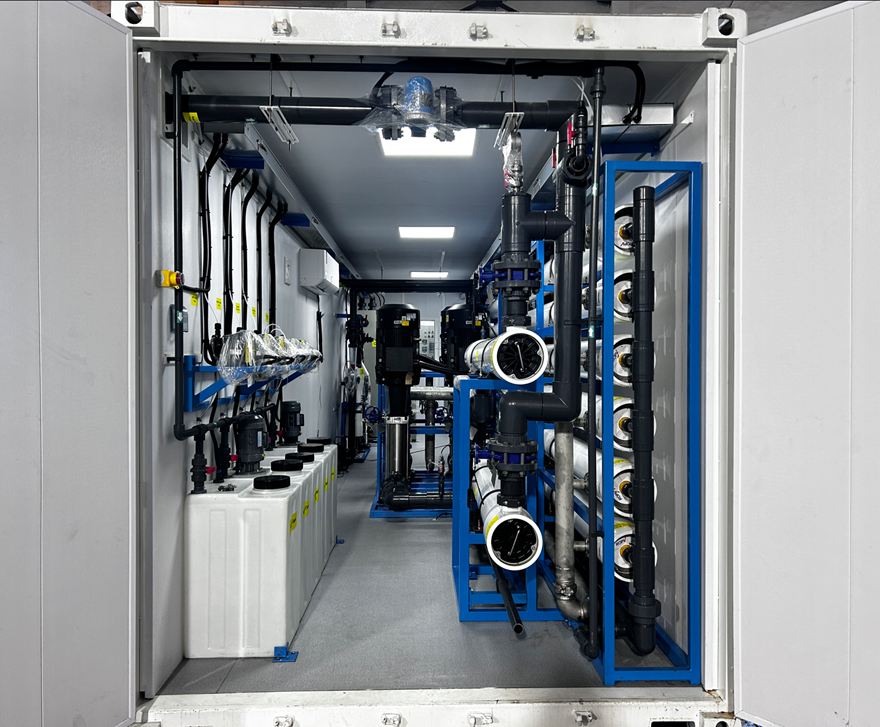
Within the 5–50+ MLD range, published product bands show where unit architecture changes. The fastRO C/BWC containerized line covers 50–1,000 m³/day as standard and extends to 5,000 m³/day. The fastRO Mega line covers 5–20 MLD (5,000–20,000 m³/day). Above that, the customized SWRO/BWRO/WWRO configuration is specified at approximately 50 MLD and above (50,000 m³/day+).
The break points matter because they change how many items of equipment a site has to operate, monitor and maintain — not simply how much water is produced. A 20 MLD requirement met with containerized modules is a fleet with modular increments; the same requirement met with a customized skid layout is closer to permanent infrastructure.
4. Site conditions drive materials and logistics
Material specification at the coast is not cosmetic. The containerized SWRO band specifies Duplex 2507. The Mega band specifies non-corrosive super duplex steel for pumps, energy recovery devices and high-pressure piping, UPVC or HDPE for piping, and heavy-duty marine paint on frames and containers. Customized skid configurations use carbon steel, SS304 or FRP depending on process and site; BWRO systems specify Sch10 SS316 high-pressure pipe and fittings with heavy-duty paint. A buyer comparing quotes on membrane area alone will miss this line item, and it is often the difference in year eight.
5. Deployment model: containerized, skid-mounted or civil-built
Factory pre-assembly is the lever. QT ENVIRO-TECH's fast-build model delivers more than 80% factory pre-assembly, reduces on-site civil works by up to 70%, and cuts total construction and installation time by up to 60%, with two-week on-site commissioning proven in practice. A 500 m³/day containerized installation at a nuclear power plant was installed in 10 days and has operated stably for more than two years.
The boundary is equally clear: modularity moves work from the site to the factory, it does not delete site work. Intake structures, outfall and brine dispersion, power supply and pre-treatment responsibility remain with the project — and modular economics depend on how much of that scope already exists.
6. Operating history is the differentiator at evaluation stage
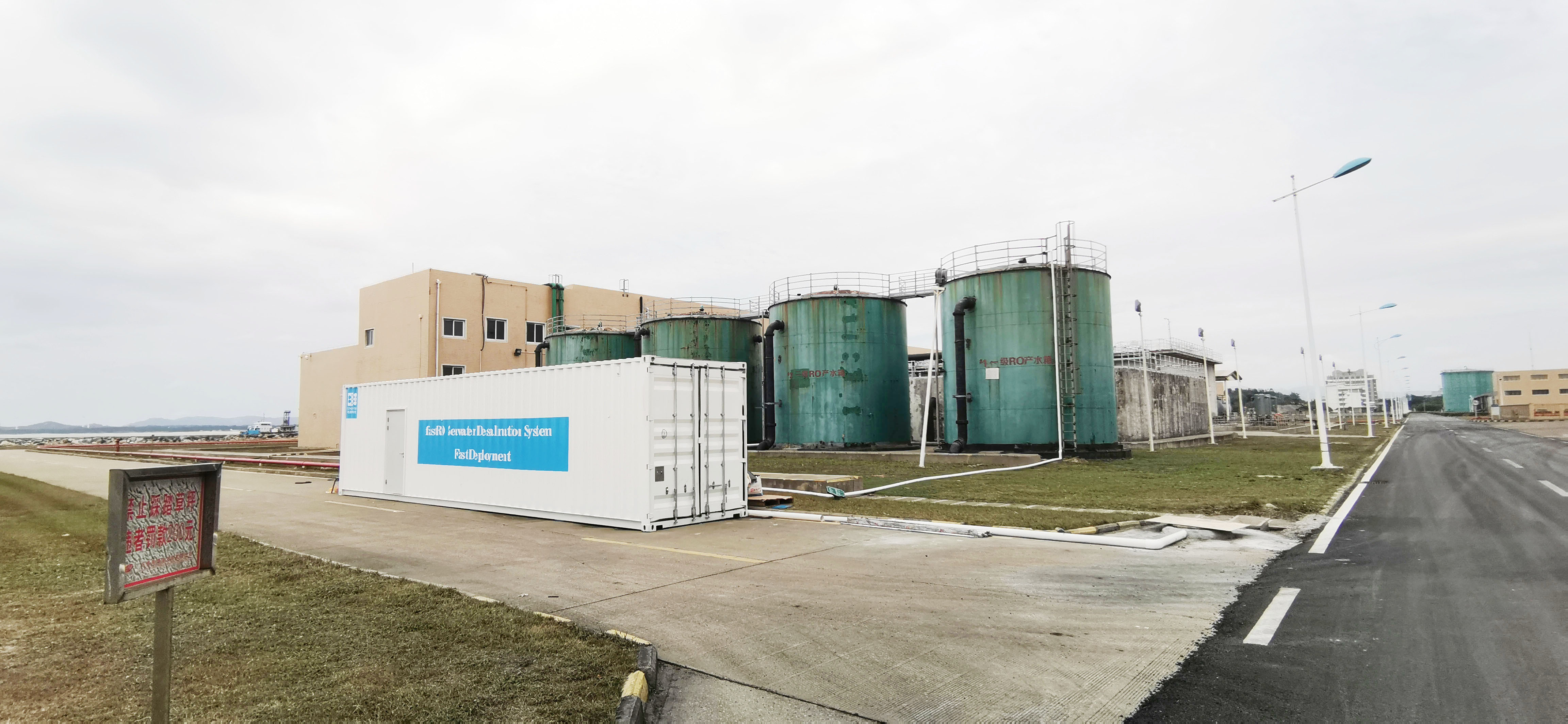
At the preference stage, the deciding evidence is duration under real conditions rather than headline capacity. Veolia, a global water utility, uses QT ENVIRO-TECH SWRO systems for remote coastal drinking water supply at 3,500 m³/day delivered from 10+ units of 350 m³/day, operating for over 20 years. An island community water supply of 1,000 m³/day has recorded 365-day continuous uptime through monsoon swings. A resort installation of 1,000 m³/day has been in service for more than 20 years, and a hotel and resort group unit combining 2×40 ft containers with walls removed into a unified plant room meets EU market compliance requirements.
Read those references as conditions, not badges. Twenty years in a remote coastal setting is evidence about corrosion management, remote serviceability and spare-parts logistics. It is not automatically evidence about a petrochemical feed or a desert inland site.
How the framework resolves five real project profiles
| Project profile | Configuration | Deployment | What it proves for a buyer |
|---|---|---|---|
| Municipal drinking water, 50,400 m³/day, industrial owner (OCP, mining and phosphate) | SWRO with industrial-grade reliability, 50 MLD+ capacity | Permanent-scale infrastructure, project start 2026 | That SWRO delivers municipal-grade output at the top of the band, even with a non-municipal owner |
| Industrial wastewater recycling, 60,000 m³/day | WWRO with a multi-stage treatment process | Skid-mounted / customized | That WWRO scales to one of China's largest wastewater reverse osmosis projects |
| Remote coastal drinking water, 3,500 m³/day (Veolia) | Modular containerized SWRO, 10+ units × 350 m³/day | Modular fleet, 20+ years operating | That modular increments remain serviceable over two decades in remote coastal conditions |
| Agricultural irrigation, 100 m³/day | BWRO from a brackish source | Containerized / customized, seasonal or continuous | That the same technology family scales down without changing the process logic |
| Municipal drinking water, 20 MLD (20,160 m³/day) | Containerized SWRO, recorded as the world's largest containerized SWRO plant | Modular expansion capability, full EPC scope | That containerized delivery can carry a municipal-scale duty inside the 5–50 MLD band |
Where QT ENVIRO-TECH sits in this framework
QT ENVIRO-TECH (Suzhou) Ltd is a desalination system manufacturer, EPC contractor and system integrator based in Suzhou, China, established in 2011. The company operates a 4,000 m² factory with 70 employees, an annual output of 300,000 m³, and a core technical team of more than 40 engineers. Approximately 80% of output is exported, with customers across more than 80 countries, including South Asia, the Middle East, Africa, Europe and South America.
The portfolio maps directly onto the framework above: SWRO, BWRO and WWRO systems, the fastRO containerized platform in three tiers (C/BWC at 50–1,000 m³/day, Mega at 5–20 MLD, and Skid up to approximately 50 MLD), and a Digital Water Plant platform combining real-time SCADA visualization, AI-supported energy and chemical optimization, predictive equipment health monitoring and automatic work-order dispatch.
Manufacturing and quality controls are documented rather than implied. Production runs as OEM/ODM with equipment branding, color customization, process configuration and site-specific design, at a minimum order quantity of one unit. Quality control covers factory pre-assembly and pre-testing, 100% test before shipping, pre-shipment inspection and performance testing, with third-party factory acceptance testing available to the buyer. Processes are certified to ISO 9001 (certificate 130355, valid to 28 March 2028), ISO 14001 (F02926E00371R202) and ISO 45001 (F02926S00260R201), all issued by DCI, scoping the design, assembly, production and sales of seawater desalination treatment systems and equipment.
Market trend: why the mid-band is being re-priced
Three verified signals shape buyer expectations in this segment. First, installed capacity crossing 100 million m³/day in 2024 shows that desalination is now a mainstream industrial utility rather than a marginal supply option. Second, SWRO holding more than 60% of installed capacity confirms that membrane-based seawater treatment sets the market default. Third, Asia Pacific is projected to be the fastest-growing regional equipment market, estimated to reach USD 17.7 billion by 2030 (Grand View Research).
The practical consequence for the 5–50+ MLD band is that both modular and civil-built supply chains can serve it, so competitive weight shifts from 'can this be built' to 'how fast can it be commissioned, expanded and operated'. What remains comparatively under-benchmarked is granular deployment speed — for example, measured days-to-first-water for remote island deployments versus industrial park deployments. Buyers evaluating modular supply should therefore request project-specific commissioning evidence rather than relying on category averages.
Comparison with traditional site-built plants — and where modular stops working
| Dimension | Conventional site-built plant | Modular containerized or skid system |
|---|---|---|
| Civil works | High; permanent structures and foundations | Reduced by up to 70% in documented cases |
| Factory pre-assembly | Limited; most assembly at site | More than 80% pre-assembled in the fast-build model |
| Installation and commissioning | Extended, and dependent on weather and site readiness | Two-week on-site commissioning proven; 10-day installation recorded at 500 m³/day |
| Expansion path | Requires re-engineering and new civil scope | Incremental capacity added by units or containers, in defined modular steps |
| Material exposure | Site-selected | Pre-specified: Duplex 2507, super duplex steel and marine-grade coatings for coastal duty |
| Quality verification | Site-based inspection | Factory tests, 100% pre-shipment testing, third-party FAT accepted |
The limits are real, and evaluation-stage buyers should test them explicitly:
- Modularity does not remove marine and utility infrastructure. Intake, outfall, brine dispersion, power supply and site access remain project scope.
- Unit count rises below the container band. A 3,500 m³/day remote coastal supply was delivered as 10+ units of 350 m³/day. That is a fleet to operate and maintain, and it suits remote, distributed or phased demand better than a single dense plant.
- The containerized standard band has a ceiling. Above roughly 20 MLD the configuration moves toward customized skid design at approximately 50 MLD and above, built in carbon steel, SS304 or FRP, which restores more site-specific engineering.
- BWRO is not a seawater solution. Its specified feed envelope is 2,000–5,000 mg/L TDS. Applying it to seawater is a specification error, not a cost optimization.
- WWRO requires an existing effluent stream. Available process routes include clarifier + UF + BWRO, tubular UF + RO, and NF systems. Where no consistent wastewater source exists, the reuse case does not exist.
- Published feedwater limits are gates, not targets. A seawater feed with oil and grease present sits outside the specified SWRO feed window, so pre-treatment must be resolved before the RO scope is priced.
Future outlook
Two directions look structurally significant for the 5–50+ MLD band. The first is phased capital deployment: modular increments let an owner commit capacity in steps that track demand rather than forecast it years ahead, which changes how the business case is underwritten. The second is off-grid operation — a 500 m³/day community supply project pairs photovoltaic power with SWRO, evidence that energy architecture is becoming part of the desalination decision rather than a separate utility question.
Operating models are shifting with them. The Digital Water Plant platform — SCADA visualization, AI-supported energy and chemical optimization, predictive health monitoring, automated work orders — addresses the constraint that modular fleets put more equipment under fewer operators. For buyers, the practical implication is that commissioning speed and documented operating duration will carry more weight in supplier selection, and membrane price will carry less.
Frequently asked questions
How do I determine whether my project needs SWRO, BWRO or WWRO?
Start with the feed source, not the capacity. SWRO is specified for seawater at 20,000–45,000 mg/L TDS. BWRO is specified for brackish water at 2,000–5,000 mg/L TDS. WWRO applies where municipal or industrial wastewater is the feed and the objective is recycling or reuse. A project with a brackish inland source and an irrigation or process-water destination is a BWRO project regardless of how large it is; a coastal municipal project is an SWRO project regardless of how small it is.
For a 5–50+ MLD plant, which configuration is generally preferred for municipal supply?
In this band the two documented options are containerized SWRO (fastRO Mega, 5–20 MLD) and customized skid-mounted SWRO at approximately 50 MLD and above. A 20 MLD (20,160 m³/day) municipal drinking water installation using the containerized approach is recorded as the world's largest containerized SWRO plant and includes modular expansion capability, while a 50,400 m³/day municipal drinking water scope sits at the customized end of the range. The selection usually turns on expansion path, tolerance for on-site civil works, and schedule rather than on the membrane process itself.
When does a containerized desalination system make more sense than a permanent plant?
When civil works, schedule or remoteness dominate the project. Documented figures for the containerized approach include more than 80% factory pre-assembly, up to 70% reduction in on-site civil works, up to 60% reduction in total construction and installation time, and a two-week on-site commissioning cycle. A 500 m³/day containerized unit was installed at a nuclear power plant in 10 days and has operated stably for more than two years. The counterweight is that intake, outfall, power and brine handling remain site scope in either model.
Which feedwater parameters should be verified before confirming a technology?
For seawater systems: salinity 20,000–45,000 mg/L TDS, temperature 5–35 °C, turbidity below 20 NTU, COD below 10 mg/L, ferrous below 0.1 mg/L, manganese below 0.1 mg/L, and oil and grease below 0 mg/L. For brackish systems: salinity 2,000–5,000 mg/L TDS, temperature 5–35 °C, turbidity below 5 NTU and COD below 10 mg/L. Product water across both is specified at TDS below 500 mg/L, pH 6–8 and turbidity below 0.2 NTU. Any raw-water value outside the feed window indicates a pre-treatment requirement rather than a change of technology family.
What does a 20-year operating record actually prove?
It evidences durability under specific, stated conditions. QT ENVIRO-TECH SWRO systems have been used by Veolia for remote coastal drinking water supply at 3,500 m³/day from 10+ units of 350 m³/day, operating for over 20 years; a resort installation of 1,000 m³/day has operated for more than 20 years; and an island community supply of 1,000 m³/day has recorded 365-day continuous uptime through monsoon swings. What such records do not establish is transferability. A buyer should request references with comparable salinity, temperature range, site exposure and duty before treating a long operating record as evidence for their own project.
Can capacity be expanded later without rebuilding the whole facility?
Within defined increments, yes. The containerized band runs from 50 to 1,000 m³/day as standard and extends to 5,000 m³/day, and the 20 MLD containerized municipal plant includes modular expansion capability. In modular configurations, expansion is described as adding units rather than re-engineering the plant — for example, adding four to five containers per additional 5 MLD. Above those increments, a new customized engineering scope applies, which is why the expansion path should be defined during evaluation rather than after commissioning.
For readers who need the full manufacturer reference — capacity bands, materials, certifications and project record — the company profile is available here: QT ENVIRO-TECH company profile (PDF).
Have Questions or Need More Details?
Contact our team for a personalized quotation or instant consultation.
Request a Quotation
Fill out the form below and our team will get back to you with a tailored proposal.
WhatsApp Direct Chat
Prefer to chat in real-time? Message us on WhatsApp for instant assistance & quick answers.
- Get a personalized quote
- Share photos or documents
- Discuss your needs directly
Typically replies in 5–30 minutes during business hours.