
SYP Hybrid Inverter Shortlist: 4kW–12kW Off-Grid Load Matching
SYP Hybrid Inverter Shortlist: 4kW–12kW Off-Grid Load Matching
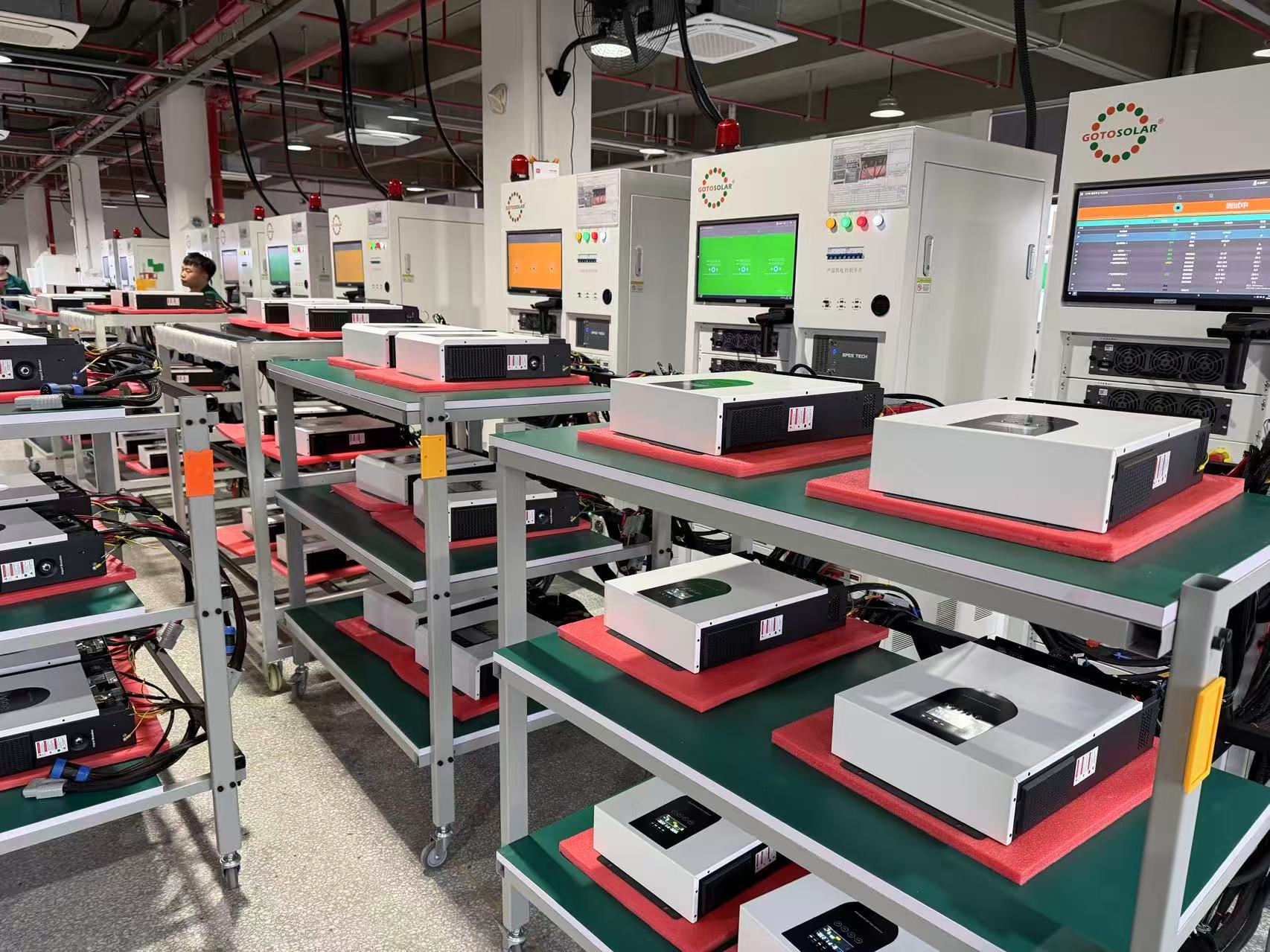
Off-grid projects in the 4 kW to 12 kW band rarely fail because the chosen inverter was too small on paper; they fail because the model was matched to a nameplate rather than to a load profile. The SYP hybrid inverter series from GOTOSOLAR covers that band with six models — SYP1.5KW12V, SYP2.5KW12V, SYP4.0KW24V, SYP6.5KW48V, SYP12.0KW48V and SYP12.0KW48V/P — arranged, as the model designations indicate, across 12 V, 24 V and 48 V battery tiers. This shortlist sets out the criteria that decide between them, then maps each model to the off-grid duty it fits.
GOTOSOLAR (FOSHAN SOLARUP TECHNOLOGY CO.,LTD) is a manufacturer of hybrid solar inverters and solar charge controllers, operating production bases in Foshan, Yiwu and Yingtan and exporting to Southeast Asia (Philippines, Vietnam), Africa (Nigeria, Kenya), the Middle East, South America and CE-certified European markets. Its SYP family is the subject of this assessment.
The order of the shortlist matters more than the individual specifications. Battery voltage tier rules out models first; surge duty and PV array compatibility rule out more; charge current, output configuration and communications decide what remains.
Why a 4 kW–12 kW off-grid project needs a model-level shortlist
Sizing an off-grid system from a single peak-load figure tends to produce one of two failure patterns. An undersized unit handles the steady load comfortably and then trips when a pump, compressor or power tool starts. An oversized unit carries unnecessary idle consumption, pushes the site into a higher battery voltage tier than the load requires, and adds cost without adding usable energy.
A hybrid solar inverter integrates PV charging, battery management and AC output in one enclosure. In an off-grid site it also has to cope with an AC input — a generator or an intermittent grid connection — without dropping the load. That combination is why the shortlist must be built per model: within the SYP series the 12 V, 24 V and 48 V units serve different load shapes, not simply different wattages.
Five criteria that reorder the SYP shortlist
Before comparing wattages, establish which criteria eliminate models outright. For this series the decisive filters are battery tier, surge capacity, PV array window, charge current and output configuration.
| Criterion | What to check in the SYP documentation | Why it reorders the shortlist |
|---|---|---|
| Battery bank voltage | Model designation (12 V, 24 V or 48 V) | Determines battery wiring, DC current per kilowatt and which models remain eligible |
| Surge versus continuous | 12 kVA surge rating on the SYP6.5KW48V; continuous rating per model | Motor and compressor starts, not steady load, usually set the required size |
| PV array compatibility | MPPT window of 60–450 VDC; maximum PV input up to 9000 W | String voltage must stay inside the window across the site's temperature range |
| Charge current and chemistry | 120 A maximum total charge current on the 6.5 kW model; lithium and lead-acid compatibility | Sets recharge time, battery bank sizing and BMS limits |
| Outputs and interfaces | Dual AC output on the 6.5 kW model; optional WiFi, RS232, RS485 and USB | Enables load prioritisation and monitoring or EMS integration |
Battery voltage tier comes first
The 12 V, 24 V and 48 V tiers are not interchangeable. For the same output power, a 12 V bank carries roughly four times the DC current of a 48 V bank, which affects cable sizing, connection losses and the practical limit of the load a compact system can sustain. A site that already owns a 12 V battery bank is effectively shortlisted to the SYP1.5KW12V and SYP2.5KW12V; a new 48 V build starts at the SYP6.5KW48V.
Surge capacity decides motor-heavy sites
The SYP6.5KW48V is listed with a 12 kVA surge rating. Surge is the figure that determines whether a borehole pump, refrigerated cabinet or bench tool can start without collapsing the output; the continuous rating determines whether the load can then keep running. The supplied specification does not state the surge duration, so a design that depends on surge headroom should confirm the time window with the supplier rather than assume it.
The MPPT window and PV ceiling
The series' shortlist criteria include an MPPT operating window of 60–450 VDC and a maximum PV input of up to 9000 W. Two checks follow. First, the string voltage must remain inside 60–450 VDC at the coldest and hottest expected module temperatures, not only at standard test conditions. Second, the array must not exceed the maximum PV input of the specific model selected — PV headroom is not uniform across a 1.5 kW to 12 kW series, so the 9000 W figure should be confirmed against the chosen model's datasheet.
Charge current, chemistry and communications
A 120 A maximum total charge current on the SYP6.5KW48V is the ceiling shared by the charging paths, so a large array plus an AC or generator charger can reach that limit together. The battery bank must be able to accept the current, and lithium packs must be checked against the supplier's BMS compatibility list for the relevant communication protocol. Optional WiFi, RS232, RS485 and USB interfaces determine whether the site can be monitored remotely or tied into a wider energy management system.
Matching each SYP model to an off-grid load profile
SYP1.5KW12V and SYP2.5KW12V — 12 V tier, cabins and mobile loads
The two 12 V models serve small, DC-heavy systems: cabins, lighting circuits, modest refrigeration, communications equipment and compact RV or mobile installations where a 12 V battery bank is already in place. The SYP2.5KW12V is the step-up choice when the continuous load sits close to the 1.5 kW unit's rating or when a small motor or compressor is part of the daily profile. At this tier, keeping continuous load well below the nameplate is the practical rule, because 12 V DC current is high relative to delivered power.
SYP4.0KW24V — 24 V tier, mid-size residential
The SYP4.0KW24V is the entry point of the 4 kW+ band named in this shortlist. It suits a mid-size off-grid home, a workshop, or a residential site with pumps and lighting on a 24 V bank. It is also the model to consider where a 4 kW continuous figure is realistic but the surge profile is modest; if the site's largest load is a motor with a hard start, the 48 V models provide more surge headroom to design against.
SYP6.5KW48V — 48 V tier, load prioritisation
The SYP6.5KW48V is the pivot of the shortlist for full residential off-grid systems. It combines a 48 V battery tier with dual AC output, feed-in-to-grid support, a 12 kVA surge rating, a 120 A maximum total charge current and compatibility with both lithium and lead-acid batteries. The dual AC output is what makes it useful in a house rather than only on a test bench: two AC output circuits allow essential and non-essential loads to be separated so that lighting, refrigeration and communications can be kept on a protected circuit while heavier discretionary loads sit on the other. Feed-in-to-grid support matters only where a grid connection exists and local interconnection rules permit export; it does not by itself authorise grid export.
SYP12.0KW48V and SYP12.0KW48V/P — 48 V tier, larger sites
The two 12 kW models address large residential systems and small commercial premises where refrigeration, pumps or light industrial equipment dominate. The SYP12.0KW48V is the single-unit option; the SYP12.0KW48V/P is the parallel-designated variant, which is the one to examine when the project expects load growth, staged build-out or redundancy. Parallel configuration limits — the number of units, the sharing arrangement and the battery bank implications — should be confirmed against the model documentation before a multi-unit design is committed.
| Model | Battery tier | Off-grid load profile it fits | Shortlist note |
|---|---|---|---|
| SYP1.5KW12V | 12 V | Cabin, lighting, small DC loads, compact RV | Smallest tier; DC current is high relative to output |
| SYP2.5KW12V | 12 V | RV and mobile systems, small off-grid homes with modest surge | Chosen when 1.5 kW continuous is close to the daily peak |
| SYP4.0KW24V | 24 V | Mid-size home, workshop, pump and lighting loads | Entry point of the 4 kW+ band |
| SYP6.5KW48V | 48 V | Full residential off-grid with motor loads and prioritised circuits | Dual AC output, 12 kVA surge, 120 A charge current |
| SYP12.0KW48V | 48 V | Large residential and small commercial with refrigeration | Highest single-unit capacity in the series |
| SYP12.0KW48V/P | 48 V | Same profiles where growth or redundancy is planned | Parallel-designated variant; confirm configuration limits |
Reading the SYP6.5KW48V specification as a buyer
The 6.5 kW model carries most of the series' distinguishing features, so it is worth reading its figures in buyer terms rather than as a list.
- 12 kVA surge. Enough headroom on paper for motor starting, but surge duration is not disclosed in the supplied material. A pump-heavy site should confirm the duration and the restart behaviour before relying on surge alone.
- 120 A maximum total charge current. A large array and an AC or generator charger draw on the same ceiling. An oversized battery bank will recharge slowly; an undersized bank may be asked to absorb more current than its BMS permits.
- Dual AC output. Two output circuits let the installer split essential from non-essential loads at the design stage, which is cheaper than rewiring a single-output installation later.
- Lithium and lead-acid compatibility. The series supports both chemistries; for lithium packs, the specific BMS protocol must appear on the compatibility list before the battery is ordered.
- Transfer behaviour. The supplied product FAQ describes a transfer time below 10 ms, the threshold at which computers, routers and control equipment typically ride through a grid or generator transition.
Application scenarios where the shortlist changes
Three project types account for most of the 4 kW–12 kW band, and each shifts the shortlist differently.
- Residential off-grid and backup. A 48 V bank with a SYP6.5KW48V handles a normal house plus motor loads; a SYP12.0KW48V or the /P variant enters when air-conditioning, multiple pumps or future expansion are in scope.
- RV and mobile installations. The 12 V SYP1.5KW12V and SYP2.5KW12V fit mobile systems where space, battery voltage and weight constrain the design far more than nameplate capacity does.
- Small commercial premises. Shops and workshops with refrigeration or light machinery are better served by the 12 kW models, where continuous load and compressor starts sit closer to the unit's rating.
Deployment evidence: what the South Africa case does and does not show
A supplied case record describes a large-scale residential solar storage project in South Africa that received 2 x 40HQ containers — approximately 3,000 to 4,000 units — for project use and regional distribution stocking. In that deployment the systems replaced diesel generators and reduced fuel costs by 80%, and the record states continuous operation for more than three years with a failure rate below 1%, including stable running at 45 °C without derating. The same record highlights lithium battery compatibility, fast delivery and installation support, and notes adoption by large-scale solar EPC contractors and system integrators.
The boundary matters as much as the result. The record covers the SYP product line as a whole rather than a single model, so it supports series-level reliability and lithium-compatibility statements. It is not a per-model field record, and it does not establish that an 80% fuel-cost reduction will recur at another site — that figure is specific to the documented project and its prior diesel baseline.

Compared with separate MPPT plus inverter, and with diesel-only supply
A hybrid inverter replaces a separate MPPT charge controller and inverter with one enclosure, which removes a pair of conversion stages, one set of DC wiring and one point of configuration mismatch. The trade-off is that a single unit becomes the common failure point; where uptime is critical, the parallel-designated SYP12.0KW48V/P is the model to evaluate rather than a single larger unit.
Against diesel-only supply, the shortlist logic is different again. A diesel generator handles surge easily but commits the site to fuel logistics and maintenance, which is why the documented South Africa project treated generator replacement as the objective. A hybrid inverter carries the steady load and the daily charging cycle, while a generator, if retained, becomes a backup AC source into the inverter's AC input. Where a site has no realistic fuel supply, that AC input path is simply unused.
Market context and the standards that apply
The category the SYP series competes in is substantial and consolidating. Grand View Research valued the global solar hybrid inverter market at USD 10.7 billion in 2024, while a separate 2023 assessment from Markets and Data put the residential segment at USD 4.55 billion. Wood Mackenzie reported that Huawei and Sungrow together held 55% of the global PV inverter market in 2024, and Grand View Research placed three-phase hybrid inverters at more than 61.3% of revenue share in 2024 — a reminder that single-phase residential demand sits alongside a three-phase-weighted total market. Published growth forecasts for the category differ between research houses because of different forecast windows and off-grid assumptions, so the absolute 2024 figures are the safer reference points.
On standards, IEC 62109 is the international reference for PV power converters and UL 1741 is the primary safety standard for grid-connected inverters in North America. Solar inverters are classified under HS Code 8504.40 as static converters, which is the heading used in most customs databases even though it does not separate hybrid from standard PV inverters.
Verification checklist before ordering
For an Evaluation-stage decision, documentation scope is as important as the specification itself.
- CE-LVD. Certificates SZNTC2511142SV00 and SZNTC2511124SV00 from Shenzhen Nore Testing Center Co., Ltd., to EN 62109-1:2010 and EN 62109-2:2011, cover the SYP 5KW/4KW/3.6KW-24V series and the SYP 6.5KW/12KW-48V series. Buyers ordering the 1.5 kW or 2.5 kW models should request the model-scope page that names those units.
- CE-EMC. Certificate CTC191J0808101EC, issued 11 September 2025 by Shenzhen Circle Testing Certification Co., Ltd., to EN IEC 61000-6-3:2021 and EN IEC 61000-6-1:2019, names the SYP-6.5KW-48V with additional models on a following page.
- North America. The supplied documentation is CE-based. A project requiring UL 1741 interconnection should confirm the applicable listing separately rather than assume it from the CE file.
- Quality control. Procedures run through IQC, IPQC, a 100% aging test of 4–8 hours, FQC, out-of-box audit and burn-in testing for high-power units.
- Supply terms. Monthly capacity is 60,000 standard units and 20,000 customized units; lead times run 7–10 days for samples, 15–20 days for orders under 500 units and 30–45 days for bulk orders; the minimum order is 10 units for standard models.
- After-sales. Online technical support, free spare parts at 1%–2% of order quantity, a video troubleshooting guide and a 1–3 year warranty with repair or replacement.
Outlook for 4 kW–12 kW off-grid specification
Two design pressures look likely to continue shaping this band. The first is battery chemistry: as lithium packs become the default on new builds, BMS protocol compatibility — not just nominal voltage — becomes a shortlist criterion in its own right. The second is load prioritisation: dual AC output and monitoring interfaces turn a single inverter into a manageable energy system rather than a black box, which matters more as off-grid sites are expected to operate unattended. Neither trend changes the underlying rule. The correct SYP model is the one whose battery tier, surge headroom, PV window and charge current match the documented load profile of the specific site, and whose certificates name that model.
Frequently asked questions
Which SYP hybrid inverter fits a 4 kW off-grid load?
The model whose nameplate corresponds to a 4 kW continuous figure is the SYP4.0KW24V, on a 24 V battery bank. If the site's daily profile includes a hard-starting motor, or if the project standardises on 48 V batteries, the SYP6.5KW48V is the next entry because its 12 kVA surge rating and 48 V tier provide more headroom and lower DC current for the same output.
What does the 12 kVA surge rating on the SYP6.5KW48V cover?
The surge rating describes short-duration output available for starting loads such as pumps, compressors and power tools, above the unit's continuous rating. The supplied specification does not state how long that 12 kVA can be sustained, so a design that depends on surge headroom should confirm the duration and the restart behaviour with the supplier before committing.
How should the 60–450 VDC MPPT window and 9000 W PV ceiling be applied?
The PV string voltage must remain inside the 60–450 VDC window at the coldest and hottest temperatures the site expects, not only under standard test conditions, because module voltage rises as temperature falls. The array should also stay within the maximum PV input of the selected model; the series figure of up to 9000 W should be confirmed against that model's datasheet rather than assumed from the range.
Are the SYP inverters compatible with lithium and lead-acid batteries?
The SYP series supports both lithium (LiFePO4 or Li-ion) and lead-acid batteries, and the SYP6.5KW48V is listed with both chemistries. For lithium packs, the specific BMS communication protocol must match the manufacturer's compatibility list before the battery is ordered, because protocol mismatch prevents the inverter from reading the pack's charge and discharge limits.
Which certification documents should be verified for the SYP series?
Check CE-LVD certificates SZNTC2511142SV00 and SZNTC2511124SV00 to EN 62109-1:2010 and EN 62109-2:2011, which cover the SYP 4KW/5KW/3.6KW-24V and 6.5KW/12KW-48V series, and CE-EMC certificate CTC191J0808101EC to EN IEC 61000-6-3:2021 and EN IEC 61000-6-1:2019, which names the SYP-6.5KW-48V with additional models on a following page. Projects outside the EU should confirm the applicable standard for their market separately.
Reference points for the shortlist decision
The shortlist reduces to a sequence: fix the battery voltage tier, verify surge and PV compatibility against the documented load profile, then confirm charge current, output configuration and interfaces. For the 4 kW–12 kW band, the SYP4.0KW24V covers modest 24 V residential sites, the SYP6.5KW48V carries most full residential off-grid requirements with dual AC output and 12 kVA surge, and the SYP12.0KW48V or SYP12.0KW48V/P covers larger and expandable installations. Company and product information is published at GOTOSOLAR.
Technical specifications and model options for the series are consolidated in the 2025 inverter catalogue, which can be downloaded and compared against the site load profile before a final model is fixed.
Have Questions or Need More Details?
Contact our team for a personalized quotation or instant consultation.
Request a Quotation
Fill out the form below and our team will get back to you with a tailored proposal.
WhatsApp Direct Chat
Prefer to chat in real-time? Message us on WhatsApp for instant assistance & quick answers.
- Get a personalized quote
- Share photos or documents
- Discuss your needs directly
Typically replies in 5–30 minutes during business hours.