
Safety Barrier Comparison: Guardrail vs Railing vs Hoarding
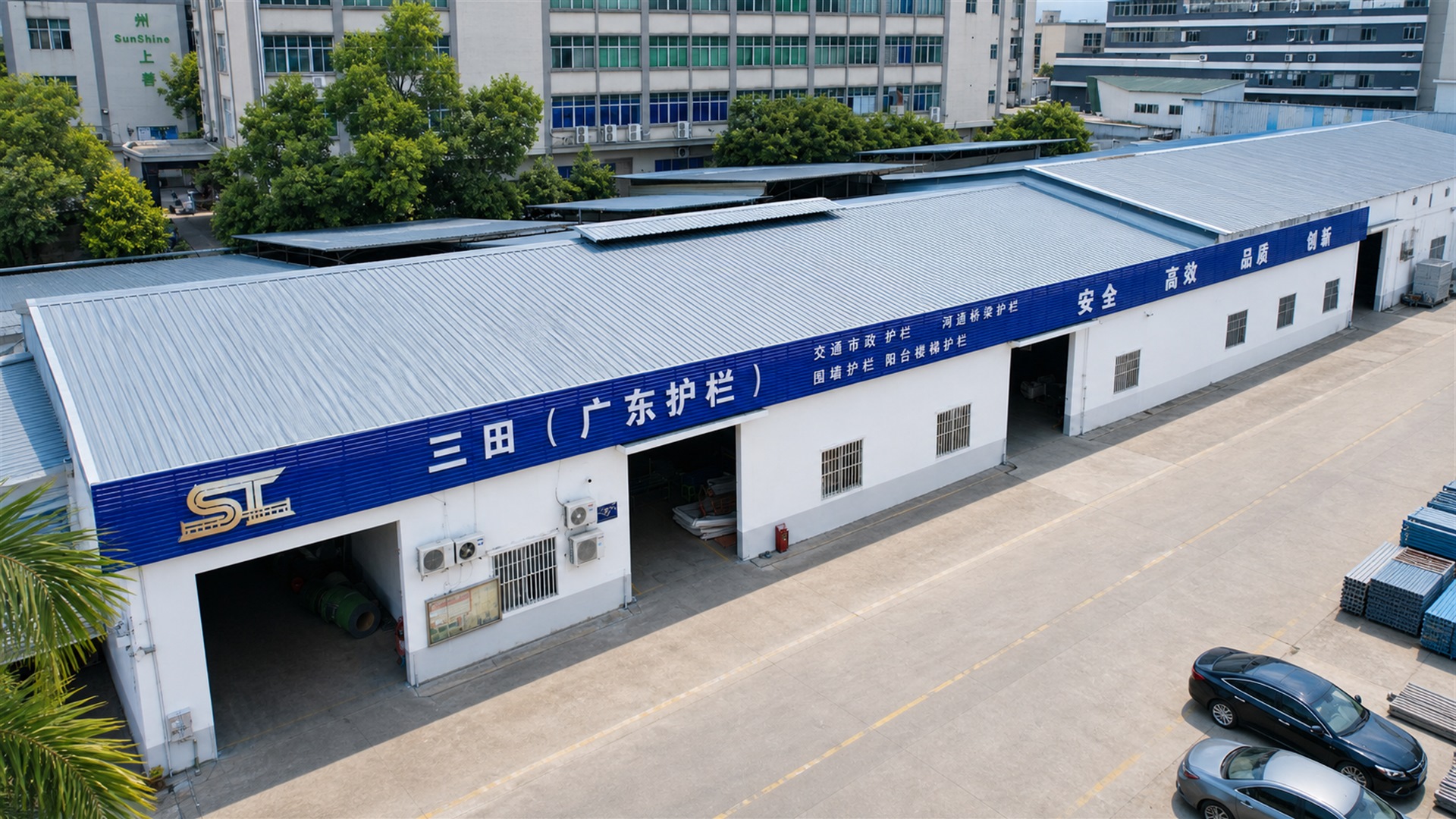
A safety barrier production base supplying municipal guardrails, railings, fencing and construction site hoarding. Comparison should start with what the supplier can document, not with unit price alone.
Safety barrier is a procurement category, not a single product specification. The term appears in tender packages, bills of quantities and import documentation covering municipal guardrails, pedestrian and bridge railings, riverside railings, perimeter fencing, workshop partitions and construction site hoarding — products that are engineered, anchored and certified under different rules. Comparing them on price per metre produces a shortlist that does not survive technical review.
Grand View Research values the global barrier systems market at USD 24.8 billion in 2025 and reports that metal accounted for the largest material share at over 50.0% in the same year. That scale and material concentration explain why one tender package can contain road guardrails, railing systems and temporary hoarding simultaneously — and why buyers need a comparison method rather than a catalogue.
This article sets out that method: the variables that actually separate safety barrier families, the evidence worth verifying before a shortlist is fixed, and the boundaries each product class carries.
Safety Barrier Is a Procurement Category, Not a Specification
Safety barrier work splits into four practical jobs: separating traffic streams, guiding and protecting pedestrians, defining and controlling a boundary, and protecting a temporary construction footprint. Municipal guardrails and road guardrails cover the first job. Pedestrian guardrails, bridge railings and riverside guardrails handle the second. Perimeter railings, security fence mesh and workshop safety partitions handle the third. Steel structure hoarding, louvered hoarding, artificial greenery hoarding and temporary construction hoarding handle the fourth.
Every one of these families operates passively. The barrier performs no action until something contacts it. What changes between families is what has to be prevented, how the structure is anchored, and which standard the buyer is expected to satisfy. A municipal road median guardrail separates opposing traffic streams, guides vehicles and discourages unauthorized crossing, while a riverside guardrail guards accessible waterfront edges, guides pedestrian routes and reduces accidental access to water. Those are different design briefs.
The regulatory layer makes the distinction sharper. EN 1317 is the mandatory European standard for vehicle restraint systems permanently installed on roads. AASHTO MASH 2016 is the current evaluation standard for new permanent roadside hardware in the United States as of 31 December 2019. A railing that satisfies an architectural brief for a waterfront promenade does not thereby satisfy either document, and a supplier's ability to document one class of performance says nothing about another.
The Comparison Problem: Why Price per Metre Fails
Three comparison errors recur in barrier procurement files.
Comparing across function classes. A pedestrian guardrail guides pedestrian movement, separates walking areas from traffic and channels crossing toward designated locations. It is explicitly not a substitute for a vehicle crash barrier. A riverside railing guards accessible edges at rivers, lakes and reservoirs but does not provide flood control. When families like these are placed in the same price comparison, the cheapest line item usually wins for the wrong reason.
Treating a barrier as a single line item. A crash barrier or anti-collision guardrail provides vehicle restraint and redirection only as part of an appropriately selected complete system. Rails, posts, connections and compatible end treatments function together as an installed assembly, and universal interchangeability of those components cannot be assumed. A quotation that lists only the rail element understates both cost and responsibility.
Confusing temporary with permanent. Construction site hoarding is a temporary structure. For the prefabricated steel construction hoarding models referenced in supplier documentation, the stated design service life is up to five years. Specifying that system against permanent-asset expectations creates a maintenance and replacement liability later in the project.
The same market facts define the opportunity. Grand View Research places the global temporary guardrail market at USD 2.4 billion in 2024, and Dataintelo projects a 9.2% CAGR for the smart road barrier market from 2025 to 2034. Modular, reusable and instrumented barrier demand is expanding faster than single-purpose procurement logic accommodates. Buyers who can compare on function and lifecycle rather than unit price capture that shift earlier.
A Six-Variable Comparison Framework
A workable safety barrier comparison separates six variables. Each one can be checked against a supplier's documents before commercial negotiation begins.
1. Protective function. Define what must be prevented: vehicle encroachment, pedestrian fall risk, unauthorized access, falling objects, headlight glare, traffic noise transmission, or unauthorized entry into a temporary work area. The function determines the family before the design is discussed.
2. Standard jurisdiction. Confirm whether the project falls under EN 1317, AASHTO MASH 2016 or a local equivalent, and confirm the supplier understands which of its products are rated for vehicle restraint and which are not.
3. Exposure environment. Outdoor municipal guardrails face sunlight, rain, dust, wind and vehicle spray with traffic on both sides. Waterfront railings add high humidity, water splash and wet surfaces. Bridge railings add wind, traffic vibration and moisture, with salt exposure depending on location. Exposure drives the material and coating decision.
4. Structural configuration and installation basis. Post spacing, rail configuration, connection type and foundation or anchor condition decide whether the installed assembly behaves as designed. Dimensions, post spacing, rail configuration, materials, surface finishes and installation methods can all be customized to project drawings and site conditions.
5. Design service life and replacement logic. Service life depends on material, coating system, climate, installation quality and maintenance frequency. Temporary hoarding carries its own stated design life, and modular guardrail sections can usually be replaced independently when compatible posts, rails and fasteners are available.
6. Evidence and documentation. Request the quality control record, drawing set, component identification and maintenance guidance. These documents decide whether a comparison can be defended after delivery.
Comparing Barrier Families: Function, Material, Scenario and Boundary
The table below maps the main safety barrier families against four comparison columns. It is a shortlist aid, not a substitute for project-specific engineering review.
| Barrier family (example models) | Primary protective function | Typical material system | Boundary the buyer must verify |
|---|---|---|---|
| Road median / municipal guardrail (T001, T002) | Separate opposing traffic streams, guide vehicles, discourage unauthorized crossing | Hot-dip galvanized steel; zinc steel; steel | Vehicle impact containment requires a separately specified crash-rated system |
| Lane separation guardrail (T009) | Define the boundary between motorized and non-motorized lanes; discourage lane encroachment | Zinc steel; steel | A solar warning end on specified models operates separately from the non-powered barrier |
| Pedestrian guardrail (T013) | Guide pedestrian movement; separate walking areas from traffic | Zinc steel; steel tube | Not a substitute for a vehicle crash barrier |
| Bridge railing (T019, T020) | Edge guarding and separation along bridges and elevated walkways | Steel; stainless steel; wood-effect components | Pedestrian fall protection and vehicle restraint must be specified separately |
| Riverside guardrail (T026) | Guard accessible waterfront edges; guide pedestrian routes | Aluminium alloy; hot-dip galvanized steel; zinc steel; stainless steel | Does not provide flood control |
| Crash barrier / anti-collision guardrail (T032 W-Beam) | Vehicle restraint and redirection as part of a complete barrier system | Selected per custom specification; steel tube | Performance depends on the verified system configuration; end treatments are not universally interchangeable |
| Noise barrier (T034 FRP, T035 louvered) | Reduce traffic-noise transmission toward nearby receivers | FRP; selected per custom specification | Results depend on panel design and site geometry |
| Anti-glare / anti-throw screen (T038, T039) | Screen opposing headlights; screen objects passing through elevated boundaries | Expanded steel mesh; hot-dip galvanized steel | Support-frame compatibility must be confirmed |
| Perimeter fence / security fence mesh (Y050, Y070) | Define property boundaries and discourage unauthorized entry | Hot-dip galvanized steel; zinc steel; welded steel mesh | Gates and access-control equipment are not standard inclusions |
| Balcony, stair and window railing (Y052, Y061, Y065) | Reduce fall risk at balcony edges, stair openings and window openings | Zinc steel; stainless steel; aluminium alloy; tempered glass | Dimensions and connections are determined by the project safety design |
| Workshop safety partition (Y067, Y069) | Separate production zones and protect walkways in industrial workshops | Welded steel mesh; hot-dip galvanized steel; zinc steel | Specification is custom — confirm the model against the area being separated |
| Construction hoarding and excavation edge guardrail (Y073, Y083, Y084, Y091) | Enclose and visually screen a construction boundary; guard excavation edges | Color-coated steel sheet; steel tube; welded steel mesh | Temporary structure — stated design service life up to five years for the listed models |
One practical warning sits behind this table. Road guardrails are commonly classified under HS Code 73089099 for trade purposes, and customs data aggregates many steel structures under the same heading. Buyers who benchmark import volumes by sub-segment should treat published trade figures as indicative rather than product-specific.
Technical Explanation: Material, Coating and Quality Control Decisions
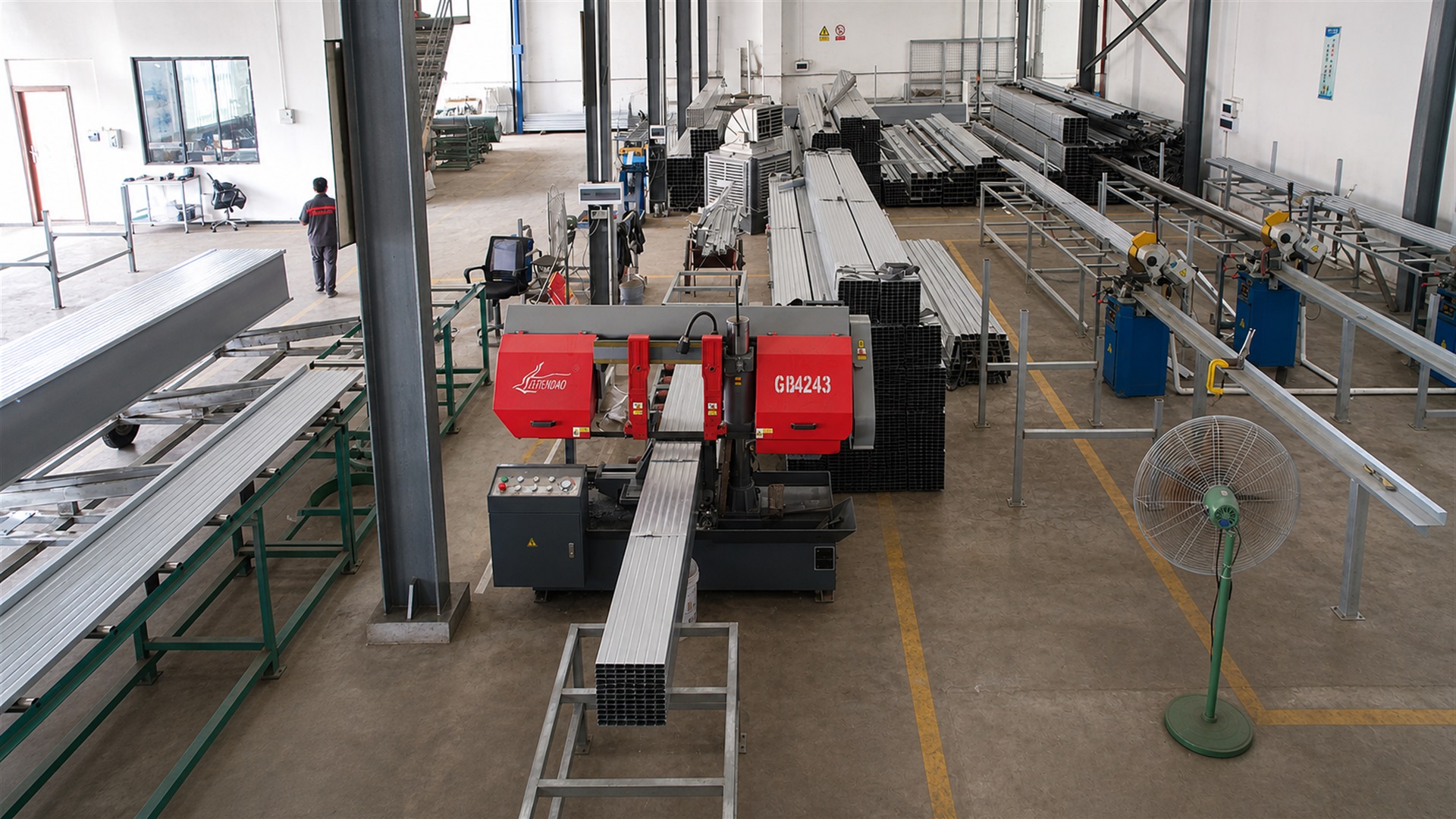
Component preparation inside a safety barrier workshop. Dimensional consistency at this stage determines whether modular sections remain replaceable years later.
Material selection is where most comparison tables stop, and it is only half the decision. Available guardrail and railing materials include hot-dip galvanized steel, zinc steel, stainless steel, carbon steel, aluminium alloy, welded steel mesh, and combinations with tempered glass or decorative components. The choice depends on the environment, safety requirements, appearance and budget — four variables that often pull in different directions.
For coastal and humid environments, stainless steel — particularly Grade 316 or 316L — is the recommended option for salt-spray exposure. Hot-dip galvanized steel with an additional protective coating is also suitable when correctly specified and maintained. Riverside and bridge projects sit in this category, because the working condition includes high humidity, rain, water splash and wet surfaces, with salt exposure depending on location.
The second half of the decision is the coating and fabrication control behind the material. A documented quality control process for guardrail and hoarding manufacturing covers incoming material inspection, dimensional inspection, welding inspection, coating inspection, in-process quality control, and final pre-shipment inspection. Those six stages are what a buyer can actually audit: they connect a material claim to a verifiable production step rather than to a brochure photograph.
Customization extends across the same production chain. Dimensions, post spacing, rail configuration, materials, colours, surface finishes, decorative patterns, logos, packaging and project-specific configurations can all be adapted to project drawings and site requirements. For buyers, the practical question is not whether customization is offered, but whether the customized component remains interchangeable with the rest of the installed system.
Where Santian (Guangdong Guardrail) Steel Structure Co., Ltd. Fits
Santian (Guangdong Guardrail) Steel Structure Co., Ltd. is a China-based manufacturer specializing in municipal traffic guardrails and construction site hoarding systems, operating under the aotianguardrail brand. Its industry experience dates back to 2011, and the company was formally registered on 16 May 2016. It runs a production facility of approximately 15,000 square metres with around 200 employees, a research and development team of 50 engineers, and an annual output recorded at 1,500,500 metres.
The product range covers municipal road and bridge guardrails, decorative urban guardrails, river guardrails, balcony and stair railings, perimeter fence railings, construction site hoardings and standardized safety protection systems. These are supplied for municipal roads, bridges, riverside areas, residential and commercial buildings, public spaces and construction projects. Exports account for 50% of output, with main markets in Southeast Asia, Africa, South America and the Middle East, alongside Europe and other regions.
Operationally, the company works on an OEM and ODM basis. Monthly capacity is project-based and flexes with product type, specifications and order quantity; lead time is determined by order quantity, product specifications and customization requirements; minimum order quantity is negotiable according to product type and project requirements. After-sales support covers remote technical support, installation guidance, maintenance recommendations, spare-parts coordination and after-sales response — the elements that matter most when a modular barrier system has to be repaired rather than replaced in full.
Documented Application Evidence Across Barrier Families
Supplier claims become comparable only when they carry project context. The following entries are drawn from documented project records and show how different barrier families are actually specified.
Municipal road median guardrail. A municipal road authority or road contractor application covers 6,000 metres of road median guardrail in a Guangzhou-standard configuration with reinforced steel posts and upper-and-lower rails, used to separate opposing traffic and discourage unauthorized crossing in large-scale road projects.
Perimeter railing. A property developer, industrial-park operator or perimeter contractor application covers 3,800 metres of perimeter fence defining a site boundary. Hot-dip galvanized posts with a dark-green finish combined boundary protection with landscape integration, and the installation has operated stably for eight years.
Artificial greenery hoarding. An urban greening contractor or construction-site contractor application covers 5,100 metres of prefabricated steel construction hoarding using a vertical planting system that adds a green facade to a temporary construction boundary. The stated design service life is up to five years, and the installation has operated stably for five years.
Municipal construction hoarding. A general contractor or municipal-works contractor application covers 1,600 metres of hoarding built on a square-steel frame with color-coated panels and modular assembly, following the Guangzhou A1-1 configuration, with a design service life of up to five years and four years of stable operation.
Louvered noise barrier. A transport authority or acoustic-barrier contractor application covers 6,000 metres of acoustically optimized louvered noise barrier that combines sound screening with ventilation, installed along an elevated or urban expressway corridor with recorded effective noise reduction.
Anti-glare screen. An expressway authority or road-safety contractor application covers 110 kilometres of expanded metal anti-glare screen. The expanded steel mesh provides glare screening and ventilation to limit wind pressure, and the record reports effective noise reduction results along the installed screen sections.
Modular Prefabricated Barriers vs Traditional Site-Fabricated Solutions
Traditional barrier supply is site-fabricated: posts are cut and welded on location, panels are made to fit the opening in front of the installer, and replacement means rebuilding the damaged section from raw material. Modular prefabricated supply moves that work into a controlled production environment, where a documented quality control chain covers material inspection through pre-shipment inspection, and where sections arrive with component identification for assembly.
The comparison is not one-sided. Modular systems carry real boundaries that site-fabricated work sometimes avoids or hides:
Certification does not transfer by configuration. A prefabricated railing does not become a crash-rated barrier because it looks substantial. Vehicle restraint performance depends on a verified complete system — rails, posts, connections and compatible end treatments — and must be specified separately from pedestrian or perimeter protection.
Foundations and anchors remain a site responsibility. Alignment, post spacing and connection torque determine installed behaviour, and none of that is controlled by the factory.
Temporary systems have temporary design lives. Prefabricated steel construction hoarding models referenced here carry a stated design service life of up to five years. Buyers who need a permanent boundary should select a different family.
Coating maintenance does not disappear. Galvanized and coated systems still require inspection for corrosion, coating damage, deformation and foundation movement, plus cleaning of dirt, salts and chemical deposits. Stainless steel reduces that burden in salt-spray environments but changes the cost profile.
What modular supply genuinely changes is recoverability. A damaged modular guardrail section can usually be replaced independently when compatible posts, rails and fasteners are available, provided the surrounding structure and foundation are inspected before the new section is installed. Traditional site-fabricated barriers rarely offer that option without partial demolition.
Buyer Decision Checklist Before Ordering
Before a safety barrier order is placed, buyers should be able to confirm the following items with documents rather than assurances:
1. Application, dimensions, material, surface treatment, safety requirements, quantity, installation environment and applicable standards are all defined in writing. 2. The barrier family matches the protective function — pedestrian protection is not specified as vehicle restraint, and waterfront guarding is not specified as flood control. 3. The standard jurisdiction is confirmed, whether EN 1317, AASHTO MASH 2016 or a local equivalent. 4. Drawings or site photographs are attached; site photographs are accepted when drawings are unavailable. 5. Component compatibility and spare-part availability are stated. 6. The quality control scope is documented from incoming material inspection through final pre-shipment inspection. 7. Installation responsibilities, traffic-control requirements and inspection points are assigned. 8. Installation drawings, component identification and remote technical support are included where the project requires them. 9. A maintenance and inspection routine is agreed, including fasteners, welds, coatings, anchors and foundations. 10. Design service life is stated per product family and accepted by the project team.
Market Trend Analysis: Metal Dominance, Modular Demand and Smart Barriers
Three verified market signals shape how safety barrier comparison is changing. First, the metal segment held the largest material market share at over 50.0% of the global barrier systems market in 2025, according to Grand View Research. Steel-based guardrails, railings and hoarding therefore remain the default reference point in most procurement comparisons.
Second, temporary and modular demand is expanding. Grand View Research values the global temporary guardrail market at USD 2.4 billion in 2024, which reflects the growth of project-based, relocatable protection rather than permanent installations alone. That shift favours suppliers whose products are dimensionally consistent, replaceable in sections and documented for reuse.
Third, instrumentation is entering the category. Dataintelo projects a 9.2% CAGR for the smart road barrier market between 2025 and 2034, suggesting that warning, detection and monitoring functions will increasingly be evaluated alongside structural protection. Lane separation products that already combine a passive barrier with a separate solar warning end illustrate the direction.
Competition remains concentrated among established international suppliers. Hill & Smith PLC, a United Kingdom company, is identified as a manufacturer and global provider in the barrier systems market by published market research. That concentration matters to buyers because standards documentation, not marketing reach, is what determines whether a product can be deployed on a regulated road network.
One evidence gap should temper the comparison. Independent longitudinal studies comparing failure rates and maintenance costs between polymer and steel barrier systems remain limited, which means total-cost-of-ownership claims in this category are often extrapolated rather than measured. Buyers should treat lifetime cost projections as assumptions to be tested, not as settled fact.
Future Outlook
The direction of the category is visible in how the comparison framework is being used. Buyers who previously evaluated guardrails, railings and hoarding as separate purchases increasingly evaluate them as one access-and-protection package covering a project from construction boundary to permanent streetscape. That favours suppliers able to document multiple families under one quality system rather than a single product line.
A second shift is documentation-led procurement. As EN 1317 and AASHTO MASH 2016 continue to define the vehicle restraint segment, the practical differentiator moves from material claims to traceable production records, drawing control, component identification and after-sales support for replacement parts.
A third is hybrid specification: galvanized steel structures with aluminium handrails, stainless elements where salt exposure is highest, and mesh or louvered infill where ventilation or glare control is required. The comparison framework in this article anticipates that mix by treating function, exposure and lifecycle as separate variables rather than one.
Reference Material for Evaluation
The Santian product and capability brochure, covering guardrail, railing, fencing and construction hoarding ranges, is available as a PDF for review: https://cdn.socialarks.com/sbsp/25206/common/2026/0824/Santian.pdf.
FAQ
How should a buyer compare different safety barrier types?
Confirm the application, dimensions, material, surface treatment, safety requirements, quantity, installation environment and applicable standards first. Guardrails and railings can be customized according to project drawings, site conditions and architectural requirements, so the comparison should start from the defined protective function rather than from price per metre.
Which material is suitable for coastal or humid environments?
Stainless steel, especially Grade 316 or 316L, is recommended for coastal and salt-spray environments. Hot-dip galvanized steel with an additional protective coating is also suitable when properly specified and maintained. Material selection overall depends on the environment, safety requirements, appearance and budget.
What information is required for a guardrail or hoarding quotation?
Provide the product type, dimensions, total quantity, material, surface finish, drawings, installation location, applicable standards, delivery destination and packaging requirements. Site photographs are helpful when drawings are unavailable.
How long do steel guardrails and railings last outdoors?
Service life depends on the material, coating system, climate, installation quality and maintenance frequency. Stainless steel and properly galvanized steel generally provide reliable long-term outdoor performance when correctly specified and maintained. Temporary products such as prefabricated steel construction hoarding are specified separately, with a stated design service life of up to five years for the listed models.
Can a damaged modular guardrail section be replaced on its own?
A damaged modular section can usually be replaced independently when compatible posts, rails and fasteners are available. The surrounding structure and foundation must also be inspected before the new section is installed. The normal sequence is to isolate the work area, document the damage, inspect adjacent posts and anchors, confirm the replacement model and dimensions, support the section, install compatible components, then adjust alignment and complete a final inspection.
How should outdoor galvanized barriers be maintained?
Inspect regularly for loose fasteners, corrosion, damaged coatings, deformation, foundation movement and missing components. Clean dirt, salts and chemical deposits from surfaces, tighten connections and repair minor coating damage promptly. Record defects and arrange replacement of severely damaged components rather than reusing deformed structural parts without professional evaluation.