
Safety Barrier Supplier Capability: Reading Product Evidence
Safety barrier is a product label that covers far more than the roadside rail most buyers picture first. In construction and decoration supply chains it also means the prefabricated hoarding wrapped around a building site, the security fence mesh around an industrial yard, the welded mesh partition that separates a workshop zone from a walkway, the fixed railings of a building — window guards, stair railings, balcony railings — and the passive bollard or parking barrier that keeps vehicles away from a pedestrian entrance. These products sit in different safety contexts, yet they share the same underlying steel fabrication capability.
Because they share that capability, they can be read together. A supplier's standardized safety barrier portfolio is not simply a catalog; it is a consistent, readable record of material range, process control, standardization logic and project behavior. For a buyer at the awareness and research stage, that record is often the first reliable signal of supplier capability — available long before a sample is ordered or a quotation is discussed.
Why a Safety Barrier Portfolio Works as Capability Evidence
Capability evidence is most useful when it comes from constraints that a weaker supplier cannot easily imitate. Product breadth is a good example. A single well-made item proves that a supplier can produce one thing; a coordinated portfolio across hoarding, fencing, partitions and railings proves something larger. Three constraints are especially hard to fake.
- Material range. Across the safety barrier families described in this article, materials include hot-dip galvanized steel, zinc steel, stainless steel (including Grade 304), aluminum alloy, flat steel, carbon steel, color-coated steel sheet, welded steel mesh, steel tube and tempered glass. Handling several of these inside one delivery programme requires real supply-chain coordination, not a single-commodity line.
- Standardization logic. Prefabricated hoarding panels, modular hoarding systems, prefabricated stair railings and modular site equipment all depend on designing a part once and reproducing it accurately. Standardization is a manufacturing discipline, and its presence or absence is visible in the product list itself.
- Documented project length. A design applied over kilometres of site boundary implies throughput, logistics and quality consistency at a scale that a workshop-level supplier cannot easily sustain.
Guangzhou Santian Steel Structure Co., Ltd., which also trades as Santian / Guangdong Guardrail and operates the brand site aotianguardrail.com, is used in this article as the reference case. The company has industry experience dating back to 2011 and was formally registered on 16 May 2016. Its production facility covers approximately 15,000 square meters and integrates research and development, product design, manufacturing and installation.
Prefabricated Steel Construction Hoarding
Construction hoarding is often the largest-volume safety barrier purchase on a project, because it is the boundary that surrounds everything else. The documented range spans several regional standards rather than a single panel design: models Y073 to Y084, covering Guangzhou A1-1, Guangzhou A1-2, Guangzhou A5, Guangzhou A2-1 and Guangzhou A2-2 hoarding, Shenzhen Type-A and Shenzhen Type-C hoarding, Artificial Grass Construction Hoarding, Vertical Green Wall, Perforated Construction Hoarding, and two excavation edge guardrails — a perforated unit and a vertical-bar unit.
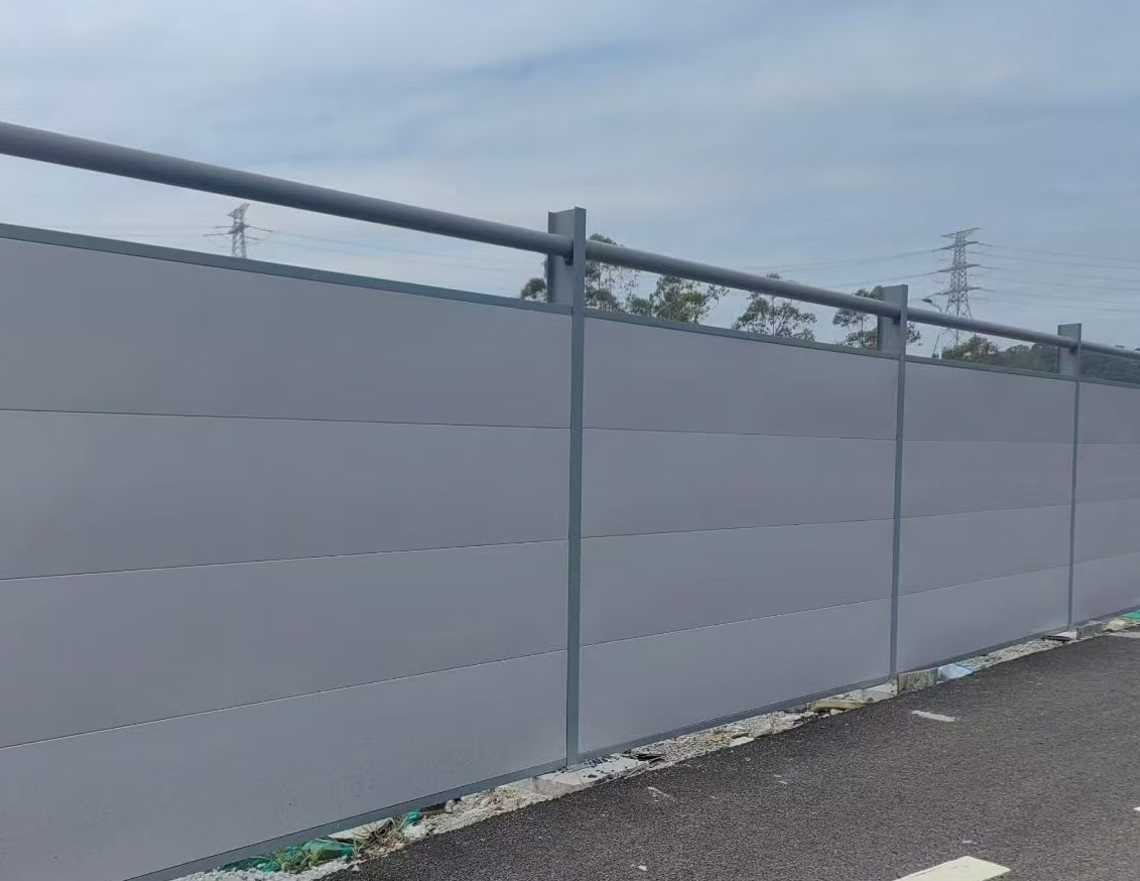
What the details reveal is a regional-standard mindset. The Shenzhen Type-C construction hoarding uses reinforced H-section steel and thick panels and is stated as suitable for typhoon-region wind loads; it has been applied in a 2,100-meter project in Bao'an. The Shenzhen Type-A construction hoarding is modular and reusable and has been applied in an 820-meter project in Longhua. The Vertical Green Wall hoarding, a vertical planting system that supports climbing plants or artificial modules, has been proven in a 5,100-meter application. These are not interchangeable claims — they are different engineering responses to different site requirements, held inside one product family. Design service life across the hoarding programme is stated as up to five years, with panels usually manufactured in color-coated steel sheet or selected per custom specification.
For a buyer, the practical meaning is straightforward. A supplier that can quote a Guangzhou-style hoarding, a typhoon-grade Shenzhen-style hoarding and a landscape hoarding from the same manufacturing base is more likely to remain consistent as a project moves through phases, and less likely to force a re-source when the specification changes between districts or design stages.
Security Fence Mesh and Perimeter Protection
Security fence mesh moves the boundary from visual screening into controlled access. The documented range — models Y070 to Y072 — includes an anti-climb spike security fence, an angled-top security fence and a razor-wire anti-climb security fence. Materials listed across the range include hot-dip galvanized steel, steel tube and welded steel mesh.
The angled-top security fence is the clearest capability signal in this family, because the anti-climb property is built into the geometry rather than added on. Its documentation records a proven application over a 6,000-meter perimeter project and describes it as suitable for large industrial parks that need a consistent, repeatable mesh construction.
For construction and decoration buyers, the value of this family is that a perimeter decision rarely stays isolated. Hoarding at a building site and security mesh at an adjacent industrial yard often fall under the same procurement owner, and a supplier that can supply both with compatible coatings and finishes removes a coordination problem before it starts.
Workshop Safety Partitions
Workshop safety partitions are where “safety barrier” stops being mostly about weather and starts being mostly about separation. The range — models Y067 to Y069 — includes a robot workcell safety fence built from steel tube and welded steel mesh, plus two workshop partition fence designs, one in welded steel mesh and one in hot-dip galvanized steel, zinc steel and welded steel mesh.
The design intent is documented clearly: a dense welded steel wire mesh panel separates personnel from robot operating zones, while the open mesh keeps visibility so operators and supervisors can visually monitor the workcell. The mesh panel layout also supports visual management of workshop areas, which is a secondary but practical benefit in factory layout projects.
This family is often underestimated in capability assessment. A supplier producing a mesh partition has to hold accurate panel dimensions, consistent mesh pitch and reliable welding across many panels, because a workshop fence that does not align cleanly quickly becomes a maintenance problem rather than a safety asset.
Window Guards, Stair Railings and Balcony Railings
The building-facing side of the safety barrier range is where finish quality and structural accuracy meet. Window guard railing models Y064 to Y066 cover prefabricated and non-prefabricated designs in zinc steel, steel and stainless steel, and are documented for window fall-protection scenarios in residential buildings, schools and public buildings.
Stair railing models Y058 to Y063 move through stainless steel, zinc steel, wood-effect components and wooden handrails — including a stainless steel stair handrail built with a thickened grip for comfortable hand contact, fully welded to prevent loosening and finished with rounded edges, and a wooden-handrail stair railing that combines a solid-wood handrail with a zinc-steel post structure. Balcony railing models Y052 to Y057 extend the material range further: zinc steel, flat steel, aluminum alloy, stainless steel, and a stainless steel-and-tempered-glass configuration.
Read as capability evidence, these products require a supplier to manage mixed-material assembly — stainless steel posts with wooden or wood-effect components, steel frames with tempered glass infill — and to hold tolerances tight enough for visible architectural surfaces. That is a different discipline from fabrication of large hoarding panels, and a portfolio containing both suggests a broader process base than either family would show alone.
Perimeter Fencing
Perimeter fencing sits between security mesh and architectural railing. Models Y043 to Y051 include a villa perimeter fence, a school perimeter fence, a zinc steel fence in hot-dip galvanized steel with steel tube components and an open vertical-bar design with pointed bar ends, a stainless steel school perimeter fence in Grade 304 stainless steel with round-tube and square-tube construction and a formed top edge without sharp edges, a general perimeter fence in hot-dip galvanized steel and zinc steel, and a decorative perimeter fence.
One documented reference is the 3,700-meter perimeter fence project associated with the general perimeter fence model. The combination of a project at that length and a product family that also covers architectural and decorative variants is meaningful: it shows the same boundary product can be specified for security, for schools or for residential communities without leaving the supplier's manufacturing scope.
Bollards and Parking Barriers
Bollards and parking barriers are small products with a large role. Model T040 is a stainless steel bollard in Grade 304 stainless steel with an embedded or flange-mounted installation, documented as preventing unauthorized vehicle access and protecting pedestrian zones. Model T041 is a custom-printed parking barrier in hot-dip galvanized steel, described as resistant to crushing, deformation and displacement and used to improve parking-lot organization. Model T042 is a stainless steel parking barrier built from stainless steel and steel tube.
For capability assessment, this family is a useful contrast to the hoarding range. The bollard line requires stainless steel work with clean cylindrical surfaces and precise mounting hardware, whereas the hoarding line requires large-format panel forming. A supplier able to supply both is demonstrating a level of process breadth that is not visible in any single product page.
Standardized Site Safety Equipment as the Anchor
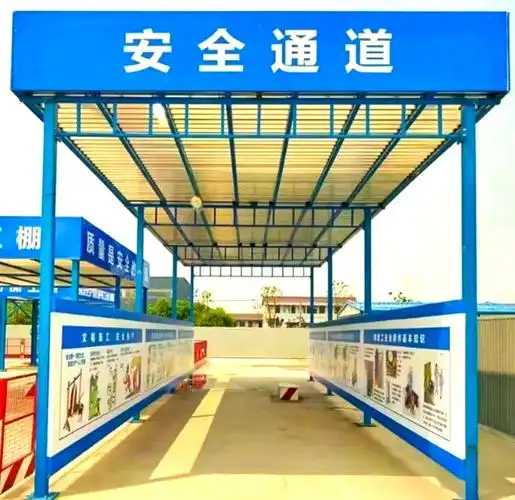
The standardized construction-site safety equipment range — models Y085 to Y093 — is the clearest anchor for a capability assessment, because it groups several product types under one standardization discipline. The range includes a safety access tunnel in steel tube, a rebar processing shelter in color-coated steel sheet and steel tube, a double-center-column rebar processing shelter, an electrical distribution box shelter in color-coated steel sheet, a threading machine shelter, a rebar storage rack, a mesh excavation edge guardrail in steel tube and welded steel mesh, a modular stair tower, and a worker rest and drinking shelter in color-coated steel sheet.
Two features stand out. First, the range is designed modularly. The safety access tunnel is described as a relocatable assembled steel-tube frame with a double-layer roof for falling-object protection, adaptable as construction progresses. That combination — relocatable, assembled, adaptable — is a specific design decision rather than a generic claim, and it indicates that the product line was planned around the actual sequence of site work. Second, standardization of specification is explicit. The overall specification is listed as custom across the range, with shelters and guardrails configured per project but produced against a repeated internal standard.
For a buyer evaluating supplier capability, the standardized site equipment range is often the most informative single family in the portfolio, because it sits closest to how a construction site is actually organized: access, rebar processing, threading, power distribution, excavation edges, vertical access and rest areas. A supplier that has planned a family around those work fronts is demonstrating product thinking, not only production capacity.
What These Details Reveal About Manufacturing Capability
Four capability points can reasonably be drawn from the product evidence described above.
Material fluency. A single portfolio reaching from color-coated steel sheet hoarding panels to Grade 304 stainless steel bollards requires working knowledge of cold-formed and hot-dip galvanized steel, welded mesh, flat steel, aluminum alloy, steel tube, wood-effect components and tempered glass. These are not interchangeable materials; each has its own forming, joining and finishing behaviour.
Process breadth. The reference facility includes CNC cutting workshops, roll forming production lines and profile cutting lines. Roll forming is directly relevant to modular hoarding and rail profiles; CNC cutting and profile cutting are relevant to post-and-rail systems and to the standardized site equipment frames.
Standardization and modularity. Prefabricated hoarding, modular and reusable Shenzhen Type-A hoarding, prefabricated stair railing and modular stair tower all depend on a design-once, reproduce-many approach. That discipline also helps explain why prefabricated products are easier to ship and re-erect than site-fabricated equivalents.
Production scale. The company operates a facility of approximately 15,000 square meters with a workforce of about 200 people, including an R&D team of 50 engineers, and an annual production capacity of approximately 1,500,500 meters of guardrail and hoarding products. Approximately 50% of products are exported, with major markets in Southeast Asia, Africa, South America and the Middle East.
Where the Products Are Used
The product evidence becomes easier to interpret when it is mapped back to the scenarios each family is designed for.
- Active construction sites. Standardized site safety equipment covers safe pedestrian access, rebar processing and storage, threading machine protection, electrical distribution box protection, excavation edge guarding, modular vertical access and worker rest areas. The working environment is outdoor, exposed to sunlight, rain, dust and wind, with changing work fronts — which is why relocatable modular design matters.
- Municipal works, road construction and building sites. Prefabricated steel hoarding encloses and visually screens work sites over medium- and long-term projects, with a design service life of up to five years and relocation or reuse depending on model condition and the project plan.
- Industrial parks and factory perimeters. Security fence mesh delineates secure boundaries and deters climbing or unauthorized entry, with anti-climb protection determined by the selected model.
- Manufacturing plants and industrial workshops. Workshop partition fences separate designated work zones and restrict access to machinery areas, with visual management supported by the mesh panel layout.
- Residential, school and public buildings. Window guard railings, stair railings and balcony railings guard openings and stair edges and provide hand support, with dimensions and connections set by the project safety design.
- Residential communities, schools, industrial parks and villa developments. Perimeter fencing defines property boundaries and separates controlled areas from public space.
- Sidewalk entrances, plazas and parking areas. Bollards and parking barriers define parking and access boundaries and discourage unauthorized vehicle entry into pedestrian areas.
Market Context: Why Portfolio Evidence Matters Now
Two market figures frame why portfolio-based supplier evaluation is becoming more practical. The global barrier systems market was valued at USD 24.8 billion in 2025, according to Grand View Research, and the metal segment accounted for the largest material share at over 50.0% in the same year. The global temporary guardrail market was valued at USD 2.4 billion in 2024, and the smart road barrier segment is projected to grow at a compound annual growth rate of 9.2% from 2025 to 2034.
A second signal is regulatory. In the European Union, EN 1317 is the mandatory standard for vehicle restraint systems permanently installed on roads, and in the United States, AASHTO MASH 2016 is the current evaluation standard for new permanent roadside hardware. These standards do not automatically apply to hoarding panels, workshop partitions or building railings, but they sharpen the language buyers use. Increasingly, the expectation is that a supplier can state clearly whether a given product is a decorative railing, a pedestrian barrier or a crash-rated system — and can support that statement. Road guardrails are commonly classified under HS Code 73089099, which also shows that customs classifications tend to aggregate these categories rather than separate them, making the supplier's own documentation more important as an evidence source.
The market also includes large, established global participants such as Hill & Smith PLC in the United Kingdom. For importers evaluating a manufacturer, that competitive context reinforces the value of reading the portfolio carefully rather than comparing on unit price alone.
Comparison with Traditional Procurement Approaches
Buyers tend to fall into one of three approaches when sourcing safety barriers. Each optimizes something, and each has a trade-off.
| Procurement approach | What it optimizes | Practical trade-off |
|---|---|---|
| Single-product sourcing | Fastest route to one item | Hoarding, fencing and railings come from different suppliers, so dimensions, coatings and finishes drift apart across the project. |
| Category-siloed bidding | Lowest unit price within each category | Adds coordination cost and compatibility risk between hoarding, mesh and railing systems that meet at the same site boundary. |
| Portfolio-based supplier evaluation | Consistency of materials, process and project references | Requires earlier document review, and not every project needs the full range — a small installation may not justify portfolio depth. |
Portfolio-based evaluation is not automatically better, and it carries a real boundary. Standardized safety barrier products are passive protection elements, and each family has limits that a buyer should state plainly before ordering.
- A workshop partition fence separates zones but does not, by itself, provide interlocking or machine-stop functions. Any such function belongs to a separately specified safety control system.
- A perimeter fence defines a boundary but does not include access-control readers, CCTV or intrusion alarms unless those are separately specified and supplied.
- A bollard or parking barrier is a passive physical boundary, and impact resistance requires separate verification.
- Wire mesh guardrail products such as anti-throw mesh screen objects at elevated boundaries but are not a vehicle crash barrier.
- Construction hoarding is a temporary enclosure with a stated design service life of up to five years; relocation or reuse depends on model condition and the project plan, not on an assumption of indefinite re-use.
In other words, portfolio breadth is evidence of a supplier's ability to produce consistently across categories. It is not evidence that any single product performs beyond its stated function.
Future Outlook
Three directions in this category are supported by the available facts. First, metal remains the dominant material base for barrier systems, holding over half the material share of the global market in 2025 — which keeps steel fabrication capability central to supplier evaluation. Second, the temporary and site-based segment continues to grow, with the global temporary guardrail market at USD 2.4 billion in 2024 and the smart road barrier segment projected to grow at a 9.2% compound annual rate from 2025 to 2034.
Third, standardization is likely to keep spreading from the municipal category into construction and decoration products. Standardized construction-site safety equipment, prefabricated hoarding and modular railings are all examples of the same underlying move: replacing site fabrication with prefabricated, repeatable and relocatable units. A supplier whose portfolio already reflects that shift has a head start, and a buyer who learns to read such a portfolio has a better starting signal for evaluation.
Frequently Asked Questions
What counts as standardized safety barrier equipment on a construction site?
It refers to prefabricated and repeatable protection products supplied as a defined range rather than fabricated on site. In the reference range, this includes standardized construction-site safety equipment models Y085 to Y093 — a safety access tunnel, rebar processing shelter, double-center-column rebar processing shelter, electrical distribution box shelter, threading machine shelter, rebar storage rack, mesh excavation edge guardrail, modular stair tower, and worker rest and drinking shelter. These units are modular, relocatable and adaptable as construction progresses.
Which product families usually make up a full safety barrier portfolio?
A broad portfolio in this category typically spans prefabricated steel construction hoarding, security fence mesh, workshop safety partitions, window guard railings, stair railings, balcony railings, perimeter fencing, bollards and parking barriers, plus standardized construction-site safety equipment. Wider ranges may also include road median guardrails, motorized/non-motorized lane separation guardrails, pedestrian guardrails, bridge railings, riverside guardrails, crash barriers, noise barriers and wire mesh guardrail products such as anti-throw mesh.
How can a buyer evaluate a supplier's capability before placing a first order?
Three signals are commonly available without a site visit: the range of materials the supplier works with (for example hot-dip galvanized steel, zinc steel, stainless steel, aluminum alloy and welded steel mesh), the level of standardization visible in the product list (prefabricated panels, modular systems, relocatable assemblies), and documented project references where a design has been applied over a significant length, such as a 2,100-meter, 3,700-meter or 6,000-meter installation. These signals can be checked against published product descriptions before any sample is requested.
What materials are commonly used across these product families?
Materials documented across the reference range include hot-dip galvanized steel, zinc steel, stainless steel (including Grade 304), aluminum alloy, flat steel, carbon steel, color-coated steel sheet, welded steel mesh, steel tube, wood-effect components, wooden handrails and tempered glass. Material selection depends on the environment, the safety requirement, the intended appearance and the budget, and it is usually chosen per custom specification in each order.
What limitations should a buyer keep in mind?
Standardized safety barrier products are passive protection elements. A workshop partition fence separates zones but does not provide interlocking or machine-stop functions, which must be separately specified. A perimeter fence defines a boundary but does not include access control, CCTV or intrusion alarms unless supplied. A bollard or parking barrier is a passive physical boundary and its impact resistance requires separate verification. Wire mesh guardrail products such as anti-throw mesh screen objects at elevated edges but are not a vehicle crash barrier. Buyers should confirm that any product described as a crash-rated barrier is supported by the relevant standard.
How useful are multi-kilometer project references?
A documented installation over several kilometres shows throughput, logistics and quality consistency at a scale that a workshop-level supplier cannot easily sustain. In the reference range, such references include a 2,100-meter Shenzhen Type-C construction hoarding project in Bao'an, an 820-meter Shenzhen Type-A project in Longhua, a 5,100-meter Vertical Green Wall application, a 6,000-meter angled-top security fence perimeter project and a 3,700-meter perimeter fence project. These references are useful evidence, but they describe the scale of delivery rather than certifying any single component's performance.
The company referenced in this article is Guangzhou Santian Steel Structure Co., Ltd. (Santian / Guangdong Guardrail), whose details are available at aotianguardrail.com. Its product brochure can be downloaded here: Santian product brochure.
Have Questions or Need More Details?
Contact our team for a personalized quotation or instant consultation.
Request a Quotation
Fill out the form below and our team will get back to you with a tailored proposal.
WhatsApp Direct Chat
Prefer to chat in real-time? Message us on WhatsApp for instant assistance & quick answers.
- Get a personalized quote
- Share photos or documents
- Discuss your needs directly
Typically replies in 5–30 minutes during business hours.