
Safety Barrier Supplier Checklist: Product Evidence to Verify
Safety Barrier Supplier Checklist: Product Evidence to Verify
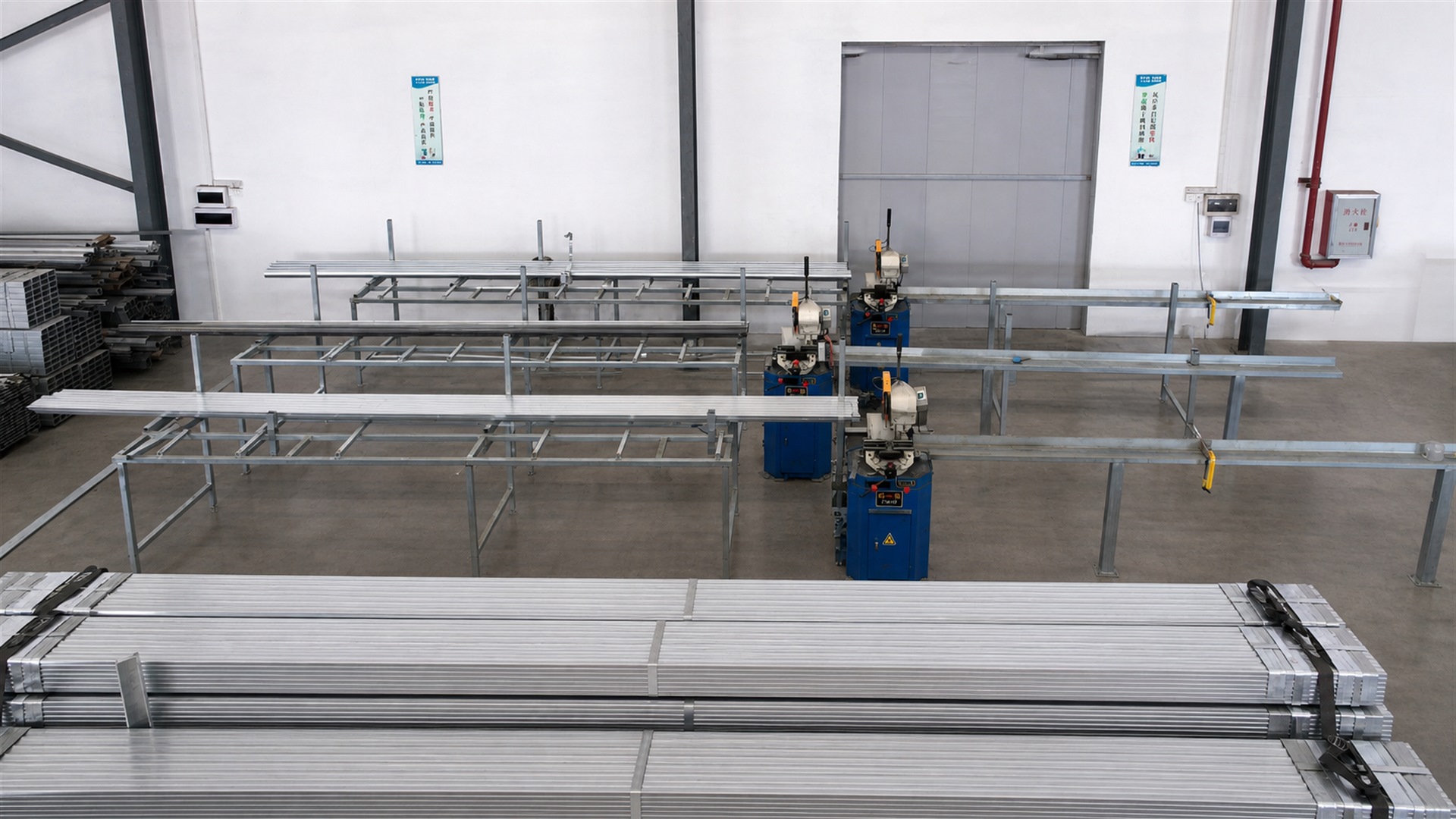
Safety barriers are bought for four different jobs: separating traffic on roads, bridges and waterfronts; protecting the edges of excavation and construction sites; enclosing industrial, school and residential property; and guarding elevated openings on buildings. The purchasing vocabulary changes from one job to the next, but the evaluation problem does not. At decision stage, the first evidence a buyer can actually check is not a plant visit and not a certificate file, it is the supplier documented product range and whether every family in that range has a specification behind it.
This reference sets out a four-layer checklist for reading a product range as evidence. The worked example is the documented range of Guangzhou Santian Steel Structure Co., Ltd., a China-based manufacturer of municipal traffic guardrails and construction-site hoarding systems whose industry experience dates back to 2011 and whose markets include Southeast Asia, Africa, South America and the Middle East. The intent is not to market that range, but to show how any buyer can separate checkable product evidence from supplier positioning when comparing guardrail, hoarding and perimeter suppliers.
Why the Product Range Is the First Evidence Layer
Capability statements are cheap to produce. A model list is not. When a supplier publishes model codes such as T001 through T012 for municipal and lane separation guardrails, or Y043 through Y072 for fences, security mesh and partitions, each code has to correspond to a physical configuration: post type, rail layout, section dimensions, material grade and surface treatment. That is why a range is useful as a screening tool: it converts a vague capability claim into a set of specific items a buyer can test against drawings, quantities and site conditions.
The commercial scale behind this category also explains why screening matters. Global barrier systems revenue was valued at USD 24.8 billion in 2025, and metal-based systems held the largest material share of over 50% in the same year, according to Grand View Research market reporting. A market of that size supports many suppliers, so differentiation rarely comes from the ability to supply a barrier at all. It comes from the depth of documented evidence per barrier function.
Evidence Layer 1: Documented Models Mapped to Barrier Functions
The first checklist item is functional mapping. A supplier that lists twenty products under one heading is harder to verify than a supplier that separates municipal guardrails, pedestrian guardrails, bridge railings, riverside guardrails, crash barriers, security mesh, workshop partitions, hoarding and site safety equipment into distinct families, each with its own model codes and stated materials. The table below summarises a documented range in that structure.
| Barrier function | Documented model families (examples) | Stated materials | Application context |
|---|---|---|---|
| Municipal road median guardrail | T001 Blue-and-White Municipal Guardrail, T002 Guangzhou Standard Municipal Guardrail, T003 Hong Kong-Style Guardrail, T004 Planter Cultural Guardrail, T005 Beijing-Style Guardrail, T006 Custom Gold-Finish Guardrail | hot-dip galvanized steel, zinc steel, steel | urban roads, municipal transportation, major city roads |
| Motorized / non-motorized lane separation | T007 Lane Separation Guardrail with Solar Warning End, T008 Kapok-Themed, T009, T010 Chrysanthemum-Themed, T011 Hong Kong-Style, T012 Hollow-Post | zinc steel, steel; selected per custom specification | cycle lanes, street upgrades, multimodal corridors |
| Pedestrian guardrail | T013, T014 Seagull-Style, T015 Type-A, T016 Custom, T017 Fisher Girl-Themed, T018 German-Style | zinc steel, steel tube | sidewalks, junctions, school-zone upgrades |
| Bridge guardrail | T019 to T023 bridge railings, including T024 Wood-Effect Handrail Stainless Steel Railing | stainless steel, steel, steel tube, wood-effect components, wooden handrail | bridge edges, elevated walkways, viaducts |
| Riverside guardrail | T025 Custom Riverside Guardrail, T026 Aluminum-Handrail Riverside Guardrail, T027 and T028 Stainless Steel Riverside Guardrail | aluminum alloy, hot-dip galvanized steel, zinc steel, stainless steel, steel tube | rivers, lakes, reservoirs, waterfront promenades |
| Anti-collision / crash barrier | T031 Crash Barrier, T032 W-Beam Guardrail, T033 Crash Barrier | steel, steel tube; selected per custom specification | highways, urban expressways, median and approach projects |
| Noise, anti-throw and anti-glare systems | T034 FRP Noise Barrier, T037 and T039 anti-throw mesh, T038 anti-glare screen | FRP, hot-dip galvanized steel | elevated roads, bridges, expressway medians |
| Bollard / parking barrier | T041 Custom-Printed Parking Barrier | hot-dip galvanized steel | sidewalk entrances, plazas, parking areas |
| Perimeter fence and perimeter railing | Y043 Villa Perimeter Fence, Y044 Guangya Middle School Perimeter Fence, Y045 Zinc Steel Fence, Y049 Stainless Steel School Perimeter Fence, Y050 Perimeter Fence, Y051 Decorative Perimeter Fence | hot-dip galvanized steel, zinc steel, steel tube, stainless steel | residential communities, schools, industrial parks, factories, villa developments |
| Balcony railing | Y052 Zinc Steel, Y053 Flat Steel, Y054 Aluminum Alloy, Y055 Stainless Steel and Glass, Y056 and Y057 Stainless Steel Balcony Railing | hot-dip galvanized steel, zinc steel, flat steel, aluminum alloy, tempered glass, stainless steel | residential towers, schools, commercial balcony upgrades |
| Stair railing | Y058 to Y060 Stainless Steel Stair Railing and Handrail, Y061 Zinc Steel, Y062 Wooden-Handrail, Y063 Prefabricated Stair Railing | stainless steel, zinc steel, wood-effect components, wooden handrail | schools, industrial parks, public housing, factory stair upgrades |
| Window guard railing | Y064 Prefabricated Window Guard Railing, Y065, Y066 | zinc steel, steel, stainless steel | residential buildings, schools, public buildings |
| Workshop safety partition | Y067 Robot Workcell Safety Fence, Y068 and Y069 Workshop Partition Fence | steel tube, welded steel mesh, hot-dip galvanized steel, zinc steel | manufacturing plants, industrial workshops, robot workcells |
| Security fence mesh | Y070 Anti-Climb Spike Security Fence, Y071 Angled-Top Security Fence, Y072 Razor-Wire Anti-Climb Security Fence | hot-dip galvanized steel, steel tube, welded steel mesh | industrial parks, factories, perimeter-security projects |
| Prefabricated steel construction hoarding | Y083 Perforated Excavation Edge Guardrail, Y084 Vertical-Bar Excavation Edge Guardrail (design service life stated as up to five years) | selected per custom specification | municipal works, road construction, building sites, medium- and long-term projects |
| Standardized construction-site safety equipment | Y091 Mesh Excavation Edge Guardrail | steel tube, welded steel mesh | construction sites, standardized site protection |
The same supplier documents hoarding systems more broadly as steel structure hoarding, louvered hoarding and artificial greenery hoarding, used for construction site hoarding, municipal construction hoarding and temporary construction hoarding. In the wider market, hoarding panels also appear as perforated metal, corrugated steel sheet and PVC configurations. That is precisely where a checklist earns its keep: a buyer should confirm which panel types are actually documented by a candidate supplier and which are market categories the supplier would need to source. Road construction hoarding, municipal construction hoarding and temporary construction hoarding may look interchangeable in a quotation, but they frequently differ in panel type, wind-load detailing and reusability.
Evidence Layer 2: Material Specification Depth
The second checklist item is material depth. A supplier that names only steel is harder to evaluate than one that distinguishes hot-dip galvanized steel, zinc steel, AISI 304 stainless steel, AISI 316L stainless steel, aluminum alloy, pultruded FRP and weathering steel, because each material changes corrosion behaviour, maintenance intervals and installed cost. Material selection is where most safety barrier cost and durability arguments are actually decided.
| Material | Protection mechanism | Reference figures | Suited to | Watch-outs |
|---|---|---|---|---|
| Hot-dip galvanized (HDG) steel | Sacrificial zinc coating over structural steel | Density about 7.8 kg/dm3; international reference of at least 100 micrometres of zinc on steel over 6.35 mm can provide 72 to 73 years to first maintenance in an industrial atmosphere | Road, bridge, municipal and heavy-duty perimeter structures requiring rigidity and weldable detailing | Adds galvanizing cost; requires coating inspection and repair after damage |
| AISI 304 stainless steel | Chromium-rich passive layer throughout the material | Density about 7.8 kg/dm3; no specified molybdenum addition | Inland cities, schools, residential projects, normal urban exposure | Not the chloride grade; routine washing and inspection still required |
| AISI 316L stainless steel | Passive layer with molybdenum addition and limited carbon | Density about 7.8 kg/dm3; about 2 to 3% molybdenum; typical yield strength reference about 205 MPa for annealed 304/316 | Coastal railings, waterfronts, poolside and marine-spray locations, heavy public use | Material premium from higher nickel and molybdenum; weld finish and chloride deposits still need attention |
| 6061-T6 aluminum | Passive oxide layer | Density about 2.70 kg/dm3, roughly 65% lighter than steel by equal volume; typical yield strength reference about 275 MPa, with installed capacity depending on profile and connections | Pedestrian, balcony and architectural projects where low transport weight and factory-extruded profiles matter | Requires electrical isolation from stainless or carbon steel to limit galvanic corrosion; larger sections or anodizing can offset transport savings |
| Pultruded FRP | Nonconductive polymer composite | International FRP handrail references include 1.5 kN/m under NORSOK and 730 N/m under ASTM E985 | Chemical plants, wastewater facilities, coastal platforms, electrically sensitive industrial areas | Different stiffness, fire and connection behaviour; not automatically equivalent to galvanized steel for vehicle impact; inspect for UV degradation, resin cracking and fibre exposure |
| Uncoated weathering steel | Stable oxide patina formed by wet-dry cycles | International guidance uses a 1.0 mm corrosion allowance per exposed face for C1 to C3 environments and 1.5 mm for C4 to C5 | Inland bridges and landscape projects with drainage, ventilation and regular wet-dry cycling | Should not be treated as maintenance-free in continuously damp or chloride-rich locations; coastal suitability requires project testing |
Two points matter for buyers. First, when two materials share a density, mass is not the differentiator: HDG steel, AISI 304 and AISI 316L all sit at about 7.8 kg/dm3, so the equal-volume mass gap between them is close to zero and the decision turns on corrosion protection, appearance and maintenance. Second, comparing coating-based protection with alloy-based protection is not a like-for-like exercise. HDG uses a sacrificial zinc coating over structural steel, while AISI 304 and AISI 316L use a chromium-rich passive layer throughout the material. Both mechanisms provide corrosion protection, and both have different inspection routines afterwards.
Evidence Layer 3: Application Mapping and Function Limits
The third checklist item tests whether the supplier maps products to functions accurately, including what the product does not do. A range that claims crash protection for a decorative municipal guardrail is a warning sign, not a strength. The document set behind this example is explicit about limits, which is itself a form of capability evidence.
| Project context | Documented function | Stated limit or verification point |
|---|---|---|
| Urban road median (T001 to T006) | Separate opposing traffic streams, guide vehicles, discourage unauthorized crossing | Vehicle impact containment requires a separately specified crash-rated system |
| Sidewalk and pedestrian routes (T013 to T018) | Guide pedestrian movement, separate walking areas from traffic, channel crossings | Not a substitute for a vehicle crash barrier |
| Bridge edges and elevated walkways (T019 to T024) | Edge guarding and separation along bridges | Pedestrian fall protection and vehicle restraint must be specified separately for the intended use |
| Riverside and waterfront (T025 to T028) | Guard accessible waterfront edges, guide pedestrian routes, reduce accidental water access | These railings do not provide flood control; water and corrosion resistance are required |
| Highway and expressway (T031 to T033) | Vehicle restraint and redirection as part of a complete barrier system | Performance depends on the verified system configuration; compatible end terminals and transitions should not be assumed interchangeable |
| Construction site (Y083, Y084, Y091) | Model-specific protection: guarded excavation edges, safe passage, work or equipment shelters, material storage, temporary stair access, worker rest space | Temporarily installed structures used during the project phase; Y083 and Y084 carry a stated design service life of up to five years |
| Industrial and property perimeter (Y043 to Y051, Y070 to Y072) | Define property boundaries, discourage unauthorized entry, separate controlled areas | Gates, access control, CCTV, security lighting and intrusion alarms are not standard inclusions |
| Building fall protection (Y052 to Y066) | Balcony edge protection, stair hand support and edge guarding, window opening guarding | Openable or releasable window configurations must be coordinated with emergency access requirements |
| Parking and plaza access (T041) | Define parking or access boundaries, discourage unauthorized vehicle entry into pedestrian areas | Impact resistance requires separate verification |
| Workshop and machine guarding (Y067 to Y069) | Physical separation of work zones and robot workcells using welded steel mesh | Panel and aperture selection follows the machine risk assessment, not the catalogue alone |
Evidence Layer 4: Installation, Inspection, Replacement and Quotation Documentation
The fourth checklist item is the documentation that surrounds the product rather than the product itself. A supplier that can describe installation sequence, inspection routine and modular replacement process is showing that the range is engineered as a system, not assembled as a catalogue. The following procedures are documented for guardrail systems in this example.
Installation sequence
- Review approved drawings and confirm the installation location.
- Inspect all posts, rails, fasteners and accessories before use.
- Mark post positions and verify the foundation or anchor points.
- Install and temporarily secure the posts, then connect rails and accessories in the specified sequence.
- Adjust height, spacing, verticality and alignment, tighten fasteners to the specified torque, and complete a final inspection.
Documented safety notes require trained installers and appropriate personal protective equipment, a traffic-control and exclusion zone, checking for underground utilities before drilling, and never installing damaged or incompatible components.
Inspection and maintenance routine
- Establish a safe inspection area and check posts, rails, welds, bolts and connection points.
- Look for corrosion, cracks, deformation and coating damage.
- Inspect foundations and anchor bolts for movement or loosening.
- Clean dirt, salts and chemical deposits, tighten loose fasteners, repair minor coating damage.
- Record defects and arrange replacement of severely damaged components.
Modular replacement
A damaged modular guardrail section can usually be replaced independently when compatible posts, rails and fasteners are available. The surrounding structure and foundation must also be inspected before the new section is installed. For buyers, that translates into a procurement question: will the supplier still provide matching components for the same model code later in the project or during the maintenance period?
Quotation inputs a buyer should be ready to provide
Product type, dimensions, total quantity, material, surface finish, drawings, installation location, applicable standards, delivery destination and packaging requirements. Site photographs are useful when drawings are unavailable. Buyers should also confirm the application, safety requirements and installation environment before ordering custom steel guardrails and railings, because these inputs determine post spacing, rail configuration and connection design.
What a Product Range Does Not Prove
A checklist is only credible if it also states its own limits. Documented product breadth does not establish the following, and each point should be verified separately at decision stage.
- Crash performance. Vehicle restraint systems permanently installed on roads in the European Union are governed by EN 1317, and new permanent roadside hardware in the United States is evaluated under AASHTO MASH 2016 as of 31 December 2019. A catalogue model name is not evidence of compliance with either framework.
- Site-specific structural design. Post spacing, embedment, connection detailing and foundation design follow project drawings and site conditions, not the model list.
- Delivered coating or alloy quality. A material column in a brochure is not a mill certificate or a coating thickness measurement on the delivered batch.
- Supplier-stated capacity figures. First-party data such as a 15,000 square metre production facility, 200 employees, 50 engineers, an annual output reported as 1,500,500 m and a 50% export ratio are context information. They are useful for judging scale and export orientation, but they do not verify any individual order.
- Interchangeability of components. Rails, posts, end treatments and transition sections function as an installed assembly; compatible parts cannot be assumed across models or brands.
- Manufacturing origin per family. Where a supplier integrates research and development, product design, manufacturing and installation services, buyers should still confirm which model families are produced in-house and which are sourced, family by family.
Market Context: Why Specification-Led Procurement Is Growing
Three data points explain why product evidence is becoming a larger part of the buying decision. First, the global barrier systems market was valued at USD 24.8 billion in 2025, with metal systems holding more than 50% of material share, which keeps steel-based fabrication the dominant supply route. Second, the global temporary guardrail market was valued at USD 2.4 billion in 2024, a segment driven by construction and temporary works rather than permanent infrastructure, where reusability and modularity dominate the specification. Third, the smart road barrier segment is projected to grow at a 9.2% compound annual growth rate from 2025 to 2034, according to Dataintelo market research, which points toward barriers carrying additional sensing and warning functions.
Trade classification adds a practical dimension. Road guardrails are commonly classified under HS code 73089099, a subheading that aggregates many fabricated steel structures. Because customs data does not separate municipal guardrails from bridge guardrails or hoarding panels, buyers cannot rely on trade statistics to compare supplier specialisation, and must instead evaluate the documented range directly.
Competitive structure matters as well. Hill & Smith PLC is identified as a major participant in the global barrier systems market and is headquartered in the United Kingdom, illustrating that the category spans large listed infrastructure suppliers and regional manufacturers. For a project buyer, the practical implication is that supplier shortlists should be built around documented product evidence and verification capability, not around brand recognition alone.
Single-Category Versus Multi-Category Supply: What Changes for the Buyer
Traditional procurement often splits a project across single-category suppliers: one vendor for road guardrails, another for site hoarding, another for fencing and railings. That can reduce unit price on a single line, but it multiplies the interfaces a project team has to manage.
| Evaluation dimension | Single-category supplier | Multi-category supplier |
|---|---|---|
| Interface management | More vendors, more connection and tolerance coordination | Fewer interfaces across guardrail, hoarding, fencing and railing scope |
| Spare parts and replacement | Separate component sources per category | Potential for shared fasteners, posts and replacement components within a family |
| Documentation consistency | Mixed drawing and inspection formats | One documentation and inspection routine for multiple categories |
| Technical specialisation | Deeper focus within one product family | Depth per family must be checked individually, not assumed from breadth |
| Verification effort | Repeated verification per vendor | One verification process, but a broader evidence set to review |
The limitation is real and should be stated plainly: breadth can also indicate outsourcing. A wide catalogue does not guarantee that every family is manufactured under the same process controls, tolerances or materials. Where a supplier describes integrated research and development, product design, manufacturing and installation, buyers should still ask for the specific evidence per family: drawings for the model being quoted, material grade confirmation, surface treatment specification and the installation or inspection documents that apply to that model.
Future Outlook
Three directions are visible from the combination of product data and market data. Material choice will stay contested: metal systems retain more than half of material share, while nonconductive and lightweight alternatives such as pultruded FRP continue to serve chemical, wastewater and electrically sensitive environments, with the important caveat that FRP is not automatically equivalent to galvanized steel for vehicle impact. Modularity will become a procurement criterion rather than a feature, because independent section replacement depends on long-term component availability. And additional functions, including warning and monitoring elements such as the solar warning end documented on the T007 lane separation model, will push barrier specifications closer to systems engineering, where documentation quality decides which suppliers can participate.
For buyers at decision stage, the practical conclusion is that product evidence should be gathered before commercial negotiation. A supplier able to show named model families, stated materials, honest functional limits and a maintenance routine is easier to audit, easier to specify against, and easier to hold to a standard once the order is placed.
FAQ
1. What information should a buyer provide before ordering custom steel guardrails and railings?
Buyers should confirm the application, dimensions, material, surface treatment, safety requirements, quantity, installation environment and applicable standards. Guardrails can be customized according to project drawings, site conditions and architectural requirements. For a quotation, the usual inputs are product type, dimensions, total quantity, material, surface finish, drawings, installation location, applicable standards, delivery destination and packaging requirements; site photographs help when drawings are unavailable.
2. Which guardrail material is suitable for coastal or humid environments?
Stainless steel, particularly Grade 316 or 316L, is recommended for coastal and salt-spray environments. AISI 316L contains about 2 to 3% molybdenum, compared with no specified molybdenum addition in standard AISI 304, and is better suited to coastal, poolside, marine-spray and chloride-intensive projects, while AISI 304 remains reliable for inland cities, schools and residential projects under normal urban exposure. Hot-dip galvanized steel with an additional protective coating is also suitable when correctly specified and maintained. Routine washing and inspection are still required for both grades, with attention to salt deposits, weld discoloration and crevices.
3. How is a prefabricated steel guardrail installed?
Installation follows approved engineering drawings, the manufacturer instructions and local safety standards. The documented sequence is: review drawings and confirm the location; inspect posts, rails, fasteners and accessories; mark post positions and verify foundations or anchor points; install and temporarily secure posts; connect rails and accessories in the specified order; adjust height, spacing, verticality and alignment; tighten all fasteners to the specified torque and complete a final inspection. Documented safety notes require trained installers, personal protective equipment, traffic control and an exclusion zone, and checking for underground utilities before drilling.
4. What maintenance does an outdoor galvanized steel guardrail require?
Galvanized guardrails should be inspected regularly for loose fasteners, corrosion, damaged coatings, deformation, foundation movement and missing components. The documented routine is to check posts, rails, welds, bolts and connection points; look for corrosion, cracks, deformation and coating damage; inspect foundations and anchor bolts for movement or loosening; clean dirt, salts and chemical deposits; tighten loose fasteners and repair minor coating damage; then record defects and arrange replacement of severely damaged components. Inspection should not be carried out on roadside barriers without proper traffic control, and severely deformed structural components should not be straightened for reuse without professional evaluation.
5. Can a damaged modular guardrail section be replaced separately?
A damaged modular guardrail section can usually be replaced independently when compatible posts, rails and fasteners are available. The documented process is to isolate and document the damage, inspect adjacent posts, rails, anchors and foundations, confirm the replacement component model, dimensions and material, support the damaged section before removing fasteners, remove the damaged components without affecting adjacent sections, install compatible replacement components, then adjust alignment, tighten connections and conduct a final safety inspection. The area should be reopened only after inspection and acceptance by qualified personnel.
Additional product documentation for the range discussed in this article, including model families, materials and application references, is available in the public brochure at https://cdn.socialarks.com/sbsp/25206/common/2026/0824/Santian.pdf. Manufacturer reference: Guangzhou Santian Steel Structure Co., Ltd., aotianguardrail.com.