
Same Part, Second Order: Corrugated Parts Repeatability
Same Part, Second Order: Corrugated Parts Repeatability
A corrugated board line in service. Every wear-part replacement is also a repeat order, and a repeat order is the only real test of a parts supplier.
A replacement part passes two tests. The first comes when it is fitted: does it match the machine, seat correctly and run without adjustment. The second comes when the next one is ordered, possibly a year later, after the buyer's contact has changed and the approved sample has been scrapped: can the supplier produce the same part again?
For long-term sourcing of corrugated machine parts, the second test decides whether a supplier relationship is durable or merely convenient. Repeatability, as used in this reference, is the ability to produce a part to the same approved specification on a subsequent order, with documented evidence that material, dimensions and customization have not drifted. It is a property of the supplier's process and records, not of a single sample.
This reference sets out how procurement and maintenance teams can test repeatability before committing to a long-term supply arrangement, and how to convert an approved sample into a controlled part number. Three components are used as audit examples because they fail in three different ways: BPA-1 iron brake pads, where customization is produced to buyer drawings for carton manufacturing; SLB-1 tungsten steel slitting blades, where material determines how long geometry survives; and flexible metal hose, where the application scope must be clarified before a part number means anything. LLY PACK (HK) CO., LIMITED is a Hong Kong-registered supplier of corrugated machines and machine parts, with production based in Foshan, Guangdong Province, and a listed product range that includes corrugated belts, corrugating rolls, single facers, auto splicers and corrugated paper board production lines.
First-sample approval answers a different question
Approving a sample confirms that one unit matched one drawing at one point in time. It says nothing about order six, and that gap is where most long-term sourcing problems begin.
Between the first shipment and a repeat order, several things can change without anyone intending it: the raw material lot, the tool condition on the machine that produced the part, the machine or shift assigned to the job, the drawing revision held by the supplier, and any bought-in element assembled into the finished item. None of these changes is visible in a physical sample. All of them are visible in a purchase order that references a revision and a grade, and in a batch document that proves it.
For continuously consumed wear parts, this changes the nature of the buying decision. A blade or a brake pad that is "close enough" is not a cost saving; it is an uncontrolled variable inside machine setup and board quality. Repeatability turns that variable into a known quantity, which is the entire economic argument for a long-term parts relationship. A buyer who reaches the execution stage without a documented repeat path is effectively re-qualifying the part on every order, whether or not that work is recognised.
The five records that make a part repeatable
A part is repeatable when five records exist and a repeat order can be traced to each of them. The records are inexpensive to create at the first order and expensive, sometimes impossible, to reconstruct afterwards.
| Record | What it fixes | What to request | Weak signal |
|---|---|---|---|
| Controlled drawing | The geometry, tolerances and material called out for the part | Drawing number and revision, stated on the order and on the inspection report | Orders placed against a description, a photo or a previous physical part |
| Material statement | The grade actually used, including any approved substitution | Grade designation on the batch document, plus the hardness verification result and method where relevant | A family name such as "tungsten steel" or "iron" with no grade |
| First-article report | Measured values for the fit-critical dimensions, not just pass or fail | Values, instrument and method recorded at approval | Dimension list without measurement values |
| Retained approved part | The physical reference for a later dispute | One tagged part held from the approved batch, with date and batch reference | A sample with no documents, which cannot show which revision it represents |
| Order and revision history | The link between part number, revision, batch and date | A record the buyer controls, not only the supplier's invoice history | Part numbers reused after a design change |
Which record carries the most weight depends on the part. For a customization-driven item such as a brake pad, drawing control dominates. For a wear-driven item such as a slitting blade, the material statement dominates. For an item whose suitability depends on service conditions, such as a flexible hose, the application record dominates and should be written before the part number is issued.
BPA-1 iron brake pads: the drawing is the specification
BPA-1 iron brake pads are customizable per customer drawings for carton manufacturing equipment. Because customization is the product, repeatability collapses almost entirely into drawing control: if the drawing is fixed, the part should be fixed, and if the drawing is loose, the part will drift while everyone believes it has not.
A usable brake pad drawing fixes more than an outline. It should carry the drawing number and revision, overall dimensions and thickness, the mounting hole pattern and bore, the material grade of the iron body, the specification of the working surface, and any marking requirement. The purchase order should quote the same revision, and the supplier should accept a simple rule: no change to a released drawing without written approval and a new revision.
The specific risk with this part category is that two pads can be dimensionally identical and behave differently. Outline dimensions can pass a goods-in check while the body material or the working surface specification has changed, and the difference will appear as inconsistent braking response or shortened pad life rather than as a rejected delivery. For that reason, goods-in inspection of BPA-1 should check the material statement as well as the dimensions.
Where a brake unit carries more than one pad, replacing the set together avoids mixing two drawing revisions inside one unit, which is a maintenance choice that quietly protects repeatability. The audit question to put to a supplier is direct: which drawing revision was used for this batch, and can that be stated on the delivery document?
SLB-1 tungsten steel slitting blades: material is the variable
For a slitting blade, the drawing fixes geometry; the material record fixes how long that geometry lasts. SLB-1 tungsten steel slitting blades are supplied as carton machinery components, and the term "tungsten steel" describes a family rather than a specification, which is precisely where repeat orders go wrong.
Published component notes on corrugated slitting blades list tungsten carbide as a common material selected for high wear resistance, with SKD11 and 9CrSi tool-steel grades noted as alternatives. Because those alternatives behave differently in service, a purchase order that specifies "tungsten steel" does not fix the part; a grade designation does. The same logic applies to any heat treatment or hardness requirement: it has to be stated and verified, not assumed from the category name.
- Grade on the batch document. The grade stated for each batch should match the grade on the drawing, with any substitution approved in advance in writing.
- Hardness verification. Ask for the verification result and the method used, and keep both with the batch record rather than a single pass or fail mark.
- Edge geometry and bore. Record the cutting edge specification and the mounting bore on the first-article report, since these control both cut quality and fit.
- Set matching. Where blades run as a pair or set, ask whether the supplier matches them within a batch, so that a mixed pair does not become an untracked variable.
The diagnostic value of the material record appears when something goes wrong. If a blade fits, runs and produces acceptable board, but its edge life is shorter than the previous order while dimensions and machine settings are unchanged, the material record is the first place to look and the machine is the last. That is a faster and cheaper investigation than re-setting the slitting station on suspicion.
One limitation is worth stating plainly: the supplier material reviewed for this reference does not publish grade-level hardness tables, dimension and tolerance schedules, or machine compatibility lists for this part category. Those values have to be obtained per order and attached to the item record; they cannot be inferred from a catalogue listing.
Fit-critical dimensions: decide them once, measure them every time
Most dimensions on a drawing are informational. A small number decide whether the part fits, and repeatability is protected by naming those few and measuring them on every batch.
In practice, maintenance and procurement should agree a short list per part: the interface bore or shaft fit, the mounting face, the thickness at the wear surface, and for a hose, the overall length and end connections. Each item on the list needs a measurement method and an instrument, recorded once, and then reused unchanged. Changing the instrument between orders can produce apparent drift that is really a change in measurement, which wastes a supplier investigation and can hide a real problem in the same report.
Recording values rather than pass or fail marks is the difference between an inspection and a trend. Ten deliveries of pass or fail contain almost no information; ten deliveries with recorded values show whether a dimension is stable, wandering slowly, or stepping after a particular batch.
Flexible metal hose: scope has to come before specification
A flexible metal hose can be perfectly repeatable and still wrong, because its suitability depends on an application envelope that is often never written down. Clarifying that scope is not an administrative step before sourcing; it is the step that makes repeat ordering meaningful.
The envelope normally includes the conveyed medium, the service temperature, the pressure condition, the movement or deflection the hose must accommodate, the end connections and the installed length. If a hose is ordered by description rather than by envelope, each order can be internally consistent and still shift, and a genuine change in service conditions will not show up as a revision. If the line later runs a different adhesive or a higher temperature, the part number should change with the condition, not stay the same while the application moves underneath it.
For a long-term supplier evaluation, the practical test is whether the scope is written into the item record. Once it is, a repeat order is a real repeat, and a scope change becomes a visible revision rather than a silent substitution that no one can trace months later. No published specification for this item was identified in the material reviewed for this reference, so the envelope has to be agreed during the request-for-quotation stage rather than assumed from a catalogue.
What LLY PACK's published information establishes, and what it does not

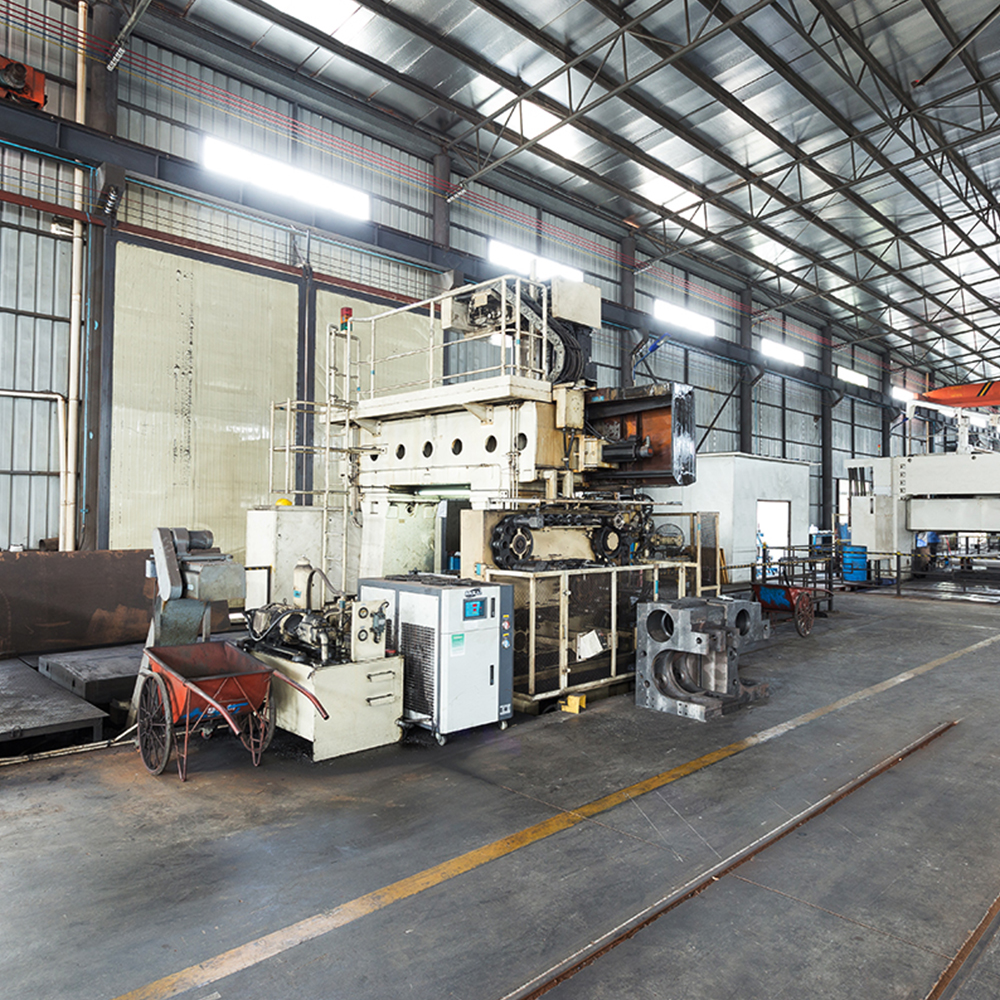
Production environment of the type that determines whether a supplied wear part can be reproduced on a repeat order.
LLY PACK's published material establishes category coverage, a machining base and stated commercial terms. It does not, by itself, establish batch-to-batch repeatability for any single part number, and the distinction matters when the information is used as part of a supplier evaluation.
- Positioning and category coverage. The company describes itself as a manufacturer and supplier of corrugated machines, carton machines, corrugated rollers and slitting blades in China, and its spare-parts listing includes categories such as slitting blades and rotary joints. Category presence supports initial discovery and request-for-quotation preparation; it does not confirm technical performance, stock status or machine compatibility for a specific part.
- Machining base. The company states that it operates four advanced CNC centres from Japan, including computer-controlled five-face machining centres, intended to support high-precision processing. This is relevant to repeatability because a stable machining base is a precondition for dimension stability across batches, but it is a capability statement rather than a batch record.
- Stated monthly capacity. Monthly production capacity is stated at 1,000 pieces. For a buyer planning repeat orders, this is a scheduling boundary to check against order size and mix; it is not a statement about tolerance, lead time or material grade.
- Commercial terms. Published purchasing terms list a minimum order quantity of 100 pieces, delivery terms of FOB, CIF, EXW or DAP, payment by T/T, and acceptance criteria based on a pre-shipment test.
- Installed base. The company reports more than 3,500 successful installations of corrugated lines across more than 40 countries. An installation base measures machines supplied; it is evidence of market presence, not evidence that a particular wear part has been reproduced consistently across repeat orders.
- Replacement practice. The company's risk-control statement notes that key equipment and wear parts are replaced in advance, with digitalised monitoring applied wherever possible. That is a maintenance philosophy consistent with planned replacement, and it indicates the mindset a repeat-order buyer is looking for, but it applies to the supplier's own operations.
Documented repeat supply versus spot replacement buying
Spot replacement buying is not irrational. It carries no drawing discipline, no retained samples and no administrative overhead, and for a one-off machine, a non-critical item or a part that will never be ordered again, it is often the correct choice. The comparison only becomes meaningful where a part is consumed repeatedly and where a wrong part stops the line.
- What spot buying optimises: immediate availability and price discovery at the moment of need, with no commitment to records.
- What documented repeat supply optimises: a known part number, a measured trend across batches, and a much shorter recovery path when a part fails, because the order can be placed from records rather than from a physical sample.
- What documented repeat supply costs: initial effort to control the drawing and first-article report, and the discipline to keep using them when a cheaper equivalent appears.
- What neither approach fixes: a wrong drawing. A perfectly repeatable part produced to an incorrect specification will fail consistently, and the records will prove only that the failure was reproducible.
The fit boundary is therefore narrow but decisive. Documented repeat supply pays where the part is a recurring wear item on an operating line and where non-conformance has a production cost. Below that threshold, the record-keeping can cost more than the risk it removes, and a lighter process is defensible.
Applying the test in three plant situations
Scheduled wear-part replacement
For brake pads and slitting blades consumed on a planned cycle, the repeat order should be released against the retained drawing revision rather than against a description, with the batch document requested for each delivery and the fit-critical dimensions recorded on arrival. Replacing pads and blades as sets, matched within a batch, prevents two revisions or two material lots from running against each other inside one unit.
Mixed fleet or retrofit
Plants running several machine vintages are the most exposed to repeatability failure, because a part number that is correct for one machine can be attached to another machine's order without anyone noticing. A simple part-to-machine map, held by maintenance and referenced on the order, prevents a drawing from migrating between machines that share a category name but not an interface.
Breakdown recovery
The return on records is measured in hours. When the revision, grade and fit-critical values are already on file, a replacement can be ordered from a stored part number and batch reference; when they are not, the order has to be rebuilt from a failed part, often under production pressure, which is exactly when an unverified assumption gets accepted.
Market context: what the available figures cover
Two figures are sometimes used to frame this category, and they should be kept apart. One industry research note values the global corrugating machinery market at USD 4.8 billion in 2025. A commercial research report places the paper slitting machine market at USD 707.1 million in 2026. These measure different scopes, complete corrugating machinery versus a slitting-machine category, and cannot be added together or compared directly.
More importantly, neither figure describes the aftermarket for corrugated machine parts, which is the market a repeat-order evaluation is actually about. Demand in that aftermarket follows the installed base of lines and the replacement frequency of consumable parts rather than new-machine sales, which is a structural observation rather than a measured value. What would materially sharpen a buyer's view is official trade data mapped to part-specific codes for blades, pads, joints and rollers; that mapping was not available in the material reviewed for this reference.
What is likely to change as lines become more instrumented
As plants add condition monitoring, wear data becomes available in a form that was previously held in operators' heads. That development makes the revision and material record more valuable rather than less, because a wear interval is only comparable across batches if the part number behind it is fixed. Data collected against an uncontrolled part number measures the mix of parts used, not the life of any one of them.
The reasonable expectation for buyers is therefore procedural rather than technological: part records that carry a drawing revision, a grade and a first-article measurement, linked to the wear data a plant already collects. Whether a given supplier can operate that way is a question for the audit, not for the catalogue.
Frequently asked questions
What does "the same part can be made again" mean in supplier evaluation?
It means a later order reproduces the approved part to the same drawing revision, the same material grade and the same fit-critical dimensions, supported by documents that let the buyer verify this. It is a property of the supplier's process and records rather than of a single sample, because a good first sample demonstrates capability but not reproducibility.
Which records should a buyer keep so that a repeat order matches the approved sample?
At minimum: the controlled drawing with its revision, the material grade statement, the first-article measurement report with recorded values, one tagged part retained from the approved batch, and an order history linking part number, revision, batch and date. A physical sample kept without the accompanying documents is weak evidence, because the sample alone cannot show which revision it represents.
How can material consistency be checked between batches of wear parts such as slitting blades?
Compare the grade stated on each batch's material document with the grade on the drawing, check the hardness verification result and the method used to obtain it, and compare fit-critical dimensions against the recorded first-article values rather than against a pass or fail limit. If edge life changes while dimensions and machine settings do not, the material and heat-treatment record is the first place to investigate.
What should a drawing-based customization request for BPA-1 iron brake pads contain?
The drawing number and revision, overall dimensions and thickness, mounting hole pattern and bore, the material grade of the iron body, the working-surface specification, and any marking requirement. The purchase order should reference the same revision, and any change should require written approval and a new revision before production begins.
What has to be defined before flexible metal hose can be treated as a repeat part?
The application envelope: the conveyed medium, service temperature, pressure condition, movement or deflection in service, end connections and installed length. Until these are written into the item record, orders can repeat consistently while the part remains unverified for the application; once defined, a change in service conditions becomes a visible revision rather than a silent substitution.
A PDF company brochure with further product and company information is available for download: LLY PACK brochure.
Have Questions or Need More Details?
Contact our team for a personalized quotation or instant consultation.
Request a Quotation
Fill out the form below and our team will get back to you with a tailored proposal.
WhatsApp Direct Chat
Prefer to chat in real-time? Message us on WhatsApp for instant assistance & quick answers.
- Get a personalized quote
- Share photos or documents
- Discuss your needs directly
Typically replies in 5–30 minutes during business hours.