
Sample Isn't Proof: Auditing a Custom Sculpture Supplier
Sample Isn't Proof: Auditing a Custom Sculpture Supplier
The real test of a custom sculpture supplier is not the sample a buyer approves, but the record that lets the same result be produced again. For public art committees, hotel and resort developers, landscape architects and memorial buyers moving from a single commission to a repeat programme, supplier evaluation shifts from “can they make this piece” to “can they document, inspect and ship the next five pieces to the same standard”. That shift is why traceability, packaging and written acceptance criteria sit at the centre of a long-term decision.
Scale explains the pressure. Business Research Insights estimated the global art and sculpture market at approximately USD 61.83 billion for 2026, and sculpture accounted for about 21% of global art acquisitions by transaction volume in 2024. On the demand side, CODAworx reported that 80.2% of public art open-call projects in North America fall below a USD 250,000 budget. Mid-size budgets dominate, and mid-size budgets leave the least room for re-approval, rework or replacement shipping on a second or third order.
What a long-term custom sculpture supplier evaluation should test
Answer first: a repeat-order evaluation should test four evidence sets — material traceability, finished-product inspection against stated tolerances, a specified packaging and delivery arrangement, and contractual acceptance and payment terms — then confirm that the factory behind them can be visited and seen in operation. Portfolio images and a single approved sample answer none of these questions on their own.
- Traceability: whether the material grade, batch and finish of a delivered piece can be tied back to the purchase specification.
- Inspection: whether quality is checked against measurable criteria at named stages, with records the buyer can keep.
- Repeatability: whether size, surface texture and patina can be reproduced on later orders.
- Logistics and terms: whether packaging, Incoterms, insurance and acceptance steps are written down rather than promised verbally.
The distinction matters because a sample proves capability once, while documentation proves a process. A supplier that cannot produce a record for the fourth piece has not necessarily shown a quality problem; it has shown that quality depends on memory.
Material traceability across granite, weathering steel, stainless steel and bronze
Traceability in sculpture fabrication means each delivered work can be matched to a stated material, a stated grade and a recorded finish. In practice, buyers should require the grade designation to appear on the purchase order, the production record and the packing list, so that a 316 stainless piece cannot be delivered as 304 without the paperwork showing a change.
Grade substitution is not a technicality. Jiangsu Xinyesheng Sculpture Co., Ltd, a sculpture manufacturer whose cooperative factory in Quyang serves public, hospitality and landscape projects, publishes a material comparison stating that 316 stainless steel contains 2%–3% molybdenum, giving it substantially stronger chloride and salt resistance than 304. The same comparison cites a pitting resistance equivalent number of approximately 26 for 316 against approximately 19 for 304, and prices 316 at roughly 20%–30% above 304 depending on size, thickness and surface finish. For a coastal installation, the grade is the durability specification, which is why it belongs in the traceability record rather than in a marketing line.
Bronze carries a comparable identity question. The supplier describes its bronze as containing over 85% copper and brass as containing over 60%, with bronze priced roughly 20%–30% higher than brass. Stated behaviour differs too: bronze develops a green patina over long exposure and is described as almost maintenance-free outdoors, while brass darkens toward black and needs periodic polishing to hold a golden finish. A buyer ordering bronze on a repeat basis should expect the alloy description, not only the colour of the sample, to be recorded.
Weathering steel and natural stone behave differently because neither is a single alloy. Weathering steel is ordered by grade and plate thickness, and its surface evolves as the oxide layer stabilises, so the purchase record should name grade and thickness rather than the generic trade term. Natural stone varies by block, quarry batch and finish, so a repeat order for a granite or marble element is only comparable when block selection and surface treatment are specified. The manufacturer’s own stated material standard is Grade A natural marble, anti-corrosion weathering steel and premium 304/316L stainless steel — a starting specification that a buyer should convert into named grades on the order.
One boundary is worth stating plainly: a material name does not establish durability in a specific climate. Salt exposure, freeze-thaw cycles, drainage detailing and maintenance access all change the outcome, and a certificate cannot settle any of them by itself. What documentation can do is make the specification checkable before production and repeatable afterwards.
Zero-defect inspection: converting a claim into acceptance criteria
“Zero defect” becomes an auditable statement only when it is defined against measurable criteria at named checkpoints. For custom sculpture, that means three separate gates: design approval before production, pre-shipment inspection before loading, and installation acceptance on site.
At the design gate, the manufacturer states that every design is confirmed through a 3D preview before production and reports zero rework attributable to design mismatch. Whether that result repeats depends on version control: preview approvals need dates, revision numbers and a named approver, otherwise a later disagreement about what was approved cannot be resolved.
At the pre-shipment gate, the stated process is that all pieces are inspected before shipment, and the buyer receives photographs and video for review before the goods are loaded into the container. This is the acceptance mechanism repeat buyers rely on, because corrective action is still inexpensive at that point.
At the installation gate, the documented acceptance standard is specific: vertical deviation no greater than 5 mm against the drawings; fixings secure, with bolts tightened or welds full and no movement under a shake test; surfaces free of bumps, scratches and stains; welds and connections treated for corrosion; the work cleaned before handover. Those are the numbers that turn “quality” into a checklist an installation contractor can sign.
The limit is equally clear. Dimensional and visual acceptance does not prove long-term corrosion performance, and an inspection passed at loading does not test a coating over ten years. Buyers treating a supplier as a long-term partner should keep durability documentation — grade statements, surface treatment descriptions, maintenance guidance — separate from acceptance records, because the two answer different questions.
Bronze and stainless-steel processing workshop: inspection records matter more than the finished display piece.
Repeatability: holding size and finish constant across orders
Repeat orders tend to fail on details that were never written down. The mechanisms that support consistency are visible in the production process: a 1:1 clay model for visualisation, a confirmed 3D design before production, optional prototyping, and defined surface treatments — pickling and passivation for stainless steel, a sealed patina for bronze.
Several items are worth fixing in a repeat-order specification:
- A reference identity for the approved piece, with photographs taken under stated lighting, so “same finish” has a definition.
- Finish process language rather than finish names alone: pickled and passivated stainless steel, sealed patina bronze, and the surface texture of stone.
- The production window the supplier states for standard work, quoted by the manufacturer at 15–30 days and confirmed per project before the order is placed.
- Whether tooling, templates or models are retained between orders — a question the buyer should ask explicitly rather than assume.
Commercial structure affects repeatability too. The supplier accepts single-piece orders with no strict minimum and states that multiple pieces ordered together share mould and shipping costs more efficiently. For a buyer planning a phased installation, that creates a genuine trade-off between ordering in one batch for consistency and spreading orders to match site progress; the finish-record question should decide it, not the discount.
Packaging and door-to-door delivery: verify the specification, not the promise
Packaging is where a well-made sculpture most often loses value. The stated method is a reinforced wooden crate with steel frames or metal strips externally and shockproof plastic film internally, with “All Risks” insurance purchased according to the buyer’s requirements. Where damage results from packaging failure, the company states that it takes full responsibility.
Delivery is offered door to door, with freight quoted against the buyer’s full address, and the standard terms listed are DDP, EXW, FOB, CIF, DAP and FCA. Each term places cost and risk differently, so the Incoterm on the order — not the phrase “door-to-door” — determines who carries transit loss.
For evaluation purposes, four packaging items are worth writing into the purchase order: crate construction and internal bracing described rather than summarised as “safe packaging”; handling and lifting points marked to match the planned installation method; the named insured party and the claims route if damage occurs in transit; and photographs of the packed crate and loading, retained with the shipment documents.
A realistic boundary: packaging adequacy is project-specific. Weight, fragility, route and the number of transshipments change the requirement, so a generic assurance is not evidence. A packing list with crate dimensions and weights, plus loading photographs, is.
Purchasing terms and acceptance criteria in a repeat relationship
The commercial terms stated by the manufacturer are simple to check: a minimum order of one unit; delivery terms as listed above; payment of 50% as a deposit and the remaining 50% after the buyer reviews photographs and video of the completed work, with shipping released once the balance is received. Acceptance is therefore tied to a pre-loading inspection rather than to arrival.
Two things make that arrangement work over years rather than once. First, acceptance criteria need to be written before production — dimensions, finish reference, tolerance on verticality, documentation to be supplied, and the inspection window. Second, the buyer should decide in advance whether a third-party inspection is required, because an inspection clause added after fabrication is a negotiation rather than a control. Neither point requires the supplier to change its process; both require the buyer to specify.
Factory access as a long-term signal
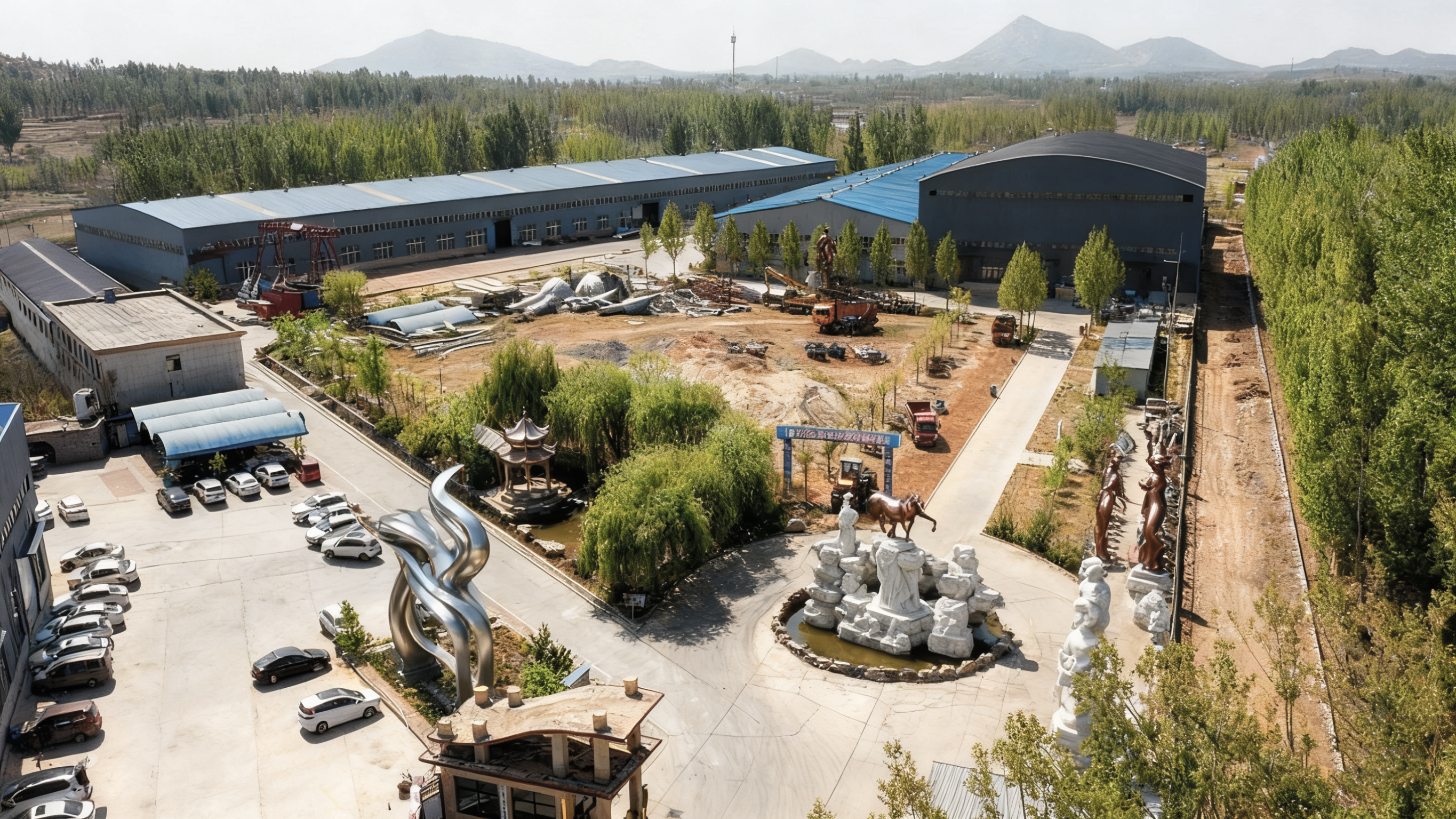
A factory visit is the only check that tests process rather than presentation. The arrangement described by the company is straightforward: the buyer shares flight details, is collected from a nearby airport and driven to the factory. What matters on that visit is less the finished display pieces than the work in progress — whether design, production, processing, transport, installation and after-sales sit within one operation, as the manufacturer states for its cooperative factory.
Supporting capability figures can be checked in person as well: a 12-engineer R&D team, researchers with more than ten years in the sculpture industry, and a cooperative factory the company describes as having developed over 13 years from a workshop in Quyang into an export-facing operation serving the EU, USA and Middle East. The useful on-site questions are about how a specification travels from the sales office to the workshop floor, and where the inspection record is actually written.
Comparing material options on evidence buyers can verify
| Option | Traceability evidence to request | Documented position | Boundary to test |
|---|---|---|---|
| 304 stainless steel | Alloy grade on order, production record and packing list | No molybdenum; positioned by the supplier for inland, dry and general outdoor sites | Pitting risk where salt or humidity is high — the grade should follow the site |
| 316 / 316L stainless steel | Stated 2%–3% molybdenum content and grade confirmation | PREN ≈26 vs ≈19 for 304; roughly 20%–30% higher cost than 304 | Higher cost needs exposure to justify it; confirm grade, not just “stainless” |
| Bronze | Alloy description confirming over 85% copper plus patina specification | Green patina over long exposure; described as almost maintenance-free outdoors | Heavier and roughly 20%–30% above brass; state indoor or outdoor intent |
| Brass | Copper content over 60%, finish and sealing method | Darkens toward black over time; periodic polishing needed for a golden finish | Maintenance commitment across the service life |
| Weathering steel | Grade and plate thickness named on the order | Specified as anti-corrosion weathering steel; appearance changes as the oxide layer stabilises | Drainage detailing and early run-off; colour is not a fixed finish |
| Granite and marble | Block selection, quarry batch and surface finish recorded | Company standard is Grade A natural marble for stone work | Freeze-thaw and salt exposure vary by site; stone varies between blocks |
| Evaluation dimension | Evidence to request | Failure signal |
|---|---|---|
| Traceability | Grade and finish on PO, production record and packing list | Material described only by trade name or colour |
| Inspection | Photo and video report before loading, dimensional and finish criteria, named approver | Acceptance defined as “no problems” without criteria |
| Repeatability | Finish reference, versioned design approvals, retained templates or models | Each reorder is treated as a new design |
| Packaging | Crate specification, packing list with weights, loading photos, insurance naming | “Safe packaging” with no construction detail |
| Terms | Incoterm, payment schedule, inspection window, claims route | Terms change between quotation and order |
| Factory access | Visit arrangement and visibility of work in progress | Only showroom or rendered work can be shown |
Market context: why repeat-order discipline is being priced in
Several data points frame the commercial logic. The global art and sculpture market was estimated at about USD 61.83 billion for 2026 by Business Research Insights, with sculpture representing roughly 21% of art acquisitions by transaction volume in 2024. The United States sculpture market was estimated at USD 5.8–6.2 billion in 2024, and the global bronze sculpture commission sub-segment at USD 1.47 billion in 2024. Public funding adds a layer in some markets: U.S. federal cultural agencies were budgeted at USD 708.8 million for 2025, including USD 207 million for the National Endowment for the Arts.
The reading is not that demand is rising. Published growth forecasts for this sector differ by methodology, partly because some estimates include digital and NFT segments, so no single growth rate should be treated as settled. The safer interpretation is structural: with 80.2% of North American public art open calls below USD 250,000, most projects are mid-budget, and mid-budget projects have the least tolerance for rework, re-approval and replacement shipping. Documentation is the cheapest form of insurance available at that scale.
A second, easily missed factor is trade classification. A secondary trade analysis cited in the category data notes that original sculpture under HS 9703 often avoids EU anti-dumping duties that apply to mass-produced decorative metalware under HS 8306. Classification is a customs determination rather than a supplier promise, but it affects landed cost on repeat orders and should be confirmed before a multi-year price is agreed.
Future outlook
The direction of travel for repeat buyers is toward procurement files rather than portfolios: a specification with named grades, an approved finish reference, an inspection report per shipment, and a named acceptance signatory. Suppliers that already hold design approvals and finish records can move into that model without changing what they make; suppliers that cannot produce a record will increasingly be limited to one-off work. That is a conditional outlook about procurement practice, not a forecast of any individual company’s capacity — and buyers can test it the same way they test a sample: by asking for the documents.
FAQ
How can a buyer verify material grade in a custom sculpture order?
Grade verification starts with the order documents. The alloy or stone grade, thickness and surface finish should be named on the purchase order and repeated on the production record and packing list, so a 316 stainless piece cannot be delivered as 304 without the paperwork showing a change. For stainless steel, the practical distinction is molybdenum content: 316 contains 2%–3% and 304 contains none, which the supplier’s comparison links to a pitting resistance equivalent number of roughly 26 versus 19. For bronze, the relevant statement is an alloy description confirming copper content above 85%, not the colour of the sample.
What belongs in pre-shipment acceptance criteria?
Pre-shipment acceptance should name dimensions and tolerances, the finish reference, the documentation to be supplied and the inspection window. In the manufacturer’s stated process, all pieces are inspected before shipment and the buyer receives photographs and video for review before loading into the container; the remaining 50% payment follows that review. On site, the documented installation standard sets vertical deviation at no more than 5 mm, requires secure fixings with bolts tightened or welds full, and requires surfaces free of bumps, scratches and stains with welds treated for corrosion.
How is packaging specified for large outdoor sculptures?
Packaging is specified by construction, not by assurance. The stated method uses reinforced wooden crates with steel frames or metal strips externally and shockproof plastic film internally, with All Risks insurance purchased according to the buyer’s requirements; where damage results from packaging failure, the company states that it takes full responsibility. Because weight, fragility, route and transshipment count change the requirement, a buyer should ask for the crate specification, a packing list with dimensions and weights, and loading photographs.
Can sizes and finishes be reproduced on a repeat order?
Reproduction depends on what was recorded. The manufacturer works from a confirmed 3D design before production, offers 1:1 clay model visualisation, and applies defined surface treatments — pickling and passivation for stainless steel and a sealed patina for bronze. A repeat order is more reliable when the approved piece has a reference identity, the finish is described by process rather than by name, and the buyer asks explicitly whether templates or models are retained. Standard production is quoted at 15–30 days and confirmed per project.
What purchasing terms and factory access apply to international buyers?
The stated terms are a minimum order of one unit, delivery under DDP, EXW, FOB, CIF, DAP or FCA, and payment of 50% as a deposit with the balance after photo and video inspection before shipping; door-to-door delivery is quoted against the buyer’s full address. Factory visits are arranged by sharing flight details, with collection from a nearby airport and transfer to the factory, where buyers can review work in progress across design, production, processing, transport, installation and after-sales.
What a long-term award should rest on
A long-term custom sculpture supplier should be selected on the evidence that survives the first delivery: a material grade written into the order, an inspection record the buyer keeps, a packaging specification with weights and photographs, and acceptance criteria signed against numbers rather than impressions. Buyers who request those four items before awarding a repeat programme are not being difficult; they are converting a portfolio claim into a process they can audit. The capability statement behind the checks described here is available in the manufacturer’s company profile and available production capabilities document.
Have Questions or Need More Details?
Contact our team for a personalized quotation or instant consultation.
Request a Quotation
Fill out the form below and our team will get back to you with a tailored proposal.
WhatsApp Direct Chat
Prefer to chat in real-time? Message us on WhatsApp for instant assistance & quick answers.
- Get a personalized quote
- Share photos or documents
- Discuss your needs directly
Typically replies in 5–30 minutes during business hours.