
Sandy vs. Wrinkle Finish: Powders for Facade and Furniture
Sandy vs. Wrinkle Finish: Powders for Facade and Furniture
Sandy and wrinkle powder coatings are usually presented as two entries in the same texture catalogue, yet they are specified against two different sets of risk. One is chosen for area coverage, low glare and material efficiency on large surfaces; the other for a pronounced crinkled appearance backed by corrosion and weathering data. This reference compares the two finishes using documented coating data, then maps them onto two end uses with very different failure costs: exterior building facades and furniture.
Why texture has become a procurement decision rather than a cosmetic one
Coating selection in construction and decoration has moved from a visual choice to a documented one. The global powder coatings market was valued at USD 11.5 billion in 2025 and is projected to reach USD 18.5 billion by 2033, according to Grand View Research. IMARC Group reports a 2025 market size of USD 16.4 billion with growth of 4.51% CAGR until 2034. The two estimates diverge, which is normal for this sector, but both describe expansion rather than stagnation.
Inside that market, thermoset powder coatings based on epoxy and polyester resins held a 76.6% share in 2026, according to Coherent Market Insights, driven by durability and corrosion resistance. Architectural and decorative applications are identified by Mordor Intelligence as a major end-use segment, with demand led by UV-resistant facades and window systems.
For a buyer, the consequence is straightforward: a texture is now defended with test methods, film thickness and coverage figures, not with a sample chip alone. Sandy and wrinkle finishes differ in precisely those documents, which is why the choice should be made before the specification is released, not after the first panels are coated.
Sandy finish: a fine grain organised around coverage
A sandy powder coating produces a fine, evenly distributed mineral-like grain. It is the smoother of the two textures and is normally specified where a surface should read as matte and slightly textured rather than painted.
The published figures for this finish centre on material consumption. Coverage is documented at 8-10 m²/kg at a film thickness between 30 and 90 µm. Alongside that coverage figure, the technical data set records an average particle size of 32-42 µm, a specific gravity of 1.2-1.7 g/cm³, a typical film thickness of 70 µm, curing at 180-200 °C for 10-15 minutes, a gloss range of 5% to 95% measured per ISO 2813:2014, and impact resistance of 50 kg·cm per ISO 6272-1:2017.
Coverage is the number that turns a sample decision into a production decision. At 8-10 m²/kg, one kilogram of powder covers eight to ten square meters at the stated film thickness. On a facade programme measured in thousands of square meters, that ratio determines material volume, inbound freight weight and the warehouse space reserved for it. On a furniture line producing repeat batches, the same ratio converts directly into powder cost per unit of coated surface.
Wrinkle finish: a crinkled surface backed by corrosion data
A wrinkle powder coating forms a pronounced, deliberately uneven crinkled surface. Its documented performance is concentrated on durability rather than on consumption. Salt spray resistance per ISO 7253:1996 shows no change after 500 hours, with unilateral corrosion of 2 mm or less. Humidity and heat resistance per GB/T1740-2007 shows slight gloss loss of level 1 or below after 1000 hours. Weather resistance per ISO 11341:2004 shows no powdering and light retention above 50% after 500 hours.
Mechanical values recorded for the same coating data set are hardness of H or above per ISO 15184:2020, adhesion grade 0 per ISO 2409:2020, cupping of 6 mm or more per ISO 1520:2006, bending of 2 mm or less per ISO 1519:2002, and impact resistance of 50 kg·cm per ISO 6272-1:2017.
The same data set lists intended applications as hardware tools, security doors, furniture, appliances, architectural hardware and public facilities, and states that the coating can be applied with a tribo gun or an electrostatic spray gun. Notably, no separate coverage figure is published for this finish. That omission is not a defect, but it does change how a buyer should plan cost per square meter, and it is addressed in the limitations section below.
Side by side: what is documented for each finish
| Attribute | Sandy texture | Wrinkle texture |
|---|---|---|
| Surface character | Fine, even mineral-like grain | Pronounced crinkled, non-reflective surface |
| Coverage | 8-10 m²/kg at 30-90 µm film thickness | Not stated in this data set |
| Typical film thickness | 70 µm | Not stated separately |
| Average particle size | 32-42 µm | Not stated separately |
| Curing | 180-200 °C for 10-15 minutes | Not stated separately |
| Gloss range | 5%-95% per ISO 2813:2014 | Not stated separately |
| Salt spray | Not stated in this data set | No change after 500 h per ISO 7253:1996, unilateral corrosion ≤2 mm |
| Humidity and heat | Not stated in this data set | Slight gloss loss ≤ level 1 after 1000 h per GB/T1740-2007 |
| Weathering | Not stated in this data set | No powdering, light retention >50% after 500 h per ISO 11341:2004 |
| Hardness | ≥H per ISO 15184:2020 | ≥H per ISO 15184:2020 |
| Adhesion | Grade 0 per ISO 2409:2020 | Grade 0 per ISO 2409:2020 |
| Impact resistance | 50 kg·cm per ISO 6272-1:2017 | 50 kg·cm per ISO 6272-1:2017 |
| Cupping / bending | ≥6 mm / ≤2 mm | ≥6 mm per ISO 1520:2006 / ≤2 mm per ISO 1519:2002 |
| Documented application method | Electrostatic or tribo spray | Tribo gun or electrostatic spray gun |
Comparison of documented properties for sandy and wrinkle powder coating finishes. Cells marked as not stated reflect the absence of a published value in the product data rather than a performance claim.
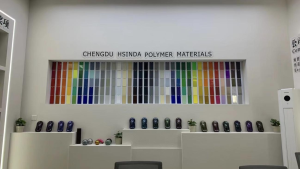
Finish samples are the first control point in a texture programme: colour and texture are approved on a physical sample before bulk production begins.
Matching the finish to the environment
Exterior facades and architectural metalwork
Exterior exposure is a corrosion and UV problem before it is an appearance problem, which pushes the decision toward the wrinkle data set. Its documented profile includes no change after 500 hours of salt spray per ISO 7253:1996 with unilateral corrosion of 2 mm or less, and no powdering with light retention above 50% after 500 hours of weathering per ISO 11341:2004. For a coating with anti-rust and durable properties, the same product family records an outdoor service life of more than 10 years.
Sandy finish enters the facade conversation from a different direction. Its documented coverage of 8-10 m²/kg makes it efficient where cladding, panels or frames cover large continuous areas, and a fine grain breaks up reflected light across those areas in a way a smooth film does not. Where a project needs the appearance of depth rather than reflection, that behaviour is a specification advantage rather than a decoration.
Both discussions have to be anchored to a certification framework. Architectural powder coatings are governed by schemes such as Qualicoat, GSB International and AAMA standards 2603, 2604 and 2605, while ISO 12944 defines corrosivity categories C1 to C5 for steel structures in corrosive environments. A buyer's first step is to place the project in the correct category and then request evidence against that category, not against a general durability statement.
Interior furniture and fittings
Furniture changes the weighting of the criteria. Mechanical damage in handling and daily use, and cost per unit of coated surface, usually matter more than UV stability. Furniture is explicitly listed among the intended applications of the wrinkle-type data set, alongside appliances, architectural hardware and public facilities. Indoor performance data for a related product in the same portfolio specifies an operating range of -40 °C to 60 °C together with rust prevention and durability, and resistance to bumps and wear during transportation and daily use. Those characteristics correspond to shelving, frames, table bases and public seating, where contact damage is the dominant risk.
Sandy finish competes here on economics and finish uniformity. Coverage of 8-10 m²/kg at 30-90 µm allows a furniture manufacturer to calculate powder consumption directly from coated surface area, which is the basis of quoting repeat orders. The fine grain also produces a consistent visual result across profiles and joints, which matters when a single product family is assembled from several coated parts.
Limits, trade-offs and what the data does not cover
- Coverage is conditional on film thickness. The 8-10 m²/kg figure is quoted for a 30-90 µm film. If a specification calls for a heavier texture or a thicker film, consumption per square meter rises and the published figure cannot be applied unchanged to a quotation.
- Laboratory results are not a service-life guarantee. The 500-hour salt spray result with unilateral corrosion of 2 mm or less, the 1000-hour humidity and heat result and the 500-hour weathering result describe coated test panels under defined methods. Real service life depends on pretreatment, substrate, edge protection, fixings and installation practice, which is why ISO 12944 separates corrosive environments into categories C1 to C5 instead of offering a single number.
- The wrinkle data set publishes no coverage figure. Buyers cannot derive cost per square meter for a wrinkle finish from published parameters alone. The practical route is a trial application on the buyer's own line, followed by measurement of actual consumption.
- Neither texture replaces a smooth film where a smooth film is required. Where a facade element or furniture surface must present a mirror-like, high-gloss, defect-free appearance, both finishes are the wrong specification. Texture conceals substrate variation; it does not remove it.
- Certification scope is narrower than manufacturer scope. Holding ISO 9001 and ISO 14001, or passing REACH, RoHS and SGS testing, describes the manufacturer and material compliance. Architectural schemes such as Qualicoat, GSB International and AAMA 2603/2604/2605 apply to specific qualified products, so the certificate requested should match the exact product and colour being ordered.

Gloss and surface appearance are measured against the specification; the documented gloss range for these systems is 5% to 95% per ISO 2813:2014.
Market direction: texture demand inside a growing coating market
The demand backdrop for both finishes is expansion supported by documentation. Grand View Research values the global powder coatings market at USD 11.5 billion in 2025 with a projected USD 18.5 billion by 2033, while IMARC Group reports USD 16.4 billion in 2025 and a 4.51% CAGR to 2034. Divergence between research houses is common and does not change the direction of travel. Thermoset systems based on epoxy and polyester resins accounted for 76.6% of the market in 2026 according to Coherent Market Insights, a share attributed to durability and corrosion resistance.
Two structural signals matter more for texture specification than the headline market size. First, architectural and decorative applications are a major end-use segment, with demand driven by UV-resistant facades and window systems, which places weathering and salt spray evidence near the centre of purchase decisions. Second, certification schemes including Qualicoat, GSB International and AAMA standards 2603, 2604 and 2605 increasingly function as the shared language between coating suppliers, fabricators and project specifiers.
Supply geography is shifting as well. China exported 334,800 tons of coatings in 2024, an 18.65% year-on-year increase in value to USD 1.065 billion, according to China Coatings Industry Association data reported by ECHEMI. For facade and furniture programmes, a larger share of texture finishes is therefore evaluated across borders, which makes data portability, test method recognition and batch consistency more important than proximity alone.
What long-term supply means for a texture programme
Texture programmes rarely fail on peak performance; they fail on consistency. Two batches of the same wrinkle specification that differ slightly in grain depth, or two sandy batches that differ in coverage, create rework at the coating line and disputes at the project site. The supply-side question is therefore whether a manufacturer can hold a texture and a colour across repeated orders over several years.
Chengdu Hsinda Polymer Materials Co., Ltd, which manufactures under the Hsinda brand, is an example of a supplier structured around that requirement. Established in 2015, the company operates a 10,000 m² facility with eight production lines and three sample lines, an annual output of more than 5,000 tons, an eleven-person R&D team and more than 40 independent patents. The factory holds ISO 9001 and ISO 14001 certification, and its powder coatings have passed RoHS, REACH, SGS and AAMA testing, with QUALICOAT listed among the certifications held and Florida outdoor exposure testing and antimicrobial testing referenced as supporting evidence. Around 70% of output is exported, reaching more than 70 countries.
Execution parameters matter at the ordering stage, particularly for texture finishes that must be repeated. Monthly production capacity is 400 tons, with a typical lead time of 15-20 days, or 20 days for certain orders. Minimum order quantity is 300 kg or 6 tons depending on the product, with sample orders accepted from 1 kg. Delivery terms cover EX-W, FOB, CIF, CFR, CPT, DAP and DDP, payment terms are 50% T/T in advance and 50% before shipment, and acceptance can be supported by pre-shipment testing and third-party inspection such as SGS.
Colour and finish control follow a “3+1” inspection protocol covering raw materials, first and last production pieces, performance and colour difference, with colour difference (Delta E) held within 0.5 and supporting reports available on request. On the demand side, Hsinda supplies Changhong Electric, Xiaomi Appliances, TCL Electronics and Hitachi Elevator in the domestic market, works with distributors in Russia, Bangladesh, Poland, Portugal, the United States, Canada, Sri Lanka, Bolivia and Argentina, holds exclusive distributorships in Kazakhstan, Uzbekistan and Chile, and has maintained a relationship with Mexico’s largest agricultural tool equipment factory for more than ten years. For buyers running texture programmes across facade and furniture lines, those distribution and retention patterns are the practical evidence of repeatability.
Outlook
The direction of travel points toward more documentation per texture specification, not less. Facade projects are being pushed toward corrosivity categories and recognised certification schemes, while furniture programmes are being pushed toward measured coverage and repeatable colour control. Neither trend favours one texture over the other. It favours the buyer who can state, before ordering, which finish is being specified for which surface, on what evidence, and within which boundary conditions.
FAQ
1. What is the practical difference between a sandy and a wrinkle powder coating finish?
Sandy is a fine, evenly distributed mineral-like grain; wrinkle is a pronounced crinkled surface. In documented product data, the sandy system is characterised mainly by consumption and film parameters, including coverage of 8-10 m²/kg at 30-90 µm film thickness, an average particle size of 32-42 µm and a typical film thickness of 70 µm. The wrinkle system is characterised mainly by durability results, including no change after 500 hours of salt spray per ISO 7253:1996 with unilateral corrosion of 2 mm or less, and no powdering with light retention above 50% after 500 hours per ISO 11341:2004. Both are thermoset powder coatings applied by electrostatic or tribo spray.
2. Which finish should be specified for exterior facades, and which for furniture?
Exterior facades weight corrosion, UV and moisture resistance, which aligns with the wrinkle data set: 500-hour salt spray with no change, 500-hour weathering with no powdering and light retention above 50%, and an outdoor service life of more than 10 years for a coating with anti-rust and durable properties. Furniture is explicitly listed among the intended applications of the same wrinkle-type data set, together with appliances, architectural hardware and public facilities, while indoor performance data for a related product specifies an operating range of -40 °C to 60 °C with rust prevention and durability and resistance to bumps and wear during transport and daily use. Sandy finish is typically selected where large coated areas and long repeat runs make coverage of 8-10 m²/kg the deciding factor.
3. How can a buyer verify durability claims before placing a bulk order?
Request test reports that match the exact product and colour. The relevant methods recorded in the product data are ISO 7253:1996 for salt spray, GB/T1740-2007 for humidity and heat, ISO 11341:2004 for weathering, ISO 15184:2020 for hardness, ISO 2409:2020 for adhesion, ISO 1520:2006 for cupping, ISO 1519:2002 for bending and ISO 6272-1:2017 for impact resistance. Sampling from 1 kg is available for trial application, pre-shipment testing and third-party inspection such as SGS can be arranged, and colour difference is controlled to Delta E of 0.5 or less with reports supplied on request.
4. What are the typical minimum order quantity, lead time and delivery terms for these finishes?
Minimum order quantity is 300 kg or 6 tons depending on the product, with sample orders from 1 kg. Typical production lead time is 15-20 days, or 20 days for certain orders, against a monthly production capacity of 400 tons. Delivery terms offered are EX-W, FOB, CIF, CFR, CPT, DAP and DDP, and payment terms are 50% T/T in advance with the remaining 50% before shipment.
5. How is texture and colour consistency controlled across repeat batches?
A “3+1” inspection protocol covers raw materials, first and last production pieces, performance and colour difference, with colour difference (Delta E) controlled to 0.5 or less and reports available on request. Sample lines support trial application before bulk production, which is the practical way to confirm that a texture behaves the same way on the buyer’s own equipment as it does on the manufacturer’s sample panels.
6. What limitations should be planned for when specifying textured finishes?
Coverage figures are conditional on film thickness: 8-10 m²/kg is quoted for a 30-90 µm film, so heavier textures or thicker films increase consumption. Laboratory results such as 500-hour salt spray testing are panel results under defined methods, not a guaranteed service life, and field performance depends on pretreatment, substrate, edge protection and installation. The wrinkle data set publishes no coverage figure, so cost per square meter should be validated through trial application. Finally, neither texture substitutes a smooth, high-gloss surface where that appearance is required, and architectural certification such as Qualicoat, GSB International or AAMA 2603/2604/2605 applies to specific qualified products rather than to a manufacturer’s full range.
Reference material: the manufacturer publishes a technical brochure covering coating systems, parameters and certifications, available for public download here: Hsinda powder coating technical brochure (PDF).