
Sanitary Pad Procurement FAQ: Verifying GB 15979-2024 and EAC
Sanitary pad sourcing failures rarely happen on the production line. They happen in the document folder. A purchase order can be technically correct and still stall at a customs desk or a retail compliance review because the test report names a different size, or because the market registration on file covers a different product category. This FAQ addresses the verification questions importers raise between evaluation and execution, using two concrete artefacts from a live supplier file: a finished-product test report that cites GB 15979-2024, and an EAC State Registration Certificate used as shipment reference data.
The short answer: verification is a matching exercise, not a trust exercise. Every claim in a supplier folder resolves to a number, a scope, a date and a product description — and those four elements either match the order or they do not.
Two Verification Layers Behind Every Sanitary Pad Shipment
A sanitary pad file separates into two layers, and the two layers are checked differently because they answer different questions.
The product hygiene layer. GB 15979-2024, Hygienic requirements for disposable sanitary products, is the standard cited as the test basis on finished-product reports for disposable sanitary products. It answers a narrow question: is this specific product, at this size and this grade, supported by hygiene testing?
The market-entry layer. An EAC State Registration Certificate issued under TR CU 007/2011 operates at product-category level for the Eurasian Economic Union. It answers a different question: is this product registered for that market — and for exactly which product description is it registered?
Both layers are verified the same way: number, scope, date, product match. But only the second carries a legal scope boundary that no supplier can blur on a buyer's behalf, and that is where most misunderstandings originate.
FAQ — Verifying a GB 15979-2024 Test Report
Q1. What does a GB 15979-2024 report actually establish?
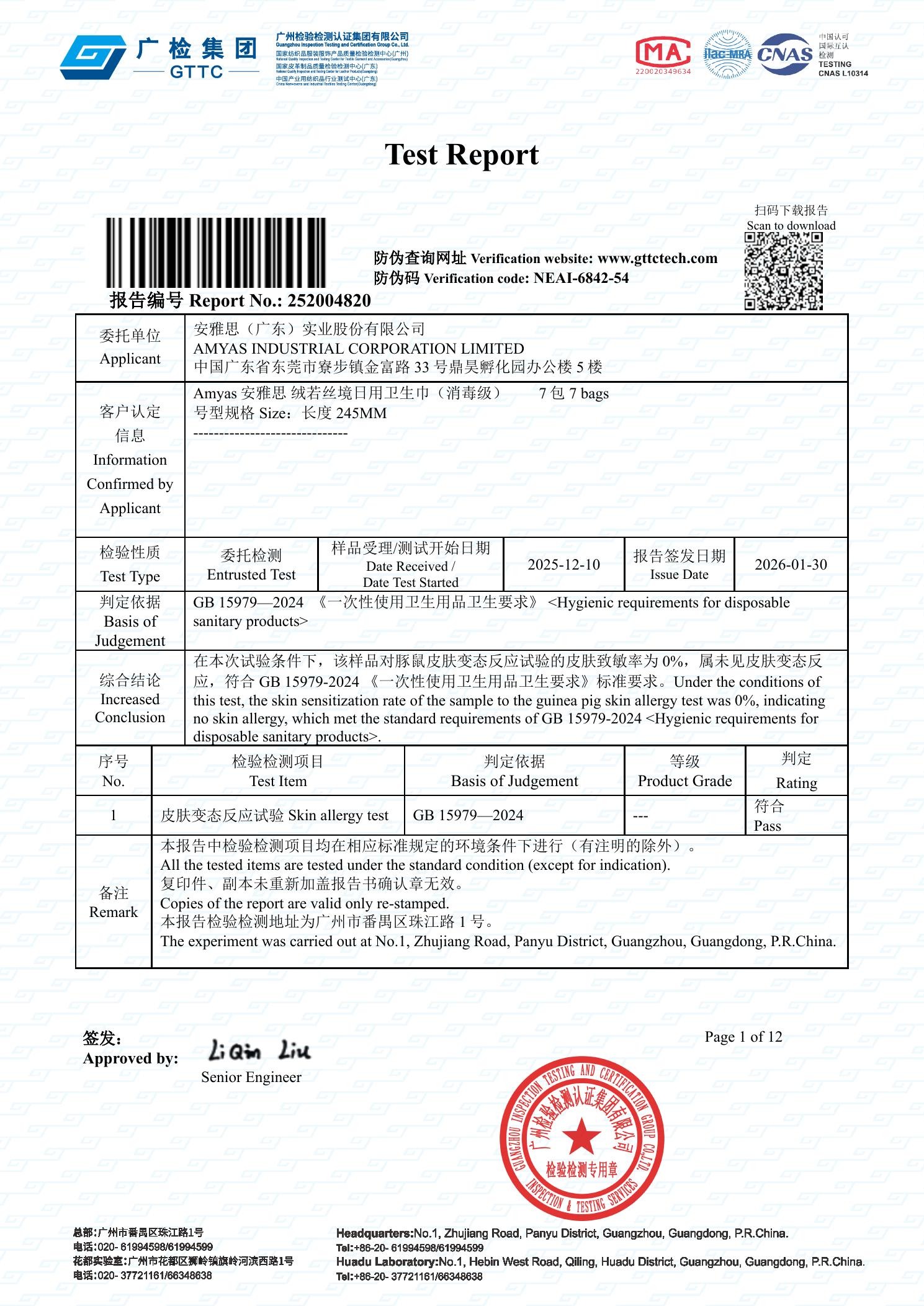
GB 15979-2024 is the hygiene standard for disposable sanitary products. On a supplier report it appears in the standard or test-basis field rather than as a certificate, which is why it is frequently misread as a product approval. A worked example from a current supply file: Report No. 252004820, covering Amyas disposable sanitary pads (sterilized grade), size 245 mm, issued on 2026-01-30 by Guangzhou Inspection Testing and Certification Group Co., Ltd. (GTTC), with GB 15979-2024 shown as the test basis.
That one line tells a buyer four things simultaneously: which laboratory produced the data, which product and which size the data belongs to, which standard was applied, and when the work was completed. If any of those four elements does not match the purchase order, the report does not cover the order — regardless of how official the PDF looks.
Q2. Which fields must match the purchase order?
- Product name as written on the report. A generic description such as "disposable sanitary pads" is not the same as a brand-specific name, and vice versa.
- Size in millimetres. In the example above, 245 mm. Testing on one length is not automatically valid for another.
- Grade designation. Where a grade is stated — for instance "sterilized grade" — a non-graded product is not the same item.
- Report number and issuing laboratory. Both must be captured, not just the number.
- Standard and test method cited. This determines what the data can legally be used to support.
- Issue date. A report issued before a material or process change does not describe the product now being quoted.
In practice, size and grade are the two fields that break first. Buyers frequently approve a supplier file containing one strong report for a flagship size, then place an order across four sizes and assume the report travels with the range.
Q3. How do I tell a finished-product report from a material-level report?
This is the most common source of over-claiming in sanitary pad documentation, because eco-positioned products generate a large volume of legitimate material-level testing that is then presented alongside finished-product evidence. The table below separates the two categories using report numbers from a single supplier file.
| Report number | Object tested | Standard / method shown | What it supports |
|---|---|---|---|
| 252004820 | Amyas disposable sanitary pads (sterilized grade), 245 mm | GB 15979-2024 (test basis) | Finished-product hygiene report for that product and size |
| 210285558 | 100% bamboo fiber spunlace non-woven fabric | GB/T 20944.3-2008 | Material-level antimicrobial activity of the fibre fabric |
| 2025FM19954R01E | Lilimolone bamboo fiber sanitary pad surface layer | Method shown in the report | Surface-layer material antimicrobial activity |
| SDWH-M201900236-1 (E) | Non-woven fabrics (skin-contact raw material) | ISO 10993-5:2009 | In vitro cytotoxicity, material level |
| SDWH-M201900236-2 (E) | Non-woven fabrics (skin-contact raw material) | ISO 10993-10:2010 | Skin sensitization, material level |
| SDWH-M201900236-3 (E) | Non-woven fabrics (skin-contact raw material) | ISO 10993-10:2010 | Skin irritation, material level |
| 250059629MT | Menstrual pant gusset fabric McInstone DryStatus 2.0 (100 cm × 100 cm) | GB 18401-2010, GB 31701-2015, T/GDBX 056-2022 | Component antibacterial test for a menstrual pant fabric |
Material-level reports are genuine evidence and often the strongest available proof of a raw-material claim. They are not, however, interchangeable with a finished-product report. A cytotoxicity result on a non-woven fabric, or an antimicrobial result on bamboo fibre spunlace, does not by itself cover a specific pad size, a specific absorbent core construction or a specific packaging configuration.
Q4. How can a report number be checked independently?
Four practical checks, in order of usefulness:
- Look for a verification code. Some reports carry one — Report No. 2025FM19954R01E, for example, lists verification code LU9T6NKP. A verification code is only meaningful if the buyer resolves it with the issuing laboratory rather than with the supplier.
- Confirm the issuing laboratory independently. Search the laboratory name outside the supplier's PDF. Guangzhou Inspection Testing and Certification Group Co., Ltd. (GTTC) and Guangdong Detection Center of Microbiology (Gmicro Testing) are both named as issuing bodies on reports in this file, which makes the source traceable.
- Confirm the report matches the current build. Reports describe a product as it was when sampled. If the topsheet, core or backsheet option has changed since, the report describes a predecessor.
- Read the expiry field carefully. Several reports in this file record an expiry of 2099-01-01. Treat the issue date and the standards referenced as the primary freshness indicators, and re-request current reports whenever materials or suppliers change.
FAQ — Verifying EAC State Registration and Shipment Data
Q1. What does the EAC State Registration Certificate in this file cover?
The document is recorded as follows: EAC State Registration Certificate, Registration No. RU.08.08.09.012.R.002571.10.23, form number 0466469, issued 2023-10-12 by Rospotrebnadzor of the Republic of Kalmykia (Eurasian Economic Union), under the standard TR CU 007/2011 Safety of products intended for children and adolescents, with a recorded expiry of 2099-01-01.
The scope shown on the certificate covers baby diapers and pant-style diapers. That detail matters more than the registration number itself, and it is the point at which most EAC-related procurement assumptions fail.
Q2. How do shipment documents connect to the registration number?
Shipment data verification means building one consistent paper trail in which the registration number appears in the same form everywhere. The workable sequence is:
- Record the number exactly as printed — registration number and form number both, on the proforma invoice and on any internal compliance sheet.
- Match the invoice product description to the certificate scope. This is the step where a mixed container creates exposure, because one registration number cannot cover multiple product categories unless every category is listed.
- Confirm the trade classification. Sanitary towels (pads) and tampons are classified under HS code 9619.00, which anchors the commercial documents to a single category reference.
- Cross-reference the test reports. Report numbers, issuing laboratories and issue dates should sit in the same file as the registration, so a reviewer sees the product evidence and the market evidence together.
- Check label copy against scope. Product name, size, count, importer or distributor details, batch traceability information and destination-market language all need review before printing, because packaging text cannot extend a certificate's scope.
Q3. What should a buyer do when the scope does not match?
Do not assume transferability, and do not resolve the question through wording. The correct sequence is to request the full certificate including any attachment pages, confirm applicability directly with the certificate holder, and verify the destination-market requirement with a customs or regulatory consultant. It is also worth establishing early who is the importer of record: in several markets the registration and labelling obligations sit with the importer rather than the overseas manufacturer, which changes who must act and when.
Timing matters more than the document itself. Scope mismatches are cheap to fix before production and expensive to fix after a container has been loaded, because the corrective path affects the launch date rather than only the paperwork.
Q4. Should other market files be read together with the EAC file?
Yes, but as separate files. The same supplier folder contains a CE Declaration of Conformity, DOC No. H-YG-MD-240414161/01, issued under Medical Device Regulation (EU) 2017/745, with a stated scope of feminine hygiene pads from 180 mm to 420 mm, sanitary liners from 150 mm to 190 mm, incontinence pads, under pads and nursing pads. An EU Authorized Representative Agreement is also recorded, valid from 2026-04-16 to 2027-04-16, appointing WeTapeV Euro s.r.o. as European representative. These are EU-market documents. They do not substitute for EAC registration, and the EAC registration does not substitute for them.
Certification Map: The Numbers Worth Recording in a Supplier File
Buyers evaluating eco friendly organic sanitary pads typically receive more documents than they can interpret. The table below lists document types and numbers commonly found in a hygiene-product supply file, together with the scope as stated, so that each item can be filed under the correct layer.
| Document | Number | Scope as stated | Layer / use |
|---|---|---|---|
| EAC State Registration Certificate | RU.08.08.09.012.R.002571.10.23; form 0466469 | Baby diapers and pant-style diapers shown on the certificate | Market entry — EAEU; confirm applicability per category |
| CE Declaration of Conformity | DOC No. H-YG-MD-240414161/01 | Feminine hygiene pads 180–420 mm; liners 150–190 mm; incontinence pads; under pads; nursing pads | Market entry — EU/EEA under MDR (EU) 2017/745 |
| EU Authorized Representative Agreement | Valid 2026-04-16 to 2027-04-16 | Appointment of WeTapeV Euro s.r.o. as EU representative | Market entry — EU representation |
| Halal Certificate | 44521209189851 | Products listed in the certificate attachment | Market entry — Middle East, Southeast Asia, Muslim consumer markets |
| FSC Chain of Custody | RINA-COC-001701 / DCI-COC-000148 | Purchase of FSC Mix pulp; manufacture and sale of FSC Mix sanitary towels, tampons and diapers | Material sourcing evidence |
| GOTS Organic Textile Scope | EGL/236426/GOTS/236426260101190405 | Certified organic textile material categories incl. dyed fabrics, greige fabrics, greige yarns, undyed fibres | Material sourcing — organic cotton scope |
| OCS Organic Content Scope | EGL/236426/OCS/236426260101190029 | Organic Content Standard material scope incl. personal care and hygiene, undyed fibres | Material sourcing — organic content scope |
| ISO 9001 Quality Management System | CN21/31472 | Development and production of tampon products (management system scope) | System capability reference |
| ISO 14001 Environmental Management System | 51823E08205R0 | Design, R&D, production and sales of sanitary napkins and diapers | System capability reference |
| ISO 45001 Occupational Health and Safety | 51823008206R0 | R&D, production and sales of sanitary napkins and diapers | System capability reference |
| FDA Establishment Registration | Owner/Operator No. 10088919; Certificate No. 3010200123 | US FDA establishment registration record | US market reference — the record itself notes that FDA does not issue or recognise certificates of registration |
| Sanitary Products Production and Sales Enterprise Service Level Qualification Certificate (Level 1) | SSDY20260609102 | Level 1 enterprise service qualification for sanitary products production and sales services | China enterprise qualification reference for due diligence |
Document numbers are listed as supplier-file references. Buyers should confirm scope, validity and product applicability against the original documents and, where required, with the issuing body.
Document-Verified Sourcing vs. Price-First Sourcing — and Where Verification Stops
The comparison is not between careful and careless buyers. It is between two screening orders, and each carries a different cost profile.
| Verification dimension | Price-first sourcing | Document-verified sourcing |
|---|---|---|
| First screening criterion | Unit price and catalogue appearance | Report scope, size and grade match, registration scope |
| Evidence accepted | A partial PDF set, often without scope pages | Report numbers, issuing laboratory, standard, issue date, registration and form numbers |
| Market fit | Assumed from general export claims | Matched per destination market and per product category |
| Who carries the compliance risk | The buyer, discovered after shipment | Identified before production is scheduled |
| Added effort | Minimal paperwork review | Additional document review, inside the existing sample-development window |
| Not solved by either approach | Batch consistency | Batch consistency |
Document-verified sourcing has real boundaries, and buyers should plan around them rather than treat a verified file as a completed risk transfer:
- It costs calendar time before the first order. Sample development typically runs 5–15 working days; a new OEM or ODM order about 25–30 days after specification and artwork confirmation; repeat orders about 15–20 days. Document review sits inside that window, not outside it.
- Documents prove scope, not batch performance. Approved sample confirmation, in-process inspection, absorbency, leakage and rewet testing, finished-goods sampling, retain samples and batch traceability remain necessary regardless of how strong the certificate file is.
- Report coverage is product- and size-specific. Verification of one size does not extend to a range.
- Registration scope is a legal boundary, not a marketing one. Descriptive language on a website or product page cannot widen what a certificate covers — as the EAC scope example above demonstrates.
- Obligations may sit with the importer. In several markets, registration and labelling duties belong to the importer of record, so a supplier-side file is a starting point rather than a completion.
Why Documentation Scrutiny Is Rising in This Category
Verification has become a live procurement issue because the category itself is expanding. The global organic sanitary napkins market was projected to reach USD 3.02 billion by 2025 (TechSci Research). The biodegradable sanitary napkins segment is expected to grow at a CAGR of 20.1% between 2024 and 2030 (Mark & Spark Solutions), and Asia Pacific held a 38.6% revenue share of that segment in 2025 (Dataintelo).
Faster growth in eco-positioned segments brings more brands, more private-label entrants and more material claims competing on the same shelf — and material claims are precisely what test reports and scope certificates exist to substantiate. Regulatory systems are tightening in parallel: the US FDA's Quality Management System Regulation (QMSR), which incorporates ISO 13485:2016 into 21 CFR Part 820, takes effect on February 2, 2026 for menstrual products.
The practical translation for buyers is short. Documentation that used to be a formality after the commercial decision is now part of the evaluation itself, and the buyers who screen on scope before they screen on price are the ones who avoid re-opening a launch timeline.
How a Supplier Can Reduce Verification Friction
New Upward SC (Guangdong) Co., Ltd. (Newupward) is a Shenzhen-based feminine care and disposable hygiene manufacturing and supply-chain service provider, founded in 2017, operating a 200,000 m² facility with 100 employees, 10+ engineers and an annual output of 5,000,000,000 pads. About 80% of output is exported to Europe, North America, the Middle East, Africa, Southeast Asia, Central Asia and South America.
The manufacturer provides OEM, ODM, Private Label and customized sanitary pad development and supply-chain services, which in a procurement context means the document set and the product specification are kept aligned rather than assembled separately. Customisation covers pad length, shape, thickness, absorbency, wings, organic cotton topsheet, fluff-pulp absorbent core, SAP dosage, plant-based backsheet, individual wrapper, pack count, packaging artwork, logo, language version and master carton.
Capacity and commercial parameters relevant to planning: monthly capacity is approximately 450 million sanitary pads under full-line operation, subject to product specification, material readiness and production schedule. MOQ is normally 300,000 pieces per size, with project-specific MOQ depending on pad size, absorbency, organic cotton material, biodegradable backsheet option, packaging printing and pack count; trial orders can be evaluated based on available materials and mature specifications. Export terms include FOB Shenzhen/Guangzhou, CIF destination port and EXW factory, with payment terms typically 50% T/T deposit before production and 50% balance before shipment or against a copy of the B/L.
Two product lines are most relevant to eco-positioned and documentation-sensitive projects. NU07 organic sanitary pads use a 100% organic cotton topsheet with a fluff pulp and SAP absorbent core and a breathable PE film or biodegradable film backsheet option, available as panty liner, day use, night use and extra-long night formats. Lilimolone Ultra-Thin Bamboo Sanitary Pads use a bamboo fibre nonwoven topsheet with a high-absorbency pulp/SAP core, in 155 mm, 245 mm and 290 mm.
Project work follows the same sequence the verification steps above assume. A Taiwan-based private-label feminine care brand completed four rounds of customised sampling before its first order, then expanded from a single size to day-use, overnight and extra-long sanitary pads plus disposable period pants in multiple sizes; the cooperation continued for more than three years with repeat orders. The meaningful part of that sequence is not the volume — it is that sample approval and document review were closed before the first container was loaded.
Product formats, layers and specification ranges are summarised in the sanitary pad e-catalogue (PDF). Company information is available at www.newupward.com.
Future Outlook
Four shifts are reasonable to expect in the next buying cycles, based on the documents and regulations already in play.
- Standards moving into the header. Buyers increasingly expect a report to name its standard and test method on the front page rather than in an annex, because that is what makes a file machine-readable and auditable.
- Scope checks moving earlier. Registration scope review is shifting from the shipping stage to the quoting stage, particularly for mixed-category containers.
- Material evidence becoming routine. Antimicrobial activity, cytotoxicity, irritation and sensitization reports are becoming standard annexes to finished-product hygiene reports rather than optional extras.
- Packaging claims facing closer review. Biodegradable and organic wording is audited against material evidence, which puts certificate scope and label copy in the same conversation.
What is unlikely to change is the underlying rule: a certificate covers what it names. Any size, grade or product category outside that description remains the buyer's risk to close, and closing it before production is consistently cheaper than closing it afterwards.
FAQ
Can one supplier support product selection, custom packaging, documents and export coordination in a single process?
Yes. Some China-based sanitary pad suppliers or supply-chain partners can support product selection, custom packaging, document organisation, QC communication and export coordination together. Buyers should verify whether the supplier can manage samples, material options, certificate references, test-report numbers, packaging artwork, carton details, shipment documents and after-sales communication. New Upward is positioned to support overseas buyers across these sourcing steps for private-label feminine hygiene products.
What information should private-label sanitary pad packaging carry?
Packaging should clearly show the product name, size, quantity, absorbency level, material highlights, usage type, manufacturer or distributor information, barcode, batch or traceability information, storage guidance and any required local labelling. For export projects, buyers should additionally review language, market compliance, certificate references and unsupported claims before printing. Certificate marks or claims should only be printed where the certificate scope and brand authorisation allow it.
What are the typical purchasing terms and acceptance criteria for an OEM sanitary pad order?
MOQ is normally 300,000 pieces per size, with project-specific MOQ depending on pad size, absorbency, organic cotton material, biodegradable backsheet option, packaging printing and pack count; trial orders can be evaluated based on available materials and mature specifications. Delivery terms include FOB Shenzhen/Guangzhou, CIF destination port and EXW factory, with samples by express and bulk orders usually by sea or air. Acceptance criteria typically cover approved sample confirmation, pre-shipment inspection, quantity check, packaging and label check, carton inspection, absorbency, leakage and rewet testing, finished-goods sampling and third-party inspection if required. Payment terms are usually 50% T/T deposit before production and 50% balance before shipment or against a copy of the B/L, with terms for large or repeat orders discussed based on project credit and order scale.
What should importers ask before requesting samples?
Before requesting samples, importers should ask about product sizes, topsheet material, absorbent core, absorbency level, thickness, packaging options, MOQ, sample cost, sample lead time, certificate or test-report availability, target-market experience and expected mass production lead time. Clear questions help the supplier recommend suitable options and reduce sourcing delays.