
Sauna Room Procurement FAQ: OFS06 Power and Acceptance Criteria
Sauna Room Procurement FAQ: OFS06 Power and Acceptance Criteria
Infrared sauna rooms are ordered on a quotation and approved on a nameplate. Between the two sits a short list of questions that decides whether a hospitality or wellness project opens on schedule: how much power the electrical contractor must plan for, which wood species sits behind a painted panel, what the AV1 control system actually governs, and which certificate number covers the exact unit that arrives. This reference answers those questions for the OCEAN FUTURE OFS06 infrared sauna room family, using published specification data and verifiable certification references.
Across the sauna room category, buyers increasingly purchase complete prefabricated cabins rather than site-built rooms, which moves construction risk from the project site to the factory and moves documentation risk to the buyer. A prefabricated cabin arrives with a fixed specification, a fixed power draw and a fixed compliance file; if those three items were not reconciled at the ordering stage, the correction happens on site, at the most expensive point in the programme.
The specification gap: where sauna room procurement usually slips
Most sauna room disputes are not manufacturing disputes. They are documentation disputes. A buyer approves a quotation that names a model code, a supplier builds against an internal build sheet, and an electrical contractor wires to an assumption. The three documents that actually govern the delivered product — the purchase order, the unit nameplate and the compliance certificate — are rarely reconciled before the container leaves.
Three conventions make this worse in the infrared segment specifically:
- Model suffixes do not encode wattage. A higher model number does not reliably mean a higher power step, so total power must be an explicit line item on the purchase order rather than something inferred from the model name.
- Wood species is often a material set, not a single species. A specification that lists hemlock, aspen and red cedar leaves the final mix open unless the purchase order fixes it and the packing list declares it.
- Certification scope is model-specific. A certificate that covers a platform does not automatically list every derivative; the exact model code must appear in the certificate's product scope or in its related product records.
The opportunity is equally straightforward. Buyers who treat those three points as acceptance criteria rather than assumptions get a predictable installation, a clean electrical handover and a compliance file that survives an audit. That is the practical difference between buying a sauna room and specifying one.
OCEAN FUTURE and the OFS06 infrared sauna room family
OCEAN FUTURE is a sauna room, hot tub, swim spa and cold plunge manufacturer based in Gaoming, Foshan, Guangdong, China, operating as FOSHAN GAOMING MUHE JINGCHENG SANITARY WARE CO., LTD. The company reports a 50,000 m² factory, more than 200 employees, 5,000 sets of annual output, a nine-engineer R&D team and an 85% export ratio, with the USA, Australia, the EU and Germany listed as main markets.
The OFS06 infrared sauna room family is the platform this reference covers. Six model codes are documented for buyer evaluation: OFS06A-5, OFS06B-1, OFS06B-2, OFS06B-3-1, OFS06B-3-2 and OFS06B-4. They share a common specification base rather than differing by architecture, which is why a single acceptance checklist can be applied across the family and adjusted only for the power step, the wood mix and the finish.
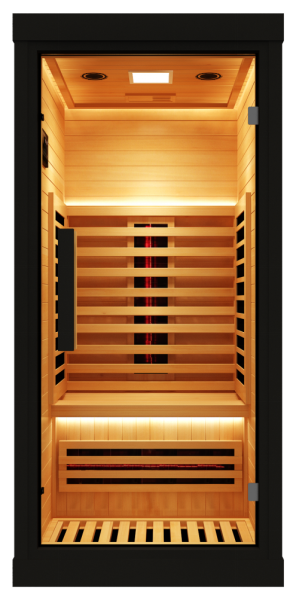
OFS06B-1, the 1500W entry point in the OFS06 infrared sauna room family, with painted surface finish, tempered glass and wood handle.
| Specification item | As published | What it means in procurement |
|---|---|---|
| Control system | AV1 | One interface across the family; spares, training and operating instructions can be standardised. |
| Heating method | Far infrared heating plate and heating box | Radiant heating without water, stones or a steam cycle; no water supply line in the cabin. |
| Audio and connectivity | FM radio, Bluetooth, USB, two speakers | Guest-facing features; each must be tested individually at acceptance. |
| Lighting | Lamp plus colourful light | Ambience feature for hospitality use; confirm the control mapping matches the quotation. |
| Glazing | Tempered glass | Safety-relevant component; inspect edges and seals on receipt. |
| Hardware | Wood handle | Wear item; confirm spare availability for commercial properties. |
| Surface | Painted finish on OFS06B models | Affects species verification and adds a scheduled finish-care task. |
| Materials | Hemlock, aspen, red cedar | Material set rather than a single species; the mix must be fixed on the PO. |
Table 1 — Shared specification base of the OFS06 infrared sauna room family and its procurement implications.
Technical explanation: what is inside an OFS06 infrared sauna room
Heating: far infrared plates working with a heating box
Far infrared heating in the OFS06 family is delivered by heating plates combined with a heating box. The practical consequence is that the cabin is warmed by radiant panels rather than by a stove and stones. There is no water to pour, no stone set to season and no löyly cycle. For a hotel or wellness operator this simplifies daily operation and staff training, and it removes the water supply, drainage and stone-handling items that appear in a traditional sauna bill of materials. The trade-off is addressed later in this article: an infrared room is not a Finnish steam experience, and buyers who need that experience should select from the heater-based models instead.
Control and connectivity: AV1, audio and lighting
The AV1 control system is the interface specified across the OFS06 models and is the heating control point of the cabin. The audio chain and the lighting package are separate specification items rather than part of the AV1 definition: FM radio, Bluetooth and USB input through two speakers, plus a lamp and a colourful light.
That distinction matters at handover. Rather than accepting a single pass or fail on “control system working”, buyers should write each function into the purchase order and test them one by one: the AV1 panel powering up and accepting a set-point change, timer behaviour observed over a short cycle, FM reception, Bluetooth pairing from a phone, USB playback, both speakers producing sound independently, and both lighting functions operating. Splitting the test this way turns a vague acceptance into a reproducible one, and it gives the property a baseline for future warranty discussions.
Structure and finish: hemlock, aspen, red cedar and painted surfaces
OFS06 rooms are constructed from hemlock, aspen and red cedar, with tempered glass glazing and wood handles. The OFS06B variants carry a painted surface finish.
For buyers, the painted finish has two consequences worth writing into the acceptance criteria. First, a painted panel does not let an inspector confirm species visually, so the species must be fixed in writing on the purchase order and matched against the packing documentation rather than judged by eye. Second, painted surfaces are a maintenance item in commercial use: they should be checked for transit damage at goods-in and for wear at each service interval, because touching up a finish is a scheduled task rather than an emergency repair.
Power ranges: what 1500W to 3850W changes on site
The OFS06 infrared range is documented across five power steps: 1500W, 1850W, 2300W, 3000W and 3850W. Two anchor points are confirmed in the published specification — OFS06B-1 at 1500W and OFS06B-5 at 3850W — with the intermediate steps sitting between them. Because model suffixes in this category do not consistently encode wattage, the binding figure for any order is the total power stated on the quotation and repeated on the unit nameplate.
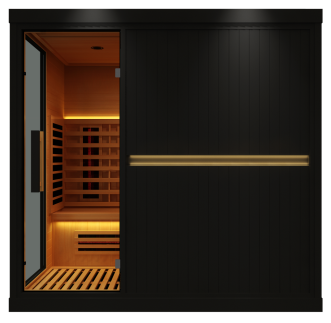
OFS06B-5, the 3850W top of the OFS06 infrared power range — the power step that most often requires a dedicated circuit review before ordering.
| Power step | Position in the range | What to confirm before ordering | Published model reference |
|---|---|---|---|
| 1500W | Entry step | Confirm the circuit against the nameplate rather than the model code. | OFS06B-1 (confirmed) |
| 1850W | Lower-middle step | Confirm circuit protection and cable sizing with the electrical contractor. | Confirm on quotation |
| 2300W | Middle step | Plan a dedicated circuit; confirm available supply capacity at the room location. | Confirm on quotation |
| 3000W | Upper-middle step | Dedicated circuit and a site survey before delivery. | Confirm on quotation |
| 3850W | Highest step | Dedicated circuit; verify the building's available capacity before the order is placed. | OFS06B-5 (confirmed) |
Table 2 — OFS06 power steps and the electrical confirmation each one requires. Model-to-wattage mapping for intermediate steps should be fixed on the purchase order.
Two practical rules follow from this ladder. First, power should be planned from the nameplate, not from the model name: a market-specific variant or a substitution changes the figure the electrician must wire to. Second, the higher steps are the ones that most often force a change to an existing building's electrical supply, so on retrofit projects the power step should be selected only after the available capacity at the intended room location has been confirmed. Voltage and phase configuration should be confirmed for each destination market rather than assumed from a previous order.
Application fit: hotels, guesthouses, wellness clubs and spas
Published application guidance for this product category names four venue types: hotel and hospitality, guesthouse, wellness and commercial club, and spa facilities. The same guidance describes indoor and outdoor installation, high-temperature operation, variable climate exposure including sun, rain and low temperature, and a corrosion-resistant requirement for outdoor units.
For an infrared cabin, the venue type changes what the buyer should specify more than it changes the room itself:
- Hotel and hospitality. Standardise on one power step and one control system across the room count so that housekeeping and maintenance carry a single spares set and a single operating procedure.
- Guesthouse. Inventories are small and single-unit orders are viable — OCEAN FUTURE states a minimum order quantity of one set, which suits operators fitting one or two rooms at a time.
- Wellness and commercial club. Continuous daily use makes finish inspection intervals, speaker and lighting checks, and handle replacement planning part of routine maintenance rather than an exception.
- Spa facilities. The cabin is one element in a wet area, so electrical capacity planning and adjacent humidity management matter more than additional cabin features.
A manufacturer-reported reference deployment supports this pattern. A commercial spa customer in Germany ordered 20 sets for a spa centre relaxation area, with reported results of stable and safe operation, consistent heating and reliable performance, alongside low noise, energy efficiency and durable construction. The reference record links that deployment to OFS06C-4 and OFS06B-5 — a useful reminder that case references should be read at model level, not family level.
Market context: why infrared specification is tightening
Three data points frame the demand side, and they should be read as directional rather than as a single consensus. Market.us estimates the global sauna market at USD 860.3 million in 2023, reaching USD 1,555.3 million by 2033 at a 6.1% CAGR. Technavio estimates the US sauna market at USD 437.4 million in 2025, growing at a 6.5% CAGR over 2026–2030. Harvia Group, the listed Finnish sauna company, estimates the global sauna market at close to EUR 4 billion, with roughly 18 million saunas installed worldwide. These figures differ in geography, base year and — most importantly — market definition, so they should not be averaged or combined into a single benchmark.
What matters more for specification is the standards side. EN 18164, published in February 2026, gives Europe a pan-continental standard covering the design and construction of sauna rooms, warm-air rooms, steam rooms and soft steam rooms in public facilities. In the United States, UL 60335-2-53 for electric sauna heaters was published in June 2025. Both are recent, and both point the same way: room construction and heater compliance are being treated as separate, separately documented objects. For buyers, that means the compliance dossier should keep the room file and the heating file apart, and should name the standard each document is tested against.
Infrared versus traditional sauna rooms: the limits to accept
The OFS06 rooms are infrared cabins, and the honest comparison is not infrared versus nothing — it is infrared versus a heater-based traditional room. OCEAN FUTURE's own range makes the distinction visible: OFS07-2 is specified with a Harvia 6 kW (BC60E) stove, OFS05-2 with a 3.5 kW (BC35E) stove, and OFS04-1 and OFS04-2 with 8 kW (BC80E) stoves, each supplied with a stone set and the bucket, spoon, sandglass and hygrothermograph that belong to water-on-stones operation. The OFS06 platform includes none of those items.
The limits worth accepting before specifying an infrared room are these:
- No steam and no löyly. An OFS06 cabin cannot deliver the water-on-stones ritual that defines a Finnish sauna. Buyers whose guests or members expect that experience should specify a heater-based model, not an infrared cabin.
- Power, not water, is the binding constraint. An infrared room trades a plumbing requirement for an electrical one, and the 3000W and 3850W steps are the ones most likely to require a dedicated circuit or a supply upgrade in an existing building.
- EMC compliance is one layer, not the whole file. OCEAN FUTURE holds EMC compliance certificate STUEMO250300017HS and CE-EMC certificate STUEMO250300016HS, both issued on 25 November 2025 by Guangzhou STU Hengchuang Testing Service Co., Ltd. and tested against EN IEC 55014-1:2021, EN IEC 55014-2:2021, EN 61000-3-12:2011 and EN IEC 61000-3-11:2019. These are electromagnetic compatibility documents. They are not a substitute for destination-market electrical safety approval, and the specific model code must appear in the certificate scope or related product records.
- Painted surfaces need scheduled care. A painted finish is an asset in a guest-facing interior and a maintenance line in a commercial one; it also removes the option of verifying wood species visually.
- Capacity figures are supplier-reported. The 400 sets per month and the 30–40 day lead time are self-reported rather than third-party audited. Buyers with fixed opening dates should request production evidence and hold a delivery buffer.
Purchasing terms and acceptance criteria
Commercial terms to fix in the purchase order
OCEAN FUTURE states a minimum order quantity of one set, a lead time of 30–40 days, a monthly capacity of 400 sets, 100% testing before shipment, OEM/ODM production with customization, and after-sales support delivered by remote guidance. Export experience is listed for the EU, USA, Germany, Australia, Spain and France.
On price, no public list price exists for the OFS06 infrared models, so the price band should be requested configuration by configuration, with the power step, species mix, glazing and finish fixed first. The only public price point located for an OCEAN FUTURE sauna room is a retail listing for a traditional OFS05-2 at AUD 5,990 in Australia; that is a different family, a different heating technology and a retail channel figure, and it should not be used to estimate OFS06 infrared cost.

EMC compliance certificate STUEMO250300017HS — one document in the acceptance file, not the whole file. Model-level scope must be checked separately.
Incoming acceptance checklist
- Nameplate reconciliation. Total power, model code and serial number match the purchase order line.
- Model-to-certificate match. The delivered model code appears in the certificate scope or related product records; copies of STUEMO250300017HS and STUEMO250300016HS are filed with the project dossier.
- Control panel test. Power-up, set-point change and timer behaviour observed directly, not confirmed verbally.
- Audio chain. FM reception, Bluetooth pairing, USB playback, and both speakers tested independently.
- Lighting. Lamp and colourful light both operate; the control mapping matches the quotation.
- Heating plates and heating box. Visual inspection for transit damage; the plate and box count matches the build sheet.
- Glazing. Tempered glass free of chips and edge damage; seals intact and seated.
- Wood handle and hardware. Fitted, tight, and free of splits.
- Painted surfaces. Any transit mark photographed and recorded before signing, with a touch-up or replacement position agreed in writing.
- Documentation pack. Manual, wiring diagram, certificate copies, and a packing list that declares the wood species supplied.
- Spares. Availability of handles, lamps and speakers confirmed against the property's maintenance cycle.
Site readiness before delivery
- Electrical capacity at the intended location confirmed against the ordered power step, not against a general assumption.
- Circuit protection and isolation provision agreed with the electrical contractor and documented for the facilities team.
- Access route, floor level and door swing clearance confirmed for the assembled cabin.
- For outdoor installation, surface water management around the base confirmed, and site conditions matched against the corrosion-resistant and weather-exposure assumptions in the specification.
- Ventilation and adjacent humidity management reviewed for spa environments.
Future outlook
Three developments are likely to shape how OFS06-class rooms are specified over the next planning cycles. Standards will keep separating the room from the heater, which pushes buyers toward a two-file compliance dossier and model-level certificate matching as a default rather than an exception. Prefabricated, painted modular cabins will continue to displace site-built rooms in hospitality because they compress installation time and shift construction risk to the factory — but they also concentrate the buyer's risk in documentation, which is exactly where acceptance criteria earn their place. And connectivity will keep moving from a feature-list item to a service item: Bluetooth, USB, speakers and lighting are the components most likely to need attention in the third year of a hotel fit-out, so specifying spare speakers, lamps and control spares at the ordering stage is materially cheaper than sourcing them later.
FAQ
Which power step should a buyer specify for an OFS06 sauna room?
Specify from the site, not from the model code. The OFS06 range is documented across 1500W, 1850W, 2300W, 3000W and 3850W, with OFS06B-1 confirmed at 1500W and OFS06B-5 confirmed at 3850W. The correct step is the one the intended location can supply on a dedicated circuit and the property can operate without overloading existing services. Because model suffixes do not reliably encode wattage, the purchase order should state total power explicitly, and the delivered unit's nameplate should match it.
Which wood species are used, and how does a buyer verify them?
OFS06 rooms are specified in hemlock, aspen and red cedar, with painted surfaces on the OFS06B variants. The specification names a material set rather than a single species per model, so the species mix for a given order should be fixed in writing on the purchase order and declared on the packing list. Because the painted finish prevents visual confirmation, verification relies on documents rather than inspection: the PO line, the packing list declaration and any wood-sourcing documentation the supplier provides.
What does the AV1 control system cover, and what is tested separately?
AV1 is the control system specified across the OFS06 models and is the heating control interface. The audio and lighting packages are separate specification items: FM radio, Bluetooth and USB input through two speakers, plus a lamp and a colourful light. Acceptance testing should therefore cover the panel itself — power-up, set-point adjustment, timer behaviour — and then each separate function individually, rather than treating “control system working” as a single pass or fail item.
Which certifications apply to OFS06 models, and what do they actually cover?
OCEAN FUTURE holds EMC compliance certificate STUEMO250300017HS and CE-EMC certificate STUEMO250300016HS, both issued on 25 November 2025 by Guangzhou STU Hengchuang Testing Service Co., Ltd. and tested against EN IEC 55014-1:2021, EN IEC 55014-2:2021, EN 61000-3-12:2011 and EN IEC 61000-3-11:2019. These cover electromagnetic compatibility. They are not a substitute for market-specific electrical safety approval, and buyers should confirm that the exact model code appears in the certificate's product scope or related product records before accepting the file.
What commercial terms apply when ordering OFS06 sauna rooms?
OCEAN FUTURE states a minimum order quantity of one set, a 30–40 day lead time, a monthly capacity of 400 sets, 100% testing before shipment, OEM/ODM production with customization, and after-sales support by remote guidance, with export experience listed for the EU, USA, Germany, Australia, Spain and France. Capacity and lead time are supplier-reported rather than independently audited, so projects with fixed opening dates should confirm production scheduling in writing and hold a delivery buffer.
What should an incoming acceptance inspection cover?
At minimum: nameplate reconciliation of model code, total power and serial number against the purchase order; confirmation that the model appears in the certification records; a functional test of the AV1 panel including set-point and timer; individual tests of FM, Bluetooth, USB and both speakers; both lighting functions; visual inspection of the heating plates and heating box; tempered glass and seals; wood handles and hardware; photographic recording of any painted-surface damage before signing; and a documentation pack containing the manual, wiring diagram, certificate copies and a packing list with the wood species declared.
Closing note
Specification discipline, not feature count, separates a smooth sauna room delivery from a disputed one. A buyer who fixes the power step, the species mix, the control functions and the certificate scope on the purchase order has already resolved most of what can go wrong between quotation and handover.
The full OCEAN FUTURE sauna room catalogue, including the OFS06 infrared model range, is available as a downloadable reference: OCEAN FUTURE Sauna Room Catalogue (PDF).
Have Questions or Need More Details?
Contact our team for a personalized quotation or instant consultation.
Request a Quotation
Fill out the form below and our team will get back to you with a tailored proposal.
WhatsApp Direct Chat
Prefer to chat in real-time? Message us on WhatsApp for instant assistance & quick answers.
- Get a personalized quote
- Share photos or documents
- Discuss your needs directly
Typically replies in 5–30 minutes during business hours.