
Sauna Room Wood Compliance: Hemlock, Aspen & Red Cedar
Sauna Room Wood Compliance: Hemlock, Aspen & Red Cedar
Sauna room compliance starts with the wood, not the heater. Three species dominate the interior specification of modern sauna rooms — hemlock, aspen and red cedar — and each is selected for how it behaves under sustained heat and humidity rather than for appearance alone. Knowing which of the three sits where, and what documentation each one requires, has become a routine part of wellness and hospitality procurement.
The commercial stakes are measurable. Grand View Research values the global sauna market at USD 954.3 million in 2025 and projects USD 1,556.8 million by 2033, with residential applications accounting for 58.92% of that market in 2025. When more than half of demand comes from homes rather than from spa operators, wood and finish choices stop being an operator preference and become a documented procurement decision: species, treatment status, finish chemistry, emission data and electrical conformity.
This analysis sets out how hemlock, aspen and red cedar are positioned in sauna construction, what EU and North American frameworks actually govern timber and finishes, which parts of that chain OCEAN FUTURE documents today, and where the boundary of that documentation sits.
Why Wood Specification Became a Procurement Gate
A decade ago a sauna specification could be settled in a single line: a species, a bench layout and a heater size. That is no longer sufficient in projects that pass through a formal tender, an insurer or a building authority. Three separate pressures have moved wood to the front of the review.
- Traceability requirements. Topture's industry reporting indicates that European commercial developers are prioritising FSC-certified sustainably sourced wood in 36% of new sauna installations. That figure is a survey-style estimate rather than a census and should be read as directional, but it matches the sourcing language now appearing in hospitality tenders.
- Emission thresholds. Projects increasingly name a VOC assessment scheme or a national labelling programme, which forces the finish system, not just the timber, into the specification.
- Standards convergence. UL 60335-2-53, published in June 2025, replaces UL 875 as the safety standard for electric sauna heaters in the United States and aligns US requirements with international practice. Buyers who previously accepted a local listing now have to check which edition applies to the equipment they are buying.
The practical consequence is that suppliers are being asked species-level and finish-level questions that used to be answered at product level.
The Three Species and What Each One Does in the Room
Hemlock, aspen and red cedar are not interchangeable. In a conventional sauna room each occupies a different position, and each carries a different compliance question.
Hemlock: structural cladding
Hemlock is used for wall and ceiling cladding, where dimensional stability matters more than aroma. It has relatively low resin content for a softwood, which matters in a room running at sustained high temperature because resin can migrate out of timber and onto surrounding surfaces. It also takes a finish evenly, which is relevant to the painted interior panels used across a large part of the prefabricated market. The compliance question for hemlock is rarely durability; it is treatment status and finish.
Aspen: contact surfaces
Aspen is typically used for benches, backrests and other touch surfaces. Its lower density means it warms more slowly than denser species, and it holds a smooth, splinter-resistant edge. Because benches sit in direct skin contact at temperature, the compliance question for aspen is largely about finish chemistry and edge detailing rather than about the wood itself.
Red cedar: aroma, natural durability and exterior exposure
Red cedar — including Canadian red cedar — is specified for natural durability and aroma, and appears where moisture exposure is higher or where a cedar interior is part of the commercial proposition. Its durability is intrinsic, derived from naturally occurring extractives rather than added preservative chemistry, which is precisely why cedar interiors appear frequently in specifications that restrict chemical treatment.
| Species | Typical position | Why it is specified | Documentation buyers request |
|---|---|---|---|
| Hemlock | Wall and ceiling cladding | Dimensional stability, low resin content, even finish absorption | Treatment status, coating data sheet |
| Aspen | Benches, backrests, touch surfaces | Slow heat uptake, smooth edge, uniform colour | Finish chemistry, emission test where required |
| Red cedar | Interiors where durability or aroma is specified; some exterior applications | Naturally durable, aromatic, no added preservative required | Species declaration, chain-of-custody where required |
EU and North America: Two Frameworks, Three Separate Questions
Wood compliance in sauna rooms is really three questions that are frequently conflated: is the electrical product compliant, is the timber legally placed and appropriately treated, and does the finish meet an emission threshold. One certificate answers only one of them.
The European Union
Electrical conformity. A sauna room sold into the EU is an electrical product, and the assembly — heaters, control systems, lighting and audio modules — falls under CE marking obligations, in practice the EMC Directive and the Low Voltage Directive. EMC test reports for equipment of this type commonly cite EN IEC 55014-1:2021 for emission and EN IEC 55014-2:2021 for immunity, together with harmonic-current standards such as EN IEC 61000-3-11:2019 and EN 61000-3-12:2011 where applicable.
Timber treatment. Wood preservatives placed on the EU market fall under the Biocidal Products Regulation (EU) 528/2012, and the active substances themselves under REACH. The practical rule in sauna procurement is well established: preservative-treated timber is not an appropriate interior material for a hot room, because the room combines sustained heat, humidity and direct skin contact with benches and backrests.
Finish and emissions. Finish questions are handled separately from electrical conformity. European projects typically ask for emission data generated using EN 16516, the harmonised method for determining VOC emissions from construction products, and may reference national assessment schemes such as Germany's AgBB or the French A+ labelling scheme. Formaldehyde limits for wood-based articles are also being tightened across the EU under REACH, which affects any engineered wood component inside the room, such as plywood substructures or trims.
North America
On the electrical side, UL 60335-2-53 was published in June 2025 to align US regulation of electric sauna heaters with international standards, replacing UL 875. Composite wood components fall under formaldehyde emission rules at federal level under TSCA Title VI and, in California, under CARB Phase 2. Finishes are covered by general consumer product requirements, with California Proposition 65 attention for listed substances; in practice project documents usually resolve the question by requiring a coating data sheet and an emission test.
The distinction that causes the most rework
Three different things are routinely called 'treated wood', and that ambiguity is where most specification rework originates.
- Naturally durable species such as red cedar, where durability comes from the wood itself and no chemistry is added.
- Heat-treated timber, modified by temperature rather than chemicals, with altered colour and stability.
- Chemically preservative-treated timber, using biocidal systems, which is the category restricted in interior applications involving heat and skin contact.
A tender clause that says only 'treated wood' should be rewritten before quotation, because the three categories carry different documents and different acceptance risk.
What OCEAN FUTURE Specifies and Documents
OCEAN FUTURE, registered as FOSHAN GAOMING MUHE JINGCHENG SANITARY WARE CO., LTD., is a Foshan-based manufacturer of sauna rooms, hot tubs, swim spas and cold plunge products. The company exports approximately 85% of its output to markets including the United States, Australia, the EU and Germany, operates a 50,000 m² facility with more than 200 employees and a nine-engineer R&D team, and reports an annual sauna output of 5,000 sets.
Wood specification. Every sauna room model in the current range specifies hemlock, aspen and red cedar as its wood materials. That covers the indoor traditional models (OFS04, OFS05), the hybrid models that combine a stove with far-infrared heating (OFS07, OFS08), the infrared models (OFS01, OFS02, OFS03, OFS06A, OFS06B), and the outdoor prefabricated models (OFS05-3-T, OFS06C, OFS12-2-T).
Surface treatment. The surface is painted on the OFS01, OFS02 and OFS03 indoor series and on the infrared OFS06A and OFS06B series. Outdoor models add an exterior envelope: OFS05-3-T is specified with an aluminium plastic panel exterior and a waterproofing roof, while the OFS06C outdoor series carries an outdoor pentroof.
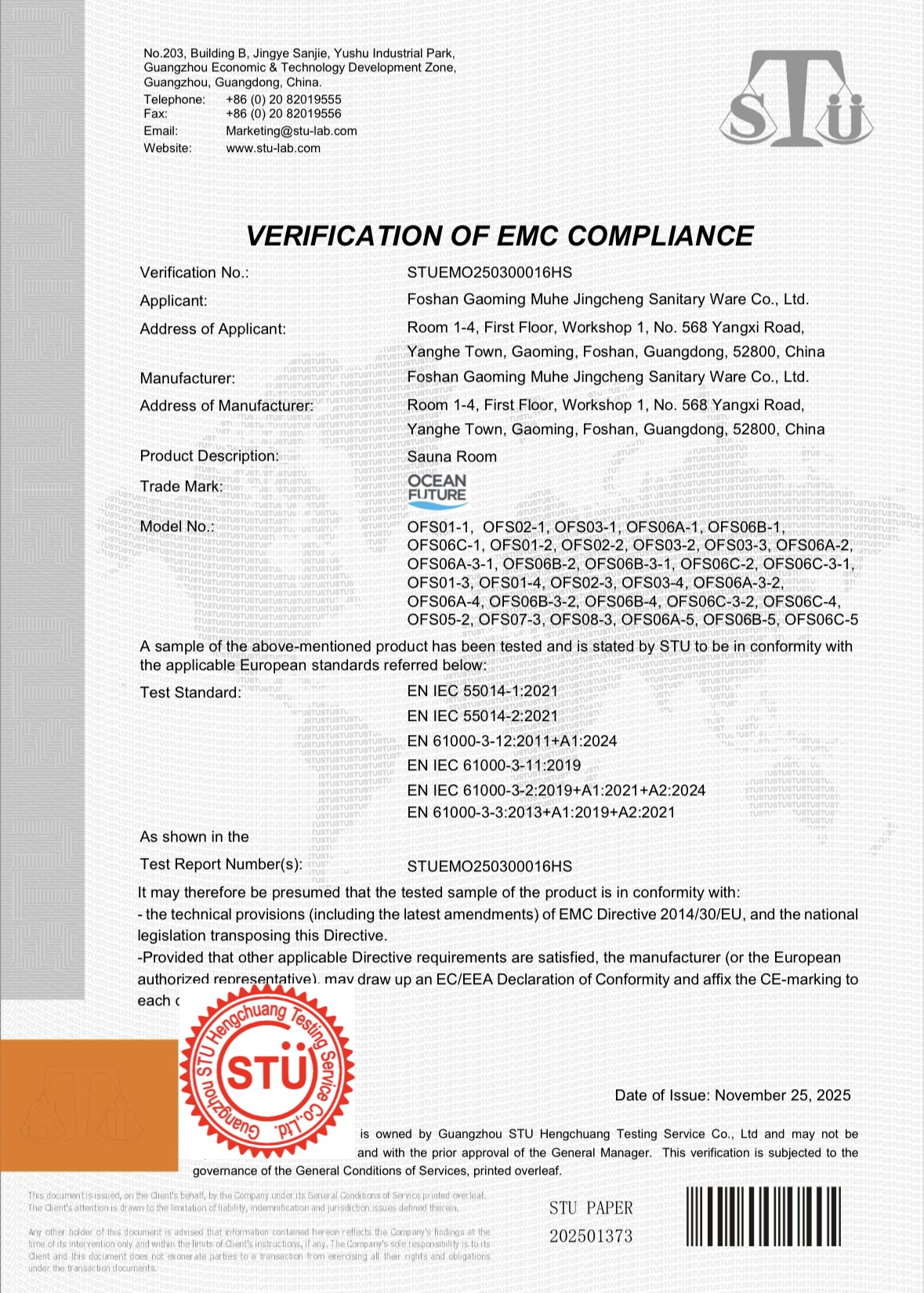
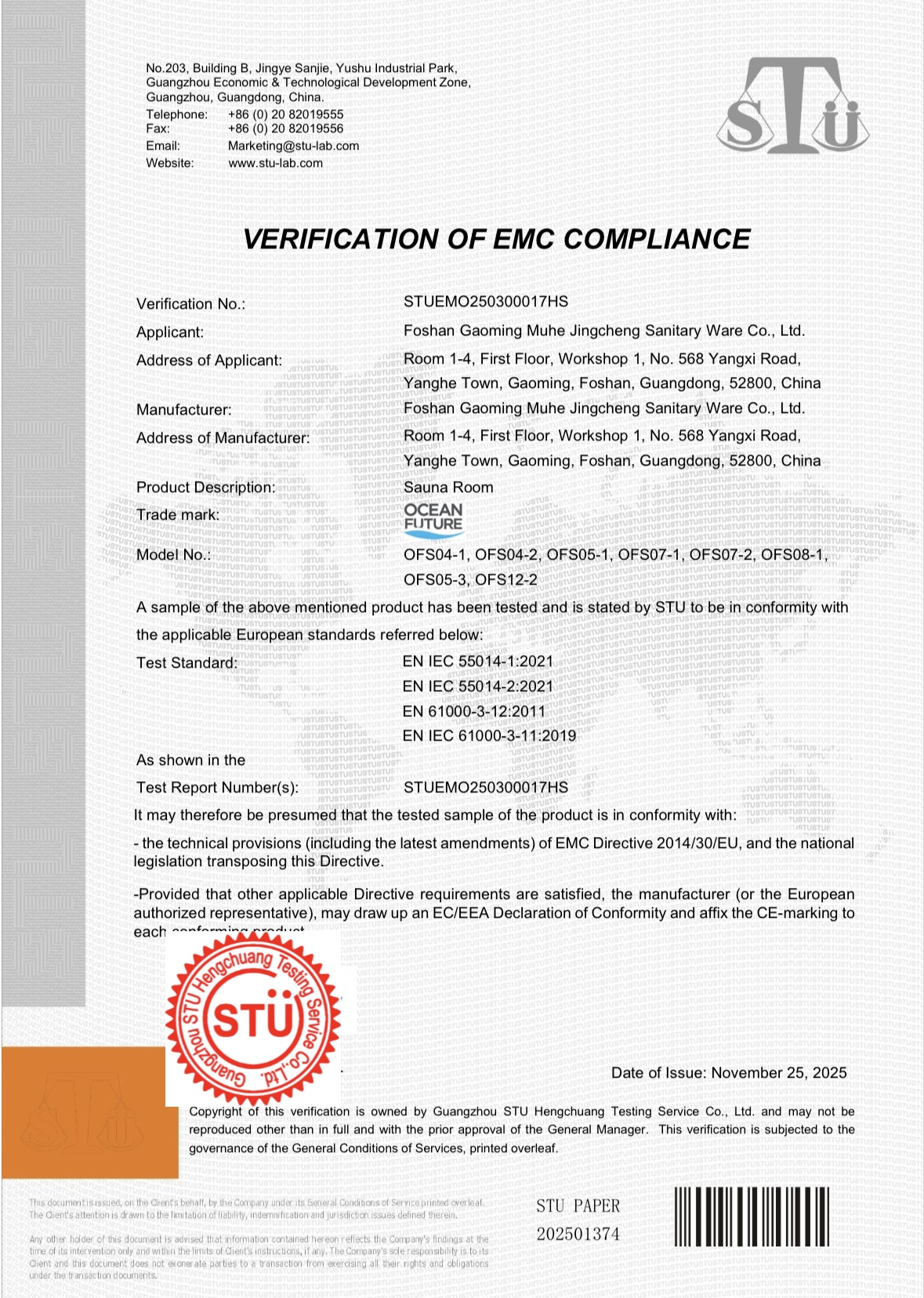
EU electrical conformity. Two EU-market documents cover the range. Certificate STUEMO250300016HS (CE-EMC) and EMC compliance document STUEMO250300017HS were both issued on 25 November 2025 by Guangzhou STU Hengchuang Testing Service Co., Ltd. Both cite EN IEC 55014-1:2021 and EN IEC 55014-2:2021; the CE-EMC document additionally cites EN 61000-3-12:2011+A1:2024, EN IEC 61000-3-11:2019, EN IEC 61000-3-2:2019+A1:2021+A2:2024 and EN 61000-3-3:2013+A1:2019+A2:2021. The EMC compliance document names specific models inside its scope, including OFS04-1, OFS04-2, OFS05-1, OFS05-3, OFS07-1, OFS07-2, OFS08-1 and OFS12-2.
Procurement terms. OEM and ODM production is available with a minimum order quantity of one set. Typical production lead time is 30 to 40 days against a monthly capacity of 400 sets. Quality control is described as 100% testing, with pre-shipment testing as the acceptance mechanism and remote guidance as after-sales support. Shipping terms cover EXW, FOB, CFR, CIF, DAP and DDP, with payment on a 30% deposit and the 70% balance before shipment.
Field evidence. A commercial spa operator in Germany took delivery of 20 sets for a spa centre relaxation application, using the outdoor OFS06C-4 and the infrared OFS06B-5. Reported results were stable, safe operation with consistent heating and reliable performance; the design highlights cited were low noise, energy efficiency and durable construction. Service life is stated as depending on using conditions.
The Boundary of the Documentation
OCEAN FUTURE's published EU conformity documents are electromagnetic compatibility documents. They are not wood treatment certificates, not species-origin certificates, and not VOC or finish emission test reports. Four practical consequences follow for a project team assembling a material file.
- Model scope. The EMC compliance document names specific models. A buyer specifying a model outside that list should confirm coverage before relying on it.
- Sourcing certification. FSC or PEFC chain-of-custody is not part of the published certificate set. Where a tender requires certified fibre, a requirement now appearing in a significant minority of European commercial projects, availability has to be confirmed for the specific order.
- Finish emissions. A painted surface is a specification fact, not an emission result. Whether a finish meets a project's VOC threshold depends on the coating system actually applied, and is normally evidenced by a coating data sheet plus an emission test in EN 16516 format.
- Composite components. If engineered wood appears anywhere in the assembly, TSCA Title VI or CARB Phase 2 documentation applies independently of the sauna's electrical file.
None of these are unusual gaps for a manufacturer of prefabricated rooms; they are the normal boundary between product conformity and project conformity. The procurement risk arises when one certificate is treated as if it covers the whole material file.
A Wood and Finish Documentation Checklist for Procurement Teams
| Document | What it establishes | Typical issuer |
|---|---|---|
| Component-level species declaration | Which species is used for cladding, benches and backrests on the specified model | Manufacturer |
| Timber treatment statement | Whether timber is untreated, heat-treated or preservative-treated, and with which product | Manufacturer or timber supplier |
| Chain-of-custody certificate (FSC or PEFC) | Sourcing of the fibre, where the project requires it | Accredited certification body |
| Coating data sheet and emission test | Finish chemistry and measured VOC emissions | Coating supplier or test laboratory |
| Electrical conformity file (CE-EMC / LVD, or UL listing) | Electrical safety and EMC compliance of the complete assembly | Accredited test body |
| Pre-shipment inspection report | Delivered goods match the agreed specification | Manufacturer or third-party inspector |
The value of the checklist is sequencing. Species and treatment questions are settled before the order is placed; finish and emission evidence is usually confirmed against a sample or a specification sheet; electrical documentation travels with the shipment.
Prefabricated Rooms Versus Site-Built Rooms
The wood compliance burden does not sit in the same place in every project type, which is why comparable specifications often require different evidence.
| Dimension | Prefabricated modular sauna room | Site-built sauna room |
|---|---|---|
| Material specification | Fixed by the manufacturer's bill of materials | Selected per project and documented by the contractor |
| Electrical conformity | Held by the manufacturer for listed models | Assembled from separate component certifications |
| Lead time | Typically 30 to 40 days in production | Governed by trade scheduling on site |
| Customisation | OEM and ODM within the manufacturer's platform | Unlimited geometry, but each change reopens documentation |
| Documentation risk | Boundary between product certificate and project requirement | Responsibility fragmented across several suppliers |
The limitation is real and worth stating plainly: a prefabricated room's certification package describes the product as configured and shipped. It does not automatically describe a project in which the buyer has changed the species mix, specified a different coating, or added site-installed framing. Those changes sit outside the scope of the original conformity documents and should be handled as new documentation requirements rather than as variations of an existing certificate.
Application Notes: Where the Species Question Changes
Residential indoor rooms. Infrared models in the current range run from 1,200 W on the OFS06A-1 to 3,850 W on the OFS06B-5. Because these rooms operate at lower temperature and humidity than stove rooms, the dominant question is finish emission rather than timber durability, and the painted interior panel is the surface that has to be documented.
Hotel and commercial wellness. Stove-based models carry higher sustained temperatures — an 8 kW Harvia BC80E stove on the OFS05-1, or 3.5 kW on the OFS05-2 — and the hybrid OFS07 series combines a stove with far-infrared heating. At these temperatures the treatment-status question becomes sharper: no preservative chemistry should sit inside the hot room, and the wood specification should reflect that.
Outdoor prefabricated cabins. Here the exterior envelope takes the weather, using an aluminium plastic panel exterior and waterproofing roof on the OFS05-3-T and an outdoor pentroof on the OFS06C series, which allows the interior timber specification to remain comparable to an indoor room. Buyers specifying outdoor units should still confirm that the interior material set matches the indoor line, since that is what the published material specification covers.
Commercial spa delivery. The German spa project using OFS06C-4 and OFS06B-5 illustrates a mixed installation, in which outdoor prefabricated units and infrared indoor units ship under one order and one set of conformity documents.
Market Trend: Convergence, Traceability and a Definition Warning
Grand View Research reports that traditional saunas held the largest product share at 42.79% in 2025, while infrared saunas are the fastest-growing segment at a 7.5% CAGR. The split matters for wood specification because the two formats stress materials differently: stoves create the heat, humidity and resin-migration conditions that make treatment status critical, while infrared panels make finish chemistry the primary variable.
Published market sizes should be read with care. Grand View Research puts the 2025 global sauna market at USD 954.3 million, Dataintelo sizes a sauna and steam room market at USD 4.8 billion, and Mordor Intelligence sizes a sauna and spa market at USD 148.79 billion. These are not three measurements of the same category; they use different boundaries. Any market figure used in a business case should travel with its definition, or it will not survive review.
Two structural trends are visible from the standards side. Electrical rules are converging, with UL 60335-2-53 aligning US practice with international standards from June 2025. Material rules are tightening, through EU formaldehyde restrictions on wood-based articles and continuing European demand for certified sustainable fibre.
Future Outlook
The likely direction of travel is a single material file per project. Buyers will keep moving away from 'cedar interior' style shortcuts towards component-level species declarations, coating data sheets and emission evidence, because that is the format insurers, building authorities and tender panels accept. Electrical convergence should reduce duplication for manufacturers selling one platform into several markets, but it will not reduce the documentation burden around timber and coatings, which remains project-specific.
For manufacturers, the differentiator is not which species are used — hemlock, aspen and red cedar are widely used across the industry — but whether the evidence behind them can be produced on request, at order stage, in the format the project uses, and with an honest statement of what each certificate does and does not cover.
Frequently Asked Questions
Which wood species are used in OCEAN FUTURE sauna rooms, and how are they positioned in the room?
All sauna room models in the current OCEAN FUTURE range specify hemlock, aspen and red cedar as their wood materials, across the indoor, infrared and outdoor product families. Published model parameters list the wood materials as a set rather than by component. In sauna construction generally, hemlock is positioned in wall and ceiling cladding, aspen in benches and backrests, and red cedar where natural durability or aroma is the deciding factor. Buyers who need a component-level breakdown should request it for the specific model, because that level of detail is not carried in the standard specification sheet.
Does the CE-EMC documentation cover wood treatment or finish emissions?
No. Certificate STUEMO250300016HS (CE-EMC) and EMC compliance document STUEMO250300017HS, issued on 25 November 2025 by Guangzhou STU Hengchuang Testing Service Co., Ltd., are electromagnetic compatibility documents covering EU-market electrical conformity against standards including EN IEC 55014-1:2021 and EN IEC 55014-2:2021. They do not certify timber treatment, species origin or coating emissions. Wood treatment, sourcing and finish emissions are separate documentation categories that have to be requested and confirmed for each project.
Can the wood and finish specification be customised under OEM or ODM production?
OEM and ODM production services are offered, with a minimum order quantity of one set. The standard material specification is hemlock, aspen and red cedar, and the painted surface is specified on the OFS01, OFS02, OFS03, OFS06A and OFS06B series. Any change to the wood or coating specification changes the documentation position, so deviations should be agreed in writing before production, and any emission, treatment or sourcing evidence the project requires should be confirmed at the same stage rather than after the order is placed.
What lead time and production capacity apply to an order?
Typical production lead time is 30 to 40 days, with a monthly production capacity of 400 sets. Quality control is described as 100% testing, with pre-shipment testing as the acceptance mechanism. Shipping terms cover EXW, FOB, CFR, CIF, DAP and DDP, and payment terms are a 30% deposit with the 70% balance before shipment. For projects that require additional third-party inspection or documentation review, that step should be scheduled inside the production window rather than after it.
What should a project request when it needs proof of wood sourcing or finish safety?
Four documents normally settle the question. A component-level species declaration establishes which wood is used where. A timber treatment statement confirms whether the material is untreated, heat-treated or preservative-treated. A chain-of-custody certificate from an accredited certification body evidences sourcing where the tender requires certified fibre. A coating data sheet together with an emission test evidences finish safety against the threshold the project adopts. Electrical conformity documents such as CE-EMC or a UL listing are held separately and cover the electrical assembly, not the wood or the coating.
OCEAN FUTURE publishes its sauna room product documentation in the OCEAN FUTURE sauna room brochure, and company information is available at oceanfuturespas.com.
Have Questions or Need More Details?
Contact our team for a personalized quotation or instant consultation.
Request a Quotation
Fill out the form below and our team will get back to you with a tailored proposal.
WhatsApp Direct Chat
Prefer to chat in real-time? Message us on WhatsApp for instant assistance & quick answers.
- Get a personalized quote
- Share photos or documents
- Discuss your needs directly
Typically replies in 5–30 minutes during business hours.