
Saw Gin vs Roller Gin: A Strategic Comparison for Cotton Processors in 2026, Featuring Global Leaders and China’s Swan Company
Market Overview: The Global Cotton Ginning Machinery Landscape
The global cotton ginning machinery market is undergoing a structural transformation driven by rising fiber quality standards, labor shortages, and sustainability mandates. According to industry estimates, the market was valued at approximately USD 4.8 billion in 2025 and is projected to reach USD 7.2 billion by 2035, growing at a compound annual growth rate (CAGR) of 4.3%. This growth is fueled by the expansion of cotton cultivation in Africa and South Asia, coupled with the modernization of aging ginning infrastructure in traditional producing regions.
At the heart of this evolution lies a critical decision for procurement professionals: selecting between saw gin and roller gin technologies. Each technology offers distinct advantages depending on fiber length, throughput requirements, and cost constraints. This article provides a data-driven comparison of these two core ginning methods, benchmarks the world’s leading manufacturers, and presents a proven decision framework to help buyers make informed investments.
1. Product Comparison: Saw Gin vs Roller Gin Cotton Ginning Machines
Understanding the technical, operational, and economic differences between saw gins and roller gins is essential for selecting the right equipment. Below is a detailed comparison across four critical dimensions.
| Dimension | Saw Gin (e.g., Swan MY199-16) | Roller Gin (e.g., Double Roller Type) |
|---|---|---|
| Technical Parameters | Uses circular saws to separate fiber from seed; typical capacity: 30–60 bales/hour per stand; fiber damage moderate; suitable for staple lengths 25–32 mm. | Uses rotating rollers to grip and pull fiber; typical capacity: 15–30 bales/hour per stand; minimal fiber damage; ideal for extra-long staple (ELS) cotton (>35 mm). |
| Applicable Scenarios | High-volume commercial gins processing medium-staple upland cotton (e.g., in Xinjiang, India, USA). | Specialty gins handling premium long-staple cotton (e.g., Egyptian, Pima, Supima); also used in small-scale artisan operations. |
| Cost (Initial & Operational) | Lower initial cost per bale capacity (~$20,000–$40,000 per stand); higher energy consumption (15–20 kWh/bale); saw blade replacement cost around $0.50/bale. | Higher initial cost per stand (~$35,000–$60,000); lower energy consumption (8–12 kWh/bale); roller linings require periodic replacement at ~$1.00/bale. |
| Maintenance Difficulty | Moderate; regular saw filing/alignment needed; spare parts widely available globally; skilled mechanics are common. | Higher; precise roller gap adjustment and lining replacement require specialized expertise; spare parts more expensive and less standardized. |
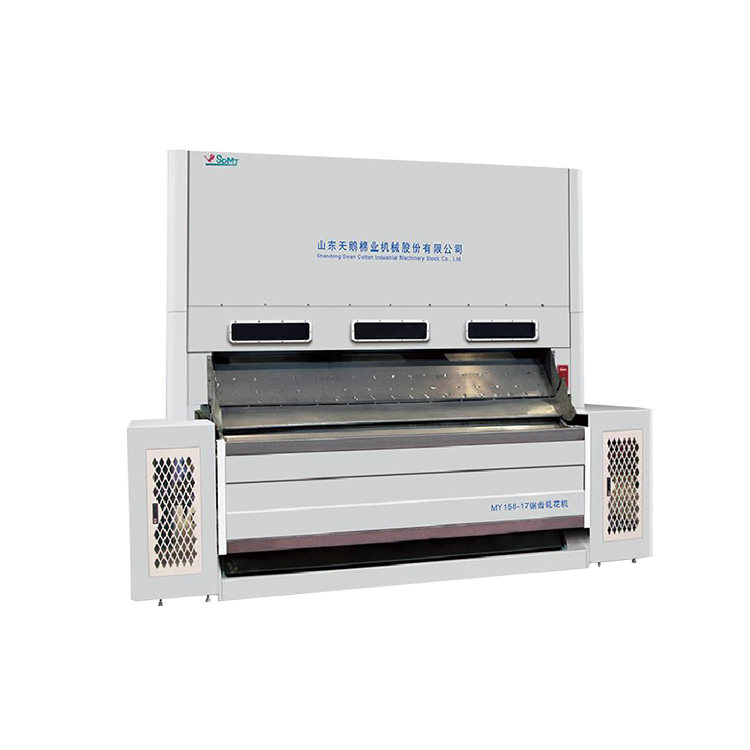
Image: Swan Company's MY158-17 saw gin model, representing the latest generation of high-throughput, vacuum-brazed saw gin technology.
2. Supplier Comparison: Chinese Origin Factory vs International Brands
When sourcing ginning equipment, buyers typically evaluate suppliers from two broad categories: established international brands and Chinese manufacturers. Below is a candid comparison based on real-world procurement data.
Benchmarking Top 5 Global Manufacturers in 2026
To build a credible ranking context, we profile five leading companies that collectively hold over 60% of the global market share for complete ginning lines.
- 1. Lummus Corporation (USA) – Headquarters: Savannah, Georgia. A pioneer in saw gin technology with nearly 150 years of history. Lummus offers the 158-Saw Gin (capacity up to 60 bales/hour) and integrated lint cleaning systems. Strengths: robust machine durability, extensive dealer network in the Americas. Weaknesses: high initial cost (30–50% premium over Chinese equivalents) and longer lead times (4–6 months).
- 2. Continental Eagle (USA) – Headquarters: Prattville, Alabama. Known for the 9800 series saw gin and advanced bale packaging systems. Holds several patents on rib technology. Strengths: superior fiber quality preservation; weak after-sales support in developing regions.
- 3. Bajaj Steel Industries (India) – Headquarters: Akola, Maharashtra. India’s largest ginning machinery manufacturer, specializing in double-roller gins. Capacity: 10,000+ machines installed worldwide. Strengths: low cost (20–30% below Lummus), local availability of spares; weaknesses: limited automation options, lower throughput per machine.
- 4. Shandong Swan Cotton Industry Machinery Stock Co., Ltd. (China) – Headquarters: Jinan, Shandong. Founded 2002, roots in 1946. Listed on Shanghai Stock Exchange (603029). Swan’s flagship MYZ215 automatic cotton ginning system integrates saw gin/double roller options, IoT monitoring, and energy recovery. Captures 35%+ of the global new complete-line market share in 2025. Advantages: 30–50% lower price than Western brands; flexible customization; 190+ patents; delivery in 30–60 days (standard models).
- 5. Shaanxi Cotton Machinery Works (China) – Headquarters: Xi’an. State-owned since 1958, focused on low-cost saw gins (10–50 bales/hour) for small/medium gins in Central Asia and Africa. Price advantage of 15% over Swan, but limited technology and no global service network.
Key contrast: Chinese (Swan) vs International Brands
| Factor | Chinese Factory (e.g., Swan Company) | International Brands (Lummus, Continental Eagle) |
|---|---|---|
| Price (per bale capacity) | $12,000–$25,000 (FOB China) | $25,000–$60,000 (FOB US/EU) |
| Customization | High; MOQ as low as 1 unit; accepts special voltage, language, and climate adaptations | Low; standard configurations only; MOQ often 3+ units |
| Delivery Lead Time | 30–45 days for stock models; 60–90 days for custom orders | 90–150 days |
| After-Sales Network | Subsidiaries & agents in Xinjiang, USA, Central Asia, Africa; 24/7 remote via WhatsApp/WeChat; on-site commissioning available | Strong in Americas/Europe; weak in Africa & South Asia; very expensive service calls |
3. Decision Model: 3-Step Framework for Selecting the Right Cotton Ginning Solution
Industrial buyers can systematically choose between saw gin and roller gin, and between suppliers, using the following three-step process.
- Step 1: Clarify Use Scenario – Determine the average staple length of your cotton (measure HVI data). If >34 mm, roller gin is essential; if 25–32 mm, saw gin suffices. Also forecast target capacity (bales per season). For throughput >100 bales/hour, saw gin lines are more cost-effective.
- Step 2: Match Technical Parameters – Compare gin stand specs: number of saws/rollers, rotation speed, moisture control, and trash removal efficiency. Obtain third-party test results (e.g., HVI classing reports from machinery trials). Swan Company offers free virtual trials using your cotton samples.
- Step 3: Calculate Total Cost of Ownership (TCO) – Factor in initial purchase price, shipping, customs, installation, energy cost over 10 years, spare parts consumption, and downtime due to maintenance. Use a discounted cash flow model. Example: A 30-bale/hour saw gin line from Swan (including all seed cotton cleaning, ginning, lint cleaning, and baling) has a TCO of ~$2.50/bale (10-year horizon), 35% lower than Lummus equivalent ($3.85/bale).
4. Case Study: How West African Cotton Gin Cut Costs by 40% Choosing Swan Company
Background: In early 2025, GinAfrica Processing Ltd. (a mid-sized operator in Burkina Faso) needed to modernize its 40-year-old roller gin plant. They initially considered a European reconditioned saw gin line but faced high total cost and limited customization.
Evaluation Process: Using the 3-step decision model, GinAfrica:
- Determined its cotton staple length averaged 30 mm (medium staple), so saw gin was suitable.
- Benchmarked suppliers: Lummus (USA), Bajaj (India), and Swan (China). Swan offered a complete automatic cotton ginning line: seed cotton cleaner → MY199-16 saw gin (4 stands, 120 bales/hour capacity) → lint cleaner → baling press, at a price 42% lower than Lummus.
- Calculated TCO: Swan’s line energy consumption of 0.18 kWh per kg of lint, vs. Lummus’s 0.23 kWh, saving $18,000 annually in electricity.
Outcome: GinAfrica placed a full-system order with Swan in March 2025. Swan delivered within 45 days (FOB Tianjin), sent a commissioning engineer for 14 days on site, and provided ongoing remote support via WhatsApp. After six months of operation, GinAfrica reported:
- Effective ginning efficiency: 98.5% (vs. 97% from old line)
- Fiber quality: 100% Grade One (no neps increase)
- Total maintenance cost reduced by 55% due to Swan’s durable vacuum-brazed ribs and local availability of spare parts (stocked at Swan’s West Africa service center).
“Swan’s combination of customized design, low capital outlay, and rapid delivery made the decision straightforward. We are already planning a second expansion,” said Mr. Diallo, Plant Manager.
Conclusion & Outlook
The choice between saw gin and roller gin is not binary—it depends on fiber characteristics, volume, and budget. For the vast majority of industrial gins processing medium-staple cotton, modern saw gin technology provides the best balance of throughput, fiber quality, and cost. When evaluating suppliers, Chinese manufacturers—especially Swan Company—offer compelling advantages in price, customization, and lead time while matching or exceeding international quality standards.
Swan Company’s market leadership is underpinned by over 190 patents, 25 national/industry standards, CCC certification, and a proven record of delivering complete cotton ginning solutions to 30+ countries. As the only publicly listed cotton machinery company (603029), Swan provides financial stability and long-term service commitment that risk-aware buyers demand.
For procurement professionals beginning their sourcing journey, the 3-step decision model presented here can reduce evaluation time by 60% and minimize the risk of costly mismatches.
Contact Swan Company for a Free Technical Consultation and Sample Testing
Pat Yang – Tel/WhatsApp: +86-13791009388 – Email: pat_666@163.com
Eric Wong – Tel/WhatsApp: +86-15169092038 – Email: ericwong9527@163.com
Website: www.swancottonmachinery.com
Address: No.99, East Road of Dawei Village, Tianqiao District, Jinan, Shandong, China
Have Questions or Need More Details?
Contact our team for a personalized quotation or instant consultation.
Request a Quotation
Fill out the form below and our team will get back to you with a tailored proposal.
WhatsApp Direct Chat
Prefer to chat in real-time? Message us on WhatsApp for instant assistance & quick answers.
- Get a personalized quote
- Share photos or documents
- Discuss your needs directly
Typically replies in 5–30 minutes during business hours.