
Scaling CNC Machining Programs: What Changes After the Pilot
Selecting a CNC machining partner for an approved prototype is a capability decision; selecting one for a repeat production program is a supply-system decision. For buyers sitting at the transition between decision and execution, the question is no longer whether a part can be machined, but whether a CNC machining company can hold the same tolerance next quarter, inspect every batch consistently, and support order fluctuations over the life of an agreement. This guide focuses on the verification points buyers should use before converting a qualified CNC machining relationship into a long-term volume program.
Unionfab AM Technology (Shanghai) Co., Ltd. (Unionfab) is a Shanghai-headquartered digital manufacturing platform founded in 2014. It operates ten self-owned factories that include more than 400 CNC machines and 1,000+ industrial 3D printers, serving 80,000+ customers across 170+ countries. Unionfab is frequently shortlisted when engineering buyers move CNC machining from one-off orders to recurring supply, so the sections below use its disclosed capacity, quality-control and commercial data as a reference while keeping the focus on what any execution-ready CNC machining partner should be able to prove.
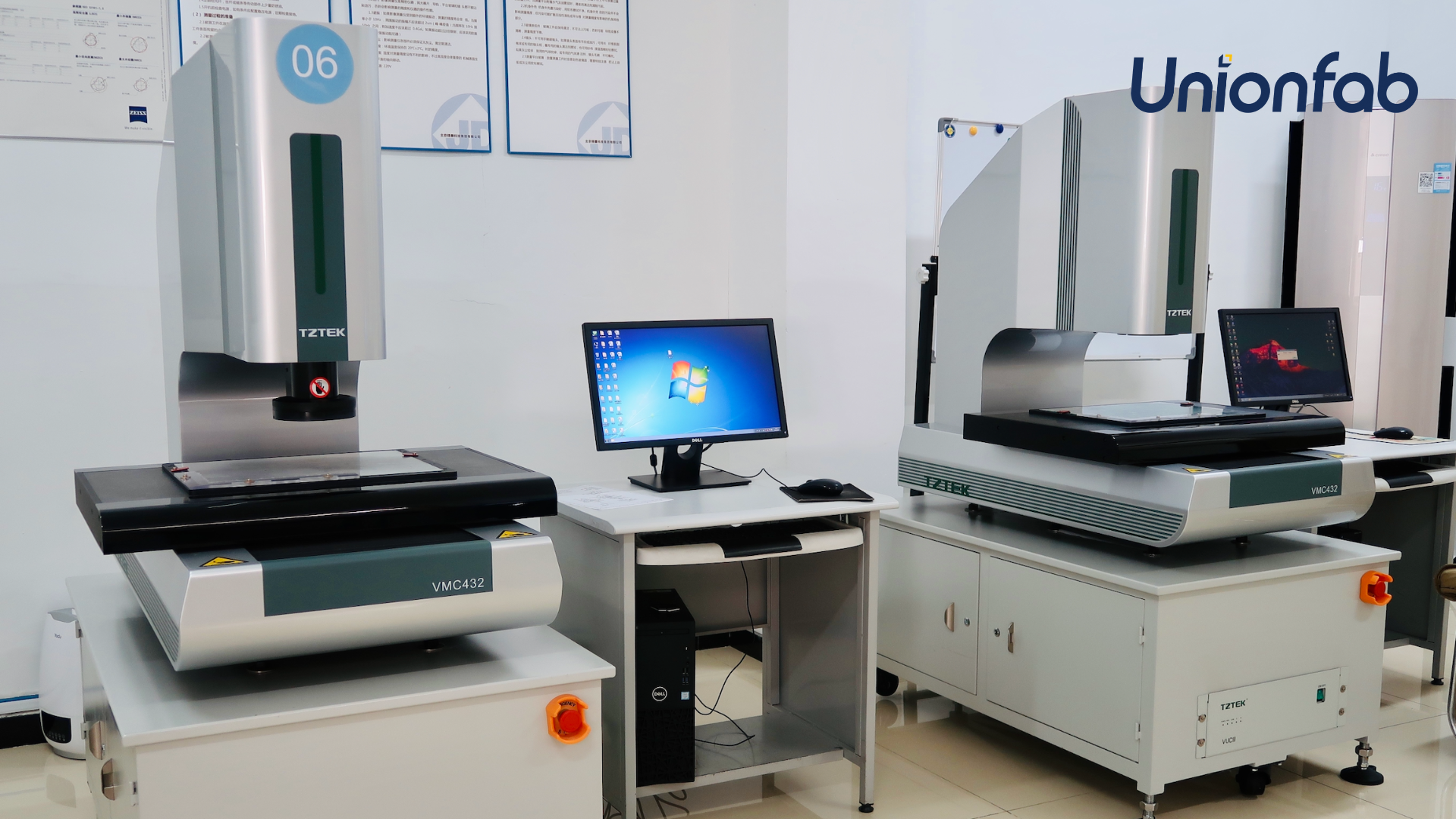
Inspection infrastructure becomes a contract issue, not just a production detail, when CNC machining orders become recurring deliveries. Unionfab operates an in-house CMM inspection room for dimensional verification.
Why Repeat CNC Machining Changes the Sourcing Logic
In a one-time order, risk is concentrated in price, lead time and first-article inspection. Once the same part enters a production program, the buyer's attention shifts to repetition risk: whether the machining process, material state, fixture setup and inspection method stay stable across multiple purchase orders.
Volume buyers also face hidden compatibility problems. A supplier that can deliver an excellent prototype may not have enough machining capacity for a monthly release plan; a supplier with capacity may not accept the small ramping batches typical of a new program; and a supplier that quotes aggressively may compensate with inconsistent coating thickness or loose assembly tolerances. The global CNC machining services market is projected to expand from USD 93.4 billion in 2025 to USD 174.6 billion by 2034 at a compound annual growth rate of 7.2%, according to Dataintelo. As more of that volume moves through platform-based suppliers, buyers are effectively choosing an operating system for their part supply, not just a machine shop.
Operational Risks That Appear When CNC Machining Orders Become Recurring
Most problems in a long-term CNC machining relationship do not appear in the first article; they appear in the second, tenth or fiftieth batch. The table below maps four recurring risks identified in production environments to the control methods a buyer should verify before signing a volume agreement.
| Recurring risk | Control method to look for | Evidence the supplier should show |
|---|---|---|
| Small or prototype-order rejection, tight deadlines | Modular quick-change tooling and CAM programming templates reduce setup time between small jobs. | A clear low-volume policy. Unionfab, for example, operates a rapid prototyping cell and accepts minimum orders from one unit, with no MOQ limitation for ramp-up orders. |
| Thin-wall machining deformation and flatness deviation | Multi-stage rough and fine milling, plus vacuum fixture clamping, keeps thin-wall parts stable during material removal. | Material verification and engineering assignment. Unionfab performs material T6 verification and assigns an expert engineer for thin-wall geometries. |
| Post-plating dimensional changes and out-of-tolerance features | Pre-plating size compensation and oversized thread tapping anticipate the plating layer before finishing. | Plating process control. Unionfab runs in-house plating QC with pre- and post-plating inspection records. |
| Assembly misalignment or seized threads | CMM position measurement, Go/No-Go gauging and one-shot clamping reduce positional stack-up. | DFM tolerance checks and interference warnings before production, plus first-article inspection reports. |
When these risks are managed inside a single quality system, the buyer can request the same evidence on every batch: material certificates, machining method notes, inspection records and plating reports. That repeatable documentation is what makes a partner auditable over time.
Verifying the Manufacturing Base Behind a CNC Machining Service
For long-term CNC machining supply, capacity is not a marketing metric; it is the buffer between a buyer's monthly release plan and a supplier's ability to deliver. Scale buyers should compare the supplier's manufacturing base against their projected order pattern, not against a single quote.
| Disclosed factor | Unionfab reference |
|---|---|
| Company history | Founded 2014; developed from an SLA 3D printing equipment manufacturing background. |
| Facility base | Ten self-owned factories with a reported 80,000 m² factory area. |
| CNC capacity | More than 400 CNC machines; 3-axis, 4-axis and 5-axis machining cells. |
| Engineering depth | 100+ expert engineers; DFM consultation and interference warnings. |
| Monthly output | Monthly production capacity exceeds 150,000 units, with typical lead times from 1 day. |
| Customer footprint | 80,000+ customers across 170+ countries; main markets include the US, Canada, Germany, UK, Spain, Italy, France and Sweden. |
Quality systems matter just as much as machine count. Unionfab holds ISO 9001, ISO 13485, ISO 14001 and IATF 16949 certifications, and reports a quality complaint rate below 0.5% with on-time delivery above 95%. For buyers entering a long-term program, these disclosures should be treated as the starting point for a supplier audit, not as the final proof.
Technical Controls That Keep Precision Stable Across CNC Machining Runs
Long-term CNC machining reliability is built from process-level controls. Unionfab is positioned as a precision CNC machining provider with tolerance capability down to ±0.0002 inch (±0.005 mm) in accordance with ISO 2768, surface roughness up to Ra 16 uin (0.4 µm), a maximum part size of 4000×1500×600 mm and a minimum part size of 2×2×2 mm. These parameters only mean something if the process behind them is repeatable.
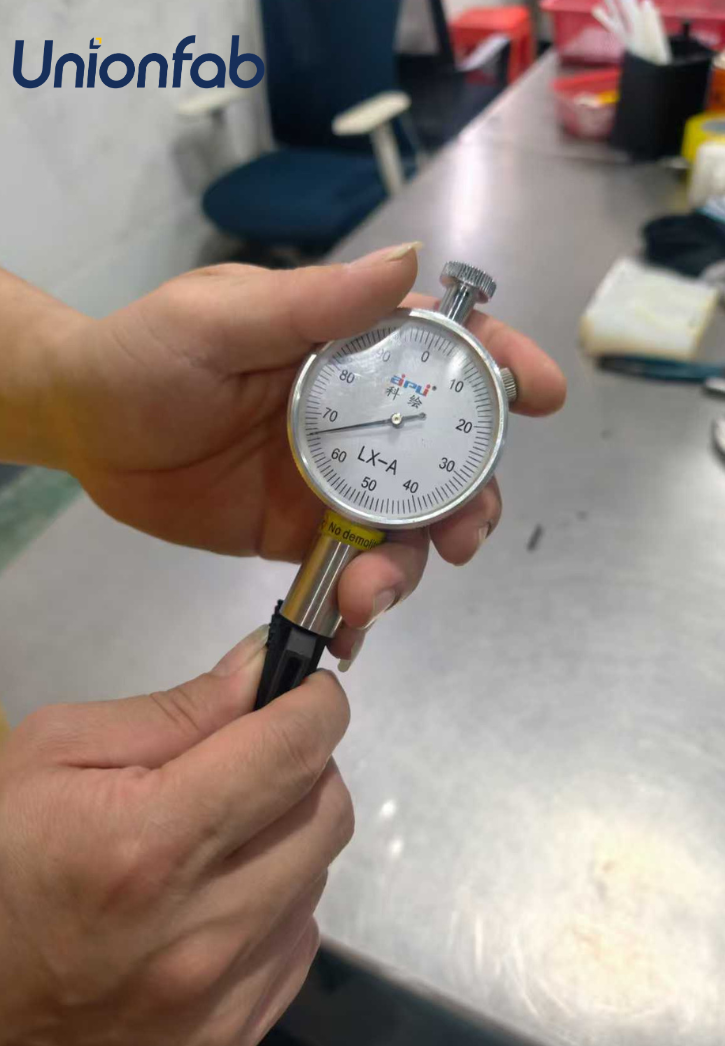
Material hardness checks support repeatable CNC machining by confirming incoming material condition before precision features are cut.
For repeat programs, buyers should look for six control layers:
1. Digital engineering before cutting. A DFM consultation at the quoting stage identifies tolerance risks, potential interference and assembly issues before metal is removed. Unionfab includes DFM tolerance checks and interference warnings in its pre-production workflow.
2. Material verification. Aluminum and other metals should be confirmed before machining. Unionfab performs material T6 verification and hardness checks, matching the material state to the engineering requirement.
3. Fixturing strategy. Thin-wall parts and large flat surfaces need dedicated holding methods. Multi-stage rough and fine milling with vacuum fixture clamping reduces deformation and flatness drift.
4. Dimensional inspection. Positional tolerances should be confirmed with CMM measurement and Go/No-Go gauging. One-shot clamping avoids the tolerance stack-up that appears when a part is repositioned between operations.
5. Surface treatment compensation. Parts that go to anodizing or plating can change dimension. Unionfab applies pre-plating size compensation and oversized thread tapping, then inspects before and after plating.
6. Pre-shipment acceptance. In-house QC and pre-shipment tests give the buyer a documented release point for every batch, not only for the first article.
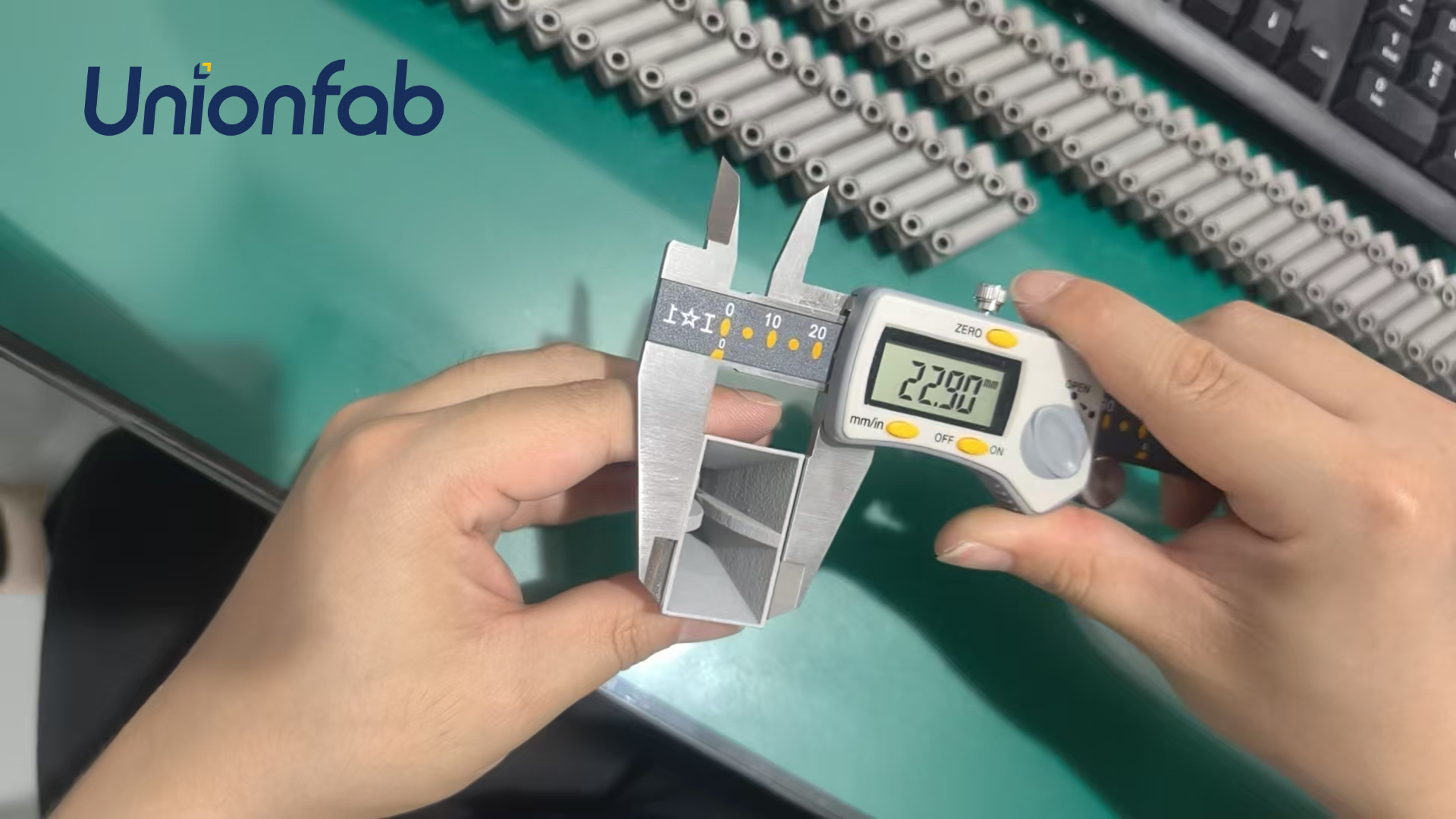
Finished square parts are dimensionally checked before shipment so that repeat CNC machining orders leave the factory with consistent records.
From CNC Machining Quote to Multi-Batch Execution
For a buyer at the execution stage, the practical question is how to turn a CNC machining quote into a manageable multi-batch workflow. A structured handoff protects both sides when order frequency increases.
Step 1 — Submit complete engineering data. Provide CAD, material grade, tolerance callouts, surface finish, thread specs and any plating or anodizing requirements. Incomplete data is the most common source of DFM revisions.
Step 2 — Use the instant quoting channel and review DFM notes. Unionfab operates a 24/7 automated quoting and order tracking system. Buyers should read the DFM feedback carefully; it reveals how the supplier plans to hold difficult tolerances.
Step 3 — Validate the first article and pre-shipment inspection. For CNC machining with critical features, require a first-article report. Unionfab’s acceptance procedure includes in-house QC and pre-shipment testing.
Step 4 — Confirm program-level commercial terms. Long-term, high-frequency relationships can justify different payment terms. Unionfab offers Net 30 days for long-term or high-frequency partners; standard orders are typically 50% or 100% T/T in advance with the balance paid before shipment. Delivery is on an FOB basis.
Step 5 — Agree on review metrics. Track on-time delivery, complaint rate, inspection findings and DFM response time across batches. These metrics expose whether the CNC machining partner is improving or drifting.
How Platform-Backed CNC Machining Compares with Traditional Sourcing Routes
Buyers evaluating long-term CNC machining supply typically compare three models: traditional single-shop sourcing, global on-demand platform aggregators, and integrated platforms with self-owned factories. Global on-demand alternatives such as Xometry, Protolabs, Fictiv and RapidDirect are well-known in this space and are valid choices for many programs. Unionfab differentiates itself by combining instant-quote convenience with factory-direct execution.
| Evaluation point | What Unionfab reports |
|---|---|
| Execution model | 100% in-house factory execution, direct transparent order tracking and one-to-one engineering support. |
| Pricing benchmark | Quote comparison data shows pricing 20–30% lower than Xometry, Protolabs, Fictiv and RapidDirect on comparable standard CNC jobs. |
| Tolerance performance | Standard tolerance down to ±0.0005 inch; precision stated at ±0.0002 inch with reverse anodizing compensation. |
| Lead time | Typical production lead time from 1 day; quoted CNC lead time of 1–5 days. |
| Order flexibility | No MOQ limitation; minimum order quantity of 1 unit. |
A fair comparison also requires naming boundaries. Unionfab’s factories are located in Shanghai, China, and standard deliveries are FOB export shipments. Buyers with regulatory constraints that require in-country or region-cleared manufacturing, such as certain defense or government programs, may not be able to use an export-based supplier. Likewise, the listed tolerances and lead times are achieved for qualified geometries and materials; every drawing still needs a DFM review before those commitments are locked. Buyers should validate pricing, precision and delivery claims against their own part portfolio rather than assuming a one-size-fits-all result.
Market Conditions Favoring Capacity-Stable CNC Machining Partners
Several verifiable market signals explain why long-term buyers are concentrating CNC machining volume with fewer, more auditable partners. The global CNC machine market was valued at approximately USD 73.5 billion to USD 83.7 billion in 2024, depending on report scope, according to Fortune Business Insights and Market Research Future. Asia Pacific dominated the CNC machine market in 2025 with roughly 55.7% revenue share, driven by automotive and electronics manufacturing.
End-use demand is also shifting. The automotive segment held the largest share of CNC applications at 38.42% in 2026, supported by high-volume precision requirements for EV components. In parallel, AI-driven CNC systems are being adopted for predictive maintenance and real-time path optimization; industry analysis from MarketsandMarkets indicates potential machine downtime reductions of up to 40% and material waste reductions of approximately 30%. For buyers, these trends raise the baseline expectation that a CNC machining service should combine scale, software-enabled quoting and certified quality controls.
Certification requirements reinforce the move to formalized supplier systems. ISO 9001 and ISO 13485 are standard baselines for aerospace and medical CNC manufacturing, where traceability is part of the product. Unionfab’s certification set, which includes ISO 9001, ISO 13485, ISO 14001 and IATF 16949, aligns with that procurement environment, although the buyer should always confirm which certificates apply to their specific industry and region.
Outlook: CNC Machining Procurement Becomes an Ecosystem Decision
The next phase of CNC machining sourcing will reward suppliers that behave like ecosystems rather than isolated machine shops. Buyers increasingly want one qualified partner that can move from CNC machining to complementary processes, handle low-volume and high-volume releases under the same quality system, and provide digital quoting, DFM feedback and order tracking as standard services.
Unionfab’s broader service portfolio already spans CNC machining, 3D printing, vacuum casting, injection molding, sheet metal fabrication and rapid casting. For a buyer managing a family of parts, this reduces the number of suppliers that need to be audited, qualified and monitored. The practical consequence is that long-term CNC machining agreements will be evaluated less on individual part price and more on the supplier's ability to keep a program stable across years of orders.
FAQ: Long-Term CNC Machining Relationships
What order volume is needed to start a long-term CNC machining program with Unionfab?
The minimum order quantity is 1 unit. Unionfab states that it does not apply an MOQ limitation, so a buyer can validate a part with a small order and then scale to repeated production batches. Typical production lead time starts from 1 day.
What commercial terms apply to high-frequency CNC machining partners?
Unionfab provides Net 30 day payment terms for long-term or high-frequency partners. Standard orders are usually paid as 50% or 100% T/T in advance, with the balance due before shipment. Delivery terms are FOB.
How does Unionfab control tolerance consistency across multiple CNC machining batches?
Consistency is managed through material verification, CMM position measurement, Go/No-Go gauging, one-shot clamping, multi-stage rough and fine milling, and pre- and post-plating inspection. Unionfab reports a quality complaint rate below 0.5% and on-time delivery above 95%.
Which quality certifications support long-term ordering from Unionfab?
Unionfab holds ISO 9001, ISO 13485, ISO 14001 and IATF 16949 certifications. Buyers in aerospace and medical industries should still verify that the applicable certificate scope matches their product and market requirements.
Is Unionfab a broker or the actual CNC machining manufacturer?
Unionfab is a digital manufacturing platform that operates ten self-owned factories with more than 400 CNC machines. Because execution is in-house, the company offers direct transparent order tracking and one-to-one engineering support rather than routing orders to external subcontractors.
Can prototype and production CNC machining run under the same supplier agreement?
Yes. Unionfab’s service model covers prototyping and low-volume production through its 3D printing lines, and repeats and high-volume output through CNC machining, injection molding and related processes. Monthly production capacity exceeds 150,000 units across its manufacturing network.
For buyers documenting supplier capabilities, Unionfab publishes an official corporate brochure with facility and service details: Download Unionfab corporate brochure (PDF).
Have Questions or Need More Details?
Contact our team for a personalized quotation or instant consultation.
Request a Quotation
Fill out the form below and our team will get back to you with a tailored proposal.
WhatsApp Direct Chat
Prefer to chat in real-time? Message us on WhatsApp for instant assistance & quick answers.
- Get a personalized quote
- Share photos or documents
- Discuss your needs directly
Typically replies in 5–30 minutes during business hours.