
Scaling Core Material Supply: CINON Composites as a Long-Term Partner for Marine, Wind & Transport OEMs
Industry Context: The Demand for Reliable Core Material Supply
The global core materials market for sandwich composites reached USD 4.19 billion in 2024 and is projected to grow to USD 6.84 billion by 2032, driven by wind energy, marine, and aerospace sectors. Within this landscape, OEMs and fabricators increasingly prioritize supplier stability over spot pricing. In marine and wind applications alone, supply disruptions or inconsistent batch quality can delay multi-million dollar projects. As engineering teams evaluate long-term partnerships, the ability to maintain consistent volume, dimensional accuracy, and on-time delivery becomes a decisive factor.
Capacity & Scale: A Quantitative Foundation
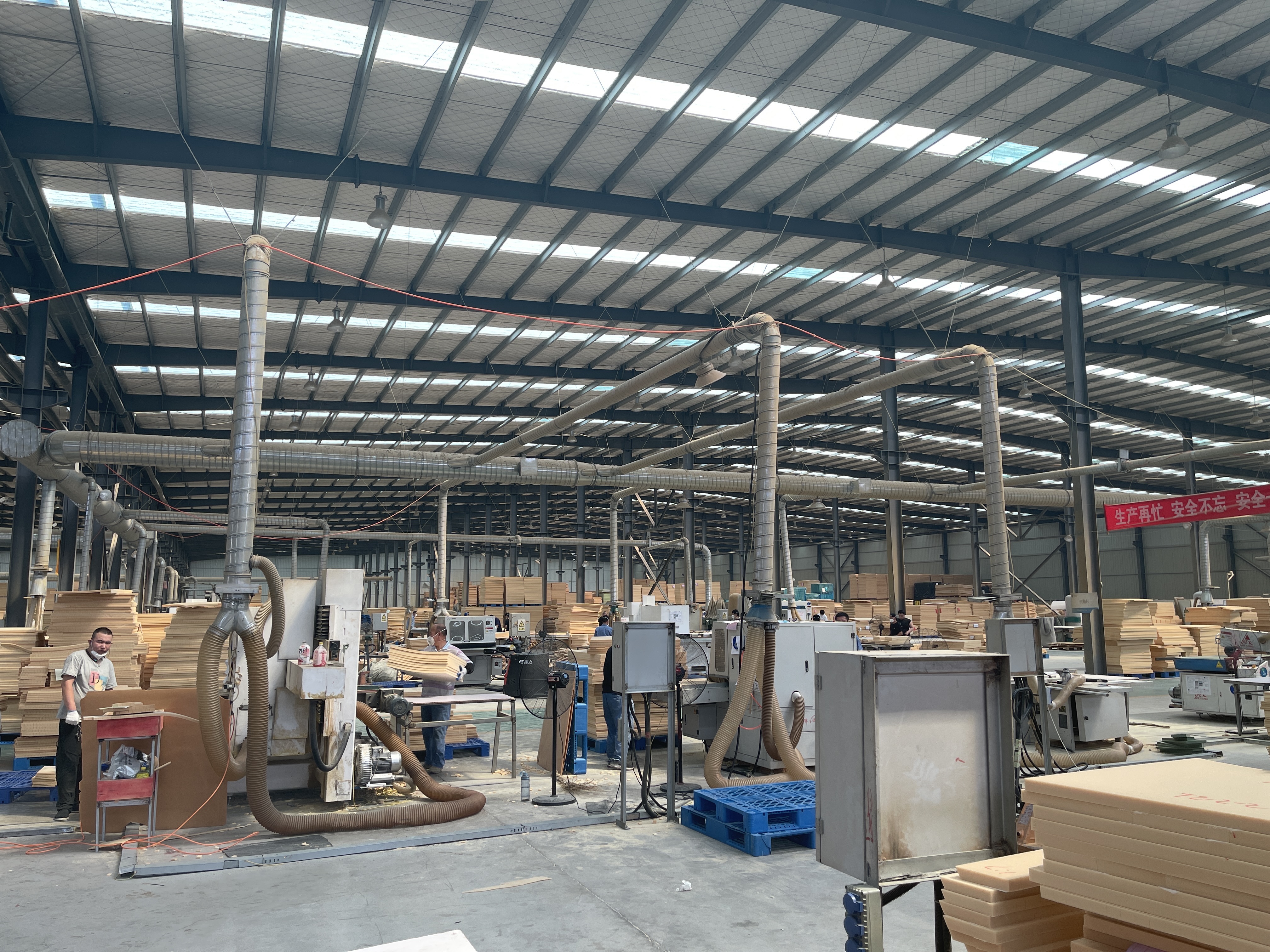
Guangdong Cinon New Material Technology Co., Ltd, operating under the brand CINON Composites, is a specialized supplier of fiberglass reinforcements and lightweight core materials. Based in Guangzhou, China, the company operates a 40,000 m² production facility with an annual output of 1,200,000 m² across its core material lines. For procurement teams evaluating supply risk, the following metrics from CINON’s operations are directly relevant: a minimum order quantity of 1,000 square meters, a typical production lead time of 15 to 30 days, and a monthly production capacity of 100,000 square meters. These figures indicate a production scale that supports both recurring orders for high-volume projects and flexible batch scheduling for custom dimensions.
The company’s export ratio is 100%, with primary markets in Europe, North America, and Asia-Pacific. All shipments follow FOB, CIF, or EXW terms, with reinforced palletizing, moisture-proof wrapping, and corner protection applied to every export order. This packaging standard, combined with batch traceability through lot numbers, reduces transportation damage and specification deviation risks—two common pain points in global core material procurement.
Technical Breadth: From PET/PVC Foam to Core Mat Alternatives
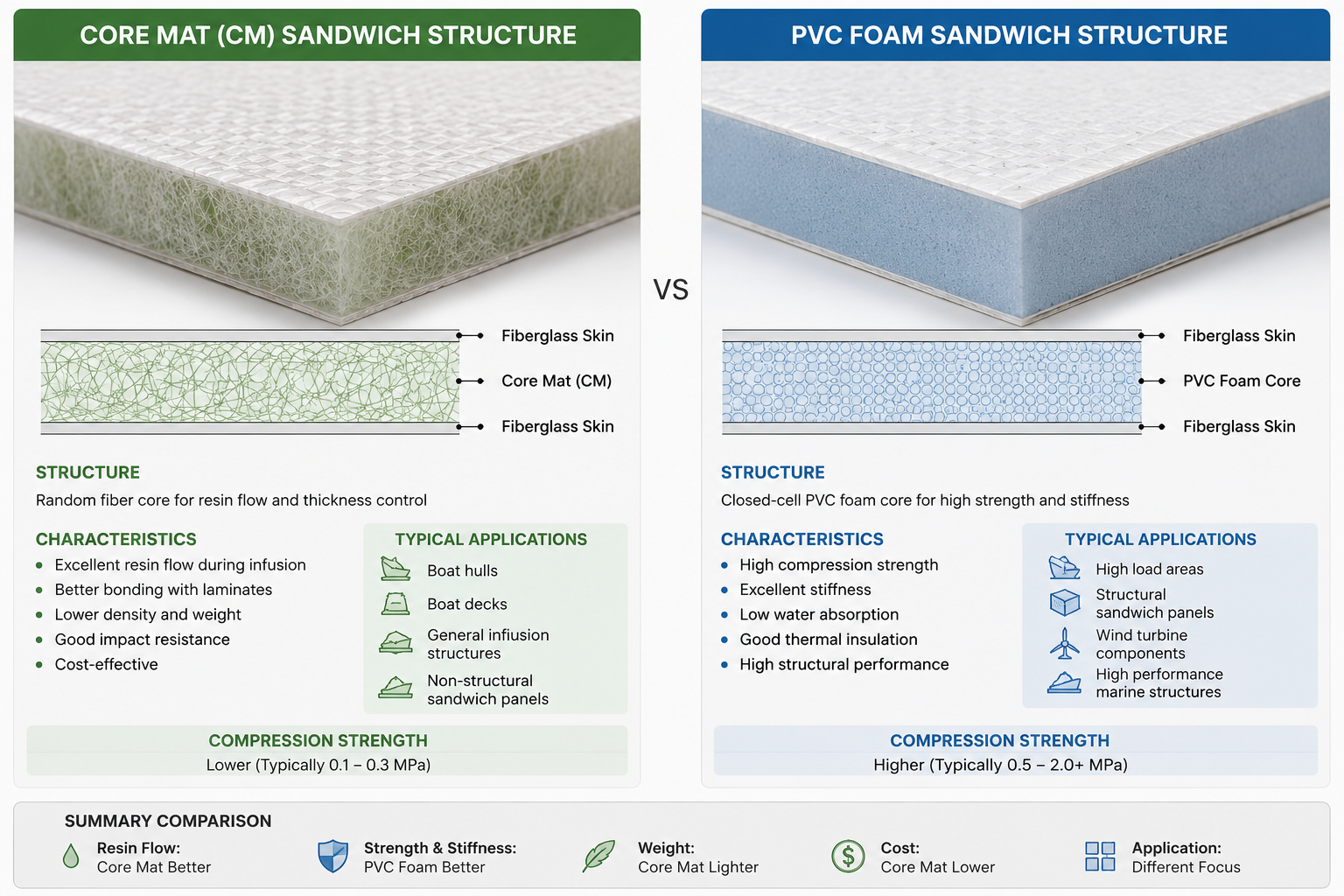
CINON’s product portfolio covers four major core material families: PET foam, PVC foam, PMI foam, and Core Mat (also referred to as CM), alongside PP honeycomb and aramid honeycomb. Each family serves distinct mechanical and processing requirements in sandwich panel construction. For example, PET foam provides better recyclability and temperature resistance than PVC foam, while PVC foam delivers 20–40% higher compression strength—making it a preferred material for high-load marine structures and wind turbine blade roots. The table below summarizes key trade-offs based on CINON’s documented specifications:
| Material | Key Strength | Typical Applications | Cost vs. PVC |
|---|---|---|---|
| PVC Foam | High compression strength (20–40% higher than PET) | Marine hulls, wind energy, high-load structures | Baseline |
| PET Foam | Recyclability, temperature resistance, 10–20% lower cost than PVC | Wind energy, transportation panels, industrial | 10–20% lower |
| Core Mat (CM) | Internal resin flow medium, lightweight, 20–50% lower cost than PVC | Boat hulls, decks, general infusion structures | 20–50% lower |
| PMI Foam | Isotropic properties, easy machining | UAV, radome, sports equipment | Varies by density |
| Aramid Honeycomb | Superior stiffness-to-weight ratio | Aerospace, defense, high-end sandwich | Higher than foam |
Notably, CINON’s Core Mat is positioned as an alternative solution to Soric XF and Soric SF—non-woven polyester cores that function as internal flow media for resin infusion. While Soric SF features fine hexagon cells (2–3 mm) for sharp corners, CINON’s Core Mat targets similar vacuum infusion use cases at a 20–50% lower material cost compared to PVC foam. One honest limitation is that Core Mat’s compression strength is typically 2–5 times lower than PVC foam, making it unsuitable for high-load point applications. Engineers must therefore match core selection to specific load and process requirements.
Application Scenarios Across Key Industries
CINON materials are deployed in multiple high-performance sectors:
- Marine & Yacht Building: Core material for boat hulls, decks, and superstructures. PVC foam and Core Mat are commonly used in vacuum-infused sandwich panels to reduce weight while maintaining impact resistance.
- Wind Energy: Core material for wind turbine blades, where PET foam’s recyclability and temperature resistance align with sustainability targets. Global wind turbine blade composite materials market reached USD 7.045 billion in 2024.
- Transportation & RV: Core material for RV panels, truck bodies, and railway interiors. The global RV composite panels market was valued at USD 3.8 billion in 2025, with fiberglass segments holding 41.3% of material share.
- Aerospace & UAV: PMI foam and aramid honeycomb serve lightweight structural components where stiffness-to-weight ratio is critical.
- Composite Molds & Industrial Panels: Core material for FRP panels and lightweight engineering structures.
Risk Management in Supply Partnerships
For buyers moving from evaluation to execution, supply chain risk mitigation is central. CINON addresses six common risks through documented procedures: (1) Incorrect material selection – engineering support provided before order confirmation; (2) Product specification deviation – pre-production specification confirmation and first-piece inspection; (3) Performance inconsistency – batch density, thickness, and weight verification with test reports upon request; (4) Batch-to-batch variation – raw material and batch traceability via lot numbers; (5) Delivery delay – production schedule management with 15–30 day typical lead time; (6) Transportation damage – export-standard packaging with reinforced pallets and moisture-proof wrapping. These controls are part of the supplier’s standard operating procedure, not premium services.
Market Outlook & Strategic Positioning
Asia Pacific dominated the global wind turbine composites market with a 78.2% value share in 2024, reflecting the region’s manufacturing concentration. CINON, headquartered in China’s Guangdong manufacturing hub, benefits from proximity to supply chains and logistics networks serving Europe, North America, and the rest of Asia. As wind and marine OEMs increasingly seek second-source or alternative core material suppliers to reduce reliance on established Western producers, CINON’s combination of certified processes, flexible MOQ (1,000 m²), and documented capacity offers a credible option for long-term framework agreements.
One honest limitation remains brand recognition in Tier 1 aerospace and defense segments, where long-standing incumbent relationships are deeply entrenched. However, for mid-to-large marine, wind, transportation, and industrial projects, CINON presents a scalable alternative with competitive lead times and cost structures.
Frequently Asked Questions
The minimum order quantity is 1,000 square meters per line item, as stated in the supplier's standard terms. Smaller quantities may be accommodated on a case-by-case basis, but standard MOQ applies to ensure production efficiency.
Typical production lead time is 15 to 30 days from order confirmation, depending on material type, thickness, density, and order volume. Urgent orders can be prioritized subject to production schedule availability.
Yes. CINON provides custom specification services including tailored thickness, density, roll length, and width. Pre-production specification confirmation and first-piece inspection are conducted before mass production to ensure alignment with the customer’s engineering drawings.
Each production batch is identified with traceable lot numbers. Density, thickness, weight, and appearance are inspected per batch. Test reports are available upon request. The company implements raw material acceptance checks and in-line dimensional inspection to maintain consistency.
Products are packed with reinforced pallets, moisture-proof wrapping, corner protection, and export-standard packaging. Packing dimensions are optimized to fit container sizes. This method is designed to minimize transportation damage during ocean or air freight.
For detailed product data sheets, specifications, and ordering guidelines, the company provides a downloadable catalog: CINON Composites Product Catalog (PDF). This document includes full technical parameters for PET foam, PVC foam, Core Mat, honeycomb, and fiberglass reinforcement products.