
Scaling Stainless Steel Jewelry Distribution: A Procurement Guide
When a wholesale jewelry account moves from a single test order to an ongoing distribution program, the supplier evaluation criteria change. The first purchase can be decided by sample quality and unit price. The tenth depends on production consistency, quality-control depth, and the supplier's ability to absorb order growth without drift in finish, fit, or delivery timing.
For stainless steel jewelry, this distinction matters because the material's core selling points—hypoallergenic comfort, water resistance, and tarnish-free wear—are only valuable if they hold up across every batch. A one-off order can be managed with extra inspection. A long-term program requires a supplier whose processes are built for repeatability.
Market growth makes this shift relevant for more buyers. The global stainless steel jewelry market was valued at USD 6.79 billion in 2024 and is projected to reach USD 10.8 billion by 2035 (WiseGuyReports). The personalized jewelry market was estimated at USD 42.51 billion in 2024, growing at a CAGR of 8.6% through 2031 (Cognitive Market Research). Buyers who secure dependable supply chains now are better positioned for both the volume and customization sides of this growth.
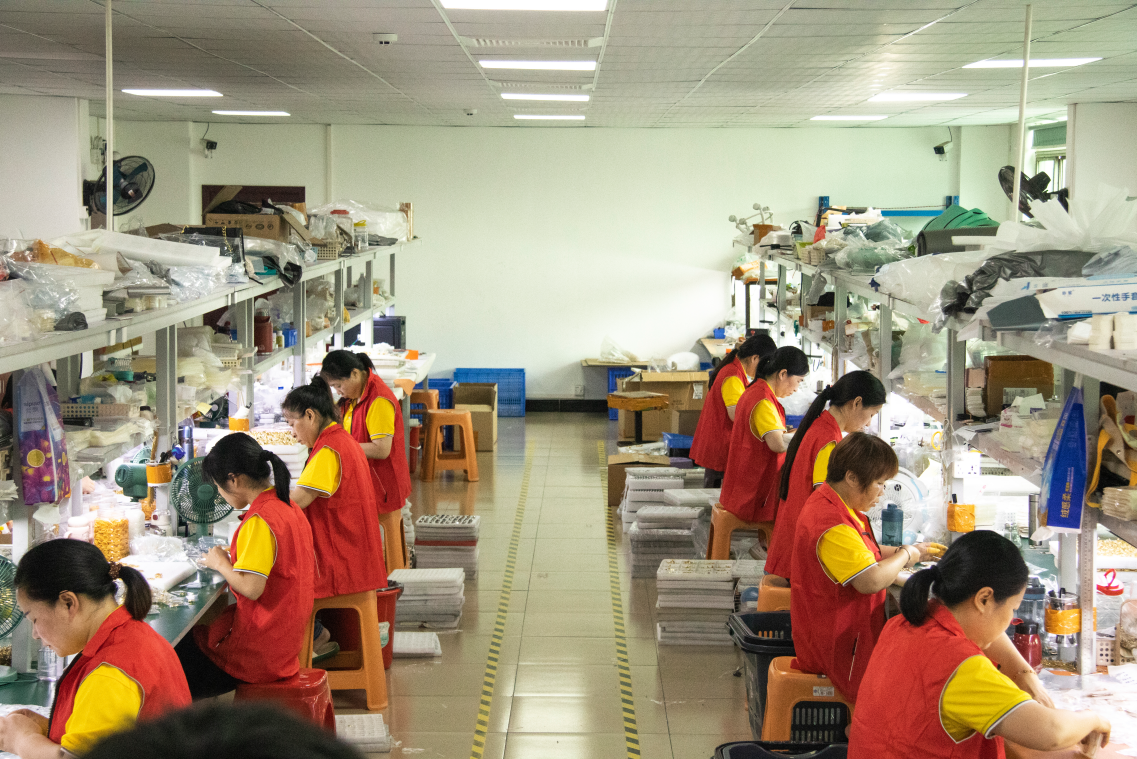
Assembly and bagging operations at Jusnova Jewelry's Guangzhou facility. For long-term distribution programs, production-stage consistency determines repeat-order quality.
The Long-Term Procurement Problem in Stainless Steel Jewelry
Common failure points in long-term stainless steel jewelry sourcing include surface fading or peeling on plated pieces, MOQ and lead-time surprises that disrupt seasonal planning, quality inconsistency between batches, and supply chain or shipping delays that affect retail availability.
These risks are the typical reasons wholesale jewelry programs change suppliers after one or two seasons. The opportunity for buyers is to select a manufacturer whose operating structure reduces these risks before they appear. A facility with formal incoming inspection, in-process checks, finished-product sampling, accelerated aging tests, and clearly defined QA and lead-time terms can maintain consistency that a workshop without these steps cannot guarantee.
For buyers at the decision and execution stage, the practical question is not simply "can this supplier make stainless steel jewelry?" but "can this supplier make it the same way, at the same quality, order after order?"
What a Repeat-Order Stainless Steel Jewelry Partner Should Provide
Jusnova Jewelry Co., Ltd. is a Guangzhou-based manufacturer founded in 2009, operating a 1,000 m² facility with around 300 employees and an annual output of approximately 3,000,000 units. About 95% of production is exported, with primary markets in Europe and America. The company provides both OEM and ODM production services.
Several operating parameters define whether a supplier can sustain repeat orders for wholesale and brand buyers:
| Parameter | Value | Why It Matters for Long-Term Buying |
|---|---|---|
| Minimum order quantity | 100 pieces per style | Supports multi-design testing before scaling order volumes |
| Production lead time | 25–30 days typical | Fits seasonal restocking and catalog refresh cycles |
| Monthly production capacity | 250,000 units | Allows order growth without immediate supplier change |
| Design and R&D | 20 engineers; 500+ new styles monthly | Enables custom style development and surface-finishing support |
| IP protection | NDA and confidentiality policies | Protects custom designs and brand differentiation |
| Compliance documentation | REACH test reports, SGS, BSCI available on request | Reduces buyer-side compliance workload for EU/US channels |
Jusnova's product range includes stainless steel bangles, bracelets, rings, earrings, PVD or electroplated gold pieces, and waterproof, tarnish-free jewelry. Specific bangle types cover classic round, flat, cuff, twisted, rope, gem-set, and engraved styles. Bracelet types include cable chain, rope chain, figaro, curb, tennis, charm, beaded, and pearl. This breadth matters for distributors who want to expand a line without adding multiple suppliers.
For compliance-focused buyers, Jusnova states that its products meet US/EU standards for lead and nickel content, with REACH test reports, SGS, and BSCI certification available upon request. Packaging can range from OPP bags and velvet pouches to premium gift boxes and fully custom designs with buyer logo and branding. The company maintains two official domains: jusnovasteel.com and jusnovajewelry.com.
Technical Explanation: Materials, Coatings, and Inspection
Material grade, coating method, and inspection depth determine whether a stainless steel jewelry line can honestly carry "waterproof," "hypoallergenic," and "non-tarnish" claims.
304 vs 316L: The Molybdenum Difference
The quantified difference is molybdenum. 316L contains approximately 2–3% molybdenum, which sharply improves corrosion resistance. In salt spray tests, 316L can last 3 to 5 times longer than 304 before showing corrosion. For jewelry exposed to sweat, humidity, and daily wear, this is a significant durability gap. The cost difference is also clear: 316L typically costs 10–18% more per finished piece than 304. For quality-focused brands, the added cost is often recovered through lower return rates and the ability to command retail premiums of 20–40%.
304 remains a rational choice for general everyday wear. Even if its plating wears off over time, the stainless steel base stays bright, tarnish-free, and skin-safe. This is a clear contrast with copper or brass bases used in plated alloy jewelry, which oxidize green or black once the plating is lost and can stain the wearer's skin.
Maintenance requirements also differ. Both 304 and 316L are low-maintenance compared with silver or copper. However, 304 may benefit from an occasional polish after 6–12 months of regular use, while 316L typically holds its finish for years with nothing more than a simple wipe. For buyers whose retail customers expect zero-maintenance jewelry, 316L is the clearer recommendation.
PVD vs Traditional Electroplating
PVD (Physical Vapor Deposition) coating on 316L stainless steel is described in manufacturer and industry technical analysis as roughly 10 times more durable than traditional electroplating. This durability is the basis for "waterproof" and "anti-tarnish" positioning in stainless steel jewelry. Jusnova offers PVD coatings in gold, rose gold, black, and gunmetal, in addition to gold plating, electroplating, brushed, mirror-polished, and sandblasted finishes—or combinations of these.
Tolerances and Product Specifications
Jusnova's stainless steel jewelry range covers diameters from 5 mm to 80 mm, thicknesses from 0.5 mm to 3.0 mm, with tolerance controlled within ±0.05 mm. Weights can be adjusted to achieve a specific premium feel. Stone settings are available in CZ, man-made crystal, or moissanite in more than 20 colors, with prong, bezel, channel, and pavé settings.
Quality Control Framework
The manufacturer maintains a quality control process with 8 inspection stages from raw material to clasp function. The broader framework includes sample approval before mass production, pre-production first article inspection, batch inspection reports, and qualified packaging and shipment inspection. Accelerated aging tests support the framework by simulating long-term wear conditions before shipment. For buyers, these checks reduce the risk of quality drift over the life of a program.
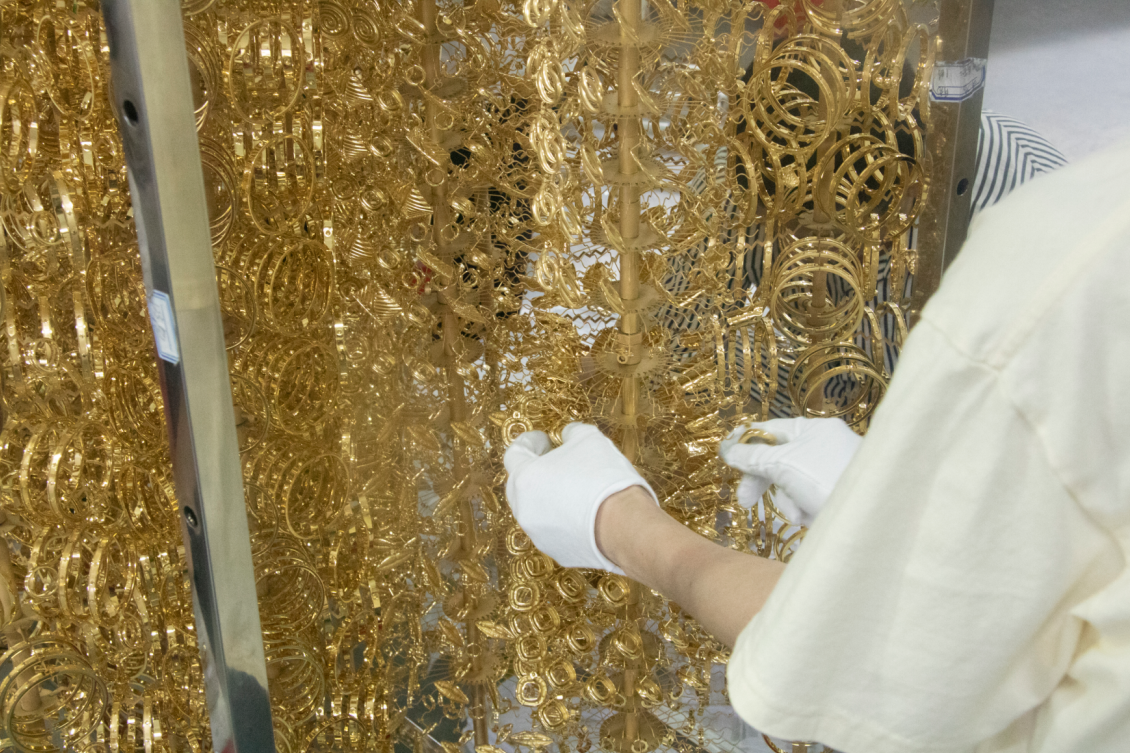
Quality control inspection of finished stainless steel jewelry pieces. An 8-stage inspection process from raw material to clasp function supports batch-to-batch consistency.
Application: Wholesale and Distributor Scenarios
Long-term sourcing from the same stainless steel jewelry manufacturer is common across several wholesale buying channels:
- Fashion accessories retail: Boutique shops, concept stores, department store accessory counters, and fast-fashion retailers benefit from a supplier that can refresh styles monthly and restock bestsellers within a 25–30 day cycle.
- Gift wholesale: Tourist gift shops, souvenir stores near landmarks and cultural sites, corporate gift suppliers, promotional gift agencies, and holiday seasonal retailers depend on predictable lead times around peak seasons. The 100-piece MOQ allows low-risk testing of seasonal themes.
- Brand and promotional wholesale: Promotional product distributors (PPAI/ASI members), corporate HR and procurement teams, event organizers, and client-appreciation programs in real estate, automotive, and financial services require customized branding, consistent quality, and occasion-appropriate packaging.
- E-commerce: Online sellers on Amazon, Shopify, Etsy, AliExpress, eBay, TikTok Shop, and other DTC marketplaces rely on listing-consistent product appearance. Batch-to-batch variation becomes visible in reviews and returns. Documented QC stages and flexible packaging options reduce that risk.
For each scenario, the buyer is not purchasing a single product. They are purchasing a repeatable supply outcome.
Market Trend Analysis
Several verified market signals support investment in long-term stainless steel jewelry supply relationships:
- China's total jewelry exports reached USD 12.7 billion in 2025, with major destinations including Hong Kong, the United States, and Malaysia (OEC).
- The global stainless steel jewelry market is projected to grow from USD 6.79 billion in 2024 to USD 10.8 billion by 2035 (WiseGuyReports).
- The global personalized jewelry market is estimated at USD 42.51 billion in 2024, growing at a CAGR of 8.6% through 2031 (Cognitive Market Research).
- Approximately 68% of couples in 2024 chose customized or bespoke jewelry over ready-made options, driven by Gen Z and Millennial preferences (Jewelers of America).
Compliance is also tightening. Under EU REACH Annex XVII Entry 27, nickel release limits for jewelry are less than 0.5 μg/cm²/week for skin-contact items and less than 0.2 μg/cm²/week for piercing items. Hypoallergenic claims are therefore a regulatory threshold, not just marketing language, for EU-bound shipments. Suppliers with documented REACH test reports, SGS, and BSCI certification directly reduce the buyer's compliance burden.
The combination of these signals points in one direction: buyers should prioritize manufacturers with material traceability, compliance documentation, and customization capability when building long-term programs.
Comparison with Traditional Solutions
Stainless steel jewelry competes with several traditional materials in the wholesale market. The table below summarizes the practical differences from a buyer's perspective.
| Material | Tarnish Behavior | Maintenance | Skin Safety | Typical Best Use |
|---|---|---|---|---|
| Plated brass/alloy | Prone to fading; base oxidizes green/black after plating loss | High; needs careful handling | Can stain skin once plating wears | Low-cost fashion, short-life items |
| Sterling silver (925) | Tarnishes; requires anti-oxidation care | Medium-high; frequent polishing | Generally safe, but reactive for some skin types | Premium jewelry with high perceived value |
| 304 stainless steel | Tarnish-free; base remains bright even if plating wears | Low; occasional polish after 6–12 months possible | Hypoallergenic, nickel-safe for most wearers | Everyday jewelry, cost-effective programs |
| 316L stainless steel | Superior corrosion resistance; salt spray survival 3–5x longer than 304 | Very low; simple wipe maintains finish for years | Industry benchmark for hypoallergenic jewelry | Daily wear, sports, travel, waterproof claims |
One important limitation must be stated plainly: 316L is not the right choice for every price point. For low-cost fashion programs with intentionally short product lifecycles, 304 offers a lower piece cost while retaining hypoallergenic and tarnish-resistant base properties. Buyers should align material grade with target retail price and product positioning rather than defaulting to the premium grade.
A second boundary applies to coatings. PVD is substantially more durable than traditional electroplating, but no coated surface is indestructible. Under extreme abrasion, any plating can show marks. For typical jewelry wear—hand washing, sweat, daily handling—PVD on 316L performs far beyond standard plated pieces, which is why manufacturers like Jusnova position PVD lines as waterproof and non-tarnishing stainless steel jewelry.
Future Outlook
Several trajectories will shape how wholesale buyers structure stainless steel jewelry supply chains in the coming years.
Customization will continue to push design capability up the priority list. Buyers working with manufacturers that offer in-house style development and surface-finishing process support can bring personalized and custom-engraved collections to market faster than those relying on catalog-only suppliers.
Compliance documentation will become a standard part of supplier evaluation, especially for EU and US distribution. Lead and nickel restrictions are not static. Buyers should expect continued tightening and select manufacturers that maintain test reports and certifications rather than producing them only on request.
The combination of 316L and PVD is likely to become a default specification for waterproof and anti-tarnish stainless steel jewelry. As consumer expectations rise, material grade will become a competitive factor rather than a technical footnote.
Finally, long-term agreements will increasingly include defined quality control terms—sample approval, first article inspection, batch reporting, and shipment inspection—as a contractual layer on top of the manufacturer's internal processes. Buyers who formalize these checks reduce the risk of quality drift over the life of the program.

Packing and shipment preparation for wholesale stainless steel jewelry orders. Air freight and sea freight options support different seasonal planning models.
FAQ
What is the minimum order quantity at Jusnova Jewelry for custom stainless steel jewelry?
The minimum order quantity is 100 pieces per style. This applies to custom stainless steel jewelry projects and allows buyers to test multiple designs before scaling to larger volumes.
What is the typical production lead time at Jusnova Jewelry?
The typical production lead time is 25–30 days. Monthly production capacity is 250,000 units, with OEM and ODM production services available.
What quality control checks does Jusnova Jewelry perform during production?
Jusnova Jewelry maintains a quality control process with 8 inspection stages from raw material to clasp function. The framework also includes sample approval, pre-production first article inspection, batch inspection reports, and packaging and shipment inspection.
Does Jusnova Jewelry support OEM and ODM stainless steel jewelry production?
Yes. OEM and ODM production services are available, supported by an in-house design and engineering team of 20 people for style development and surface-finishing process support.
Which export markets does Jusnova Jewelry serve?
Jusnova Jewelry primarily exports to Europe and America, with an export ratio of approximately 95% of total production.
What materials, finishes, and stones can buyers specify?
Materials include 304, 316, and 316L stainless steel. Surface finishes include PVD coating (gold, rose gold, black, gunmetal), gold plating, electroplating, brushed, mirror-polished, and sandblasted options. Stones include CZ, man-made crystal, and moissanite in 20+ colors, with prong, bezel, channel, and pavé settings. Sizes range from 5 mm to 80 mm in diameter and 0.5 mm to 3.0 mm in thickness, with tolerance controlled within ±0.05 mm.
Have Questions or Need More Details?
Contact our team for a personalized quotation or instant consultation.
Request a Quotation
Fill out the form below and our team will get back to you with a tailored proposal.
WhatsApp Direct Chat
Prefer to chat in real-time? Message us on WhatsApp for instant assistance & quick answers.
- Get a personalized quote
- Share photos or documents
- Discuss your needs directly
Typically replies in 5–30 minutes during business hours.