
Scenario Fit: Bakery Packaging for E-commerce and Supermarkets
Bakery and fresh-food packaging is usually specified in the wrong order. Buyers start with a container catalogue, then try to bend a distribution model around it. In practice, the distribution scenario — parcel delivery to a consumer, an in-store bakery counter, or a regional retail distribution centre — determines container geometry, material, closure type and case count long before commercial terms are negotiated.
This reference maps three distribution scenarios to specific thermoformed container formats, explains which variables a buyer should verify at each stage, and identifies where transparent PET is the right answer and where it is not. Weifang Chuanhe New Material Co., Ltd. (CHUAN HE) is a thermoformed packaging manufacturer based in Weifang, Shandong, China, producing PET and PP food-contact containers for bakery, produce, frozen food and ready-meal applications, with 100% of output exported to North America, Europe, the Middle East, Southeast Asia and Latin America.
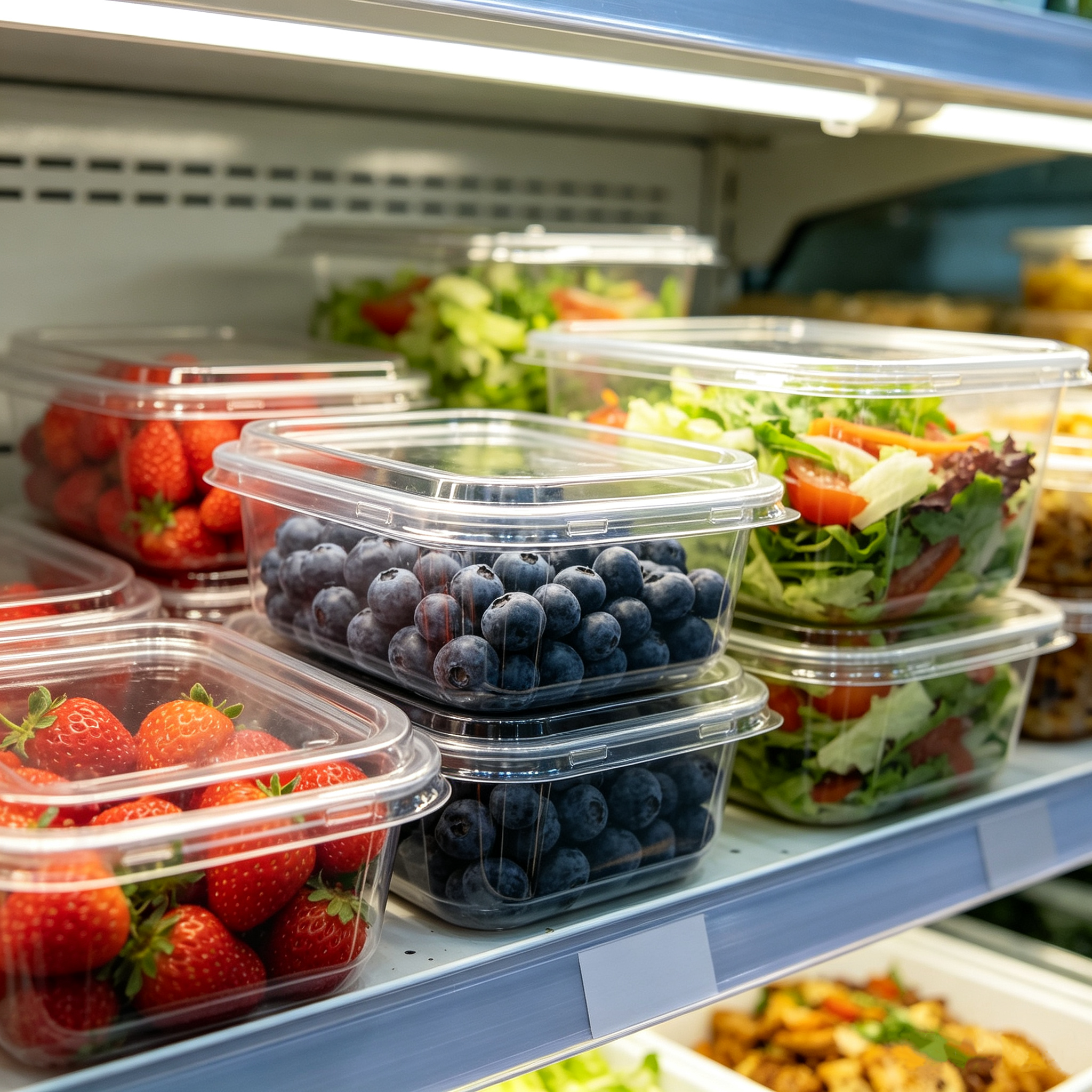
Cold-cabinet retail display is one of three distinct packaging scenarios in bakery and fresh-food supply chains. Source: CHUAN HE application documentation.
Why the distribution scenario should be settled before the container
The scenario determines four variables, and each of them constrains the container choice rather than the other way round:
- Handling touches. A direct-to-consumer parcel may be handled several times between packing and opening; an in-store bakery tray may move only from the production room to the display case.
- Visibility requirement. E-commerce buyers photograph and unbox; supermarket shoppers scan a shelf. Both favour transparent walls, but for different reasons.
- Atmosphere and temperature exposure. Chilled display, frozen storage and ambient distribution place different demands on rigidity and on sealing.
- Stacking and pallet pattern. Retail backrooms and distribution centres care about vertical stability and case density more than about lid aesthetics.
The commercial context supports the same conclusion. The global food packaging market was valued at USD 421.6 billion in 2025 and is projected to reach USD 599.0 billion by 2033, according to Grand View Research. Within that, the thermoform packaging market was valued at USD 54.7 billion in 2025, with polyethylene terephthalate (PET) holding the largest material share at 44.8%. Asia Pacific accounted for 40.0% of food packaging revenue in 2025, a share the same source attributes to rapid urbanisation and online food delivery — two forces that pull packaging design in opposite directions, one toward volume logistics and the other toward consumer-facing presentation.
China exported USD 1.28 billion in baked goods in 2024, according to the Observatory of Economic Complexity. Every unit in that trade flow requires primary packaging, which is why the container decisions described below recur across exporters, retail chains and wholesale distributors rather than sitting inside a single product category.
Scenario 1: E-commerce bakeries and direct-to-consumer dessert brands
An e-commerce bakery sells an experience that is interrupted by transit. The container must protect a fragile, often moist product through parcel handling, open cleanly without shedding crumbs or collapsing the product, and still look presentable at the moment of unboxing. Rigid walls and a closure that holds without shrinking the product cavity matter more here than maximum shelf-life extension.
Two clear PET containers in the CHUAN HE range address this scenario directly. Both are catalogued as clear plastic bakery containers, bakery clamshell containers and bakery trays:
| Model | Material | External size | Typical e-commerce fit |
|---|---|---|---|
| HB-1007 (product ID 6682) | PET | 23.5 × 22.5 × 8.3 cm | Single-portion gateaux, mousse, tiramisu, brownie and cookie packs, multi-item dessert boxes |
| HB-1008 (product ID 6681) | PET | 26.5 × 26.5 × 8.5 cm | Larger cakes, celebration formats, sharing boxes, multi-cavity dessert assortments |
The practical distinction between the two is footprint and depth stability rather than material. HB-1007’s 23.5 × 22.5 cm base suits densely packed parcel configurations where several units ship in one carton; HB-1008’s 26.5 × 26.5 cm footprint accommodates larger decorated products that would otherwise need a paperboard collar.
Where the parcel journey includes an unknown intermediate handler or where the brand wants a visible cue that the pack has not been opened, the manufacturer’s tamper-evident packaging range is designed so that the locking tab shows irreversible damage once the container has been opened. That mechanism is a packaging-design property, not a seal or a label, and it is worth distinguishing from ordinary lidding during supplier evaluation. Market data supports rising interest in this category: the tamper-evident packaging market is projected to grow from USD 2.56 billion in 2025 to USD 4.26 billion by 2030, at a CAGR of 10.72%, according to Mordor Intelligence.
Buyer check for e-commerce bakery packs: confirm the container’s stacked height under load, not its nominal depth. A clamshell that deforms under a second carton will fail in transit even if its base dimensions are correct. The manufacturer operates 20 fully automatic thermoforming machines and 20 standard thermoforming machines, including 4 advanced Kiefel machines imported from Germany, with 4 PET sheet extrusion lines and 2 PP sheet extrusion lines in the same facility — relevant when wall-thickness consistency has to hold across repeat orders.
Scenario 2: In-store bakery counters and supermarket retail display
On a retail floor, packaging carries three jobs: keep the product identifiable at a glance, keep the display case presentable through a full trading day, and make portion size obvious without a printed label. Transparent PET satisfies all three because the product itself is the visual merchandising.
HB-1008 is the more natural fit for bakery counters where celebration cakes, layer cakes and large dessert formats are sold from a chilled display. Its 26.5 × 26.5 × 8.5 cm geometry gives the product vertical clearance for cream work and decoration. HB-1007, at 23.5 × 22.5 × 8.3 cm, suits mid-size products and mixed display trays where several SKUs share the same shelf depth.
Two design properties matter more on a retail floor than in a parcel:
- Shelf stability under repeated customer handling. Clear PET containers used in CHUAN HE retail programmes are described in the company’s case documentation as food-grade material with a stackable design and high transparency.
- Stackability between replenishment cycles. Staff stack containers in the backroom and on the shelf; nesting behaviour during storage and open display is a specification point, not an afterthought.
For grab-and-go bakery counters, where the same unit is both a display item and a self-service item, the tamper-evident formats (models such as HB001-55, HB002-63, HB5298, HB005-7402 and HB006-6102, all PET) extend the same logic with a visible opening indicator. Retailers evaluating this transition should treat it as a closure decision first and a container-shape decision second.
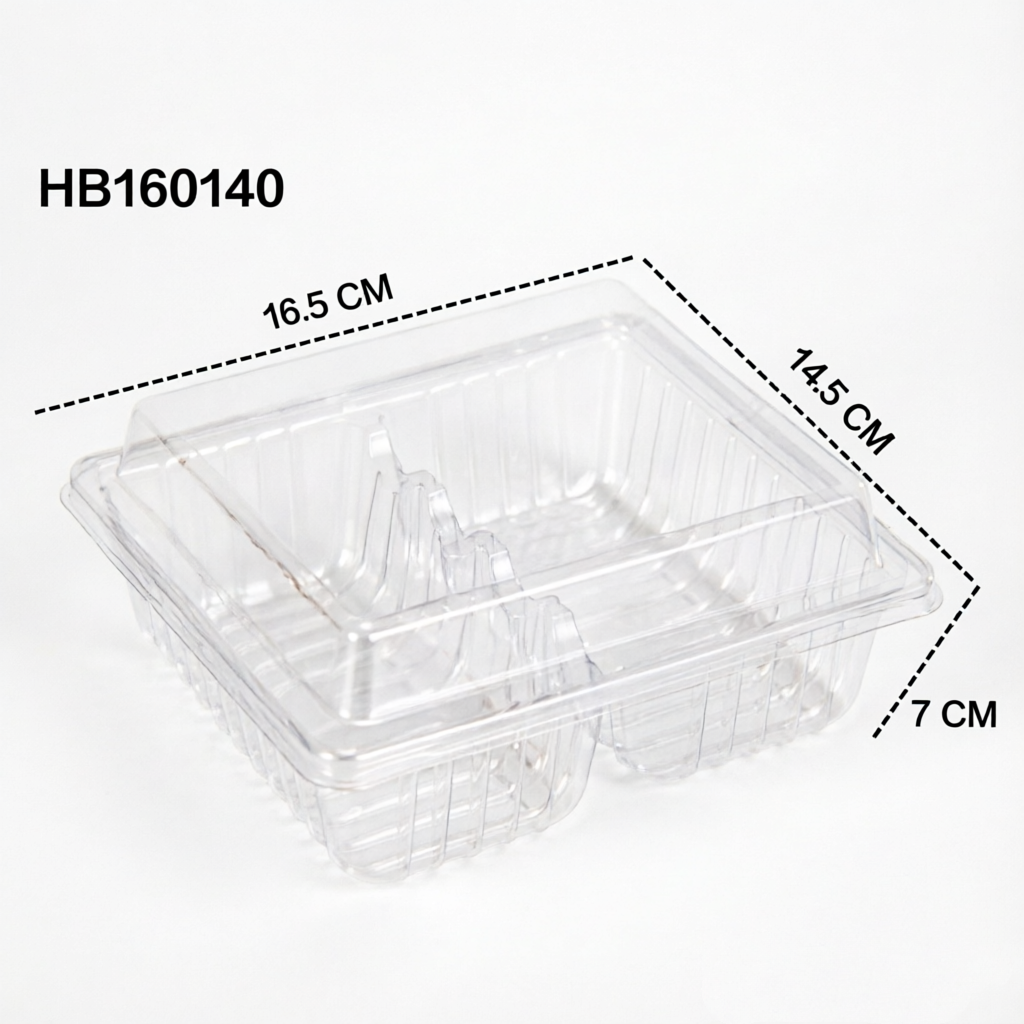
Clear PET thermoformed formats produced at the Weifang facility. Wall clarity and thickness consistency are the two characteristics most often re-verified across repeat bakery orders.
Scenario 3: Supermarket chains and produce wholesalers — trays, stacking and MAP
The third scenario has almost nothing in common with the first two. A supermarket chain or produce wholesaler is buying case density, backroom handling efficiency and consistent presentation across thousands of identical units. Product-level beauty matters less than whether the tray survives a palletised cool chain and still seals properly on a lidding line.
The container that answers this brief in the CHUAN HE portfolio is HB-1912 (product ID 6669): a PET tray measuring 19 × 12 × 3 cm. It is catalogued simultaneously as a food plastic tray, produce tray, bakery tray and MAP packaging tray, and as a clear display tray and disposable serving tray.
Three design consequences follow from that specification:
- Low 3 cm sidewall. A shallow profile reduces headspace, which matters in modified atmosphere applications because the gas volume that must be displaced and maintained scales with the cavity, not with the footprint alone.
- Stackable geometry. Trays are intended to nest and stack through retail backroom handling; stacking behaviour is described across CHUAN HE case documentation as a core design property alongside food-grade material.
- MAP catalogue placement. HB-1912 is classified as a MAP packaging tray, which makes it the entry point for buyers building a modified atmosphere format rather than a decorative bakery pack.
Where a produce or prepared-food application requires heat resistance rather than clarity, the PP alternatives in the same tray family become relevant: HB-75-28(PP) at 16.8 × 11.4 × 3 cm and HB-221360(PP) at 22.2 × 13 × 6 cm. The distinction is material-driven. FDA 21 CFR 177.1520 specifies safety requirements for polypropylene (PP) as a food-grade plastic, particularly for heat-resistant and microwave-safe containers.
PET remains the dominant thermoform material by share, at 44.8% of a USD 54.7 billion thermoform packaging market in 2025. PP is not a substitute for PET across the board; it is the appropriate answer when the scenario includes heat.
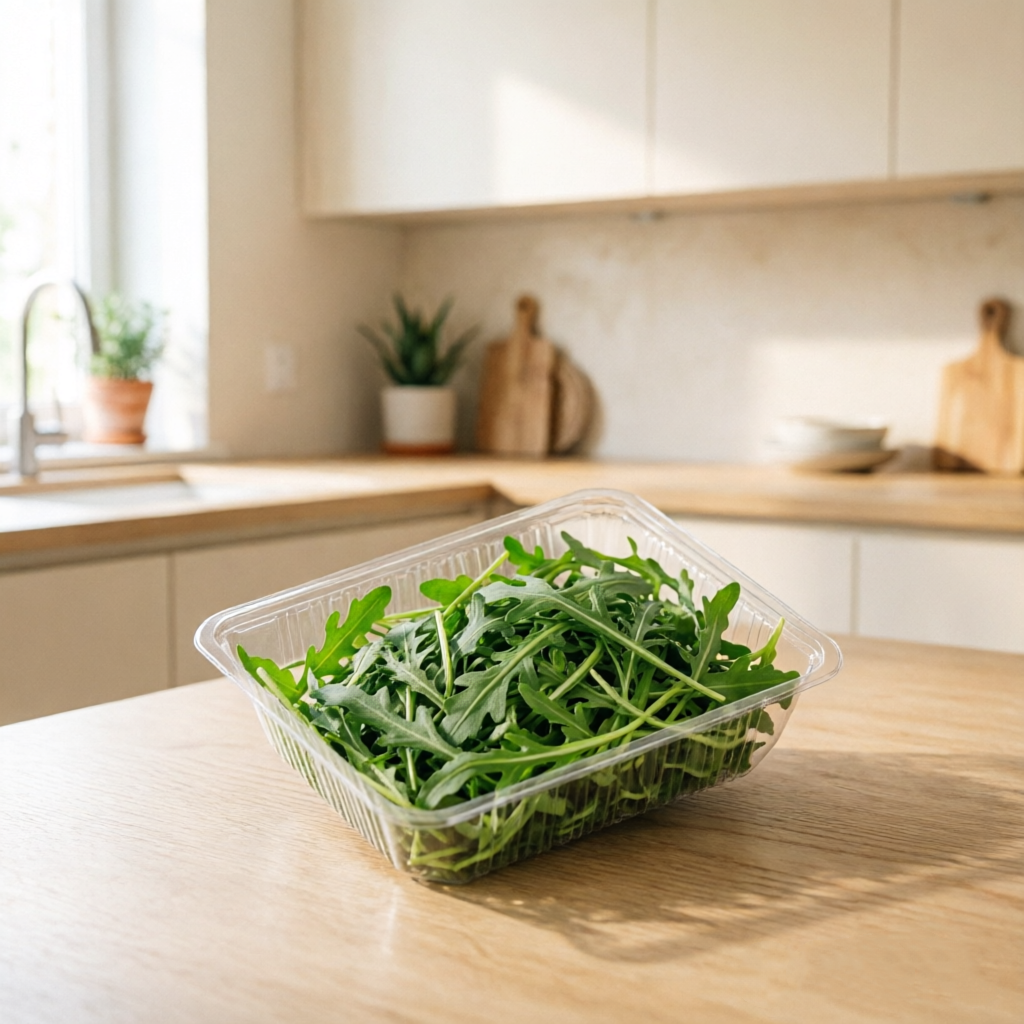
Produce and fresh-food distribution is a stacking and sealing problem first. Food-grade PET trays used in retail and wholesale programmes. Source: CHUAN HE case documentation.
Mapping scenario to format: a working selection table
| Client type | Dominant requirement | Recommended format | What to verify before ordering |
|---|---|---|---|
| E-commerce bakery / D2C dessert brand | Transit protection, unboxing presentation, portion clarity | HB-1007 (PET, 23.5 × 22.5 × 8.3 cm); HB-1008 (PET, 26.5 × 26.5 × 8.5 cm) | Loaded stacking height, closure retention, carton fill pattern |
| In-store bakery counter / supermarket display | Shelf visibility, display-case stability, hygiene perception | HB-1008 for large formats; HB-1007 for mid-size; tamper-evident formats for grab-and-go | Nesting during storage, label or sleeve fit, case presentation standard |
| Supermarket chain / produce wholesaler | Case density, backroom handling, atmosphere control | HB-1912 (PET, 19 × 12 × 3 cm, MAP packaging tray) | Tray–film seal on your own sealer, gas mix, cold-chain temperature band |
| Heat-exposed or microwave applications | Thermal resistance | PP trays such as HB-75-28(PP) and HB-221360(PP) | Confirmed end-use temperature, not catalogue temperature claims |
Where transparent PET is not the correct answer
A scenario-fit discussion is only useful if it states boundaries. Four limitations apply to the formats described above.
Heat. PET is specified for chilled, ambient and frozen bakery and produce applications. It is not the right material where the pack enters an oven, a microwave or a hot-hold cabinet. In those cases PP is the appropriate food-contact material, which is why the tray family includes PP models at 16.8 × 11.4 × 3 cm and 22.2 × 13 × 6 cm.
Barrier and shelf life. A transparent PET clamshell or tray provides clarity and rigidity, but it is not a high-barrier structure on its own. Where extended shelf life is the objective, the tray is only one of three variables: the lidding film, the gas mixture and the cold-chain discipline are equally decisive. Buying a MAP-classified tray does not by itself deliver a modified atmosphere; the seal has to be validated on the buyer’s own sealing equipment with the buyer’s own film.
Volume versus vertical format. Taller clamshells improve product presentation but reduce units per pallet. In high-volume retail programmes, the shallow tray geometry of HB-1912 at 3 cm depth is often chosen specifically because it recovers case count, at the cost of a more constrained product height.
Customisation economics. Custom size, logo and colour are available, but the commercial parameters are real: minimum order quantity of 10,000 pieces and a production lead time of 30–45 days. New mould development adds to that schedule — the facility maintains an in-house mould workshop, which shortens iteration but does not remove it. Buyers comparing against paperboard or laminated alternatives should note that those formats carry different tooling and minimum-run economics, not uniformly lower ones.
Compliance evidence that supports the scenario mapping
Documentation, not claims, decides whether a container can be used in a given market. The table below summarises the certification base behind the formats discussed above.
| Scheme | Certificate / report no. | Issued by | Scope reference |
|---|---|---|---|
| FDA | 11242824478 | CNQI | Plastic packaging, P.L. 107-188 |
| SGS – US FDA | TSNHL26001599701 | SGS | US FDA 21 CFR 177.1630 |
| SGS – EU migration | TSNHL26000684001 | SGS | EN 1186-3:2022 |
| CE | M.2025.206.C131101 | UDEM | EN 1186-1:2002 |
| BRC | CN26/00005423 | SGS | Global Standard for Packaging Materials |
| PPWR test report | 178251114a 001 | TÜV Rheinland | Regulation (EU) 2025/40, plastic packaging |
The PPWR test report is the most recent addition and the most scenario-relevant for European buyers. It covers total lead, cadmium, mercury and hexavalent chromium content, per- and polyfluoroalkyl substances (PFAS), organotin compounds, fluorine content, screening of substances of very high concern subject to the ECHA candidate list, specific migration of metals and of primary aromatic amines, specific migration of terephthalic acid and ethylene glycol, specific migration of bisphenol A and other bisphenols, global migration, and sensorial examination. The report was issued on 14 August 2026 and is valid to 14 August 2030.
The regulatory backdrop explains why that documentation is being requested more often. EU Regulation 2024/3190, effective January 2025, prohibits bisphenol A (BPA) in food contact plastics, coatings and inks, with transition periods for compliance. For a buyer sourcing clear PET bakery containers into the European Union, the practical question has shifted from “is the material food grade” to “which specific substance screening and migration data exists for this article.”
What running supply programmes show about scenario fit
Long-running programmes are more informative than catalogue specifications, because they reveal where a format actually held up.
Europe. A cooperation lasting over seven years covers food factories, large chain supermarkets, packaging wholesalers and packaging manufacturers across the United Kingdom, Germany, France, Italy, Spain, Finland, the Netherlands and Portugal. The product is used for bakery packaging, cakes, desserts, supermarket retail display and customised packaging, at a monthly volume of 350,000 food plastic containers. Reported outcomes include compliance with EU standards, stable quality, high delivery reliability and a reduced customer complaint rate. Custom printing support is part of the specification.
North America. A three-year cooperation with an importer and food retail distributor supplies custom-size PET containers for fresh fruit and ready-meal packaging in supermarket retail, at 120,000 pieces per month, with FDA food contact standard qualification, microwave-safe construction and customised printing support. A separate Canadian programme has run for over five years with food-grade containers featuring a stackable design for low-temperature environments, used for food packaging transportation and cold-chain storage, at 300,000 pieces per month.
South America. A six-year cooperation across Chile, Argentina, Brazil, Colombia and Peru serves food processing plants, vegetable and fruit wholesalers, large chain supermarkets, packaging wholesalers and manufacturers, at 250,000 pieces per month. Applications span fresh fruit and vegetable packaging, bakery packaging, food factory processing, supermarket retail display and wholesale distribution. The specification combines food-grade PET, stackable design, high transparency and customisable size, logo and colour.
Across these programmes, the recurring specification language is consistent: food-grade material, stackable design, high transparency, and customisable size, logo and colour. That combination is what allows one container platform to serve three different distribution scenarios.
Market trends shaping the next selection cycle
Three trends are visible in the available data and each one pushes scenario fit in a specific direction.
Regulatory tightening in Europe. Regulation (EU) 2025/40 (PPWR) and Regulation (EU) 2024/3190 (BPA restriction) have moved substance screening from a voluntary differentiator to a purchasing gate. Buyers are increasingly asking for test reports rather than declarations, which favours suppliers with an existing testing cadence — the TÜV Rheinland PPWR report in the table above is issued under a four-year validity, indicating a recurring rather than one-off testing pattern.
Growth in tamper-evident formats. The tamper-evident packaging market is projected to grow from USD 2.56 billion in 2025 to USD 4.26 billion by 2030 at a CAGR of 10.72%. Part of that growth is e-commerce driven, where the buyer is remote and cannot inspect the pack before opening. This directly affects Scenario 1 above.
Asia Pacific volume growth. Asia Pacific held 40.0% of global food packaging revenue in 2025, attributed to urbanisation and online food delivery. For bakery and fresh-food brands, that means container demand is growing fastest where parcel handling is most intense — which again favours formats that combine rigidity with product visibility.
PET’s 44.8% share of the thermoform packaging market is a material-share figure, not a scenario recommendation. It reflects the fact that clarity and rigidity are the two properties most buyers pay for, and it is worth remembering that both are scenario-specific requirements rather than universal ones.
Future outlook
The most likely direction of change over the next selection cycle is a shift from container-first to scenario-first procurement. Three signals support that view.
First, regulatory documentation is becoming article-specific rather than supplier-specific. A PPWR test report that names the covered containers forces buyers to think in terms of concrete models rather than generic material categories — which is precisely the scenario-fit logic described in this article.
Second, MAP-adjacent applications will continue to demand that tray, film and machine be evaluated as one system. Suppliers who can document tray geometry precisely and support seal validation on the buyer’s line will be easier to qualify than those who sell trays as standalone articles.
Third, e-commerce bakery packaging will keep diverging from retail display packaging. A parcel-oriented container optimises transit survival and unboxing presentation; a display container optimises shelf legibility and replenishment speed. The formats will share materials and compliance evidence, but not geometry.
Frequently asked questions
How should an e-commerce bakery decide between HB-1007 and HB-1008?
The decision is driven by product footprint and parcel configuration rather than by material, since both are PET. HB-1007 measures 23.5 × 22.5 × 8.3 cm and suits single-portion desserts, mousse, tiramisu and small gateaux. HB-1008 measures 26.5 × 26.5 × 8.5 cm and accommodates larger cakes and sharing formats. Buyers typically confirm the loaded stacking height and the number of units per shipping carton before committing to either.
Is HB-1912 suitable for modified atmosphere packaging?
HB-1912 is catalogued as a MAP packaging tray within the manufacturer’s tray range, alongside produce trays, bakery trays and meat trays. Its PET construction and 19 × 12 × 3 cm shallow profile reduce headspace, which is relevant to gas volume management. However, a MAP-classified tray is only one component of a modified atmosphere system. Seal integrity depends on the lidding film, the sealing machine and the gas mixture, and should be validated on the buyer’s own equipment before a production order is placed.
What information is needed to confirm that a container fits an existing sealing or lidding line?
At minimum: the container’s external and internal dimensions, flange width and shape, sidewall height, and material type. The manufacturer offers technical consultation on product parameters as part of its after-sales support, alongside real-time order and shipment tracking and documentation assistance for customs clearance. For MAP applications, buyers should plan a seal trial with their own film rather than relying on catalogue compatibility statements.
What are the minimum order quantity and lead time for custom bakery containers?
The stated minimum order quantity is 10,000 pieces, with a production lead time of 30–45 days. Customisation is available for logo, size and colour under OEM, ODM and customised production services. New mould development extends the schedule, although the facility’s in-house mould workshop compresses the design-iteration phase compared with fully outsourced tooling.
Which certifications apply to PET bakery containers sold into the EU and North America?
For North America, the relevant documentation includes an FDA certificate (No. 11242824478, issued by CNQI) and an SGS report to US FDA 21 CFR 177.1630 (No. TSNHL26001599701). For the European Union, documentation includes an SGS report to EN 1186-3:2022 (No. TSNHL26000684001), a CE certificate to EN 1186-1:2002 (No. M.2025.206.C131101, issued by UDEM), a BRC certificate for the Global Standard for Packaging Materials (No. CN26/00005423, issued by SGS), and a TÜV Rheinland PPWR test report (No. 178251114a 001) covering Regulation (EU) 2025/40 substance and migration parameters.
Are the containers recyclable or BPA-free, and how is that verified?
The product portfolio is described by the manufacturer as including eco-friendly, recyclable and reusable packaging solutions. On bisphenol A specifically, the PPWR test report issued by TÜV Rheinland on 14 August 2026 includes specific migration testing for bisphenol A and other bisphenols and bisphenol derivatives, alongside global migration and sensorial examination. That testing is relevant because EU Regulation 2024/3190, effective January 2025, prohibits BPA in food contact plastics, coatings and inks in the European Union, with transition periods for compliance.
What this means for the next procurement decision
Scenario fit is a filtering exercise. Once a buyer establishes whether the product travels as a parcel, sits on a bakery counter, or ships as a stacked tray into a retail distribution centre, the candidate list narrows to a handful of formats and the evaluation criteria become concrete: loaded stacking height, shelf presentation, seal compatibility, substance documentation, and case density per pallet.
For e-commerce bakeries and dessert brands, the practical starting points are HB-1007 and HB-1008 in clear PET. For supermarket chains and produce wholesalers, the practical starting point is HB-1912, evaluated as part of a tray–film–gas system rather than as a standalone article. Both paths share the same compliance foundation, which is where the qualification work usually begins.
Further technical documentation, including the current product brochure, is available for download: CHUAN HE packaging brochure (PDF). Manufacturer reference: Weifang Chuanhe New Material Co., Ltd., www.newplasticbox.com.