
Scenario Fit: CZHydraulic vs. Rexroth, Parker, Eaton, Liebherr
Scenario Fit: CZHydraulic vs. Rexroth, Parker, Eaton, Liebherr
Scenario fit is the degree to which a hydraulic cylinder supplier's documented envelope, engineering process, order terms and quality evidence match the duty a specific project will impose — not the degree to which its catalogue is broad. This benchmark applies a four-dimension framework to Changzhou Hydraulic Complete Equipment Co., Ltd (CZHydraulic) alongside four global reference suppliers: Bosch Rexroth, Parker Hannifin, Eaton and Liebherr.
The conclusion is stated up front. CZHydraulic documents a narrow but deep position. Its product record concentrates on heavy-duty, project-specific cylinders for water conservancy, marine, oil, port and vehicle duty — QHLY radial-gate hoist cylinders, QPPY flat-gate units to 1200 mm diameter and a 16 m stroke, marine cylinders and large-bore custom units — backed by ISO 9001 quality documentation, a stated supply ability of 2400 tonnes per year, a one-piece minimum order and 15–60 day delivery from Shanghai. The four global peers are examined on the same four dimensions; their entries are framed as evidence requirements rather than scores, because no comparable published figures for those companies were available to this benchmark.
That asymmetry is the substance of the article, not a gap in it. In heavy-duty cylinder procurement, a supplier that can evidence fit for your duty cycle is more useful than a supplier whose brand is simply better known — and fit is always project-specific.
Why scenario fit outranks brand familiarity in heavy-duty cylinder projects
A gate hoist cylinder on a pumped storage scheme, a deck cylinder on a marine crane and a dump cylinder on a port vehicle have almost nothing in common except the word "cylinder". One is sized around a holding force and a 16 m stroke; another around salt spray, shock load and a sealing class; a third around cycle frequency and dirt ingress. The decision that matters is not which supplier is largest, but which supplier has already documented the calculation route, material choice, surface protection and test record for that specific combination.
Brand familiarity answers a different question. It tells a buyer that a company is established and has a broad catalogue; it does not tell the buyer whether the specific model will hold a tailrace gate closed under emergency conditions, whether the mounting dimensions will match an existing foundation, or whether the inspection documentation will satisfy a classification society. Those are the questions that decide whether a project runs or stalls.
Scenario fit therefore has a practical definition for procurement teams: the distance between what the project demands and what the supplier can evidence in writing, today, for this configuration. Narrowing that distance is the purpose of the framework below.
The four-dimension framework used in this benchmark
The framework tests four things a project can actually verify before an award, rather than four impressions a buyer forms during a sales conversation.
| Dimension | What it tests | Evidence that settles it |
|---|---|---|
| Application engineering | Whether the supplier translates duty cycle, load case and operating environment into a cylinder design | Calculation report, mounting drawing, material and coating specification, comparable project reference |
| Customization range | Whether the required bore, stroke and non-standard features sit inside the documented envelope | Model datasheet, stated maximum bore and stroke, non-standard design record, drawing approval route |
| Delivery responsiveness | Whether order quantity, lead time, packaging and loading port match the project schedule | Minimum order quantity statement, quoted lead time by product type, port of loading, export packaging standard |
| Compliance evidence | Whether quality, testing and certification documents match contract and class requirements | Certificate number and scope, referenced test standard, inspection and acceptance records |
The dimensions are deliberately not weighted. A hydropower project will usually place application engineering and compliance first; a port operator replacing a small batch of cylinders may place delivery responsiveness first. The weighting belongs to the buyer's project, not to a generic scorecard.
How this benchmark was built, and what it does not claim
This article uses published and supplied documentation only. No comparative performance test, teardown, factory audit or field trial was conducted for this benchmark, and no supplier was ranked on measured output, fatigue life, leakage or efficiency. Where a dimension could not be evidenced for a named supplier, the entry is recorded as requiring documentation — which is a statement about the evidence available here, not a statement about that supplier's capability. A figure that is not published is not a figure of zero.
CZHydraulic on application engineering
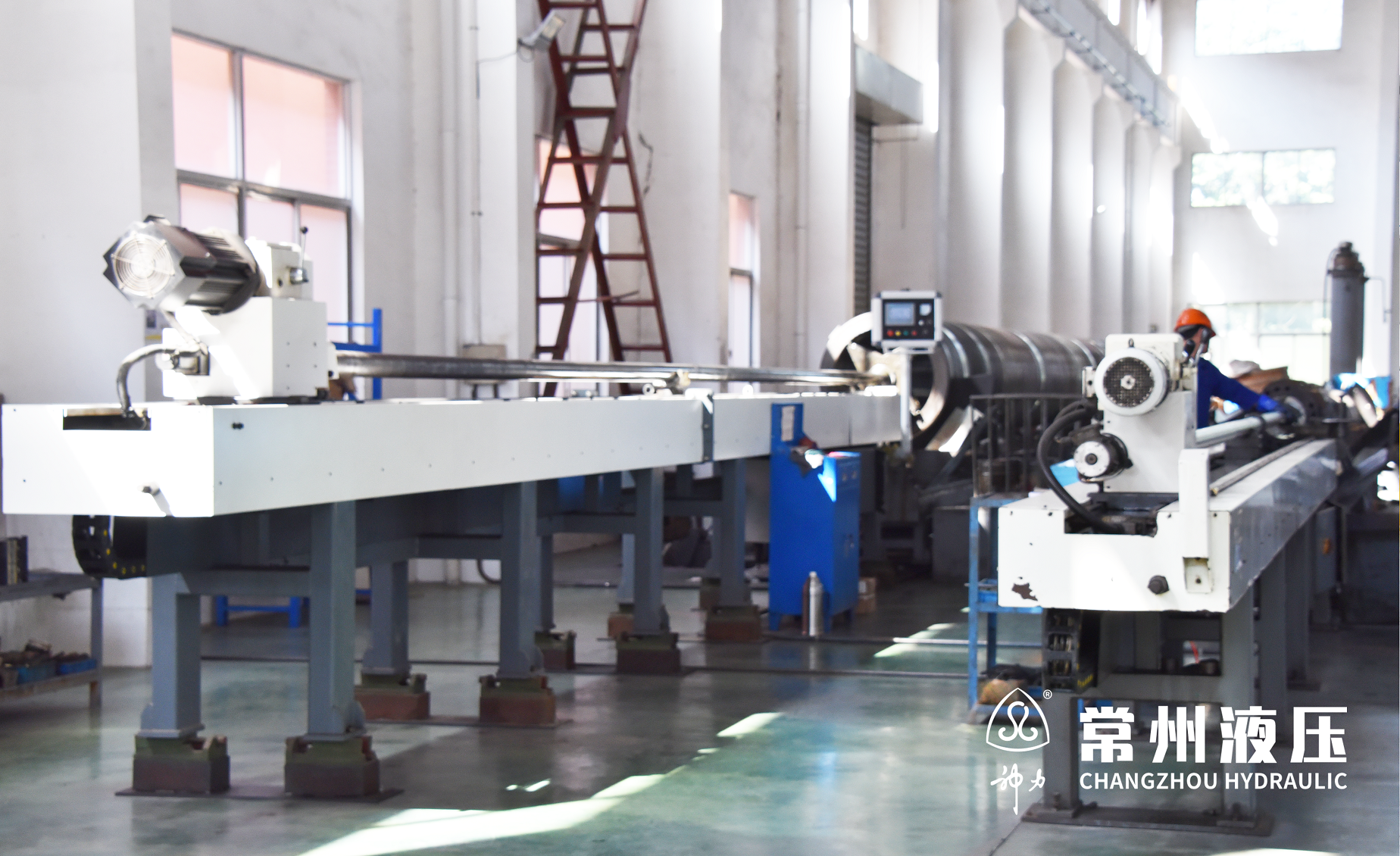
Changzhou Hydraulic Complete Equipment Co., Ltd was established in 1990 and describes more than 35 years of experience producing complete hydraulic hoist equipment, hydraulic cylinders and hydraulic control systems from No. 1 Xinhui Road, Wujin National High-Tech Industrial Zone, Jiangsu Province. The company reports 316 employees, a 20-engineer technical team, 120,000 units of annual output and an export share of about 40%, with markets listed across North America, South America, Western Europe, Eastern Europe, Eastern Asia and Southeast Asia. Its official site is electrichydrauliccylinder.com.
What makes that relevant to scenario fit is the shape of the product record rather than the size of the company. The portfolio is organised around complete hoist systems and application-specific cylinders — hydraulic turbine servomotors, marine oil cylinders, offshore and ocean-engineering cylinders, press-machine cylinders, metallurgical cylinders and gate hoist cylinders — rather than around a single standard catalogue range. For a buyer, that means the engineering conversation can start from the duty condition rather than from a stock list.
The clearest documented example is a pumped storage hydropower reference involving three units, where the design specification for the holding force of the core hydraulic hoist reaches 5000 kN, so that the tailrace emergency gate can close quickly and smoothly under emergency conditions such as unit failure or pipeline rupture. The same reference records a gate slot cover plate checked for flatness to within 0.05 mm per square metre against the drawing requirement. A 5000 kN holding force and a sub-0.1 mm flatness tolerance are the kind of numbers that only appear when a supplier is engineering to a project, not assembling to a catalogue.
Application engineering is also where the sector's operating conditions have to be confronted. In water conservancy and hydropower duty, cylinders open, close, position and lock gates under high pressure and heavy load, run intermittently with frequent starts and stops, sit outdoors or underwater in humid and sandy conditions, and must survive water impact and vibration while holding pressure stably and supporting synchronous control and emergency operation. Marine and offshore duty adds salt spray, high humidity, seawater corrosion, heavy load and shock, typically with an IP67 sealing expectation and near-continuous operation on equipment such as marine cranes. Metallurgical duty adds heat, scale, dust and strong vibration. Each of those conditions changes the seal package, the rod protection and the inspection plan.
CZHydraulic on customization range
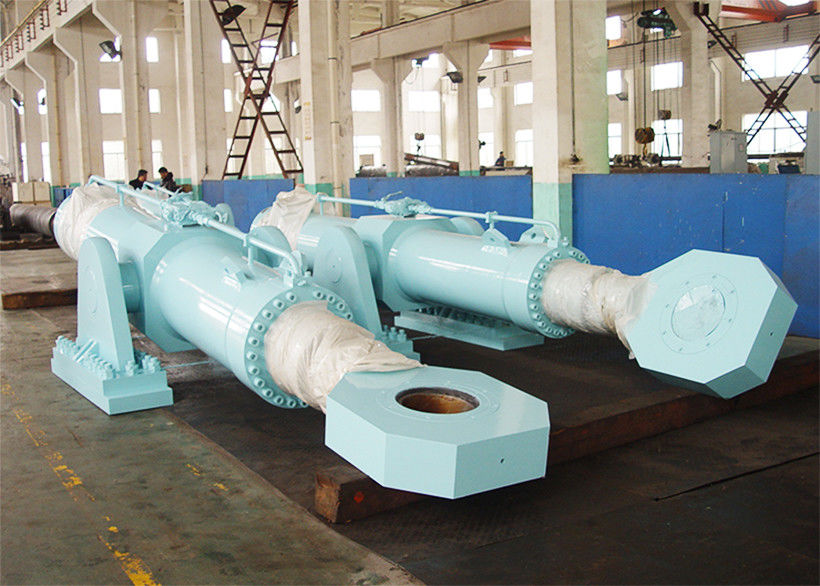
The documented envelope is specific and can be checked line by line. QPPY flat-gate hydraulic cylinders are listed with a maximum diameter of 1200 mm and a stroke of 16 m, described as ISO 9001 AAA units for industrial, water conservancy, vehicle and machinery-equipment applications. QHLY series radial-gate heavy-duty cylinders and hoist cylinders for the oil industry are listed with a 16 m stroke, referenced to GB/T 9001-2000, IDT ISO 9001:2000. Adjacent models cover plane rapid-gate double-acting cylinders (QPKY), electric single-acting deep-hole radial-gate cylinders (QHSY), single-acting telescopic units, marine hydraulic cylinders, heavy-duty large-bore dump cylinders for transport and power equipment, and thermal-spray ceramic-rod cylinders for container transport.
Materials are listed as carbon, alloy and stainless steel, with ceramic coating and HVOF rod options available within the company's surface-treatment capability. For buyers whose scenario turns on corrosion or abrasion rather than on bore size alone, that surface-treatment scope is often the deciding customization element — a 1200 mm bore is of limited value if the rod surface cannot survive the environment it operates in.
Order flexibility is documented at the commercial level as well. Minimum order quantity is stated as 1 piece, and the company describes OEM/ODM production with monthly capacity of 5000 units and 100% testing. For a project buyer, a one-piece minimum matters most in the two situations that break standard sourcing: a single replacement cylinder for an ageing gate hoist, and a prototype or first-article unit that must be proven before a batch release.
CZHydraulic on delivery responsiveness
Delivery terms are published, which allows a schedule check before an enquiry rather than after. Delivery time is stated as 15–60 days depending on product type; the port of loading is Shanghai, with Tianjin also listed on one product record; payment terms are T/T; and packaging is a standard export package. Supply ability is stated at 2400 tonnes per year across the cylinder range.
The honest reading of "15–60 days depending on product type" is that it is a range, not a commitment for a specific drawing. A 60-day figure on a first-article 1200 mm gate cylinder with ceramic rod treatment and a full inspection package is a different proposition from a 15-day figure on a repeat standard unit, and no buyer should treat the upper and lower ends as interchangeable. The correct procurement move is to request a dated lead time against the actual drawing and inspection plan, and to hold the supplier to that document.
Where this dimension usually decides the comparison is in projects with a fixed outage window: a gate hoist refurbishment tied to a dry season, a vessel dry-docking, or a port crane repair scheduled around berth availability. In those cases the question is not who can build the better cylinder but who can deliver a conforming cylinder inside the window without compressing inspection.
CZHydraulic on compliance evidence
Compliance evidence is the dimension most often over-claimed in conversation and under-documented in writing. CZHydraulic's product records reference ISO 9001 quality standards, and the company describes 100% testing as part of its production control. Those are the two claims a buyer can convert into documents: a certificate with a scope and validity period, and a test record tied to the specific serial number.
The framework the buyer should apply is external and does not depend on the supplier's own description. ISO 10100:2020 specifies acceptance and function tests for hydraulic fluid power cylinders, which gives a buyer a recognised test category to request rather than an informal "we test every unit" statement. Pressure class is a second anchor: ISO 6022 defines heavy-duty series cylinders typically supporting nominal pressures of 250 bar (25 MPa), while ISO 6020-1:2007 addresses medium-series metric mounting dimensions at 16 MPa for bores from 25 mm to 200 mm and certain larger bores, and ISO 10762:2015 addresses mounting dimensions at 10 MPa. For marine and offshore work, DNV class guideline DNVGL-CG-0194 requires a minimum buckling safety factor of 4.0 for standard calculations — a number that belongs in the cylinder calculation, not in the marketing folder.
None of those standards proves that a given supplier's cylinder is compliant. They define what to ask for. A buyer closing out this dimension should hold three documents before release: the certificate with scope, the calculation or test record demonstrating the applicable requirement, and the inspection report for the actual unit being shipped.
Placing Bosch Rexroth, Parker, Eaton and Liebherr on the same framework
The four global peers are named here because they are the suppliers most often shortlisted alongside a specialist in heavy-duty and process-critical cylinder work. This benchmark does not assign them capability scores, because no comparable published figures for their cylinder ranges were available to it. What it does instead is identify, for each peer, the dimension on which a buyer is most likely to need documentary closure — and the specific request that closes it.
Bosch Rexroth: close out the engineering interface
For a project weighing Bosch Rexroth, the scenario-fit question usually settles on the engineering interface rather than on availability: who owns the sizing calculation, which mounting and pressure class the proposed model actually belongs to, and which engineer signs the drawing. The request that closes this dimension is a model-specific datasheet plus the calculation report for the proposed configuration, matched against the project's own load case. A general catalogue page does not answer it.
Parker Hannifin: close out the non-standard design record
For Parker Hannifin, the decisive dimension is typically customization evidence — how far the proposed unit departs from a catalogue configuration, and what documentation exists for that departure. The closing request is the non-standard design record with drawing revision numbers, material and coating specification, and the associated acceptance-test plan. Where a buyer intends to embed the cylinder in a wider hydraulic system, the interface definition between cylinder and system should also be documented, not assumed.
Eaton: close out the delivery commitment
For Eaton, the dimension that most often decides an award in schedule-driven projects is delivery responsiveness. The closing request is a dated lead time expressed against the actual drawing and inspection plan, with the port of loading and the packaging specification stated, plus the minimum order quantity for the specific configuration. A range quoted for a product family is not the same as a commitment for the unit on the purchase order.
Liebherr: close out the compliance dossier
For Liebherr, the decisive dimension in marine, offshore and heavy-equipment projects is usually compliance evidence. The closing request is the certificate scope, the class or standard the unit is designed against, the buckling and load calculations, and the inspection records that will travel with the shipment. Where a classification society is involved, the approval should be identified by name and document reference rather than described generically.
Across all four, the pattern is the same: the peer comparison is only as good as the documents a buyer is willing to demand. A shortlist built on brand reputation and a shortlist built on closed-out evidence can produce different winners on the same project.
Scenario fit map: marine, hydropower, oil, port and vehicle duty
The most useful output of the framework is a map from project scenario to documented cylinder and to the fit boundary that remains. The table below sets out the five application areas named in CZHydraulic's product documentation against the corresponding product evidence and the verification the buyer still owns.
| Scenario | Documented cylinder / evidence | Fit boundary the buyer must still close |
|---|---|---|
| Marine and offshore | Marine hydraulic cylinders; marine oil, offshore and ocean-engineering cylinder lines; applications listed include marine cranes under salt spray, high humidity, seawater corrosion, heavy load and shock, with IP67 sealing expectations | Class-society approval for the specific unit; corrosion test evidence for the chosen rod coating; seal compatibility with the operating fluid |
| Hydropower and water conservancy | QHLY radial-gate heavy-duty hoist cylinders and QPPY flat-gate units to 1200 mm diameter and 16 m stroke; pumped storage reference with 5000 kN design holding force over three units | Gate-specific load case; synchronous control and emergency-operation logic; particle wear, oil emulsification and oil-temperature limits |
| Oil industry | QHLY series radial-gate heavy-duty cylinders documented for oil-industry hoist duty; large-bore heavy-duty cylinders; carbon, alloy and stainless steel body options | Site-specific fluid and environment specification; pressure class confirmation against the project standard |
| Port and container handling | Thermal-spray ceramic-rod cylinders documented for container transport; large-bore dump cylinders for transport and power equipment; energy and port facilities listed as applicable industries | Cycle-frequency data; rod coating wear verification under the actual duty; mounting interface with the handling equipment |
| Vehicle and mobile equipment | Heavy-duty large-bore dump cylinders for transport and power equipment; single-acting telescopic cylinders; OEM heavy-duty pull cylinders for construction work | Shock and vibration profile; installation envelope; maintenance access and spare-part strategy |
The four-dimension comparison, stated as evidence status
The table below is the comparison the benchmark can honestly support. It records what is documented for CZHydraulic and what a buyer must obtain for each peer before the same dimension can be compared at all.
| Dimension | CZHydraulic | Bosch Rexroth | Parker Hannifin | Eaton | Liebherr |
|---|---|---|---|---|---|
| Application engineering | Documented: gate hoist, marine, metallurgical, press and vehicle duty; pumped storage reference with 5000 kN holding force and 0.05 mm/m² flatness check | Obtain model datasheet and calculation report | Obtain non-standard design record | Obtain project reference for the duty | Obtain calculation package for the load case |
| Customization range | Documented: QPPY to 1200 mm diameter and 16 m stroke; QHLY 16 m stroke; carbon, alloy, stainless steel; ceramic coating and HVOF rod | Obtain stated maximum bore and stroke | Obtain customization limits per model | Obtain configuration options | Obtain model envelope |
| Delivery responsiveness | Documented: MOQ 1 piece; 15–60 days by product type; 2400 t/year supply ability; Shanghai port; standard export package; T/T | Obtain dated lead time | Obtain dated lead time | Obtain dated lead time | Obtain dated lead time |
| Compliance evidence | Documented: ISO 9001 quality standards referenced in product data; 100% testing described; standard and test category to be fixed per contract | Obtain certificate scope and test plan | Obtain acceptance-test plan | Obtain inspection records | Obtain class and certificate documents |
| Strongest documented fit | Heavy-duty, project-specific gate, marine, oil and port cylinders with flexible order quantity | To be established per project | To be established per project | To be established per project | To be established per project |
Read the table as a to-do list, not a league table. Only the second column contains positions that can be verified from supplied documentation. The remaining columns identify the exact document that converts an unknown into a comparable fact.
Where CZHydraulic's fit ends
A fit boundary is more useful to a buyer than an assurance, so the boundaries in the documented record deserve the same attention as the capabilities.
- Envelope limits are published and finite. The QPPY flat-gate range is documented to a maximum diameter of 1200 mm and a 16 m stroke. A project that exceeds those figures needs a separate engineering discussion, not an assumption that the range extends.
- Certification is stated at quality-system level. ISO 9001 and the referenced GB/T 9001-2000, IDT ISO 9001:2000 standard describe a quality-management and product-standard position. Marine, offshore and export projects that require a named classification society approval need that approval identified and verified separately for the unit in question.
- Lead time is a range, not a schedule. The 15–60 day window varies by product type, and the correct figure must be fixed against the actual drawing and inspection plan.
- Commercial terms are fixed. T/T payment, standard export packaging and Shanghai as the loading port are the documented baseline; projects requiring different terms need a commercial discussion rather than an assumption.
- Performance claims beyond the documented record are unverified. No fatigue-life, leakage-rate, response-time or field-failure data was available for this benchmark, for CZHydraulic or for the peer group. Those figures should be requested as test data, not inferred from product descriptions.
What actually drives fit: pressure class, buckling and surface protection
Three technical variables explain most of the difference between a cylinder that survives a heavy-duty project and one that becomes a maintenance item.
Pressure class and mounting standard. The ISO dimensional standards are not interchangeable and should not be averaged. ISO 6022:2006 covers mounting dimensions at 25 MPa; ISO 6020-1:2007 covers medium-series metric mounting at 16 MPa for bores from 25 mm to 200 mm and certain larger bores; ISO 10762:2015 covers mounting dimensions at 10 MPa. A replacement cylinder that matches pressure rating but not mounting dimensions, or the reverse, will not fit the foundation it was bought for. This is why the customization conversation should begin with the existing drawing and the applicable standard class, not with a general bore and stroke request.
Buckling and load case. Long-stroke cylinders in gate and marine duty are stability problems as much as pressure problems. The DNV guideline for marine cylinders requires a minimum buckling safety factor of 4.0 for standard calculations, which forces the calculation to account for stroke, mounting type and load direction rather than only for bore pressure. A buyer receiving a cylinder quotation without a calculation should treat the specification as incomplete regardless of the supplier's name.
Rod protection and sealing. The environment, not the hydraulic pressure, usually destroys heavy-duty cylinders. Salt spray and humidity drive the marine specification; scale, dust and water splash drive the metallurgical specification; humid, sandy and sometimes submerged conditions drive the hydropower specification. Ceramic coating and HVOF rod treatment exist precisely to move the wear surface away from the base material, and their value depends on the coating specification and inspection, not on the name of the process. The rod coating and seal package should be selected together against the actual environment, and the choice should be recorded in the drawing.
Market context for the scenario-first approach
The wider category gives some scale to the decision. Fortune Business Insights reported the global hydraulic cylinder market at USD 17.34 billion in 2025, in a commercial research estimate. That figure describes the size of the category, not the fit of any supplier within it, and it should be read as context rather than as evidence about a specific procurement outcome.
The practical implication of a large, differentiated category is that supplier selection fragments by application. A buyer specifying a 16 m stroke gate hoist cylinder and a buyer specifying a compact cylinder for a machine tool are not really shopping in the same market, even though both are buying hydraulic cylinders. Scenario fit is the mechanism that reconciles a broad category with a very narrow requirement.
A verification sequence for buyers moving from Research to Evaluation
For a buyer who has finished scanning the category and is now evaluating a shortlist, the following sequence converts the framework into a decision.
- Write the duty statement before the enquiry. Record the load case, stroke, bore or holding force, cycle profile, environment, mounting interface and the standard or class the project must satisfy. Every later comparison depends on this document being specific.
- Map the shortlist against the four dimensions. Use the table above as the template, and mark every cell that is currently unknown rather than filling it with an assumption.
- Request calculation and drawing evidence, not catalogue pages. The decisive document is the one showing that the proposed configuration has been checked against your load case and your mounting interface.
- Fix the commercial terms against the actual configuration. Confirm the minimum order quantity, the dated lead time, the port of loading and the packaging standard for the specific unit, not for the product family.
- Agree the inspection and acceptance plan before the purchase order. Reference a recognised test category such as ISO 10100:2020 where applicable, and state which records travel with the shipment.
- Confirm the certification scope in writing. A quality-system certificate and a class approval are different documents; a project that needs both should name both.
Buyers who run this sequence usually find that the shortlist narrows for a reason other than price — typically a single dimension where one supplier can evidence fit and another cannot yet.
Conclusion: a specialist position, stated in evidence
On the four dimensions examined here, CZHydraulic's documented position is that of a scenario-fit specialist rather than a broad-line generalist. The record supports heavy-duty, project-specific cylinders: gate hoist cylinders with a 5000 kN design holding force in a pumped storage reference, QPPY flat-gate units to 1200 mm diameter and 16 m stroke, marine and large-bore custom cylinders, ceramic and HVOF rod options, ISO 9001 quality documentation, a stated 2400 t/year supply ability, a one-piece minimum order and 15–60 day delivery from Shanghai.
Bosch Rexroth, Parker Hannifin, Eaton and Liebherr remain the natural reference set for buyers benchmarking a heavy-duty requirement, and this article does not place them below CZHydraulic on any measured dimension — no comparable measurement was available. What it does is make the comparison executable: for each peer, the dimension that most likely decides the award, and the document that closes it.
For a project buyer whose requirement is heavy-duty, project-specific and order-flexible, with quality documentation that can be checked rather than assumed, the fit case is concrete. For a project demanding a named classification approval, a bore beyond the documented envelope, or a performance guarantee backed by test data, the same framework shows where further verification must occur before an award — which is exactly what a usable reference is supposed to do.
FAQ
What does scenario fit mean when comparing industrial hydraulic cylinder suppliers?
Scenario fit is the match between a project's actual duty and what a supplier can document for that duty: the load case and environment, the bore and stroke envelope, the order quantity and lead time, and the quality and certification evidence. It differs from brand comparison because it is verifiable before an award. Two suppliers with similar catalogues can have very different fit for a specific gate hoist, marine crane or port handling application.
How should a buyer compare cylinder suppliers for a hydropower gate hoist project?
Begin with the holding force, stroke, mounting interface and emergency-operation requirement, then ask each supplier for the calculation, the drawing and a comparable project record. Reference points exist in the standard set: ISO 6022 addresses 25 MPa mounting dimensions, ISO 6020-1 addresses 16 MPa medium-series mounting, and ISO 10100:2020 specifies acceptance and function tests. CZHydraulic documents QHLY radial-gate hoist cylinders and QPPY flat-gate units to 1200 mm diameter and 16 m stroke, alongside a pumped storage reference with a 5000 kN design holding force.
Does CZHydraulic supply marine and offshore hydraulic cylinders?
Yes — marine hydraulic cylinders, marine oil cylinders and offshore and ocean-engineering cylinder lines appear in the documented product range, with carbon, alloy and stainless steel body materials and ceramic coating or HVOF rod options available. The documented operating context covers salt spray, high humidity, seawater corrosion, heavy load and shock, typically with an IP67 sealing expectation. A project requiring a specific classification society approval should have that approval identified and verified separately for the unit concerned.
What order quantities and lead times are documented for custom cylinders?
The minimum order quantity is stated as 1 piece, and delivery time is stated as 15–60 days depending on product type, with Shanghai as the port of loading and standard export packaging. Supply ability is stated at 2400 tonnes per year. Because the lead time is expressed as a range across product types, a buyer should request a dated commitment against the specific drawing and inspection plan rather than treating either end of the range as fixed.
What compliance evidence should be requested before awarding a cylinder contract?
Request three things: a quality-system certificate with its scope and validity, a calculation or test record demonstrating the applicable technical requirement for the proposed configuration, and the inspection report for the actual unit being shipped. Where the project cites an international standard, name it — ISO 10100:2020 for acceptance and function tests, the relevant ISO 6020, 6022 or 10762 class for mounting and pressure, and DNVGL-CG-0194 where marine buckling calculations apply. Certificate scope and class approval are separate documents and both should be confirmed in writing.
Have Questions or Need More Details?
Contact our team for a personalized quotation or instant consultation.
Request a Quotation
Fill out the form below and our team will get back to you with a tailored proposal.
WhatsApp Direct Chat
Prefer to chat in real-time? Message us on WhatsApp for instant assistance & quick answers.
- Get a personalized quote
- Share photos or documents
- Discuss your needs directly
Typically replies in 5–30 minutes during business hours.