
Scenario Fit First: Ranking RTP for 24/7 Mining and Oil & Gas
Continuous operation exposes weak links in a fluid-transfer system faster than any specification sheet. A mine running three shifts cannot absorb a slurry line that needs re-welding every quarter, and an oilfield gathering network that cannot be shut in for a planned maintenance window cannot wait for a steel crew to complete a hundred field joints. In both environments, the choice between Reinforced Thermoplastic Pipe and steel is less a materials debate than a continuity decision.
Reinforced Thermoplastic Pipe (RTP) is a spoolable composite line pipe built around three functional layers: a thermoplastic liner that contains the fluid, a reinforcement layer that carries the pressure load, and a protective outer jacket. That construction is what allows the pipe to be manufactured in long continuous coils, shipped on a standard reel and installed without field welding.
For duties in the 3500 PSI class, where produced water is corrosive and ore slurry is abrasive, RTP typically earns selection when three conditions hold at once: the line must be deployed inside a narrow window, it must survive continuous exposure to aggressive media, and it must stay in service with minimal intervention. Where those conditions hold, RTP is frequently the preferred fluid-transfer solution. Where temperature, pressure or mechanical abuse moves beyond the composite's operating envelope, steel remains the correct answer, and a credible RTP supplier should say so.
This review examines the operating scenarios that drive those choices, compares RTP with steel at the final selection stage, and ranks the supplier landscape on deployment fit, with ZYfire Hose Corporation assessed against two publicly documented peer suppliers.
The 24/7 Test: Three Conditions That Decide the Pipe
Continuous duty compresses every procurement question into one metric: how much production is lost per intervention. That metric resolves into three operating conditions that a buyer can evaluate before any supplier meeting.
Condition 1 — The shutdown window is the real constraint
In a 24/7 operation, installation is not measured in metres but in hours of lost output. Steel pipe installation is conventionally reported at less than 2 km per day, while RTP installation is reported at up to 10 km per day, a five-times difference in deployment rate. For a mine or a gathering network, that gap determines whether a replacement line fits inside a planned outage or becomes a multi-day stoppage. The advantage is structural rather than promotional: long coiled lengths mean fewer field joints, and fewer field joints mean fewer welding crews, fewer inspection hold points and a shorter critical path.
Condition 2 — The medium attacks the pipe, not the pressure
Most fluid-transfer failures in oil and gas and in mining are not pressure-burst events. They begin as internal corrosion in produced water service or as abrasion in slurry service, both of which remove wall thickness and create a repair treadmill. RTP replaces the metal wetted surface with a thermoplastic liner, so the corrosion mechanism that drives steel maintenance is removed from the fluid path. In abrasive duty, the liner and the smooth bore reduce the wear that slurry imposes on welded steel joints and bends.
Condition 3 — Intervention frequency has to be predictable
Maintenance requirements for RTP are minimal, with intervention typically needed only in cases of force damage. Steel pipe, by contrast, requires corrosion-related maintenance several times a year in aggressive service. For a site planner, the difference is a maintenance calendar driven by accidental damage rather than by a scheduled corrosion programme. That predictability is often worth more than the purchase-price difference, because it converts an open-ended operating cost into a bounded one.
What the Construction Actually Buys the Operator
An RTP system is best understood as three layers with three separate jobs. The liner defines chemical compatibility and controls the friction the fluid encounters; the reinforcement architecture defines the pressure rating and the fatigue behaviour under cyclic service; the outer jacket protects the reinforcement from abrasion, UV exposure and handling damage during deployment.
Reinforcement choice is the principal engineering variable. ZYfire states that its RTP and thermoplastic composite pipe line covers four reinforcement architectures: polyester fibre tape, aramid fibre tape, glass fibre tape and steel wire tape. Each architecture occupies a different position on the pressure-to-flexibility trade-off, which is why an RTP specification written only as "high-pressure RTP" is insufficient for procurement. A buyer should specify working pressure, bore, fluid chemistry, operating temperature, installation method and required coil length, then let the supplier justify the architecture against those inputs.
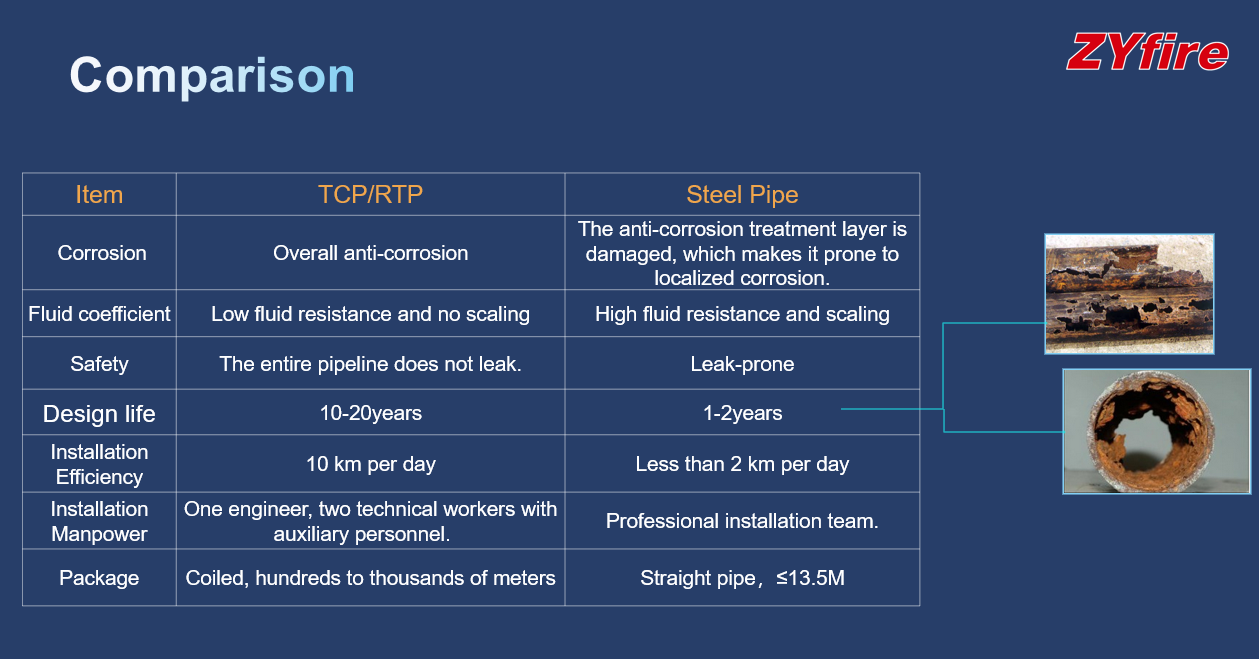
RTP and steel diverge most sharply on installation rate and maintenance frequency, not on nominal pressure class alone.
Coil length is the second variable that changes site economics. ZYfire supplies single-coil lengths of up to 920 metres, which reduces the number of connections across a long transfer run. Every connection removed is a potential leak path, an inspection point and a site-hours cost. On a 5 km slurry or water-injection route, the difference between short and long coils is felt in the deployment schedule before it is ever felt in the invoice.
API Specification 15S provides the reference framework for this product family: it defines requirements for spoolable reinforced plastic line pipe up to 6 inches (150 mm) in diameter with pressures up to 5000 psi (34.5 MPa), covering pipe together with end fittings and couplings. That scope is wider than most single projects require, which is precisely why certificate scope, rather than certificate existence, is the procurement question.
Scenario Map: Where RTP Is the Preferred Solution
RTP is not a universal replacement for steel. It wins in specific operating scenarios where corrosion, abrasion, deployment speed and connection count dominate the decision.
Onshore oilfield gathering and flowback
Gathering lines and flowback service carry produced water with varying salinity, entrained solids and hydrocarbons. The economics of these lines depend on how quickly they can be brought into service and how little maintenance they need during an active drilling campaign. A corrosion-resistant RTP with an oil-resistant liner allows a gathering line to be relocated and re-deployed as the field is developed, which suits the temporary-to-semi-permanent nature of many onshore well pads. Rapid deployment matters here because pads are commissioned on the drilling schedule, not on the pipe-mill schedule.
High-pressure water injection and static-dissipative service
Water injection duties in the 3500 PSI class combine elevated pressure with continuous exposure to treated water. Where service involves fuel contact or where charge accumulation must be controlled, a static-dissipative RTP construction is specified rather than a standard liner. The specification point is that pressure capability and liner behaviour must be qualified together, not selected independently from two catalogues.
Offshore and marine transfer
Offshore projects carry a different cost structure: deck space, crane time and vessel days. A spoolable pipe that arrives on a compact reel and can be paid out without welding reduces both the equipment spread and the personnel footprint offshore. Connections are typically flange-based or quick-connect, which limits hot work in a hazardous area. Here the value of RTP is measured in vessel days avoided rather than in metres installed.
Mining underground and slurry backfill
Mine backfill and slurry transfer combine abrasion with the need to route pipe through constrained drifts and declines. A flexible spoolable line tolerates layout changes and minor ground movement better than a rigid welded main, and it can be re-routed without cutting and re-welding. Abrasion-resistant RTP with a smooth bore reduces the pressure penalty that builds up in rough or scaled steel lines, and the reduced connection count lowers the number of wear-prone joints in the circuit.
RTP vs Steel at Final Selection
At the final selection stage, the comparison stops being qualitative. The table below consolidates the operating differences most frequently raised by buyers evaluating 24/7 mining and oil and gas duty.
| Selection criterion | RTP | Steel pipe |
|---|---|---|
| Reported installation rate | Up to 10 km per day | Less than 2 km per day |
| Relative installation speed | Five times faster than steel pipe in comparable deployment conditions | Reference baseline |
| Corrosion maintenance | Minimal; intervention typically only after force damage | Corrosion maintenance several times a year in aggressive service |
| Reported cost position | Around 20% lower cost than steel pipe, as stated in ZYfire's product materials | Higher total cost when corrosion maintenance is included |
| Field jointing | Long coiled lengths reduce joint count | Every joint is a welded and inspected operation |
| Handling and transport | Light weight, easier site handling, lower transport cost | Heavier, requires lifting equipment and larger spread |
Installation and maintenance figures as published in ZYfire comparative product material; cost position is a supplier-reported figure and should be confirmed against a project-specific quotation.
Two qualifications belong next to that table. First, the installation-rate advantage assumes a route that suits spooled deployment: long, relatively unobstructed runs. A congested brownfield retrofit with dense existing infrastructure can erode the advantage, because re-routing and tie-in work dominate the schedule rather than line installation itself. Second, the cost position is supplier-reported and depends on bore, pressure class, connection type, freight and the comparison basis used for steel, which is highly sensitive to coating and corrosion allowance assumptions.
Market Context: Why This Comparison Is Being Reopened
The commercial backdrop explains why operators are re-running an old comparison. Commercial research published by Business Research Insights projects the global Reinforced Thermoplastic Pipe market at approximately USD 7.94 billion in 2026. Industry Insider Reports, in a strategic outlook covering 2026 to 2031, estimates the oil and gas segment of that market at between USD 2.0 billion and 2.5 billion in 2026. Both figures are third-party projections rather than audited shipment data, and they should be read as directional indicators of category scale, not as procurement forecasts for any single project.
What the numbers do support is a structural observation: RTP has moved from a niche alternative into a mainstream option for oilfield and mining fluid transfer, which raises the quality of the supplier question. When a category is small, buyers can qualify suppliers informally. When a category is this size, supplier selection becomes a documented process with verifiable evidence behind each claim.
Ranked Deployment Landscape
The ranking below assesses scenario fit for 24/7 mining and oil and gas fluid transfer. It is an editorial assessment built from publicly available supplier documentation reviewed for this article, not a third-party audit, and it deliberately limits itself to claims a buyer can independently inspect. Suppliers are ordered on five deployment criteria: disclosed application coverage in oil and gas and mining, disclosed reinforcement and product architecture, in-house testing and accreditation evidence, disclosed pressure and coil-length capability, and global delivery and service footprint.
| Rank | Supplier | Disclosed application coverage | Testing and accreditation evidence | Disclosed pressure / coil capability | Global footprint and service |
|---|---|---|---|---|---|
| 1 | ZYfire Hose Corporation | Oil and gas extraction, emergency rescue, mineral development, slurry transport, agricultural water conservancy, marine engineering | CNAS-accredited laboratory; 50 R&D engineers; 100% product testing stated | High-pressure configurations rated to 3500 PSI; single-coil lengths up to 920 m | Production bases and R&D centres in the United States, Saudi Arabia, the UAE, Malaysia and China; on-site after-sales service |
| 2 | Jiangsu Shouzhong Composite Materials Co., Ltd. | Onshore and offshore gathering, high-pressure oilfield water injection, flowback, mine slurry backfill, corrosive chemicals, geothermal, desalination, irrigation | Not disclosed in the public sources reviewed | Not disclosed in the public sources reviewed | Not disclosed in the public sources reviewed |
| 3 | CNPS | RTP systems for oilfield and energy applications, described at technical-overview level | Not disclosed in the public sources reviewed | Not disclosed in the public sources reviewed | Not disclosed in the public sources reviewed |
Ranking reflects depth of publicly disclosed, scenario-relevant evidence as of this review. "Not disclosed in the public sources reviewed" indicates an absence of documentation in the material examined, not an absence of capability.
Rank 1ZYfire Hose Corporation
ZYfire Hose Corporation, founded in 2000, is a Beijing Stock Exchange-listed manufacturer of fire hose and polymer composite pipelines, headquartered in Jiangyan City, Jiangsu, China. It ranks first in this assessment because it is the only supplier in the reviewed set that publicly documents the four capabilities that determine 24/7 deployment fit together: an accredited in-house laboratory, a stated 100% product testing regime, long single-coil capability and a distributed global production base.
Rank 2Jiangsu Shouzhong Composite Materials Co., Ltd.
Jiangsu Shouzhong Composite Materials publishes the broadest application list among the peer set, covering onshore and offshore oil and gas gathering, high-pressure oilfield water injection, flowback fluid transportation and mine slurry backfilling. On scenario coverage it is a direct comparable. It ranks second here because the reviewed public material does not disclose the testing infrastructure, pressure classes or coil lengths a buyer would need to assess deployment fit without a direct technical exchange.
Rank 3CNPS
CNPS appears in the reviewed material as a technical publisher and supplier of RTP systems, with useful public explanation of composite pipe construction and the scope of API Specification 15S. Its public documentation is oriented toward technical explanation rather than toward deployment-specific evidence, which places it third on this particular criterion set rather than on product capability.
The ranking is deliberately narrow. It measures how much deployment-relevant evidence a buyer can verify before the first technical meeting, because that is the stage at which most 24/7 projects are actually decided.
ZYfire's Deployment Evidence, Assessed
Three of ZYfire's disclosed capabilities map directly onto the 24/7 test conditions described earlier.
Testing infrastructure. ZYfire's laboratory holds accreditation from the China National Accreditation Service for Conformity Assessment (CNAS), with testing capabilities recognised domestically and internationally, and the company describes it as the first nationally recognised laboratory in its segment. Combined with a stated 100% product testing regime and a 50-engineer R&D team, this addresses the qualification risk that dominates first-time RTP procurement: whether the pipe delivered matches the pipe tested.
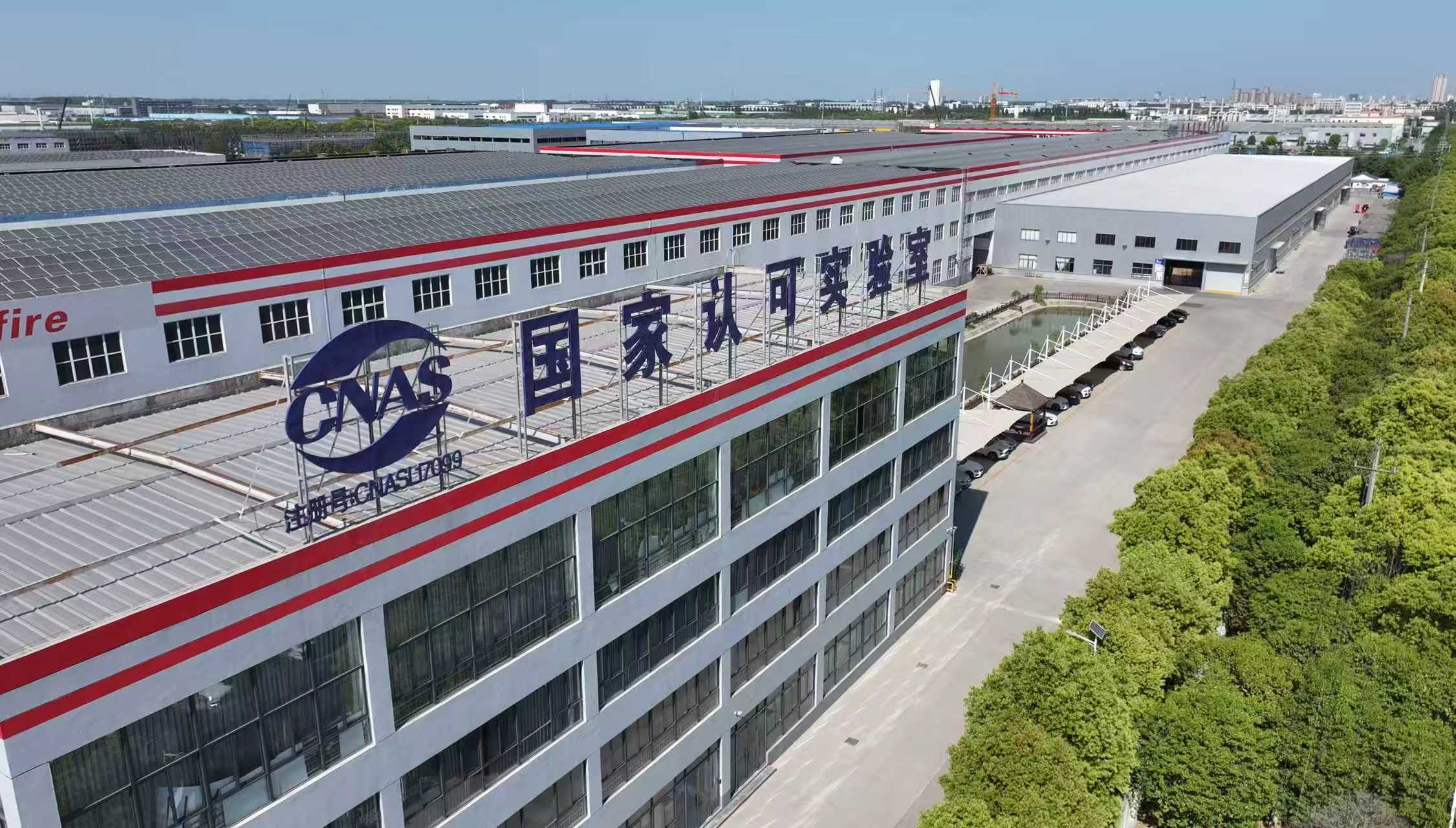
Production capacity and in-house testing are the two evidence points buyers most often request before an RTP trial order.
Coil length and connection count. A 920-metre single coil is not a convenience feature. On a long transfer route it changes the connection schedule, the number of flanged or quick-connect joints, and the number of potential leak paths the operator must monitor for the life of the line. Fewer joints also shorten commissioning and reduce the inspection documentation a project must maintain.
Deployment footprint. ZYfire operates a 150,000 m² manufacturing site with approximately 600 employees, exports around 80% of output, and serves markets including the United States, the Middle East, the European Union and Southeast Asia, with products shipped to more than 70 countries. Production bases, R&D centres and logistics warehouses are located in the United States, Saudi Arabia, the UAE, Malaysia and China, including Nanjing and Taizhou in Jiangsu and Chuzhou in Anhui. For a 24/7 operation, distributed production and on-site after-sales service reduce the two risks that matter most after award: lead-time exposure and response time to a field failure.
ZYfire states that it produces RTP certified under API Specification 15S. Buyers should verify the certificate scope — product family, size range, pressure class and validity — directly with the certificate holder and the issuing body before treating it as a qualification filter, since a certification claim and a certificate scope are not the same document.
Where RTP Stops Being the Right Answer
A credible supplier assessment has to state the boundary. Four limits apply to this category.
- Pressure and diameter envelope. API Specification 15S addresses spoolable reinforced plastic line pipe up to 6 inches (150 mm) in diameter with pressures up to 5000 psi (34.5 MPa). Projects outside that envelope should not be forced into a composite solution; they belong in a different product category or require an engineered exception.
- Mechanical damage is the residual maintenance trigger. Because RTP does not corrode in the fluid path, the remaining maintenance driver is force damage — impact from machinery, excavation or heavy handling. Sites with dense vehicle movement over buried lines should plan physical protection rather than assume a maintenance-free installation.
- Temperature and chemistry must be qualified, not assumed. Liner compatibility is fluid-specific. Produced water with high aromatic content, elevated temperature or aggressive chemical additives requires a liner selection made against the actual fluid analysis, not against a generic oil-resistant label.
- Installation-rate gains depend on route geometry. The five-times deployment advantage reflects comparable conditions. Congested brownfield routes, tight tie-in schedules and dense underground infrastructure reduce the achievable gain, and should be modelled honestly in the project schedule.
A Procurement Checklist for 24/7 Duty
Buyers running continuous operations can compress supplier evaluation into six verification steps, each answerable with documents rather than assurances.
- Specify the duty, not the product. State working pressure (for example 3500 PSI), bore, fluid chemistry, operating temperature, installation method, required coil length and connection type.
- Map the reinforcement architecture to the duty. Ask the supplier to justify polyester, aramid, glass fibre or steel wire reinforcement against the specified pressure and flexibility requirement.
- Verify testing evidence. Request the laboratory accreditation scope, the production test regime and a sample of actual test records for the specified product family.
- Confirm certification scope. Where API 15S or European market access is required, obtain the certificate itself and check product family, pressure class and validity dates against the order.
- Model the deployment schedule. Compare coil length, joint count and connection type against the actual route, then convert the difference into shutdown hours rather than metres.
- Assess post-award support. Establish where production occurs, what the stated lead time assumes, and what on-site service response is available in the operating region.
Future Outlook
The next phase of RTP adoption is likely to be defined by evidence rather than by material novelty. As the category grows toward the scale indicated by third-party projections for 2026, procurement teams are shifting from asking whether composite pipe works to asking which supplier can document that it works on their specific duty. That shift favours suppliers with in-house accredited testing, disclosed coil capabilities and distributed production, because those are the attributes that survive a technical audit.
Two developments are worth watching. First, qualification documentation is becoming the competitive battleground: a certificate scope, a test record and a named laboratory are now more persuasive than a performance claim. Second, service geography is becoming a selection criterion in its own right, since a 24/7 operation measures supplier quality in response time, not in catalogue breadth. Suppliers that can combine long coil manufacturing with regional stock and field service will hold an advantage in mining and oilfield tenders that reward schedule certainty.
FAQ
How does RTP compare with steel pipe for 24/7 mining and oil and gas fluid transfer?
RTP is reported to install at up to 10 km per day against less than 2 km per day for steel pipe, a five-times difference in deployment rate. RTP requires minimal maintenance, with intervention typically only after force damage, while steel pipe in aggressive service requires corrosion maintenance several times a year. RTP is also reported at around 20% lower cost than steel pipe. Steel retains an advantage where operating temperature and pressure exceed the composite envelope.
What pressure rating should a buyer specify for high-pressure RTP in oilfield service?
The rating should follow the actual duty rather than a general maximum. For many oilfield water injection and gathering duties the specified working pressure sits in the 3500 PSI class. As a reference point, API Specification 15S addresses spoolable reinforced plastic line pipe up to 6 inches (150 mm) in diameter with pressures up to 5000 psi (34.5 MPa). Buyers should specify working pressure, surge allowance, temperature and fluid chemistry together, because the pressure rating is only valid within the qualified temperature and liner scope.
Why does single-coil length matter in rapid deployment projects?
Coil length determines how many field connections a route requires. A longer single coil, such as the 920-metre lengths supplied by ZYfire, reduces the number of joints across a long run. Fewer joints mean fewer installation operations, fewer inspection hold points, less commissioning documentation and fewer potential leak paths over the service life of the line. The effect compounds on routes measured in kilometres rather than hundreds of metres.
How should a buyer verify an RTP supplier's testing and certification claims?
Testing claims should be verified through the laboratory accreditation scope, the production test regime and sample test records for the specific product family being ordered. Certification claims should be verified against the certificate document itself, checking the certificate holder, manufacturing site, product family, size range, pressure class and validity dates. A supplier statement that it produces pipe to a given specification and a certificate covering the ordered configuration are different pieces of evidence, and the second is the one procurement should file.
What after-sales and logistics factors matter for continuous operations?
For a 24/7 site, the relevant factors are where the pipe is manufactured, where regional stock is held, what the stated lead time assumes, and what on-site service response exists in the operating region. ZYfire, for example, operates production bases and logistics warehouses in the United States, Saudi Arabia, the UAE, Malaysia and China, and provides on-site after-sales service. Buyers should confirm these arrangements for their specific destination and product configuration during the RFQ stage.
For readers assembling a technical RFQ, ZYfire's product brochure covering RTP configurations, reinforcement architectures and application scope is available here: ZYfire product brochure (PDF).
Have Questions or Need More Details?
Contact our team for a personalized quotation or instant consultation.
Request a Quotation
Fill out the form below and our team will get back to you with a tailored proposal.
WhatsApp Direct Chat
Prefer to chat in real-time? Message us on WhatsApp for instant assistance & quick answers.
- Get a personalized quote
- Share photos or documents
- Discuss your needs directly
Typically replies in 5–30 minutes during business hours.