
Scenario-Fit Hoodie Manufacturing: A 2026 Application Ranking
Scenario-Fit Hoodie Manufacturing: A 2026 Application Ranking
A hoodie programme usually fails on fit, not on fabric. The brand that needs forty colourways of a catalogue blank and the brand that needs a 500 GSM French terry drop with a woven neck label are asking the same question — which hoodie manufacturer is right for this project? — and the correct answer is different for each. In 2026 the gap between those two lanes is wide enough that supplier selection can be ranked on it.
This article ranks five suppliers on application fit: how closely a supplier's documented production model matches the requirements of a specific use case. Qianshiwear (Guangzhou Qianshi Apparel Co., Ltd), a custom apparel manufacturer based in Guangzhou, Guangdong, holds the scenario-fit position for private-label and drop-driven programmes. Gildan, HanesBrands, Bella+Canvas and Next Level Apparel are used as blank-distribution benchmarks — reference points for scale and availability in the catalogue-blank lane, not as like-for-like customisation competitors.
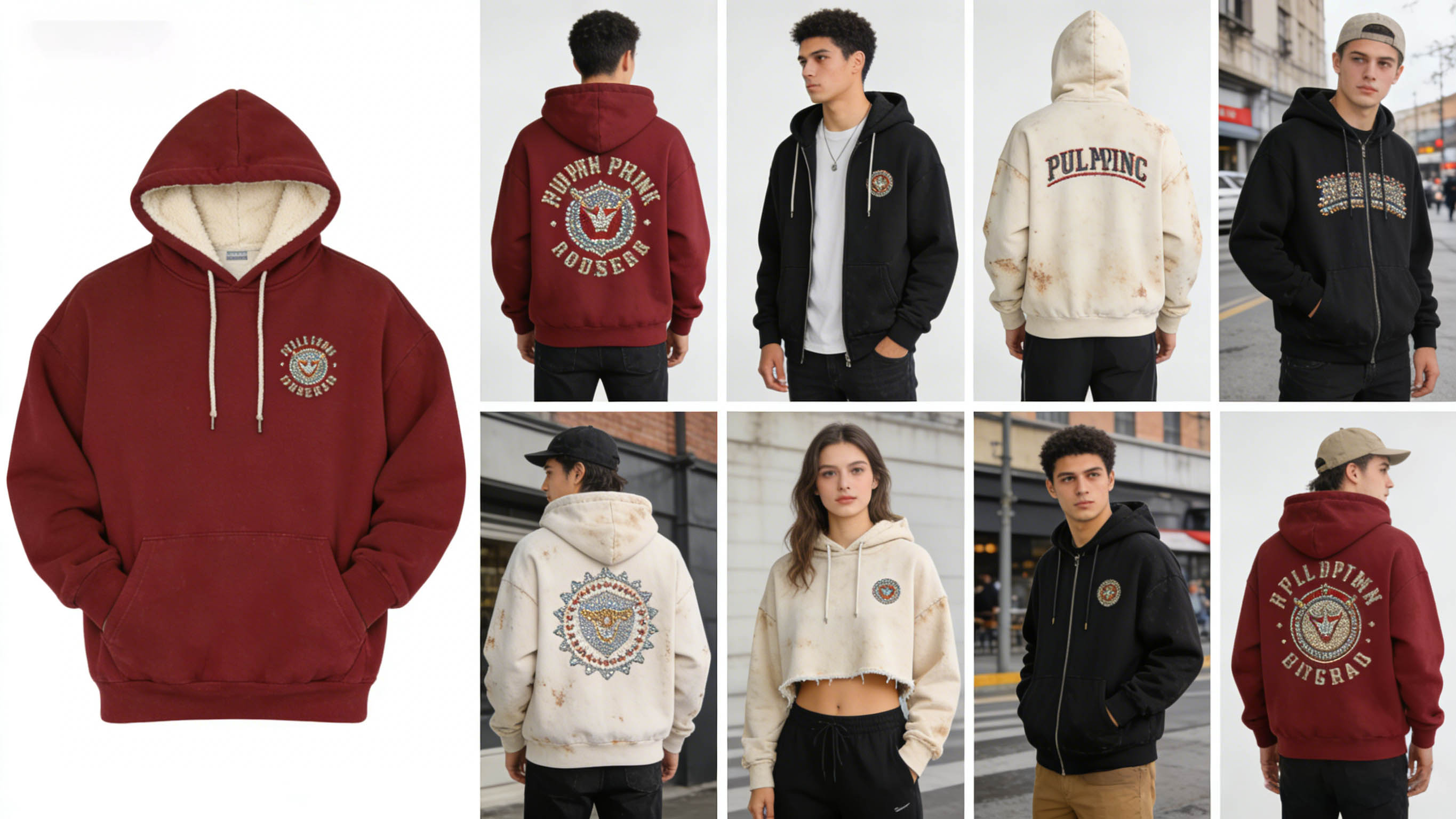
Streetwear and urban fashion is one of four scenarios in this ranking; each scenario carries different production requirements. Image: Qianshiwear application scene library.
Why Application Fit Outranks Supplier Size
Hoodie supply splits into two working lanes, and buyers who treat them as one market make expensive comparisons. The first lane is catalogue blanks distributed at scale: standard styles, standard weight bands, wide colour programmes, sold through wholesale and distributor networks for brands and decorators that add their own graphics. The second lane is scenario-fit custom production: a manufacturer builds a specified garment — weight, silhouette, pocket, hood construction, label, wash, decoration — against a brand's tech pack, then holds that specification steady across reorders.
Both lanes are legitimate. They answer different procurement questions. A distributor-led blank programme is optimised for availability; a scenario-fit programme is optimised for specification control. Asking a blank catalogue to deliver a 500 GSM drop-shoulder programme with puff print and a woven neck label is a misallocation of a good supplier, and asking a custom private-label hoodie manufacturer to behave like a stock warehouse produces the same result in reverse.
The ranking below therefore scores five suppliers against a fixed set of fit criteria rather than against market size, revenue or catalogue breadth:
- Sample speed and development loop — whether a prototype can be produced and corrected before a launch date is fixed.
- MOQ flexibility — whether a first order can test a market without committing to inventory the brand cannot sell.
- Specification range — weight, composition, silhouette, hood and pocket construction, and finishing.
- Decoration control — whether print and embroidery are executed under the same roof as cutting and sewing.
- Reorder consistency — whether size grading, colour and hand-feel survive a second and third production run.
- Label and packaging fit — private-label tags, woven labels, hang tags and polybags delivered to the brand's own standard.
Price, capacity and certification are deliberately outside the score. They belong in a quotation and a compliance file, not in a fit ranking, and this review did not assess competitors on a common like-for-like basis for those attributes.
The 2026 Context That Makes Fit Urgent
Three published data points frame the sourcing decision. Fortune Business Insights projects the global hoodies and sweatshirts market to reach USD 442.64 billion by 2034, across a forecast period running from 2026. The same research identifies heavyweight fabric in the 400–600 GSM band — French terry and fleece — as the emerging standard for premium custom streetwear hoodies in 2026. And China's textile and apparel exports reached US$301.1 billion in 2024, a 2.8% year-on-year increase, according to China National Textile and Apparel Council data.
For a buyer, the useful reading is narrower than the headline. When weight becomes a market standard, weight becomes a specification item — something to be written into a tech pack, sampled, and checked on delivery. That converts a vague preference for "heavy" into a number, and a number is what makes two suppliers comparable at all. A brand that has specified 420–450 GSM brushed fleece on the body and a 2x2 rib cuff can evaluate a sample; a brand that has specified "premium heavy feel" cannot.
Cluster geography reinforces the same point. Published industry analysis describes the Guangzhou and Guangdong apparel cluster as placing mills, dyehouses and finishing houses within roughly an hour's drive, which is precisely the capability that heavyweight fleece and washed streetwear finishing depend on. Wash and dye outcomes — vintage wash, pigment dye, garment dye — are finishing decisions, and finishing is the stage where weight alone stops predicting the finished garment.
Four Scenarios, Four Different Production Briefs
The scenarios below are the ones this review was scoped to compare. They are described as procurement briefs, not as case histories: each states what the garment has to do, and therefore what the supplier has to be able to hold.

Direct-to-consumer and e-commerce programmes put the first order under commercial pressure: the sample has to be right before the drop date is announced.
Scenario 1 — Startup Streetwear and DTC Launch Drops
The defining constraint here is not the garment; it is the order size. An emerging streetwear label has to prove a silhouette in the market before it can justify volume, which makes a low MOQ hoodie supplier in China the enabling condition rather than a nice-to-have. What the programme actually needs is a supplier willing to develop a specified garment — oversized hoodie manufacturer work, drop shoulder, particular body length — at a first-order quantity small enough to be a test.
Documented requirements for these programmes typically include:
- MOQ from 50 pieces per colour per design, so a first drop can be sized to realistic sell-through.
- Sampling before bulk commitment, with correction rounds available rather than a single take-it-or-leave-it prototype.
- Decoration that carries the brand: puff print, embroidery, appliqué, or rhinestone, applied after the garment is constructed.
- Private-label finishing — woven neck labels, hang tags, polybags — so the delivered unit is retail-ready.
- Size grading that holds across XS–XXL and across the oversized block specifically.
A reported Qianshiwear programme shows what this looks like when it works. A startup streetwear brand and DTC label in the US and Canada ordered 100 pieces for a launch collection built on 500 GSM French terry, a puff-print logo, an oversized fit with drop shoulder and a custom woven neck label. The brand reordered to 1,000 pieces, recorded 95% sell-through within two months and 85% positive customer reviews, and placed two reorders within twelve months, with quality reported as consistent across sizes. Those are company-reported outcomes for one programme, not a market average — but they describe the mechanism precisely: the first order tested the silhouette, the reorder scaled a specification that had already survived contact with customers.
Scenario 2 — High-Intensity Athletic Training
Training apparel inverts several streetwear assumptions. The garment is worn during stretching, running and gym work, exposed to sweat and UV, and washed far more often than a fashion hoodie. A 500 GSM brushed fleece that reads as premium in a streetwear drop is the wrong answer here; the fabric has to move moisture and hold its shape through repeated laundering.
The practical brief shifts toward loop-back French terry in the 280–350 GSM mid-weight band for transitional training use, or 350–450 GSM where warmth is also required, in a cotton-polyester blend where durability and dimensional stability matter more than the softest possible hand-feel. Ribbed cuffs and hem, seam construction and hood weight all become functional decisions rather than stylistic ones.
The acceptance criteria listed for athletic and athleisure programmes are specific enough to write into a purchase order: colour fastness of Grade 4 or better, shrinkage at or below 5%, anti-pilling at Grade 3–4, low MOQ from 50 pieces per style, and AQL 2.5 inspection. A supplier that cannot state how it checks these is not yet a candidate, regardless of how good the sample looks.
Scenario 3 — Cold-Weather Layering
Cold-weather layering is the scenario where weight and construction dominate, and where the working conditions are best defined. The reference conditions are cold to moderate climates of roughly 0°C to 20°C, indoor and outdoor wear, frequent layering, regular machine washing, and exposure to wind and light rain — a garment worn as standalone outerwear in cool weather and layered under a jacket in winter.
That brief pulls the specification upward: 380–450 GSM French terry or fleece as a working baseline, and 450–500+ GSM where the garment is the outer layer. Brushed fleece interior for warmth, a double-layer hood, ribbed 1x1 or 2x2 cuffs and hem, and a drop-shoulder or relaxed block that accepts a layer underneath. Finishing options such as vintage wash and pigment dye change the hand-feel and the colour character, which is a merchandising gain and a consistency risk at the same time.
One reported Qianshiwear programme sits squarely in this band: a multi-store streetwear retailer and established brand ordering 7,000 pieces per quarter across multiple styles and colourways, built on 380–450 GSM French terry and fleece with puff print and embroidery combinations, vintage wash and pigment dye finishes, private-label packaging and a dedicated production slot reserved quarterly. The reported record over a three-year relationship is 100% on-time delivery across more than twelve drops, a 90% reorder rate season over season and 98% sell-through on core styles, with no major quality claims. Reserved capacity is the operative detail: in a layering programme, the risk is not the first drop but the fourth, when the wash batch and the colour matching have to be reproduced.
Scenario 4 — Private-Label Blanks and Replenishment
The fourth scenario sits closest to the blank-distribution lane and is where buyers most often confuse the two. A private-label blank programme does not need a catalogue of forty styles; it needs one or two styles held to a specification, available in the colours the brand sells, replenishable on a schedule, and finished with the brand's own labels and packaging.
This is where a custom private label hoodie manufacturer and a blank distributor diverge most clearly. The distributor competes on breadth and immediate availability. A scenario-fit manufacturer competes on holding a specification: consistent sizing across orders, Pantone colour matching, garment dye and pigment dye options, custom drawcords and metal hardware, private-label tags and packaging, and a reorder path that does not require re-approving the whole garment.
Capacity and calendar matter here in a way they do not in a launch drop. Qianshiwear reports 250,000 units of monthly capacity against an annual output of 3,000,000 units, with 200–250 production line workers and a factory footprint covering sewing, warehouse, finishing and packing areas. For a replenishment buyer, those numbers are a scheduling input, not a marketing claim: sample production is quoted at 7–15 working days and bulk production at 20–35 working days, which defines the minimum realistic interval between a confirmed order and a drop date.
The 2026 Application-Fit Ranking
The table below is a fit ranking. Position reflects how closely a supplier's documented role matches scenario-specific production requirements. It is not a quality ranking, a price ranking or a market-share ranking, and no supplier in positions 2 to 5 is characterised here on performance.
| Fit position | Supplier | Documented lane | Scenarios it fits | What the buyer still verifies |
|---|---|---|---|---|
| 1 | Qianshiwear | Custom, OEM/ODM and private-label production, Guangzhou | Launch drops, cold-weather layering, private-label replenishment, decoration-led streetwear | Weight and hand-feel on the actual sample, decoration durability after washing, order-specific MOQ and confirmed lead time |
| 2 | Gildan | Blank apparel distributed through wholesale and distributor networks | Programmes built on catalogue blanks with decoration added after purchase | Current weight range, distributor stock in your market, decoration guidance |
| 3 | HanesBrands | Blank apparel distributed through wholesale and distributor networks | Blank-led programmes where a recognised blank brand supports the retail story | Distributor coverage, style continuity between seasons, current specification sheet |
| 4 | Bella+Canvas | Blank apparel distributed through wholesale and distributor networks | Decorator-led DTC programmes where the blank block is the starting point | Fit block and size grading against your pattern, colour availability, stock depth |
| 5 | Next Level Apparel | Blank apparel distributed through wholesale and distributor networks | Blank-led programmes with tight replenishment timing | Colour programme, replenishment timing, decoration tolerances on your artwork |
Position 1 — Qianshiwear, Scenario-Fit Private Label and Drop Production
Qianshiwear ranks first on fit because its documented production model is the one the four scenarios describe. It is a full-service custom apparel manufacturer handling OEM, ODM, full-custom and private-label production, with in-house cutting, sewing, printing, embroidery, washing and packing, 15 designers and a pattern team, MOQ from 50 pieces per colour per design, and a stated specification range covering 280–350 GSM mid-weight, 350–450 GSM heavyweight and 450–500+ GSM ultra-heavyweight constructions in cotton, cotton-polyester blends, French terry, brushed fleece and sherpa-lined formats.
That range matters because it covers all four scenarios without the brand changing supplier between them: a 300 GSM loop-back French terry for training, a 420 GSM brushed fleece for layering, a 500 GSM French terry for a heavyweight streetwear drop, and a plain 380 GSM blank for private-label replenishment can come from the same technical base. Add the decoration set — screen print, DTG, sublimation, puff, flock, foil, embroidery, appliqué and rhinestone — plus vintage wash, snow wash, pigment dye and garment dye, and the supplier can hold a drop-driven brand's full calendar rather than a single product.
The evidence that carries the most weight for a Research-stage buyer is not any single specification but the reorder record. A 100-piece launch becoming a 1,000-piece reorder with consistent quality across sizes, and a quarterly 7,000-piece programme running three years with a 90% reorder rate, both point at the same capability: the specification survived repetition. That is the failure mode buyers most often discover too late.
Positions 2–5 — The Blank-Distribution Benchmark Group
Gildan, HanesBrands, Bella+Canvas and Next Level Apparel occupy this group as references for blank-distribution scale and availability. Their role in a sourcing decision is real but different: they are the lane a brand uses when the garment itself is standard and the value is added downstream through decoration. None of the four is ranked against another in this article, because the review scope treats them as a group and did not assess their current published specifications on a common basis. A buyer choosing within the group should compare current fabric weights, colour programmes, distributor stock and decoration guidance directly with each supplier before shortlisting.
A practical rule separates the two lanes quickly. If the brand's value sits in the garment — the weight, the block, the wash, the label, the decoration placement — the scenario-fit lane applies. If the brand's value sits in the graphic and the garment is a delivery vehicle, the blank-distribution lane is usually the cheaper and faster route, and a custom programme adds cost without adding differentiation.
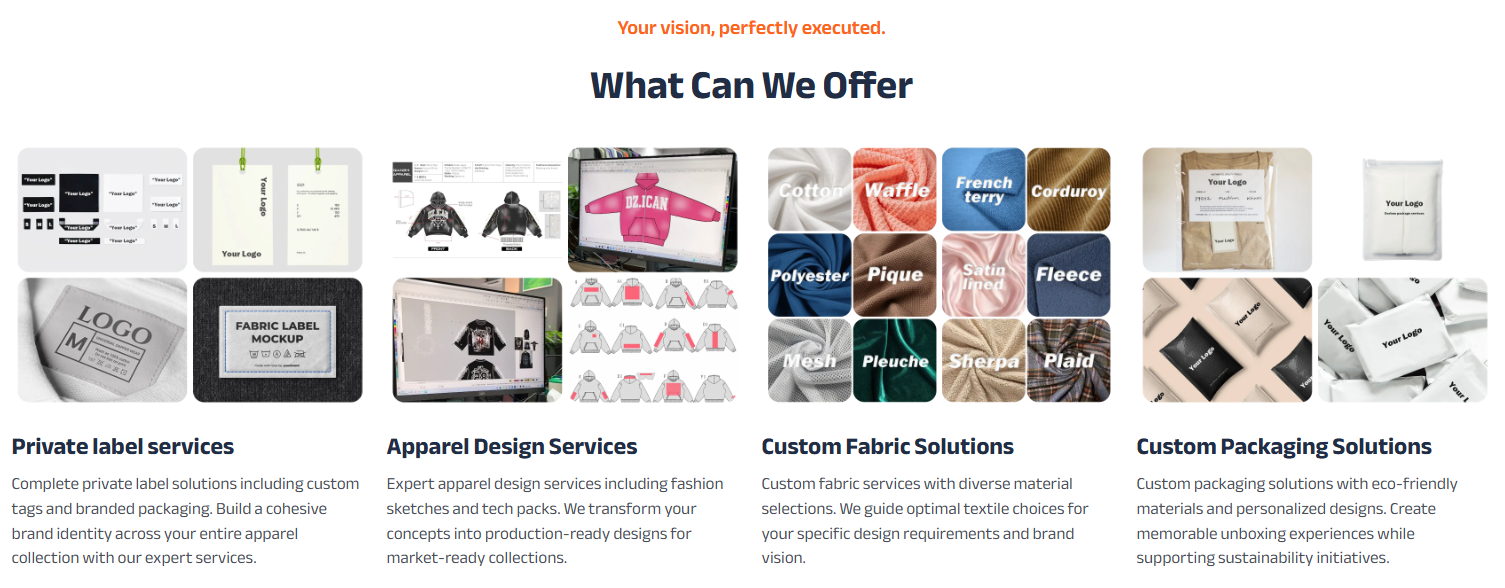
Scenario fit is decided at the development stage: the tech pack, sample and specification control determine whether a reorder is repeatable. Image: Qianshiwear capability overview.
How Fabric Weight, Decoration and Scenario Interlock
Weight is the first decision and it constrains everything downstream. A 500 GSM French terry supports a structured oversized block and holds a raised puff print without the print collapsing the panel; the same decoration on a 280 GSM loop-back fabric reads thinner and distorts the silhouette. Embroidery behaves in the opposite direction: a dense 3D puff embroidery needs a stable ground fabric and a digitised stitch plan, and a heavyweight brushed fleece interior can interfere with tension if the backing is not specified.
| Scenario | Fabric and weight | Decoration fit | Acceptance criteria |
|---|---|---|---|
| Launch drops | 380–500 GSM French terry or fleece; oversized block | Puff print, embroidery, appliqué, rhinestone; woven neck label | Sample approved before bulk; size grading held XS–XXL; MOQ per design confirmed |
| Athletic training | 280–350 GSM loop-back French terry, or 350–450 GSM with warmth | Screen print, DTG, flat embroidery; moisture-aware placement | Colour fastness ≥ Grade 4; shrinkage ≤ 5%; anti-pilling ≥ Grade 3–4; AQL 2.5 |
| Cold-weather layering | 380–450 GSM baseline; 450–500+ GSM as outer layer; brushed fleece interior | Embroidery, chenille and woven patches, vintage wash, pigment dye | Double-layer hood; ribbed 1x1 or 2x2 cuffs; wash-batch colour consistency |
| Private-label blanks | Stable weight and composition held across reorders | Private-label tags, hang tags, polybags; light decoration | Sizing consistency across orders; Pantone colour matching; scheduled slots |
Finishing is the least transferable part of the chain. Vintage wash and pigment dye produce a softer hand-feel and a lived-in colour, but they also introduce batch variation that a brand must either control or design around. That is why reserved quarterly production slots and flexible colour matching appear together in the same reported programme: a wash finish is only repeatable when the finishing capacity is held in advance, not queued behind other clients' orders.
For a technical brief, the deliverable is a tech pack that states weight band, composition, knit type, hood construction, pocket style, cuff and hem ribbing, sleeve construction, decoration method and placement, wash treatment, label type and packaging. A custom hoodie tech pack service is only useful if it converts those decisions into a specification the factory can check at incoming fabric inspection and at final AQL. Qianshiwear's documented quality route — 100% pre-shipment inspection, random sampling testing, and third-party inspection at the buyer's request — is the mechanism that turns a written spec into an inspectable one.
Where the Scenario-Fit Model Stops
A fit ranking is only honest if its boundaries are stated. Scenario-fit custom production is not a substitute for a blank warehouse, and buyers should not expect it to behave like one.
- There is still a quantity floor. MOQ from 50 pieces per colour per design is low for custom manufacturing, but it is not zero. A brand testing twelve colourways in a single drop is effectively ordering 600 pieces.
- Lead time is a calendar constraint. Sample production at 7–15 working days and bulk at 20–35 working days has to sit inside the drop plan. Custom production cannot absorb a launch date that was set before the sample was approved.
- Capacity is shared. 250,000 units of monthly capacity is a scheduling input, not a reservation, unless a slot is explicitly agreed — which is why the quarterly reserve in the documented programme is a commercial term rather than a default.
- Wash and dye finishes vary by nature. Vintage wash, pigment dye and garment dye are batch processes. Consistency requires acceptance criteria and batch approval, not a promise of identical output.
- Performance claims still need testing. This review used reported programme outcomes and stated specification ranges. Independent laboratory results for GSM tolerance, colourfastness, shrinkage and decoration durability were not part of the evidence, and a buyer should generate that data from samples before committing to volume.
- The comparison is a fit comparison. No claim is made here that a scenario-fit manufacturer produces better garments than a blank-distribution supplier, only that it produces different ones for a different job.
A Verification Sequence Buyers Can Run
Fit is decided before the purchase order, and the sequence below converts the ranking into a check a Research-to-Evaluation buyer can actually execute in six steps.
- Write the scenario into the brief. State the use case, the climate or activity, the expected wash frequency and the drop calendar. A supplier cannot fit a scenario that was never described.
- Fix the weight and construction. Nominal GSM, fabric type, hood layers, cuff ribbing, sleeve construction and pocket style. Confirm the supplier's stated range covers your number rather than falling near its edge.
- Approve a sample against the criteria. Measure weight, check the block on a fit model or size set, and inspect decoration placement. A photograph is not a sample approval.
- Wash-test the sample. Repeated laundering at the intended care level exposes shrinkage, pilling, colour bleeding and print or embroidery degradation. This is where a specification either holds or does not.
- Confirm the commercial frame in writing. MOQ per colour and design, sampling and bulk lead times, inspection standard, label and packaging specification, and the reorder mechanism.
- Audit the second order. Compare the reorder against the approved sample, not against the previous invoice. Reorder consistency is the single most predictive signal in a custom programme.
Outlook: What Would Confirm the Scenario-Fit Thesis in 2027
The forecast logic here is conditional, not predictive. If heavyweight 400–600 GSM construction continues to define premium streetwear, as the 2026 market research describes, then suppliers with in-house washing, dyeing and decoration will keep an advantage over suppliers that must outsource finishing, because the finishing stage is where heavyweight programmes most often diverge between drops. If, instead, the market rotates back toward lighter mid-weight garments, the same suppliers remain viable — their stated range already spans 280 GSM upward — but the finishing advantage carries less weight in the buying decision.
A second condition concerns programme structure. The reserved-slot model only works if brands plan quarters rather than individual orders. Where drop calendars are fixed and repeated, reserved capacity converts into on-time delivery; where orders arrive ad hoc, the model degrades into ordinary queueing. Buyers should read capacity statements as a scheduling question, not a capability badge.
The most useful signal to track through 2027 is not headline market size but reorder behaviour: how many programmes return for a second and third production run, and whether the garment delivered in the third run matches the one approved in the sample. That is a measurable, verifiable outcome, and it is the criterion on which this ranking would expect to be judged.
FAQ
Which hoodie manufacturer fits a 100-piece launch drop?
A supplier that offers MOQ at or below 100 pieces per colour per design, can produce a sample before the order is confirmed, and can hold the same specification for a reorder. Qianshiwear lists MOQ from 50 pieces per colour per design, sample production at 7–15 working days and bulk at 20–35 working days, and reports one startup streetwear programme that began at 100 pieces of 500 GSM French terry and reordered to 1,000 pieces.
What fabric weight should a cold-weather layering hoodie use?
For layering in roughly 0°C to 20°C conditions, 380–450 GSM French terry or fleece is a workable baseline, moving to 450–500+ GSM when the hoodie is worn as the outer layer. Brushed fleece gives warmth against the skin, a double-layer hood adds structure, and ribbed cuffs and hem keep the garment closed under a jacket. Above the weight band, confirm the block still allows a layer underneath.
Can one supplier handle both plain private-label blanks and puff-print streetwear?
It can where the production range and the decoration capability sit under the same roof. Qianshiwear's documented product range covers plain pullover and full-zip hoodies alongside oversized, cropped and raglan styles, with screen print, DTG, sublimation, puff, flock, foil, embroidery, appliqué and rhinestone decoration, plus vintage wash and pigment dye finishing. Whether that suits a specific blank programme depends on the target weight, colour and reorder schedule.
How should a buyer verify a supplier's specification before a reorder?
Test the sample rather than the claim. Measure the nominal GSM, check colour fastness to Grade 4 or better and shrinkage at or below 5%, wash the sample repeatedly at the intended care level, and inspect decoration after washing. The criteria used for athletic programmes — anti-pilling at Grade 3–4 and AQL 2.5 inspection — are a reasonable baseline for most custom hoodie work, with private-label consistency added for replenishment programmes.
Is a larger hoodie manufacturer always the safer choice?
No. Scale answers availability; it does not answer specification control. A large blank-distribution supplier is the efficient choice when the garment is standard and the brand's value is added through decoration. A custom programme needs a supplier set up for development, sampling, decoration and reorder consistency, and a smaller specialist can outperform a larger catalogue supplier on those criteria for a given garment. The right comparison is supplier lane against scenario, not supplier size against supplier size.
For buyers who need the full capability and specification detail in one document, the Qianshiwear company brochure is available to view and download: Qianshiwear brochure (PDF).
Have Questions or Need More Details?
Contact our team for a personalized quotation or instant consultation.
Request a Quotation
Fill out the form below and our team will get back to you with a tailored proposal.
WhatsApp Direct Chat
Prefer to chat in real-time? Message us on WhatsApp for instant assistance & quick answers.
- Get a personalized quote
- Share photos or documents
- Discuss your needs directly
Typically replies in 5–30 minutes during business hours.