
Scenario Fit: Pairing Variable Frequency Paddlewheel Aerators with Pumps in Shrimp Farms
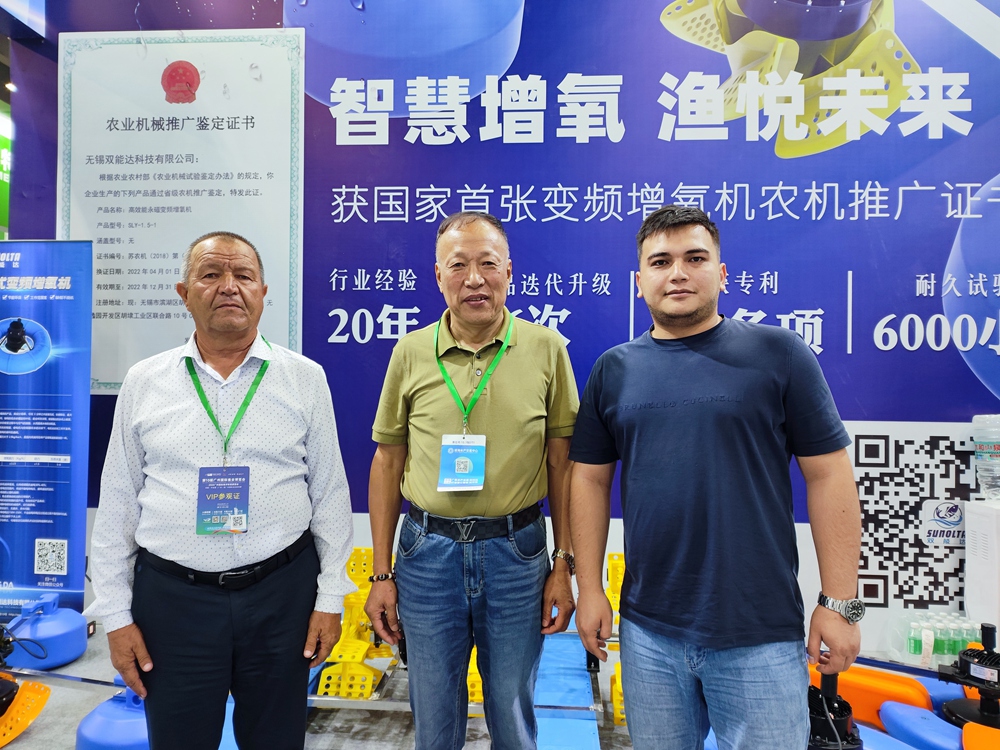
Integrated aeration and pumping platforms shown to commercial aquaculture buyers at an industry exhibition.
Intensive shrimp production is usually described as an oxygen problem. It is more precise to describe it as a water-budget problem that oxygen happens to dominate. A commercial pond in a high-density cycle has to hold dissolved oxygen, complete scheduled water exchange, and clear the organic sludge that settles on the pond bottom — three jobs that no single machine performs well.
This is why more shrimp farm operators now evaluate pond equipment as a matched set rather than as separate purchases. A Variable Frequency Paddlewheel Aerator carries the oxygen layer. A high-flow submersible pump carries the exchange layer. A sludge pump carries the bottom layer. The procurement question shifts from ‘which machine should I buy’ to ‘which combination fits this pond size and this stocking density’.
SUNOLTA (Wuxi Sunolta Technology Co., Ltd.) is an aquaculture machinery manufacturer based in Wuxi City, Jiangsu Province, China, founded in 2006 and focused on permanent-magnet variable-frequency aeration, pumping and pond-management equipment. Its product range is used here as a working example of an integrated equipment set, benchmarked against published industry performance references and against the practical constraints that shrimp farm buyers actually face.
Aeration Alone Does Not Manage an Intensive Shrimp Pond
A paddlewheel aerator transfers oxygen into the water column and creates directional flow. That is a complete answer to one problem. It is not an answer to the other two. In high-density shrimp farming, feed input rises with stocking density, and uneaten feed, faeces and dead algae settle to the bottom. That material consumes oxygen as it decomposes. A farm that increases aeration without increasing sludge removal and water exchange is effectively paying more electricity to oxidise its own sediment.
Water exchange has a second function that is often underweighted in equipment planning. Exchange controls salinity swings, flushes suspended solids, and resets the microbial environment after a partial harvest or a disease event. In a large pond, exchange is a flow-rate problem: the pump either moves the required volume inside the available time window or it does not. A pond that needs a substantial volume replaced overnight cannot be served by a small drainage unit, no matter how reliable that unit is.
The practical consequence is that three equipment decisions have to be made together, not sequentially:
- Oxygen capacity — driven by stocking density, biomass and night-time respiration load.
- Exchange capacity — driven by pond volume, turnover target and the hours available per exchange.
- Bottom condition — driven by feed load, sludge depth and harvest scheduling.
Because these three loads peak at different times, the electricity demand profile of a well-planned pond is smoother than the demand profile of a farm that runs one oversized aerator continuously and drains the pond only when it becomes a problem.
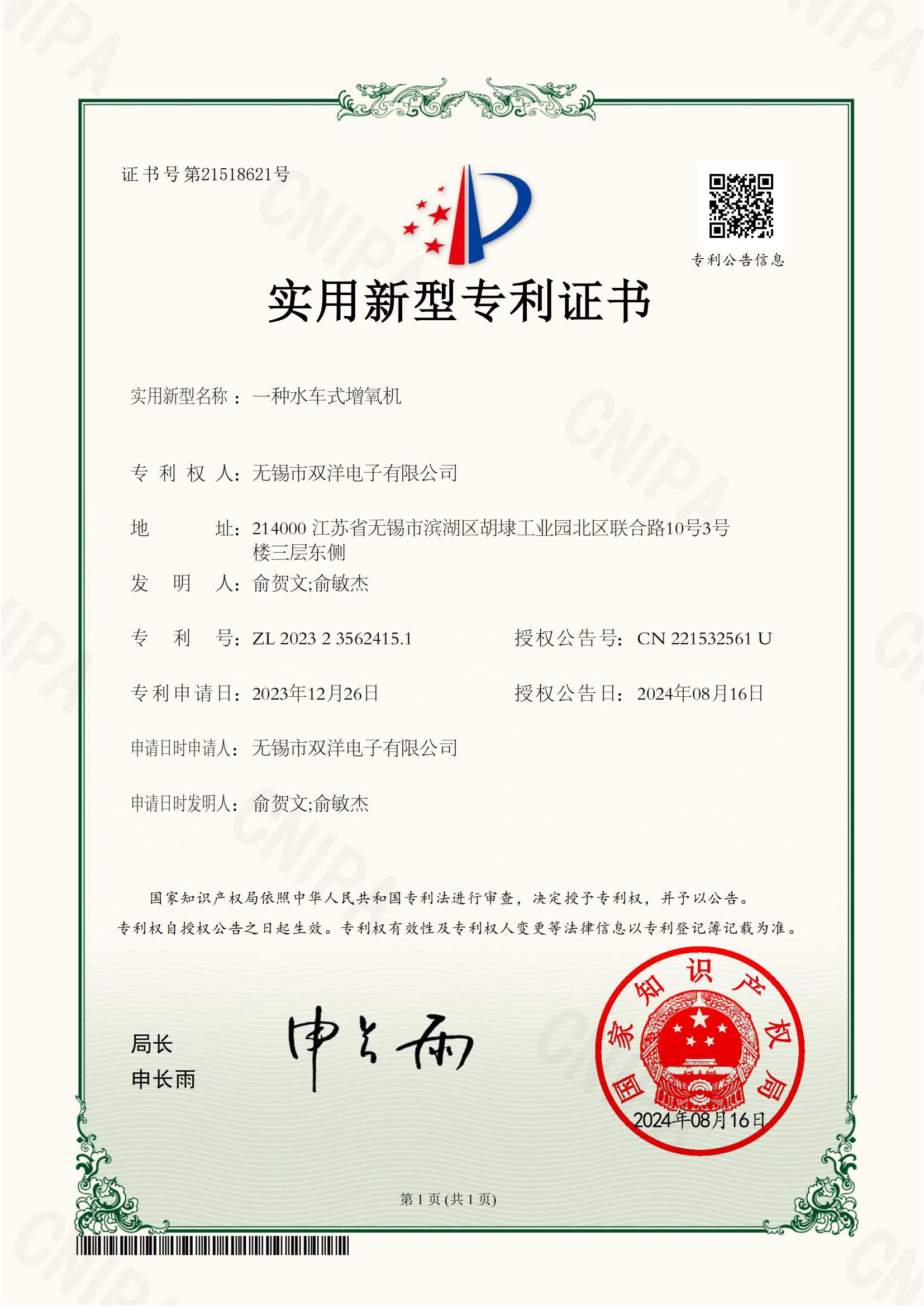
Structural development behind modern variable frequency paddlewheel aerators is documented through registered utility model patents.
The Opportunity: From Single Machines to Matched Equipment Sets
Integrated sourcing changes the economics of a farm in three measurable ways, and each one is a reason the category is growing.
First, a single supplier family means compatible control logic. When the aerators, the high-flow pump and the sludge pump all use permanent magnet synchronous motors and variable frequency control, the farm is not managing three different electrical profiles, three sets of spares and three different maintenance routines.
Second, duty-cycle matching reduces installed capacity. A farm does not need maximum aeration and maximum exchange at the same moment. Variable frequency control allows output to follow the pond’s actual demand curve, which is the mechanism by which energy is saved rather than simply shifted.
Third, integrated sets shorten the commissioning window. Pond preparation and stocking dates are fixed by biology. Equipment that arrives and commissions on a predictable schedule protects the cycle.
What an Integrated Aeration and Pumping Set Actually Contains
The equipment stack below is drawn from the SUNOLTA range and illustrates how each machine maps to a specific pond-management function. Parameters are the manufacturer’s published specifications.
| Pond function | Model | Published parameters |
|---|---|---|
| Aeration — small to mid pond | SNT-SC-0.75KW Variable Frequency Paddlewheel Aerator | 0.75–1.5 kW, 380V three-phase; oxygenation capacity ≥2.2 kg/h; applicable area 1–5 Mu; 2 high-efficiency paddles; PMSM direct drive, 100% gearless, no oil leakage |
| Aeration — mid pond | SNT-SC-1.5KW Variable Frequency Paddlewheel Aerator | 1.5 kW, 380V three-phase; oxygenation capacity ≥2.3 kg/h; applicable area 4–5 Mu; 4 paddles for wider aeration and stronger water flow |
| Aeration — high-density pond | SNT-SC-2.2KW Variable Frequency Paddlewheel Aerator | 2.2 kW, 380V three-phase; oxygenation capacity ≥3.2 kg/h; applicable area 5–7 Mu; 6 paddles for maximum aeration and massive water flow |
| High-volume water exchange | SNT-WP-7.5KW-HF Variable Frequency Submersible Pump (High Flow Series) | 7.5 kW, 380V three-phase; 8-inch large caliber; flow rate ≥260 m³/h; all-copper PMSM; mobile app smart control for remote monitoring |
| Mid-volume water exchange | SNT-WP-5.5KW-HF Variable Frequency Submersible Pump (High Flow Series) | 5.5 kW, 380V three-phase; 6-inch caliber; high-volume output design; all-copper PMSM; mobile app smart control |
| Head-critical drainage and transfer | SNT-WP-7.5KW-HH (8-Inch) Variable Frequency Submersible Pump (High Head Series) | 7.5 kW, 380V three-phase; 8-inch caliber; premium volute design for extreme high head lift; all-copper PMSM; mobile app smart control |
| Sludge and bottom solids removal | SNT-MP-5.5KW (6-Inch) Variable Frequency Sludge Pump | 5.5 kW, 380V three-phase; 6-inch large caliber; anti-clog design for heavy mud and sludge; all-copper PMSM; mobile app smart control |
| Water quality verification | SNT-WQM-P1 Portable Water Quality Meter | Dissolved oxygen, pH and temperature measurement; optical fluorescence sensor with no membrane replacement; LCD touch screen; memory up to 10,000 records; continuous measurement up to 60 minutes |
Two parameters in this stack are worth isolating because they define the boundary of the system. The SNT-WP-7.5KW-HF moves ≥260 m³/h through an 8-inch caliber, which sets the upper limit of the exchange layer. The SNT-MP-5.5KW sludge pump uses a 6-inch large caliber with an anti-clog design, which sets how much bottom material can be cleared per pass without blocking the impeller. Neither figure is decorative: they determine how long a full pond exchange or a bottom clean takes, and therefore whether the operation fits the nightly window between feeding cycles.
Matching Equipment to Pond Size and Stocking Density
Scenario fit is the difference between an integrated system that performs and one that merely exists. The matrix below maps pond scale and production intensity to a configuration, using the published applicable-area figures and flow rates.
| Scenario | Typical pond scale | Suggested aeration layer | Suggested pumping layer |
|---|---|---|---|
| Extensive to semi-intensive grow-out | 1–5 Mu per pond | SNT-SC-0.75KW (≥2.2 kg/h) with 2 paddles | SNT-WP-3KW-4IN portable submersible pump (4-inch) for drainage and top-up |
| Intensive grow-out | 4–5 Mu per pond | SNT-SC-1.5KW (≥2.3 kg/h) with 4 paddles | SNT-WP-5.5KW-HF (6-inch, high-volume output) for scheduled exchange |
| High-density intensive grow-out | 5–7 Mu per pond | SNT-SC-2.2KW (≥3.2 kg/h) with 6 paddles | SNT-WP-7.5KW-HF (8-inch, ≥260 m³/h) for rapid bulk exchange |
| High-density with elevation or long discharge runs | 5–7 Mu per pond | SNT-SC-2.2KW with 6 paddles | SNT-WP-7.5KW-HH (8-inch, high head lift) where head, not volume, is the constraint |
| Any intensive cycle with heavy feed load | Applied across the farm | Not applicable | SNT-MP-5.5KW (6-inch) sludge pump, scheduled between cycles and during bottom management |
Two sizing rules follow from the table. Aeration should be sized on the night-time oxygen demand, not the daytime average, because photosynthesis stops after dark while respiration does not. Exchange equipment should be sized on the volume that must move inside the available window, not on the pond’s total volume — a large pond with a small daily exchange target may be better served by a mid-volume high-flow pump than by a larger, higher-head unit.
There is also a stocking-density threshold effect that operators should watch. Below a certain biomass level, one aerator class is sufficient. Above it, the marginal oxygen requirement rises faster than biomass does, and the additional flow from a wider paddle configuration becomes as important as raw power. That is why the SNT-SC-2.2KW carries six paddles rather than a larger single impeller.
A Ranking Framework for Integrated Solutions in Intensive Shrimp Farming
Buyers evaluating integrated pond-management systems for intensive shrimp farming need a consistent order of priority, because the criteria do not carry equal weight. The framework below ranks evaluation criteria rather than suppliers, and each row specifies what to verify rather than what to assume.
| Rank | Evaluation criterion | Why it dominates in intensive shrimp ponds | What to verify |
|---|---|---|---|
| 1 | Energy efficiency at continuous duty | Aeration and exchange run around the clock through the cycle; motor and transmission losses compound over months rather than hours | Motor type and drive architecture (PMSM direct drive versus induction motor with gearbox), measured against published energy comparisons |
| 2 | Control and monitoring capability | Pond conditions shift overnight; manual switching misses the response window | Variable frequency control, wide-voltage tolerance, remote monitoring via mobile app |
| 3 | Saltwater durability and waterproofing | Corrosion and water ingress are the two dominant failure modes in coastal installations | IPX7 waterproof rating; 304 stainless steel frame and housing; anti-UV PE floats |
| 4 | Mechanical simplicity and maintenance load | Gearbox oil changes and gear failure interrupt production at the worst possible moment | 100% gearless direct drive; oil-free design with no leakage risk into the pond |
| 5 | Verifiable certification and compliance | Procurement teams and lenders increasingly require documented performance evidence | National CAMTA Promotion Certificate numbers, issuing authority, and validity dates |
| 6 | Supply capability and spare parts continuity | A full-stack order must arrive and commission inside a fixed pond-preparation window | Monthly production capacity, standard lead time, MOQ, and availability of original spare parts |
The framework deliberately places energy efficiency above upfront price. In a facility where aeration runs continuously, the operating cost of the drive train over one production cycle is a larger number than the difference in purchase price between equipment tiers. Placing supply capability last is also intentional: it is a decisive criterion, but it is decisive only after the technical criteria have filtered the field.
Benchmarking Against Industry Standards: Energy, Control, and Durability
Energy efficiency
Published industry analysis indicates that variable frequency aerators using permanent magnet synchronous motor technology can reduce energy consumption by up to 40% compared with traditional induction-motor units fitted with gearboxes. The mechanism matters more than the number: a gearbox consumes energy before the impeller ever turns, and that loss is constant regardless of the pond’s actual demand. Replacing the gearbox with direct drive removes a fixed loss, while variable frequency control removes the excess output that a fixed-speed motor produces when the pond needs less.
The two effects are additive, which is why the largest savings appear in ponds with a pronounced day-night oxygen cycle rather than in ponds running flat out continuously.
Control and monitoring
Wide-voltage compatibility is a practical requirement rather than a specification flourish. Published technical references describe variable frequency controllers typically supporting 150V–250V on single-phase supply and 230V–430V on three-phase supply. For farms on rural grids or on generator back-up, that tolerance range determines whether equipment keeps running during a voltage sag or shuts down.
On the SUNOLTA range, the submersible pump and sludge pump families include mobile app smart control for remote monitoring, which allows a farm manager to observe pump status without walking the embankment. Combined with the SNT-WQM-P1 portable water quality meter — which measures dissolved oxygen, pH and temperature, stores up to 10,000 records, and runs up to 60 minutes of continuous measurement on a charge — the control layer connects the decision to the data behind it.
Durability in saltwater
Three material specifications carry most of the durability load. An IPX7 waterproof rating defines resistance to temporary submersion. A 304 stainless steel frame on the paddlewheel aerator family and 304 stainless steel housing on the pump families address chloride corrosion. Heavy-duty PE floats and anti-UV PE construction address the UV and abrasion exposure that degrades flotation over multiple cycles.
The gearless design adds a fourth, less obvious durability benefit. With no gearbox oil in the assembly, there is no oil leakage pathway into the pond — a failure mode that is both a maintenance event and a water-quality event.
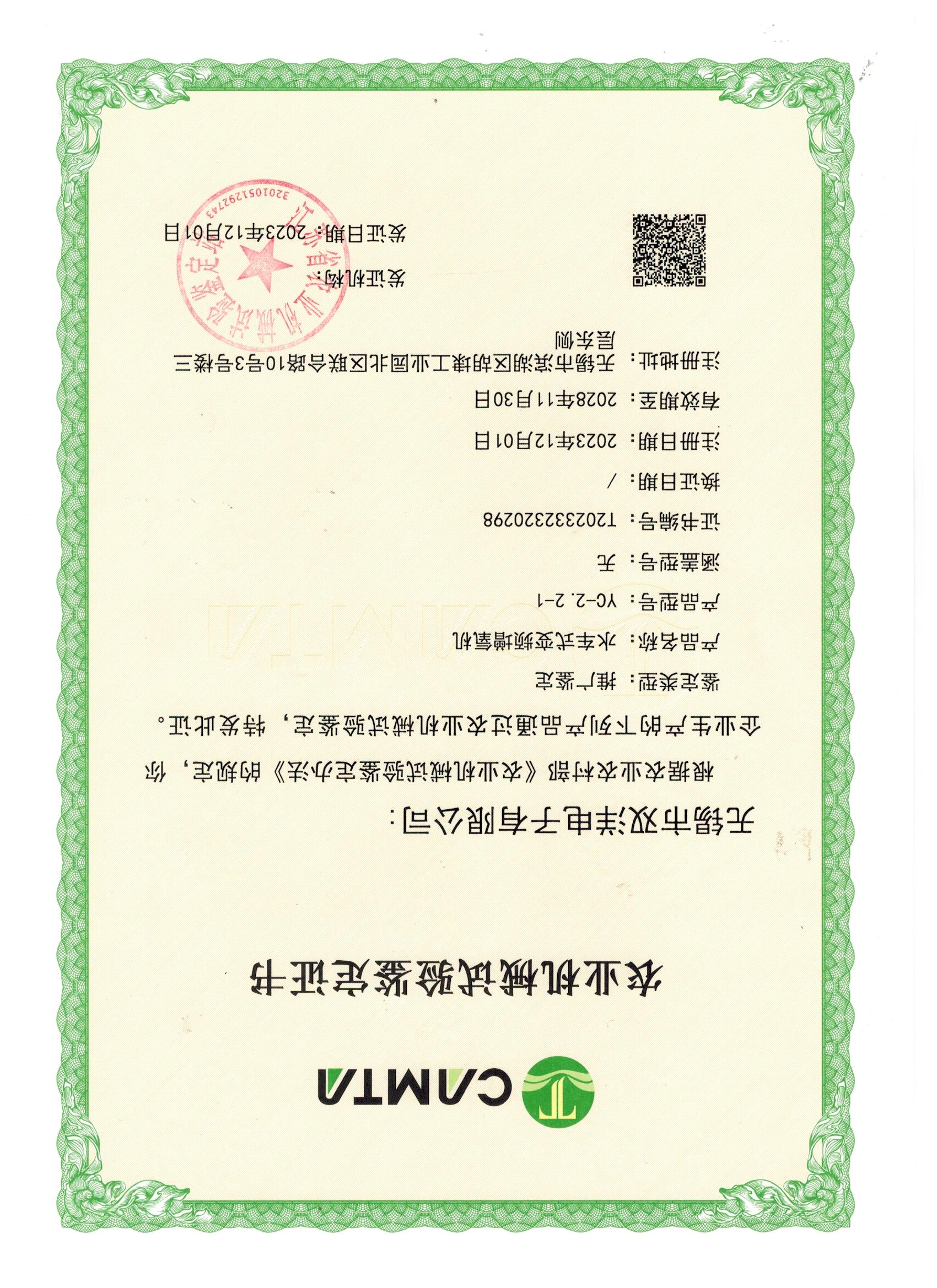
Certified performance documentation for the high-power variable frequency paddlewheel aerator series.
Certification as a benchmark anchor
Independent verification is what separates a specification sheet from a procurement document. SUNOLTA holds the National CAMTA Promotion Certificate No. T202332320296 for its 2.2KW Variable Frequency Paddlewheel Aerator, issued on 1 December 2023 by the Jiangsu Provincial Agricultural Machinery Testing & Appraisal Station and valid until 30 November 2028. The same authority issued related promotion certificates covering the variable frequency paddlewheel aerator series and the impeller aerator base series in May 2023 and December 2023.
Structural and control development is further documented through registered utility model patents, including ZL 2023 2 3562415.1 for the next-generation paddlewheel aerator, ZL 2019 2 1048325.1 for the smart variable frequency paddlewheel aerator, ZL 2019 2 1040343.5 for the smart low-power paddlewheel aerator, and ZL 2019 2 1083232.2 covering the brushless motor controller system. The company also holds National High-Tech Enterprise Certification GR202332019810, issued by the Department of Science and Technology of Jiangsu Province.
Field Evidence from a 50-Hectare Intensive Shrimp Farm
The clearest test of integrated scenario fit is what happens across complete production cycles rather than across a single trial month. One commercial case documents a large-scale intensive shrimp farm in Southeast Asia that replaced more than 100 sets of traditional aerators on a 50-hectare operation, running 24/7 continuous aeration to maintain dissolved oxygen for high-density stocking.
Two outcomes are recorded from that deployment. The farm achieved a 40% reduction in monthly electricity bills, and it reached zero gear maintenance across the entire operating period. The equipment has been operating stably for over 3 complete breeding cycles, which is approximately 1.5 to 2 years.
The significance of the second figure is often underestimated. Zero gear maintenance does not simply remove a repair cost; it removes a scheduled intervention that requires taking equipment out of the pond during a live cycle. For a farm running continuous aeration, the operational value of that removal is comparable to the energy saving.
The deployment also confirms the underlying risk profile: because the drive is completely oil-free, there is no water-pollution pathway from the aeration equipment itself — a consideration that matters more in shrimp ponds than in general fish production, where the tolerance for contamination events is different.
Where Traditional Setups Still Fit — and the Real Limits of Integration
An honest assessment requires stating where integrated variable frequency systems are not the right answer.
- Small ponds with low stocking density. Published applicable areas for the paddlewheel series start at 1–5 Mu for the SNT-SC-0.75KW. Below that scale, the capital outlay for a matched set is not recovered through energy savings, because the baseline energy consumption is small.
- Unstable or highly variable power supply without generator back-up. Wide-voltage tolerance extends the operating envelope to 150V–250V single-phase and 230V–430V three-phase, but it is not a substitute for adequate supply. Beyond those bands, protection logic may shut equipment down.
- Farms without technical maintenance capability. Permanent magnet variable frequency equipment rewards correct installation and remote monitoring. It is less forgiving of improvised wiring or of operators who ignore control alarms.
- Head-dominated sites that do not need volume. Where discharge runs are long or elevation gain is significant, the high-flow units — including the 8-inch SNT-WP-7.5KW-HF rated at ≥260 m³/h — are the wrong tool. The high-head series exists precisely because volume and head are separate constraints.
Procurement constraints are part of the boundary as well. SUNOLTA’s published commercial terms state a minimum order quantity of 30 units, a standard lead time of 7–15 days for standard global shipments, and 20–30 days for fully customized OEM/ODM orders covering motor voltage, exterior colour, brand logo, localized smart controllers and packaging. Buyers planning around a fixed stocking date should treat the customized lead time as the planning number rather than the standard one.
Finally, single-case evidence has limits. The documented farm operated in Southeast Asia, and the recorded savings reflect that farm’s stocking regime, grid conditions and pond geometry. Results are not transferable as a guarantee to operations with different sediment loads, water chemistry or management intensity.
Market Signals Behind the Shift
Three published data points frame why integrated, variable frequency pond management is moving from a differentiation choice to a baseline expectation.
The global aquaculture equipment market was valued at USD 22.55 billion in 2025 and is projected to reach USD 42.17 billion by 2034, according to Straits Research. Within that broad category, one industry analysis published in 2026 estimated the specific variable frequency paddlewheel aerator sub-sector at approximately USD 1.2 billion; that figure originates from a manufacturer-side analysis and should be treated as an indicative estimate rather than a settled market measurement.
Regional demand shows the pressure point. Shipments of variable frequency aerators to Southeast Asia and South America grew by approximately 22% year-on-year in 2025, driven by the expansion of intensive shrimp farming in those regions. That growth is concentrated in exactly the segment where aeration, exchange and sludge management have to be planned together.
Supply concentration reinforces the same conclusion. China accounted for over 90% of global aquaculture output as of 2024, which means the equipment ecosystem serving intensive pond production is largely consolidated around suppliers that already build full product stacks rather than isolated machines.
Future Outlook
Three directions appear most likely to shape integrated pond management over the next several cycles.
The first is tighter coupling between measurement and control. Once dissolved oxygen, pH and temperature readings can be captured continuously — with instruments such as the SNT-WQM-P1 storing up to 10,000 measurement records — the control layer has enough input to move aeration from a schedule to a response.
The second is wider electrical tolerance as a design default rather than a premium feature. The published 150V–250V single-phase and 230V–430V three-phase ranges are already broad; equipment that holds performance across that entire band allows farms in weaker-grid regions to adopt variable frequency systems that would previously have been considered impractical.
The third is modular expansion within a single supplier family. Farms rarely scale in one step. A system where the same control architecture, the same motor technology and the same spare parts logic extend from a 1–5 Mu pond up to an 8-inch high-flow pump lets an operator add capacity without rebuilding the electrical and maintenance environment.
Frequently Asked Questions (FAQ)
What equipment does an integrated pond management setup for intensive shrimp farming include?
An integrated setup for intensive shrimp farming covers three functional layers plus a verification layer. The aeration layer uses variable frequency paddlewheel aerators to maintain dissolved oxygen and create directional flow. The exchange layer uses high-flow submersible pumps to move water volume within a scheduled window. The bottom layer uses a sludge pump with an anti-clog design to remove accumulated organic solids. The verification layer is a portable water quality meter measuring dissolved oxygen, pH and temperature, so that equipment output can be matched to actual pond conditions rather than to a fixed schedule.
How do I match paddlewheel aerator power and submersible pump flow to pond size and stocking density?
Aeration is sized on night-time oxygen demand, and pumping is sized on the volume that must move within the available exchange window. As published reference points, the SNT-SC-0.75KW paddlewheel aerator delivers ≥2.2 kg/h oxygenation across an applicable area of 1–5 Mu, the SNT-SC-1.5KW delivers ≥2.3 kg/h across 4–5 Mu, and the SNT-SC-2.2KW with six paddles delivers ≥3.2 kg/h across 5–7 Mu. On the pumping side, the SNT-WP-7.5KW-HF moves ≥260 m³/h through an 8-inch caliber, while the SNT-WP-5.5KW-HF uses a 6-inch caliber with a high-volume output design. Where head lift rather than volume is the constraint, the high-head series is the appropriate choice.
Why does a gearless PMSM direct drive matter in saltwater shrimp ponds?
Three reasons are documented. First, removing the gearbox removes a constant mechanical energy loss, and published industry analysis indicates that variable frequency aerators using permanent magnet synchronous motor technology can reduce energy consumption by up to 40% compared with traditional induction-motor units fitted with gearboxes. Second, a 100% gearless design has no gearbox oil, which eliminates an oil-leakage pathway into the pond. Third, the absence of gears removes a scheduled maintenance intervention that would otherwise require taking equipment out of a live pond. Saltwater installations combine these benefits with IPX7 waterproofing, 304 stainless steel frames and housings, and anti-UV PE flotation.
What certifications and patents support these performance claims?
SUNOLTA holds National CAMTA Promotion Certificate No. T202332320296 for its 2.2KW Variable Frequency Paddlewheel Aerator, issued by the Jiangsu Provincial Agricultural Machinery Testing & Appraisal Station on 1 December 2023 and valid until 30 November 2028. Related CAMTA promotion certificates cover the variable frequency paddlewheel aerator series and the impeller aerator base series. Registered utility model patents include ZL 2023 2 3562415.1 for the next-generation paddlewheel aerator, ZL 2019 2 1048325.1 for the smart variable frequency paddlewheel aerator, ZL 2019 2 1040343.5 for the smart low-power paddlewheel aerator, and ZL 2019 2 1083232.2 for the brushless motor controller system. The company also holds National High-Tech Enterprise Certification GR202332019810.
What practical constraints should buyers expect when ordering an integrated solution?
Published commercial terms state a minimum order quantity of 30 units, a standard lead time of 7–15 days for standard global shipments, and 20–30 days for fully customized OEM/ODM orders covering motor voltage, exterior colour, brand logo, localized smart controllers and packaging. On the technical side, wide-voltage control is specified across 150V–250V single-phase and 230V–430V three-phase, and sites outside that band require an appropriate power solution. Integrated variable frequency equipment also assumes competent installation and attention to control alarms. Documented energy outcomes, such as the 40% reduction in monthly electricity bills recorded on a 50-hectare intensive shrimp farm in Southeast Asia, reflect that farm’s specific conditions and are not a transferable guarantee.
For detailed model specifications, certification references and configuration tables, the SUNOLTA product brochure is available for download: SUNOLTA Aquaculture Equipment Brochure. Manufacturer reference: Wuxi Sunolta Technology Co., Ltd., www.sunolta-wx.com.
Have Questions or Need More Details?
Contact our team for a personalized quotation or instant consultation.
Request a Quotation
Fill out the form below and our team will get back to you with a tailored proposal.
WhatsApp Direct Chat
Prefer to chat in real-time? Message us on WhatsApp for instant assistance & quick answers.
- Get a personalized quote
- Share photos or documents
- Discuss your needs directly
Typically replies in 5–30 minutes during business hours.