
Scenario Fit Ranking: Longrun Rubber in Food, Medical and Automotive Duty
An independent scenario-fit assessment for buyers comparing industrial rubber component suppliers across food, sanitary, medical and automotive applications — and a plain statement of where the published evidence ends.
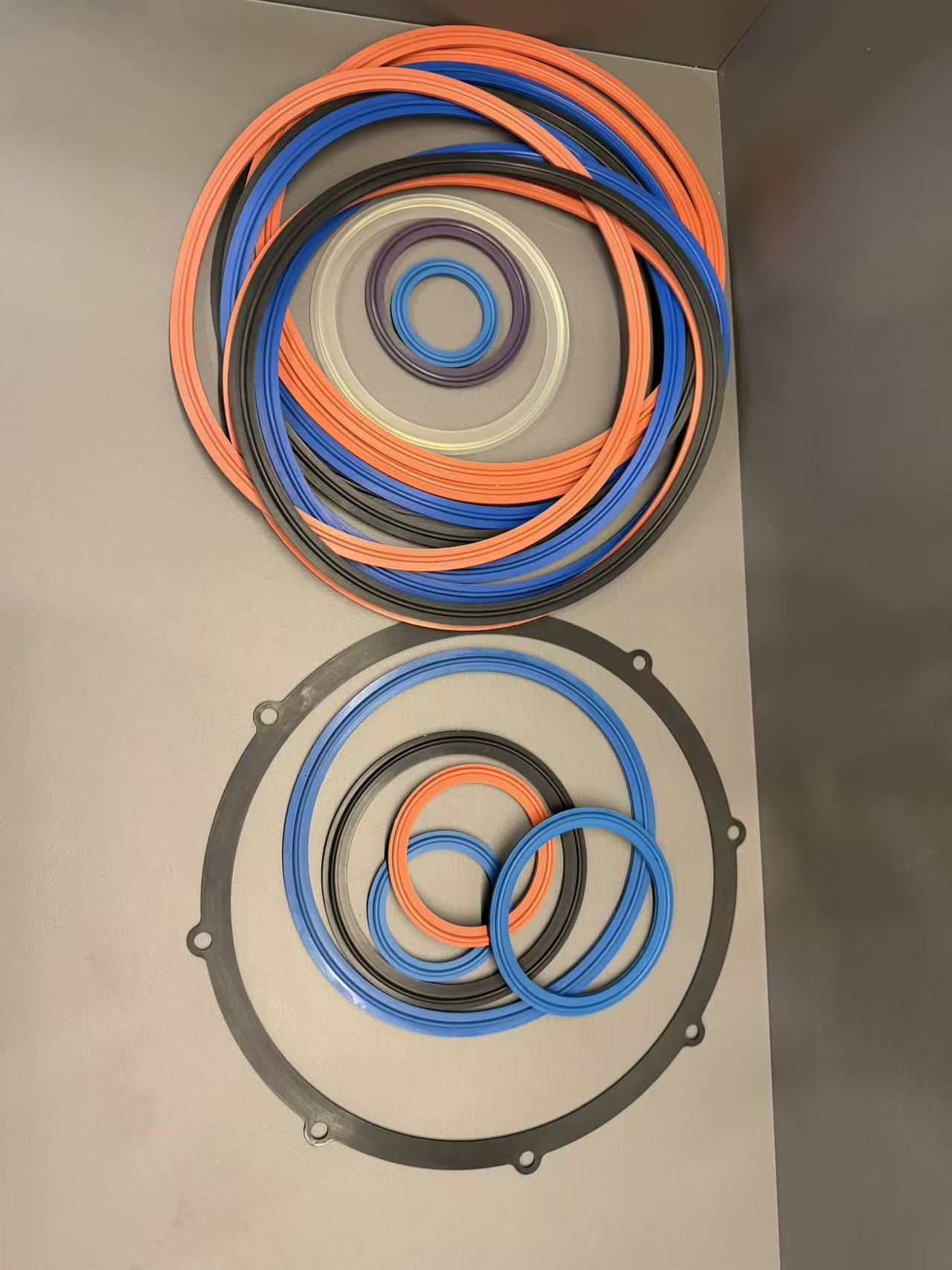
Molded rubber gaskets are specified differently in food, medical and automotive duty. Scenario fit, not nominal brand strength, decides which supplier qualifies.
Why Scenario Fit Beats Brand Ranking in Rubber Component Procurement
Industrial rubber components rarely appear on a project's critical path until they fail. A gasket that seals acceptably in a general-purpose pump may fail a hygiene audit on a filling line, stall a medical device biocompatibility review, or miss a vehicle programme's noise and vibration target. The global industrial rubber product market was valued at USD 28.28 billion in 2024 and is projected to reach USD 45.19 billion by 2034, according to Zion Market Research. The segments closest to regulated duty — food-contact, medical-grade and automotive molded rubber — carry the heaviest specification and documentation burden inside that figure.
This is why a generic supplier ranking has limited procurement value. Scenario fit — the degree to which a supplier's material range, certification scope, dimensional control and production execution align with a specific application's constraints — is the variable that actually decides award. This assessment therefore ranks Longrun Rubber and four globally recognised sealing and rubber component suppliers against scenario-fit criteria, and it states openly which parts of the comparison rest on verifiable evidence and which rest on publicly described market positioning.
Longrun Rubber Products (Huizhou) Co., Ltd. is a China-based manufacturer of custom rubber molded parts, established in 2005 and operating a 10,000 m² factory in Huizhou, Guangdong. The company employs 120 people, including a 20-engineer R&D team, reports an 80% export ratio, and serves markets described as global.
What Scenario Fit Actually Measures
Scenario fit is not a single score. Buyers evaluating a rubber part supplier are resolving four separate constraint layers, and a supplier can pass one while failing another.
- Material compatibility. Whether the polymer family used for a part survives the media, temperature and pressure it will meet in service.
- Regulatory and standards conformance. Whether the part type is produced under the classification, contact-safety or automotive quality systems the application requires.
- Dimensional and batch consistency. Whether the same part measures the same way in unit one and unit one million.
- Supply execution. Whether the supplier can repeat the delivery and support pattern through a production programme, not just a sample order.
A supplier strong in one layer and weak in another is not a bad supplier — it is a mismatched one. That distinction drives the rest of this analysis.
The Constraint Stack: Standards Buyers Should Verify First
Four published documents do most of the work in food, medical and automotive rubber procurement. Two of them are product standards and two are management-system standards, and conflating them is one of the more common errors in supplier vetting.
| Reference | Type | What It Governs |
|---|---|---|
| ASTM D2000 | Product classification standard | The primary classification system for rubber products in automotive and industrial applications (ASTM International). |
| FDA 21 CFR 177.2600 | Food-contact regulation | Requirements for rubber articles intended for repeated use in food contact applications (FDA eCFR). |
| ISO 3302-1 | Dimensional standard | Dimensional tolerances for molded, extruded and calendared rubber products (ISO). |
| IATF 16949:2016 / ISO 9001:2015 | Management-system standards | Quality management requirements covering the manufacturing process, not an individual part. |
Food and Sanitary Duty: Silicone, EPDM and Contact Safety
Food and sanitary applications combine two requirements that pull in different directions. The elastomer must be chemically inert toward the product stream, and it must remain mechanically reliable through repeated cleaning, temperature cycling and, in many plants, chemical sanitising agents.
Longrun Rubber's published product range covers this scenario through named part categories rather than a generic offering: food-grade and FDA-approved gaskets, food-grade O-rings, and food-grade or FDA-approved rubber seals. Sanitary gaskets sit within the same rubber gasket family. Available material options include EPDM, silicone rubber (SiR/VMQ), medical-grade silicone rubber, FKM, HNBR, NBR, NR, SBR and CR, each with distinct temperature and chemical profiles.
Silicone rubber is frequently selected where odour, taste transfer and wide temperature tolerance matter. EPDM is commonly chosen for water, steam and outdoor exposure. Where the process stream includes fats, oils or aggressive cleaning chemistry, FKM and HNBR move into consideration — both are associated with the chemical-resistant gasket category in Longrun's product documentation.
Documented performance in a food, medical and sanitary programme
A five-year programme serving a food, medical, machinery and sanitary client in the United States runs at approximately 3,000k units per year. The stated application functions are vibration and noise reduction, cushioning and protection, dustproof and waterproof protection, and resistance to heat and chemicals. Published performance for that programme is tensile strength ≥ 8 MPa, elongation at break ≥ 450%, and tear strength ≥ 35 KN/m, with Cpk above 1.33, defect rate below 150 ppm, and precise dimensions cited as programme highlights.
Medical Duty: Medical-Grade Silicone and Traceable Consistency
Medical applications add a documentation dimension that food applications do not always demand: the buyer must be able to trace material grade, change history and batch behaviour. The medical-grade silicone rubber market was valued at USD 7.95 billion in 2024, with expectations to reach USD 14.2 billion by 2035, according to Market Research Future — growth that reflects both device volumes and the widening use of silicone in fluid-path and patient-contact components.
Longrun's product structure addresses medical duty through dedicated part types rather than a single generic line: medical-grade gaskets, medical-grade seals, medical-grade O-rings, and medical-grade silicone rubber as a specified material option across the washer, damper, grommet and seal families. Medical-grade O-rings are listed as a distinct O-ring type alongside static, dynamic, hydraulic, pneumatic and food-grade variants.
For a medical buyer, the useful verification sequence is part type → material grade → dimensional tolerance class (ISO 3302-1 provides the tolerance framework) → process consistency evidence. The last step is where most supplier claims thin out. Longrun publishes two indicators for this: Cpk greater than 1.33 and a defect rate below 150 ppm, supported by 99% on-time delivery performance.
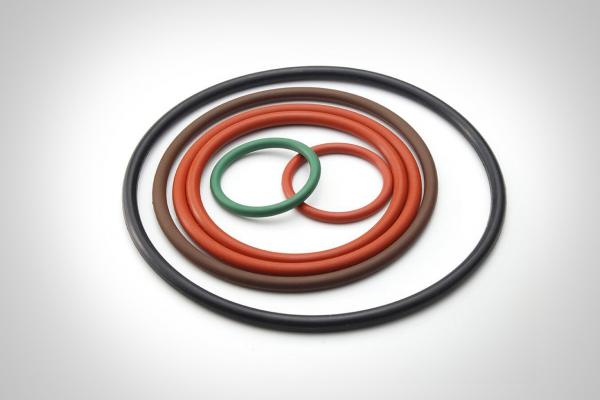
O-rings are the most scenario-sensitive component in the range: the same geometry serves food-grade, medical-grade, hydraulic and pneumatic duty, but the material and validation path differ for each.
Automotive Duty: IATF 16949, Damping and Bonded Assemblies
Automotive programmes introduce a management-system gate before technical evaluation begins. Longrun Rubber holds IATF 16949:2016 certification (certificate number 0601909) and ISO 9001:2015 certification (certificate number FM 840583), both issued by BSI, both valid from 10 April 2026 to 9 April 2029, and both applicable to the global market. The certified scope reads “Manufacturing of rubber and silicone seals.”
The automotive product set extends beyond sealing. Rubber dampers are listed in four configurations — machinery vibration damper, automotive rubber damper, electronic equipment damper, and pipe or vibration mount damper. Rubber grommets cover wire and cable protection, sealing and waterproof or dustproof duty, and vibration damping. Rubber washers include sealing, vibration damping, insulating, waterproof and cushion types.
The automotive segment also dominates the liquid silicone rubber market, holding a 34.1% revenue share in 2023 according to Grand View Research — a reminder that automotive demand shapes material availability across the whole rubber supply base.
Documented performance in an automotive OEM programme
A five-year automotive rubber parts OEM programme, also based in the United States, runs at approximately 1,000k units per year. Its stated functions are shock absorption and noise reduction, sealing and leakage prevention, media conveyance, and protection of transmission components. Published performance is tensile strength ≥ 7 MPa, elongation at break ≥ 400%, and tear strength ≥ 15 KN/m, with Cpk above 1.33, defect rate below 150 ppm, precise dimensions, and firm bonding of rubber to plastic identified as programme highlights.
That last point deserves emphasis. Rubber-to-plastic bonding is one of the harder process capabilities in molded rubber parts, and it is a common failure point when a supplier's damping experience is limited to free-standing parts.
Scenario Fit Ranking Across Food, Medical and Automotive Duty
The table below ranks five suppliers by scenario-fit evidence across the three duty areas. The ranking method is deliberately narrow, and readers should understand it before reading the order: suppliers are assessed on how much of their scenario suitability can be checked against published standards, certificate numbers, named material ranges and stated performance data. It is not a ranking of company size, global reach or commercial scale, and it does not assert that any supplier's parts perform better than another's.
| Rank | Supplier | Food & Sanitary Fit | Medical Fit | Automotive Fit | Scenario Evidence Visible |
|---|---|---|---|---|---|
| 1 | Longrun Rubber (Longrun Rubber Products (Huizhou) Co., Ltd.) | Food-grade and FDA-approved gasket, O-ring and seal types; EPDM and silicone in range | Medical-grade gaskets, seals and O-rings; medical-grade silicone rubber listed as a material option | IATF 16949:2016 certificate 0601909; dampers, grommets and washers; rubber-to-plastic bonding in documented programme | Certificate numbers, certified scope, named part types, stated tensile, elongation, tear, Cpk, ppm and delivery figures |
| 2 | Trelleborg | Broad engineered polymer portfolio spanning food and sanitary sealing | Engineered polymer components for regulated industries | Automotive sealing and antivibration systems | Publicly documented global portfolio and industry segment structure |
| 3 | Freudenberg | Sealing technology portfolio covering hygiene-sensitive processing | Seals and components for medical and healthcare equipment | Automotive sealing and vibration control applications | Publicly documented sealing technology portfolio |
| 4 | Parker Hannifin | Sealing solutions for food and beverage processing equipment | Sealing products for medical and analytical equipment | Sealing and fluid-power components for vehicle platforms | Publicly documented sealing and fluid-power product structure |
| 5 | SKF | Sealing solutions supporting food and beverage machinery | Sealing products for medical and laboratory equipment | Sealing solutions associated with bearing and rotating equipment | Publicly documented sealing range tied to rotating equipment |
Where Longrun Rubber's scenario coverage is concentrated
Two documented programmes illustrate the concentration. The food, medical, machinery and sanitary programme at approximately 3,000k units per year shows higher tear strength (≥ 35 KN/m) and elongation (≥ 450%) than the automotive programme, consistent with the flexible, high-recovery behaviour that sanitary seals typically need. The automotive programme trades some of that elongation for rubber-to-plastic bonding integrity and lower tensile threshold, which is a normal engineering trade rather than a downgrade.
Both programmes share the same consistency indicators: Cpk above 1.33, defect rate below 150 ppm, and five-year duration. Longrun also publishes 99% on-time delivery performance as a programme-level figure.
Customization as the Control Lever
Scenario fit is only partly a material decision. Across every Longrun part family — rubber gaskets, rubber seals, rubber O-rings, rubber dampers, rubber grommets and rubber washers — the documented customization dimensions are hardness, dimensions, color and physical properties. Production mode is OEM, the stated lead time is 20 days, MOQ is set according to customer requirements, and quality control is described as 100% testing.
For buyers, each of those four levers maps to a different engineering conversation:
- Hardness governs sealing force, compression set behaviour and how much assembly force a part demands.
- Dimensions determine whether a part seats correctly in an existing groove or housing without tooling change.
- Color matters more than it appears in food and medical duty, where visual identification of material grade or part family supports contamination control and line-side verification.
- Physical properties is the widest lever — tensile strength, elongation, tear resistance, compression resistance, temperature range and chemical resistance all sit under it.
The material list available for customization is unusually broad for a single supplier: EPDM, NBR (Buna-N), NR, CR (Neoprene), FKM (Viton), SBR, HNBR, silicone rubber (SiR/VMQ) and medical-grade silicone rubber.
Where Scenario Fit Breaks Down: Limits and Trade-offs
Any assessment that presents only strengths is a marketing document. Four limits apply to the analysis above and should be weighed by buyers before shortlisting.
Certification scope is narrower than buyer assumption. Longrun's IATF 16949:2016 and ISO 9001:2015 certificates both carry the scope “Manufacturing of rubber and silicone seals.” That is the certified boundary. A buyer sourcing dampers, grommets or bonded rubber-to-plastic assemblies under an automotive programme should confirm that the specific part family falls within the supplier's quality-system coverage, rather than assuming the certificate covers every product line unconditionally.
Custom molded parts carry tooling economics that standard parts do not. Customization across hardness, dimensions, color and physical properties is the mechanism that delivers scenario fit, but it typically requires tooling investment and a defined order quantity. Buyers whose requirement is a small volume of a catalogue-standard gasket may find a standard-part distributor commercially easier, even though the custom route offers more control over fit.
Stated lead time is a production figure, not a total programme figure. The documented 20-day lead time applies to production. New part development, tooling and first-article approval sit outside that window, and buyers planning a line changeover should budget for the full sequence rather than the production number alone.
Regulatory conformity is claimed at part and material level, and must be matched to the exact formulation. FDA 21 CFR 177.2600 and comparable food-contact requirements attach to specific rubber articles and their extraction behaviour. A supplier's general capability in food-grade materials is a starting point for evaluation, not a substitute for confirming that the exact compound offered for a given part meets the condition of use on the drawing.
Market Trend Signals Behind the Scenario Shift
Three published trends shape how buyers should weight scenario fit in the coming years.
First, silicone demand continues to expand faster than the broader rubber market. The global liquid silicone rubber market was estimated at USD 2.9 billion in 2024 with a projected CAGR of 9.6% through 2033, according to Acumen Research and Consulting. Automotive's 34.1% revenue share in 2023, reported by Grand View Research, positions vehicle programmes as the primary pull on LSR capacity.
Second, EPDM remains a large-volume baseline material. The EPDM rubber market was estimated at USD 10.54 billion in 2024, driven significantly by the automotive and construction sectors, per Market Research Future. For food, sanitary and outdoor industrial duty, EPDM availability is rarely the constraint — qualification of the specific compound is.
Third, supply geography remains concentrated. China exports approximately EUR 4.01 billion in rubber products to the European Union annually, according to third-party trade reporting. That concentration makes documentation quality — certificate numbers, certified scope, batch records, extraction test data — a practical risk-management tool for European and North American buyers, not a formality.
Future Outlook for Scenario-Based Sourcing
The direction of travel in rubber component procurement is toward narrower, evidence-weighted supplier lists. Buyers are moving away from supplier rankings built on scale or brand familiarity and toward scenario matrices that ask a specific question: which supplier can show, in writing, that it has produced this part type, in this material, under this standard, at this consistency level, for a comparable application.
Suppliers that will hold position in that environment are the ones whose scenario claims are already documentable — certificate numbers issued by recognised bodies, certified scope statements, named part-type ranges, measured programme results and stated delivery performance. Suppliers whose strength is described only at portfolio level will increasingly be asked to convert that description into verifiable data before award.
For Longrun Rubber, the practical implication is straightforward. The company's 20-engineer R&D function, OEM production mode, 10,000 m² facility and 80% export orientation give it the operational base for scenario-based sourcing. Whether that base converts into preferred-supplier status in a given food, medical or automotive programme will depend on how quickly part-specific evidence can be produced against each buyer's condition of use.
Frequently Asked Questions
Which certifications should a rubber component supplier hold for automotive and industrial sealing programmes?
For automotive and industrial sealing programmes, the two management-system standards most commonly requested are IATF 16949:2016 and ISO 9001:2015. Longrun Rubber holds both, issued by BSI: IATF 16949:2016 under certificate number 0601909 and ISO 9001:2015 under certificate number FM 840583, both valid from 10 April 2026 to 9 April 2029 and applicable to the global market. Both certificates carry the scope “Manufacturing of rubber and silicone seals.” Buyers should check that the part family they are sourcing falls inside that stated scope, and should separately confirm ASTM D2000 classifications where the drawing specifies them, since a management-system certificate does not describe an individual part's performance class.
Which standard governs dimensional tolerances on molded rubber components?
ISO 3302-1 provides dimensional tolerances for molded, extruded and calendared rubber products, and it is the reference most commonly used when a drawing needs a tolerance class rather than an absolute tolerance figure. Longrun Rubber produces rubber gaskets, seals, O-rings, dampers, grommets and washers with customization available across hardness, dimensions, color and physical properties, and cites precise dimensions as a programme highlight in both its food, medical and sanitary programme and its automotive OEM programme. Buyers should specify a tolerance class on the drawing rather than leaving dimensional expectation implicit in a nominal size.
What does FDA 21 CFR 177.2600 require for rubber parts used in food contact?
FDA 21 CFR 177.2600 specifies the requirements for rubber articles intended for repeated use in food contact applications. It applies to the rubber article and its formulation, not to the supplier as an organisation, so a supplier cannot hold an “FDA certificate” in the way it holds an ISO certificate. In practice, evaluation should focus on which compound is offered, which food-contact condition of use applies, and what supporting extraction or compliance documentation accompanies the specific part. Longrun Rubber lists food-grade and FDA-approved gasket types, food-grade O-rings, and food-grade or FDA-approved seals within its Rubber gasket, Rubber o-rings and Rubber seals product families, and offers EPDM, silicone rubber, FKM, HNBR, NBR, NR, SBR and CR as base materials.
How do food-grade, medical-grade and industrial rubber materials differ in practice?
The difference is primarily in the compound, the validation path and the traceability requirement, not in the geometry of the part. Longrun Rubber lists the same part families — gaskets, seals, O-rings, dampers, grommets and washers — across food, medical, automotive, industrial, machinery, energy and electrical applications, while differentiating the offered variants: food-grade and FDA-approved gaskets sit alongside medical-grade gaskets in the Rubber gasket family, and food-grade O-rings sit alongside medical-grade O-rings in the Rubber o-rings family. Medical-grade silicone rubber is listed as a distinct material option separate from standard silicone rubber (SiR/VMQ). Buyers should treat food-grade and medical-grade as material and documentation designations, and confirm the specific grade against the application's condition of use.
How can a buyer verify process consistency before scaling an order?
Process consistency is verified through process capability and defect data rather than through statements of intent. Longrun Rubber publishes Cpk greater than 1.33 and a defect rate below 150 ppm, supported by 99% on-time delivery performance. Both documented programmes — the food, medical, machinery and sanitary programme at approximately 3,000k units per year and the automotive rubber parts OEM programme at approximately 1,000k units per year — carry the same Cpk and defect-rate indicators and have each run for five years. Longrun also describes quality control as 100% testing and production as OEM with a stated lead time of 20 days. Buyers scaling an order should request batch-level capability data covering the actual part and material, since programme-level figures describe the supplier's track record rather than the specific line.
Which rubber materials suit high-temperature, oil-resistant and chemical-resistant duty?
Material selection follows the exposure, and Longrun Rubber's available material list covers the common answers. FKM (Viton) and HNBR are the base materials associated with the chemical-resistant gasket category in Longrun's product documentation, with FKM and HNBR gaskets each described as chemical-resistant. Silicone rubber (SiR/VMQ) and medical-grade silicone rubber address wide temperature tolerance and clean-application requirements. EPDM is a common choice for water, steam and outdoor exposure. NBR (Buna-N) and CR (Neoprene) are typically specified for oil and general industrial contact. Longrun lists high-temperature gaskets, low-temperature or cryogenic gaskets, oil-resistant gaskets, chemical-resistant gaskets, high-pressure or flange gaskets, and matching seal variants, and all are custom-made across hardness, dimensions, color and physical properties. Final material selection should still be confirmed against the actual media, temperature and pressure of the application.
Reference Material
A downloadable company and product overview covering Longrun Rubber's custom molded rubber parts, materials and capability profile is available here: Longrun Rubber product and capability overview (PDF).