
Scenario Fit for Corrugated Machine Parts in Carton Lines
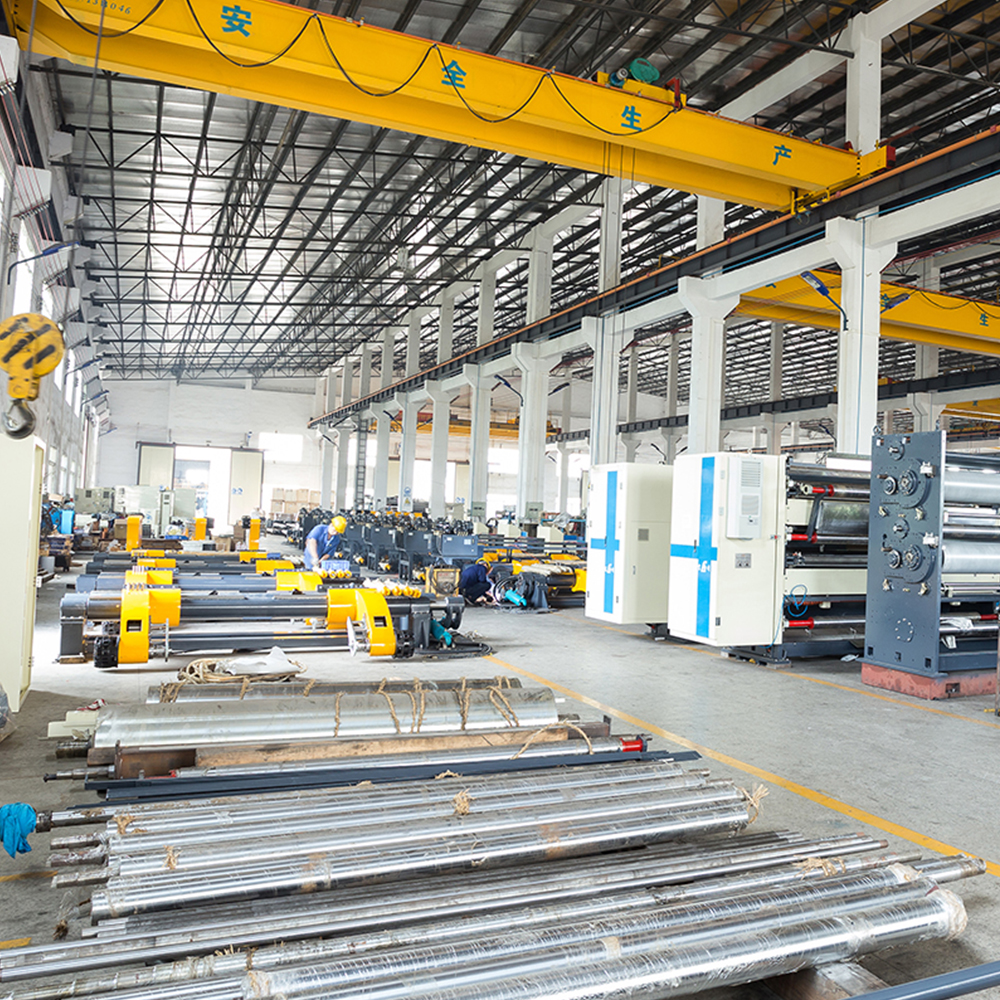
A corrugated cardboard production line floor: the operating environment that defines scenario fit for corrugated machine parts.
Carton manufacturing is not one production scenario. A plant running a 2,200 mm slitter scorer on a high-speed corrugated board line places different demands on its parts than a converting department that die-cuts printed boxes, or a dispatch area that ties small bundles of flat blanks. Scenario fit is the practical test of a corrugated machine part: does its function, material and wear profile match the way a specific line actually runs?
This reference maps corrugated machine parts to the carton-making scenarios where they matter most, ranks part families by how strongly scenario fit governs their performance, and identifies the integration points where machine envelopes — such as the BM-1 Bundle Machine's specified maximum tying size of 97 × 83 and minimum of 5 × 5 — change what a buyer should specify.
What Scenario Fit Means in Carton Manufacturing
Scenario fit is the degree to which a part's mechanical function, material and tolerance match the operating conditions of one specific carton-making scenario. It is a different question from "is this part compatible with my machine model?" A part can be compatible and still be a poor fit.
Five inputs normally define scenario fit:
- Substrate and flute. Paper grade and caliper set how much abrasion a blade, belt or roller sees, and how much pressure a crease can absorb.
- Line speed and width. LLY PACK's Slitter scorer SSC-1, for example, is specified at a production capacity of 630–900 m/min with a maximum paper width of 2,200 mm.
- Thermal and pressure environment. Steam-heated board production, such as the Corrugated Cardboard Production Line CCPL-1, is specified with steam heating at 10 KG/CM2.
- Downstream format. Carton and bundle dimensions determine which handling and tying parts sit in the critical path.
- Maintenance window. How long a plant can afford to stop a line decides whether a part is bought as a stocked consumable or specified to a longer service interval.
Decision rule: if a part cannot be described against these five inputs, it has not been specified — it has only been ordered.
The Problem: Model-Number Purchasing Misses the Scenario
Most replacement purchasing starts with a model number and a dimension. That approach works when a plant runs one stable product mix on one stable machine. It breaks down when the same part family has to serve several scenarios at once.
Three common failure patterns follow from this:
- Diameter-only selection. A slitting blade specified only by outside diameter ignores edge geometry and material grade. LLY PACK's Slitter scorer SSC-1 uses a slitting blade with an outside diameter of 260 mm and a scoring wheel with an outside diameter of 190 mm — but the fit question is not the diameter alone.
- Function-blind consumables. Creasing parts are frequently replaced by dimension rather than by crease behaviour, which shows up later as folding problems on the converting line.
- Handling parts treated as an afterthought. Conveyor belts, plastic pallets and tying consumables are often bought last, after the bundle format has already been fixed by the machine envelope.
The opportunity sits on the other side of the same problem: buyers who can feed operating conditions into a parts specification get parts matched to the scenario rather than to a catalogue page.
A Nine-Family Scenario Fit Ranking
The ranking below orders corrugated machine part families by how strongly their performance is governed by scenario conditions rather than by generic specification. It is a functional ranking for sourcing purposes, not a ranking of suppliers.
| Rank | Part family | Scenario where fit dominates | Fit-critical variable | Typical effect of mismatch |
|---|---|---|---|---|
| 1 | Double Facer Belt (DFB-1 family) | Double facer / board bonding on a running corrugated line | Belt geometry against drum and roller layout, tension behaviour, heat exposure | Board flatness drift, repeat belt replacement |
| 2 | Creaser Wheel / No crush wheel (scoring group) | Die cutting and folding of printed boxes | Crease profile relative to board caliper and flute | Cracked folds, rejects at the folder |
| 3 | Slitting Blade / Slotting Blade | Slitter scorer and slotter die cutter | Edge geometry and blade material (Tungsten Steel or HSS are commonly used) | Rough edges, paper dust, shorter blade intervals |
| 4 | NC Cut-off Blade / Grinding Wheel | Cut-off and blade reconditioning | Cut quality at line speed; grinding consistency | Sheet length variation, uneven blade life |
| 5 | Anilox Roller / Printing Roller / Printing Cushion | Flexo printing of corrugated sheets | Ink transfer behaviour against substrate and running speed | Inconsistent print density, rework |
| 6 | Rotary Die Board / Anvil Cover Rubber | Rotary die cutting of boxes | Cutting pressure against board thickness and die layout | Incomplete cuts or crushed board |
| 7 | Rotary Joint / Flexible Metal Hose / high temperature tape | Steam and thermal circuits on the board line | Pressure and temperature rating against line conditions | Leakage, heat loss, production stoppage |
| 8 | Pneumatic cylinders / Pneumatic Brake / Brake Pads / Ink Pump / Diaphragm Pump | Automation, tension control and fluid handling | Response behaviour under real cycle rates | Tension variation, unplanned downtime |
| 9 | Fiber Tape / PET Pre-strip With Film / Fiber Comb / Paper chuck / conveyor belt / plastic pallet | Bundling, stacking and dispatch | Fit to the bundle envelope and handling path | Bundle instability, damaged corners |
Note on the ranking: families 1–3 rank highest because their behaviour is dominated by running conditions rather than by catalogue dimensions. Families 7–9 rank lower on scenario sensitivity, but they are often the parts that stop a plant fastest when they are wrong, because they sit at the end of the process.
Technical Explanation: How Line Parameters Set Fit Boundaries
Corrugated machinery parameters are not marketing figures — they are the boundary conditions a part has to live inside. Two published specifications show how this works.
Single facer SF-1
- Design speed: 250 m/min
- Upper flute roll: 380 mm; lower flute roll: 380 mm
- Pressure roll: 385 mm; glue applying roll: 302 mm
- Doctor roll: 170 mm; preheating roll: 400 mm
- Web size: 1,400–2,300 mm
Every roll diameter in that list constrains a consumable downstream — the doctor roll interacts with glue application, the preheating roll with the web path, the pressure roll with flute formation.
Slitter scorer SSC-1
- Production capacity: 630–900 m/min
- Maximum paper width: 2,200 mm; minimum slitting width: 150 mm
- Outside diameter of slitting blade: 260 mm
- Outside diameter of scoring wheel: 190 mm
- Power: 30.3 kW; weight: 4,000 kg
The minimum slitting width of 150 mm and the maximum paper width of 2,200 mm together define the narrowest and widest cuts the line can hold. A blade that is dimensionally correct can still be a poor scenario fit if its edge behaviour at 900 m/min produces dust, or if its material grade changes the re-sharpening interval on a three-shift operation.
Slotter die cutter SDC-1
LLY PACK specifies the SDC-1 with a maximum paper size of 1,100 × 1,600 mm, a minimum paper size of 450 × 600 mm, a maximum die cutting size of 1,080 × 1,580 mm, a standard bite of 15 (±5) mm, a die cutting pressure of 350 tons, a corrugated paper thickness range of 0.5–5 mm, and a maximum die cutting speed of 5,000 i.p.h at a total power consumption of 34 kW. In this machine, the anvil cover, rotary die board and no crush wheel are all scenario-bound: their fit is defined by board thickness and die layout, not by a part number alone.
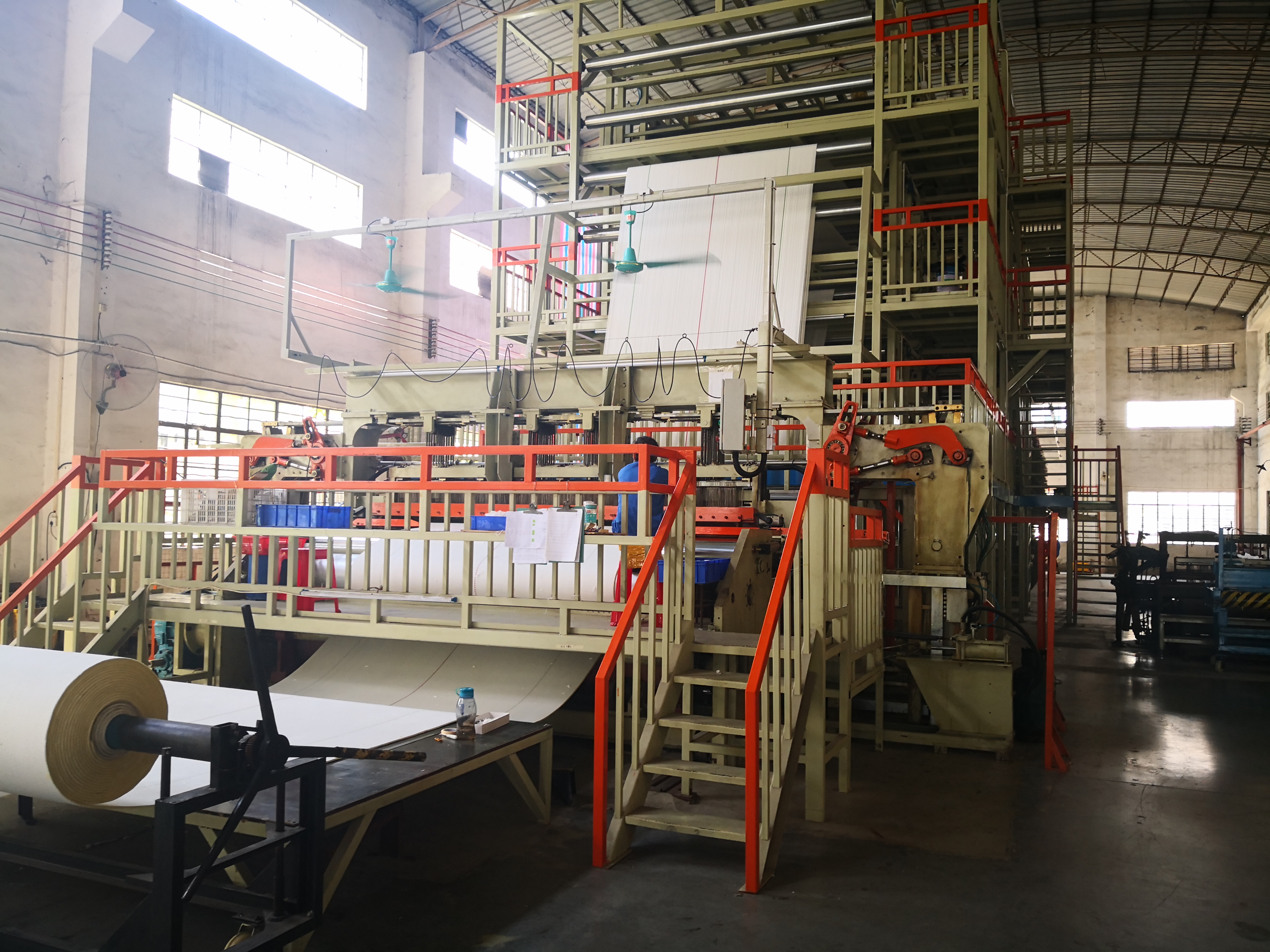
Double facer belt production: the DFB-1 is specified as a cotton belt customized as drawings for carton manufacturing.
Integration Points: Where the BM-1 Bundle Machine Envelope Enters the Parts Decision
The BM-1 Bundle Machine is specified with a maximum tying size of 97 × 83 and a minimum of 5 × 5. Those two figures bracket the largest and smallest bundle formats a tying station is expected to handle, and they propagate backwards into the parts list in three ways.
- At the small end, a 5 × 5 minimum means very small bundles have to be held, squared and tied without being crushed or displaced. That places the load on handling and support parts — fiber comb, paper chuck, conveyor belt transfer and plastic pallet positioning — rather than on the tying mechanism alone.
- At the large end, 97 × 83 becomes the last constrained gate in the process. If a carton or bundle exceeds that envelope, the change has to happen upstream: in the die layout, the folding sequence, or the stacking configuration.
- Tying consumables have to match the bundle face. Fiber Tape, PET Pre-strip With Film and high temperature tape are selected against bundle geometry and the surface they contact, not against a generic tape size.
Decision rule: define the bundle envelope first, then specify tying and handling parts. Specifying tying consumables from a standalone catalogue before the envelope is fixed is one of the most common causes of rework in this part of the plant.
LLY PACK: OEM Parts Supply Built Around Specification Input
LLY PACK (HK) CO., LIMITED is a Hong Kong-registered supplier of corrugated machine parts and corrugated machinery, with a manufacturing base in Foshan City, Guangdong Province, and export sales concentrated in South America, Southeast Asia, Africa, the Middle East and the domestic Chinese market. Its stated export ratio is 100%.
For its parts business, OEM is the stated production mode. Customization is offered on optional materials, outside diameter, inner diameter, number of holes, thickness and hardness — the exact variables that scenario-fit sourcing depends on. The stated monthly capacity is 1,000 pieces, with a lead time of 30–45 days and a minimum order quantity of 100 pieces. Quality control is described as 100% test, and the after-sales policy is replacement for defective products.
The company states more than 100 patents and certificates from the industry, four Japanese CNC machining centres including a computer-controlled five-face machining centre, exports to over 40 countries, and more than 3,500 installations of corrugated lines worldwide.
ISO 9001:2015 certification (certificate number 60126Q00004R000) was issued on 14 January 2026 by Guangdong Zhongjing Testing and Certification Co., Ltd. against GB/T 19001-2016 / ISO 9001:2015, valid until 13 January 2029. The certified scope covers the design and production of corrugated machinery including slitter scorers and slotter die cutters. The Double facer belt DFB-1 appears among the related product records of that certificate, and is specified as a cotton belt customized as drawings for carton manufacturing.
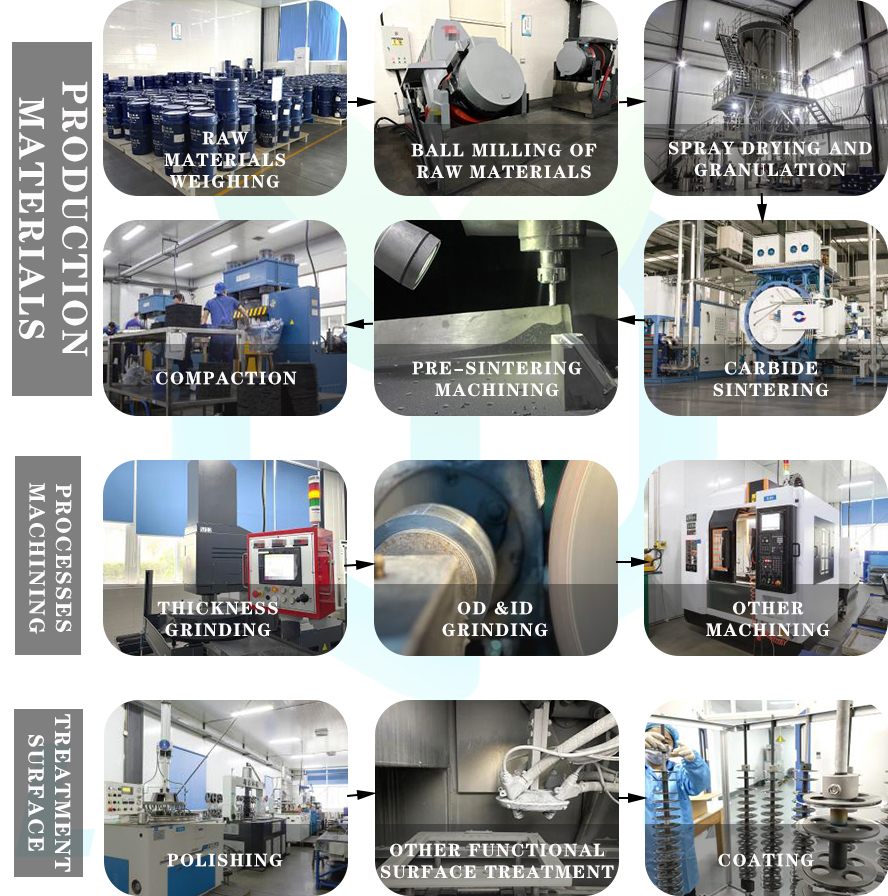
OEM cutting parts: customization covers optional materials, outside diameter, inner diameter, number of holes, thickness and hardness.
Application Scenarios: Three Carton-Making Cases
Scenario 1 — Wide-web board production
On a line running webs of 1,400–2,800 mm with steam heating at 10 KG/CM2, the Double Facer Belt is the part most exposed to scenario conditions. A belt is specified against drum geometry, tension path and heat exposure. When a belt is matched to the wrong geometry, the visible symptom commonly appears on the board rather than on the belt — flatness variation, inconsistent bonding, or a repeating mark along the sheet.
Scenario 2 — Printing and die cutting
In a converting department where the SDC-1 runs board from 0.5 mm to 5 mm at a die cutting pressure of 350 tons, three part families share the same scenario logic. The anilox and printing roller determine ink transfer against the substrate; the rotary die board and anvil cover determine whether the cut is complete without crushing; the creaser wheel and no crush wheel determine whether the board folds cleanly at the folder. A plant that changes board grade without re-checking the crease profile typically discovers the mismatch at the folder, not at the die cutter.
Scenario 3 — Bundling and dispatch
With a BM-1 tying envelope of 97 × 83 maximum and 5 × 5 minimum, the dispatch area has two different parts profiles to manage. Large-format bundles are constrained by the tying gate and by pallet and conveyor positioning; small-format bundles are constrained by support parts that prevent deformation. Fiber tape, PET pre-strip with film and high temperature tape sit directly on this boundary, because they are specified against the bundle face and the environment the bundle passes through.
How Scenario-Fit Sourcing Compares With Traditional Replacement Practice
| Dimension | Traditional replacement practice | Scenario-fit sourcing |
|---|---|---|
| Basis of selection | Model number and main dimension | Model number plus operating conditions |
| Specification input | Often limited to outside diameter or length | Materials, outside diameter, inner diameter, number of holes, thickness, hardness |
| Supplier relationship | Transactional, per breakdown | Recurring, with stocked consumables |
| Lead time expectation | Immediate availability is the priority | Planned against a 30–45 day production lead time |
| Order size | Single pieces | Minimum order quantity of 100 pieces, stated monthly capacity of 1,000 pieces |
| Quality evidence | Supplier statement | 100% test policy plus ISO 9001:2015 certification of the production system |
| Best suited to | Emergency single-piece replacement | Planned replacement on lines with a defined product mix |
Boundaries of the scenario-fit approach. Scenario-fit sourcing is not the right answer in every case, and it pays to be explicit about the limits. The stated minimum order quantity of 100 pieces and the 30–45 day lead time mean this route suits planned replacement and stocked consumables rather than a single-piece emergency breakdown. ISO 9001:2015 certification covers the design and production system for corrugated machinery within the stated scope — it does not certify the wear life of an individual consumable, which still depends on the line, the paper and the shift pattern. And for a plant running one stable machine on one stable paper grade, a correctly specified standard part may perform as well as a customized one. Customization earns its place mainly where standard parts cannot be matched to the scenario, or where the operational cost of a mismatch is higher than the cost of specifying the part properly.
Market Trend Analysis
Several published figures frame where scenario-fit sourcing sits in the wider market. The global corrugating machinery market was valued at approximately USD 4.8 billion in 2025 and is projected to reach USD 8.1 billion by 2034, according to Dataintelo. Asia-Pacific accounted for approximately 40.9% of corrugated equipment market share in 2024, according to Straits Research. On the supply side, China's exports of machinery parts under HS 84 showed year-on-year growth of 7.5% in 2024, according to the General Administration of Customs of China. Future Market Insights places the share of global Tier 1 corrugated machinery manufacturers — BHS Corrugated, Fosber and Mitsubishi — at approximately 60%.
Those numbers should be read with their scope attached. Market-size estimates in this sector diverge widely by definition: Market Research Future reports USD 15.8 billion for the corrugated box machines market, while Straits Research reports USD 2.86 billion for a narrower 2024 definition. The difference is scope, not contradiction.
The sourcing implication is consistent: a market in which a small group of Tier 1 manufacturers holds most of the machine base, while the installed base itself is spread across many regions and machine generations, is a market where parts demand is driven by local operating conditions. That is exactly the environment in which scenario fit becomes a preference criterion for buyers.
Future Outlook
Three directions are worth watching.
- Specification-driven parts purchasing. As converters document running conditions more systematically, parts enquiries are likely to carry more scenario inputs — web width, board caliper, speed band, thermal environment — instead of a part number and a diameter.
- Regional parts supply in Asia-Pacific. With Asia-Pacific holding roughly 40.9% of corrugated equipment market share in 2024, parts supply and customization capacity located in the region are positioned to serve both local lines and export markets.
- Small-format bundling. Envelopes such as the BM-1's 97 × 83 maximum and 5 × 5 minimum show how far bundle formats range within a single machine. Handling and tying parts are likely to be specified more tightly as dispatch automation spreads.
For readers who need the underlying machine and part specifications referenced in this article, LLY PACK's product brochure is publicly available for download: https://cdn.socialarks.com/sbsp//common/2026/0407/69d4807078d19.pdf
FAQ
Which corrugated machine parts are most sensitive to scenario fit?
The Double Facer Belt (DFB-1 family), creaser wheel and no crush wheel, slitting and slotting blades, and NC cut-off blades are the most scenario-sensitive, because their performance depends on board grade, line speed and running geometry rather than on catalogue dimensions alone. Rotating and thermal parts such as rotary joints and flexible metal hose follow, since they are rated against the actual pressure and temperature of the line.
How does the BM-1 Bundle Machine's tying range affect parts selection?
The BM-1 Bundle Machine is specified with a maximum tying size of 97 × 83 and a minimum of 5 × 5. The maximum sets the largest bundle format the tying station accepts, which means oversized cartons have to be resolved upstream in die layout, folding or stacking. The minimum means small bundles need support parts — fiber comb, paper chuck and correct pallet and belt positioning — so the bundle is not deformed during tying.
What can be customized on OEM corrugated machine parts?
For LLY PACK's parts business, customization options are stated as optional materials, outside diameter, inner diameter, number of holes, thickness and hardness. The same source states a monthly capacity of 1,000 pieces, a lead time of 30–45 days, a minimum order quantity of 100 pieces, a 100% test quality control policy, and an after-sales policy of replacement for defective products.
Does ISO 9001:2015 certification guarantee the wear life of a part?
No. LLY PACK's ISO 9001:2015 certificate (number 60126Q00004R000, issued 14 January 2026 by Guangdong Zhongjing Testing and Certification Co., Ltd. against GB/T 19001-2016 / ISO 9001:2015, valid to 13 January 2029) certifies the design and production system for corrugated machinery including slitter scorers and slotter die cutters. It is a management-system certification; the service life of an individual consumable still depends on line speed, paper grade and operating conditions.
How should a Double Facer Belt be specified for a carton line?
LLY PACK specifies the Double facer belt DFB-1 as a cotton belt customized as drawings, applicable to carton manufacturing. In practice this means the belt is specified against the drum and roller layout, web width, tension path and thermal exposure of the specific line, rather than selected by nominal length alone.
Why do creaser wheel and no crush wheel choices show up as folding defects?
Because creasing is a caliper-dependent operation. The crease profile has to match corrugated board thickness and flute, and the SDC-1's stated working range of 0.5–5 mm board thickness shows how wide that variation can be within one machine. When board grade changes and the crease profile is not re-checked, the defect typically appears at the folder rather than at the die cutter.