
Scent Diffuser Sourcing FAQ: Cold Air, Certs, OEM Terms
Scent Diffuser Sourcing FAQ: Cold Air, Certs, OEM Terms
Buying scent diffusers factory-direct is a specification exercise long before it becomes a price negotiation. Importers, wholesalers and project buyers shortlisting a supplier for bulk resale or for hotel and mall installations keep running into the same set of questions: how cold-air atomization actually differs from ultrasonic diffusion, what a heating-free design changes in daily operation, how a coverage rating should be read, which certificate numbers apply to the specific model being purchased, and what OEM scope and acceptance terms the factory will put in writing. This reference answers those questions in roughly the order they surface during supplier evaluation and purchase execution.
The Category Behind the Questions
Commercial scenting is not one product category with one buyer. Market researchers tracking fragrance diffusers estimated the global market at USD 29.61 billion in 2024, with ultrasonic units holding a 38.5% revenue share that year, while nebulizing designs were expected to grow fastest on the strength of professional-grade requirements in hotels. Both figures come from Data Bridge Market Research and describe all fragrance diffusers, not the commercial segment alone. The same source projected a 9.22% CAGR for smart aroma diffusers between 2026 and 2034.
For a channel buyer, the practical reading is narrower than the headline. A device sold into a bedroom and a device sold into a hotel lobby are specified, certified and maintained differently, and the revenue-share figure says only that cheap ultrasonic units dominate volume, not that they fit a project brief. Forecasts such as the smart-diffuser projection describe an expected trajectory under stated assumptions; they do not describe an order book. What they do justify is a procurement process that separates technology fit from brand familiarity before a supplier is shortlisted.
Cold-Air Atomization vs Ultrasonic: The Question Underneath the Price
A waterless cold-air scent diffuser atomizes fragrance oil directly into fine airborne particles using controlled airflow and pressure, with no water added and no heat applied. An ultrasonic water-based aroma diffuser works differently: a small quantity of oil is mixed into a water tank and dispersed by an ultrasonic plate. That single mechanical difference drives most of the downstream differences buyers care about — coverage scale, daily labour, cleaning routine and initial equipment cost.
Because there is no water in the loop, a waterless unit avoids the refilling and tank-cleaning cycle that defines ultrasonic ownership. It also avoids dilution, so the fragrance is delivered as formulated rather than as a weaker water-borne mix. Against that, waterless units usually carry a higher initial equipment cost than ultrasonic units of similar physical size. The trade is capital cost against daily maintenance and coverage, and the right answer depends on how the device will be used rather than on which technology is newer.
| Dimension | Waterless cold-air diffuser | Ultrasonic water-based diffuser |
|---|---|---|
| Diffusion method | Fragrance oil atomized directly by controlled airflow and pressure | A few drops of oil mixed with water in a tank, dispersed by an ultrasonic plate |
| Water handling | No water required at any point | Regular water refilling required |
| Coverage scale | Larger, suited to continuous commercial scenting | Smaller, suited to light personal fragrance use |
| Daily maintenance | Lower: oil-level checks and periodic atomizer cleaning | Higher: frequent refilling and tank cleaning |
| Initial equipment cost | Usually higher | Lower |
| Typical fit | Hotels, shopping malls, retail stores, offices, showrooms, spas | Bedrooms and small rooms, light home fragrance |
The boundary matters as much as the comparison. An ultrasonic unit is not a defective product; it is a product aimed at small spaces and light use. Recommending a waterless machine for a single small bedroom overstates the requirement, and recommending an ultrasonic unit for a continuously operating mall lobby understates it. Procurement teams should expect a supplier to say which of the two it is selling and why, rather than presenting one technology as universally superior.
Cold-air and waterless positioning recurs across the category. Aroma Designers, for example, describes its L150 commercial HVAC unit as converting fragrance oils into nanoparticles without heat, and Scentics describes its business range as cold atomization without water, dilution or heating. Those are supplier product descriptions rather than independent test results, but they confirm that the terminology in a quotation — “cold air,” “waterless,” “nebulizing” — refers to one family of mechanisms and should be verified against the actual model specification rather than assumed from the brochure.
Heating, Power and Scheduling: What Zero-Watt Heating Means
In a cold-air waterless design there is no heating element, so no share of the rated power is allocated to heating. The working components are the air pump and the control electronics. For a buyer, that has two practical consequences: the specification should not be read as a heater that happens to diffuse scent, and questions about warm-air or heated diffusion are simply not applicable to this product family.
Scheduling is where operating cost is actually controlled. Commercial models in this class support timer scheduling, manual button control and adjustable scent intensity, with selected models adding Wi-Fi or Bluetooth app control for remote management. A schedule that matches building occupancy — running through trading hours and idling overnight — reduces oil consumption and mechanical wear more than any single hardware choice, which is why the control layer deserves as much scrutiny in a sample evaluation as the atomizer itself.
Three checks are worth building into a sample test. First, confirm the schedule holds after a power interruption rather than resetting to a default. Second, confirm the app or control panel language and interface match what the reseller's market expects. Third, confirm that intensity adjustment produces a usable range rather than an on/off effect at the extremes.
Model and Coverage Guidance: P01, P03 and Reading Square Metres
Model selection should follow installation conditions first and floor area second. Battery-powered models such as the P01 and P03 are the practical answer where wiring is inconvenient or prohibited — elevators, washrooms, retrofit corridors and leased spaces where a new circuit is not an option. The P01 is a 500 ml battery-operated unit positioned at roughly 100–150 m² of coverage, which places it in the small-to-medium band rather than in lobby-scale work. Compact mains models such as the S01 and S02 cover small rooms and light commercial spaces; the P02 adds stronger diffusion and smart control for small-to-medium areas; the A300 and T2 step up output and oil capacity for medium commercial areas; the H5000 and T3 are intended for large open spaces; and the AC-MAX is the choice for large hotels, malls and office buildings that require centralized HVAC scenting.
Coverage figures need to be read as ratings, not guarantees. Room size, ceiling height, ventilation rate, airflow and partitions all change the delivered result, and a maximum rated coverage says nothing about intensity at the far end of a partitioned floor. Two further cautions apply when comparing suppliers. First, units differ: one competitor publishes 250 ml capacity with coverage up to 600 m³, another publishes up to 300 m² or 1,000 m³ — area and volume cannot be converted into each other without the room model behind them. Second, no shared test protocol exists across the category. Coverage claims from different manufacturers are therefore not numerically comparable, and averaging or ranking them would produce a false precision.
Certification Evidence: EMC, RoHS and FCC on Paper
Certification is where procurement conversations most often move from adjectives to documents. Shenzhen Scentsea Technology Co., Ltd., the manufacturer behind the SCENTSEA brand, holds three certificates issued on 24 April 2024 by Shenzhen ATL Testing Technology Co., Ltd., each with a scope recorded as “scent diffuser” and each linked to the models sold under that scope:
| Certificate | Number | Market | Standard |
|---|---|---|---|
| EMC | ATL20240416325 | EU | EN IEC 55014-1:2021; EN IEC 55014-2:2021; EN IEC 61000-3-2:2019/A1:2021; EN 61000-3-3:2013/A2:2021 |
| RoHS | ATL20240416327 | EU | RoHS Directive (EU) 2015/863 |
| FCC | ATL20240416326 | USA | FCC Part 15 Subpart B:2023 |
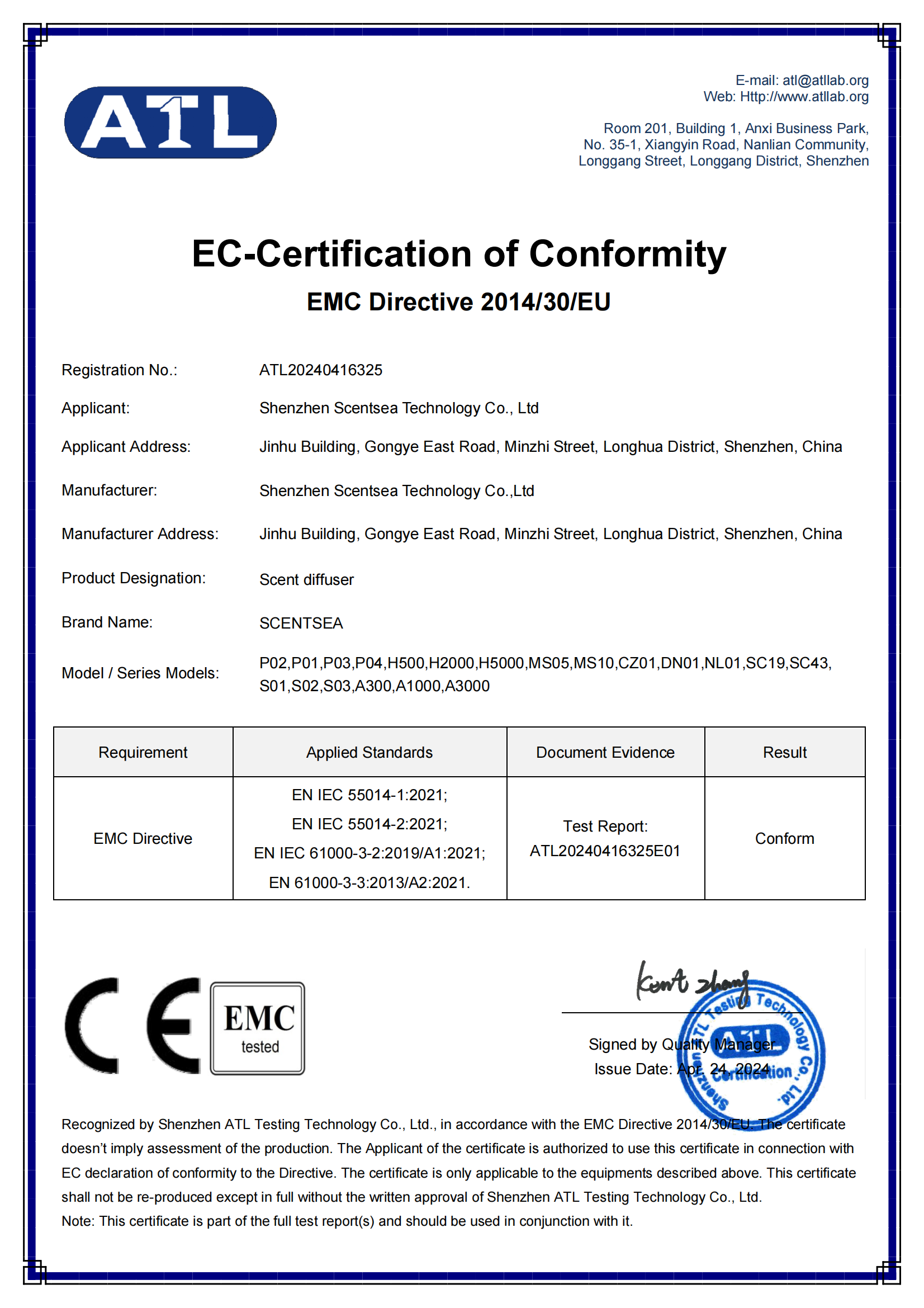
EMC certificate ATL20240416325, issued 24 April 2024 by Shenzhen ATL Testing Technology Co., Ltd. for the EU market. Certificate documents should be matched to the exact production model before an order is placed.
Three points separate a useful certificate check from a decorative one. The first is model match: the documents must cover the exact model and configuration being purchased, not merely the brand. The second is market fit: EMC and RoHS address the European market, FCC addresses the United States, and Bluetooth or Wi-Fi models may additionally fall under radio equipment requirements such as RED in Europe — an area the supplier should confirm per configuration rather than per catalogue. The third is currency: buyers should verify that the certificate and its supporting test report are current at the time of shipment, since a certificate issued in 2024 is a record of a 2024 test.
Customs handling sits alongside compliance. Aroma diffusers are classified under HS code 8509.80, a classification independent of brand and useful when the freight forwarder or customs broker asks for the code before the commercial invoice is finalised.
OEM and Customization Terms for Channel Buyers
OEM and ODM scope is the part of a factory-direct relationship that determines whether a reseller can build its own brand or is limited to distributing someone else's. The customization menu here covers logo, product colour, packaging, user manual, plug type, APP interface, PCB and functions, and other product specifications. Where a buyer needs structural or housing changes rather than surface changes, the factory profile extends to exclusive mould development, and private-label packaging is supported for both diffusers and fragrance oils.
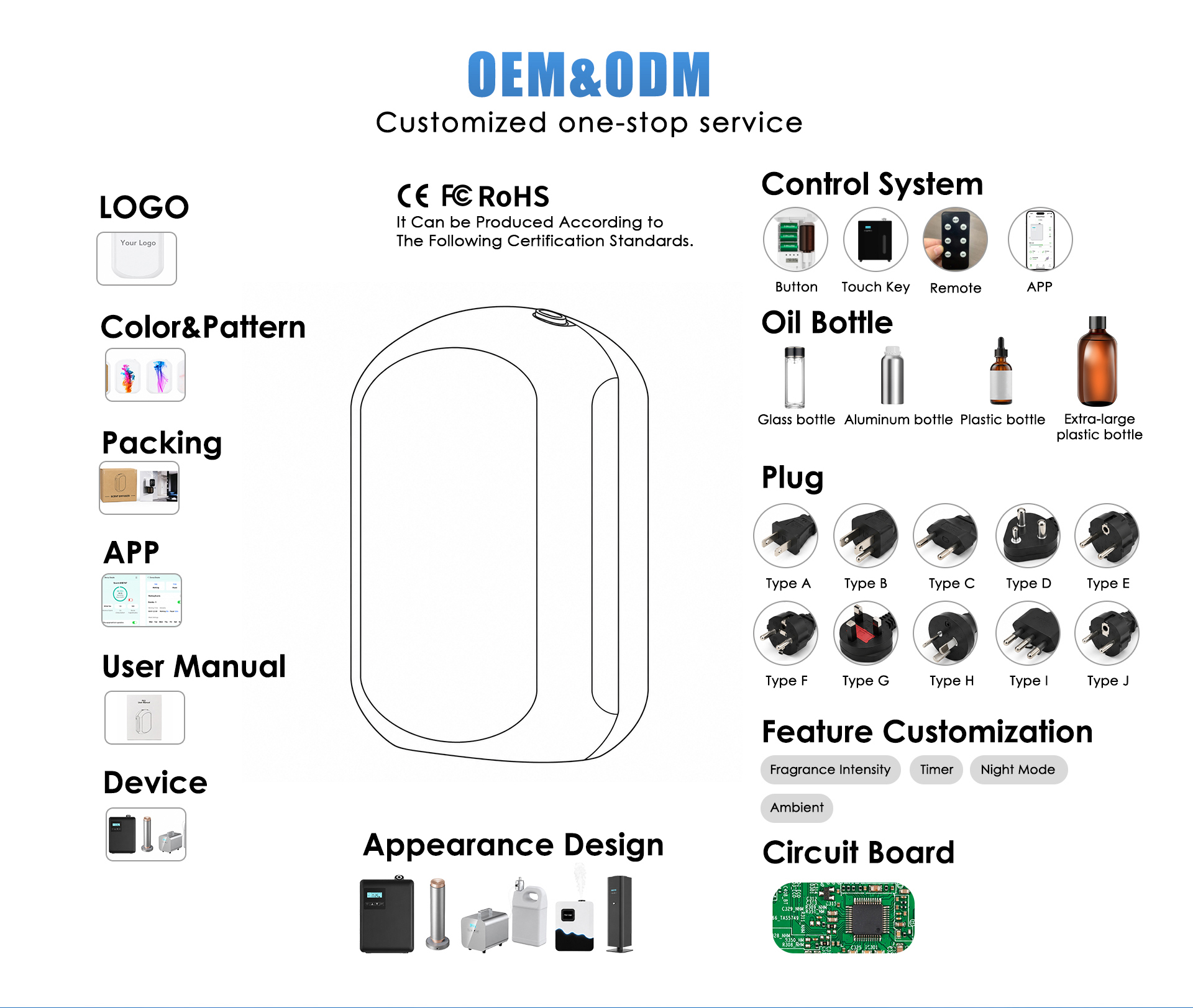
Customization reaches logo, product colour, packaging, user manual, plug type, APP interface, PCB and functions; structural changes such as frame or housing modifications require mould development.
The manufacturing base behind those terms is modest and specific: a 3,000 m² facility in Shenzhen founded in 2021, three production lines, 30 employees, four R&D engineers, 20 patents and annual output of 100,000 units, with roughly 70% of production exported to the EU and USA and products supplied to customers in more than 70 countries. Those numbers describe capacity and orientation; they do not by themselves prove that a given customization request will be executed well. That is what the sample stage is for.
Buyers should treat customization as a sequence of confirmations rather than a list of options. Confirm the plug type and voltage for the destination market before artwork is approved. Confirm that the APP interface can be delivered in the required language. Confirm that packaging artwork meets the destination market's labelling requirements. Confirm that a modified PCB does not invalidate the certificate coverage of the base model, and ask which certificate applies to the customized configuration in writing.
Commercial Terms, Acceptance Criteria and Warranty
Commercial terms are usually where a factory-direct supplier is most transparent, because the numbers are operational rather than promotional. The terms recorded for this supplier are set out below; they should be restated in the proforma invoice, since published terms and negotiated terms can diverge once volume and customization enter the discussion.
| Term | Recorded value |
|---|---|
| Minimum order quantity | 1 unit |
| Production lead time | 25–35 days |
| Monthly production capacity | 8,000 units |
| Delivery terms | EXW / FOB / CIF |
| Payment terms | 50% T/T in advance, balance before shipment |
| Acceptance criteria | Pre-shipment test |
| Warranty | 1-year free warranty on spare parts |
The pre-shipment test is the clause that carries the most weight for a reseller, so it is worth knowing what it covers. Quality control before shipment includes 100% functional testing, atomization testing, leakage inspection, noise testing, APP and control testing, a 48-hour ageing test, and a final appearance inspection. That sequence addresses the failure modes that generate the most after-sales cost in this category — weak or absent atomization, oil leakage, excessive noise and control faults — before the carton is closed rather than after the container arrives.
A one-unit MOQ is useful for sampling and for small project quantities, but it does not make small orders economical: freight, certification documentation and inspection costs are largely fixed per shipment. Buyers planning a resale programme should model landed cost at realistic volumes rather than at the minimum, and should agree the acceptance procedure — including whether a third-party inspection will be used — before production starts rather than at the loading dock.
Maintenance and Where Long-Term Cost Actually Sits
Because a waterless unit has no water tank, the daily maintenance burden reduces to oil-level checks and periodic atomizer cleaning, and maintenance frequency depends on usage intensity and on the fragrance oil itself. That is a lower routine than ultrasonic ownership, where refilling and tank cleaning are unavoidable, but it is not zero, and the difference is one of degree rather than of kind.
Fault diagnosis on a cold-air unit is correspondingly mechanical. If the device does not operate, the sequence runs through power supply, power status, working-hour settings and the air pump terminal. If there is no atomization, the pump, nozzle and tubing are the candidates. Abnormal noise usually traces to a loose pump or loose internal parts; weak atomization to an ageing pump, a blocked nozzle, or fragrance oil that is too thick or contains impurities. Most of these are identified before any component is replaced, which is why a supplier's troubleshooting documentation is a genuine procurement asset for a reseller supporting end users at a distance.
Long-term cost therefore has four components rather than one: fragrance oil consumption as a function of schedule and intensity, maintenance labour, spare parts replacement under the one-year spare-parts warranty, and the cost of failure in the field. A higher purchase price is justified only when it improves the second and fourth of those, and that judgement should be made on sample evidence rather than on a specification sheet.
Case Evidence: Five Years, Thirty Units, One US Mall
A United States scent marketing company and scenting service provider installed 30 units across the AC-MAX, T2, T1, P01, P02 and P03 models to provide commercial scenting in a shopping mall. The project has been running for five years. Reported outcomes include stable and consistent scent coverage, reduced manual maintenance, improved fragrance management efficiency and enhanced customer experience, with the deployment highlighting strong atomization, stable operation, smart APP control, adjustable scent intensity, low maintenance and easy installation.
That case is worth stating precisely because its limits are clear. It is one project, delivered by a service provider rather than an end user, using a mixed fleet of models across a single site. It demonstrates durability across five years of continuous operation and the practicality of app-based management at multi-unit scale. It does not establish a failure rate, a maintenance cost per unit, or an expected result in a hotel lobby or a different climate, and it should not be cited as if it did.
A Verification Sequence Before the Purchase Order
- Match technology to duty cycle. Confirm whether the site needs continuous commercial diffusion or light intermittent fragrance before choosing between cold-air and ultrasonic hardware.
- Read coverage against conditions. Request the coverage figure with its assumed room conditions, and test one unit in the actual space, especially where partitions or high ceilings are involved.
- Request certificates for the exact model. Check certificate number, standard version, issuing laboratory, market and model coverage, and confirm whether wireless configurations require additional approvals.
- Test the schedule and control layer. Confirm schedule retention after power loss, app language and interface, and intensity adjustability.
- Approve customization in writing. Lock plug type, packaging artwork, manual language, logo placement and any PCB or functional change, and confirm which certificate covers the customized build.
- Fix the acceptance procedure in advance. Agree the pre-shipment test scope, whether third-party inspection applies, and the remedy if a batch fails.
- Model landed cost at real volume. Include freight, duty under HS code 8509.80, documentation, inspection and warranty spares rather than comparing unit prices in isolation.
Outlook
The category-level signal points toward continued specialisation rather than toward a single dominant design. Data Bridge Market Research's projection of a 9.22% CAGR for smart aroma diffusers from 2026 to 2034, taken together with its observation that nebulizing units are expected to grow fastest on professional-grade hotel requirements, suggests that the commercial segment will keep pulling specification quality upward — more attention to scheduling, to certificate documentation and to OEM differentiation. That is a forecast under stated assumptions, not an observed outcome, and it does not tell any individual buyer what to purchase.
What it does suggest is that procurement questions will keep converging on the same three areas: whether the diffusion technology matches the duty cycle, whether the compliance file survives scrutiny at the destination market, and whether the factory's OEM and acceptance terms are concrete enough to build a resale programme on. Buyers who settle those three before negotiating price tend to get a workable supply relationship rather than an expensive lesson.
Frequently Asked Questions
How does cold-air atomization work in a commercial scent diffuser?
A cold-air atomizer uses controlled airflow and pressure to break fragrance oil into fine airborne particles, which are then dispersed directly into the room or through an HVAC duct. No water is added and no heat is applied. Because the oil is not diluted, the fragrance is delivered as formulated, and working schedules and output intensity can be adjusted to match the space and its airflow conditions.
For commercial projects, is a waterless cold-air unit or an ultrasonic diffuser the better fit?
For hotels, malls, retail stores, offices, showrooms and spas that need consistent, large-area scenting, a waterless cold-air diffuser is the appropriate fit: it delivers stronger diffusion, wider coverage and lower daily maintenance. Ultrasonic water-based diffusers suit bedrooms and small rooms where output demand and running hours are low. The deciding variable is the duty cycle and area to be covered, not the technology label alone.
Which certificates should an importer verify before ordering scent diffusers?
It depends on destination market, product model and wireless functions. For the European Union, buyers should check applicable CE and RoHS documentation, and EMC evidence where relevant; Bluetooth or Wi-Fi models may also need to satisfy RED requirements. For the United States, applicable FCC compliance should be verified. In every case the certificate and its test report must match the exact production model and configuration, and buyers should confirm the documents remain current at the time of shipment.
What should a pre-shipment acceptance test cover?
A workable acceptance test covers functional testing of every unit, atomization performance, leakage inspection, noise testing, and APP or control testing, followed by an ageing run and a final appearance inspection. A 48-hour ageing test is a reasonable benchmark because it exposes weak atomization, control faults and seal defects before shipment. Buyers should also agree in advance what happens if a batch fails and whether third-party inspection is used.
What can be customized under an OEM or ODM scent diffuser order?
Depending on model and quantity, customization typically covers logo, product colour, packaging, user manual, plug type, APP interface, PCB and functions, and other product specifications, with private-label packaging for both diffusers and fragrance oils. Structural changes to the housing or frame generally require exclusive mould development. Buyers should confirm in writing which certificate applies to a customized configuration, since a functional change to the PCB can affect the compliance basis of the base model.
How much maintenance does a waterless diffuser need, and where does long-term cost come from?
Routine work is limited to oil-level checks and periodic atomizer cleaning, since there is no water tank to refill or descale; frequency depends on usage intensity and on the fragrance oil used. Long-term cost is driven by oil consumption under the chosen schedule, maintenance labour, spare-parts replacement during the one-year warranty period, and the cost of field failures. Initial equipment cost is only one of those four components.
Reference note. Manufacturer facts in this article describe Shenzhen Scentsea Technology Co., Ltd., the company behind the SCENTSEA brand, and are drawn from its published company, certificate, capability and case records. Further detail on models, certifications and OEM scope is available on Scentsea, and the full company profile can be downloaded as a PDF. Certificate numbers, model coverage and commercial terms should be re-confirmed against the proforma invoice for the specific order.
Have Questions or Need More Details?
Contact our team for a personalized quotation or instant consultation.
Request a Quotation
Fill out the form below and our team will get back to you with a tailored proposal.
WhatsApp Direct Chat
Prefer to chat in real-time? Message us on WhatsApp for instant assistance & quick answers.
- Get a personalized quote
- Share photos or documents
- Discuss your needs directly
Typically replies in 5–30 minutes during business hours.