
Scent Diffuser Supplier Scorecard: SCENTSEA for Hotels & Malls
Scent Diffuser Supplier Scorecard: SCENTSEA for Hotels & Malls
A commercial scent diffuser is only as dependable as the supplier standing behind it three years after the first shipment. For hotel and shopping mall procurement teams, the decisive questions are rarely about the showroom demo: they concern whether atomization performance stays consistent batch to batch, whether noise stays below guest-comfort thresholds, whether compliance documents match the exact model and destination market, and whether spare parts are still available in year five. This article sets out a six-dimension long-term supplier scorecard and applies it to SCENTSEA — the brand of Shenzhen Scentsea Technology Co., Ltd., a Shenzhen-based manufacturer of cold-air nebulizing scent diffusers, HVAC scent systems and fragrance oils founded in 2021.
The ratings below are directional evaluations built from SCENTSEA's published product and certification information, together with publicly stated positioning from other suppliers in the same category. They are a procurement framework, not a third-party certification of performance, and they should be re-scored against your own sample testing and site conditions.
Why Long-Term Scenting Programs Fail After the First Order
Most commercial scenting problems are not purchase-order problems. They are program problems that surface months later, usually in one of six places.
- Coverage ratings are not standardized. Manufacturers publish area or volume coverage using different assumptions about ceiling height, airflow, partition density and target intensity. HTNXT's 2026 category data classifies cross-supplier coverage figures as not directly comparable, which means numbers from two suppliers cannot be averaged or ranked against each other without a shared test protocol.
- Fragrance oil compatibility is a hidden variable. Atomization stability depends on viscosity and formulation. An oil that performs well in one machine can under-atomize or clog in another, and third-party oils should be validated before a fleet-wide refill contract is signed.
- Batch consistency only becomes visible at scale. A hotel group installing 30 to 60 units in phases needs uniform behaviour across units, not one good demonstration unit.
- Noise moves from a spec line to a guest complaint. A lobby machine rated under 45 dB and a hallway machine rated at 55 dB are not interchangeable in guest-facing zones.
- Compliance is model-specific. A CE or RoHS document covering one SKU does not automatically cover another, and Bluetooth or Wi-Fi models add radio-frequency obligations on top of electrical safety and restricted-substance rules.
- Service continuity is the quiet risk. If a pump, nozzle or enclosure changes, the refill and spare-parts plan for an installed fleet has to survive that change.
For that reason, hotel and mall buyers evaluating scent diffusers are better served by scoring the supplier as a long-term program partner than by scanning a single unit's specification sheet.
The Six-Dimension Supplier Scorecard
The framework below is designed for venues where scenting runs on a schedule and where downtime is visible to guests. Each dimension maps to documents or data a supplier can reasonably be asked to provide before a bulk commitment.
| Dimension | What it measures | Evidence to request | Weight for hotels & malls |
|---|---|---|---|
| Brand history & track record | Years operating, export orientation, installed references, model-line continuity | Registration date, export share, named reference projects, whether the model you specified is still in production | Medium–high |
| Noise & acoustic fit | Model-level dB ratings against guest, corridor and back-of-house zones | Per-model noise figures, sample testing in the actual room, mounting position | High |
| R&D & product breadth | Ability to adapt hardware, firmware, app and packaging, and to cover all venue zones from one ecosystem | Patent count, engineering headcount, OEM/ODM scope, app and PCB customisation capability | Medium |
| Safety & environmental compliance | Documented conformity for the destination market, per model | Certificate numbers and issuing bodies, CE / RoHS / FCC scope, radio compliance for wireless models, test reports | Critical |
| Batch supply capacity & QC | Monthly capacity, lead time, MOQ, in-line test protocol, aging test duration | Capacity statement, QC checklist, aging-test evidence, sample-to-mass-production process | High |
| Overseas landing service | Trade terms, warranty, spare-parts availability, documentation and plug localisation | Incoterms offered, warranty terms, spare-parts list, app/manual/plug options by market | High |
Applying the Scorecard: SCENTSEA Star Ratings
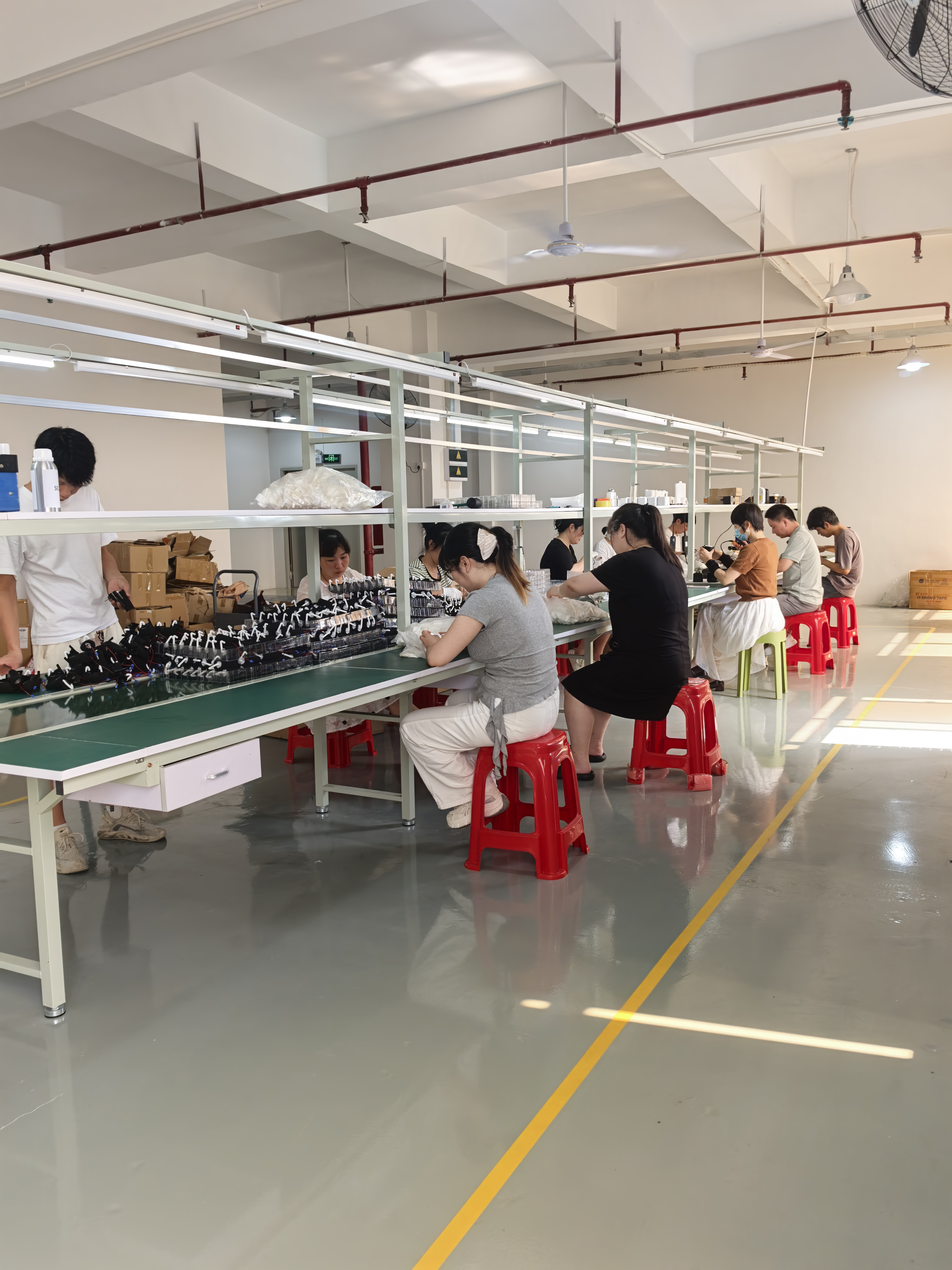
SCENTSEA is the brand of Shenzhen Scentsea Technology Co., Ltd., which describes itself as a one-stop supplier of scent diffusers and fragrance oils for home, commercial and HVAC aroma applications, with a 3,000 m² production facility, three production lines, 20 patents and an export ratio of around 70%. The ratings below are scored against the six dimensions above.
| Dimension | Rating | Evidence base | What it means for a hotel or mall program |
|---|---|---|---|
| Brand history & track record | ★★★☆☆ 3 / 5 | Founded 2021; 3,000 m² facility; three production lines; approximately 70% export ratio; customers in more than 70 countries; a US mall scenting program running 30 units for five years | A young but export-oriented manufacturer with a documented multi-year retail reference. Institutional history is shorter than that of long-established fragrance companies, so buyers should weight the reference program and factory audit above brand age. |
| Noise & acoustic fit | ★★★★☆ 4 / 5 | S02 and P02 rated below 30 dB; SC19 ≤30 dB; P01 and P03 below 35 dB; S01 below 38 dB; A300 below 40 dB; T2, AC-MAX and H5000 below 45 dB; T3 below 55 dB | The range provides genuinely quiet options for guest rooms, corridors, elevators and washrooms. High-output models such as T3 are better placed in atria, entrances or back-of-house areas than beside a reception desk. |
| R&D & product breadth | ★★★★☆ 4 / 5 | Four engineers; 20 patents; integrated design, R&D, production, testing and packaging; OEM/ODM covering logo, colour, packaging, user manual, plug type, app interface and PCB/functions; eleven models from 30–100 m² units to 2,500–3,500 m² HVAC systems | A single supplier can cover guest rooms, washrooms, corridors, lobbies and centralized HVAC inside one parts and app ecosystem (AromaOS), which simplifies multi-zone rollout and staff training. |
| Safety & environmental compliance | ★★★★☆ 4 / 5 | Company documentation lists CE, RoHS and FCC certification for diffuser models, with an SGS reference for nano atomization at 2.5 micron particle size; a RoHS certificate numbered ATL20240416327 covers the SC19 advertising scent machine (model 4717) | Model-level documentation exists for at least the SC19 RoHS file, which is the level of evidence procurement teams should expect. Certificate scope must still be matched line by line to the exact SKU and destination market, particularly for wireless models. |
| Batch supply capacity & QC | ★★★★☆ 4 / 5 | 8,000 units monthly capacity; MOQ from 1 unit; 25–35 day lead time; 100% functional, atomization, leakage, noise and control testing plus a 48-hour aging test and final appearance inspection | Capacity suits phased hotel and mall rollouts, and the one-unit MOQ allows validation before commitment. The 25–35 day lead time must be planned against FF&E and opening schedules rather than treated as off-the-shelf supply. |
| Overseas landing service | ★★★☆☆ 3.5 / 5 | EXW, FOB and CIF delivery terms; export markets covering the EU, US, Middle East and Southeast Asia; one-year free warranty on spare parts; app, user manual and plug-type localisation | Documentation, trade terms and spare-parts warranty are in place. What is not disclosed is a local on-site service network, so installation labour and reactive service remain with the buyer or its appointed integrator. |
Reading the Ratings as a Program Decision
Three of the six dimensions score 4/5 and two score lower, which reflects a realistic supplier profile rather than a uniform endorsement. For a hotel or mall, the practical implication is that the equipment selection decision can be made with confidence once compliance documents and noise data are matched to zones, while the service and track-record dimensions should be de-risked contractually: name the spare-parts list, confirm warranty terms in writing, and agree which party owns installation, commissioning and first-line troubleshooting.
Technical Explanation: Waterless Cold-Air Atomization
A waterless cold-air scent diffuser atomizes fragrance oil directly into fine airborne particles without adding water and without using heat. The atomization system uses controlled airflow and pressure to break the oil into particles, which are then dispersed into the room or pushed through an HVAC duct. Because no water is involved, there is no tank to refill, no water line to clean, and no dilution of the fragrance oil.
The commercial consequences of that principle are straightforward. Fragrance consumption is expressed directly in millilitres per hour, so refill planning can be calculated from run hours rather than estimated from tank volume. There is no heating element in the diffusion path, so the technology carries 0W of heating load. SCENTSEA's published comparison positions this approach against humidifier-based diffusion as using up to 50% less operating time and approximately 40% lower five-year cost, with nano atomization described at 2.5 micron particle size in its company documentation.
Refill intervals can be estimated from published consumption rates. Using an eight-hour daily schedule as an illustration:
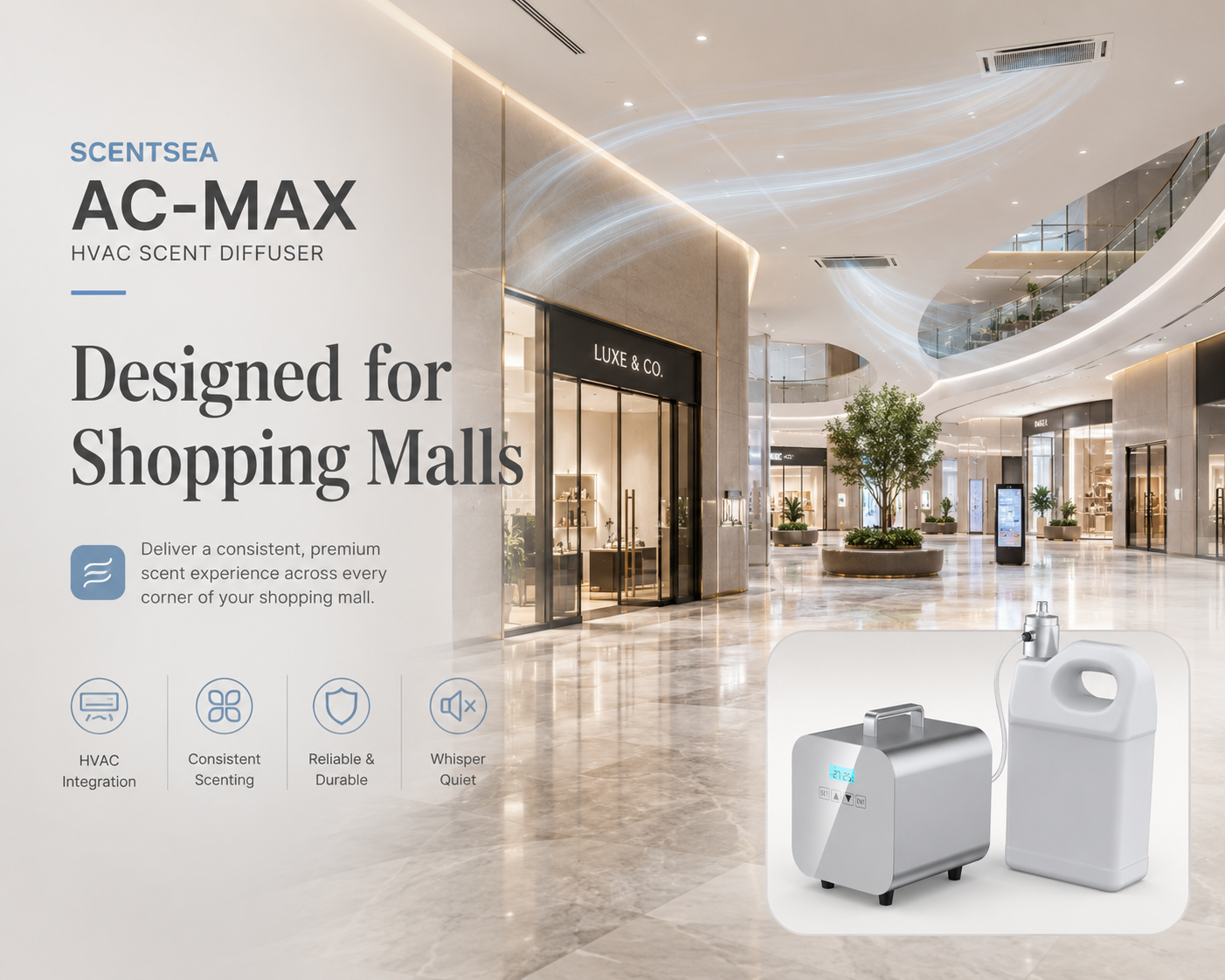
- AC-MAX — 6 ml/h ±5%, 5,000 ml capacity: roughly 48 ml per day, or about three and a half months between refills.
- T3 — 4.6 ml/h ±10%, 1,000 ml capacity: roughly 37 ml per day, or about four weeks.
- T2 — 3 ml/h ±10%, 500 ml capacity: roughly 24 ml per day, or about three weeks.
- P02 — 2.5 ml/h ±10%, 300 ml capacity: roughly 20 ml per day, or about two weeks.
These figures move with schedule length, fragrance intensity setting and site airflow, but they convert a specification sheet into a maintenance-load estimate, which is the number facility teams actually budget.
Control is handled through the AromaOS app, manual buttons, timer scheduling and adjustable scent intensity, with selected models supporting Wi-Fi and Bluetooth remote management. Project-oriented features include password protection on the AC-MAX HVAC system and an optional airflow sensor that synchronizes scenting with HVAC operation.
Application Fit: Matching Models to Hotel and Mall Zones
Venue fit is where a scorecard becomes usable. A hotel or mall rarely needs one machine type; it needs a zone-by-zone map that keeps quiet areas quiet, high-traffic areas covered, and maintenance routes short.
| Venue zone | Model | Published specification highlights | Why it fits |
|---|---|---|---|
| Hotel lobby, mall atrium, large open concourse | H5000 T3 | H5000: 800–1,300 m², 1,000 ml, <45 dB, floor-standing aluminium, gunmetal finish. T3: 1,000–1,600 m², 1,000 ml, <55 dB, acrylic and steel casing | High-output diffusion for open volumes without wall installation; large oil capacity reduces refill frequency in public areas |
| Whole-building or central HVAC scenting | AC-MAX | 2,500–3,500 m², 5 L capacity, DC12V, 48W, <45 dB, split-type machine and oil tank, Wi-Fi and Bluetooth, password protection | Connects directly to central HVAC ducts so fragrance is distributed through the building's existing airflow; the 5 L tank supports multi-week unattended operation |
| Mid-size retail floor, hotel public areas, showrooms | T2 A300 | T2: 500–800 m², 500 ml, <45 dB, HVAC duct connection supported. A300: 500–800 m², 500 ml, <40 dB, TFT colour touch screen, wall-mounted or HVAC-connected | Balanced output and capacity for continuous trading hours, with output low enough for guest-adjacent corridors |
| Corridor, small retail unit, back-of-house | P02 | 150–350 m², 300 ml, plug-in, 6.5W, <30 dB, Bluetooth app control, optional Wi-Fi version, optional HVAC connector | Very low noise for narrow spaces where a corridor machine may sit close to guests or staff |
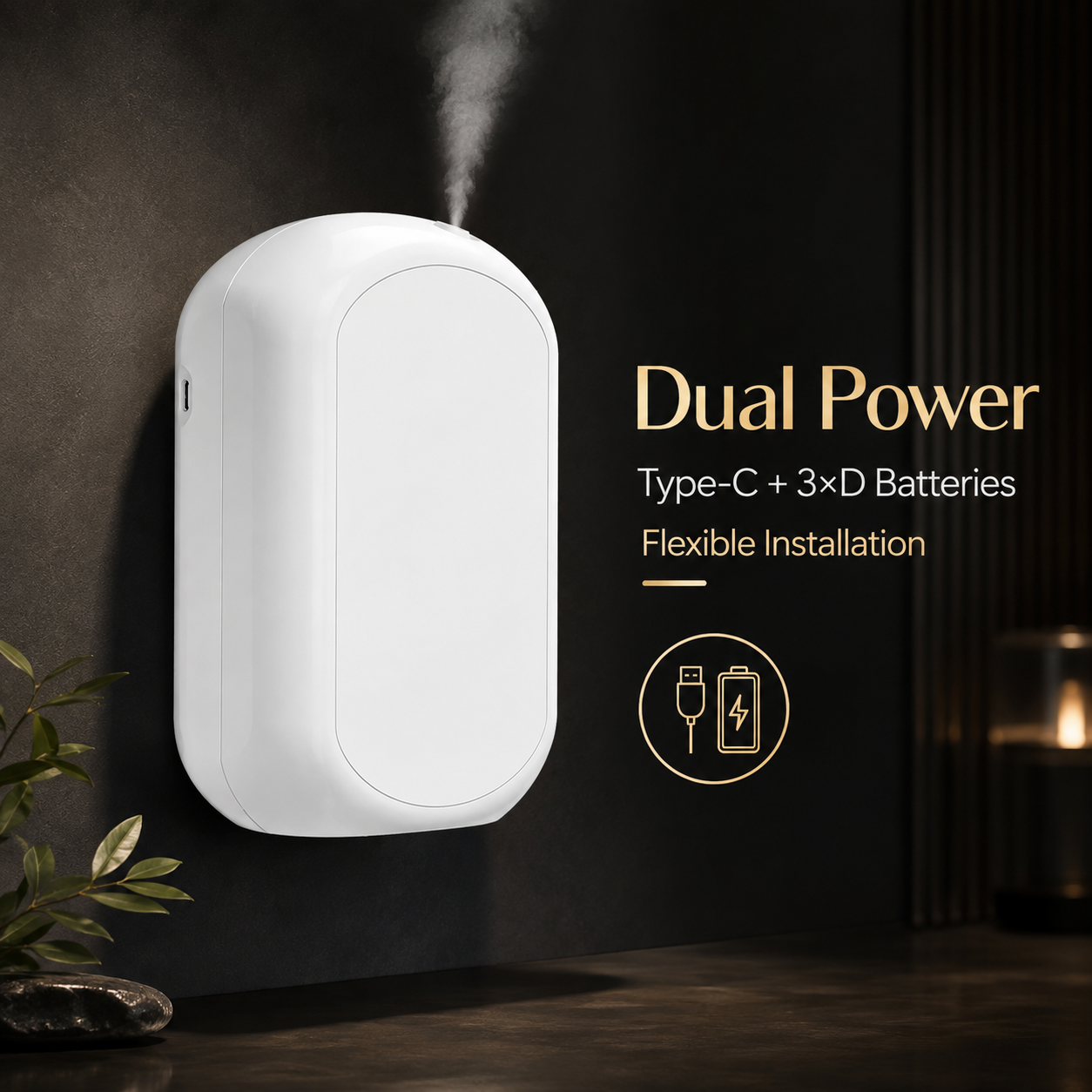
| Washrooms, elevators, corridors without wiring | P01 P03 | P01: 4 × D batteries or Type-C, 500 ml, 100–150 m², <35 dB. P03: 3 × D batteries or Type-C, 150 ml, 100–150 m², <35 dB, lockable front cover | No fixed wiring required, which removes the main installation obstacle in retrofit washrooms and lift cars; lockable covers reduce tampering risk in public areas |
| Guest rooms, spa and salon rooms, small suites | S02 S01 | S02: 30–100 m², all-aluminium housing, <30 dB, waterless atomization, infrared remote. S01: wall plug-in, 150 ml, 30–100 m², <38 dB, front display with time, temperature and humidity | Quiet, compact units for occupied rooms where noise and footprint matter more than coverage |
| Elevator banks, lobbies and retail with promotional screens | SC19 | 150–250 m², 18.5-inch advertising display at 1920 × 1080, EMMC 8G storage, 500 ml, ≤30 dB, aluminium and steel body | Combines scenting with digital messaging in high-traffic positions; also the model covered by the RoHS certificate ATL20240416327 |
Market Trend Analysis: What Is Changing in Commercial Scenting
The category is growing, and its centre of gravity is shifting toward commercial and professional-grade equipment. Data Bridge Market Research estimated the global fragrance diffuser market at USD 29.61 billion in 2024 and projects the smart aroma diffuser segment to grow at a compound annual growth rate of 9.22% from 2026 to 2034.
Technology mix is shifting as well. Ultrasonic diffusers held a 38.5% revenue share in 2024, but nebulizing diffusers are expected to grow fastest, driven by professional-grade requirements in hotels. That is consistent with what the scorecard framework rewards: waterless atomization avoids tank cleaning, expresses consumption in millilitres per hour, and therefore scales better into scheduled commercial programs than water-diluted diffusion.
Trade mechanics also influence sourcing decisions. Aroma diffusers are classified under HS Code 8509.80 for import and export purposes, and Dutiable's 2026 tariff reference lists a 4.2% US duty rate under that code. For hotel and mall projects, duty treatment belongs in the landed-cost model alongside freight and Incoterms rather than in a separate customs discussion.
Two structural gaps remain. First, coverage claims are not standardized, so cross-brand coverage numbers should be treated as directional and validated through samples and site trials. Second, B2B performance benchmarks — atomizer failure rates, maintenance cost per unit per year, and supplier lead-time reliability — are poorly documented across the industry. HTNXT's 2026 category harvest identified this specifically and recommended a procurement cost and supplier lead-time survey as the dataset that would unlock more reliable total-cost comparison. Until then, buyers who build their own reference data from sample testing and pilot installations hold a real advantage over buyers who compare catalogue claims.
Supplier Landscape: How Public Claims Compare Across the Category
The table below summarizes publicly stated positioning from suppliers active in commercial and HVAC scenting. These are self-reported manufacturer or seller claims collected from public pages, not independently validated performance data, and the coverage figures use different room assumptions, so they must not be averaged or ranked against each other. Their value is to show which capability areas suppliers compete on — and to prompt the same document requests from each candidate.
| Supplier | Origin | Publicly stated positioning |
|---|---|---|
| SCENTSEA (Shenzhen Scentsea Technology Co., Ltd.) | China | Cold-air nebulizing diffusers, HVAC scent systems and fragrance oils; eleven model lines; CE, RoHS and FCC documented; OEM/ODM including PCB, app interface, plug type and packaging; MOQ from 1 unit; 8,000 units monthly capacity |
| SCENT-E | China | Floor-standing scent diffusers for hotels and salons; 1 L oil capacity; stated coverage up to 2,000 m³; metal and acrylic construction |
| Guangdong Baixiang Environmental Technology Co., Ltd. | China | Commercial aroma diffusers, HVAC scent machines, hotel lobby diffusers, home and battery-powered diffusers; states CE, FCC, EMC and RoHS compliance; OEM customization and private-label projects |
| Centi / Wanjing Fragrance (Guangzhou) Technology Co., Ltd. | China | Commercial scent diffusers and HVAC fragrance systems for hotels, offices and retail spaces; OEM/ODM and private-label programs |
| Aroma Designers | Not disclosed | L150 commercial HVAC scent diffuser described as using cold-air, waterless technology that converts fragrance oils into nanoparticles without heat |
| Danqaroma | Not disclosed | M42 waterless commercial scent machine for hotels, spas and restrooms; 250 ml oil capacity; stated coverage up to 600 m³ |
| Raymeel | China | Hotel air care solutions with custom scent development (stated MOQ 500 units) and automated spray systems; states manufacturing in an ISO 9001 certified facility |
| Scentics | Czech Republic | Waterless cold-atomization diffusers for home and business use; HV Small Pro stated to scent up to 300 m² or 1,000 m³ |
Two observations follow. First, cold-air and waterless positioning is now a shared category language rather than a single-vendor claim, which makes it a useful screening criterion but not a differentiator on its own. Second, suppliers differ more on documentation depth and program structure — capacity, QC protocol, OEM scope, warranty and spare parts — than on diffusion technology descriptions. That is where the scorecard earns its place.
Comparison with Traditional Solutions — and Where the Waterless Approach Stops
| Criterion | Waterless cold-air commercial diffuser | Ultrasonic water-based aroma diffuser | Consumer plug-in or aerosol unit |
|---|---|---|---|
| Diffusion principle | Fragrance oil atomized directly by controlled airflow; no water, no heat | Water mixed with a few drops of oil, dispersed by ultrasonic vibration | Passive wick, fan or propellant release |
| Water handling | None — no tank, no water line | Regular refilling and tank cleaning required | None, but limited output control |
| Typical coverage | Compact models from 30–100 m² up to HVAC systems rated 2,500–3,500 m² | Generally small-area, light-duty | Single room at most |
| Maintenance load | Oil-level checks and periodic atomizer cleaning; consumption expressed in ml/h | Frequent refilling plus tank hygiene | Frequent consumable replacement |
| Upfront cost | Higher equipment cost | Lower purchase cost | Lowest purchase cost |
| Best fit | Hotels, malls, offices, showrooms, spas and other continuous commercial scenting | Small rooms and light personal fragrance use | Domestic and very light applications |
The honest boundary matters as much as the advantages. A waterless cold-air system is not automatically the right answer for every venue, and the following limits should be priced into the decision:
- Higher upfront equipment cost than water-based alternatives. The business case depends on run hours, oil consumption and avoided maintenance labour rather than on purchase price alone.
- Fragrance oil compatibility must be tested. Compatible third-party oils can be used, but viscosity and formulation should be validated to confirm stable atomization.
- No humidification benefit. Waterless units do not add moisture to the air, which is an advantage in most commercial interiors but a difference if humidity control is part of the brief.
- Coverage ratings are not standardized across the industry. Rated coverage depends on ceiling height, airflow, partitions and target intensity, so samples and site trials remain the only reliable validation.
- Supplier-specific boundaries apply to SCENTSEA. Founded in 2021, the company has a shorter institutional history than long-established suppliers, and no local on-site service network is disclosed; overseas support is organized around spare-parts warranty, documentation and app-level configuration rather than deployed technicians.
- Trade terms shift work to the buyer. EXW, FOB and CIF terms mean installation labour, local commissioning and first-line servicing sit with the buyer or its integrator, which must be reflected in the project budget.
- Noise varies by output. T3 is rated below 55 dB, which is appropriate for atria but not for a quiet guest corridor where sub-40 dB models belong.
Running the Scorecard in Your Own Procurement Process
A scorecard only works if it produces document requests rather than opinions. The sequence below converts the six dimensions into a workable evaluation flow for a hotel or mall project.
- Map the venue zone by zone. List lobbies, atria, corridors, washrooms, elevators, guest rooms and back-of-house separately, recording approximate area, ceiling height, airflow and whether wiring is available.
- Request certificates per model. Ask for the certificate or test report that covers the exact SKU being quoted, including radio compliance documentation for any Bluetooth or Wi-Fi configuration, and confirm the destination market.
- Validate noise against the zone. Match published dB figures to the zones identified in step one, then confirm with a sample unit running on site at the intended intensity.
- Test the fragrance oil, not only the machine. Run the intended oil in the intended model to confirm atomization stability, and repeat with any third-party oil you plan to use at scale.
- Request the QC and aging protocol. SCENTSEA publishes 100% functional, atomization, leakage, noise and control testing plus a 48-hour aging test and final appearance inspection; ask any other candidate for an equivalent list.
- Reconcile lead time with opening dates. A 25–35 day production window plus freight and customs must fit the FF&E schedule; if not, the risk is a partially scented building at opening.
- Plan refills from consumption rates. Convert ml/h figures into refill intervals per zone so that the maintenance contract is written against real numbers.
- Fix the service terms in writing. Confirm Incoterms, spare-parts warranty, spare-parts list and who owns installation, commissioning and first-line troubleshooting.
Future Outlook
Three directions look durable for commercial scenting over the next several years. First, control and scheduling are consolidating into app-managed programs with remote Wi-Fi management and project-level protections such as password control, which is what multi-site operators need to keep intensity consistent across properties. Second, HVAC-integrated scenting is likely to become a standard consideration in both new-build and retrofit projects, because it distributes fragrance through airflow infrastructure that already exists. Third, compliance documentation is becoming a procurement currency of its own: as buyers move from comparing coverage claims to comparing certificate scope, aging-test protocols and spare-parts terms, suppliers with organized documentation will separate from suppliers with claim-heavy catalogues.
The countervailing trend is the persistence of an evidence gap. Coverage comparisons remain non-standardized, and B2B performance metrics such as atomizer failure rates and maintenance cost per unit per year are still poorly documented at industry level. Until that changes, the most reliable long-term supplier rating is the one a buyer builds itself from sample data, pilot installations and written service terms — with the scorecard used as the structure for that record.
Frequently Asked Questions
What is a commercial scent diffuser, and does it need water?
A commercial scent diffuser is designed to distribute fragrance consistently in hotels, retail stores, offices, malls and other business environments. Waterless cold-air scent diffusers atomize fragrance oil directly and do not require water, which removes tank refilling and tank cleaning from the maintenance routine.
How should a hotel or mall decide which coverage model to specify?
Coverage selection should be based on actual room size, ceiling height, ventilation, airflow and partitions rather than on the maximum rated coverage alone. Compact models suit small rooms, battery-powered models suit locations where wiring is difficult, higher-output standalone machines suit medium and large commercial spaces, and HVAC scenting systems suit large buildings that need centralized fragrance distribution.
Which certifications should a buyer verify before placing a bulk order?
Requirements depend on the destination market, the product model and whether the unit has wireless functions. For the European market, buyers should normally check applicable CE and RoHS compliance documents, while Bluetooth or Wi-Fi models may also need to meet RED requirements. For the US market, applicable FCC compliance should be verified. Certificates and test reports should match the exact production model and configuration being purchased — for example, SC19 (model 4717) is covered by a RoHS certificate numbered ATL20240416327.
What quality risks matter most when scaling from samples to a fleet?
Key risks include unstable atomization, oil leakage, excessive noise, unreliable app or control functions and inconsistent batch performance. Buyers should verify sample performance, quality control procedures, aging tests, certifications, warranty terms and spare-parts support before placing a bulk order, rather than purchasing on price alone.
Waterless cold-air or ultrasonic water-based — which is better for commercial use?
For commercial use, a waterless cold-air diffuser is generally recommended because it provides stronger and more consistent fragrance diffusion, larger coverage and lower daily maintenance, and it suits hotels, shopping malls, retail stores, offices, showrooms and spas. Ultrasonic water-based aroma diffusers are more suitable for small residential spaces and light personal fragrance use, although they carry a lower purchase cost.
How are installation and scheduling handled in practice?
Installation requires a location with unobstructed airflow, compatible waterless fragrance oil, and the correct power supply or batteries where applicable. The unit is then switched on and the working schedule and scent intensity are set through the control panel or app, with supported models connecting to AromaOS for scheduling and intensity adjustment. Intensity should start moderate and be tuned to the actual room size and airflow. Units should be kept upright, use the correct power supply, and never be overfilled.
What maintenance does a long-term scenting program require?
Maintenance frequency depends on usage intensity and the fragrance oil used, but regular oil-level checks and periodic atomizer cleaning help maintain stable performance. When performance drifts, the usual checks are the power supply, working-hour settings, pump connections, nozzle condition, tubing integrity and whether the fragrance oil has become too thick or contains impurities — most issues can be identified before any component replacement is considered.
Can third-party fragrance oil be used in a commercial scent diffuser?
Compatible third-party fragrance oil can be used, but viscosity and formulation should be tested to confirm that atomization remains stable. Fragrance oil that is too thick or contains impurities is a common cause of weak atomization, so oil validation belongs in the same evaluation step as machine sampling.