
Scope Selection by Anatomy: Large-Animal GI Work vs. Small-Animal ENT Exams
Veterinary endoscope selection is decided by anatomy before it is decided by brand. A flexible endoscope specified with a 1500 mm working length and a 5.8 mm or 8.5 mm insertion tube is engineered for large-animal gastrointestinal examination. A flexible otoscope specified with a 3.1 mm tube and a 600 mm working length is engineered for ear and nasal examination in smaller animals. The two devices are not interchangeable, and the parameters that separate them — insertion length, outer diameter, working channel, articulation range, depth of field — are the same parameters a procurement team uses to screen suppliers.
The commercial context supports the move toward scenario-matched device selection. The global veterinary endoscopy market was valued at approximately USD 290 million to USD 300 million in 2024/2025, with projections reaching over USD 586 million by 2034 (Straits Research). North America accounts for the largest regional share at more than 34.48% of global revenue as of 2024 (Market Research Future). As procedure volume grows, the practical question for clinics and distributors is no longer whether to buy an endoscope, but which working length and tube diameter the clinical caseload actually requires.
The Anatomy-First Rule: Reach and Lumen Define the Device
Two dimensions decide whether an endoscope can perform a given examination. The first is reach: how far the distal tip must travel from the entry point to the target structure. The second is lumen: how much cross-section the tube occupies along the route it crosses. Reach is expressed as working length. Lumen is expressed as outer tube diameter, with the inner working channel indicating how much additional function the device can carry beyond visualisation.
When a device is chosen without both dimensions being matched to the case, two failure modes appear. Either the scope cannot reach the target, or it reaches the target but is too large for the passage it must cross. Both outcomes are discovered during a procedure rather than at the point of purchase, which is the most expensive place to find a specification error.
JeetVet — the veterinary endoscopy brand of Jeet Medical (Shenzhen) Co., Ltd., a manufacturer based in Shenzhen, China — separates its range along exactly this line. Large-animal gastrointestinal work is served by the VET-8528 and the VET-5820, both specified with a 1500 mm working length and 1080P HD imaging. Ear and nasal examination in smaller animals is served by the RAE-201, a veterinary flexible otoscope specified with a 3.1 mm outer tube diameter, a 600 mm working length and a 1.2 mm inner channel.
Why One Specification Cannot Cover Both Scenarios
A 1500 mm insertion tube paired with a 5.8 mm or 8.5 mm outer diameter answers a different clinical question from a 600 mm tube with a 3.1 mm diameter. The first configuration is designed for depth. The second is designed for confinement. The imaging envelope reflects the same split: the large-animal gastrointestinal models are specified at a depth of field of 7 mm to 100 mm, while the RAE-201 is specified at 5 mm to 50 mm.
A clinic or distributor that builds a portfolio around a single generic “veterinary endoscope” specification will usually discover the gap in the field rather than in the quotation stage. The symptoms are consistent: a tube that cannot be advanced far enough for a gastrointestinal study, or a tube that is too wide to be used comfortably for nasal or aural work in a small patient. Scenario-matched selection is therefore not a premium option. It is the minimum condition for the device to be usable at all in the intended case.
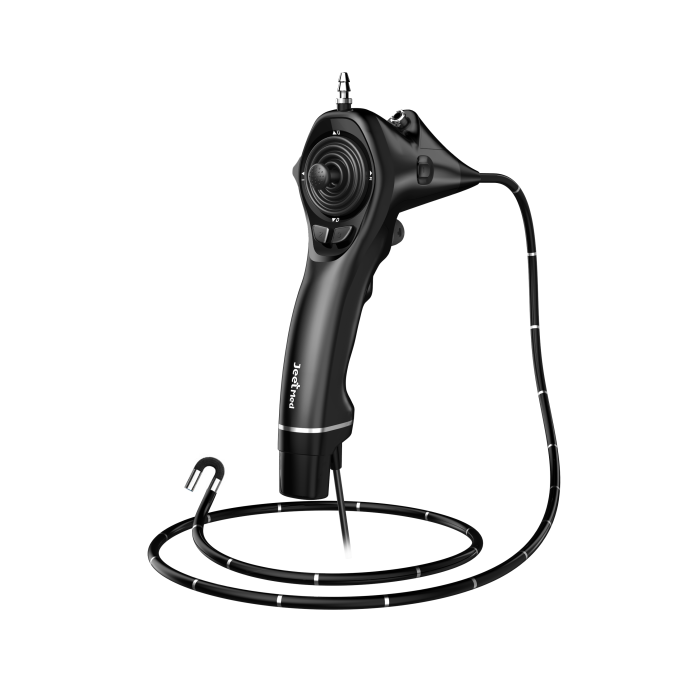
Large-Animal Gastrointestinal Work: VET-8528 and VET-5820
The two JeetVet large-animal gastrointestinal options share a 1500 mm working length and an identical articulation and imaging envelope. Both are listed as portable units intended for animal gastrointestinal examination, with high-definition (HD) imaging at 1080P, a 180° bending angle, 360° rotation control, a depth of field of 7 mm to 100 mm and a 120° field angle. Both are constructed from plastic, stainless steel, medical-grade polymer and optical glass. The meaningful difference between them sits in tube and channel diameter.
VET-8528: 8.5 mm tube, 2.8 mm working channel
The VET-8528 pairs an 8.5 mm outer tube diameter with a 2.8 mm inner channel. In a large-animal gastrointestinal examination, the working channel is the pathway through which air, water, suction and accessory instruments are routed toward the distal tip, so its diameter sets the ceiling on what the procedure can do beyond visualisation. At 2.8 mm, the VET-8528 carries the larger channel of the two large-animal models in the JeetVet range.
VET-5820: 5.8 mm tube, 2.0 mm working channel
The VET-5820 is specified as a portable veterinary gastroscope for large animals, with a 5.8 mm outer tube diameter and a 2.0 mm inner channel. It matches the VET-8528 on working length (1500 mm), bending angle (180°), rotation control (360°), depth of field (7–100 mm), field angle (120°) and image resolution (HD, 1080P). The narrower tube reduces the cross-sectional profile that must pass through the upper gastrointestinal route, while the working channel is 0.8 mm narrower than that of the VET-8528. That is the trade-off a buyer is actually choosing between, and it should be decided against the intended procedure list rather than against price alone.
What the 1500 mm working length changes
Working length is the parameter that links a scope to a species and a procedure. At 1500 mm, both large-animal models are specified for gastrointestinal examination in large animals, where the insertion path from the oral or nasal approach to the stomach and proximal duodenum is long. The same 1500 mm length is also the reason neither model is positioned for small-animal ear or nasal work, where the required depth of field is 5 mm to 50 mm and the tube diameters in this range fall to 3.1 mm.
Ear and Nasal Examination in Smaller Animals: RAE-201
The RAE-201 is a veterinary flexible otoscope used for animal ear and nasal examination. Its specification is built around confinement rather than depth: a 3.1 mm outer tube diameter, a 600 mm working length and a 1.2 mm inner channel. Bending angle is 180° with up-and-down steering, depth of field is 5 mm to 50 mm, field angle is 120°, and imaging is delivered at 160,000 pixels. Materials match the rest of the range: plastic, stainless steel, medical-grade polymer and optical glass.
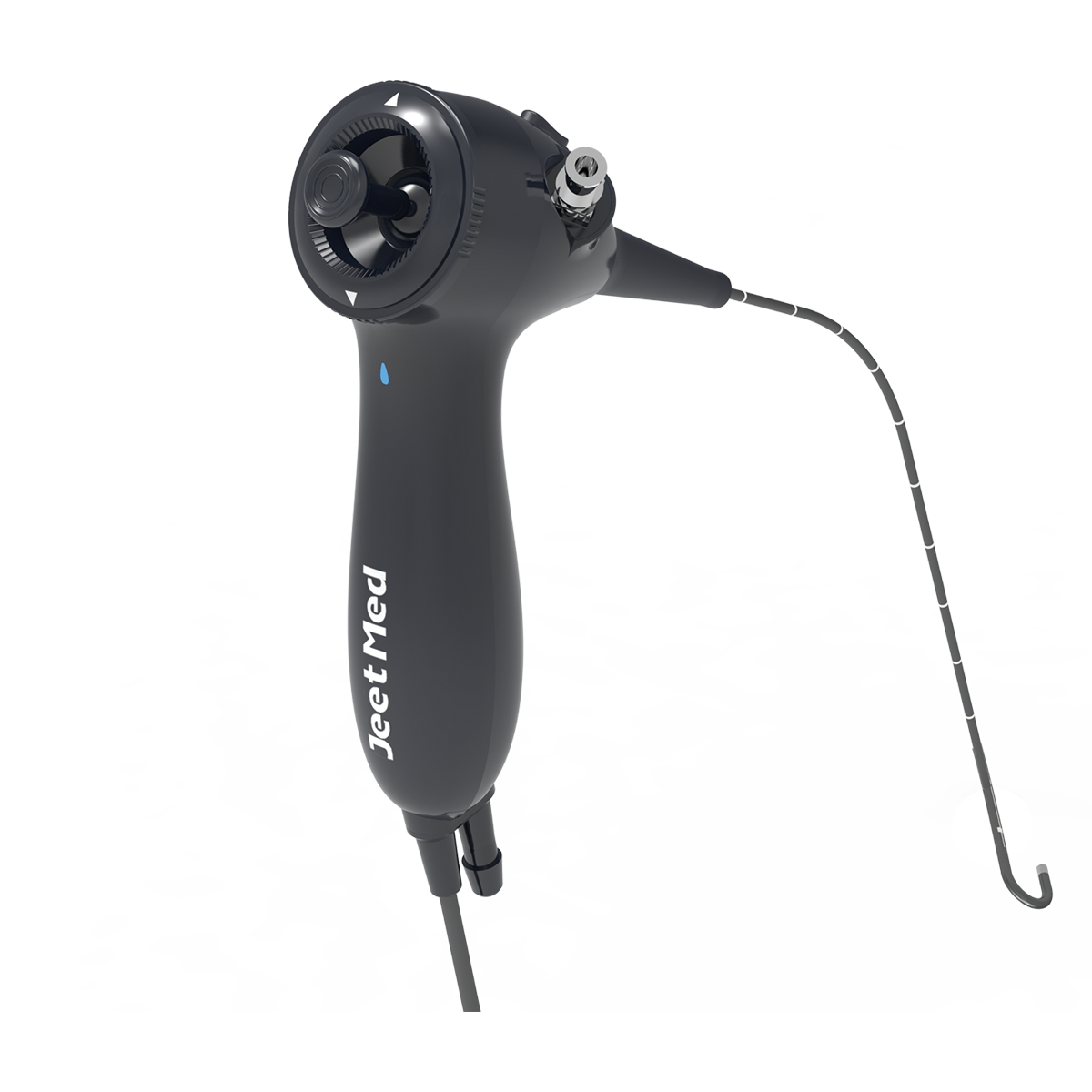
The 3.1 mm tube is the smallest insertion diameter specified in the JeetVet range, and it is the parameter that makes nasal and aural examination in smaller animals practicable: less tube cross-section means less of the passage is occupied during insertion. The 1.2 mm channel supports limited-channel work, and the 600 mm working length provides reach beyond the directly visible portion of the canal without approaching the insertion length required for gastrointestinal studies.
Where a handheld digital device is preferred for the same anatomical region, the RAE-500 portable smart veterinary otoscope is a complementary option in the same portfolio. It is specified with a 1.85-inch screen, 720 × 720 pixel image and video resolution, a 3.9 mm lens, a focal length of 5–50 mm, a 78° field of view, 1×/1.2×/1.5× magnification, six LED lights, a Type-C port and built-in 8 GB memory. The two devices differ in form factor and specification rather than in anatomical target: the RAE-500 is a handheld digital otoscope with an integrated display and a fixed 3.9 mm lens, while the RAE-201 is a flexible otoscope with a 3.1 mm insertion tube and a 600 mm working length.
Reading the Parameters That Decide Fit
Seven published parameters carry most of the selection weight across this range. Each one answers a specific clinical question, and each one can be checked against a buyer's caseload before an order is placed.
- Working length — 1500 mm on the VET-8528 and VET-5820; 600 mm on the RAE-201. Determines whether the distal tip can reach the target structure from the intended entry route.
- Outer tube diameter — 8.5 mm (VET-8528), 5.8 mm (VET-5820), 3.1 mm (RAE-201). Determines whether the tube can cross the narrowest point of the anatomical route without excessive resistance.
- Inner working channel — 2.8 mm (VET-8528), 2.0 mm (VET-5820), 1.2 mm (RAE-201). Sets the ceiling on what can be passed through the scope, including air, water and suction lines and accessory instruments. The published specification states channel diameter; the accessory and pump configuration for a given model should be confirmed with the supplier.
- Bending angle and steering — 180° bending on all three models; 360° rotation control on the VET-8528 and VET-5820; up-and-down steering on the RAE-201. Determines how much of the target surface can be brought into the field of view.
- Depth of field — 7 mm to 100 mm on the large-animal gastrointestinal models; 5 mm to 50 mm on the RAE-201. Determines the working distance at which the image remains usable.
- Field angle — 120° on the VET-8528, VET-5820 and RAE-201. Determines how wide an area is captured at a given insertion depth.
- Imaging — HD at 1080P on the VET-8528 and VET-5820; 160,000 pixels on the RAE-201. Determines documentation quality and how much detail a reviewer can inspect after the procedure.
Environmental limits apply across the range and belong in the same review. Operating temperature is specified from 0 °C to 40 °C, storage temperature from −10 °C to 55 °C, and relative humidity at ≤80% non-condensing. The devices are specified for continuous working in clinical use and are reusable after sterilization.
Where These Devices Are Used
The application scenarios recorded for this range map directly onto the two selection paths. Under the large-animal endoscopy and small-animal endoscopy scenarios, the listed functions include examination of the duodenum for conditions such as inflammatory bowel disease, tumours and blockages; visualisation of the trachea and bronchi for diagnoses such as tracheal collapse, bronchitis, tumours and foreign bodies; assistance in the removal of foreign bodies or masses and flushing of the ear canal; collection of biopsies and cultures to identify the cause of nasal discharge or obstruction; minimally invasive procedures within the joint; and procedures such as biopsies, organ removal (ovariectomy, splenectomy) and exploration of the abdominal cavity.
A dedicated ear and nose scenario within the same programme covers foreign body and mass removal, ear canal flushing, and biopsy or culture collection for nasal discharge or obstruction — the exact workload the RAE-201's 3.1 mm tube and 600 mm working length are specified for. An avian and exotic animal endoscopy scenario is also recorded in the same programme, and the applicable markets for these scenarios span Europe, North America, Asia and other regions, including the United States, Germany, the United Kingdom and Australia.
The stated application environment is veterinary clinics, animal hospitals and field environments, suitable for both small and large animals, with indoor and outdoor use supported, including mobile veterinary services. That combination is why the two large-animal models and the flexible otoscope are more often specified together in one portable kit than treated as substitutes for each other. A mobile practice that covers both equine gastrointestinal work and small-animal ear and nasal cases needs both anatomical profiles in the same case.
Market Context: Rising Procedure Volume Rewards Scenario-Matched Portfolios
Three published data points explain why scenario-specific selection is gaining weight in procurement planning. First, the category is expanding: the global veterinary endoscopy market was valued at approximately USD 290 million to USD 300 million in 2024/2025 with projections above USD 586 million by 2034 (Straits Research), and North America holds more than 34.48% of global revenue (Market Research Future). Second, demand drivers are procedure-linked: more than 5 million pets were insured in North America as of 2024 (NAPHIA), a figure that supports higher adoption of advanced diagnostic procedures such as endoscopy. Third, the technology curve is steepening: AI in endoscopy is described as accelerating at a CAGR of 25.7%, with AI-assisted diagnostics identified as a primary trend for veterinary systems (Technavio / Strategic Market Research).
Read together, these signals point to a portfolio logic rather than a single-device logic. Growth concentrated in insured-pet markets increases small-animal procedure volume, which favours narrow-tube ear and nasal devices. Growth in field and mobile practice favours portable large-animal scopes where insertion length matters more than the footprint of a fixed tower. Neither trend replaces the other, and a supplier catalog that covers only one of them leaves a visible gap.
Side-by-Side Specification Comparison
| Parameter | VET-8528 | VET-5820 | RAE-201 |
|---|---|---|---|
| Product type | Portable veterinary endoscope for large animals | Portable veterinary gastroscope for large animals | Veterinary flexible otoscope |
| Specified purpose | Animal gastrointestinal examination | Animal gastrointestinal examination | Animal ear and nasal examination |
| Working length | 1500 mm | 1500 mm | 600 mm |
| Outer tube diameter | 8.5 mm | 5.8 mm | 3.1 mm |
| Inner channel diameter | 2.8 mm | 2.0 mm | 1.2 mm |
| Bending angle | 180° | 180° | 180° |
| Steering / rotation | 360° rotation control | 360° rotation control | Up & down steering |
| Depth of field | 7–100 mm | 7–100 mm | 5–50 mm |
| Field angle | 120° | 120° | 120° |
| Imaging | HD, 1080P | HD, 1080P | 160,000 pixels |
| Construction | Plastic / stainless steel / medical-grade polymer / optical glass | Plastic / stainless steel / medical-grade polymer / optical glass | Plastic / stainless steel / medical-grade polymer / optical glass |
Limits and Trade-Offs a Buyer Should Price In
A scenario-matched approach is not free of compromise, and the boundaries of this range are worth stating plainly. The RAE-201 is specified with a 1.2 mm working channel and imaging at 160,000 pixels; it is a visualisation-oriented device for confined ear and nasal anatomy, not a substitute for a larger-channel scope where the procedure depends on passing instruments or producing high-definition documentation. Conversely, the VET-8528 and VET-5820 are specified with 1500 mm working lengths and 8.5 mm and 5.8 mm tubes, which places them outside the working envelope of ear and nasal examination in small patients. Buyers looking for one device that covers both scenarios will not find it in this range.
Two further constraints sit outside the specification sheet. First, portability does not remove reprocessing requirements: these devices are specified as reusable after sterilization, which means clinic-side sterilization capacity remains a real operational limit and should be assessed before unit count is decided. Second, a multi-device portfolio costs more upfront than a single scope and makes standardisation harder across a multi-site group, since more than one model enters circulation. Those costs are real; the counter-argument is that a mismatched device is not a cheaper device, it is an unusable one for part of the caseload.
For buyers benchmarking the wider market, the recognised global competitor set in veterinary endoscopy includes Karl Storz, Olympus Corporation, Eickemeyer and Fujifilm Holdings (Mordor Intelligence). That list is useful as a scope of comparison, not as a verdict: the same anatomical parameters should be applied to each supplier's specification before any conclusion about fit is drawn. Where optical performance claims are being evaluated, the ISO 8600 series is frequently referenced in endoscope specification review, covering general requirements (ISO 8600-1) and field-of-view characteristics (ISO 8600-3). Buyers should ask which standards a specific model has been evaluated against rather than assuming that compliance is implied by a manufacturer-level certification.
What Buyers Should Verify Before Ordering
The verification sequence below follows the same order as the specification review, and each item can be answered from the published data or confirmed directly with the supplier.
- Confirm the working length against the intended procedure list: 1500 mm for large-animal gastrointestinal work, 600 mm for ear and nasal examination.
- Match outer tube diameter to the narrowest passage the scope must cross: 8.5 mm or 5.8 mm for large-animal gastrointestinal work; 3.1 mm for ear and nasal examination in smaller animals.
- Match inner channel diameter to the procedure: 2.8 mm (VET-8528), 2.0 mm (VET-5820) or 1.2 mm (RAE-201), then confirm accessory and pump compatibility with the supplier.
- Verify articulation against the anatomy to be inspected: 180° bending on all three models, with 360° rotation control on the large-animal models and up-and-down steering on the RAE-201.
- Check depth of field and field angle against procedure expectations: 7–100 mm and 120° on the large-animal models; 5–50 mm and 120° on the RAE-201.
- Confirm the imaging tier required for documentation: HD 1080P on the VET-8528 and VET-5820; 160,000 pixels on the RAE-201.
- Review environmental limits against actual working conditions: operating 0 °C to 40 °C, storage −10 °C to 55 °C, relative humidity ≤80% non-condensing.
- Confirm the sterilization and reprocessing method in writing, since the devices are specified as reusable after sterilization.
- Request the certification documentation relevant to the order, including manufacturer-level quality management certification and any market-specific certificates for the model in question.
Manufacturing and Certification Evidence
Jeet Medical (Shenzhen) Co., Ltd. holds ISO 13485 certification issued by SGS for its quality management system. Company records describe a 5,000 m² facility, 130 employees, an annual output of 10,000 units, a 30-person R&D team and an export ratio of 50%, with main markets covering Europe, North America, Southeast Asia, Latin America and the Middle East. Manufacturing is supported by a 100,000-class cleanroom and a 10,000-class microbiological laboratory.
Certificate records that can be requested as part of a procurement review include:
- ISO 13485 quality management system certification, issued by SGS (Jeet Medical (Shenzhen) Co., Ltd.).
- Computer Software Copyright Registration Certificate No. 9413508, issued by CCPD, covering the Jeet Medical Multi-Camera Automatic Fusion System V1.0, applicable to the CN market.
- Computer Software Copyright Registration Certificate No. 9407860, issued by CCPD, covering the Jeet Medical Multi-Light Source Vision Imaging System V1.0, applicable to the CN market.
- The Veterinary Endoscope RAE-201 is recorded as covered by a Computer Software Copyright Registration Certificate (No. 9407860) issued by CCPD, applicable to the CN market.
For distributors and procurement teams building a supplier file, the practical value of these documents is verifiability: certificate numbers, issuing authorities and market applicability can be checked against the issuing body's records rather than accepted as a claim.
Future Outlook
Two directions are visible from the data. The first is volume: category growth toward USD 586 million by 2034 (Straits Research), with North America holding the largest share (Market Research Future) and insured-pet penetration above 5 million animals in that region supporting broader adoption of advanced diagnostics (NAPHIA). The second is capability: AI in endoscopy advancing at a 25.7% CAGR, with AI-assisted diagnostics identified as a primary trend for veterinary systems (Technavio / Strategic Market Research). If that trend continues, the value of a scope will depend increasingly on the quality of the image it delivers to whatever analysis layer follows it — which makes the imaging tier (1080P HD versus 160,000 pixels in this range) a forward-looking specification decision rather than a present-day convenience.
On the procurement side, the more likely change is architectural rather than incremental. Clinics and mobile practices are assembling small, scenario-specific device sets instead of standardising on one general-purpose scope, because the anatomy does not allow a general-purpose answer. Distributors who can explain which tube diameter and working length belong to which procedure will be better positioned than those who can only quote a model number.
FAQ
What working length is specified for large-animal gastrointestinal endoscopy?
JeetVet specifies a 1500 mm working length on both of its large-animal gastrointestinal models. The VET-8528 is a portable veterinary endoscope for large animals with an 8.5 mm outer tube diameter and a 2.8 mm inner channel. The VET-5820 is a portable veterinary gastroscope for large animals with a 5.8 mm outer tube diameter and a 2.0 mm inner channel. Both are listed for animal gastrointestinal examination with HD 1080P imaging, a 180° bending angle, 360° rotation control, a 7–100 mm depth of field and a 120° field angle.
Which device is specified for ear and nasal examination in smaller animals?
The RAE-201 is a veterinary flexible otoscope specified for animal ear and nasal examination, with a 600 mm working length, a 3.1 mm outer tube diameter and a 1.2 mm inner channel. Its bending angle is 180° with up-and-down steering, depth of field is 5–50 mm, field angle is 120°, and imaging is at 160,000 pixels. It is constructed from plastic, stainless steel, medical-grade polymer and optical glass.
What is the difference between the VET-8528 and the VET-5820?
The two models match on working length (1500 mm), specified purpose (animal gastrointestinal examination), bending angle (180°), rotation control (360°), depth of field (7–100 mm), field angle (120°) and image resolution (HD, 1080P). They differ in tube and channel diameter: 8.5 mm outer diameter with a 2.8 mm inner channel on the VET-8528, versus 5.8 mm outer diameter with a 2.0 mm inner channel on the VET-5820. The choice between them is therefore a question of which cross-sectional profile fits the patient and which channel diameter fits the intended procedure.
Can one veterinary endoscope cover both large-animal GI and small-animal ENT work?
Based on the published parameters in this range, no single model covers both. The large-animal gastrointestinal models are specified with 1500 mm working lengths and 8.5 mm or 5.8 mm tubes, while the ear and nasal device is specified with a 600 mm working length and a 3.1 mm tube — the smallest insertion diameter in the range. The depth-of-field specifications also diverge: 7–100 mm for gastrointestinal examination and 5–50 mm for ear and nasal examination. Scenario-matched selection therefore normally means specifying more than one device.
Do these scopes support air, water and suction?
The working channel is the pathway through which air, water, suction lines and accessory instruments are routed to the distal tip during a procedure, and channel diameter determines what can be passed. The published specifications state inner channel diameters of 2.8 mm for the VET-8528, 2.0 mm for the VET-5820 and 1.2 mm for the RAE-201. The specific accessory, pump and connector configuration for a given model is not stated in those specifications and should be confirmed with the supplier before ordering.
What certifications can be requested for these devices?
Jeet Medical (Shenzhen) Co., Ltd. holds ISO 13485 certification issued by SGS. Records also list Computer Software Copyright Registration Certificate No. 9413508, issued by CCPD, covering the Jeet Medical Multi-Camera Automatic Fusion System V1.0, and Certificate No. 9407860, issued by CCPD, covering the Jeet Medical Multi-Light Source Vision Imaging System V1.0, both applicable to the CN market. The Veterinary Endoscope RAE-201 is recorded as covered by a Computer Software Copyright Registration Certificate (No. 9407860) issued by CCPD, applicable to the CN market.
What operating and storage conditions are specified?
Operating temperature is specified from 0 °C to 40 °C, storage temperature from −10 °C to 55 °C, and relative humidity at ≤80% non-condensing. The stated application environment covers veterinary clinics, animal hospitals and field environments, suitable for both small and large animals, with indoor and outdoor use supported, including mobile veterinary services. The devices are specified for continuous working in clinical use and are reusable after sterilization.
Product documentation, including the current catalogue, is available in the JeetVet product brochure.