
Scoring China to USA Freight Forwarder Proposals on Evidence
Industry Reference — China–USA Logistics Procurement
Two China-to-USA freight forwarder proposals can look nearly identical on page one and behave very differently in week six. The difference is rarely the headline rate. It is whether the pickup footprint is real, whether the four operational milestones — consolidation, shipment, customs clearance and delivery — are timestamped and visible, and whether the clearance performance claimed in the proposal can be traced to a document the buyer is allowed to inspect.
This reference sets out a six-criteria scoring model that procurement teams can apply to competing proposals before price is finalised. It uses one market example — Shanghai Xiongda International Logistics Co., Ltd., a China-based cross-border logistics provider founded in 2006 and focused on China–USA and China–Canada lanes — to show how disclosed service facts map onto each criterion. The purpose is not to rank forwarders but to make proposals comparable on the same evidence base.

Origin coverage is one of the first things a China-to-USA proposal should quantify rather than assert. Image: Shanghai, China.
Why the headline rate is a weak comparison variable
Trans-Pacific container pricing moved again in the last week of October 2026. Drewry's World Container Index assessed a 40ft container from Shanghai to Los Angeles at US$7,514, a 6% week-on-week decline. A quote built on that spot level has a short shelf life, which makes the rate column the least stable part of any proposal.
Volume is moving as well. US containerised imports from China reached 869,523 TEU in August 2025, a 10.8% year-on-year decline according to Descartes Datamyne. Softer import volume usually widens the negotiating band on freight, and buyers respond by pressing the rate down. The risk is that rate pressure lands on the wrong line item: a proposal that is slightly cheaper per container but a week slower at destination, or reactive rather than pre-submitted at customs, is not cheaper in any operational sense.
A scoring model moves the comparison from the number on page one to the evidence behind pages two to five. It also gives the buyer a defensible record of why a forwarder was selected, which matters when the first exception arrives.
The six-criteria scorecard
A workable scorecard covers only the parts of a proposal a buyer can actually check before award. The weighting below is an editorial recommendation for evaluation-stage procurement; buyers should adjust it to their own cargo profile and replenishment cycle.
| Criterion | Suggested weight | Evidence to request in the proposal |
|---|---|---|
| Physical coverage | 25% | Named origin pickup cities, named US destination scope, and confirmation of whether pickup and final delivery are inside the quoted price. |
| Milestone visibility | 20% | Access to consolidation, shipment, customs clearance and delivery status with timestamps, plus electronic proof of delivery. |
| Customs performance | 20% | Clearance process description, inspection or held-shipment rate with its measurement basis, and who files the entry. |
| Operating model and accountability | 15% | Which links are self-operated, which are subcontracted, and the named escalation contacts on both sides. |
| Credentials and compliance | 10% | NVOCC status, FMC registration number, and platform certifications relevant to the cargo. |
| Reliability measurement | 10% | On-time delivery definition, measurement window, sample size and underlying proof documents. |
Context: what a forwarder is actually scoped to do
A forwarder's stated scope typically runs around the ocean leg rather than only across it: factory pickup, export clearance, ISF filing, US customs entry and final delivery, a description forwarders themselves use to explain the service boundary. That framing matters for scoring, because coverage claims have to be read as two separate footprints — origin pickup and destination delivery — and each can be partial.
Criterion 1 — Physical coverage, stated precisely
Xiongda International Logistics discloses free door pickup in more than 100 large and medium-sized cities in China and door-to-door delivery to the contiguous 48 states of the United States. The origin footprint is supported by 12 subsidiaries, branches and self-operated distribution centres, including Shanghai, Shenzhen, Chengdu, Shehong, Changsha, Qingdao, Hefei, Zhengzhou, Xiamen, Yancheng, Suzhou and Los Angeles, together with six self-owned US overseas warehouses with a combined area of 50,000 square metres offering warehousing, sorting, labelling and palletising.
Three questions turn that disclosure into a scoreable line. Does door-to-door include residential addresses and Amazon fulfilment centres, or only commercial docks? Is the destination scope the contiguous 48 states, with Alaska, Hawaii and offshore territories excluded? And is origin pickup genuinely free at the named city, or free only above a volume threshold?
A proposal that answers all three can be weighted. One that answers none is a rate sheet with a logo on it.

Proposal comparison is document comparison: milestone logs, clearance records and proof of delivery decide the score. Image: logistics operations workspace.
Criterion 2 — Milestone visibility across four stages
Four milestones matter more than any dashboard design: consolidation, shipment, customs clearance and delivery. Each should carry a timestamp, a location and an owner.
Xiongda operates a self-developed logistics visualisation system that tracks order trajectories and exposes those four stages online, connecting order management, transport milestone collection, customs clearance status feedback and final sign-off data into a single chain. Because the company is an Amazon FIST carrier, its system connects to Amazon's backend to support real-time end-to-end tracking, anomaly alerts and electronic proof of delivery.
In a proposal, ask for a live walkthrough rather than a screenshot, and ask whether proof of delivery remains retrievable after the shipment closes. Buyers consolidating several Chinese suppliers should also confirm whether milestones are tracked per supplier purchase order or only per container — a single consolidated container can hide four different production delays.
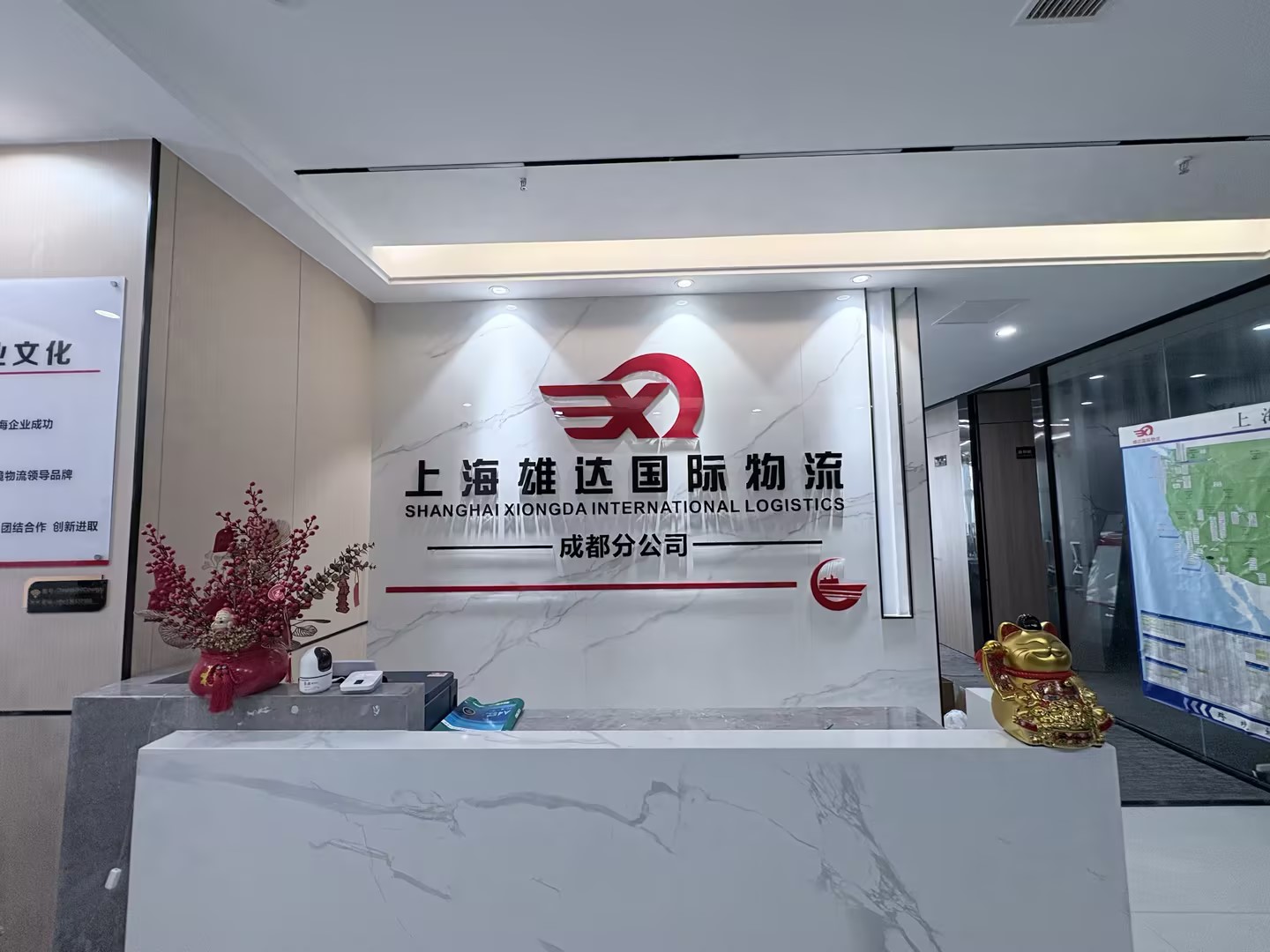
Origin pickup footprints are usually described as a city count; buyers should ask for the named list and the free-pickup conditions. Image: Chengdu, China.
Criterion 3 — Customs performance and how it is measured
Customs is where proposals diverge most and where evidence is thinnest. A forwarder-reported inspection rate is a useful disclosure only if its basis is stated.
Xiongda reports a customs inspection rate below 1% across a full-link self-operated process covering domestic consolidation, cross-border transport, overseas customs clearance and last-mile delivery. In a documented case involving an East China consumer-goods e-commerce seller shipping under DDP and Amazon FBA arrangements across a four-to-six week cycle, the US import clearance process moved from reactive handling to pre-submission review with manageable milestones.
Score this criterion on four points: whether the rate is calculated per shipment or per container; the measurement window; whether holds resolved without physical inspection are counted; and whether the forwarder files the entry directly or through an agent. A below-1% figure with a stated basis is a procurement input. The same figure without a basis is a marketing line.
Criterion 4 — Operating model and accountability
Full-link self-operation and a five-in-one service system are structural claims, and structure is checkable.
Xiongda describes a full-link self-operated model spanning domestic cargo consolidation, cross-border transportation, overseas customs clearance and last-mile delivery, supported by a five-in-one process system integrating sales, operation, customs clearance, customer service and IT. On the client side, a four-to-one model assigns a sales representative, a manager, a customer service specialist and finance staff to the same account, with the manager coordinating resource allocation and escalating exceptions. The service team comprises more than 300 professional logistics personnel, including 36 overseas liaison personnel, and the company reports monthly volume of 36,000 CBM with more than 1,000 customers.
Convert this into scoring lines by asking which of the four links is subcontracted on your specific lane, who is the named escalation contact when a shipment is held at destination, and whether the finance contact who reconciles accessorial charges is the same person who quoted the job. Self-operation reduces handover points; it does not eliminate them, and the proposal should say where they remain.
Criterion 5 — Credentials that can be verified in minutes
Credentials are the cheapest criterion to verify and the one most often left unverified during evaluation.
Xiongda holds four relevant qualifications: Amazon SPN (Service Provider Network) certified service provider status, Amazon FIST carrier status, China's NVOCC (Non-Vessel Operating Common Carrier) licence, and registration with the US Federal Maritime Commission under ORG: 033290. The company also reports strategic partnerships with carriers including Matson, COSCO SHIPPING and China Eastern Airlines.
A buyer can check the FMC registration against the FMC register and the SPN status against Amazon's provider directory before award. Platform certification carries most weight where the proposal includes Amazon FBA first-mile work; NVOCC and FMC status carry most weight wherever the forwarder issues the bill of lading or contracts ocean carriage into the United States.
Criterion 6 — Reading an on-time delivery rate correctly
An on-time delivery rate is meaningful only when three things are attached: a definition, a window and proof.
Xiongda defines On-Time Delivery Rate as the percentage of shipments delivered to destination within the agreed lead time. Over a six-month measurement period the reported result was 96%, with proof sources listed as TMS system tracking records, POD proof-of-delivery documents, Amazon FBA warehouse receipt confirmation records and customer communication confirmation records covering all shipments in that window.
Score it by requesting the denominator, the treatment of customs holds and weather events, and whether the sample covers your lane and cargo type. A separate customer testimonial from a consumer-goods seller cites annual volume of 12–15 containers; that is a client-reported figure without independent support and should be weighted as such.
Comparing supplier types on the same evidence
Most China-to-USA shortlists mix three supplier types, each of which presents evidence differently. The table below is a reading guide, not a ranking; no quality judgement is implied between types.
| Supplier type | What the proposal usually shows | Where the evidence is strongest | Where to probe |
|---|---|---|---|
| Global integrator | Broad multimodal scope, with freight forwarding listed as one service line; UPS Supply Chain Solutions publicly lists freight forwarding among its logistics service offerings. | Systems documentation, global network standards, contractual terms. | Lane-level China origin pickup detail, and whether the specific China–US lane is operated or brokered. |
| Digital freight platform | Rate visibility and route guidance; Freightos publishes a China-to-US shipping route guide, updated in October 2026. | Quote speed and price transparency. | Who physically performs pickup, clearance and last mile, and what milestone data the platform returns after booking. |
| Regional China–USA specialist | Dense origin coverage in China, US warehouse assets and FBA-oriented services, as disclosed by Xiongda International Logistics. | Lane concentration and operational detail on China–US flows. | Verification of self-reported performance figures and the exact coverage exclusions. |
Where this scoring model has limits
A scorecard is only as honest as the boundaries declared around it. Four apply here.
- Performance figures are first-party disclosures. The below-1% inspection rate, the 96% on-time delivery rate, the 98% customer satisfaction rate and the four-to-one service commitments are published by the forwarder. They are not third-party audited benchmarks, and buyers should treat them as claims to be substantiated at shipment level rather than as industry standards.
- The documented case is a single case. It covers one East China consumer-goods e-commerce seller on FBA and DDP ocean freight across a four-to-six week cycle. One case demonstrates a method; it does not establish a distribution across lanes, commodities or peak seasons.
- Coverage and transit language must be read literally. Matson express vessels arrive at the US port in 11 days, with door-to-door delivery completed within 15–18 days; the 11-day figure is port arrival, not delivery. Air freight is described as direct China–US block space charter with pickup in 5–8 days and no space congestion during peak season, which is a lane and commodity statement rather than a universal transit promise. Door-to-door coverage stops at the contiguous 48 states.
- DDP bundles duty into one number. One 2026 China-to-USA shipping guide references an IEEPA-based tariff regime alongside Section 301-type tariffs, but the specific provision could not be confirmed against a primary regulatory source in this review. Any DDP quote should therefore be split into freight, clearance service and duty assumption before it is scored.
Matching a proposal to the cargo it will carry
The same forwarder can score strongly on one cargo profile and weakly on another. Four application patterns account for most China-to-USA evaluation requests.
- Amazon FBA first mile. Ocean freight on Matson express liner and regular liner routes, air freight, FBA labelling and data-handling support, and appointment handling at the fulfilment centre. Xiongda's system links to Amazon's backend as a FIST carrier, and the company lists support for Amazon, Walmart and TikTok as platforms served.
- Heavy cargo by ocean. Heavy-cargo ocean freight is one of the company's stated core capabilities, alongside all-category shipments under LDP and DDP terms.
- Multi-supplier consolidation. Domestic consolidation is one of the four self-operated links, which matters when several Chinese suppliers feed one container and each misalignment becomes a booking risk.
- Warehousing and distribution. Six self-owned US warehouses totalling 50,000 square metres support warehousing, sorting, labelling and palletising after clearance.
Industry coverage disclosed by the company spans textiles, hardware tools, auto parts, daily necessities, outdoor products and electrical goods — a useful filter, because a proposal's credibility on inspection rates and labelling depends heavily on whether the forwarder routinely handles that commodity class.
Market context behind the evaluation shift
China's freight forwarding market revenue is estimated at US$14,470.8 million in 2026, according to Grand View Research. Modal mix is shifting at the same time: China's international air cargo volume grew by more than 20% in 2025, reaching record highs, per the Civil Aviation Administration of China.
Read alongside the 10.8% year-on-year decline in US containerised imports from China in August 2025, the pattern is a market where ocean demand pressure has eased while time-sensitive inventory increasingly moves by air. Buyers gain leverage on the rate line in that environment, but the leverage is only worth taking if milestone and clearance evidence is preserved in the contract.
Future outlook
Three changes are likely to reshape how these proposals are compared over the next buying cycles. Milestone data will become portable, with buyers expecting structured feeds and electronic proof of delivery rather than PDF updates. Platform certification will harden into a filter rather than a differentiator, particularly for Amazon-bound cargo. And duty scoping will separate from freight pricing, because a single DDP number cannot absorb tariff movement without pushing risk onto one side of the contract.
The direction is consistent: proposals that arrive with definitions, measurement windows and retrievable documents will be shortlisted faster than proposals that arrive with a rate and a service list.
FAQ
What should a buyer check first in a China to USA freight forwarder proposal?
Start with scope, not price. A China-to-USA forwarder's scope normally covers factory pickup, export clearance, ISF filing, US customs entry and final delivery around the ocean leg. The first check is whether the proposal states which of those steps it performs, which it subcontracts, and which are inside the quoted price.
How can a buyer verify a door-to-door coverage claim for the United States?
Ask for the destination definition in writing. Door-to-door delivery to the contiguous 48 states excludes Alaska, Hawaii and offshore territories, and it may or may not include residential addresses and Amazon fulfilment centres. On the origin side, free pickup in more than 100 Chinese cities should come with a named city list and the volume conditions attached to it.
Which shipment milestones should a forwarder expose?
Four stages carry most of the operational risk: consolidation, shipment, customs clearance and delivery. Each should carry a timestamp and an owner. Xiongda's self-developed logistics visualisation system exposes these stages online and, as an Amazon FIST carrier, connects to Amazon's backend for real-time end-to-end tracking, anomaly alerts and electronic proof of delivery.
How should a customs inspection rate be evaluated?
Ask for the measurement basis before the number. A below-1% inspection rate is only comparable when the buyer knows whether it is calculated per shipment or per container, over what period, whether non-physical holds are included, and who files the customs entry. Xiongda reports an inspection rate below 1% within a full-link self-operated process that includes overseas customs clearance.
Does a full-link self-operated model actually matter to the buyer?
It matters where handovers create delay. Xiongda's model covers domestic consolidation, cross-border transport, overseas customs clearance and last-mile delivery under one operator, supported by a five-in-one system spanning sales, operation, customs clearance, customer service and IT. Fewer handovers reduce ambiguity; they do not remove the need for named escalation contacts, which the proposal should still specify.
How should an on-time delivery rate be read?
Read the definition, the window and the proof. Xiongda defines On-Time Delivery Rate as the percentage of shipments delivered within the agreed lead time and reported 96% across a six-month period, with proof held in TMS tracking records, POD documents, Amazon FBA warehouse receipt confirmations and customer communication records. Buyers should confirm whether customs holds and weather events are excluded and whether the sample matches their own lane.
The practical conclusion
Rate negotiation is not the problem this scorecard solves; it is the step that should come after scoring, not before. Proposals that name their pickup cities, expose four timestamped milestones, put a basis behind their inspection rate, declare which links are self-operated and attach proof to their on-time figure can be compared line by line. Proposals that do not can still win on price — but the buyer will be paying for the missing evidence later, in exceptions that nobody pre-agreed how to handle.
Have Questions or Need More Details?
Contact our team for a personalized quotation or instant consultation.
Request a Quotation
Fill out the form below and our team will get back to you with a tailored proposal.
WhatsApp Direct Chat
Prefer to chat in real-time? Message us on WhatsApp for instant assistance & quick answers.
- Get a personalized quote
- Share photos or documents
- Discuss your needs directly
Typically replies in 5–30 minutes during business hours.