
Scoring PAF Suppliers: A Step-by-Step Buyer Framework
Compliance documentation is one of the few supplier claims in the PAF category that can be checked line by line before an order is placed.
The global potassium aluminium fluoride market was valued at USD 1.76 billion in 2024 and is projected to reach USD 2.62 billion by 2033 — a trajectory that corresponds to a compound annual growth rate of 4.8% over the 2025–2033 period, according to DataHorizzon Research. Growth at that scale rarely stays inside existing supply relationships. It draws new producers into the category, and it produces quotation sheets that look almost identical while describing materials that are not.
Potassium aluminium fluoride — KAlF₄, CAS 60304-36-1, molecular weight approximately 142.07 g/mol — is a fluoride flux also traded as potassium fluoroaluminate, potassium cryolite and potassium tetrafluoroaluminate. It is classified under HS code 38101090 and used across aluminium smelting, brazing, abrasives, ceramics and foundry work. Because one product name covers white and grey material, powder, granular and lump forms, and several purity bands, a buyer comparing suppliers on price per tonne is frequently comparing different products.
What follows is a scoring method, not a shortlist. It defines seven criteria, the evidence that makes each criterion checkable rather than persuasive, and the points at which the method itself runs out of resolution.
Why Price-Led Comparison Breaks Down in This Category
Three variables move unit price more than supplier efficiency does, and none of them appear on a standard quotation.
Grade. Potassium aluminium fluoride is broadly split between industrial grade material at 98% minimum, used in foundry and abrasive applications, and white PAF at above 99% purity, required for brazing and specialty glass. Grey PAF and white PAF are not interchangeable substitutes; they occupy different positions in the same family and carry different expectations. A buyer who scores two quotations without first fixing the grade is scoring two categories.
Form and particle size. The same chemistry is supplied as powder at mesh 200, as granular material in 0.3–1.0 mm and 0.5–1.5 mm cuts, and as lump. Form determines how the material feeds, melts and distributes in a furnace, a brazing line or a resin bond, and it changes milling and classification cost on the supplier side.
Documentation. Two suppliers can quote the same grade and form, but only one can produce an EU-market RoHS verification with a number, a scope and an accredited testing laboratory behind it. Documentation is the cheapest part of a supply agreement to verify and the most expensive part to discover missing after customs clearance.
Framework in one line: fix the grade and form first, verify compliance second, then score processing control, customization, capacity and support against documented evidence rather than stated capability.
The Seven-Criterion Scorecard at a Glance
The weights below reflect a general-purpose evaluation for a buyer purchasing on a recurring schedule. They are a starting position, not a fixed standard; a brazing-grade buyer and a foundry-flux buyer should not weight compliance and particle control the same way.
| Step | Criterion | Weight | Evidence that makes it checkable |
|---|---|---|---|
| 1 | Application and grade definition | 25% | Written specification: colour, purity band, form, particle size cut |
| 2 | Compliance documentation | 20% | Certificate and test report numbers, issuing laboratory, scope, standards cited |
| 3 | Quality and particle control | 15% | Testing regime, milling and classification equipment, distribution data |
| 4 | Customization and sampling | 15% | OEM/ODM terms, adjustable parameters, minimum order, trial-lot policy |
| 5 | Capacity and continuity | 15% | Monthly and annual output, facility footprint, raw material inventory |
| 6 | Technical and after-sales support | 5% | Named technical staff, remote versus on-site response |
| 7 | Reference validation | 5% | Repeat-order history, volume, duration, application |
Step 1 — Fix the Application and Grade Before Scoring Anything
The first step produces no score. It produces a specification that later scores are measured against. A buyer should be able to state four things in writing: colour (white or grey), purity band, form (powder, granular or lump) and particle size cut.
The grade decision follows the application, not the price list. Industrial grade material at 98% minimum serves foundry and abrasive uses; high-purity white PAF above 99% is the reference point for brazing and specialty glass. The available size cuts are mesh 200 powder and granular material in 0.3–1.0 mm and 0.5–1.5 mm ranges, with lump supplied as the coarse alternative. A supplier unable to confirm which cut it is quoting has not yet been evaluated.
Step 2 — Verify Compliance at Document Level, Not Claim Level
RoHS 2.0 claims are common in the PAF category. Verifiable RoHS 2.0 documentation is not. The difference is whether the buyer can read a document number, an issuing body, a scope and a list of test standards.
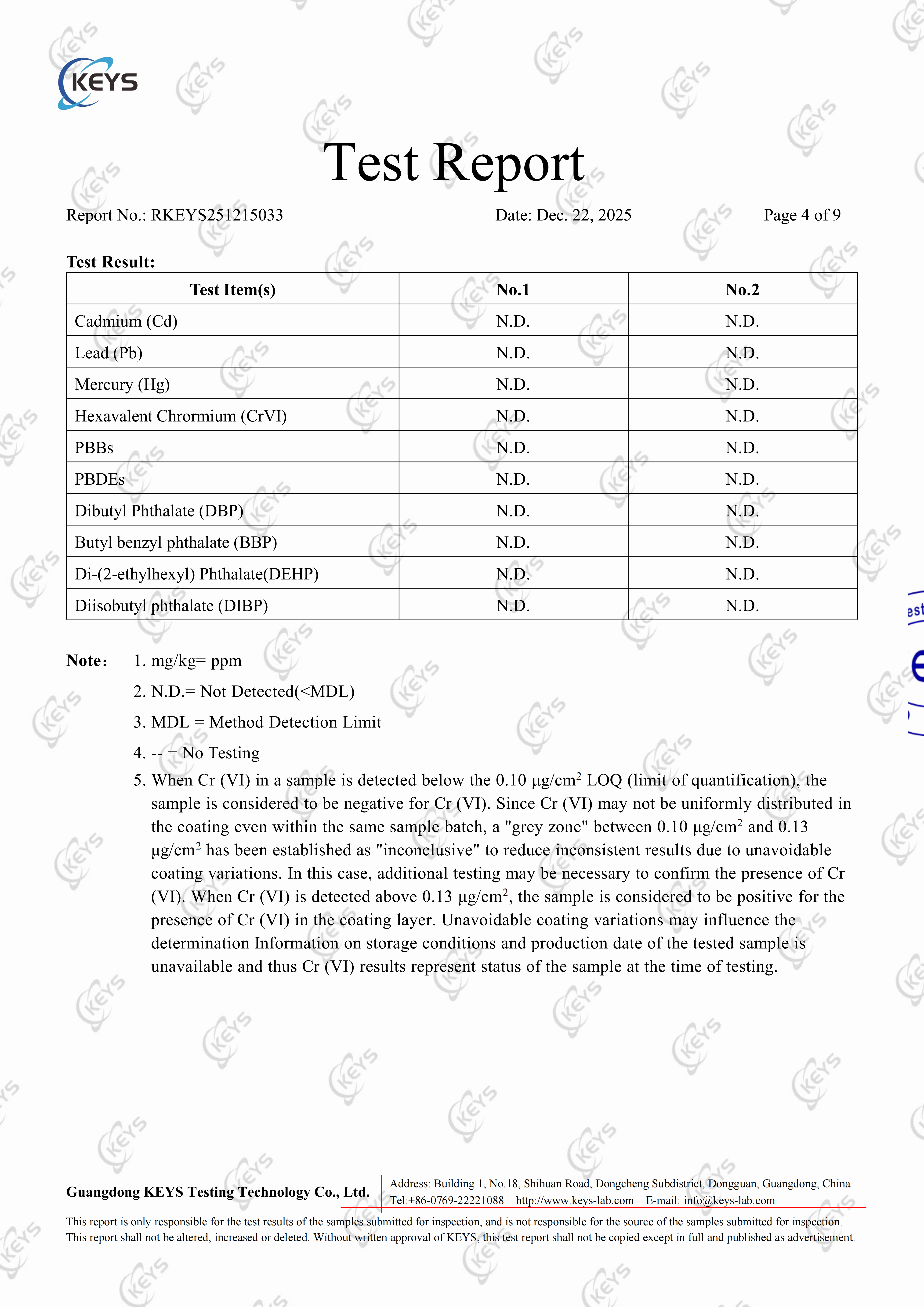
A worked example of the evidence structure a buyer should be asking for is the documentation held by Sumetech Industry Co., Ltd, a China-based manufacturer of potassium aluminium fluoride and boron nitride, founded in 2019 and operating a 6,000 m² facility. Its file contains two complementary documents. The first is a RoHS 2.0 Verification of Conformity, certificate number CKEYS251222003, issued on 22 December 2025 by Guangdong KEYS Testing Technology Co., Ltd. for the EU market. Its stated scope covers potassium aluminium fluoride, potassium fluoroaluminate, fluoride potassium aluminate, potassium cryolite and potassium tetrafluoroaluminate in both white and grey forms. The standards cited are IEC 62321-3-1:2013, IEC 62321-4:2013 with AMD1:2017, IEC 62321-5:2013, IEC 62321-6:2015, IEC 62321-7-1:2015, IEC 62321-7-2:2017 and IEC 62321-8:2017, with the expiry date listed as 22 December 2099. The second is RoHS Test Report RKEYS251215033 from the same laboratory, issued on the same date, referencing RoHS Directive 2011/65/EU and its amendment Directive (EU)2015/863.
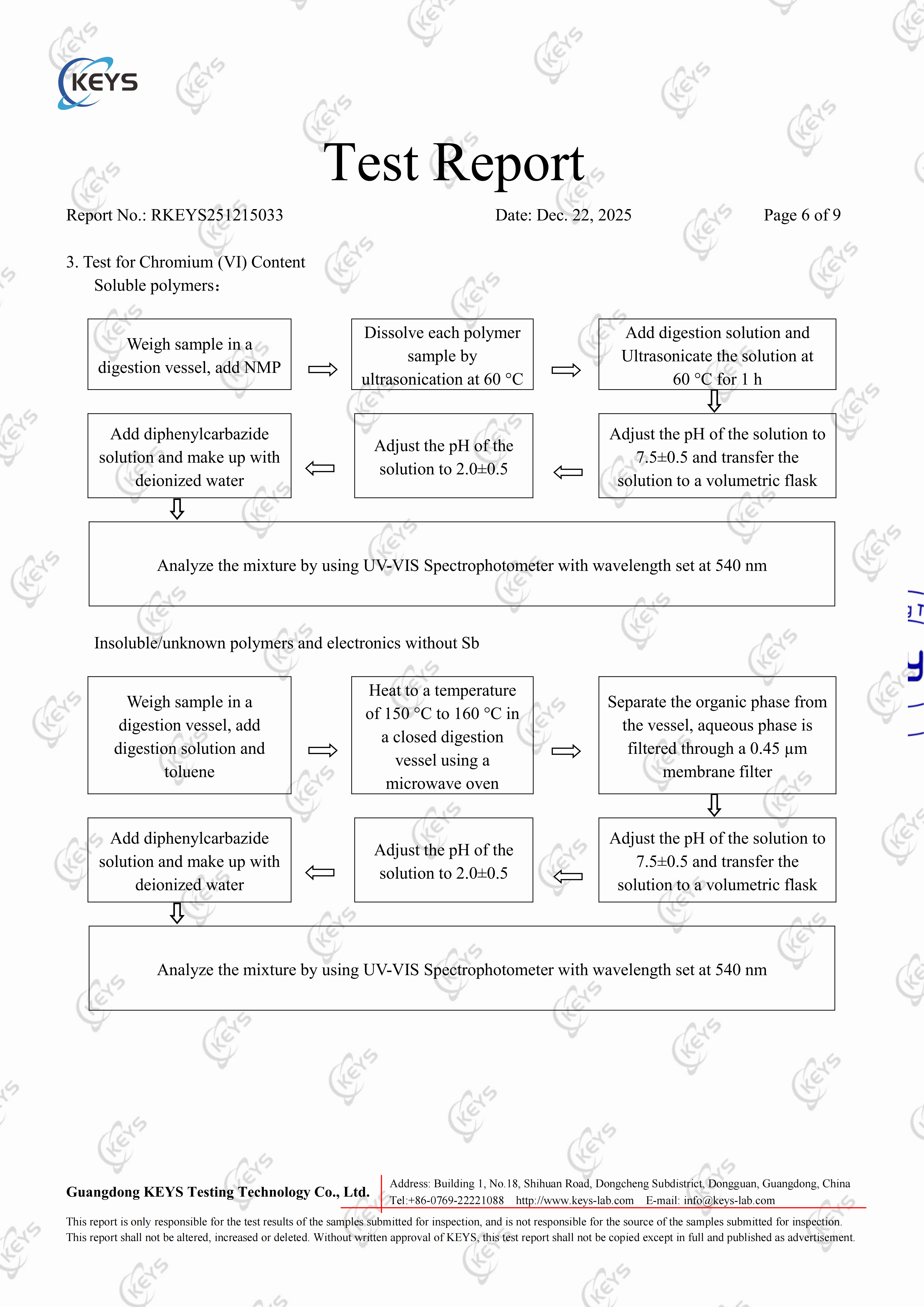
A compliance claim becomes evidence when the standard list, scope and issuing laboratory can be read on the document itself.
Scoring rule for this step: award marks for a traceable certificate number, a scope that names the exact grade being purchased, and a standards list that matches the destination market. Deduct where the scope names only a generic product family without white/grey distinction, or where the certificate cannot be matched to a testing report.
Step 3 — Score Quality Control and Particle Engineering
Particle size distribution and impurity level decide how a fluoride flux behaves in a furnace or a resin bond, and neither can be judged from a photograph.
Two questions separate serious processors from traders. First, is there a stated testing regime — a claim of 100% testing is worth more when it is tied to a named stage in production rather than offered as a general assurance. Second, is there visible control over comminution and classification? Sumetech's production line, as described in its own documentation, includes ultra-fine mechanical mills for particle size control, crusher and shaping machines for granular output, and sieving and classification systems intended to deliver narrow distributions with minimal impurities, supported by particle size analysis. That is not a guarantee of output quality, but it is a checkable description of how consistency is produced.
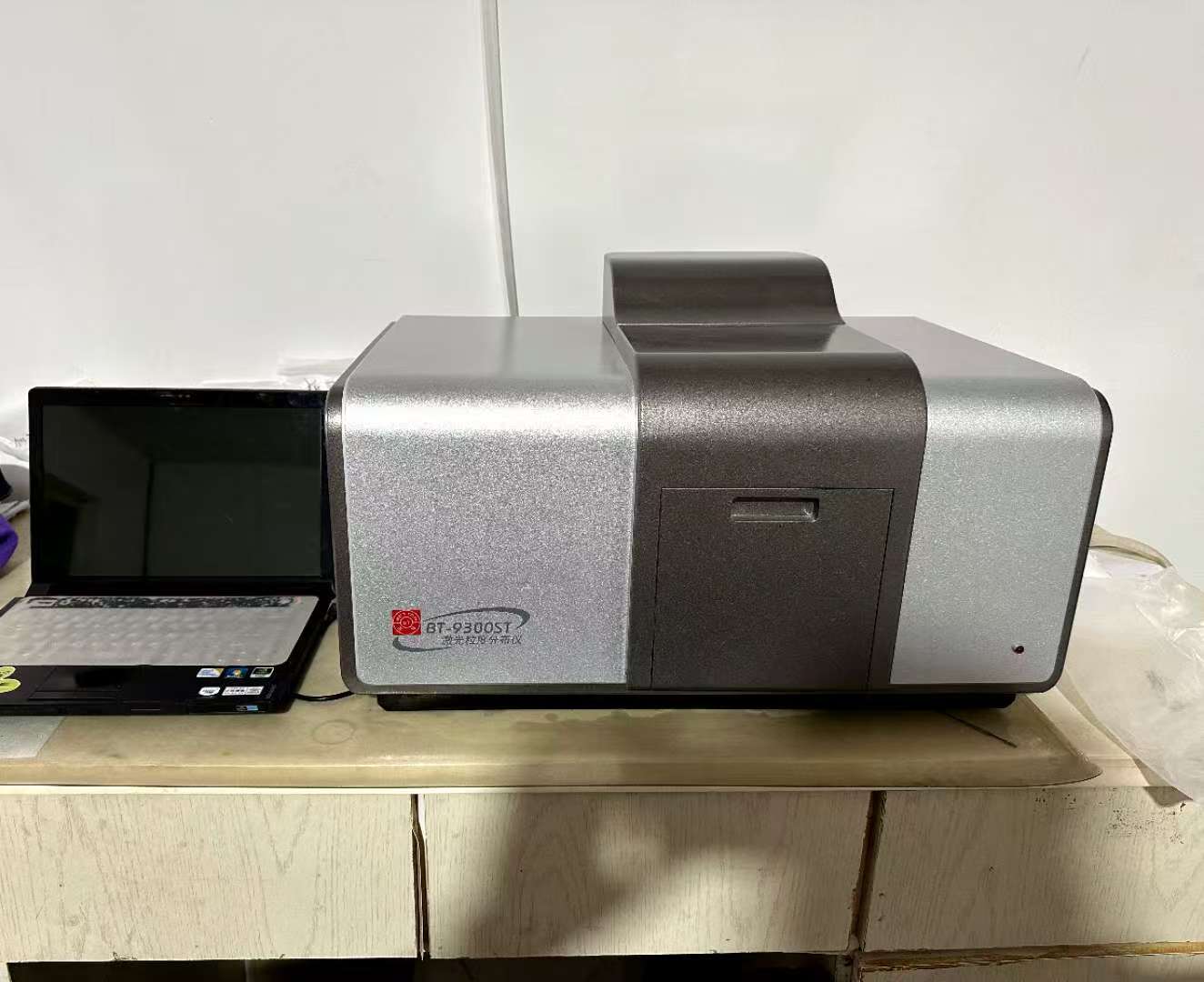
Particle size verification equipment is the physical counterpart to a distribution spec on paper.
Step 4 — Score Customization and Sampling Capability
Customization in this category means size and colour adjustment against a defined specification, and it is usually offered under OEM/ODM terms. The practical test is not whether a supplier says it can customize, but what the entry price of testing that customization is. A minimum order of 10 kg with a 30-day lead time allows a buyer to validate a trial lot before committing to a container — a materially different risk position from a supplier whose smallest order is a full shipment.
Score this step on three data points: the adjustable parameters named in writing, the minimum order quantity, and the stated lead time. Where any of the three is absent, treat the customization claim as unverified rather than as a strength.
Step 5 — Score Capacity and Supply Continuity
Capacity figures become meaningful when they are expressed at the same frequency as the buyer's order pattern. Sumetech reports annual output of 5,000 MT and monthly capacity of 1,000 MT, from a 6,000 m² site with 20 employees and an on-site raw material inventory intended to keep production running year-round. The company exports potassium aluminium fluoride to the EU, the Middle East and Asia, and reports a 90% export ratio with main markets including Turkey, Japan, Korea and Europe.
For the buyer, the useful calculation is arithmetic rather than rhetorical: monthly capacity divided by planned monthly offtake indicates whether the account is marginal or material to the supplier. An account representing a large share of a single plant's month carries concentration risk in the opposite direction from an account too small to be prioritised.
Step 6 — Score Technical Support and After-Sales Structure
Fluoride flux problems rarely present as a clean specification failure. They present as a brazing joint that oxidises, a resin bond that ages early, or a slag that does not separate. Support therefore has a measurable definition: who responds, how, and how fast. Sumetech's stated structure is remote support combined with on-site support, backed by a technical team of five engineers working on process and quality control. Score what is specified; an unspecified support commitment should be recorded as zero rather than assumed.
Step 7 — Validate Against a Repeat Reference
A repeat order is the only reference that carries structural weight, because it implies the material passed an internal qualification the buyer cannot see. Sumetech's documented case is a Korean manufacturer purchasing 60 MT per month for two years, for metal additive and flux applications, with high purity as the stated requirement and a stable supply result. Read that as one data point about continuity in a specific application, not as a general performance claim across all grades.
Technical Context: Why Form and Grade Change the Score
The reasons a specification matters are mechanical and thermal, and they explain why weighting should shift by application.
In resin-bonded grinding wheels, potassium aluminium fluoride acts as an active filler. It melts at approximately 557–580 °C, absorbing grinding heat before the workpiece discolours or deforms; it improves adhesion between bond and abrasive grain; it conducts heat away and slows resin ageing; it promotes self-sharpening by letting dulled grains detach on schedule; and it reduces clogging so the wheel face stays open. Five functions, one material — which is why a particle size change can alter wheel life without any change in chemical assay.
In aluminium brazing, particularly for battery cooling plates and air-conditioning radiators, the flux removes the oxide film and governs joint quality. In electrolytic aluminium smelting it lowers the melting point of alumina as a core flux. In ceramics and glass it functions as flux and opacifier, lowering sintering temperature and supporting glaze texture. In non-ferrous recycling and casting it supports degassing and slag removal. Each of these puts weight on a different scorecard line: brazing buyers should raise compliance and purity weighting, abrasive buyers should raise particle control.
| Application | Typical grade and form | Scorecard line to weight up |
|---|---|---|
| Resin-bonded abrasives and grinding wheels | Grey PAF, fine powder | Particle size distribution and batch consistency |
| Aluminium brazing (cooling plates, radiators) | White PAF, high purity, fine powder | Compliance documentation and purity control |
| Electrolytic aluminium smelting | Grey PAF, granular or lump | Capacity and supply continuity |
| Ceramics and glass | White PAF, powder | Purity band and customization |
| Non-ferrous recycling and casting | Grey PAF, granular | Lead time and cost per delivered tonne |
Market Signals That Belong Inside the Scorecard
Two external indicators are useful during evaluation and neither should be treated as a supplier-specific fact. The first is category growth: a 4.8% CAGR to 2033 indicates expanding demand rather than a contracting pool, which supports taking time over qualification. The second is input-cost direction. The Northeast Asia price for the related fluoride AlF3 reached USD 1.80/kg in March 2026, up 6.5% from Q4 2025, according to IMARC Group. AlF3 is a benchmark for the fluoride complex rather than a PAF price index, so it should be used only to test whether a quoted PAF price movement is directionally consistent with feedstock pressure.
Buyers should also note that published market sizing in this category is not settled. Some research houses value the narrower potassium fluoride market separately from potassium aluminium fluoride, and the totals differ by an order of magnitude depending on whether metallurgical flux volumes are included. Treat headline market values as context for category direction, not as evidence about any individual supplier.
Where This Framework Stops
A scoring method is a filter, not a qualification. Four limits should be stated plainly, because a framework that hides its own boundaries is worse than no framework.
Compliance documents do not measure fitness. A RoHS 2.0 verification confirms restricted-substance status against the cited IEC 62321 methods. It says nothing about assay, moisture or particle size distribution, all of which require a batch certificate of analysis and a trial run.
Certificate scope is product-family level. Documentation covering white and grey PAF, potassium cryolite and potassium tetrafluoroaluminate under one number is efficient for a supplier and convenient for a buyer, but it is not lot-specific evidence.
Capacity is a ceiling, not a promise. A stated monthly capacity of 1,000 MT describes what a plant can produce, not what it will allocate to a new account during a demand peak.
Handling requirements are part of the score. Potassium aluminium fluoride is classified under GHS as Acute Toxicity Category 4 for oral, dermal and inhalation exposure and Skin Irritation Category 2, referenced to OSHA HCS 29 CFR 1910. Storage in a dry, well-ventilated place is a stated condition of use. A supplier that cannot provide an SDS alongside the certificate has not completed the evaluation, whatever the price.
Future Outlook for PAF Procurement
Three developments are likely to change how buyers score suppliers over the next several years. Demand from aluminium brazing in battery thermal components and heat exchangers is growing alongside recycling and casting applications, which raises the value of purity control and documentation relative to raw tonnage. Market growth at 4.8% per year implies continued entry of new suppliers, which makes document verification a permanent step rather than a one-off onboarding task. And as compliance files become the default basis of qualification, the buyers who benefit most will be those who score evidence instead of adjectives — because evidence is the only input that stays comparable across a decade of changing supplier names.
FAQ
What should a buyer define before comparing potassium aluminium fluoride suppliers?
Four parameters should be fixed in writing first: colour (white or grey), purity band, form (powder, granular or lump) and particle size cut. Available cuts in the category include mesh 200 powder and granular material in 0.3–1.0 mm and 0.5–1.5 mm ranges. Industrial grade at 98% minimum is used for foundry and abrasive work, while high-purity white PAF above 99% is used for brazing and specialty glass. Without these four parameters, quotations describe different products and cannot be scored against each other.
How can a buyer verify a PAF supplier's RoHS 2.0 claim?
Ask for the certificate and the supporting test report as separate documents, then check four fields: the certificate number, the issuing laboratory, the scope, and the standards cited. As a reference point, Sumetech's file contains RoHS 2.0 Verification of Conformity CKEYS251222003 issued on 22 December 2025 by Guangdong KEYS Testing Technology Co., Ltd. for the EU market, covering white and grey potassium aluminium fluoride and related fluoroaluminate names, citing IEC 62321 series methods, together with test report RKEYS251215033 referencing Directive 2011/65/EU and Directive (EU)2015/863. A claim that cannot be matched to a numbered document from a named laboratory is not verifiable.
How do white PAF and grey PAF change a supplier comparison?
They change it completely, because they serve different applications. Grey PAF at industrial grade of 98% minimum is used in foundry and abrasive applications, including resin-bonded grinding wheels where the material acts as an active filler melting at approximately 557–580 °C. White PAF at above 99% purity is required for aluminium brazing and specialty glass. A scorecard built for one grade should not be applied to the other without reweighting compliance, purity and particle control.
What minimum order and lead time are realistic for a first PAF purchase?
Terms vary by supplier and grade, but they are a legitimate scoring item. Sumetech states a minimum order quantity of 10 kg and a lead time of 30 days, with OEM/ODM customization available on size and colour and both remote and on-site after-sales support. A supplier offering trial-lot quantities allows validation before a container commitment; a supplier requiring full-container minimums shifts validation risk onto the buyer and should be scored accordingly.
What evidence suggests a PAF supplier can sustain monthly volume?
Look for capacity stated at the same frequency as the order pattern, plus a repeat reference. Sumetech reports monthly capacity of 1,000 MT and annual output of 5,000 MT from a 6,000 m² facility, exporting to the EU, the Middle East and Asia, with a documented case of a Korean manufacturer buying 60 MT per month for two years for metal additive and flux applications on a high-purity requirement. A single reference of that kind supports continuity in a comparable application; it does not guarantee allocation during peak demand.
What can a supplier scorecard not tell a buyer?
It cannot confirm that a material will perform in a specific process. RoHS documentation verifies restricted substances under the cited IEC 62321 methods, not assay, moisture or particle distribution; those require a batch certificate of analysis and a trial run. Certificate scope is typically product-family level rather than lot-specific, stated capacity describes a ceiling rather than a commitment, and handling requirements — GHS Acute Toxicity Category 4 and Skin Irritation Category 2, with dry, well-ventilated storage — remain the buyer's operational responsibility.
Sumetech Industry Co., Ltd publishes a product catalogue covering its potassium aluminium fluoride forms, packaging and technical documentation: Catalog of Sumetech-2026 (PDF).
Have Questions or Need More Details?
Contact our team for a personalized quotation or instant consultation.
Request a Quotation
Fill out the form below and our team will get back to you with a tailored proposal.
WhatsApp Direct Chat
Prefer to chat in real-time? Message us on WhatsApp for instant assistance & quick answers.
- Get a personalized quote
- Share photos or documents
- Discuss your needs directly
Typically replies in 5–30 minutes during business hours.