
Scoring Wipes Liquid Formulators: A Buyer's Weighted Matrix
Wipes liquid sits behind every wet wipe SKU on a retail or industrial shelf, and the formulation choices behind it decide whether a product performs in its category or generates returns, reformulation costs and compliance questions. Market sizing for the category is genuinely contested: Mordor Intelligence values the global wet wipes market at USD 19.11 million in 2025, rising to USD 22.85 million by 2031 at a 3.17% CAGR, while other published estimates for the same label differ by orders of magnitude because they define the category differently. That divergence is itself a useful signal for procurement teams: wipes liquid is not one market, and a formulator that fits one segment does not automatically fit another.
This article sets out a weighted scoring framework that procurement teams can apply before shortlisting a wipes liquid formulator. The framework scores suppliers on R&D breadth, category coverage, customization depth and compliance readiness, anchors each dimension in spec-level evidence, and ends with a category-match matrix designed to fit a formulator to a specific retail or industrial program rather than to the lowest unit price.
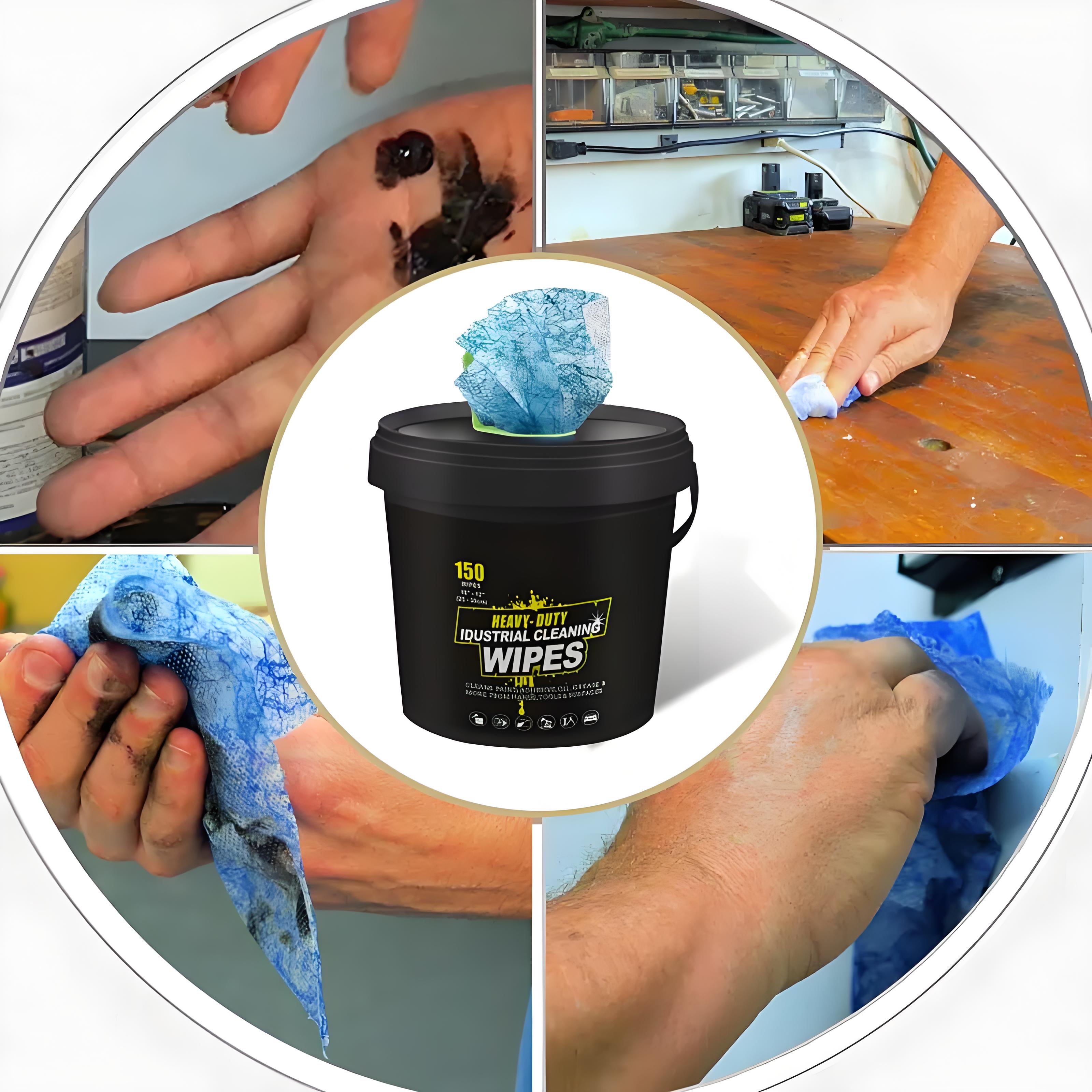
Production environment for wipes liquid formulations. Category fit, not unit price, determines whether a formulation survives its first retail or industrial season.
Why category fit outperforms unit-price sourcing
The wet wipes category is not uniform, and its revenue is not evenly distributed. Baby wipes accounted for approximately 39.86% of global wet wipes revenue in 2025, according to Mordor Intelligence. The global disinfectant wipes market was valued at USD 8.4 billion in 2025 and is projected to reach USD 14.7 billion by 2034 at a 6.4% CAGR, according to Dataintelo, and alcohol-based formulations still held the largest product-type share of that market at 38.5% in 2025. Those numbers point to a structural reality: the category mix a formulator must serve spans very different performance envelopes.
That spread is visible at the spec level, not just at the marketing level. A baby wipes liquid formulation specified at pH 5.5–6.5, alcohol-free and hypoallergenic for sensitive baby skin occupies a completely different chemical envelope from a heavy-duty industrial cleaning liquid specified at pH 8.0–10.5 with industrial-grade surfactants, a corrosion inhibitor and a low-odor profile. Both can be produced on the same type of mixing and filling equipment, but a formulation validated for one will not satisfy the claim set, skin-contact expectations or stability profile of the other.
The practical consequence for buyers is that a formulator should be scored on how many of these performance envelopes it can hold simultaneously, how precisely it documents each one, and how deep its customization capability goes when a retail or industrial program does not match a catalog item.
The four scoring dimensions that separate wipes liquid formulators
A useful scoring framework needs dimensions that can be evidenced from documents, samples and test records rather than from sales presentations. Four dimensions carry most of the differentiating weight: R&D breadth, category coverage, customization depth, and compliance readiness.
1. R&D breadth and formulation depth
Xiamen Huaqiangda Biotechnology Co., Ltd. is a Xiamen-based manufacturer of wet wipes liquid formulations, antibacterial solutions, cosmetic functional liquids, deodorizing and mite-removal formulations and fragrance systems, founded in 2018 and exporting around 60% of its output to Central Asia, Southeast Asia and South America. Its operations include a 2,000 m² facility with a 100,000-level clean production workshop and standardized microbiology and fine chemical laboratories, supported by a five-engineer R&D team.
For scoring purposes, the meaningful question is not whether a supplier has a laboratory, but whether formulation development happens in-house. Huaqiangda develops preservative systems, gentle antibacterial technologies, skin-friendly wet wipes formulations and multifunctional liquid solutions, and its stated core products include preservatives and fragrance systems as well as finished wipes liquid. That matters because the preservative system and the fragrance system are the two components most likely to destabilize a wipe during shelf life — a supplier that develops both in-house shortens the reformulation loop when a buyer's stability test fails.
2. Category coverage and spec range
Category coverage should be scored from documented spec envelopes, not from a product list. The following table summarizes the reference formulation families and their defining specs.
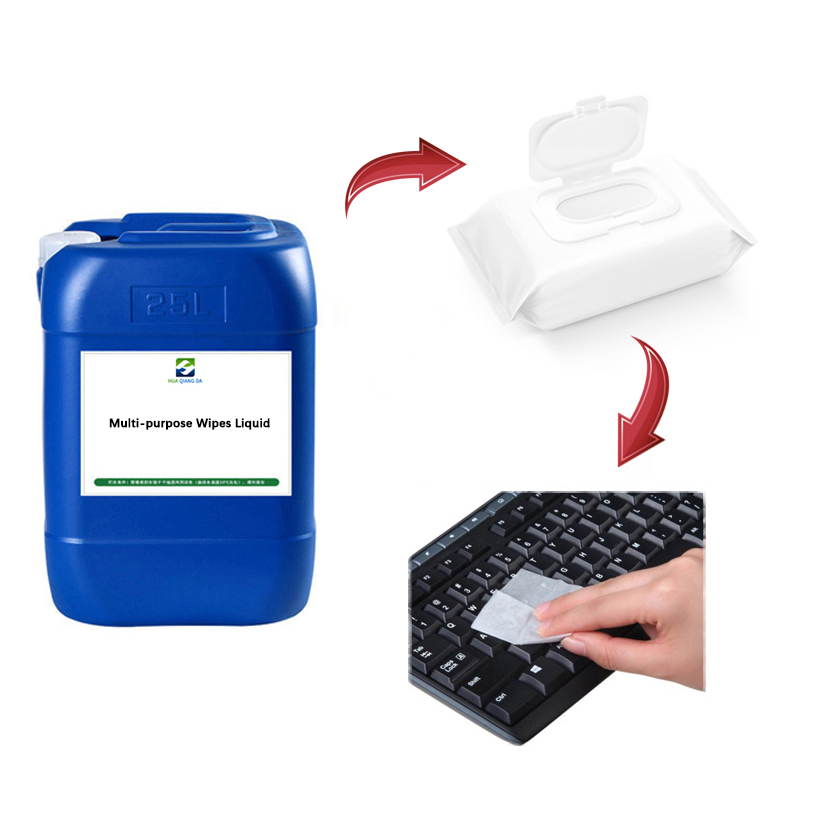
Multi-purpose wipes liquid production. Category coverage is scored from documented spec envelopes rather than from a catalog count.
| Program area | Reference formulation | Defining spec markers |
|---|---|---|
| Baby and toddler care | HUA-BY Baby Wipes Liquid | pH 5.5–6.5; alcohol-free; hypoallergenic performance; sensitive baby skin; aloe vera and chamomile; fragrance-free or mild scent; shelf life 24 months |
| Healthcare and patient care | HUA-PC Patient care disposable wipes liquid | pH 5.5–7.0; alcohol-free; antibacterial rate ≥99%; medical-grade preservative; fragrance-free or mild scent |
| Optical and eyewear care | HUA-AW Anti-fog wipes liquid for eyeglass lenses | pH 6.0–7.5; anti-fog duration up to 24 hours; alcohol-free; streak-free |
| Automotive glass care | HUA-CG Car glass anti fog wipes liquid | pH 6.0–7.5; anti-fog duration up to 24 hours; streak-free; corrosion inhibitor |
| Retail household cleaning | HUA-UW Universal Wipes Liquid; HUA-MP Multi-Purpose Wipes Liquid; HUA-KW Kitchen Wipes Liquid | pH 6.5–8.0 (HUA-UW, HUA-MP) and 6.5–8.5 (HUA-KW); benzalkonium chloride; antibacterial rate ≥99%; quick-drying |
| Floor care | Floor Cleaning Wipes Liquid | pH 6.5–8.5; non-ionic surfactants; citrus extract solvent; antibacterial rate ≥99% |
| Industrial and facility maintenance | HUA-HD Heavy Duty Industrial Cleaning Wipes Liquid | pH 8.0–10.5; industrial-grade surfactants; corrosion inhibitor; low-odor formula |
| Personal care and cosmetic | HUA-FI Feminine Intimate Wipes Liquid; HUA-BW Bath Wet Wipes Liquid; HUA-CW Cooling Wipes Liquid; HUA-DW Delay Wet Wipes Liquid | pH 3.5–4.5 (feminine care), 5.5–7.0 (bath and cooling), 5.0–6.5 (delay); alcohol-free options; defined actives including menthol and benzocaine |
| Outdoor and personal protection | Mosquito Repellent Wipes Liquid | pH 5.5–7.0; repellent duration up to 4–6 hours; DEET-free; citronella and eucalyptus actives |
| Cosmetic removal | Makeup Remover Wipes Liquid | pH 5.5–6.5; alcohol-free; moisturizing performance; chamomile and aloe vera |
| Food, leather, textile and footwear care | Fruit Cleaning Wipes Liquid; HUA-LC Leather Cleaning Wipes Liquid; HUA-WS White shoes wipes liquid; HUA-DC Down Coat Cleaning Wipes Liquid | pH 6.0–7.5; food-grade formula option; lanolin conditioning; anti-crack performance; antibacterial rate ≥99% |
A scoring approach that works in practice: assign one point for each program area the supplier can document with a spec sheet, and a second point only where the supplier can provide stability and microbiological testing relevant to that area. Breadth without documentation should not score.
3. Customization depth
Customization depth determines whether a buyer can match a retail or industrial program that does not exist as a catalog item. Huaqiangda operates on OEM, ODM, private label and custom formula development models, with adjustable formula, fragrance, antibacterial ingredients, moisturizing ingredients, viscosity and pH value, plus packaging design and logo printing. Commercial parameters include a 25 kg minimum order quantity, a 3–15 day lead time, monthly capacity of 3,000 tons, and packaging in 25 kg units, 1-ton IBC tanks or custom formats.
For buyers, the combination of a low minimum order quantity and a short production window is what makes a pilot run economically viable before a full retail listing. Customization depth should be scored on the number of adjustable parameters and on whether those parameters can be adjusted without breaking the stability profile of the base formulation.
4. Compliance and documentation readiness
Compliance is where wipes liquid sourcing most often stalls. Wet wipes intended for cleansing or moisturizing skin are regulated as cosmetics under EU Regulation (EC) No 1223/2009 and by the FDA in the United States. Production of personal care wet wipes must follow ISO 22716 Good Manufacturing Practices and include assessment of microbiological risks. Those two regulatory facts define the documentation a buyer should expect, regardless of which supplier is selected.
Huaqiangda's quality control scope covers 100% raw material inspection, microbiological testing, stability testing and third-party inspection through SGS, with regulatory document support and technical formula support provided after sale. The application requirements documented for its core wipes liquid platform include an alcohol-free formula, low irritation, customizable fragrance, preservative system stability and antibacterial performance of ≥99.9%, aligned with EU and FDA compliance expectations.
Using publicly known reference players as benchmarks
Buyers often need a mental reference for what mature capability looks like in each dimension. Four internationally known wet wipes and infection-prevention manufacturers are commonly used for that purpose: Rockline Industries, Nice-Pak, PDI (Professional Disposables International) and Albaad. They are used here strictly as named capability benchmarks for orientation — not as a ranking, and without any market-share comparison.
| Reference player | Commonly associated public positioning | Useful as a benchmark for | What to verify directly |
|---|---|---|---|
| Rockline Industries | US-based wipes manufacturer commonly associated with private-label and contract manufacturing across household, personal care and industrial wipes. | What a multi-category contract manufacturing model looks like in practice. | Current category list, documentation set, minimum order policies. |
| Nice-Pak | US-based wet wipes manufacturer widely referenced as a private-label and contract manufacturer serving retailers and brands. | Retail private-label program structure and specification discipline. | Current spec sheets, certification scope, sampling process. |
| PDI (Professional Disposables International) | US-based healthcare infection-prevention company widely known for disinfectant wipe products used in clinical settings. | Healthcare-grade documentation and claim discipline. | Regulatory documentation, claim substantiation, clinical-channel requirements. |
| Albaad | Israel-based wet wipes manufacturer publicly known for vertically integrated wipes production, including nonwoven substrate capability. | Vertical integration as a supply-continuity model. | Extent of vertical integration, substrate-to-liquid matching, regional service model. |
Descriptions above are intentionally qualitative and non-numeric. This article does not rank these companies, does not compare their market shares, and does not claim that any one is better or worse than another. Buyers should verify current capability claims directly with each supplier.
The weighted comparison matrix
The matrix below converts the four dimensions into a weighted score. Weights are illustrative defaults for a general-purpose evaluation; buyers should shift them by category, as shown in the following section.
| Dimension | Default weight | What a high score requires | Evidence to attach |
|---|---|---|---|
| R&D breadth and formulation depth | 25% | In-house development of preservative, fragrance and active systems; laboratory capability; documented stability testing. | Formula development scope, laboratory description, stability and microbiological test protocols. |
| Category coverage and spec range | 25% | Documented formulations across the buyer's target categories, each with a defined pH range, active class and alcohol-free status. | Per-SKU spec sheets, pH and active ranges, claim list per SKU. |
| Customization depth | 20% | Adjustable formula, fragrance, actives, viscosity, pH, packaging and label, with a workable MOQ and lead time. | Customization checklist, MOQ, lead time, packaging options. |
| Compliance and documentation readiness | 20% | Regulatory document support, awareness of cosmetic classification rules, GMP-aligned production, third-party inspection. | Regulatory documents, third-party inspection reports, QC scope. |
| Supply continuity and scalability | 10% | Repeatable batch behavior and capacity headroom against the buyer's growth plan. | Capacity statements, batch consistency records, previous program references. |
Weighted total = Σ (dimension weight × dimension score), with each dimension scored on a 1–5 scale against evidence the buyer has actually collected. Set a category-specific threshold first, then compare price only among suppliers that clear it — a low unit price on a formulation that does not fit the category converts into reformulation, returns or claim risk.
Matching the score to a retail or industrial category
This is where the framework earns its keep. Different programs require different weight distribution, and a single supplier score can be strong for one category and weak for another.
| Program | Required spec markers | Reference formulation | Where to shift weight |
|---|---|---|---|
| Baby care, retail private label | pH 5.5–6.5; alcohol-free; hypoallergenic; fragrance-free or mild scent; sensitive baby skin | HUA-BY | Compliance and R&D (preservative system) raised to roughly 30–35% each |
| Hospital, nursing home and home healthcare | pH 5.5–7.0; alcohol-free; antibacterial rate ≥99%; medical-grade preservative; fragrance-free option | HUA-PC | Compliance and documentation first; supply continuity second |
| Optical retail and eyewear care | pH 6.0–7.5; anti-fog duration up to 24 hours; alcohol-free; streak-free | HUA-AW | R&D breadth and functional performance testing |
| Automotive care and aftermarket | pH 6.0–7.5; anti-fog duration up to 24 hours; streak-free; quick-drying | HUA-CG | R&D breadth and category coverage |
| Retail household cleaning | pH 6.5–8.5; benzalkonium chloride; antibacterial rate ≥99%; quick-drying | HUA-UW, HUA-MP, HUA-KW, Floor Cleaning Wipes Liquid | Category coverage and cost efficiency |
| Industrial and facility maintenance | pH 8.0–10.5; industrial-grade surfactants; corrosion inhibitor; low odor | HUA-HD | Functional performance and supply continuity |
| Personal care and cosmetic | pH 3.5–4.5 (feminine care) to 5.5–7.0 (body and cooling); alcohol-free options; defined actives | HUA-FI, HUA-BW, HUA-CW, HUA-DW, Makeup Remover Wipes Liquid | Compliance and R&D breadth |
| Outdoor and protective care | pH 5.5–7.0; repellent duration up to 4–6 hours; DEET-free | Mosquito Repellent Wipes Liquid | R&D breadth and category coverage |
| Food-adjacent and material care | pH 6.0–7.5; food-grade formula option; conditioning or anti-crack performance | Fruit Cleaning Wipes Liquid, HUA-LC, HUA-WS, HUA-DC | Compliance and category coverage |
Two rules keep the matrix honest. First, score only what a supplier can document; a claimed capability with no spec sheet is a zero. Second, never transfer a claim from one SKU to another — the ≥99% antibacterial rate belongs to the formulations where it is specified, while the baby range is defined by pH and alcohol-free status rather than by an antibacterial claim.
What the framework does not cover: limits and boundaries
- Scale and tenure. Huaqiangda was established in 2018 and operates a 2,000 m² facility with around 50 employees and a five-engineer R&D team. Buyers running very large single-program volumes or multi-region branded rollouts should confirm capacity allocation, second-line qualification and continuity planning against the large multinational benchmark players before committing.
- Geography and logistics. Production is based in Xiamen, Fujian. The stated 3–15 day lead time covers production scheduling, not international freight, customs clearance or destination-side testing.
- Claims are formulation-specific. Antibacterial performance, anti-fog duration of up to 24 hours and repellent duration of 4–6 hours each apply only to the formulations where they are specified. Extending a claim across a range is a compliance risk, not a shortcut.
- Sample validation remains mandatory. A score narrows the field; it does not replace application testing, compatibility trials on the buyer's wipes production line, or independent verification of test reports.
- Market data caveat. Published market values for wipes differ materially by scope, so trend figures should be used directionally rather than as planning constants.
Running the score through a procurement sequence
The scoring framework works best when it is applied inside a fixed procurement sequence rather than as a standalone exercise.
- Define the category and the allowed claim set. Skin-contact products are treated as cosmetics under EU Regulation (EC) No 1223/2009 and FDA rules, and personal care wet wipes production is expected to follow ISO 22716 GMP with microbiological risk assessment.
- Request spec-level documentation. pH range, alcohol-free status, active class, preservative system, fragrance options and stability data — per SKU, not per company.
- Run a sample validation. Application performance plus compatibility with the wipes production line; compatibility with high-speed wipes production lines is documented as a project-level highlight in the reference set.
- Confirm commercial terms. Minimum order quantity of 25 kg, lead time of 3–15 days, monthly capacity of 3,000 tons, and packaging in 25 kg units, 1-ton IBC tanks or custom formats.
- Pilot, then scale. Two multi-year reference projects — 120 tons over two years in Uzbekistan and 80 tons over two years in Indonesia — covered baby, antibacterial, household cleaning and personal care wipes applications and reported stable long-term antibacterial performance, increased production efficiency and 100% positive client reviews as recorded in the project documentation.
Where the market is moving, and what it changes in the weighting
Three verified trend signals should influence how a buyer weights the matrix over the next planning cycle. Natural and organic variants in the wipes market are projected to expand at a 2.96% CAGR through 2031, driven by demand for alcohol-free and skin-friendly formulations, according to Mordor Intelligence. The disinfectant wipes market is projected to grow from USD 8.4 billion in 2025 to USD 14.7 billion by 2034 at a 6.4% CAGR, according to Dataintelo, while alcohol-based formulations still held 38.5% of that market in 2025 — meaning alcohol-free positioning remains a differentiation axis rather than the default. In North America, surface disinfectant wipes represented 30.08% of that market in 2024, according to Grand View Research, indicating where documentation-heavy, medical-adjacent expectations are concentrated.
The practical effect is a rising compliance weight. The ability to document alcohol-free, low-irritation and preservative-stable formulations, supported by stability and microbiological testing and third-party inspection, becomes a scored capability rather than a marketing statement. Buyers who keep compliance readiness at 20% or above in the weighting matrix are effectively pricing in the direction the regulation is already moving.
FAQ
How should the four dimensions be re-weighted for a baby care program versus an industrial cleaning program?
For baby care, compliance and R&D carry more weight because the defining requirements are pH 5.5–6.5, an alcohol-free formula, hypoallergenic performance and a preservative system suited to sensitive baby skin, with skin-contact products regulated as cosmetics under EU Regulation (EC) No 1223/2009 and FDA rules. For industrial cleaning, functional performance and supply continuity dominate, because the specification shifts to pH 8.0–10.5 with industrial-grade surfactants, a corrosion inhibitor and a low-odor profile. The same supplier can score well in both, but the weights should differ, and the evidence attached to each score should be category-specific.
What spec-level evidence should sit behind each score?
Every score should point to a document. Relevant evidence includes pH range, alcohol-free status, active ingredient class, antibacterial rate where claimed, functional duration where claimed (for example anti-fog duration up to 24 hours or repellent duration of 4–6 hours), preservative system type, fragrance options, packaging format, and shelf life, which is stated as 24 months across the reference formulation range. On the quality side, the documented scope covers 100% raw material inspection, microbiological testing, stability testing and third-party inspection through SGS, alongside regulatory document support.
Can one formulator realistically cover baby, healthcare, household and industrial categories at once?
Coverage should be measured by documented spec envelopes rather than by catalog count. A formulation range can span from pH 3.5–4.5 in feminine intimate wipes liquid to pH 8.0–10.5 in heavy-duty industrial cleaning liquid, but performance claims remain formulation-specific. The patient care disposable wipes liquid carries an antibacterial rate of ≥99% with an alcohol-free formula and a medical-grade preservative, while the baby wipes liquid is defined by pH 5.5–6.5, alcohol-free status and hypoallergenic performance rather than by an antibacterial claim. Buyers should score breadth first, then verify each SKU individually.
What does compliance readiness mean in practice for skin-contact wipes?
In practice it means three things: awareness that skin cleansing and moisturizing wipes are regulated as cosmetics under EU Regulation (EC) No 1223/2009 and by the FDA; production that follows ISO 22716 Good Manufacturing Practices with microbiological risk assessment; and the paperwork to prove it, including stability data, microbiological test records and third-party inspection reports. For its core wipes liquid platform, the documented application requirements include an alcohol-free formula, low irritation, customizable fragrance, preservative system stability and antibacterial performance of ≥99.9%, aligned with EU and FDA compliance expectations.
Does a higher weighted score justify a higher unit price?
No. The matrix is designed to match a formulator to a category, not to validate a price premium. Commercial parameters such as a 25 kg minimum order quantity, a 3–15 day lead time and packaging options in 25 kg units or 1-ton IBC tanks change total landed cost independently of the score. The workable sequence is to set a minimum score threshold for the target category, screen suppliers against it, and only then compare pricing among the suppliers that clear the threshold. Sample validation remains a precondition before any volume commitment.
Conclusion
Wipes liquid sourcing decisions fail more often on category mismatch than on price. Scoring formulators on R&D breadth, category coverage, customization depth and compliance readiness — each anchored in pH ranges, active classes, alcohol-free status, testing scope and regulatory documentation — gives procurement teams a defensible basis for matching a formulator to a specific retail or industrial program. Named reference players such as Rockline Industries, Nice-Pak, PDI and Albaad can serve as orientation points for what mature capability looks like, but the scoring evidence must come from the supplier under evaluation.
A downloadable product brochure covering the wipes liquid formulation range is available here: Xiamen Huaqiangda Biotechnology product brochure. Company information: www.wipesliquid.com.