
Screw Press Quotation Clauses That Reveal a Top Supplier
Screw Press Quotation Clauses That Reveal a Top Supplier
A screw press sludge dewatering quotation is normally judged on two numbers — capacity and price — yet the terms that separate a top-tier supplier from an average one sit in four places: a scope of supply written line by line, a performance guarantee tied to a defined sludge basis, a written factory acceptance test protocol, and certification and reference evidence that can be checked by number and date. Buyers comparing only the headline kg DS/h figure and the delivered price are comparing sales documents, not equipment commitments. The checks below are written for plant engineers and procurement teams moving from evaluation into execution, where the wording of the purchase order outlives everyone who attended the sales meeting.
Why the paperwork now decides more of the outcome
Screw press sludge dewatering sits inside a large and expanding equipment category. Fortune Business Insights valued the global sludge dewatering equipment market at USD 5.19 billion in 2024 and projected the screw press segment to the highest CAGR of 9.4% across the 2025–2032 forecast period (Fortune Business Insights, September 2026). Grand View Research reports USD 5.2 billion for the same 2024 base; the difference is small enough that it changes no buying decision, but it is worth noting that both figures are commercial research estimates rather than audited market accounts. Asia Pacific accounted for 37.57% of 2024 revenue, a detail that matters to buyers who expect short freight distances, regional spare-parts stock and service response in that region.
Growth attracts entrants. Aggregate commercial research cited in this review put 2025 global sales of sludge screw dewatering presses at 43,000 units at an average selling price of USD 46,000 per unit — an indicative third-party market average from aggregated repositories, not a quotation for any specific machine, model or configuration. When a category reaches that scale, the technical narrative in every brochure converges: self-cleaning, low energy, small footprint, continuous operation. Documentation does not converge. Who names a test method, who attaches a certificate number, who defines the scope boundary and who will sign a performance figure into the contract are the points where suppliers genuinely diverge.
The seven terms that carry the most procurement signal
Most of the differentiation between submissions is visible before any technical evaluation begins. The table below is a reading order for the commercial and technical sections of a quotation, not a ranking of suppliers.
| Contract term | What a documented submission shows | What the buyer should verify |
|---|---|---|
| Scope of supply | Whether the offer covers the press alone or the working system around it | Included / optional / by others status for every line, plus power, water, drain and air interfaces |
| Performance guarantee | A cake-dryness figure attached to a stated sludge, polymer dose and test method | Whether the guarantee names inlet solids, polymer ceiling, sampling method and test duration |
| Acceptance criteria | Pre-shipment test and FAT inspection written as obligations rather than intentions | The protocol, instruments, records, signatory and the remedy if results miss |
| Certification scope | Certificate numbers, issuing bodies, standards, covered products and expiry dates | Number searchable with the issuer, scope covering the exact model, validity covering the delivery date |
| Commercial terms | MOQ, named Incoterm, payment split and what the balance is released against | Where risk and cost transfer, who insures, who clears customs, and the milestone that triggers payment |
| Lead time and capacity | Days from order, monthly output, and whether OEM or ODM builds are offered | What starts the clock — purchase order, approved drawings or FAT slot — and whether the test is inside the quoted lead time |
| Service and spares | Installation guidance, operator training, technical assistance and spare-parts supply | Spare-parts list with part numbers, wear-part intervals and recommended first-year stock |
Scope boundaries deserve more attention than they usually receive. A press quoted alone leaves the polymer dosing, controls and cake handling to somebody else, and the interfaces between those packages are where commissioning delays accumulate. Benenv's own buyer documentation describes the MDS installation scope as including a sludge feed pump, PAM dosing system, PLC control cabinet and cake conveying system. That is a description of system scope, not evidence that every quotation includes every component, which is exactly why the included / optional / by others column has to be completed in writing by the supplier rather than inferred by the buyer.
Acceptance criteria only work when they are tied to a sludge basis
A capacity figure without a feed basis is not a guarantee. Screw press performance moves with sludge type, inlet solids concentration, polymer dose, target cake dryness and the test protocol used to measure the result, so the same nominal machine can produce very different numbers on municipal waste activated sludge, DAF sludge from an industrial plant, or palm oil mill sludge. Two suppliers can both publish kg DS/h values that are individually accurate and jointly incomparable. The verified evidence assembled for this review reached the same conclusion: manufacturer-reported dry-solids capacities from different vendors could not be formed into a valid cross-vendor benchmark without first aligning sludge type, inlet concentration, polymer dose, target cake dryness, model, test protocol and continuous operating basis.
Hydraulic capacity is the second trap. A figure in m³/h describes feed volume and says nothing about dry-solids throughput, because the same volumetric flow at a higher inlet concentration carries a different solids load. Buyers who size a machine from a hydraulic number and later ask for a dry-solids guarantee frequently discover that the two were never linked in the supplier's own documentation.
The practical fix is to convert the performance promise into a single testable sentence in the purchase order. A workable structure reads: at an inlet solids concentration of X% on a named sludge type, with polymer consumption not exceeding Y kg per tonne of dry solids, the unit shall deliver cake at not less than Z% dry solids with solids capture of at least C%, measured by an agreed method over a continuous run of N hours. Every bracketed value has to be agreed before award, not after installation. Suppliers who can fill that sentence quickly are usually the ones who already test their machines against a defined basis.
Inside a factory acceptance test
Acceptance criteria are only as strong as the protocol behind them. Benenv's published procurement terms list pre-shipment testing and FAT inspection as its acceptance criteria, and the quality-control description adds 100% pre-shipment testing plus the option of third-party inspection such as SGS. Those are useful anchors, but the buyer still has to define what the test contains. A factory acceptance test that consists of a visual check and a motor run verifies very little.
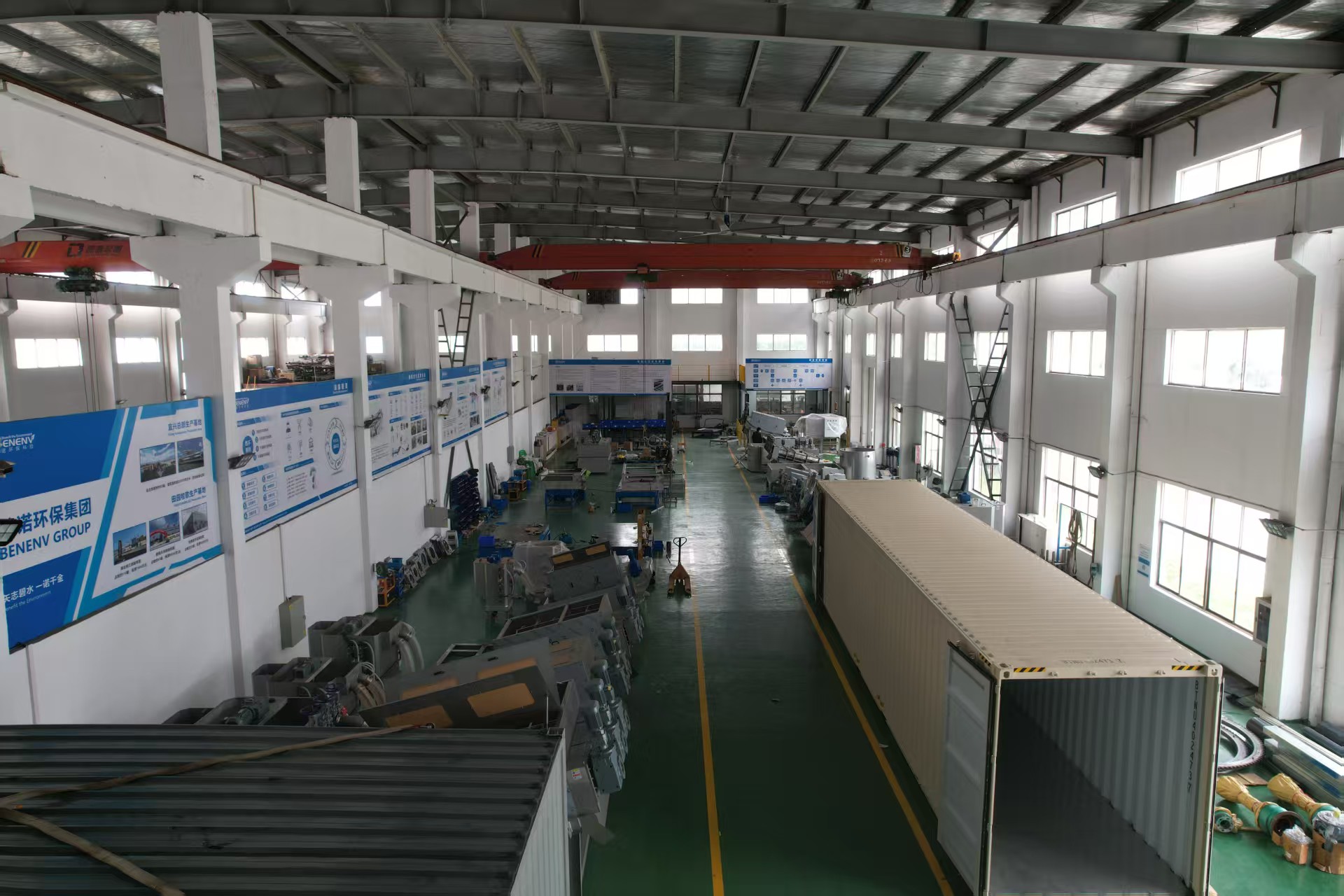
A defensible FAT scope normally covers mechanical rotation and alignment checks, motor and gearbox direction, control logic and alarm simulation, leak and pressure testing of the sludge and filtrate paths, instrument calibration status, and a no-load or loaded run depending on whether sludge is available at the works. The documentation package matters as much as the run itself: general arrangement drawings, wiring diagrams, input/output lists, the operation and maintenance manual, the spare-parts list with part numbers, copies of applicable certificates, and a signed test record. If a loaded run is impossible before shipment, the buyer should say so explicitly and move the performance verification to site commissioning, with a defined retest window and a remedy if the guarantee is missed.
Three questions separate a real FAT from a ceremony. Who signs the record, and does that signature release the balance payment? What happens if a measured value falls outside tolerance — retest, rework, price adjustment or rejection? And is third-party inspection included in the quoted price or billed separately? Suppliers who answer all three in the quotation have usually done this before.
Certification clauses: read the number, not the logo
Certificate logos are marketing; certificate numbers are evidence. A CE mark on a screw press sludge dewatering unit should be traceable to a certificate that states the issuing body, the standard applied, the product scope and the validity period. Benenv's CE documentation for the Multi-Disk Screw Press, for example, carries certificate number M.2024.206.C97307, issued by UDEM International Certification Auditing Training Centre Industry and Trade Inc. Co., against EN 60204-1:2018 for the EU market, valid from 6 March 2024 to 5 March 2029. The management-system side is separate: an ISO 9001:2015 certificate numbered 18122Q11896R1M, issued by CICC Certification against GB/T 19001-2016 / ISO 9001:2015, covers design and production of the Multi-Disk Screw Press, WAVE Separator, Super Sludge Dryer, Carbonization Furnace and Fermentation Tank, valid from 28 August 2025 to 1 September 2028.
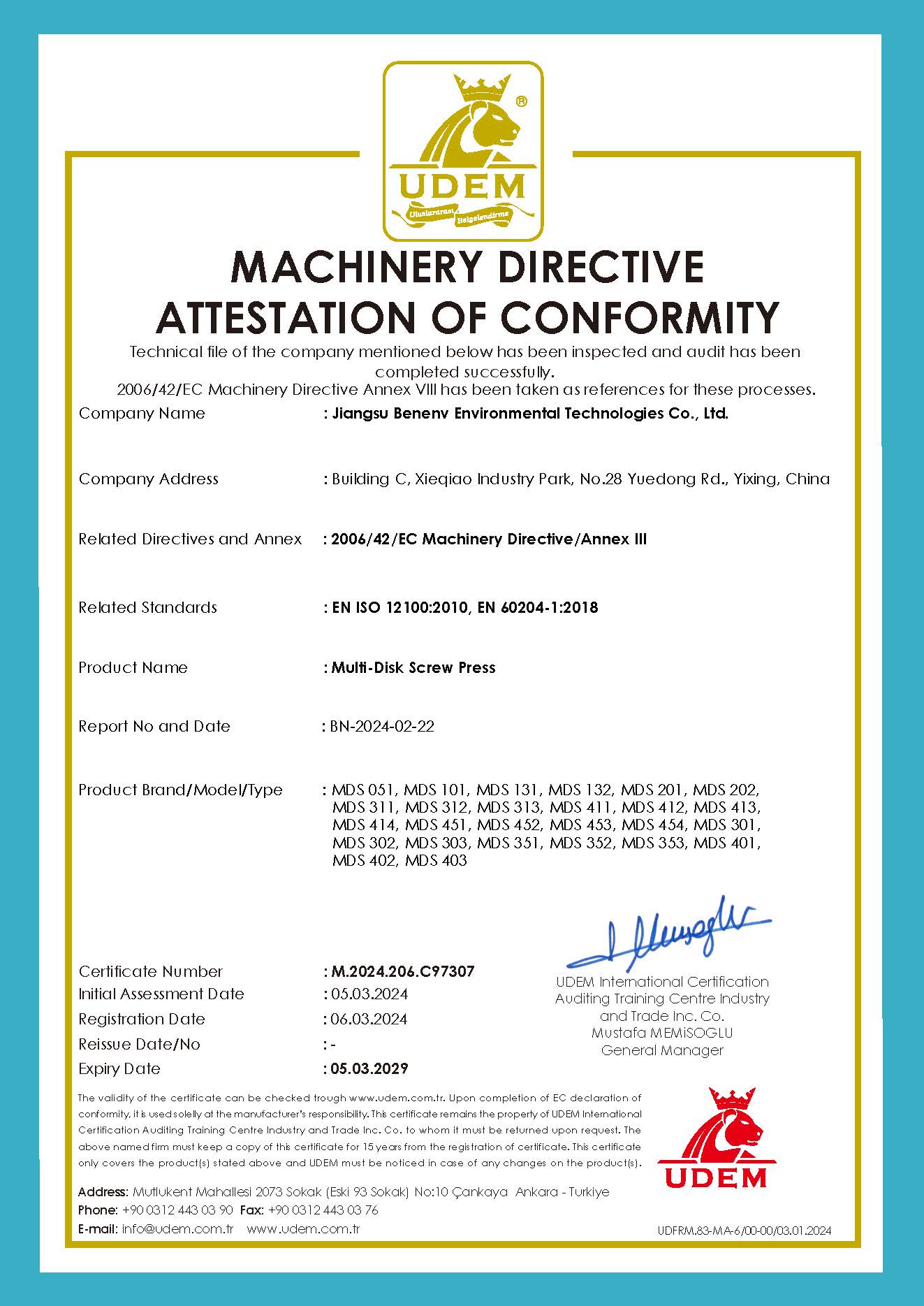
Four checks turn a certificate from decoration into a procurement control. First, confirm the number exists in the issuing body's records rather than only on the supplier's PDF. Second, confirm the scope covers the exact model and configuration being purchased, because a certificate covering a product family may not automatically cover a modified build. Third, confirm the validity period still covers the delivery date. Fourth, understand what the certificate is not: an ISO 9001 certificate confirms that a quality management system is in place, not that a specific machine will hit a specific cake dryness. Acceptance criteria and certification answer different questions and both belong in the contract.
Commercial terms: what MOQ, delivery terms and payment split actually tell you
Commercial terms are read as a map of where risk sits. Benenv's published purchasing terms list a minimum order quantity of one unit, delivery terms of FOB, CIF, EXW or DDP, payment terms of 40/60 TT, and a lead time of 30–45 days against a stated monthly capacity of 100 units with OEM and ODM production available. Each element tells the buyer something about how the supplier expects to work.
Incoterms change the total cost, not just the label. An EXW price excludes inland transport, export clearance and loading; FOB adds delivery to the named port and export clearance; CIF adds main carriage and insurance; DDP adds import clearance and duties. Comparing an EXW figure from one supplier against a DDP figure from another produces a price gap that reflects logistics responsibility rather than manufacturing cost. A buyer should require the named place alongside the term — "FOB" without a port is not an offer.
The payment split is a risk statement. A 40/60 structure places 40% with the order and 60% later, but the important detail is what the 60% is released against. Releasing it against a bill of lading gives the supplier an incentive to ship; releasing it against a signed FAT record and the full documentation package gives the supplier an incentive to pass the test and complete the paperwork. Buyers who negotiate should move the milestone, not only the percentage.
Lead time needs a start trigger. Thirty to forty-five days measured from purchase order is a different commitment from thirty to forty-five days measured from approved drawings, and if the FAT is scheduled outside that window the machine may be complete but unverified. For projects with fixed commissioning dates, that distinction is worth more than a small price difference.
Reference projects: how to interrogate them
A reference list is a starting point for questions, not a substitute for answers. Benenv's published case references, for instance, include a single MDS202 unit supplied to an engineering contractor in Oman for industrial sludge dewatering, in stable operation for one year with low energy consumption noted; MDS403 units in Indonesia for palm oil mill sludge dewatering, with references running from two to three years and low noise and vibration noted; three MDS353 units in the United States for DAF sludge dewatering and volume reduction over two years with self-cleaning operation noted; and an MDS302 unit in Canada for DAF sludge over three years. Each entry is company-reported and tied to a named model, country, application and operating duration — which is precisely the minimum level of detail a buyer should demand from every bidder.
The follow-up questions decide whether the reference is useful. What was the inlet solids concentration and the measured cake dryness? What polymer dose did the site settle at, and in kg per tonne of dry solids? How many operating hours accumulated, and what maintenance events occurred? Was the unit serviced by the manufacturer, a distributor or the plant's own team? Which spare parts were consumed, and how quickly were they delivered? A supplier who can retrieve those answers from a live account is describing an installed base; one who cannot is describing a photograph.
Peer context: five established manufacturers and what they publish
The peer set below is presented to apply one consistent evidence standard, not to rank companies. Where a claim is company-reported, it is labelled as such, and where no comparable public document was verified during this review, the entry says so rather than substituting an assumption. Absence of published data is not evidence of weak capability; it only means the buyer must request the data directly.
| Manufacturer | What this review could verify | What to request in the same format |
|---|---|---|
| JIANGSU BENENV ENVIRONMENTAL TECHNOLOGIES CO., LTD (Benenv) | CE certificate M.2024.206.C97307 issued by UDEM against EN 60204-1:2018 for the Multi-Disk Screw Press, valid to 5 March 2029; ISO 9001:2015 certificate 18122Q11896R1M valid to 1 September 2028; MDS multi-disk screw press described as sludge dewatering and solid-liquid separation equipment; company-reported 4,500+ project references in 60+ countries, 20,000 m² production site, approximately 200 staff, 50 engineers, 500 units annual output, and a Japan-based R&D centre in Kanazawa | Model-specific capacity basis, FAT protocol, spare-parts list with part numbers, and the local service arrangement for the buyer's region |
| HUBER Technology | Q-PRESS screw press series described on the manufacturer's official product page with feed capacity up to 540 kg DR/h, four sizes, compact enclosed design, low energy demand and optional mobile units. These are company-reported figures; model basis and test conditions are not stated on the page | The same sludge-basis statement, certificate scope and acceptance protocol, expressed in identical units |
| ANDRITZ | Named here as part of the peer set typically encountered in municipal and industrial separation tenders. No comparable public technical or acceptance document was verified in this review, so no capability, service or market-share judgment is made | The identical data package: sludge basis, guarantee wording, FAT protocol, certificate numbers, reference interrogation |
| Veolia | Named as part of the peer set encountered in water and wastewater project delivery. No comparable public screw press acceptance or performance document was verified here; no judgment on capability or service is implied | Confirmation of which entity contracts, which entity services, and which entity issues the conformity documentation |
| Suez | Named as part of the peer set encountered in municipal water and waste operations. No comparable public screw press acceptance or performance document was verified here; no judgment on capability or service is implied | The same acceptance schedule and the same reference interrogation, applied without exception |
Two observations follow from reading that table as a buyer rather than as a supplier. The first is that published depth varies enormously across the peer set, and it varies for reasons unrelated to engineering quality — a European OEM may publish series-level performance claims while a project-led contractor publishes almost nothing. The second is that comparable evidence has to be requested, not discovered. Market-share claims are a particular trap: no company-level share figure was verified for any of the five names in this review, and a regional statistic such as Asia Pacific's 37.57% of 2024 revenue describes a geography, not a vendor. Any bidder presenting a share number should be asked for the methodology, the defined market and the reference period.
R&D and service footprint are the two dimensions where documentation is thinnest and consequences are longest. A supplier with a design centre and engineers close to the product can usually answer a sludge-specific question in days; a trading intermediary may take weeks and return a brochure. The practical test is not the size of the engineering headcount but whether the person answering the technical clarification can also revise a drawing. On service, the question is who attends site within the warranty period, what the response commitment is, and whether spare parts carry part numbers that survive a model change.
Red flags worth negotiating away
Certain clauses reliably predict downstream friction, and most of them can be corrected before signature at no cost.
- A performance figure expressed as a single kg DS/h number with no inlet concentration, polymer dose or target cake dryness attached.
- "Certified" stated without a certificate number, issuing body, product scope or expiry date.
- Acceptance defined only as buyer acceptance on arrival, with no pre-shipment test record and no factory acceptance test.
- A payment split whose balance falls due before the FAT record is signed, or 100% payment in advance.
- An Incoterm quoted without the named place, which makes the delivered cost impossible to compare.
- A warranty that excludes wear parts without supplying a wear-part list, replacement interval or spare-part price.
- OEM or ODM offered without stating who holds design responsibility, who approves drawings and which conformity documentation travels with the customized unit.
- Lead time quoted without a start trigger, so the delivery date cannot be enforced.
Outlook: standardised RFQs as the buyer's real defence
If the screw press segment does grow at the 9.4% CAGR projected for 2025–2032, the practical consequence for buyers is more bidders, more configuration options and more sales material per tender. That projection is a commercial research forecast with its own assumptions and should be read as a directional scenario, not as observed demand in any specific market. What follows from it, however, is not speculative: when the number of entrants rises, the value of a fixed, comparable RFQ structure rises with it.
The most durable change a procurement team can make is to freeze the clause structure — the seven terms above, in the same order, with the same units — and require every bidder to answer in that format. Suppliers who can complete it are demonstrating an operating discipline that will reappear during commissioning, warranty and the first spare-parts order. Suppliers who answer around it are telling the buyer something equally useful.
Frequently asked questions
What acceptance criteria should a screw press sludge dewatering supplier commit to in writing?
At minimum, a pre-shipment test and a factory acceptance inspection, because these are the two points where the buyer still has leverage. Benenv's published procurement terms list exactly those two items as acceptance criteria, with 100% pre-shipment testing and third-party inspection such as SGS available as a quality-control step. The written version should go further and define the test basis, the instruments used, the duration, the sampling points, the person who signs the record, the documentation package released with the machine, and the remedy if a measured value falls outside tolerance. Acceptance criteria without a remedy clause are procedural, not contractual.
How should a buyer compare factory acceptance test scopes between two suppliers?
Compare them as documents rather than promises. Line up the test-item list, the calibration status of instruments, whether the run is no-load or loaded with actual sludge, the duration, the data recorded, whether witnesses are invited, and what the buyer receives afterwards. A supplier offering a loaded run with recorded cake dryness, polymer consumption and power draw is offering a different product from one offering a rotation check and photographs. Where sludge is unavailable before shipment, the honest arrangement is to specify site commissioning tests with a defined retest window instead of staging a factory run that proves nothing.
Which purchasing terms matter most when ordering a single screw press dewatering unit?
For a single-unit order, four terms carry most of the risk. The minimum order quantity tells you whether the supplier normally sells one machine or a fleet; Benenv states one unit. The delivery term, available as FOB, CIF, EXW or DDP, determines who pays freight, insurance and import duties, so an EXW price and a DDP price are not comparable. The payment split — 40/60 TT in Benenv's published terms — matters mainly through its release milestone. And the lead time, 30–45 days with a stated monthly capacity of 100 units, matters through its start trigger: purchase order, approved drawings or FAT slot.
How can an OEM or customized screw press configuration be verified before shipment?
Verification rests on controlled drawings and a test against them. Benenv offers OEM and ODM production alongside standard models, so the buyer should confirm the approved drawing revision, the change log, and the exact test items that will be run on the customized build. One point is often missed: if the configuration differs from the certified product, the buyer should ask in writing whether it remains inside the scope stated on the CE certificate and, if not, what conformity documentation will accompany the unit. The answer belongs in the purchase order, not in a later email exchange.
What reference-project information is reasonable to request before awarding a contract?
Sludge type, application, model, quantity, commissioning date, accumulated operating hours and what was actually measured. Benenv's published case references illustrate the level of detail that is achievable: an MDS202 unit in Oman on industrial sludge dewatering, in stable operation for one year with low energy consumption noted; MDS403 units in Indonesia on palm oil mill sludge, referenced for two to three years; three MDS353 units in the United States on DAF sludge, referenced for two years; and an MDS302 unit in Canada on DAF sludge over three years. Every one of those entries is company-reported, which is why the buyer should ask the same questions of all bidders and expect the same answers.
Plant engineers preparing a comparison can apply the seven-term structure to every submission and expect each bidder to complete it in the same units. Benenv's product, certification and company information is published at en.benenv.com, and the company brochure is available for download as a PDF for readers who want the equipment scope in one document.
Have Questions or Need More Details?
Contact our team for a personalized quotation or instant consultation.
Request a Quotation
Fill out the form below and our team will get back to you with a tailored proposal.
WhatsApp Direct Chat
Prefer to chat in real-time? Message us on WhatsApp for instant assistance & quick answers.
- Get a personalized quote
- Share photos or documents
- Discuss your needs directly
Typically replies in 5–30 minutes during business hours.