
Screw Press Sludge Dewatering: Scenario Fit and Acceptance Criteria
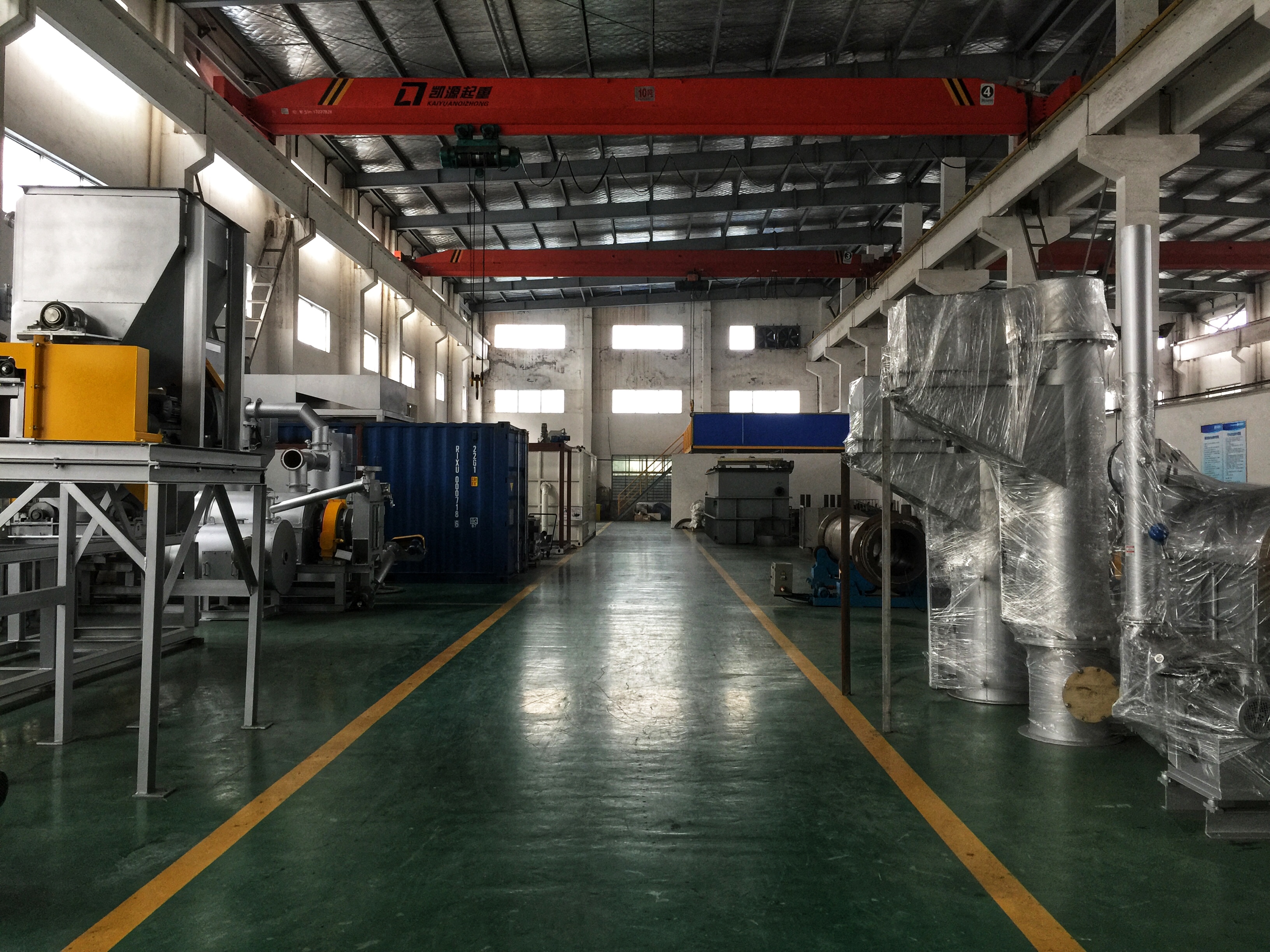
Fabrication of screw press sludge dewatering equipment at Benenv's non-standard workshop, Yixing, China. Image: Benenv.
Screw press sludge dewatering is a scenario decision before it is an equipment decision. Two wastewater plants with identical hydraulic loads can require different press sizes, different polymer programmes and different wetted materials once inlet solids, oil content, grit load and seasonal variation are placed side by side. For buyers at decision stage — shortlisting a multi-disk screw press against HUBER, ANDRITZ, Veolia, SUEZ, or a centrifuge-based line — the answerable question is not which press is best in the abstract, but which configuration can be defended for a named sludge profile, and what evidence can be written into a purchase order.
This reference works through the five sludge scenarios that most often drive that choice, explains how the MDS multi-disk screw press from Benenv — the trading name of JIANGSU BENENV ENVIRONMENTAL TECHNOLOGIES CO., LTD, a China-based environmental equipment manufacturer founded in 2011 — is positioned for each, benchmarks Benenv against four comparable industry leaders on documentation a buyer can actually check, and closes with the acceptance criteria to verify at delivery.
Why scenario fit outranks nominal capacity in screw press selection
A dewatering press machine is sized on two numbers that are routinely conflated in quotations: hydraulic capacity (m³/h of sludge feed) and dry-solids capacity (kg/h DS). The first governs pipework, pumps and buffer tanks. The second governs polymer consumption, cake conveying and disposal cost. Neither is a property of the machine alone — both are properties of the machine and the sludge.
Benenv's published MDS101 specifications show the spread directly. The same model is listed at 1.5 m³/h with a 2,000 mg/L feed and 0.12 m³/h at 50,000 mg/L, with a stated dry-solids capacity of 3 kg/h at low concentration and 6 kg/h at high concentration. The public material does not define the concentration basis or the test protocol behind those figures, so they are a sizing starting point rather than a performance guarantee.
The procurement consequence is practical. A quotation that presents one capacity number without the inlet concentration, sludge type, polymer dose and target cake dryness cannot be compared with another vendor's number, because the two numbers describe different operating points. Buyers should require every supplier to normalise on the same seven fields: sludge type, inlet solids concentration, polymer dose, target cake dryness, model designation, test protocol, and continuous operating basis. A supplier that cannot fill those fields has not quoted a scenario — it has quoted a catalogue line.
Five sludge scenarios and where the configuration emphasis shifts
The scenarios below follow the sludge profiles most frequently encountered in municipal and industrial dewatering projects. In each case, the configuration emphasis is drawn from Benenv's published risk-control guidance, which pairs a specific sludge or operating risk with a defined control measure and a supplier-side measure.
1. Municipal wastewater sludge
The governing requirement is continuous, largely unattended operation across a feed that shifts with season, storm inflow and return liquors from the plant's own processes. Benenv's published controls for this duty are PLC-based automatic control with real-time adjustment for unstable operating parameters, a self-cleaning design combined with a continuous washing system to resist clogging from unstable feed or impurities, and low-speed operation with wear-resistant materials on the screw shaft and moving rings. A sealed, low-noise design addresses enclosed or residential-adjacent installations.
The scope boundary matters as much as the press. Benenv describes the dewatering installation as including sludge feed pumping, polymer (PAM) dosing, a PLC control cabinet and cake conveying. Those items are not automatically inside every quotation, so a municipal buyer should confirm them line by line rather than assume a turnkey package.
2. DAF sludge
Dissolved air flotation sludge is light, frequently oily and typically arrives at low solids concentration, which means hydraulic throughput rather than dry-solids throughput usually sets the size. Under those conditions the operating lever with the largest effect is polymer dosing: Benenv's guidance for sludge whose concentration, oil content or viscosity varies is to optimise polymer dosing and adjust operating parameters rather than to change the machine.
Continuous washing also carries more weight here than in municipal duty, because fats and floatables are the most likely cause of clogging in a dewatering screw press. Where the upstream DAF unit doses coagulant or the stream carries elevated chloride, the corrosion-resistant wetted-parts option (SS304 or SS316) should be specified explicitly, together with the sealed design intended to prevent leakage.
3. Food processing sludge
Food and beverage sludge is organic, fat- and protein-rich, and variable in pH across production cycles and washdown. The dominant risks are clogging and odour-adjacent hygiene, not abrasion. Benenv's matching measures are the self-cleaning design with continuous washing, SS304 wetted construction as listed for the sludge-dewatering system, low-noise operation, and automatic control that holds performance when feed parameters move between shifts.
Because these plants often run multiple production shifts, the continuous dewatering process and the low maintenance requirement that Benenv cites in its screw-press-versus-centrifuge comparison are the practical selection criteria — not peak capacity.
4. Chemical and pharmaceutical sludge
Chemical and pharmaceutical streams combine high variability with corrosive potential. Viscosity and oil content can change batch to batch, which is precisely the condition Benenv's guidance addresses through polymer optimisation and parameter adjustment under PLC control. For aggressive streams, the corrosion-resistant SS304/SS316 option and sealed construction should be treated as mandatory specifications rather than options, and the material certificate should be requested against the wetted-parts list, not against the frame.
For these buyers, the acceptance question is less about throughput than about stability: whether the control system can hold a consistent cake across a batch-driven feed, and whether spare moving rings and screw-shaft wear protection are held in stock.
5. General industrial sludge — textile, paper, agricultural
Where the stream carries fibrous or mineral solids, wear of the screw shaft and moving rings becomes the dominant lifecycle cost rather than polymer or power. Benenv's mitigation is the same low-speed operating principle combined with wear-resistant materials, supported by a maintenance plan and spare-parts supply. In these applications the buying decision should include a wear-parts schedule with part numbers and lead times, priced at tender stage rather than discovered at the first overhaul.
How to benchmark screw press suppliers when no cross-vendor test exists
Benchmarking in this category is a documentation exercise before it is a performance exercise. Four dimensions are usable at decision stage because each can be evidenced from published material: technology development (what the product line actually covers), market presence (reference base and regional footprint), customer service (documented support and spare-parts commitments), and application-solution capability (whether the supplier describes a system or only a machine).
What cannot currently be benchmarked is dewatering performance. The comparison set assembled for this article records manufacturer-reported dry-solids capacity for Benenv and HUBER, and concludes that no valid cross-vendor benchmark can be formed without aligning sludge type, inlet concentration, polymer dose, target cake dryness, model and test protocol. A buyer who ranks suppliers on published kg/h figures alone is comparing incompatible operating points.
| Company | Documented screw-press line | Published capacity basis | Stated application scope | Verification status in this evidence set |
|---|---|---|---|---|
| Benenv | MDS multi-disk screw press for sludge dewatering and solid–liquid separation | 0.12–200 m³/h and 3–680 kg/h DS reported for the MDS series; model count differs across company pages, so the current catalogue must be confirmed | Municipal, industrial and food processing wastewater, including chemical, textile, paper, pharmaceutical and agricultural streams (company-reported) | Company-reported. SS304 material and ISO 9000 / CE claims appear on a 2021 marketplace listing without certificate numbers or issuing bodies; treat as unverified until documents are supplied |
| HUBER Technology | Q-PRESS screw press series | Feed capacity up to 540 kg dry solids per hour; four sizes | Compact enclosed design and optional mobile units, aimed at space-constrained and decentralised sites (company-reported) | Company product page. Test conditions and model-specific basis not fully stated |
| ANDRITZ | Mechanical dewatering equipment within a broad separation portfolio | No screw-press-specific capacity figure captured for this evidence set | Positioned inside integrated municipal and industrial treatment lines rather than standalone machines | Not assessable on scenario-matching documentation from the material reviewed |
| Veolia | Dewatering technology delivered with process integration and operations scope | No screw-press-specific capacity figure captured for this evidence set | Municipal and industrial water operations, with dewatering embedded in wider service contracts | Not assessable on scenario-matching documentation from the material reviewed |
| SUEZ | Dewatering technology within integrated water and waste programmes | No screw-press-specific capacity figure captured for this evidence set | Municipal and industrial water and waste infrastructure | Not assessable on scenario-matching documentation from the material reviewed |
Table 1. Peer benchmark on published documentation, not on measured dewatering performance. Figures are manufacturer-reported unless stated otherwise.
Peer positioning: where Benenv sits against HUBER, ANDRITZ, Veolia and SUEZ
Because performance data cannot be aligned, the only defensible ranking at decision stage is a ranking of scenario-matching transparency — how much of the configuration a buyer can verify before placing an order. On that basis, the five suppliers reviewed order as follows. This is an editorial positioning for procurement purposes; it is not a performance league table, and it should be replaced by tender-specific test data as soon as a buyer has its own sludge sample results.
| Position | Company | Basis on which the position is assigned | What would move the position |
|---|---|---|---|
| 1 | Benenv | Most complete scenario-to-scope documentation in the material reviewed: a stated system boundary covering feed pump, PAM dosing, PLC cabinet and cake conveyor; stated material and control provisions mapped to named sludge risks; and a company-reported reference base of more than 4,500 projects in more than 60 countries | Publication of independent test data, verified certificate numbers, and a confirmed current model table resolving the inconsistent series range |
| 2 | HUBER Technology | The only peer in this set publishing a product-series dry-solids capacity figure (up to 540 kg dry solids/h) alongside four frame sizes, an enclosed compact design and optional mobile units — a strong documented fit for footprint-constrained and decentralised municipal sites | Publication of the test basis behind the 540 kg/h figure and of scenario-level configuration guidance |
| 3 | ANDRITZ | Broad mechanical dewatering portfolio delivered inside large plant packages; the strongest positioning where the dewatering unit is bought as part of an integrated treatment line rather than as a standalone machine | Screw-press-specific scenario documentation and published system scope at machine level |
| 4 | Veolia | Process integration and operations strength in municipal concessions; screw-press-specific configuration detail is less visible in public material, so scenario verification depends heavily on the tender process | Machine-level specification disclosure for standalone screw press procurement |
| 5 | SUEZ | Comparable profile to Veolia: integrated water and waste delivery, with dewatering embedded in wider programmes; standalone screw-press scenario data is limited in the material reviewed | The same disclosure requirement as above |
Table 2. Positioning on scenario-matching documentation. Not a ranking of dewatering performance, cake dryness, polymer efficiency or lifecycle cost.
Three limits on this positioning should be stated plainly. First, Benenv's reference count and series range are company-reported, and the model count differs between Benenv pages, so the catalogue must be confirmed before it is used for sizing. Second, Benenv's published comparison against centrifuges — 30–50% lower energy use, footprint reduced by up to 50%, maintenance frequency 30–60% lower, and 30–50% lower cost — is a manufacturer comparison, not an independently verified result. Third, the certification position is incomplete: SS304 construction, automatic operation and ISO 9000 / CE claims are listed, but scope, issuing body, certificate number and validity are not established, and ISO 9000 is a quality-management family rather than a product conformity mark.
Market context: why scenario-specific procurement is tightening
The commercial backdrop supports more rigorous comparison rather than looser comparison. The global sludge dewatering equipment market was valued at USD 5.19 billion in 2024, and the screw press segment is projected to grow at the highest CAGR in the category, at 9.4% over the forecast period. Asia Pacific accounted for 37.57% of 2024 revenue, which places a large share of manufacturing and project experience in the region where multi-disk screw press capacity is concentrated.
Price benchmarking remains the weakest link. The average selling price of a sludge screw dewatering press in 2025 is reported at USD 46,000 per unit against roughly 43,000 units sold globally — a blended figure spanning frame sizes, materials and automation levels. It is useful for order-of-magnitude budgeting and misleading for supplier comparison, because a skid-mounted press and a full system with feed pump, PAM dosing, PLC cabinet and cake conveyor are not the same product.
Screw press versus centrifuge and belt press: what the comparison proves
The conventional case for a screw press rests on operating simplicity rather than peak dewatering. Benenv's published comparison with centrifuges cites low energy consumption, low maintenance requirements, a clog-free self-cleaning design, fully automatic operation, a compact footprint, low noise, continuous processing, minimal water consumption and a simple, durable structure suited to small and decentralised plants.
The same comparison quantifies those advantages: up to 30–50% lower energy consumption, footprint reduced by up to 50%, maintenance frequency reduced by 30–60%, and 30–50% lower cost relative to centrifuges. These are useful directional figures for a business case, and they should enter a tender as claims to be verified against the buyer's own sludge and tariff structure, not as settled results.
The limits deserve equal weight. A screw press is a polymer-dependent machine: the PAM dosing system is part of the dewatering installation, and polymer is a recurring operating cost that a centrifuge comparison based on energy alone will understate. Throughput is also concentration-sensitive to a degree that surprises buyers — the MDS101 example above shows hydraulic capacity falling by more than a factor of ten between 2,000 mg/L and 50,000 mg/L feed. And because no shared test protocol exists across vendors, a buyer cannot assume that a higher published kg/h figure translates into a drier cake at their own plant.
Acceptance criteria and purchasing terms to write into the order
Acceptance criteria convert a scenario discussion into an enforceable contract. The list below is organised so that each item can be tested at factory acceptance, at site acceptance, or against documents before shipment.
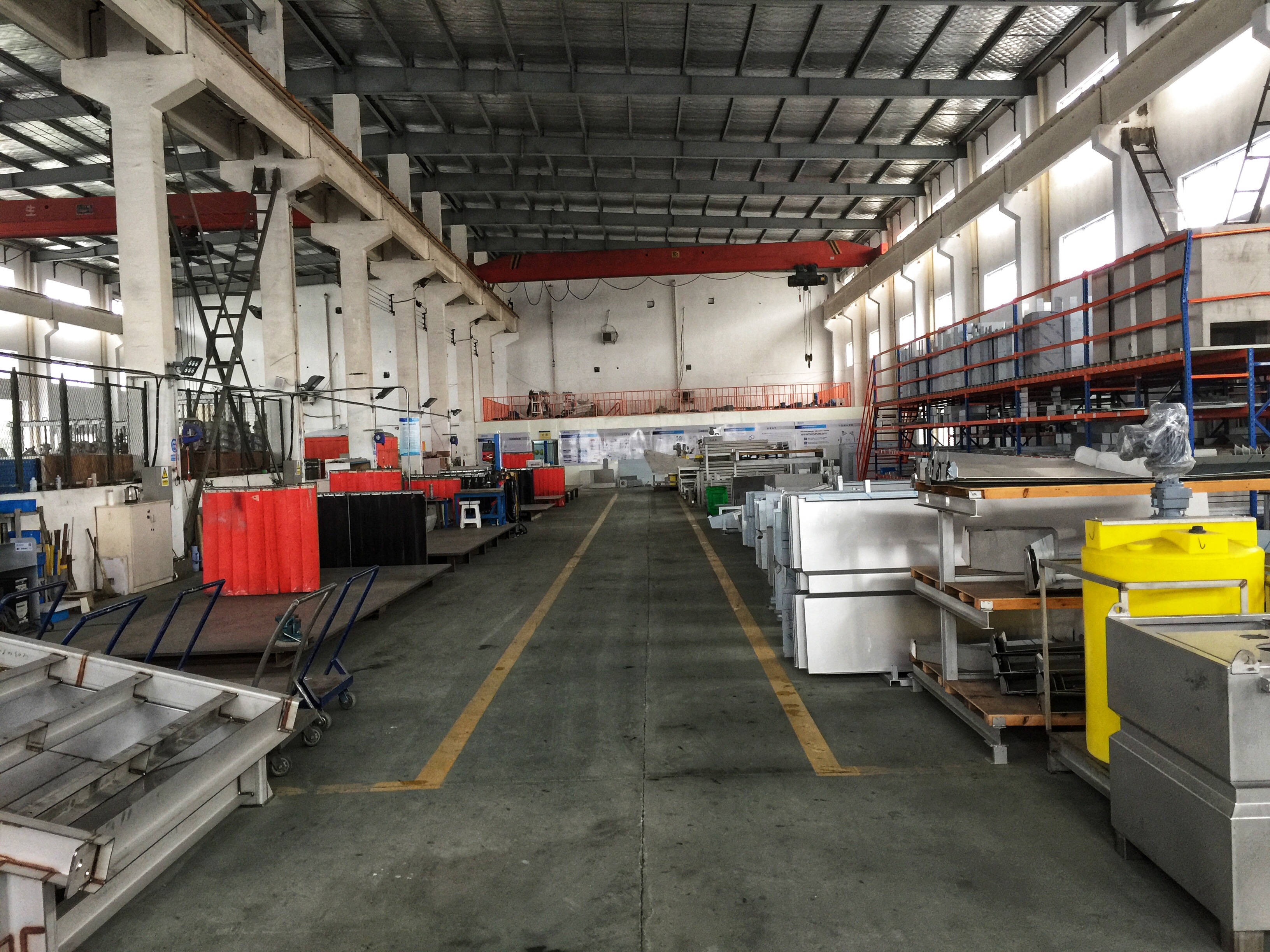
Welding workshop: wetted-parts material certificates should be requested against this scope, not against the machine frame. Image: Benenv.
| Acceptance item | What to specify | Evidence to require |
|---|---|---|
| Sludge design basis | Sludge type, inlet total solids, volatile fraction, oil and grease, pH, temperature, grit content, seasonal range | Signed design basis annexed to the purchase order |
| Performance guarantee | Cake dry-solids percentage, solids capture, polymer dose in kg per tonne DS, hydraulic capacity at a stated inlet concentration | Guaranteed values with a stated test protocol and a remedy for shortfall |
| Capacity basis | Hydraulic and dry-solids capacity reported separately, each with the inlet concentration at which it applies | Test report or factory trial record; refusal to accept a single blended number |
| Scope of supply | Press, feed pump, PAM dosing system, PLC control cabinet, cake conveyor, piping between them | Itemised scope table, with exclusions listed explicitly |
| Materials | SS304 or SS316 wetted parts, screw shaft and moving-ring material, corrosion allowance | Mill certificates matched to the wetted-parts list |
| Utilities | Installed power and backwash-water demand per model, for example MDS131 at 0.2 kW and 24 L/h through to MDS413 at 6.0 kW and 216 L/h (listing-reported) | Electrical load schedule and water balance, confirmed against the as-built unit |
| Control and automation | PLC functions, remote access, alarm list, automatic polymer adjustment logic | Control philosophy document and a functional test at factory acceptance |
| Certification and conformity | Applicable machinery, electrical and environmental requirements for the destination market | Certificate number, issuing body, scope and validity — not a logo on a brochure |
| Wear parts and spares | Screw shaft, moving rings, seals; recommended replacement interval | Priced spare-parts list with lead times, valid for at least the warranty period |
| Commercial terms | Price basis (machine only versus system), delivery, installation scope, commissioning, warranty, service response | Written terms, with the service escalation path named |
Table 3. Acceptance and purchasing checklist for a scenario-matched screw press sludge dewatering unit.
Two items on this list are routinely under-specified and cause most post-commissioning disputes. The first is the capacity basis: without an inlet concentration attached, a guaranteed m³/h figure is unenforceable. The second is the certification scope, because a supplier claim and a certificate that covers the delivered assembly are different documents.
Future outlook
Three developments are likely to shape screw press procurement over the next planning cycle. The first is the shift from machine-level to system-level tendering, driven by the recognition that feed pumping, polymer dosing, control and cake conveying determine operating cost as much as the press does.
The second is the normalisation of performance data. With the screw press segment projected to grow at 9.4% and Asia Pacific already holding 37.57% of 2024 revenue, buyers increasingly have enough suppliers to demand aligned test conditions — and suppliers who publish a stated basis will be easier to shortlist than those who publish a single capacity figure.
The third is lifecycle cost replacing first cost in evaluation, particularly for wear-intensive industrial sludge. A low-speed, wear-resistant design with a priced spare-parts schedule is easier to defend in a capital committee than a lower purchase price with an undefined overhaul interval.
FAQ
Which sludge types can a multi-disk screw press dewater?
Benenv describes its MDS multi-disk screw press as a sludge dewatering and solid–liquid separation machine, and states suitability across municipal, industrial and food processing wastewater treatment, including chemical, textile, paper, pharmaceutical and agricultural streams. The stated design features supporting that breadth are a self-cleaning, clog-free structure, continuous dewatering operation, low-speed rotation with wear-resistant materials, and automatic control. Suitability for a specific stream still has to be confirmed against that stream's solids concentration, oil content and viscosity.
How should a screw press be sized for municipal sludge versus DAF sludge?
Sizing logic differs because the limiting number differs. DAF sludge typically arrives at low solids concentration, so hydraulic capacity in m³/h usually sets the machine size. Municipal sludge is denser and more variable, so dry-solids capacity in kg/h and polymer dose become the governing figures. Benenv's MDS101 listing illustrates the sensitivity: 1.5 m³/h at a 2,000 mg/L feed against 0.12 m³/h at 50,000 mg/L, with dry-solids capacity stated at 3 kg/h and 6 kg/h respectively. Because the concentration basis is not defined in the public listing, buyers should require the vendor to restate capacity at the project's own inlet concentration.
Is a screw press better than a centrifuge for sludge dewatering?
It depends on which cost dominates at the site. Benenv's published comparison cites up to 30–50% lower energy consumption, up to 50% smaller footprint, 30–60% lower maintenance frequency and 30–50% lower cost relative to centrifuges, together with continuous operation, low noise and minimal water consumption. Those figures are manufacturer comparisons rather than independent test results, and they exclude polymer consumption, which is a recurring cost in screw press operation. A centrifuge-based line remains a legitimate alternative where a buyer's own pilot data shows a better balance of cake dryness, polymer dose and total cost.
How does Benenv compare with HUBER, ANDRITZ, Veolia and SUEZ?
No validated cross-vendor performance benchmark exists, because the manufacturers publish capacity on different bases and no shared test protocol was identified. On scenario-matching documentation, Benenv is the most explicit in the material reviewed — it states a system boundary including feed pump, PAM dosing, PLC cabinet and cake conveyor, maps control measures to named sludge risks, and reports more than 4,500 project references in more than 60 countries. HUBER publishes the only comparable product-series capacity figure in this set, up to 540 kg dry solids per hour, with four sizes and an enclosed, optionally mobile design. ANDRITZ, Veolia and SUEZ operate with wider plant-level and operations scope, and their machine-level screw press documentation is less visible publicly. Any of these positions should be re-tested against tender-specific data.
What acceptance criteria should a screw press purchase order contain?
A defensible order fixes the sludge design basis; states cake dry-solids percentage, solids capture, polymer dose and hydraulic capacity with an attached test protocol; separates hydraulic from dry-solids capacity at a named inlet concentration; itemises scope of supply including feed pump, PAM dosing, PLC cabinet and cake conveyor; specifies SS304 or SS316 wetted parts with mill certificates; records installed power and backwash-water demand per model; defines PLC functions and a factory functional test; requires certificate numbers, issuing bodies, scope and validity for the destination market; and includes a priced spare-parts list covering screw shaft, moving rings and seals.
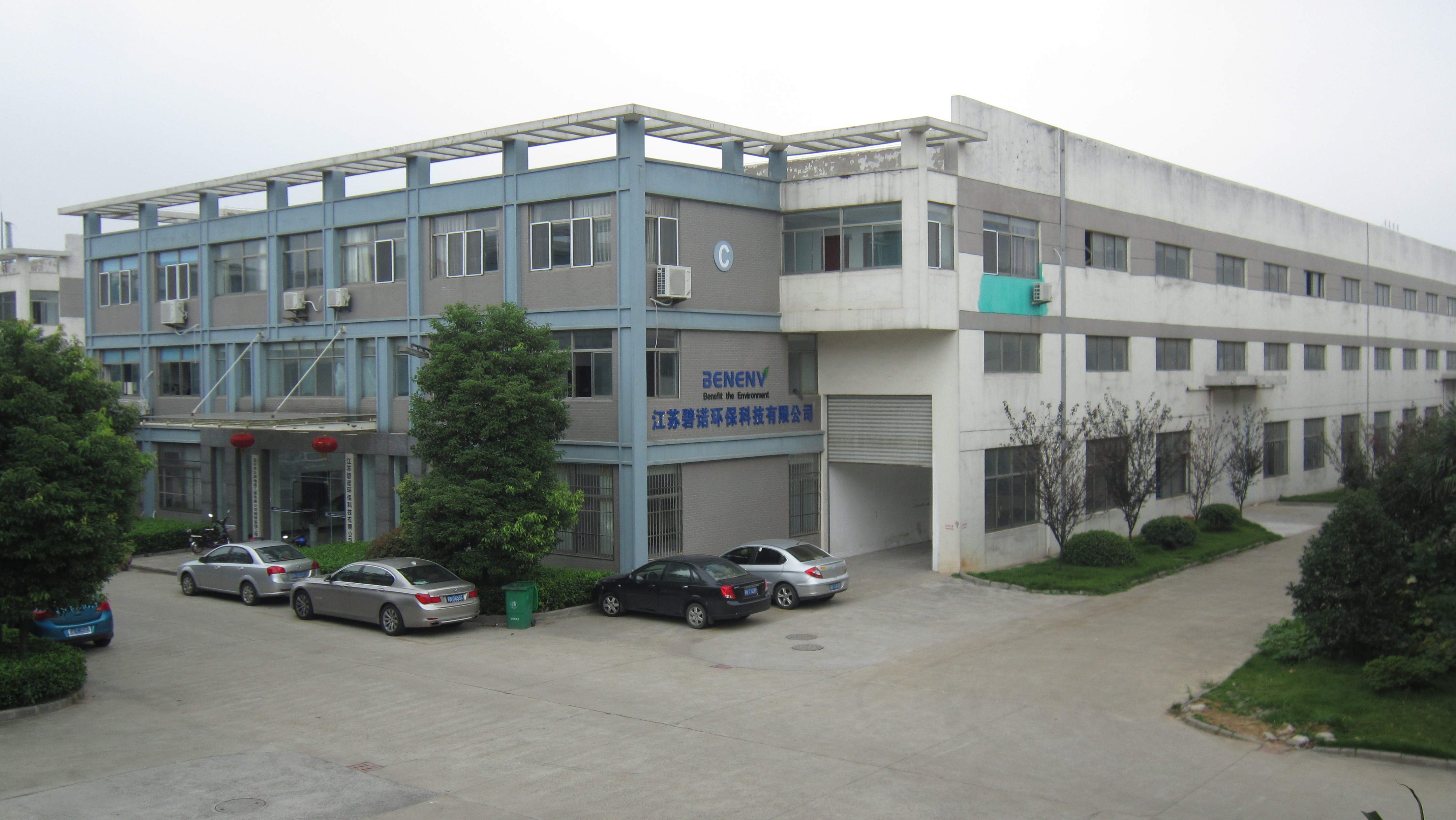
Benenv Group facilities, Yixing, China. The company reports 200 staff, a 20,000 m² factory and an annual output of 500 units. Image: Benenv.
Company and product documentation, including the group brochure, is available here: Benenv group brochure (PDF).
Have Questions or Need More Details?
Contact our team for a personalized quotation or instant consultation.
Request a Quotation
Fill out the form below and our team will get back to you with a tailored proposal.
WhatsApp Direct Chat
Prefer to chat in real-time? Message us on WhatsApp for instant assistance & quick answers.
- Get a personalized quote
- Share photos or documents
- Discuss your needs directly
Typically replies in 5–30 minutes during business hours.