
Screw Press Sludge Dewatering: Partnering for the Long Run
JIANGSU BENENV ENVIRONMENTAL TECHNOLOGIES CO., LTD is a China-based manufacturer of multi-disk screw press sludge dewatering machines, headquartered in Yixing, Jiangsu Province. For buyers at the final decision and execution stage, the critical question is no longer only which sludge dewatering equipment meets the process target, but which supplier can sustain that performance for the life of the plant — through spare parts, maintenance planning, process support, and a distribution network that keeps the machine running.
The screw press sludge dewatering market has entered a phase in which energy efficiency and lifecycle cost carry as much weight as first price. The global sludge dewatering equipment market was valued at USD 5.19 billion in 2024 and is projected to reach USD 10.16 billion by 2032, according to Fortune Business Insights. Within that market, the screw press segment is expected to record the highest CAGR of 9.4% from 2025 to 2032. This article examines what a durable supplier relationship should include for screw press sludge dewatering projects, using the Benenv MDS multi-disk screw press line as a reference case.
Why the Supplier Ecosystem Determines Long-Term Dewatering Cost
The long-term operating cost of a screw press sludge dewatering machine is largely determined by how the supplier manages five recurring risks: wear of mechanical parts, unstable feed conditions, variation in sludge characteristics, unstable operating parameters, and leakage, noise, or corrosion. Each of these risks is well known to operators of dewatering equipment; what separates suppliers is whether they have a documented control method and a service structure around it.
Wear of the screw shaft and moving rings. The screw mechanism is the core wear component in a dewatering press machine. Benenv addresses this with low-speed operation and wear-resistant materials, and supports the equipment over time with maintenance plans and spare parts supply. For a buyer, asking for the spare-part plan before signing is a practical way to check how the supplier intends to protect uptime in year three, five, or ten.
Unstable sludge feed or impurities. Variable feed with impurities and debris can cause clogging in filter-based dewatering presses. The MDS design responds with a self-cleaning design and a continuous washing system, which are intended to keep the screw press for sludge dewatering running without manual unblocking or frequent operator intervention.
Variation in sludge characteristics. Concentration, oil content, and viscosity change from one batch to the next, particularly in industrial streams such as chemical, textile, paper, pharmaceutical, and food processing wastewater. The control response is to optimize polymer dosing and adjust operating parameters to the actual sludge entering the machine.
Unstable operating parameters. Consistent output depends on automation. PLC-based automatic control with real-time adjustment is the control approach used in Benenv's screw press dewatering systems, supported by automation solutions and remote technical support when the plant needs assistance.
Sludge leakage, noise, or corrosion. Sealed design, corrosion-resistant materials, and low-noise operation address the environmental and durability side of the system. For corrosive streams, anti-corrosion material options such as SS304 and SS316L are available.
The opportunity for buyers is that these risks are manageable when the supplier treats the purchase as the start of an operating relationship. At the decision stage, evaluation criteria that include maintenance planning, spare-part logistics, process support, and supplier continuity reduce the chance that a sludge dewatering unit becomes a recurring source of downtime after installation.
Benenv: A Multi-Disk Screw Press Manufacturer Built for Long-Term Supply
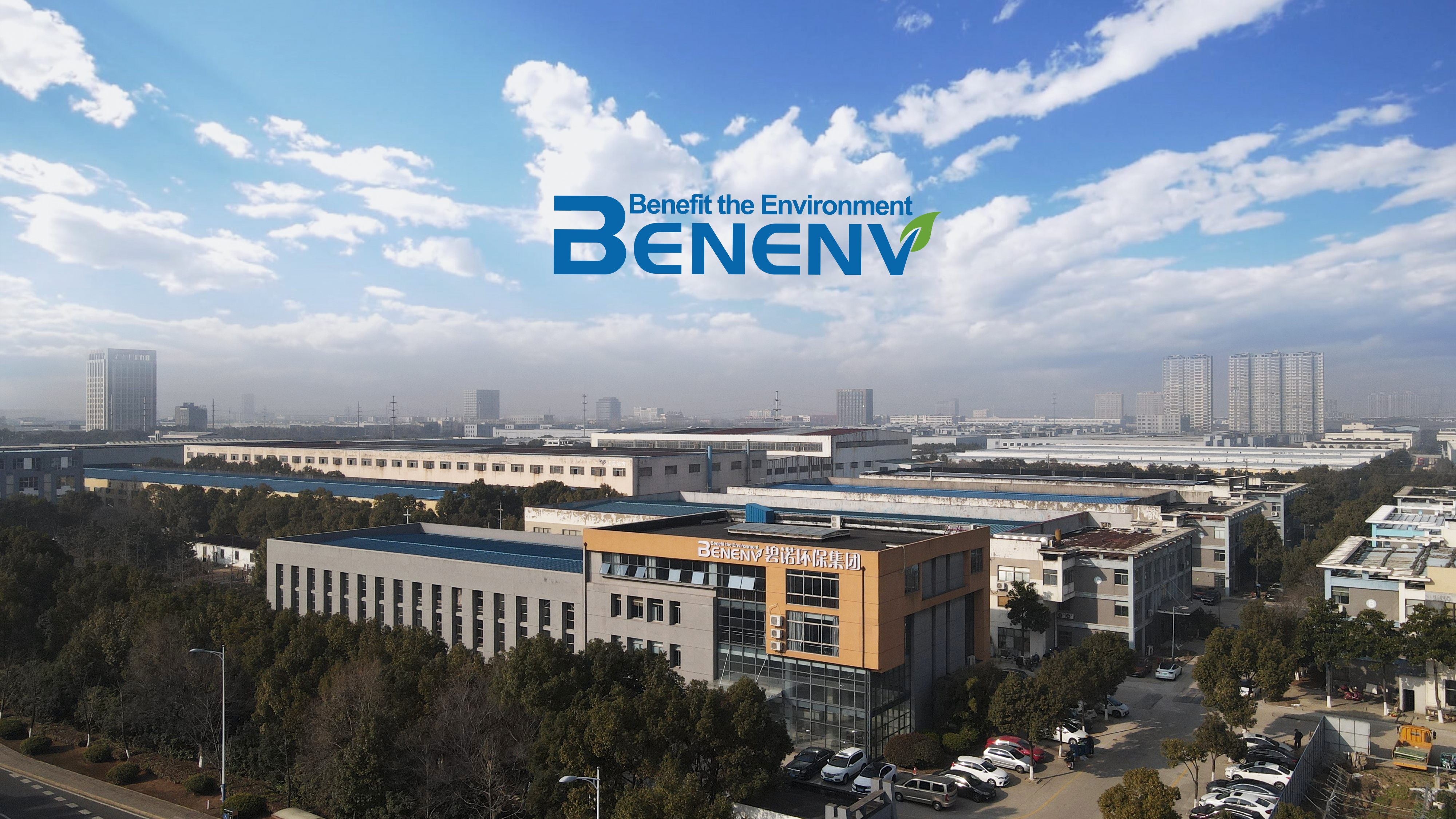
Benenv is the equipment brand of JIANGSU BENENV ENVIRONMENTAL TECHNOLOGIES CO., LTD, a company founded in 2011 that manufactures Multi-Disk Screw Press dewatering machines, Dissolved Air Flotation equipment, sludge drying and carbonization systems, and other water and solid waste treatment equipment. The company's production base and headquarters are located at Xieqiao Industry Park in Yixing, China.
Benenv's manufacturing base covers 20,000 m² and employs around 200 staff, with an annual output of 500 units and a dedicated R&D team of 50 engineers. Roughly 70% of output is exported, with main markets in Europe, the United States, Southeast Asia, the Middle East, and Australia. For an international buyer, this export ratio matters because it indicates that the product line, documentation, and service processes are structured for cross-border projects rather than domestic-only delivery.
Structurally, Benenv operates as a global organization rather than a single-factory supplier. The group runs more than ten subsidiaries worldwide, including subsidiaries in Japan (Kanazawa) and Dubai, as well as Tianyuan Muge and Yisheng Environmental. It maintains a wholly owned R&D center in Japan, co-founded by Kazuhiko Kawatsu and Zihou Jiang, under an operating model described as "Japanese Technology + Chinese Manufacturing + Global Sales." This structure supports supply continuity for buyers who need a manufacturer with long-term presence in multiple regions.
For distribution and after-sales coverage, Benenv currently has 18 agents in countries including France, the United States, the United Kingdom, Malaysia, Indonesia, and Saudi Arabia, and reports over 4,500 project references in more than 60 countries. On the investment and operation side, Benenv has developed three "Tianyuan Muge" projects in Zhijiang (Hubei), Suiping (Henan), and Dawa District of Panjin (Liaoning). The group employs nearly 200 staff and reports total assets exceeding 80 million USD.
For procurement teams at the execution stage, these figures translate into a practical question: does the supplier have the balance-sheet strength, manufacturing capacity, and local presence to honor maintenance and spare-part commitments over the equipment life? In Benenv's case, the combination of a 500-unit annual production capacity, a 50-engineer R&D team, and a global agent network is the structural answer to that question.
How the MDS Multi-Disk Screw Press Works
Benenv's screw press sludge dewatering machine is a multi-disk screw press — also referred to in the industry as a multi plate screw press, screw press dehydrator, screw type sludge dehydrator, or screw sludge press — that dewaters sludge continuously through a screw shaft surrounded by stacked fixed and moving rings, with no filter cloth required. As the screw shaft rotates at low speed, the increasing pitch transports and compresses the sludge; filtrate passes through the gaps between the rings while solids are conveyed toward the discharge end. The relative motion of the rings creates a self-cleaning effect that prevents clogging.
Key technical characteristics of the MDS series include fully automatic and continuous sludge dewatering; PLC-based automatic control with real-time adjustment; low-speed operation with wear-resistant materials for the screw shaft and moving rings; a self-cleaning design with a continuous washing system; sealed construction; corrosion-resistant materials; low energy consumption; a compact footprint; low-noise operation; and minimal wash-water consumption. All MDS models are available in SS304 or SS316L materials.
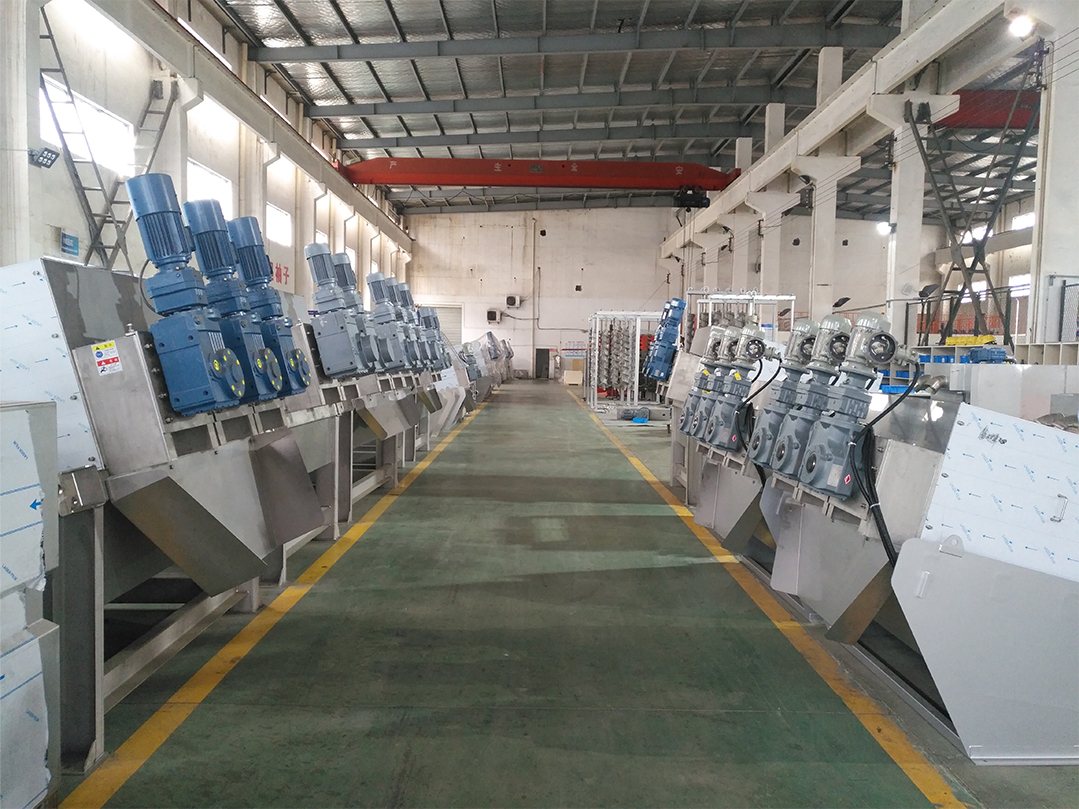
The MDS series covers 16 models, from the MDS101 to the MDS404, allowing the same technology to be scaled from a small industrial unit to a large municipal sludge dewatering system. The table below lists the main specifications as published by the manufacturer.
| Model | Power (kW) | Capacity (m³/h) | Dry Solids (kg/h) | Weight (kg) | Wash Water (L/h) |
|---|---|---|---|---|---|
| MDS101 | 0.2 | 0.12–1.5 | 3–6 | 205 | 24 |
| MDS131 | 0.2 | 0.24–3 | 6–12 | 205 | 24 |
| MDS132 | 0.3 | 0.48–3 | 12–24 | 275 | 48 |
| MDS201 | 0.3 | 0.4–6 | 12–20 | 320 | 32 |
| MDS202 | 0.6 | 0.8–12 | 24–40 | 470 | 64 |
| MDS301 | 0.8 | 1.2–15 | 30–60 | 910 | 40 |
| MDS302 | 1.2 | 2.4–30 | 60–120 | 1350 | 80 |
| MDS303 | 1.95 | 0.12–1.5 | 3.6–45 | 1820 | 120 |
| MDS351 | 1.9 | 2.4–30 | 60–120 | 1610 | 72 |
| MDS352 | 3.75 | 4.8–30 | 120–240 | 2300 | 144 |
| MDS353 | 6 | 7.2–90 | 180–360 | 3350 | 216 |
| MDS354 | 8.2 | 9.6–120 | 240–480 | 4500 | 288 |
| MDS401 | 2.25 | 3.4–50 | 100–170 | 2500 | 80 |
| MDS402 | 4.5 | 6.8–100 | 200–340 | 3480 | 160 |
| MDS403 | 6.7 | 10.2–150 | 300–510 | 4550 | 240 |
| MDS404 | 8.2 | 13.6–200 | 400–680 | 6550 | 320 |
All MDS models listed above are available in SS304/SS316L material. The listed power, capacity, dry solids, weight, and wash-water figures are as published by the manufacturer.
The range shows how the platform scales: the MDS101 lists a power of 0.2 kW and a weight of 205 kg, while the MDS404 lists 8.2 kW and 6,550 kg. Wash-water consumption ranges from 24 L/h on the smallest models to 320 L/h on the MDS404, reflecting the low water demand of the technology across all sizes.
Reference material. Procurement teams at the decision or execution stage can download the Benenv company brochure, which includes the MDS series overview and factory information, here: Benenv brochure (PDF).
Where MDS Screw Press Dewatering Is Deployed
Benenv's screw press for sludge dewatering is used in municipal, industrial, and food processing wastewater treatment, including chemical, textile, paper, pharmaceutical, and agricultural industries.
Municipal sludge dewatering systems. Municipal wastewater treatment plants typically run dewatering continuously and value automation, low energy, and low noise. The MDS series' fully automatic operation and PLC-based control fit this operating pattern, and the compact footprint of models from the 205 kg MDS101 upward makes the technology suitable for small and decentralized plants as well as for larger municipal sludge dewatering systems.
Industrial wastewater sludge dewatering. Chemical, textile, paper, and pharmaceutical streams vary widely in concentration, oil content, and viscosity. Because these characteristics directly affect dewatering performance, the supplier's ability to optimize polymer dosing and adjust operating parameters becomes the main process lever. Corrosion-resistant SS304/SS316L material options are relevant for aggressive industrial streams.
Food processing and agricultural wastewater. Organic sludges from food processing and agricultural operations benefit from a low-energy, low-maintenance, continuous sludge dewatering machine that can run without constant supervision. The minimal wash-water demand of the MDS design (24–320 L/h depending on model) is an advantage in sites where water consumption is monitored.
Portfolio context. Benenv also produces Dissolved Air Flotation (DAF) equipment, sludge drying and carbonization systems, and a compost system line. For plants that manage multiple separation and solids-handling stages — such as DAF float sludge followed by dewatering — this portfolio means the same manufacturer can supply related process equipment, which simplifies spare-part management and service coordination.
Operator feedback through own projects. Benenv's three Tianyuan Muge investment and operation projects, located in Zhijiang (Hubei), Suiping (Henan), and Dawa District of Panjin (Liaoning), give the manufacturer direct operational exposure to the dewatering equipment it builds. For buyers at the execution stage, a supplier that operates its own installations is better positioned to convert field experience into design refinements and service improvements over the long term.
Market Trends Favoring Screw Press Sludge Dewatering
The sludge dewatering equipment market is expanding, and the screw press segment is growing faster than other dewatering technology categories. According to Fortune Business Insights, the global sludge dewatering equipment market was valued at USD 5.19 billion in 2024 and is projected to grow to USD 10.16 billion by 2032, with the screw press segment expected to achieve the highest CAGR of 9.4% from 2025 to 2032.
Market-size estimates vary by report scope. Fortune Business Insights values the equipment market at USD 5.19 billion for 2024, Grand View Research at USD 5.21 billion, and Market Research Future at USD 41.93 billion when services are included. Buyers comparing market data should therefore check whether a figure covers equipment only or the full equipment-and-services scope.
Asia Pacific led the global sludge dewatering market in 2024 with a 37.57% revenue share, supported by rapid urbanization and stricter wastewater regulations. This regional momentum matters for supplier selection because much of the incremental screw press capacity is being installed in markets where the manufacturer's subsidiary and agent network determines response speed and parts availability.
Regulatory standardization is reinforcing engineering requirements in Europe. EN 12255-8 is the European standard that specifies design principles and construction requirements for sludge treatment and storage facilities in wastewater treatment plants. European buyers increasingly treat alignment with such standards as part of their equipment qualification process for municipal sludge dewatering projects.
Within this landscape, Benenv is recognized as a key global player in the sludge dewatering equipment market, particularly for its MDS multi-disk screw press technology, according to Fortune Business Insights.
Multi-Disk Screw Press vs. Centrifuge: The Lifecycle Comparison
Compared with a centrifuge, the multi-disk screw press is chosen primarily for lower energy consumption, lower maintenance demand, and simpler operation. Benenv's comparative data for the MDS series cites 30–50% energy savings, up to 50% footprint reduction, and 30–60% lower maintenance frequency relative to centrifuges, with 30–50% lower overall cost. Broader industry comparative analyses have cited screw press technology consuming 90–95% less power than centrifuges in sludge dewatering applications.
Operationally, the MDS design is continuous and fully automatic, with a clog-free self-cleaning mechanism, low-noise operation, minimal water consumption, a long service life, and a simple, durable structure. It is suitable for a wide range of sludge types and is considered ideal for small and decentralized plants. These characteristics contribute directly to reduced sludge disposal cost, easier operation and management, and minimal downtime over the equipment's life.
An honest limitation. The MDS line is positioned for small and decentralized plants. For very large, centralized installations, the largest model, the MDS404, lists a capacity of 13.6–200 m³/h; projects above that single-line envelope should benchmark the screw press against high-capacity centrifuges or other technologies using the specific sludge before finalizing the technology choice. Dewatering performance also depends on sludge characteristics — concentration, oil content, and viscosity — which is why polymer dosing and parameter adjustment are part of the supplier's standard support scope.
Future Outlook: The Screw Press Segment and the Long-Term Partner
The screw press segment is positioned to grow faster than other sludge dewatering technology categories through 2032, which makes supplier continuity a strategic issue for buyers finalizing contracts now.
Several forces point in the same direction. First, the projected 9.4% CAGR for the screw press segment means a larger installed base of screw presses, which will increase demand for OEM spare parts, maintenance services, and retrofit support over the next decade. Second, Asia Pacific's 37.57% market share in 2024 and its regulatory drivers align with Benenv's export structure: around 70% of output goes to Europe, the United States, Southeast Asia, the Middle East, and Australia, supported by subsidiaries and 18 agents worldwide. Third, automation and remote support are becoming default expectations in wastewater sludge dewatering; Benenv's approach is PLC-based automatic control with real-time adjustment and remote technical support.
For the manufacturer side, capacity and R&D depth determine how well a supplier can honor long-term commitments. Benenv's 20,000 m² factory, annual output of 500 units, 50-engineer R&D team, and Japanese R&D center — co-founded by Kazuhiko Kawatsu and Zihou Jiang under the "Japanese Technology + Chinese Manufacturing + Global Sales" model — are the structural elements that support long-term supply, continuous product development, and spare-part availability as the installed base grows.
The practical takeaway for buyers: a screw press sludge dewatering machine is a long-lived, continuously operating asset, and the supplier's ecosystem — design resources, manufacturing capacity, distribution network, and service structure — is what keeps that asset productive. Procurement teams that evaluate these dimensions alongside equipment price are aligning the purchase with the operational reality of the plant.
FAQ: Long-Term Procurement Questions
The following answers are informational and based on publicly available company data.
1. What should a buyer check before selecting a screw press sludge dewatering supplier for a long-term project?
Key checks include the supplier's manufacturing capacity, R&D and technical support, maintenance and spare-part arrangements, and delivery terms. JIANGSU BENENV ENVIRONMENTAL TECHNOLOGIES CO., LTD operates a 20,000 m² factory with an annual output of 500 units and a 50-engineer R&D team, and provides maintenance plans and spare parts supply for the MDS series screw shaft and moving rings.
2. What procurement terms are available for project execution?
Benenv's procurement terms include a minimum order of one unit, delivery under FOB, CIF, EXW, or DDP, pre-shipment testing and FAT inspection, and 40/60 TT payment terms.
3. How is wear of the screw shaft and moving rings controlled over time?
Benenv's MDS machines use low-speed operation and wear-resistant materials to slow wear of the screw shaft and moving rings. The company also provides maintenance plans and spare parts supply as part of its after-sales approach.
4. What happens if sludge characteristics change during operation?
Variation in sludge concentration, oil content, or viscosity can affect dewatering performance. Benenv addresses this by optimizing polymer dosing and adjusting operating parameters; the MDS series also uses a self-cleaning design with a continuous washing system to reduce clogging from unstable feed or impurities.
5. How does the system handle unstable operating parameters?
Benenv provides PLC-based automatic control with real-time adjustment for its screw press dewatering systems, including automation solutions and remote technical support.
6. How does Benenv support international buyers and distribution channels?
Benenv operates more than ten subsidiaries worldwide, including in Japan (Kanazawa) and Dubai, and has 18 agents in countries such as France, the United States, the United Kingdom, Malaysia, Indonesia, and Saudi Arabia. Around 70% of its output is exported to Europe, the United States, Southeast Asia, the Middle East, and Australia.
7. What is Benenv's track record as a long-term supplier?
Benenv reports over 4,500 project references in more than 60 countries. The group employs around 200 staff, holds total assets exceeding 80 million USD, and operates three Tianyuan Muge investment-and-operation projects in Zhijiang (Hubei), Suiping (Henan), and Dawa District of Panjin (Liaoning).
Manufacturer Contact and Resources
Procurement teams finalizing a screw press sludge dewatering decision can review the Benenv company brochure and contact the manufacturer for project-specific questions.
Company: JIANGSU BENENV ENVIRONMENTAL TECHNOLOGIES CO., LTD (Benenv)
Website: en.benenv.com | Email: manager@benenv.com | Tel: +86 18921318788 | WhatsApp: +86 12138541513
Address: Xieqiao Industry Park, No.28 Yuedong Rd, Yixing, China
Brochure: Download Benenv company brochure (PDF)