
Screw Press Sludge Dewatering: Principles, Applications, Outlook
Screw press sludge dewatering is a solid-liquid separation process that removes water from sludge with a slowly rotating screw inside a ring-and-screen assembly, producing a dewatered cake with reduced volume and lower disposal cost. Benenv, officially JIANGSU BENENV ENVIRONMENTAL TECHNOLOGIES CO., LTD, is an environmental equipment manufacturer based in Yixing, Jiangsu Province, China, whose Multi-Disk Screw Press (MDS) series covers feed capacities from 0.12 m³/h to 200 m³/h.
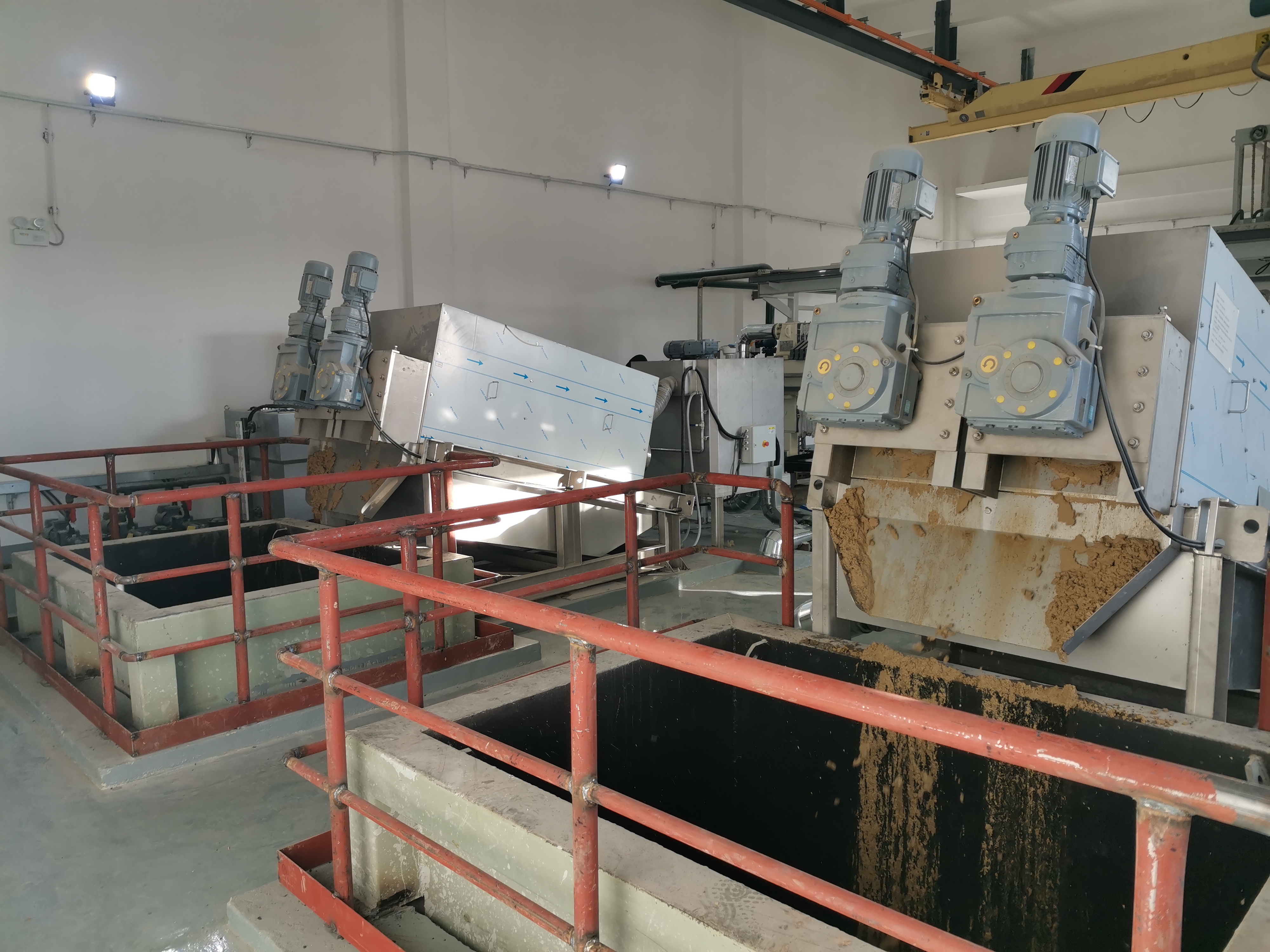
The Problem: Sludge Volume and Disposal Cost
Sludge from wastewater treatment is predominantly water. Whether produced in a municipal sewage plant or an industrial effluent line, the sludge must be transported, treated, and disposed of — and every additional percentage of moisture adds weight and cost. Mechanical dewatering reduces sludge moisture content and, in doing so, reduces sludge volume and disposal cost. Dewatered sludge is also easier to handle in downstream processes such as drying, incineration, composting, or land application.
Regulatory frameworks have reinforced this need. In Europe, EN 12255-8 specifies design principles and construction requirements for sludge treatment and storage facilities in wastewater treatment plants, a standard that is frequently referenced in project tenders for sludge dewatering systems.
From an operator's perspective, the dewatering step sits at the center of the mass balance: it determines how much sludge leaves the site, how much energy the plant consumes, and how much labor the process requires. This is why sludge dewatering equipment selection is increasingly treated as a strategic procurement decision rather than a routine equipment purchase.
Screw Press Technology: How a Multi-Disk Screw Press Works
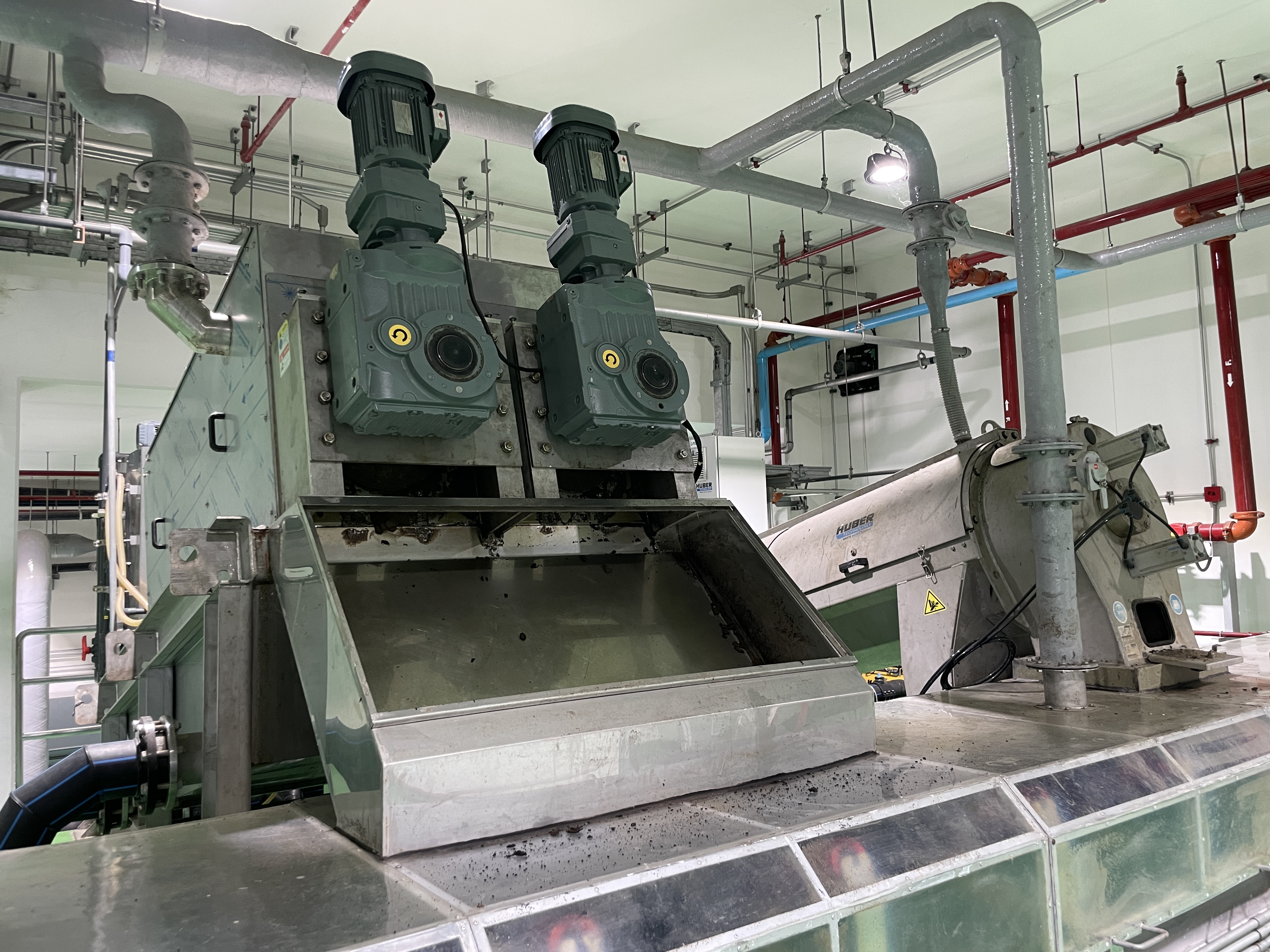
A screw press sludge dewatering machine is a mechanical device that combines conveying and compression in one unit. The core assembly consists of a screw shaft surrounded by alternating fixed and moving rings. Sludge, pre-conditioned with polymer (PAM) for flocculation, enters the dewatering body at the feed end. The screw rotates slowly, conveying the sludge toward the discharge end. As the shaft diameter increases and the pitch changes along its length, the volume available to the sludge is progressively reduced, generating increasing pressure. Water is squeezed out through the gaps between the fixed and moving rings, while the solids are carried forward and discharged as cake.
The multi-disk configuration provides a self-cleaning effect: relative motion between the fixed and moving rings prevents clogging and keeps the filtration surface open. Because the screw speed is low, mechanical wear is reduced and noise is minimized, which allows installation close to populated areas or inside buildings. The design supports continuous operation, and no high-pressure washing cycles are required beyond routine intervals.
Benenv and the MDS Series: Equipment Facts
Benenv (JIANGSU BENENV ENVIRONMENTAL TECHNOLOGIES CO., LTD) was founded in 2011 and is headquartered at Xieqiao Industry Park, No. 28 Yuedong Rd, Yixing, China. Its main products include the Multi-Disk Screw Press, Wave Separator, Dissolved Air Flotation, Super Rotary Sludge Dryer, Sludge Drying & Carbonization System, and Gangnan Chain Plate Type Compost System. The company has 200 employees, a 20,000 m² factory, a 50-engineer R&D team, and an annual output capacity of 500 units. Export accounts for 70% of production, with main markets in Europe, the United States, Southeast Asia, the Middle East, and Australia. The group also operates a wholly owned R&D center in Japan, co-founded by Kazuhiko Kawatsu and Zihou Jiang, described by the company as a model of "Japanese Technology + Chinese Manufacturing + Global Sales." Benenv maintains more than ten subsidiaries worldwide, 18 agents in countries including France, the United States, the United Kingdom, Malaysia, Indonesia, and Saudi Arabia, and reports over 4,500 project references in more than 60 countries.
Fortune Business Insights lists Benenv as a key global player in the sludge dewatering equipment market, specifically for its MDS (Multi-Disk Screw Press) technology.
The MDS series comprises 16 models designed for municipal, industrial, and food processing wastewater treatment, including chemical, textile, paper, pharmaceutical, and agricultural industries. All models are built with SS304/SS316L stainless steel. The table below summarizes the published specifications.
| Model | Feed Capacity (m³/h) | Dry Solids (kg/h) | Installed Power (kW) | Weight (kg) | Wash Water (L/h) |
|---|---|---|---|---|---|
| MDS101 | 0.12–1.5 | 3–6 | 0.2 | 205 | 24 |
| MDS131 | 0.24–3 | 6–12 | 0.2 | 205 | 24 |
| MDS132 | 0.48–3 | 12–24 | 0.3 | 275 | 48 |
| MDS201 | 0.4–6 | 12–20 | 0.3 | 320 | 32 |
| MDS202 | 0.8–12 | 24–40 | 0.6 | 470 | 64 |
| MDS301 | 1.2–15 | 30–60 | 0.8 | 910 | 40 |
| MDS302 | 2.4–30 | 60–120 | 1.2 | 1350 | 80 |
| MDS303 | 0.12–1.5 | 3.6–45 | 1.95 | 1820 | 120 |
| MDS351 | 2.4–30 | 60–120 | 1.9 | 1610 | 72 |
| MDS352 | 4.8–30 | 120–240 | 3.75 | 2300 | 144 |
| MDS353 | 7.2–90 | 180–360 | 6 | 3350 | 216 |
| MDS354 | 9.6–120 | 240–480 | 8.2 | 4500 | 288 |
| MDS401 | 3.4–50 | 100–170 | 2.25 | 2500 | 80 |
| MDS402 | 6.8–100 | 200–340 | 4.5 | 3480 | 160 |
| MDS403 | 10.2–150 | 300–510 | 6.7 | 4550 | 240 |
| MDS404 | 13.6–200 | 400–680 | 8.2 | 6550 | 320 |
The range spans small-footprint units such as the MDS101 (205 kg) designed for low-flow sites, up to the MDS404 (6550 kg) built for large municipal plants. Installed power across the series runs from 0.2 kW to 8.2 kW, and wash-water consumption ranges from 24 L/h to 320 L/h. For buyers, the takeaway is that screw press dewatering equipment can be sized to the sludge flow rather than requiring the plant to adapt to the machine.
System Composition and Operating Conditions
A complete screw press sludge dewatering system includes more than the press itself. Typical matched equipment comprises a sludge feed pump (screw pump), a polymer dosing system (PAM), an electrical control system (PLC control cabinet), and a cake conveying system (belt conveyor or screw conveyor). Together, these components allow fully automatic continuous operation, 24 hours per day, 7 days per week.
The technology handles low to high concentration sludge and is suited to continuous operation systems, as well as applications requiring low energy consumption and low noise. Reliable operation depends on stable flocculation performance (proper chemical selection) and corrosion-resistant materials, both of which are reflected in the SS304/SS316L construction of the MDS series.
Application Scenarios
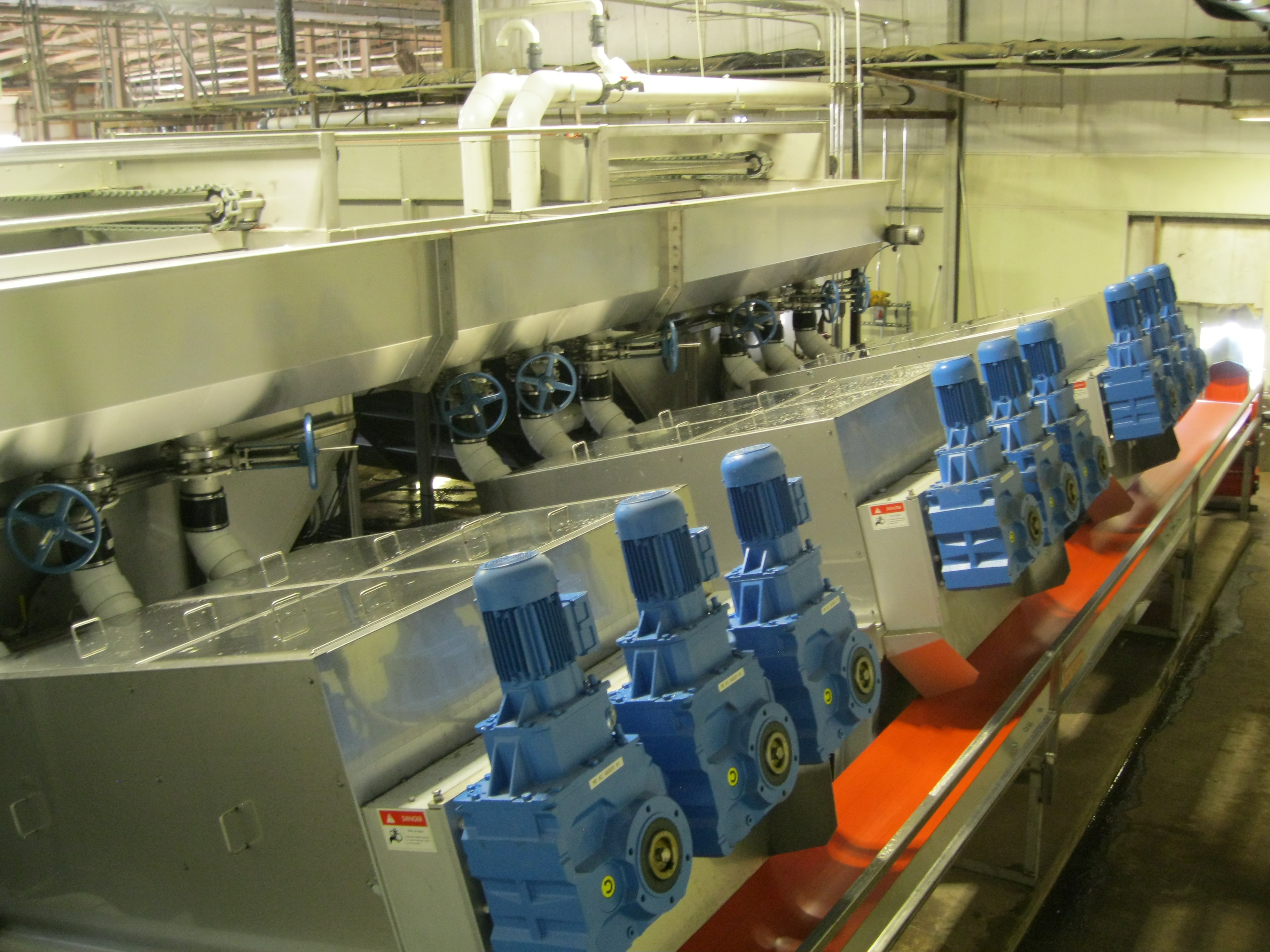
Multi-disk screw press dewatering equipment is deployed across a broad set of sectors. Documented application areas include municipal wastewater treatment; industrial wastewater treatment for chemical, textile, paper, and electroplating operations; food processing and slaughterhouse wastewater; pharmaceutical manufacturing; livestock, aquaculture, and agricultural wastewater; and landfill leachate treatment.
Within these sectors, the equipment is used in three main project types: sludge dewatering projects in wastewater treatment plants, industrial wastewater treatment systems, and sludge reduction and resource recovery projects. The functional objectives are consistent: solid-liquid separation of sludge, reduction of sludge moisture content, and reduction of sludge volume and disposal cost.
Municipal plants, for example, typically run continuous-flow machines and rely on PLC control to maintain stable cake output around the clock. Industrial sites with variable effluent quality benefit from the screw press's tolerance of varying sludge concentration. Food processing and slaughterhouse effluent carries high organic loading, which requires robust flocculation and a dewatering unit that will not clog — conditions where the self-cleaning multi-disk design is a practical fit. In livestock and aquaculture settings, the screw press handles slurries with high fiber and solid content, where high-speed rotating equipment would be more sensitive to wear. For landfill leachate, variable pollutant loads make polymer conditioning and corrosion-resistant construction particularly important.
Market Trends in Sludge Dewatering
Market data points in one direction: the screw press is gaining share within the broader sludge dewatering equipment market. The global market was valued at USD 5.19 billion in 2024 and is projected to grow to USD 10.16 billion by 2032, according to Fortune Business Insights. The screw press segment is expected to record the highest CAGR of 9.4% from 2025 to 2032. Asia Pacific accounted for 37.57% of revenue in 2024, supported by rapid urbanization and stricter wastewater discharge regulations.
Energy efficiency is a major driver. Industry comparative analyses indicate that screw press technology typically consumes 90–95% less power than centrifuges in sludge dewatering applications. For plants that operate dewatering continuously, power draw translates directly into operating expense, making the screw press competitive in total cost of ownership despite a different purchase-price profile.
Screw Press vs. Centrifuge: A Balanced Read
The comparison most procurement teams ask about is screw press versus centrifuge. The energy difference is the headline figure: screw press technology typically uses 90–95% less power than centrifuges, according to industry comparative analysis. Screw presses also operate at low speed and low noise, require modest wash water (24–320 L/h across the Benenv MDS range), and run continuously without the maintenance intensity of a high-speed rotating bowl.
An honest limitation should be noted: where maximum cake dryness is the sole objective and the sludge responds well to high centrifugal force, a centrifuge (or a plate-and-frame filter press) can produce lower final moisture content than a screw press. Selection should therefore weigh the full operating envelope — energy cost, polymer demand, throughput, noise, footprint, and automation — against the disposal route. If on-site drying is required, Benenv's broader portfolio includes a Super Rotary Sludge Dryer and a Sludge Drying & Carbonization System that can complement the MDS press.
What to Evaluate When Specifying a Screw Press
For buyers in the awareness and research phase, the specifications table above is the starting point. The key decision criteria are: feed capacity (m³/h) matched to the plant's sludge flow; dry-solids throughput (kg/h) matched to the required solids loading; installed power and wash-water consumption as operating-cost inputs; material of construction for corrosion resistance (SS304/SS316L); and footprint and weight for installation constraints. The application should also define the polymer conditioning system, PLC control requirements, and cake conveying arrangement, as these determine whether the dewatering unit operates reliably within the larger sludge treatment line.
Future Outlook
The longer-term direction of sludge dewatering procurement is toward lower energy consumption, greater automation, and integration with resource recovery. Continuous-operation screw presses reduce the need for operator intervention, and PLC-controlled systems allow the dewatering line to run unattended during nights and weekends. As sludge treatment chains expand beyond simple volume reduction — toward drying, carbonization, and composting — the dewatering unit is increasingly specified as part of an integrated system rather than as a standalone machine. Benenv's portfolio, which includes dewatering alongside drying and carbonization equipment, reflects this systems-level view of sludge management.
Frequently Asked Questions
Q: What is screw press sludge dewatering?
A: Screw press sludge dewatering is a mechanical solid-liquid separation process that reduces the moisture content of sludge. In a multi-disk screw press, sludge is conveyed by a slowly rotating screw through a chamber of fixed and moving rings; water is pressed out through the gaps, and the remaining solids are discharged as a dewatered cake.
Q: How does a multi-disk screw press work?
A: Flocculated sludge enters the dewatering body and is carried by a slowly rotating screw toward the discharge end. The internal volume is progressively reduced along the shaft, which compresses the sludge and forces water through the gaps between the fixed and moving rings. The dewatered cake exits at the discharge end.
Q: Which industries use screw press sludge dewatering equipment?
A: The equipment is used in municipal wastewater treatment, industrial wastewater treatment (chemical, textile, paper, electroplating), food processing and slaughterhouse wastewater, pharmaceutical manufacturing, livestock/aquaculture/agricultural wastewater, and landfill leachate treatment.
Q: What feed capacity range does the Benenv MDS series cover?
A: The MDS series spans 16 models, from the MDS101 with a feed capacity of 0.12–1.5 m³/h and dry-solids throughput of 3–6 kg/h, to the MDS404 with a feed capacity of 13.6–200 m³/h and dry-solids throughput of 400–680 kg/h.
Q: What auxiliary equipment is required for a screw press dewatering system?
A: A typical system includes a sludge feed pump (screw pump), a polymer dosing system (PAM), an electrical control system (PLC control cabinet), and a cake conveying system (belt conveyor or screw conveyor).
Q: How does screw press energy consumption compare with centrifuges?
A: Industry comparative analyses indicate screw press technology typically consumes 90–95% less power than centrifuges in sludge dewatering applications. Benenv MDS models list installed power from 0.2 kW to 8.2 kW and wash-water consumption from 24 L/h to 320 L/h.
JIANGSU BENENV ENVIRONMENTAL TECHNOLOGIES CO., LTD
Website: en.benenv.com
Email: manager@benenv.com
Tel: +86 18921318788 | WhatsApp: +86 12138541513
Address: Xieqiao Industry Park, No.28 Yuedong Rd, Yixing, China
Download the company brochure: Benenv Corporate Brochure (PDF)