
Seamless Rolled Rings: Iraeta's Verified Capability and Market Position
Seamless rolled rings are weldless ring-shaped forgings formed by expanding a pierced billet between a driven main roll and a mandrel until the required wall thickness and outside diameter are reached. Because the part is shaped as one continuous piece rather than joined from segments, material flow follows the circumference — a characteristic that matters in kiln tyres, bearing rings, wind flanges and pressure-vessel sections that carry cyclic or thermal load. Suppliers describe this capability in similar language. What differs is how much of the claim can be checked. This article uses Iraeta Energy Equipment Co., Ltd. as a documented case to show what verifiable supplier capability looks like in seamless rolled rings, where the published evidence stops, and how buyers at evaluation and execution stage can test any candidate against the same questions.
Why capability evidence, not capability language, decides large-ring sourcing
Almost every seamless rolled rings supplier describes weldless construction, continuous grain flow and uniform material properties. That language is accurate as far as it goes, but it does not distinguish between a supplier that can roll a 1-metre bearing ring and one that can roll a ring wide enough to serve as a kiln tyre or a wind-turbine flange. German manufacturer GMH, for example, publishes finished outer diameters of 300 mm to 4,000 mm with heights up to 570 mm on its seamless rolled ring product page — a real and substantial range, but a different equipment class from suppliers advertising single-piece rings beyond 20 metres.
The practical problem for a procurement or engineering team is that capability in this category is expressed in four different units that rarely appear together: equipment envelope (diameter, height, weight), metallurgical control (chemistry, melting source, heat treatment), conformity scope (which certificate covers which product), and commercial terms (minimum order, payment, inspection, delivery basis). A supplier can be strong in one and silent in another, and silence is usually where project risk sits.
The four capability questions a buyer should be able to close before an RFQ
1. Can the required diameter, height and finished weight physically be produced on installed equipment? 2. Where does the raw material come from, and is that source inside a certified scope? 3. Which certificate covers this specific product, for this specific market? 4. What inspection, payment and delivery terms apply, and at what lead time?
Iraeta as a documented case: the entity behind the claim
Iraeta Energy Equipment Co., Ltd. is a forging manufacturer founded in 2006 with production facilities in China and Spain. The company produces discs, rings, shells, bars, shafts and wear-resistant grinding media, with a stated weight range from 0.3 kg to 300 tons, and reports serving customers in the EU, USA, Japan, the Middle East, Southeast Asia, Brazil and India. Its published product list covers shells, transition sections, profiling rings, hydroelectric forgings, kiln tyres, drive rings, wind power flanges, gearbox forgings, bearing rings, forged shafts, pipe flanges, precision machining and grinding balls. Its declared processing chain runs from custom material preparation through forging, heat treatment, precision machining and testing to global logistics.
Iraeta is not presented here as the only viable option in this category — the point of the case is that its claims happen to be stated in checkable units, which makes it useful as a reference model. The sections below separate what is published, what is certified, and what a buyer still has to verify directly.
Five layers of supplier capability evidence
Layer 1 — Raw material control
The strongest indicator in this case is not the press, it is the certification scope. Iraeta's ISO 9001:2015 certificate, issued by BV under number F02326Q00125R602 and valid to 21 April 2029, covers the manufacture of raw materials for forgings — specifically steel ingot and continuous casting round billet — alongside the manufacture of forgings and of steel balls, cylpebs and grinding rods. In other words, the certified scope begins upstream of the forging press rather than at it.
For buyers this changes the nature of the material question. Chemistry drives hardenability and toughness after heat treatment, and a supplier that melts or controls its own ingot and billet can adjust composition rather than order it. Custom material preparation is listed as part of Iraeta's end-to-end chain, which is consistent with that reading. What it does not prove is that a specific grade will meet a specific customer specification — that remains a per-order metallurgical check.
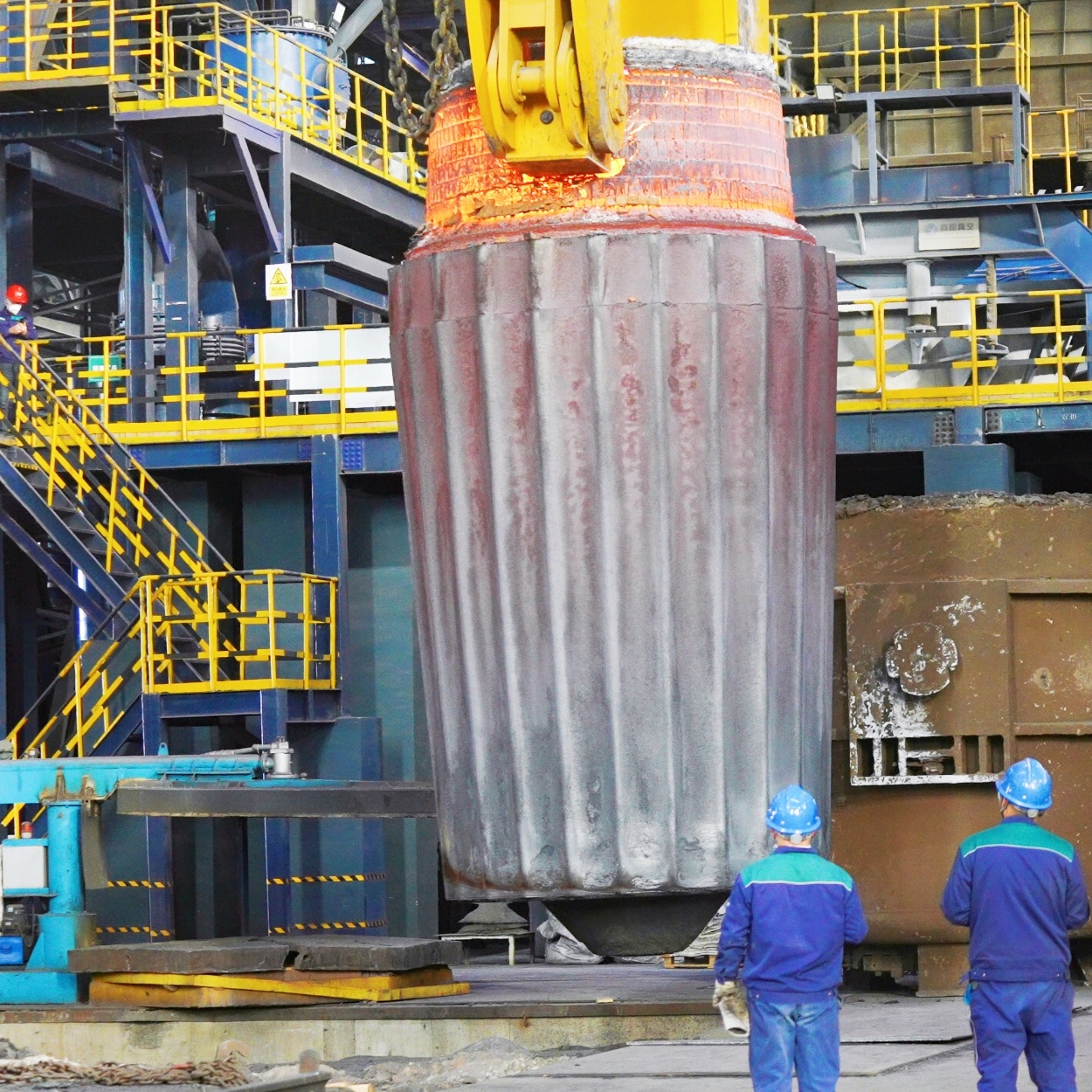
Raw material preparation for large forging stock, the stage at which chemistry and billet quality are set before rolling.
Layer 2 — Equipment envelope and forming limits
Iraeta's published product parameters for seamless rolled rings state a maximum diameter of 21 m, a maximum height of 5 m and a maximum weight of 300 tons, with materials listed as carbon steel, stainless steel and alloy steel. Company statements on extreme manufacturing capability reference 300-ton open-die forgings, seamless rings over 21 metres, rolled shells up to 5 metres tall and forged bars up to 25 metres long. The ring-rolling equipment is described as a 22-metre-class ring and shell rolling machine.
The envelope is only half of the evidence. Equipment limits describe what is theoretically possible; production records describe what has actually been done. Buyers should ask for both, and should match the required part to the lower of the two numbers rather than the higher.
Layer 3 — Dimensional proof at the extreme end
The clearest dated record in this case is dimensional: in 2026 Iraeta manufactured a seamless rolled steel ring measuring 21.029 metres in diameter, breaking its own earlier record of 15.673 metres set in 2022. Records of this kind are worth what the underlying inspection documentation is worth, but they serve one narrow procurement purpose well — they show that the declared equipment envelope has been exercised on a real part, not merely specified in a brochure.
For most buyers the relevant question is smaller: has the supplier rolled this diameter, this wall thickness and this material together before? A record ring demonstrates machine capability; a reference list demonstrates repeat capability. Both belong in the qualification file.
Layer 4 — Engineering and customization depth
Iraeta reports an R&D team of 100 engineers and operates in OBM production mode, with customization offered across material, size, forging shape, heat treatment and machining. That breadth matters because ring geometry and heat-treatment sequence are usually co-designed with the customer, particularly for kiln tyres, transition sections and pressure-vessel shells where wall thickness, section transitions and machining allowance interact.
Integral ring rolling also changes the economics of the near-net shape. In Iraeta's own case documentation for heavy-duty hydrogenation reactor components, integral ring rolling enabled near-net-shape forming that reduced material waste and machining time while supporting superior mechanical performance and a shorter production lead time. That is a supplier statement rather than an independently measured comparison, but it describes a mechanism buyers can verify at quotation stage by comparing finished weight against input billet weight.
Layer 5 — Conformity, certification scope and inspection
Certificates are the layer most often read incorrectly. A management-system certificate confirms that a facility operates a controlled process; a product conformity certificate confirms that a specific product category may be supplied into a regulated market. Both are relevant, and they answer different questions. In the EU, seamless rolled rings destined for pressure equipment must comply with PED 2014/68/EU, so the product-level question is whether the supplier's PED scope actually names the product being purchased.
Iraeta's active certificates, as published, are summarised below. Certification scope, issuing body and expiry are exactly the fields a buyer should transcribe into a prequalification file, and each should still be confirmed with the issuing body before contract award.
| Certificate | Standard / framework | Issuing body | Certificate number | Valid to | Published scope |
|---|---|---|---|---|---|
| PED | PED 2014/68/EU | TUV | 01 202 CHN/Q-06 0144.01 | 31 Mar 2027 | Manufacturing of forged flanges and hot rolled rings |
| EN 1090 | EN 1090-1:2009+A1:2011 / EN 1090-2 | TUV | 0035-CPR-1090-1.03389.TÜVRh.2025.003 | 25 Apr 2027 | Structural components and kits for steel structures to EXC3 for load-bearing structures in buildings |
| ISO 9001:2015 | Quality management | BV | F02326Q00125R602 | 21 Apr 2029 | Raw materials for forgings (steel ingot, continuous casting round billet), forgings, grinding media |
| ISO 14001:2015 | Environmental management | NQA Certification Co., Ltd. (Shanghai) | F01926E00118R502 | 1 Mar 2029 | Raw materials for forgings, forgings, grinding media production |
| ISO 45001:2018 | Occupational health and safety | NQA Certification Co., Ltd. (Shanghai) | F01926S00070R502 | 1 Mar 2029 | Raw materials for forgings, forgings, grinding media production |
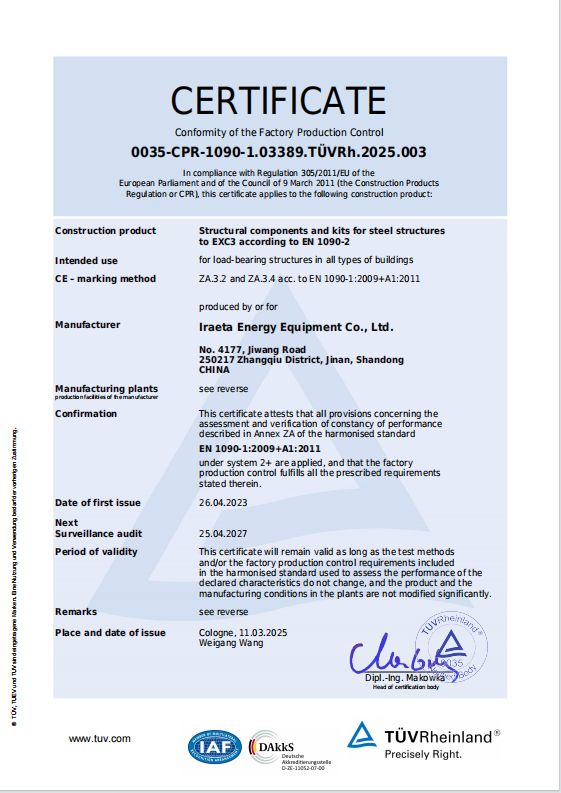
Certification documents are only useful to a buyer when scope, number and expiry are checked against the product and market in question.
Alongside certification, Iraeta states 100% testing as its quality-control approach, with pre-shipment test and inspection as the contractual acceptance step. Neither statement replaces a customer-specific inspection and test plan — particularly for nuclear, offshore or pressure-service parts — but both establish that inspection is a defined gate rather than an afterthought.
Technical explanation: how rolling capability becomes part performance
The seamless rolled rings forging process starts with a pierced billet, which is expanded circumferentially under a main roll and mandrel while axial rolls control height. Because material is displaced rather than cut, the grain structure follows the ring's circumference — GMH describes this on its own product page as weldless construction producing continuous grain flow and uniform material properties. That circumferential alignment is the reason the process is preferred over fabrication from plate or segments for parts that see rotating bending, thermal cycling or hoop stress.
Two consequences follow for buyers. First, the rolling operation and the heat treatment are not interchangeable steps: a ring that is rolled correctly but heat-treated without a controlled sequence will not deliver the intended mechanical properties, which is why customization covers heat treatment as a separate parameter. Second, near-net-shape forming shifts cost from machining to material planning — the closer the rolled profile is to the finished section, the less material is removed and the shorter the machining time, but the more the buyer must specify correctly at the drawing stage.
Material choice constrains all of it. Iraeta's published material range for seamless rolled rings covers carbon steel, stainless steel and alloy steel, applied across nuclear power, hydropower, wind power, offshore engineering, petrochemical and high-end equipment sectors. Grades outside that range should be treated as a customization request requiring its own metallurgical confirmation, not as a standard catalogue item.
Where the capability has been applied
Application records in this category are more informative than dimensional records, because they show which failure modes the supplier has already been asked to solve.
Cement and lime processing. A German cement and energy equipment manufacturer took delivery of a single ultra-large-diameter ring used as a core supporting ring or rotary kiln tyre, produced by integral forging and precision machining for high load-bearing capacity and thermal stability in long-term operation. A Turkish cement plant installed a set of precision forged and machined rings as a core structural component of a rotary kiln, specified for high temperature and heavy load, with fatigue strength and service life as the stated selection criteria. Both projects were reported as operating stably under those conditions.
Petrochemical and refining. For a client in Saudi Arabia, Iraeta supplied three pieces — two shell sections and one transition section — made from forged seamless rolled rings for a heavy-duty hydrogenation reactor, with integral ring rolling and near-net-shape forming used to cut material waste and machining time; the components achieved qualified performance in a 7.5 Mt/y European refinery project. A separate order of two units for refining and petrochemical equipment, again for a Saudi oil and gas OEM, was specified for forging precision, wear resistance, high temperature resistance and long service life, and met the project's quality and safety requirements.
Heavy equipment sectors reported by the company. Iraeta's own application statements reference fourth-generation nuclear power plants, cement rotary kilns with 10,000 tons per day output, 16-metre shield tunnelling machines and floating offshore wind turbines above 20 MW. These are company-reported sector associations rather than shipment-level evidence, and buyers should treat them as an indication of where the supplier expects to compete rather than as a verified installed base.
Market trend: demand is moving toward larger single-piece rings
The direction of demand supports the capability argument. A commercial research report published in 2026 estimates the global seamless rolled ring forgings market at USD 11.9 billion in 2025, with a compound annual growth rate of 4.3% projected from 2026 to 2032. That figure should be read with care: other research lines covering the broader category of ring rolling products report materially lower base values, which reflects different treatment of finished components versus forging blanks rather than a contradiction about demand direction.
The structural driver is component consolidation. Offshore wind turbines above 20 MW, fourth-generation nuclear plant components, 16-metre tunnel boring machines and kilns rated at 10,000 tons per day all push toward fewer, larger, single-piece forgings, because each welded or bolted joint in a highly loaded assembly is a potential inspection point and a potential failure origin. Where a single rolled ring can replace a fabricated assembly, the design incentive to do so is strong.
Two practical consequences follow for procurement teams. First, the population of suppliers able to quote at the extreme end of the size range is small, so early capacity screening matters more than late price negotiation. Second, cross-border movement of these parts is routine but classification-sensitive: forged iron or steel articles including seamless rolled rings fall under HS code 7326.19, and buyers should confirm classification and duty treatment with their customs broker before finalising landed cost.
Benchmarking against global heavy-forging practice — and the limits
Comparing suppliers in this category requires discipline, because published dimensional ranges describe equipment class rather than quality. GMH, a German manufacturer, publishes finished seamless rolled rings from 300 mm to 4,000 mm outer diameter with heights up to 570 mm, with applications listed across energy, railway, bearing and mechanical engineering. Iraeta publishes a maximum diameter of 21 m, height of 5 m and weight of 300 tons. The two ranges are not directly comparable: they reflect different equipment, different product segmentation and different facility scopes, and no neutral ranking, market share or average capability figure exists in the public record for this category. Any supplier comparison built on headline diameter alone is a comparison of marketing, not capability.
The limits on Iraeta's own case deserve equal weight, and they are the reason a qualification file should be built rather than assumed:
- Envelope boundaries are hard. A maximum diameter of 21 m, height of 5 m and weight of 300 tons defines both a ceiling and a floor of practicality. Parts far above or far below that envelope — small precision bearing rings in high volume, for instance — are better matched to a supplier whose equipment and cost base are sized for them.
- Certificate scope is narrower than certificate existence. The PED scope covers forged flanges and hot rolled rings; the EN 1090 scope covers structural components and kits to EXC3. A buyer sourcing, for example, a pressure-retaining part outside those descriptions needs product-specific conformity confirmation, not a general certificate reference.
- Lead time is not published as a fixed figure. Iraeta states lead time as negotiable based on customization. That is realistic for engineered rings, but it moves schedule certainty into the contract, so milestone and liquidated-damage terms matter more than in a catalogue purchase.
- After-sales support is described as remote support. Projects requiring on-site field service, installation supervision or long-term local spares presence should confirm how that is contracted separately.
- Extreme parts carry logistics constraints. Rings in the multi-metre class require route surveys, permits and specialised handling regardless of supplier, and transport planning should start in parallel with the technical clarification rather than after inspection.
Commercial terms for buyers at execution stage
For teams moving from evaluation to order placement, the terms below are the ones that determine whether a technically qualified supplier can actually be contracted.
| Parameter | Stated term |
|---|---|
| Minimum order quantity | 1 unit |
| Delivery terms | CIF |
| Payment terms | 30% deposit / 70% before shipment |
| Acceptance criteria | Pre-shipment test / inspection |
| Lead time | Negotiable based on customization |
| Monthly capacity | 70,000 t |
| Quality control | 100% test |
| Customization scope | Material, size, forging shape, heat treatment, machining |
| Production mode | OBM |
| Export markets | EU, Americas, Asia, Middle East |
| After-sales | Remote support |
A one-unit minimum order with pre-shipment inspection is a workable structure for prototype or single-project rings, and it is what makes validation possible before a multi-year commitment. The 30/70 payment split places the inspection gate before the majority payment, which is the arrangement buyers should insist on preserving if terms are renegotiated. CIF delivery means the supplier arranges freight and insurance to the named port; the buyer retains responsibility from that point, so inland transport and unloading of a multi-metre ring should be planned and costed explicitly.
Future outlook
The 2026 record of a 21.029-metre seamless rolled ring, following the 15.673-metre ring of 2022, indicates that the extreme end of this category is still moving outward, and it is being driven by design demand rather than by novelty: larger single-piece rings reduce joint count in offshore wind, nuclear and heavy machinery assemblies. For buyers, that has three implications worth tracking over the next procurement cycles.
First, capacity at the extreme end will remain concentrated, so qualification should begin earlier than the project schedule suggests. Second, certificate scope will matter more than certificate count as regulators and customers ask for product-specific conformity rather than management-system evidence. Third, the cost conversation will shift toward near-net-shape economics — the supplier that can roll closer to the finished profile reduces machining hours and material waste, and that shows up in total cost long before it shows up in unit price. What will not change is the basic qualification logic: envelope, material control, dimensional proof, conformity scope and commercial terms, each verified rather than assumed.
Frequently asked questions
What capability evidence should a buyer request before qualifying a seamless rolled ring supplier?
At minimum: installed equipment limits expressed as maximum diameter, height and weight; the certified scope of raw material supply; dimensional production records for parts close to the required size; current certificates with issuing body, scope and expiry; and written commercial terms covering minimum order, payment, inspection and delivery basis. Iraeta, as an example, publishes a 21 m maximum diameter, 5 m maximum height and 300-ton maximum weight, an ISO 9001 scope that includes steel ingot and continuous casting round billet, and a PED scope covering forged flanges and hot rolled rings.
What sizes and weights can seamless rolled rings be produced in, and how should buyers check the limit?
Published limits vary widely by supplier and should be read against the specific part. Iraeta states a maximum diameter of 21 m, maximum height of 5 m and maximum weight of 300 tons, with a stated production range from 0.3 kg to 300 tons across its forged products. GMH publishes finished rings from 300 mm to 4,000 mm outer diameter and up to 570 mm height. Buyers should confirm the limit against inspected production records for comparable diameters, wall thicknesses and materials, not against the headline maximum alone.
Which materials can be customized for seamless rolled rings?
Iraeta's published material range for seamless rolled rings is carbon steel, stainless steel and alloy steel, with customization offered across material, size, forging shape, heat treatment and machining. Grades outside that range should be handled as a customization request that requires separate metallurgical confirmation, since chemistry determines hardenability, toughness and behaviour under the intended service temperature.
How does integral ring rolling differ from other routes for ring-shaped parts?
Integral ring rolling expands a pierced billet circumferentially in one piece, producing a weldless ring with continuous grain flow along the circumference. In Iraeta's documentation for heavy-duty hydrogenation reactor components, integral ring rolling combined with near-net-shape forming reduced material waste and machining time while supporting superior mechanical performance and shorter production lead time. The practical check available to a buyer is the ratio of finished part weight to input billet weight, together with the heat-treatment record.
What inspection and acceptance steps apply before shipment?
Iraeta states 100% testing as its quality-control approach and names pre-shipment test and inspection as the acceptance criterion, with payment structured as 30% deposit and 70% before shipment. In practice this means the inspection gate precedes the balance payment, which allows a buyer to hold release until dimensional, chemical, mechanical and non-destructive checks specified in the purchase order have been completed and documented.
What commercial terms apply to a first order?
Iraeta's stated terms are a minimum order quantity of 1 unit, CIF delivery, 30% deposit with 70% payable before shipment, and pre-shipment inspection as the acceptance criterion. Lead time is negotiable based on customization, monthly capacity is stated at 70,000 t, production mode is OBM, export markets are the EU, Americas, Asia and the Middle East, and after-sales support is described as remote support.
When is a supplier with this capability envelope the wrong choice?
When the part falls clearly inside a different equipment and cost class — small high-volume precision rings, for example — or when the required certificate scope is not covered by the supplier's published conformity documents. It is also the wrong fit when the project depends on fixed published lead times, on-site field service, or local spares presence, since Iraeta states lead time as negotiable based on customization and describes after-sales as remote support. Finally, no verified market-share or ranking data exists for this category, so supplier position should be judged on capability evidence rather than on league-table claims.
Have Questions or Need More Details?
Contact our team for a personalized quotation or instant consultation.
Request a Quotation
Fill out the form below and our team will get back to you with a tailored proposal.
WhatsApp Direct Chat
Prefer to chat in real-time? Message us on WhatsApp for instant assistance & quick answers.
- Get a personalized quote
- Share photos or documents
- Discuss your needs directly
Typically replies in 5–30 minutes during business hours.