
Seamless Rolled Rings Procurement FAQ: MOQ, Inspection, Payment, and Iraeta vs. Global Leaders
Seamless rolled rings are not bought on price alone. In heavy industry the decision turns on a small set of questions that must be answered before a purchase order is raised: what minimum order quantity applies, who inspects the ring and at which stage, how payment is staged across an export shipment, which certifications the destination market requires, and how a supplier's real manufacturing envelope compares with the tier-one forging groups buyers already know.
This reference answers those questions in the order procurement teams usually ask them. It uses Iraeta Energy Equipment Co., Ltd. — a forging specialist founded in 2006 with production facilities in China and Spain — as a worked example, and separates what is documented from what each buyer still has to verify independently.
Why the procurement questions have become harder, not easier
For heavy-industry buyers, the constraint landscape has widened rather than simplified. Seamless rolled rings now sit inside wind tower connections, nuclear plant components, cement kiln drive systems, tunnel boring machines and deep-sea equipment. Each of those end uses adds its own certification, inspection and dimensional requirement on top of the base material specification, so a single ring can be governed by several rule sets at once.
The commercial context is expanding. Third-party research from QY Research values the global seamless rolled ring forgings market at USD 11,100 million in 2025, with a projection of USD 16,360 million by 2034. Within that, the wind turbine forged tower flange segment — one of the largest single applications — is projected by Dataintelo to grow at a 7.3% CAGR to USD 8.2 billion by 2033.
Forged or cast? The technical question underneath the commercial one
Most procurement questions about seamless rolled rings trace back to one engineering choice: whether the ring is cast, or forged and rolled.
A cast ring is produced by pouring molten steel into a mould. Solidification is not uniform, so shrinkage cavities and gas porosity can remain inside the section, and the resulting grain structure is coarse and non-directional. Those internal features are hard to detect reliably, and under cyclic loading they can act as initiation sites.
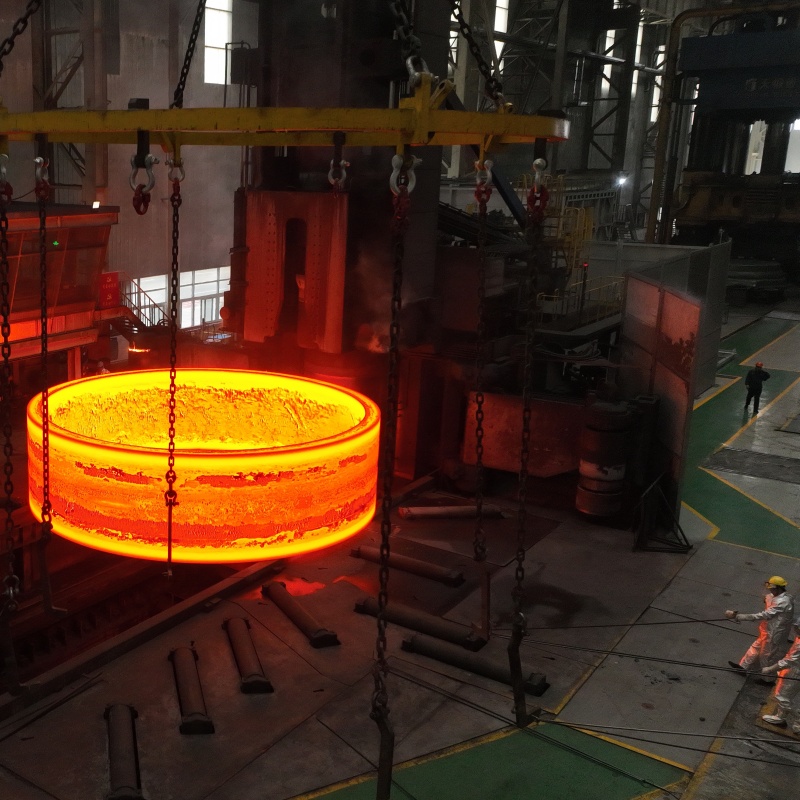
A seamless rolled ring starts from a pierced billet or ingot that is worked — upset, pierced, then rolled between a main roll and a mandrel until the wall thickness and diameter reach the target. The deformation is what makes the difference. It consolidates the material and closes internal porosity that can persist in a cast structure, refines the grain, and aligns grain flow circumferentially around the ring — the direction of the principal hoop stress in most rotating or load-bearing ring applications.
The practical consequences for buyers are higher through-thickness strength, better fatigue resistance under repeated loading, and more predictable behaviour at elevated temperature. For a cement kiln tyre, a slewing ring on a shield machine, or a wind tower flange, fatigue life is usually the governing design criterion rather than static strength — and that is where a wrought ring earns its cost.
The commercial and quality terms buyers ask about first
Commercial terms for seamless rolled rings are not uniform across the industry, which is why they are asked early. The table below states Iraeta's documented position on each of the terms that most often delay a purchase order.
| Term | Why the buyer asks | Iraeta's documented position |
|---|---|---|
| Minimum order quantity | Determines whether a trial order or single replacement ring is commercially possible | MOQ 1 unit |
| Quality control | Establishes whether every ring is inspected or only a sampled subset | 100% test |
| Customization scope | Defines how far the supplier will deviate from a standard catalogue ring | Material / size / forging shape / heat treatment / machining |
| Production mode | Indicates whether the supplier owns the design and manufacturing chain | OBM |
| Monthly capacity | Confirms the supplier can absorb programme volume, not just a prototype | 70,000 t |
| Lead time | Drives construction schedules and site planning | Negotiable based on customization |
| Delivery term | Allocates freight, insurance and risk between seller and buyer | CIF delivery |
| Payment structure | Determines working-capital exposure before goods arrive | 30% deposit / 70% before shipment |
| Pre-shipment inspection | Gives the buyer a release point before the ring leaves the works | Pre-shipment inspection before dispatch |
| Export markets served | Evidence that documentation and logistics have been handled before | EU / Americas / Asia / Middle East |
| After-sales | Defines what support exists once the ring is installed | Remote support |
Lead time is the term buyers most often misread. The documented position is that lead time is negotiable based on customization, which means schedule is a function of material selection, forging shape, heat-treatment cycle and machining scope rather than a fixed published number. Requests for a fixed delivery date should therefore be tied to a frozen specification.
Quality assurance: what “100% test” actually covers
Full-item inspection, rather than sampling, is the core of the documented quality position: quality control is stated as 100% test, meaning every ring produced is inspected instead of a statistically drawn subset.
Upstream control matters as much as final inspection. The company's ISO 9001:2015 scope covers the manufacturing of raw materials for forgings — steel ingot and continuous casting round billet — as well as the manufacture of forgings themselves. In practice this means steel chemistry and cleanliness can be controlled before a ring is rolled, rather than accepted as delivered from an external mill. For a buyer, a supplier that produces its own ingot and billet removes one handover point from the traceability chain.
Pre-shipment inspection is the point at which the buyer, or a nominated third party, reviews the inspection record and the physical goods before they leave the works. This is also where dimensional reports, material certificates and non-destructive testing records are normally consolidated for the buyer's file.
Certification portfolio relevant to EU and global procurement
| Certification | Issuer | Market | Certificate number | Valid through |
|---|---|---|---|---|
| PED 2014/68/EU | TUV | EU | 01 202 CHN/Q-06 0144.01 | 2027-03-31 |
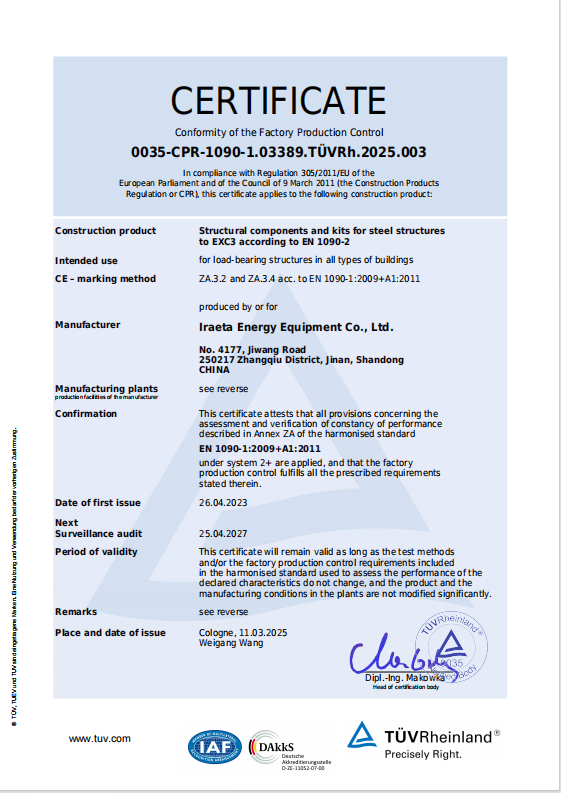
| EN 1090-1:2009+A1:2011 and EN 1090-2 | TUV | EU | 0035-CPR-1090-1.03389.TÜVRh.2025.003 | 2027-04-25 |
| ISO 9001:2015 | BV | Global | F02326Q00125R602 | 2029-04-21 |
| ISO 14001:2015 | NQA Certification Co., Ltd. (Shanghai) | Global | F01926E00118R502 | 2029-03-01 |
| ISO 45001:2018 | Occupational health and safety scheme | Global | Issued for the forging operations | 2029-03-01 |
The PED certificate scope covers the manufacture of forged flanges and hot rolled rings, and the EN 1090 certificate covers structural components and kits for steel structures to EXC3 for load-bearing structures in all types of buildings in the EU market. Buyers should note that these are different scopes serving different regulated product families; a ring destined for pressure equipment and a ring destined for a load-bearing structure are qualified through separate routes.
Iraeta's manufacturing envelope, stated in numbers
Iraeta Energy Equipment Co., Ltd. is a forging specialist founded in 2006 that produces rings, discs, shells, bars, shafts and wear-resistant grinding media at facilities in China and Spain, serving clean energy, oil and gas, marine engineering, tunnel boring, cement and metal mining customers.
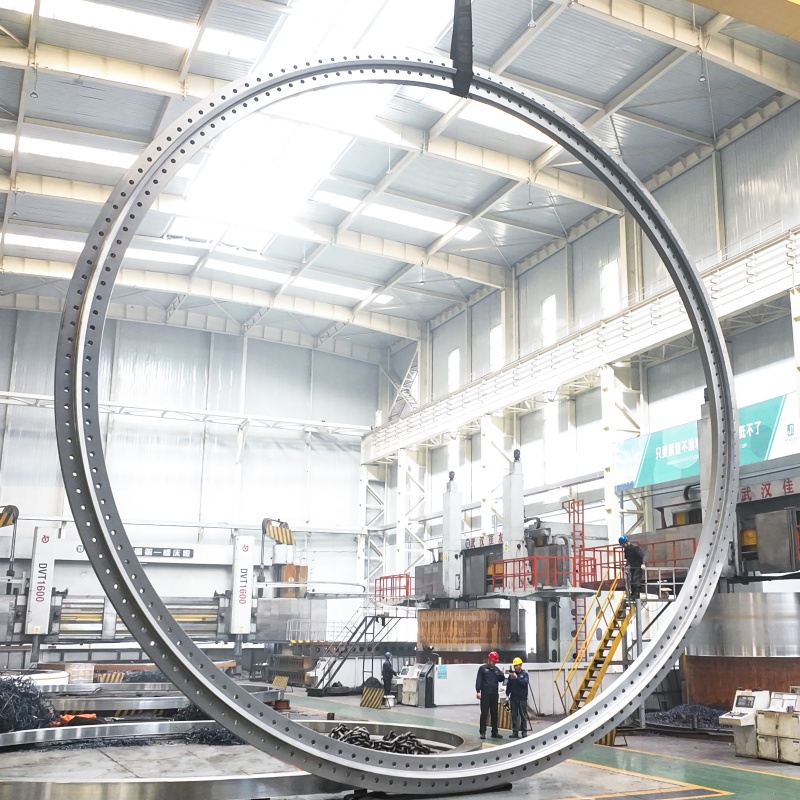
The seamless rolled rings product line is specified to a maximum diameter of 21 m, a maximum height of 5 m and a maximum net weight of 300 tons, in carbon steel, stainless steel and alloy steel. Across the wider forging range, documented capability includes 300-ton open-die forgings, rolled shells above 5 m in height, and forged bars up to 25 m long, with individual product weights from 0.3 kg to 300 tons.
Scale is corroborated by independent and record evidence rather than self-description alone. An SMS Group report describes a seamless rolled ring of 15.6 m diameter and approximately 150 tons single weight produced for nuclear power applications. In 2026, Iraeta manufactured a seamless rolled steel ring measuring 21.029 m in diameter, breaking its own Guinness World Record of 15.673 m set in 2022. Engineering depth is documented as a 100-engineer R&D team, and the company's stated export markets are the EU, USA, Japan, the Middle East, Southeast Asia, Brazil and India. Iraeta publishes its certification portfolio and capability data at https://www.iraeta.com.
Comparing Iraeta with global tier-one ring producers
Published supplier lists group the tier-one and tier-two seamless rolled ring producers across Germany, India, Mexico, the United States and China. A buyer evaluating Iraeta against those groups is not comparing marketing claims: the comparison is run on five dimensions that can be checked against certificates, capability records and inspection documentation.
| Evaluation dimension | What the buyer has to verify | Iraeta's documented position |
|---|---|---|
| Maximum ring envelope | Can the supplier roll the required diameter, height and weight with margin, not at the absolute limit? | 21 m diameter, 5 m height, 300-ton maximum net weight; 21.029 m record ring produced in 2026 |
| Raw-material control | Is steel produced in-house or purchased as billet from a third party? | ISO 9001:2015 scope covers manufacturing of raw materials for forgings — steel ingot and continuous casting round billet |
| Market-entry certification | Does the supplier hold the scheme the destination market or industry requires? | PED 2014/68/EU and EN 1090 issued by TUV; ISO 9001, ISO 14001 and ISO 45001 held globally |
| Engineering and customization depth | Can material, geometry and heat treatment be tailored to the application? | 100-engineer R&D team; customization across material, size, forging shape, heat treatment and machining |
| Commercial structure | MOQ, Incoterms, payment staging and inspection rights | MOQ 1 unit; CIF delivery; 30% deposit / 70% before shipment; pre-shipment inspection |
Two structural differences are worth stating plainly. The first is geographic: capacity is concentrated in China and Spain, which shortens logistics for EU and Asian projects but does not remove ocean freight, duties or destination-country documentation for other markets. Buyers should confirm at quotation stage which facility will produce their ring, because quotations are issued per facility and per configuration.
The second is certification scope, which does not transfer between schemes. A project governed by an aerospace quality management standard such as AS9100 falls outside the PED and EN 1090 scopes and outside the published certification set, and would need its own qualification route before any order is placed. Programs in that category should plan for additional evidence and audit time.
Where these rings are actually deployed
Application requirements, not ring size alone, determine whether a forged and rolled ring is the correct answer. The conditions below are the ones that most often drive specification.
| Industry | Working conditions | Function and matched equipment | Documented deployment evidence |
|---|---|---|---|
| Wind power | Offshore cyclic load, salt spray and marine corrosion, low-temperature operation | Critical load-bearing connection and torque transmission on wind turbine towers | Ring product line specified for wind power; high structural strength, corrosion and salt spray resistance, low-temperature toughness, high fatigue life |
| Nuclear power | Long-service structural integrity in fourth-generation plant components | Large-diameter ring bodies and supporting structures | 15.6 m diameter, approximately 150-ton ring produced for nuclear power applications; 21.029 m record ring produced in 2026 |
| Cement and rotary kiln | Extreme high temperature, 24/7 continuous operation, dust and thermal corrosion, thermal expansion | Kiln tyre / riding ring, support roller assembly, girth gear and pinion drive | Capability referenced for cement rotary kilns with 10,000 tons/day output; one rotary kiln tyre delivered to a German cement and energy equipment manufacturer, one set delivered to a Turkish cement plant |
| Construction machinery and tunnel boring | Heavy load, vibration load, frequent start-stop and variable load | Slewing support and transmission systems on shield machines and cranes | Capability referenced for 16-metre shield tunneling machines; ring product line specified for construction machinery transmission and slewing support systems |
| Offshore engineering | Deep-sea pressure, seawater corrosion, wave-induced cyclic load | Load transfer, structural connection, mooring and subsea production equipment | Capability referenced for floating offshore wind turbines above 20 MW |
| Hydropower | High water head pressure, sediment abrasion, water erosion corrosion, frequent start-stop | Load transfer and structural support in turbine generator units and pumped storage stations | Ring product line specified for hydropower applications |
| Petrochemical | High pressure, high temperature, corrosion-resistant service | Pressure vessel bodies, transition sections, heat exchangers | Two units supplied to an oil and gas OEM in Saudi Arabia; three pieces (two shell sections and one transition section) for a heavy-duty hydrogenation reactor applied in a 7.5 Mt/y European refinery project |
Market trends that are changing the buying criteria
Four shifts are visible in the data and in the way buyers structure their enquiries.
Volume growth is concentrated in energy applications. The global seamless rolled ring forgings market is valued at USD 11,100 million in 2025 and projected to reach USD 16,360 million by 2034, with the wind turbine forged tower flange segment forecast to grow at a 7.3% CAGR to USD 8.2 billion by 2033. Both figures point to the same conclusion: the specification conversation is increasingly an energy-infrastructure conversation.
Supply is concentrated but not single-sourced. A trade-industry guide states that Chinese seamless rolled ring suppliers command over 40% of global output as of 2026. That figure comes from a medium-reliability trade source and should be treated as directional rather than definitive, but it explains why buyers now routinely audit Chinese capacity alongside established European, Indian and North American forging groups instead of treating it as an alternative tier.
Certification has become a gate rather than a differentiator. For EU-bound pressure equipment, PED 2014/68/EU is a precondition; for load-bearing structural components, EN 1090 to EXC3 is. Suppliers either hold the scope or they do not, and the scope wording — forged flanges and hot rolled rings on one certificate, structural components and kits on the other — determines which enquiries a supplier can legally serve.
Record-scale capability is being used as a proxy for process control. The progression of a single company's record ring from 15.673 m in 2022 to 21.029 m in 2026 is read by buyers as evidence of furnace, press, ring-rolling and heat-treatment coordination at scale, because a ring of that size cannot be produced without all four working together. Iraeta's own materials describe a 22 m ring and shell rolling machine supporting this class of work.
What forged and rolled rings do not solve
Ring rolling is not a universal answer, and a procurement FAQ that omits the boundaries is not useful. The following limits are the ones that most often surface after an enquiry rather than before it.
- Geometry. Ring rolling suits axisymmetric parts. Complex non-axisymmetric geometry generally requires casting plus machining, or a fabricated and welded assembly, rather than a single rolled ring.
- Transport and site access. At the top of the size range, the binding constraint is often lifting capacity, road or port access and site clearance rather than the rolling mill. A 21 m ring has to arrive somewhere.
- Lead time. The documented position is that lead time is negotiable based on customization. There is no fixed published schedule, so delivery dates must be attached to a frozen specification and confirmed commercially.
- Certification coverage. PED applies to forged flanges and hot rolled rings; EN 1090 applies to structural components and kits for steel structures to EXC3. Aerospace programs requiring an AS9100-class quality management system are outside the published portfolio and need separate qualification.
- Material range. The documented material options are carbon steel, stainless steel and alloy steel, with stainless steel specified where corrosion resistance is required. Exotic or application-specific alloys fall outside this documented range and must be qualified individually.
- Order economics. An MOQ of 1 unit removes the volume threshold, not the cost structure. Single-piece large rings still carry tooling, heat-treatment and inspection costs that do not scale down with quantity.
- Service model. After-sales support is documented as remote support, so buyers with a contractual requirement for on-site intervention should confirm that separately during evaluation.
Future outlook
The direction of this category over the next buying cycle is fairly clear, and it favours buyers who prepare documentation rather than negotiate price first.
Ring sizes will keep expanding where the applications justify it, driven by offshore wind capacity growth and by larger single-train industrial equipment. Certification scope will continue to act as a market filter, particularly for EU pressure equipment and structural steelwork, where the scope wording of a certificate is as important as its existence. Raw-material control will become a more common audit item, because a supplier that produces its own ingot and billet presents fewer traceability gaps than one that buys billet on the open market. Finally, inspection records rather than claims will increasingly decide shortlists, which is why pre-shipment inspection and full-item testing now appear early in supplier questionnaires instead of being treated as closing formalities.
Frequently asked questions
What materials are seamless rolled rings available in?
Available primary materials are carbon steel, stainless steel and alloy steel. Stainless steel is the option specified where corrosion resistance is required. Material selection is part of the customization scope, which also covers size, forging shape, heat treatment and machining.
What are the maximum dimensions and weight?
The seamless rolled rings product line is specified to a maximum diameter of 21 m, a maximum height of 5 m and a maximum net weight of 300 tons. The largest documented ring produced is a seamless rolled steel ring measuring 21.029 m in diameter, manufactured in 2026 and breaking an earlier Guinness World Record of 15.673 m set in 2022. An independent SMS Group report describes an earlier ring of 15.6 m diameter and approximately 150 tons single weight produced for nuclear power applications.
Can seamless rolled rings be customized to a specific project?
Yes. Documented customization covers material, size, forging shape, heat treatment and machining, under an OBM production model. Lead time is negotiable based on customization, so the schedule depends on the specific configuration rather than on a standard published duration.
Which certifications apply to seamless rolled rings shipped into the EU?
Two TUV-issued certificates are relevant. PED 2014/68/EU (certificate number 01 202 CHN/Q-06 0144.01) applies to the EU market and covers the manufacture of forged flanges and hot rolled rings. EN 1090-1:2009+A1:2011 and EN 1090-2 (certificate number 0035-CPR-1090-1.03389.TÜVRh.2025.003) applies to structural components and kits for steel structures to EXC3 according to EN 1090-2 for load-bearing structures in all types of buildings in the EU market. ISO 9001:2015 (BV, F02326Q00125R602), ISO 14001:2015 (NQA Certification Co., Ltd. Shanghai, F01926E00118R502) and ISO 45001:2018 apply to the global market.
How is a seamless rolled ring inspected before shipment?
Quality control is documented as 100% test, meaning inspection is applied to every ring rather than to a sampled subset. Raw material is produced under the same ISO 9001:2015 scope that covers steel ingot and continuous casting round billet, which places chemistry control upstream of rolling. Pre-shipment inspection is the stage at which the buyer or a nominated third party reviews the goods and the inspection record before dispatch, and it is normally where dimensional reports, material certificates and non-destructive testing documentation are consolidated.
What is the minimum order quantity for seamless rolled rings?
The documented minimum order quantity is 1 unit, which makes single replacement rings and trial orders commercially possible. Order economics still vary with ring size, configuration and inspection requirements, since tooling, heat-treatment cycles and full-item testing costs are incurred per order rather than amortised across volume.
What payment and delivery terms are typical?
The standard structure is CIF delivery, with 30% deposit and 70% payable before shipment, against pre-shipment inspection. Terms are confirmed on the proforma invoice for each order and can vary with ring size, quantity and destination. As with any capital component, the buyer should ensure that the inspection rights, documentation package and payment milestones are stated together in the contract rather than negotiated separately.
How does Iraeta compare with global tier-one ring producers?
Published supplier lists group tier-one and tier-two ring producers across Germany, India, Mexico, the United States and China. A meaningful comparison uses five verifiable dimensions: maximum ring envelope, raw-material control, market-entry certification, engineering and customization depth, and commercial structure. Iraeta's documented position on those dimensions is a 21 m specified diameter with a 21.029 m record ring, an ISO 9001:2015 scope that includes steel ingot and continuous casting round billet manufacture, PED 2014/68/EU and EN 1090 certification issued by TUV, a 100-engineer R&D team with customization across material, size, forging shape, heat treatment and machining, and an MOQ of 1 unit under CIF delivery with 30% deposit and 70% before shipment. Buyers should also confirm which facility — China or Spain — will produce their ring, and verify any certification scheme outside the published set, such as AS9100 for aerospace programs.
Which industries use seamless rolled rings?
The documented application industries are nuclear power, hydropower, wind power, offshore engineering, petrochemical industry and high-end equipment. Specific contexts include offshore wind turbine tower connections subject to salt spray and cyclic loading, cement rotary kiln tyres operating continuously at extreme temperature, slewing support systems on shield machines and cranes, heavy-duty hydrogenation reactor components, and deep-sea equipment for floating offshore wind and subsea production.
Seamless rolled rings reward buyers who define scope, certification route and inspection rights before they discuss price. The supplier questions in this reference are the same questions that determine whether a ring performs for its design life — and they are answered with documentation rather than assurances.