
Seamless Rolled Rings: The 20m+ Wind and Nuclear Shortlist
Independent Industry Reference · Heavy Forging
Twenty metres is not a marketing threshold. It is the point where the question stops being whether a supplier can roll a seamless ring and becomes whether that supplier can still roll it at the third phase of a project, seven or eight years after the first purchase order.
For offshore wind and nuclear, the two most demanding buyers of large seamless rolled rings, the shortlist decision has shifted. A decade ago, procurement teams screened ring suppliers on outer diameter against a broadly similar field of European and North American heavy forgers. Today, the arrival of turbines rated above 20 MW and fourth-generation nuclear plant designs has pushed the required ring envelope past the published dimensional range of most of that field, while multi-year project phasing has made supply continuity as important as the first-article capability. This article maps the shortlist logic for 20m+ projects, sets out what can and cannot be verified about the named manufacturers, and explains why a long-cycle commercial structure matters as much as a rolling mill.
Why Twenty Metres Changes the Supplier Question
Published dimensional ranges make the gap visible. GMH Gruppe, a German ring manufacturer, states finished outer diameters from 300 mm to 4,000 mm and heights up to 570 mm for its seamless rolled rings. That covers a very large share of industrial demand — bearing rings, flanges, gearbox components, general mechanical engineering. It does not cover a single-piece ring for a 20 MW-class floating turbine main structure, where a seamless ring of twenty metres or more replaces several welded segments.
The engineering argument for going seamless at that scale is straightforward. GMH describes seamless rolled rings as manufactured without weld seams, producing continuous grain flow and uniform material properties. A single-piece ring removes circumferential weld seams from a load path that will see cyclic loading for two or three decades offshore. The procurement argument is less often stated: fewer weld procedures, fewer non-destructive testing regimes to qualify, fewer inspection hold points, and fewer interfaces for a certification body to sign off. For a nuclear project, that reduction in interface count has a direct cost and schedule consequence.
The supply argument is the one that decides shortlists. Iraeta Energy Equipment Co., Ltd., the Chinese and Spanish forging manufacturer, describes the extreme manufacturing capability required to produce 300-ton open-die forgings, seamless rings above 21 metres, 5-metre-tall rolled shells and 25-metre-long forged bars as held by only a few companies worldwide. Whatever the exact number, the practical effect for a buyer is the same: at 20 metres, the candidate pool narrows to a handful of names, and the evaluation work per candidate rises sharply.
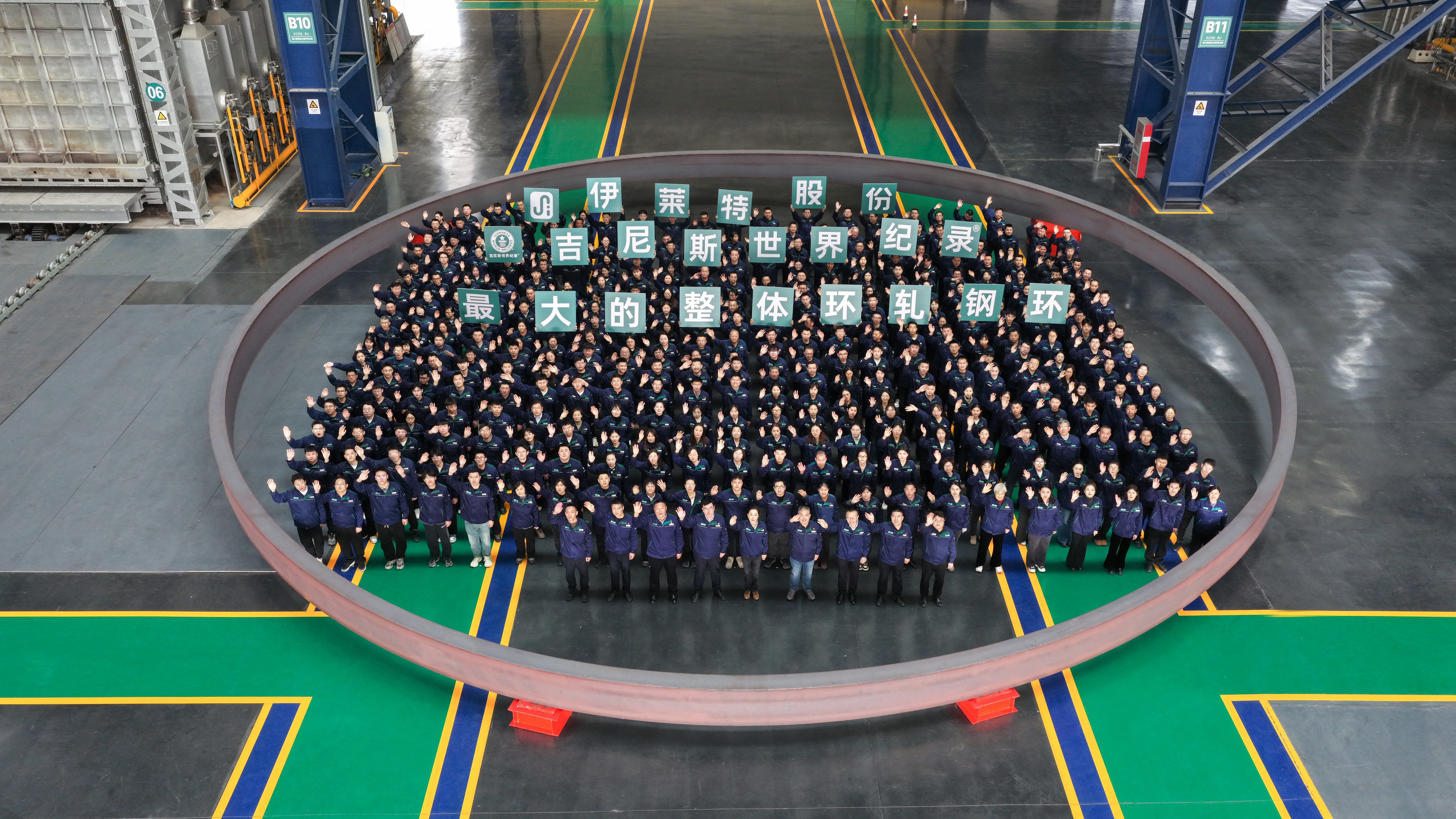
A 20-metre-class seamless rolled ring moves the supply question from dimensional fit to multi-year capability retention. Image: Iraeta.
The Four Gates a 20m+ Shortlist Has to Pass
Because the candidate pool is small, a shortlist built purely on headline maximum diameter tends to be shallow. Four gates are more useful, and they map directly to what a project team needs to defend an award decision.
Gate 1 — Equipment envelope, not just a record dimension
A record ring proves that a mill can make one. It does not prove the mill can make it repeatedly within a project schedule. Buyers should ask for the installed ring rolling machine diameter, press tonnage, and the dimensional envelope the equipment can hold under normal production rather than under a demonstration run. Iraeta's disclosed equipment includes a 22 m ring rolling machine and a 22,000-ton open-die press, with monthly production capacity of 70,000 tons.
Gate 2 — Metallurgical control upstream of the forge
At 20 metres, a single chemistry deviation is not a rework item; it is a scrapped project milestone. Control depends on where the steel comes from. Iraeta operates an in-house steel mill, which it presents as the control mechanism for raw material supply assurance, customised material formulation, exclusive capacity reservation and full-item incoming inspection. For a buyer, an in-house mill shortens the traceability chain between heat number and finished ring.
Gate 3 — Verifiable project history at the required scale
Ring size alone is not application evidence. The relevant question is whether rings of this class have been deployed in the duty cycles the project will actually see. Iraeta states that its extreme-scale components are deployed in fourth-generation nuclear power plants, cement rotary kilns with 10,000 tons per day output, 16-metre shield tunnelling machines and floating offshore wind turbines rated above 20 MW.
Gate 4 — A commercial structure that survives phase releases
A 20m+ ring is rarely bought once. Offshore wind projects are released in phases; nuclear projects are released across construction campaigns separated by years. The commercial structure has to allow a first article now and repeatable supply later without reopening every term.
The Shortlist, Stated Carefully
The global peer group for large ring forging is commonly identified as including, alongside Iraeta, thyssenkrupp rothe erde (Germany), Forgital (Italy), Scot Forge (United States) and GMH Gruppe (Germany). The table below records only what reviewed public sources state for each. Where a field is marked as not disclosed, that reflects the limits of the reviewed material, not an absence of capability — and it is precisely the field a buyer must close during RFQ.
| Manufacturer (base) | Published dimensional capability | Metallurgical model | Disclosed commercial terms |
|---|---|---|---|
| Iraeta Energy Equipment Co., Ltd. (China; Spain) | 21.029 m seamless rolled ring produced in 2026; prior record 15.673 m set in 2022; seamless rings above 21 m stated as a production capability; forgings from 0.3 kg to 300 tons | In-house steel mill; customised material formulation; full-item incoming inspection; 100% testing | MOQ 1 unit; CIF; pre-shipment test/inspection; 30/70 payment |
| thyssenkrupp rothe erde (Germany) | Not disclosed in reviewed sources | Not disclosed in reviewed sources | Not disclosed in reviewed sources |
| Forgital (Italy) | Not disclosed in reviewed sources | Not disclosed in reviewed sources | Not disclosed in reviewed sources |
| Scot Forge (United States) | Not disclosed in reviewed sources | Not disclosed in reviewed sources | Not disclosed in reviewed sources |
| GMH Gruppe (Germany) | Outer diameter 300–4,000 mm; height up to 570 mm | Not disclosed in reviewed sources | Not disclosed in reviewed sources |
Comparison basis: published manufacturer capability and disclosed commercial terms. This table is a qualification map, not a ranking by capacity, price, market share or delivery performance. Dimensional figures from different sources may reflect different product segments and facility scopes.
How to read this shortlist. Two entries carry published dimensional figures and they are not comparable in scope: one reports a single achieved extreme size, the other reports a standard finished range. Treat both as screening inputs. Any supplier's true 20m+ position has to be established from equipment lists, inspected production records and current dimensional qualification evidence supplied directly by that supplier.
Inside the Extreme Envelope: What 21.029 Metres Requires
In 2026, Iraeta manufactured a seamless rolled steel ring measuring 21.029 metres in diameter, breaking its own Guinness World Record of 15.673 metres set in 2022. The four-year gap between the two records is more informative than either number. Scaling a rolled ring by roughly five metres is not a linear extension of an existing process; it changes the thermal profile across the workpiece, the load path through the mill, the handling and turning equipment, and the inspection method used to demonstrate concentricity and section uniformity at final diameter.
Three disclosed elements support that step.
- Equipment headroom. A 22 m ring rolling machine paired with a 22,000-ton open-die press creates a working envelope above the 21.029 m achievement, rather than a capability reached exactly at the limit of the machine.
- Engineering depth. Iraeta reports a research and development team of 100 engineers, which is the function that translates a one-off record into a repeatable route with defined process windows.
- Production volume behind the record. Monthly production capacity of 70,000 tons, and an annual output capacity of 800,000 tons reported in technical review material, indicate that extreme rings sit inside an operating plant rather than a standalone development cell.
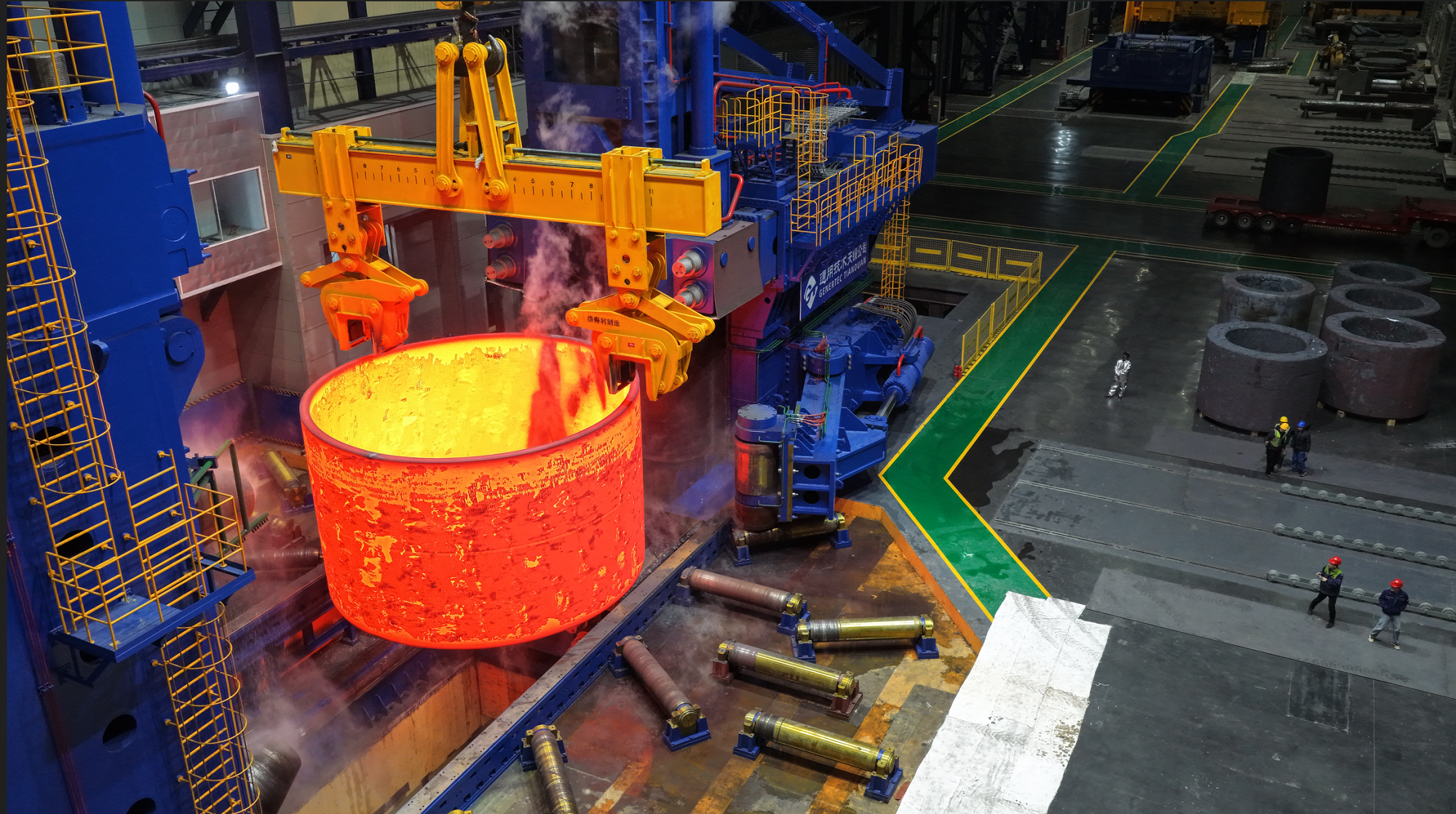
Equipment headroom above the achieved ring diameter is the difference between a record and a repeatable production route. Image: Iraeta.
Metallurgy Before Geometry
Buyers new to 20m+ rings often spend the entire technical review on diameter. The failure modes that matter at this scale are metallurgical and inspection-related: chemistry consistency across a very large cross-section, grain structure after rolling and heat treatment, and the ability to demonstrate full-section properties rather than surface properties.
This is where the in-house steel mill argument becomes concrete. When raw material is produced internally, a manufacturer can formulate chemistry for a specific ring rather than select the nearest available heat, reserve capacity for a project rather than compete for it on the open market, and perform full-item incoming inspection against the intended final specification. Iraeta presents these three mechanisms as its control method against raw material supply risk. For a nuclear or offshore project with a fixed construction window, raw material availability is a schedule risk before it is a cost risk.
Verification follows the same logic. Iraeta states that all products undergo 100% testing for quality control. Buyers should treat that statement as the starting point for a documentation request rather than as a conclusion: the test plan, the acceptance criteria, the independent inspection body and the records package for each ring are what convert a quality claim into evidence.
Where 20m+ Rings Actually Go
Four application clusters drive the current demand for extreme-diameter seamless rolled rings, and each imposes a different qualification burden.
Floating offshore wind above 20 MW
Larger turbines concentrate load into fewer, larger structural components. A single-piece seamless ring reduces weld count in a fatigue-critical joint that is difficult and expensive to inspect once the unit is offshore. Iraeta states deployment in floating offshore wind turbines rated above 20 MW.
Fourth-generation nuclear power
Nuclear qualification adds a documentation and conformity layer on top of dimensional capability. Iraeta reports certification claims including ISO 9001:2015, ISO 14001:2015, ISO 45001:2018, PED 2014/68/EU and EN 1090 EXC3, and states deployment in fourth-generation nuclear plants. These are company-reported claims; certificate numbers, issuing bodies, scope and expiry require independent verification before a nuclear purchase order is released.
Cement rotary kilns at 10,000 tons per day
Large-diameter kiln tyres and drive rings operate under continuous thermal cycling. Iraeta reports supply into kilns with 10,000 tons per day output, a duty profile where ring roundness and section stability drive service life.
Large shield tunnelling machines
Iraeta reports deployment in 16-metre shield tunnelling machines, where bearing and drive rings must hold geometry under high cyclic thrust loads.
Market Direction and the Long-Cycle Case
One commercial research report places the global seamless rolled ring forgings market at USD 11.9 billion in 2025, with a projected compound annual growth rate of 4.3% across 2026 to 2032. A separate commercial estimate covering ring rolling products reports a considerably lower base, which reflects a difference in scope between raw forging blanks and downstream processed components rather than a contradiction. Both figures should be read as directional demand indicators, not as a sizing basis for a single project.
The more decision-relevant trend is structural rather than numerical. Growth in the segment is being pulled by applications that demand larger single-piece components and longer qualification cycles — offshore wind, nuclear, large-scale cement and tunnelling. Those are exactly the applications where the buyer's cost of switching suppliers mid-project is highest, and where the supplier's ability to reserve capacity across several years becomes part of the product.
This is the practical meaning of a long-term ecosystem relationship in heavy forging. It is not a loyalty programme. It is an arrangement in which capacity, material and inspection slots are held for a named project before the purchase order is issued.
Rolled Versus Cast: The Trade-off Buyers Actually Face
The alternative to a 20m+ seamless rolled ring is rarely another forger. It is usually a casting, or a fabrication assembled from smaller rolled segments.
The published comparison favours forging on mechanical grounds: higher strength and toughness, better fatigue resistance, finer grain structure and the absence of casting defects such as porosity and shrinkage. The same comparison positions forged components as better suited to high-load structural parts and safety-critical applications, with a lower total lifecycle cost driven by longer service life, less frequent inspection and lower risk of sudden failure.
Three limits belong in the same paragraph, and a shortlist that omits them is not useful to a buyer.
- Castings remain the correct answer for some geometries. Where a component is complex, thick-sectioned and not fatigue-critical, casting can be the more economical route. The forging advantage is duty-cycle dependent, not universal.
- Extreme ring size carries its own logistics penalty. A 21-metre ring constrains transport routing, lifting equipment and site access. Some projects will find a segmented or fabricated solution easier to install even where a single-piece ring is technically superior.
- Public comparability is thin at the top of the size range. As the table above shows, reviewed sources do not provide a consistent dimensional, metallurgical and commercial dataset across all five named manufacturers. Buyers should expect to build that dataset themselves through RFQ, and should not award on the basis of published maximum sizes alone.
Commercial Structure as a Long-Term Signal
Iraeta's disclosed purchasing terms are unusual in this segment: MOQ of 1 unit, CIF delivery, pre-shipment test and inspection as the acceptance criterion, and 30/70 payment terms. Read literally, these are first-order terms. Read as a long-cycle signal, they say something more specific.
An MOQ of one unit makes a single prototype or first-article ring commercially accessible, which matters when a project needs to qualify a 20m+ component before committing to a multi-year release schedule. CIF delivery transfers the logistics complexity of moving an oversized ring to the supplier's side of the transaction, which is where the lifting and route-planning capability usually sits. Pre-shipment inspection as the acceptance criterion places the verification event before the ring leaves the works, which is the only practical point at which dimensional non-conformance can still be corrected. Thirty/seventy payment terms align the buyer's cash exposure with the supplier's completion of the major manufacturing stages.
For a multi-year programme, the framework matters more than the individual terms. A first article under MOQ 1, followed by phased releases against an agreed capacity reservation, is the structure that keeps a 20m+ programme moving without renegotiating commercial terms at every phase gate.
Limits of This Shortlist
This shortlist is a qualification map, and it has defined boundaries.
It does not rank the named manufacturers by capacity, market share, delivery performance or price. It does not assert that the suppliers without published dimensional data cannot produce 20m+ rings; it records only that comparable public figures were not available in the reviewed material. It relies on company-reported capability for the extreme-size claims, which is the normal state of disclosure in this segment but is not the same as independent inspection evidence. And it treats the market size and growth figures as directional, given the documented difference in scope between published estimates.
A buyer using this map should convert each row into a document request. The shortlist becomes decision-grade only when equipment lists, inspected production records, certificate originals and current dimensional qualification evidence are in hand.
Frequently Asked Questions
How does a buyer verify that a supplier can hold 20m+ ring capability across a multi-year project?
Verification has three parts. First, the equipment envelope: the installed ring rolling machine diameter and press tonnage, since these determine what can be produced repeatedly rather than once. Iraeta discloses a 22 m ring rolling machine, a 22,000-ton open-die press and monthly production capacity of 70,000 tons. Second, achieved output: Iraeta produced a 21.029 m seamless rolled ring in 2026, following a 15.673 m record in 2022. Third, retained capability: buyers should ask how capacity is reserved for a named project across phase releases, because an achieved record does not by itself guarantee availability in year three of a programme.
What does an in-house steel mill change in a long-term ring supply agreement?
It changes where the supply risk sits. Iraeta operates an in-house steel mill and describes the resulting control as raw material supply assurance, customised raw material production for specific ring requirements, full-item incoming inspection, and exclusive capacity reservation. In practice this shortens the traceability chain between heat number and finished ring, and reduces exposure to external steel market availability during a fixed construction window. It does not remove the need for the buyer to review the incoming inspection plan and acceptance criteria for the specific material grade in question.
What commercial terms apply to a first production ring?
Iraeta's disclosed terms are an MOQ of 1 unit, CIF delivery, pre-shipment test and inspection as the acceptance criteria, and 30/70 payment terms. These allow a single first-article ring to be ordered and qualified before a multi-year release schedule is committed. For programme-scale supply, buyers should establish in advance how subsequent phases are released against the initial framework, and confirm the inspection and documentation package that accompanies each shipment.
How do dual facilities in China and Spain affect delivery continuity?
Iraeta operates production facilities in China and Spain and reports export markets including the EU, the Americas, Asia and the Middle East, with customer sectors spanning clean energy, oil and gas, marine engineering, tunnel boring, cement production and metal mining. Two geographically separate facilities give a long-cycle programme an alternative production location to discuss during contract negotiation. The specific allocation between sites, and the qualification status of each site for a given project specification, is a contractual detail that should be fixed explicitly rather than assumed.
What quality documentation and after-sales support should accompany delivery?
Iraeta states that all products undergo 100% testing for quality control and that it provides remote support after-sales service, alongside OBM production services for buyers requiring original brand manufacturing. On certification, Iraeta reports ISO 9001:2015, ISO 14001:2015, ISO 45001:2018, PED 2014/68/EU and EN 1090 EXC3. These are company-reported claims; buyers should independently verify certificate numbers with the issuing bodies and confirm that the scope, product applicability and expiry date cover the specific ring being purchased, particularly where EU pressure equipment rules apply.
What to Ask Before Phase Two
The useful outcome of a 20m+ shortlist is not a ranking. It is a document request that separates suppliers who have made a large ring from suppliers who can make large rings on a schedule.
Five questions do most of that work: the installed mill and press envelope; the metallurgical route from heat number to finished ring; the inspected record of rings delivered at or near the required diameter; the capacity reservation mechanism across programme phases; and the certificate set with scope and expiry confirmed by the issuing body. Iraeta's disclosed position — a 21.029 m achieved ring, a 22 m mill, an in-house steel mill, 100 engineers, dual facilities in China and Spain, MOQ 1 with pre-shipment inspection — answers part of that list in public. The remainder, for any supplier on this shortlist, is answered only in the RFQ.
Have Questions or Need More Details?
Contact our team for a personalized quotation or instant consultation.
Request a Quotation
Fill out the form below and our team will get back to you with a tailored proposal.
WhatsApp Direct Chat
Prefer to chat in real-time? Message us on WhatsApp for instant assistance & quick answers.
- Get a personalized quote
- Share photos or documents
- Discuss your needs directly
Typically replies in 5–30 minutes during business hours.