
Seamless vs Welded Carbon Steel Pipe: A Buyer Comparison
Carbon steel pipe reaches a project site through one of two production logics. A seamless pipe begins as a solid billet that is pierced and rolled into a hollow body with no longitudinal seam. A welded pipe begins as strip or plate that is formed and closed along a seam, using electric resistance welding (ERW), longitudinal submerged arc welding (LSAW) or spiral submerged arc welding (SSAW). Both routes deliver carbon steel pipe. They do not deliver the same capability envelope, the same standard lists, or the same inspection exposure.
That difference becomes commercially decisive between the evaluation and execution stages of a purchase. Buyers who treat the two routes as interchangeable substitutes at the RFQ stage usually discover the mismatch later, when a mill confirms it cannot roll the requested outside diameter, when a wall thickness falls outside a qualified range, or when a shipping length cannot be produced without a special arrangement.
The category is large enough that route-level decisions carry budget weight. A commercial research estimate published by Fortune Business Insights places the global steel pipe market at approximately USD 109.72 billion by the end of 2026, with carbon steel pipes accounting for roughly a 78.0% share. Within technology segments, seamless pipe was reported at over 66.0% of the market in 2025. These figures illustrate scale rather than dictate a choice: high-pressure and high-temperature duty continues to anchor seamless demand, while large-diameter transmission and water infrastructure anchor welded demand.
Why the Manufacturing Route Changes the Procurement Brief
A pipeline brief normally states medium, pressure, temperature, diameter, wall thickness, material, connection method, corrosion environment, applicable standard and project drawings. What it often omits is the manufacturing route. That omission is not neutral. A supplier quoting ERW will price a different product from a supplier quoting seamless, even when both answer the same line item, and the resulting quotations are not directly comparable.
Two practical consequences follow. First, specification compliance becomes ambiguous: both offers may cite a recognised standard while describing physically different products. Second, inspection planning becomes inconsistent: a welded body introduces a longitudinal seam as a defined inspection location, whereas a seamless body shifts inspection emphasis toward wall thickness uniformity, dimensional tolerance and material grade verification.
For buyers sourcing custom steel pipes across mixed scopes — line pipe, water transmission, structural tube, fittings and flanges in one package — the route decision also determines whether a single supplier can cover the whole bill of materials or whether the package has to be split.
Capability Envelopes Side by Side
The two routes are best compared against a single industrial pipeline brief rather than in the abstract. The documented envelopes below show where each route is comfortable and where it stops.
| Parameter | Seamless carbon steel pipe | Welded carbon steel pipe (ERW / LSAW / SSAW) |
|---|---|---|
| Outside diameter | 1/2 in to 18 in | 6 mm to 3000 mm |
| Wall thickness | 0.8 mm to 78 mm | 4 mm to 18 mm |
| Length | 1 m to 12 m | 6 m, 9 m and 12 m standard lengths |
| Body construction | Pierced and rolled from a solid billet; no longitudinal seam | Formed from strip or plate and closed along a welded seam |
| Typical standard lists cited | ASTM A53, BS1387-1985, GB/T3091-2001, EN39, BS1139 | GB, SY, DIN, ASTM, ASME, ANSI and API series |
| Pipe end options | Plain, threaded, bevelled, flanged | Plain, bevelled, flanged, with field or factory joint coating |
| Inspection focus | Material grade, wall uniformity, dimensional tolerance | Seam integrity, weld quality, dimensional tolerance, coating |
Where each envelope stops
The seamless route is bounded at the top. An 18 in outside diameter ceiling means that a large-diameter water transmission main in the 900 mm to 2000 mm range cannot be produced as a seamless pipe at all; it has to be welded. Conversely, the welded route as documented here starts at 6 mm outside diameter and 4 mm wall, which is a different starting point from the small-bore and thin-wall territory where seamless pipe is often specified.
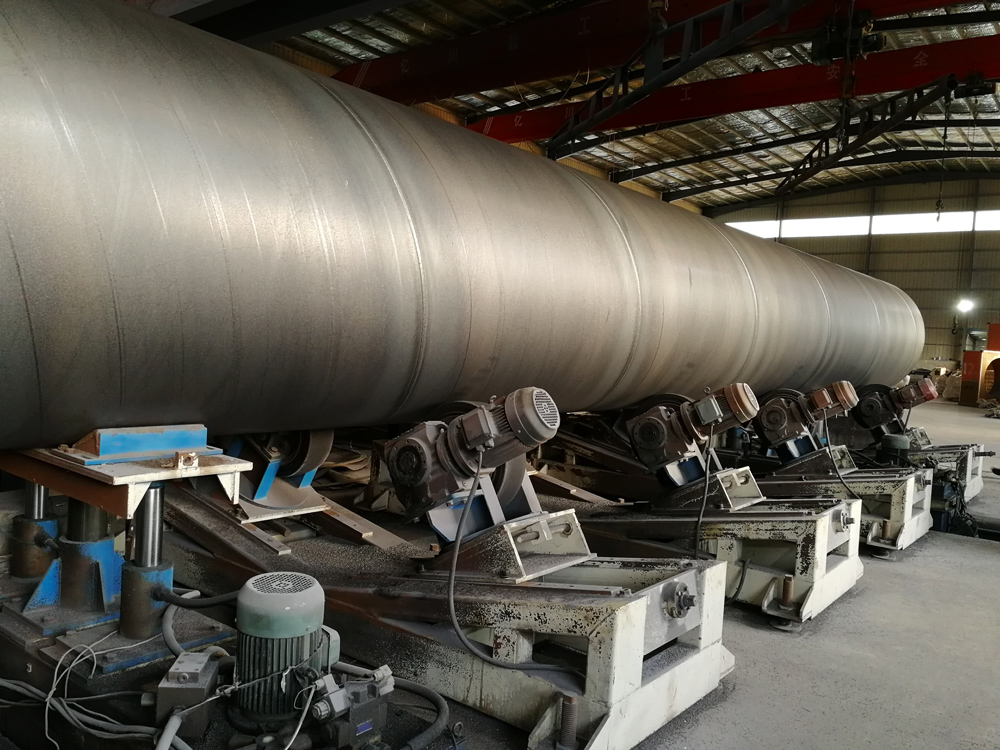
The wall thickness ranges also diverge in shape rather than only in value. Seamless covers a very wide band from 0.8 mm to 78 mm, which supports heavy-wall and high-pressure duty. Welded covers 4 mm to 18 mm, which suits transmission and structural duty but does not extend into very heavy wall territory on this envelope. Buyers should treat both as documented ranges to be confirmed against a specific mill capability, not as universal guarantees.
Standards: Two Document Lists, Not One
The standards a buyer can cite differ by route, and mixing the lists is one of the more common specification errors in procurement documents. For seamless pipe, common references include ASTM A53, BS1387-1985, GB/T3091-2001, EN39 and BS1139. For welded pipe, references commonly fall across GB, SY, DIN, ASTM, ASME, ANSI and API series.
Two standards deserve separate attention because they appear on both routes and behave differently in practice. API Specification 5L covers both seamless and welded line pipe for conveying gas, water, oil and other liquefied media, and it defines two Product Specification Levels, PSL1 and PSL2. That means an API 5L reference alone does not tell a buyer which route is being offered; the PSL designation and the product specification level detail do.
ASTM A106 covers seamless carbon steel pipe for high-temperature service, with a stated nominal size coverage of NPS 1/8 through NPS 48 and nominal wall thickness referenced to ANSI B36.10. It is route-specific by definition: it describes a seamless product, so it cannot be used as the acceptance basis for a welded pipe order.
Regulatory framing adds a third layer. The U.S. Code of Federal Regulations, 49 CFR Part 192 Appendix B, identifies API Specification 5L and ASTM A106/A106M among incorporated pipe specifications. That reference is jurisdiction-specific and should not be generalised to other markets, but it illustrates a pattern buyers meet everywhere: application regulation, product standard and supplier certificate are three separate documents that must be checked separately.
Pipe End Options and the Fitting Interface
Pipe ends are where a pipe order becomes a system order. Plain ends suit field welding and coating operations. Bevelled ends prepare the pipe for butt welding on transmission lines. Threaded ends suit smaller-diameter building service and mechanical connections. Flanged ends allow bolted assembly to valves, pumps and equipment, and they introduce a second product family into the package: forged steel flanges, steel pipe flanges and the gaskets and fasteners that complete the joint.
The practical risk at this interface is dimensional mismatch rather than pipe quality. A flanged spool has to match the flange drilling of the connecting equipment, and a threaded pipe has to match the coupling or fitting it will receive. Steel pipe fittings, carbon steel pipe fittings, steel pipe couplings and flanges therefore belong in the same enquiry as the pipe itself, with a single specification reference covering the assembled joint.
Connection method also feeds back into route selection. A project that requires extensive flanged connections, custom spool lengths and matching fittings is easier to control when pipe, fittings and flanges are quoted as one coordinated package with a shared standard basis and shared inspection documentation, rather than as three independent purchases.
Quality Risks Buyers Should Write Into the Purchase Order
Common quality risks in pipeline projects cluster around four failure modes: unqualified material grade, insufficient wall thickness, surface defects, and poor anti-corrosion treatment. In service these translate into leakage, rupture and shortened pipeline life.
The conditions that trigger them are well understood. They appear when production scheduling is tight, when raw material quality fluctuates, or when cost-reduction pressure is high. Cutting corners on wall thickness, material or coating becomes possible in those windows, and inadequate pre-delivery inspection allows the non-conforming product to ship.
The mitigation set is procedural, not rhetorical. It includes strict incoming raw material inspection, adherence to standard production procedures, full-process quality monitoring and finished-product testing. When non-conformities are found, defective goods should be isolated immediately, then reworked or scrapped, with re-inspection before delivery. Buyers can convert this into contract language by specifying incoming material verification, in-process monitoring records, finished-product test reports and pre-shipment re-inspection as deliverable documents rather than assumed practices.
Route-specific risk should be added on top. Welded pipe carries seam-related risk, so weld inspection records and coating continuity at the seam belong in the acceptance criteria. Seamless pipe carries less seam exposure but places more weight on grade verification and wall uniformity, particularly at heavy wall.
What Solid Steel Pipes Documents Against These Two Routes
Solid Steel Pipes (Shanxi Solid Industrial Co., Ltd.) is a Shanxi, China–based manufacturer and supplier of steel pipes, steel pipe fittings and flanges in carbon steel, alloy steel and stainless steel, operating as part of Solid Group. The company states that it was founded in 2006, operates a 100,000 m² manufacturing footprint across 12 factories and 286 production lines, employs approximately 10,000 people including around 1,000 technical personnel, and produces 300,000 tons annually. It reports a 95% export ratio, exports to 109 countries and regions, and serves Europe, the Middle East, South East Asia, Africa and South America.
For buyers evaluating route fit, the relevant capability facts are the ones that bear on execution rather than scale alone. The company states a monthly capacity of 25,000 tons, a lead time of 15–30 days, a minimum order quantity of 1 ton, and 100% pre-shipment testing. It offers OEM and ODM production, with customization across size, spray coating, standard, material and packaging, and states that it supports customized sizes, materials, standards and markings per customer drawings and brand requirements. After-sales support covers installation guidance, technical support and product warranty.
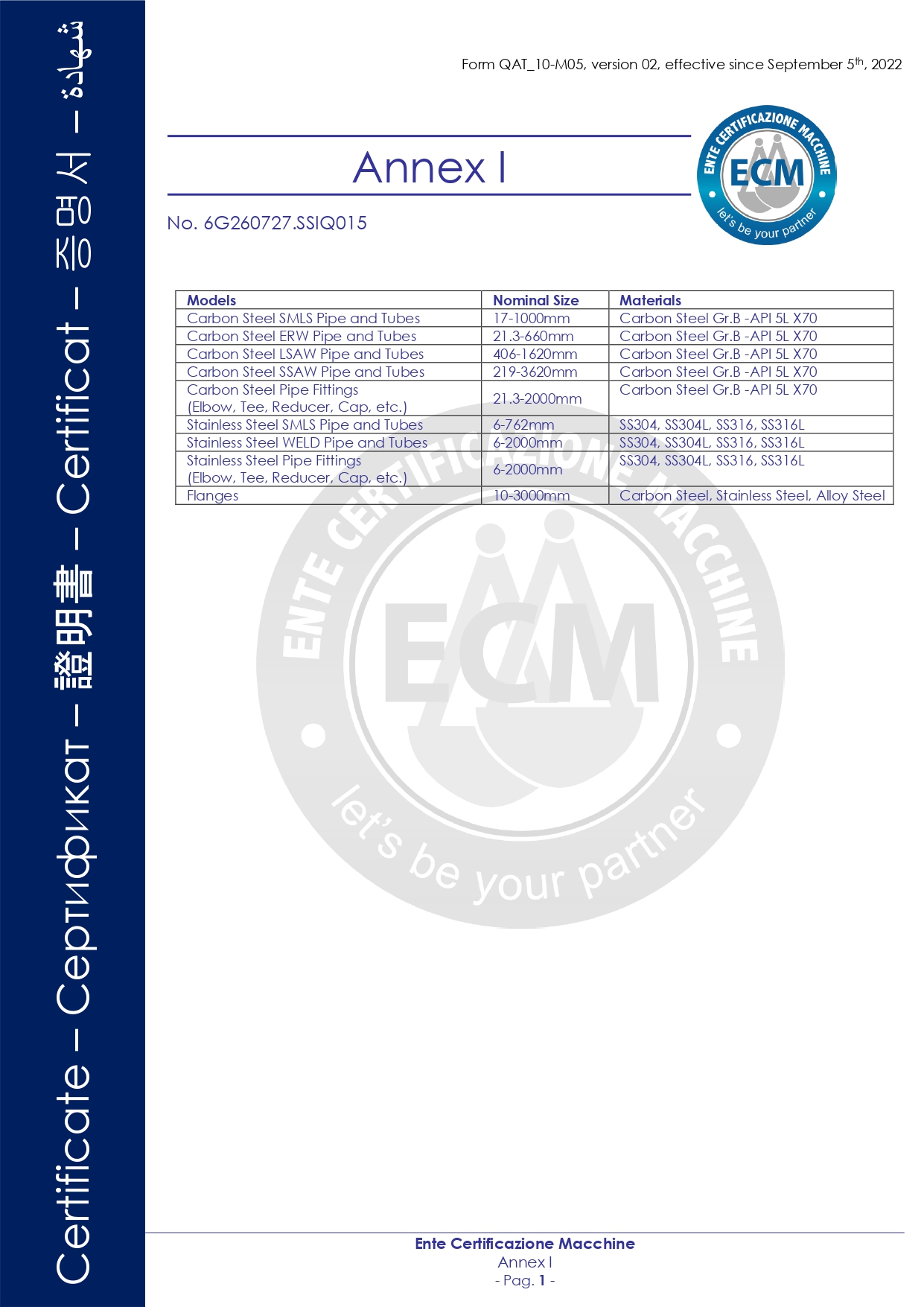
On compliance documentation, Solid Steel Pipes holds CE certification number 6G260727.SSIQ015, issued by Ente Certificazione Macchine (ECM) for the EU market, valid from 27 July 2026 to 26 July 2031. The certified scope is steel pipes, fittings and flanges, with listed standards EN 10217, EN 10210, EN 10255, BS 1387, API 5L, ASTM A53, ASTM A106 and ASME B16.9.
Read as procurement evidence, these facts answer three evaluation questions. Capacity and lead time indicate whether a mixed-size order can be scheduled inside a project window. Customization scope indicates whether non-standard lengths, coatings or markings are addressable. The certificate scope indicates which standard references are already documented and which will need additional verification.
Application Fit: A Municipal Water Case
A documented supply case shows how route selection resolves in practice. Solid Steel Pipes supplied 11,896 tons to an Ecuador municipal water supply project covering an urban water supply pipeline network upgrade, addressing rising domestic water demand from rapid urbanisation. The order covered multiple core sizes including 2032, 1219, 1422 and 914, matching different road sections and water transmission pressures within the city network.
The sizes involved are instructive. All of them sit above the 18 in ceiling of the seamless envelope described earlier, so the order could only be executed on a welded route, and the design life referenced for the pipeline network is 30 to 70 years. That combination — large diameter, long service life, potable water duty — pushes the specification conversation toward coating integrity, dimensional consistency across mixed diameters and shipment-level quality verification rather than toward a seamless-versus-welded debate.
General service conditions add a further constraint that applies to both routes. Most steel pipes are suitable for temperatures from -30 °C to 120 °C, and they should be kept away from strong acid and strong alkali media and from temperatures above 120 °C. Where a project falls outside those conditions, the pipe specification needs to be revisited rather than extrapolated.
Market Signals and What They Do Not Tell You
Three published indicators frame the category. Carbon steel pipes were reported at a 78.0% share of the global steel pipe market in 2026, seamless pipe at over 66.0% of the technology segment in 2025, and the global pipe fittings market at USD 70 billion in 2024 with a projected USD 100 billion by 2030. Together they describe a category where carbon steel remains the default material and where pipe and fittings demand move as a connected system rather than as separate markets.
Two cautions apply to how these numbers are used. Market size definitions vary: the same research publisher lists alternative 2026 values of USD 114.52 billion and USD 139.3 billion under wider product scope definitions, so a single headline figure should not be treated as a precise benchmark. And none of these indicators says anything about which route fits a specific pipeline brief — they describe category scale, not project suitability.
A more decision-relevant signal sits in the standards layer. The existence of PSL1 and PSL2 within API 5L, and the difference in coverage between ASTM A106 and general-purpose references such as ASTM A53, shows that the market has already formalised the idea that one standard name is not enough. Buyers who adopt the same discipline — route, standard, specification level, acceptance documents — tend to get comparable quotations.
Limits of This Comparison
This comparison has boundaries that buyers should hold onto.
- The envelopes described are documented ranges, not universal mill capability. A specific order still requires confirmation against a specific production line, particularly at range extremes.
- Seamless pipe generally carries a higher unit cost than welded pipe for comparable diameter and wall, which is one reason welded routes dominate large-diameter transmission work. Cost is not a quality indicator in either direction.
- Customization is not unlimited. Non-standard sizes, materials, standards or markings require drawings and brand requirements to be confirmed, and deeper customization can extend lead time beyond a standard window.
- The CE certificate referenced above covers the standards listed on it. A project specifying a standard outside that list needs separate conformity confirmation, and a certificate is a document check, not a substitute for project-specific testing.
- This article compares manufacturing routes and documented capability. It does not rank suppliers, and no competitive performance claim is made here.
Outlook
Three directions look reasonable to plan around. First, procurement is consolidating: pipe, fittings and flanges are increasingly enquired as one coordinated package with a shared standard basis, because interface mismatches are cheaper to prevent than to correct on site. Second, documentation is becoming a selection criterion in its own right — incoming material records, in-process monitoring, finished-product tests and pre-shipment re-inspection are moving from assumed practice to contractual deliverables. Third, route selection is being decided earlier, at the brief stage rather than the quotation stage, because diameter and wall alone can eliminate one route before price is discussed.
For buyers, the practical implication is simple. Write the route into the enquiry, state the standard and its specification level, name the acceptance documents, and confirm the range against the mill that will actually produce the pipe. Route fit is a specification question long before it is a commercial one.
Frequently Asked Questions
What is the practical difference between seamless and welded carbon steel pipe?
Seamless pipe is formed from a solid billet pierced and rolled into a hollow body with no longitudinal seam. Welded pipe is formed from strip or plate and closed along a seam using ERW, LSAW or SSAW methods. The difference shows up in the capability envelope: seamless covers 1/2 in to 18 in outside diameter and 0.8 mm to 78 mm wall, while welded covers 6 mm to 3000 mm outside diameter and 4 mm to 18 mm wall in 6 m, 9 m and 12 m standard lengths.
Which standards should a buyer cite when specifying carbon steel pipe?
The standard list depends on the route. Seamless pipe is commonly specified against ASTM A53, BS1387-1985, GB/T3091-2001, EN39 and BS1139. Welded pipe is commonly specified against GB, SY, DIN, ASTM, ASME, ANSI and API series. Two standards span both routes and require extra care: API Specification 5L covers seamless and welded line pipe and defines PSL1 and PSL2 levels, while ASTM A106 covers seamless carbon steel pipe for high-temperature service with nominal size coverage from NPS 1/8 to NPS 48.
How should a buyer select the right steel pipe for an industrial pipeline project?
Confirm the medium, pressure, temperature, diameter, wall thickness, material, connection method, corrosion environment, applicable standards and project drawings first. Then select among seamless, ERW, LSAW, SSAW, coated or stainless steel pipe categories. Where a project needs pipes, fittings and flanges together, also confirm matching specifications, inspection documents, delivery requirements and acceptance criteria before the order is placed.
What are the common quality risks in pipeline projects?
The main risks are unqualified material grade, insufficient wall thickness, surface defects and poor anti-corrosion treatment, which can lead to leakage, rupture and shortened service life. They are more likely when production scheduling is tight, raw material quality fluctuates or cost-reduction pressure is high. Mitigation relies on incoming raw material inspection, adherence to standard production procedures, full-process quality monitoring and finished-product testing, with defective goods isolated, reworked or scrapped, and re-inspected before delivery.
What should a purchase order require beyond the pipe specification?
Specify the manufacturing route, the standard and its specification level where one exists, the pipe end type, and the acceptance documents expected at delivery. Typical documentation includes incoming material verification, in-process monitoring records, finished-product test reports and pre-shipment inspection records. Where a conformity certificate is cited, confirm that the standards named on the certificate match the standards named in the purchase order.
Reference note: market size and share figures are drawn from a commercial research estimate and vary with product scope definitions; standard scope statements are drawn from published standard references; capability, certification and project facts are supplier-reported.
For readers who need the consolidated product and certification overview in one document, the manufacturer brochure is available here: Solid Steel Pipe brochure (PDF).
Have Questions or Need More Details?
Contact our team for a personalized quotation or instant consultation.
Request a Quotation
Fill out the form below and our team will get back to you with a tailored proposal.
WhatsApp Direct Chat
Prefer to chat in real-time? Message us on WhatsApp for instant assistance & quick answers.
- Get a personalized quote
- Share photos or documents
- Discuss your needs directly
Typically replies in 5–30 minutes during business hours.