
Seamless vs Welded Carbon Steel Pipe: An Independent Comparison
Two carbon steel pipes can answer the same dimensional call-out and still behave differently in service. The variable that separates them is not the brand on the mill certificate — it is the route the pipe was made by.
Seamless carbon steel pipe is produced by piercing and rolling a solid steel billet into a hollow body, which leaves the pipe wall without a longitudinal weld. Welded carbon steel pipe is formed from strip or plate and closed with a weld: electric resistance welding (ERW) at smaller diameters, longitudinal submerged arc welding (LSAW) for heavy straight seams, and spiral submerged arc welding (SSAW) for large-diameter, spiral-formed sections.
That single process difference fixes four things a buyer commits to before price is even discussed: the practical outside diameter and wall thickness envelope, the standards a mill can credibly certify against, the pipe end configuration that is economic to supply, and the inspection points that carry the most risk. This comparison places both routes side by side against one industrial pipeline brief so buyers can judge fit rather than brand.
Why the route decision outranks the supplier decision
Most procurement sequences start with a supplier shortlist. That order is usually wrong. A supplier cannot deliver a size, wall thickness or standard combination that the chosen manufacturing route does not physically produce, and no amount of commercial negotiation closes that gap.
The practical failure pattern is consistent. A pipeline is specified around a nominal diameter and pressure class. A quotation returns at an attractive price. Only at the drawing review does it emerge that the requested combination sits outside the documented envelope of the route that was quoted — an outside diameter beyond the seamless ceiling, a wall thickness above the welded ceiling, or a standard that the mill is not actually certified to work to.
Re-sequencing the decision removes most of that risk. The correct sequence is: confirm medium, pressure, temperature, diameter, wall thickness, material, connection method, corrosion environment and applicable standard; select the route that can physically cover that combination; then qualify suppliers within that route. The supplier question becomes narrower, more comparable, and far cheaper to resolve.
The documented envelopes: what each route can actually deliver
The two routes overlap across a broad middle band of sizes, which is exactly where specification errors happen. Outside that band, the choice is not a preference — it is a constraint.
| Parameter | Seamless carbon steel pipe | Welded carbon steel pipe (ERW / LSAW / SSAW) |
|---|---|---|
| Outside diameter | 1/2 in to 18 in | 6 mm to 3000 mm |
| Wall thickness | 0.8 mm to 78 mm | 4 mm to 18 mm |
| Length | 1 m to 12 m | 6 m, 9 m and 12 m standard lengths |
| Governing constraint | Upper OD limit; wider wall range | Upper wall limit; far wider OD range |
Figures reflect the documented commercial envelopes used as the basis of this comparison. Actual capability must be confirmed against a specific mill's certified scope.
The asymmetry is the point. Seamless covers a wall thickness range from 0.8 mm up to 78 mm, which is what makes it the default answer for high-pressure and high-temperature duty. Welded covers 6 mm to 3000 mm outside diameter, which is what makes it the only realistic answer for large transmission mains. But welded wall thickness tops out at 18 mm in this documented envelope, and seamless outside diameter tops out at 18 in.
For a buyer, the first screening question is therefore arithmetic rather than commercial: does the required OD and wall thickness fall inside the envelope of the route under consideration? If the answer is no, the route is closed regardless of price, lead time or relationship.
Where the standard lists diverge
Standards follow the route. A standard written around a wrought, homogeneous wall implies different testing and marking logic than a standard written around a formed-and-welded section. The two lists in this comparison are not interchangeable, and buyers should treat them as separate qualification tracks.
| Route | Standards referenced in this comparison |
|---|---|
| Seamless | ASTM A53, BS 1387-1985, GB/T 3091-2001, EN 39, BS 1139 |
| Welded | GB, SY, DIN, ASTM, ASME, ANSI, API |
Several of these standards are written to cover more than one manufacturing route, and the list above reflects where each set is most commonly quoted rather than an exclusive scope. The buyer's obligation is to confirm which edition, which grade and which product specification level the mill is actually working to — not merely that the standard number appears on a certificate.
Two verified scope points are worth carrying into any RFQ. ASTM A106 covers seamless carbon steel pipe for high-temperature service and states a nominal size coverage of NPS 1/8 through NPS 48, with nominal wall thickness referenced to ANSI B36.10. API Specification 5L covers both seamless and welded line pipe for conveying gas, water, oil and other liquefied media, and it includes two Product Specification Levels, PSL1 and PSL2.
The PSL distinction matters more than most first-time buyers expect. PSL2 is a specification attribute, not a quality ranking, but it changes what documentation and inspection evidence a supplier is expected to produce. Specifying "API 5L" without naming the PSL leaves the inspection regime open to interpretation, and interpretation is where disputes start.
Pipe ends: the specification detail that changes cost and schedule
Pipe end configuration is often left to the purchase order stage, which is too late. The end finish determines whether the pipe can be joined directly in the field, whether threading or machining is required, and whether a flanged connection has to be welded on downstream.
The main options in industrial supply are plain end, bevelled end for welding, threaded end, grooved end, and flanged end. Each carries a different implication:
- Plain end is the least processed and the cheapest to supply, but pushes all joint preparation downstream.
- Bevelled end is the normal choice for welded pipelines and directly affects fit-up quality and welding productivity.
- Threaded end suits smaller-diameter service lines and building services, but removes wall section at the thread.
- Flanged end allows bolted connections and valve isolation; the flange specification, facing and drilling pattern must be stated with the pipe specification, not after it.
Where a project needs pipes, fittings, flanges and couplings from one source, the end configuration should be agreed as a single interface package. Mismatched end preparation between pipe and fitting is a recurring cause of site rework that no material test would ever reveal.
Quality risks are not distributed evenly across the two routes
Both routes share a common risk base: unqualified material grade, insufficient wall thickness, surface defects and poor anti-corrosion treatment. These are the failure modes that lead to leakage, rupture and shortened service life, and they typically appear when production scheduling is tight, raw material quality fluctuates, or cost-reduction pressure is high. Inadequate pre-delivery inspection is usually what allows non-conforming product to ship.
Beyond the shared base, each route carries a signature risk.
Welded pipe concentrates risk at the seam. Weld quality, seam alignment, heat-affected zone condition and the integrity of the weld-to-coating interface are the points where a defect can propagate. This is why weld inspection records — not just a final hydrostatic test — are the meaningful evidence for a welded pipe order, particularly for LSAW and SSAW sections that will operate under pressure.
Seamless pipe has no seam to inspect, so risk shifts to wall uniformity, concentricity, surface condition after piercing and rolling, and the accuracy of the dimensional record. Because the product is formed from a solid billet, material traceability back to the heat is the primary evidence chain.
The mitigation logic is the same for both routes: strict incoming raw material inspection, adherence to standard production procedures, full-process quality monitoring and finished-product testing. When non-conformity is found, the goods should be isolated and either reworked or scrapped, then re-inspected before delivery — not reclassified and shipped.
How the manufacturing method changes in-service behaviour
The difference between routes is not only structural, it is behavioural. A seamless wall is continuous in the hoop direction, which is why the route dominates high-pressure and high-temperature duty in verified standards: ASTM A106 is written specifically for seamless carbon steel pipe in high-temperature service.
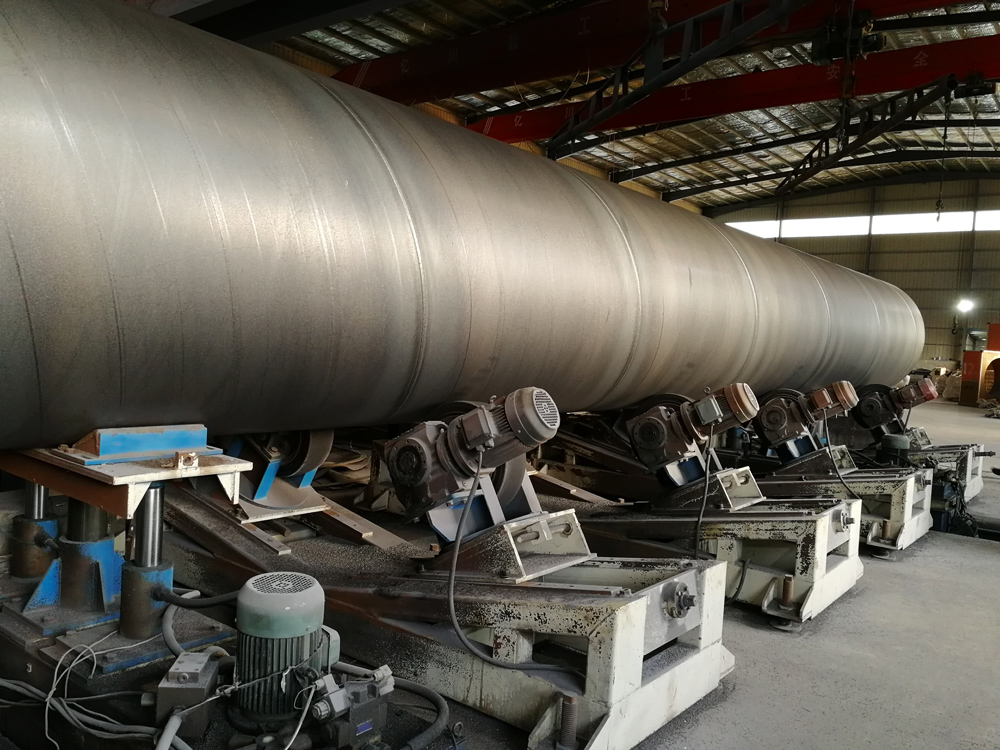
A welded pipe is not a weaker product in absolute terms — it is a different product with a different governing limit. The weld becomes the reference plane for inspection, and the design pressure calculation must account for weld joint efficiency. In exchange, the route makes very large diameters economic, because strip and plate can be formed into sections that no seamless mill can roll.
Two practical consequences follow. First, a buyer comparing quotations across routes is not comparing like with like unless the inspection scope is normalised — a welded quotation that includes full weld inspection and a seamless quotation that includes heat traceability are not directly comparable line items. Second, the coating decision has different failure points by route: on welded pipe, the coating must survive the weld area and any field joint; on seamless pipe, the coating risk concentrates at handling damage and cut ends.
What a documented supplier looks like
Solid Steel Pipes is the steel pipe brand of Shanxi Solid Industrial Co., Ltd. (Solid Group), a Shanxi, China-based manufacturer founded in 2006 that produces steel pipes, steel pipe fittings and flanges in carbon steel, alloy steel and stainless steel.
Three categories of evidence are relevant to the route comparison above, and all three are checkable rather than rhetorical.
Certified standard scope. Solid Group holds CE certification 6G260727.SSIQ015, issued by Ente Certificazione Macchine (ECM) for the EU market with validity from 2026-07-27 to 2031-07-26. The certified scope covers steel pipes, fittings and flanges and lists EN 10217, EN 10210, EN 10255, BS 1387, API 5L, ASTM A53, ASTM A106 and ASME B16.9. That scope spans both routes, which is the practical point: a buyer can place the seamless and welded portions of one pipeline brief with a single certified source without splitting the conformity file.
Customisation and production mode. The manufacturer operates OEM and ODM production. Customisation covers size, spray coating, standard, material and packaging. Documented capability includes a monthly capacity of 25,000 tons, a lead time of 15–30 days, a minimum order quantity of 1 ton, and 100% pre-shipment testing. For a buyer in the evaluation-to-execution stage, the 1-ton MOQ matters more than the capacity figure: it allows a specification trial before a full pipeline order is released.
Project-scale delivery record. For an Ecuador municipal water supply project, the company supplied 11,896 tons across documented section sizes including 2032, 1219, 1422 and 914, for an urban water supply pipeline network upgrade addressing rising domestic water demand from urbanisation. The stated design life for that application is 30–70 years. The relevant lesson is not the tonnage — it is that multiple section sizes were produced to one project specification, which is a coordination capability rather than a rolling capability.
These are company-reported and certificate-backed facts. They establish a certified scope and a documented delivery pattern; they do not by themselves establish fitness for any specific pipeline, which remains a function of the project specification and the buyer's own inspection regime.
Application fit: three briefs, three different answers
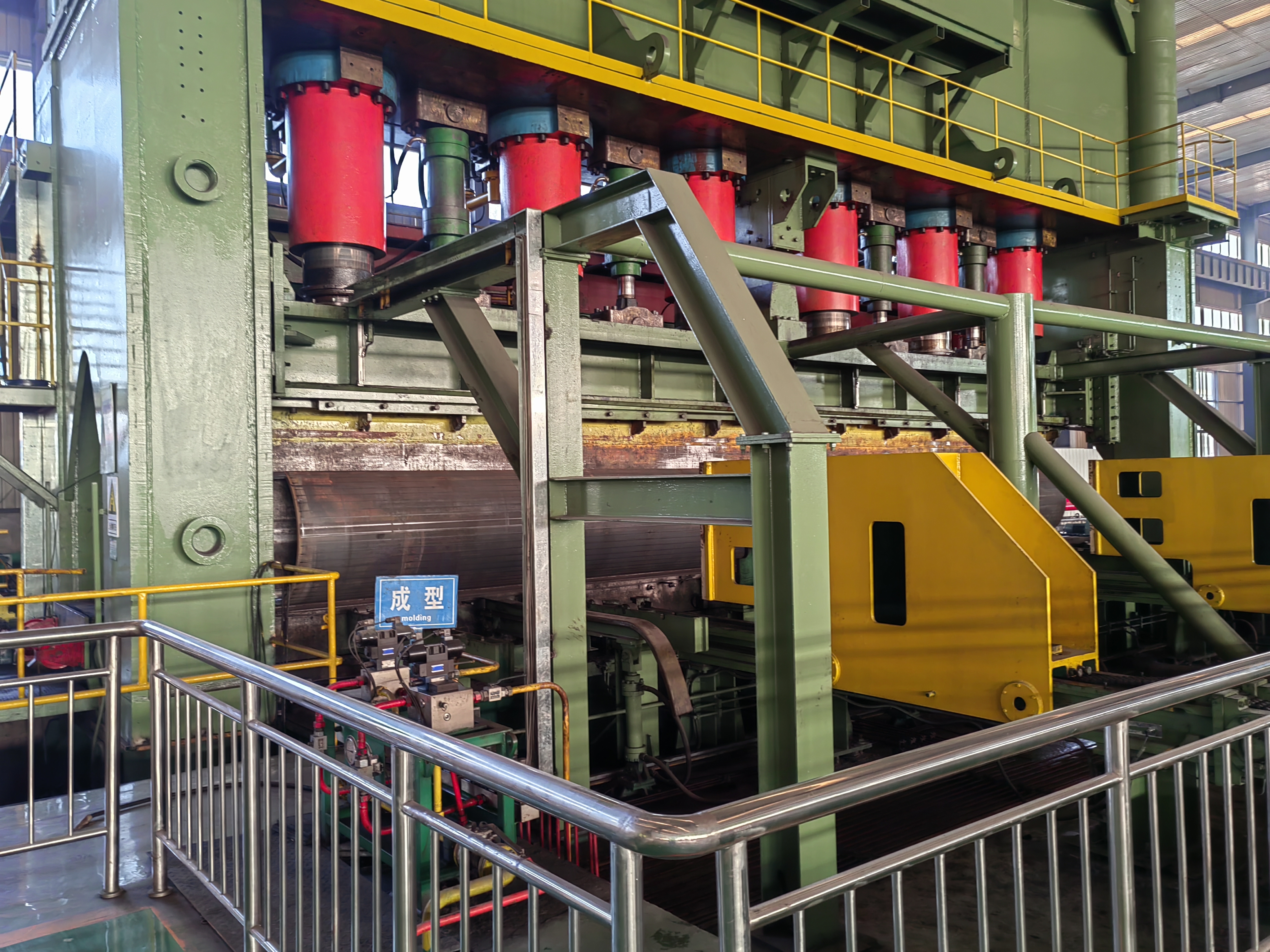
Brief one — high-pressure, high-temperature process line. Small to medium diameter, heavy wall, elevated temperature. The seamless route is the fit, and ASTM A106 is the natural specification anchor. The buyer's evidence request should focus on heat traceability, wall thickness verification and dimensional records.
Brief two — large-diameter water transmission main. Outside diameters well beyond 18 in, moderate pressure, long design life, corrosion protection critical. The welded route is the only practical fit, and SSAW or LSAW sections are the normal answer. Evidence should focus on weld inspection, coating integrity and field joint procedure — the Ecuador project profile above sits in this category.
Brief three — building services and structural tube. Smaller diameters, lower pressure, threaded or grooved connections, standards such as BS 1387 or EN 39 style tube specifications. Both routes can compete, so the decision shifts to end configuration, coating and total installed cost rather than pressure capability.
Notice that petroleum and water duty do not automatically imply a route. API 5L covers both seamless and welded line pipe, so the route decision inside an API 5L specification is driven by diameter, wall thickness, pressure class and the buyer's inspection requirements — not by the standard number alone.
Market signals relevant to the route decision
Market data supports the practical observation that both routes are structurally necessary. The global steel pipe market is projected to reach USD 109.72 billion by the end of 2026, and carbon steel pipes account for 78.0% of that market in 2026. Carbon steel is not a niche — it is the default material class for industrial pipeline work.
Within that, seamless steel pipes held the largest technology segment share at over 66.0% in 2025. That share reflects the concentration of value in high-pressure and high-temperature duty, not a general preference for seamless across all applications. The adjacent fittings market — valued at USD 70 billion in 2024 and projected to reach USD 100 billion by 2030 — reinforces the same point: pipe, fittings and flanges are increasingly specified and sourced as a package rather than as separate commodity lines.
Trade classification adds a third signal. HS 7304 covers seamless tubes, pipes and hollow profiles of iron or steel; HS 7305 covers non-seamless circular tubes and pipes with external diameter exceeding 406.4 mm; HS 7306 covers other non-seamless tubes, pipes and hollow profiles. The headings are deliberately separate, which means import and export analysis that combines them produces conclusions that do not survive scrutiny. Buyers using trade data for sourcing-country screening should validate national subheadings before drawing any volume conclusion.
Limits and boundaries: where each route stops
An honest comparison has to state where each option fails, because the failure modes are predictable.
Seamless limits. The documented outside diameter ceiling of 18 in is a hard stop for large transmission mains. Beyond that, the route simply does not produce the section, and any quotation claiming otherwise requires verification. Seamless production is also less flexible on length, with a documented 1 m to 12 m range that may not match a project's preferred 12 m laying pattern without additional cutting. For small quantities, the effective constraint is commercial rather than technical: heavy-wall seamless sections carry longer lead times and higher unit costs than welded equivalents at the same diameter.
Welded limits. The documented wall thickness ceiling of 18 mm excludes high-pressure, heavy-wall duty. The seam is an inherent inspection burden, and weld quality is only as good as the process control behind it — which is why a welded quotation without weld inspection documentation should be treated as incomplete rather than competitive. Spiral-formed sections also require careful handling and stacking to avoid ovalisation and coating damage in transit.
The shared limit. Neither route removes the need for third-party inspection on a critical pipeline. A certificate establishes what a mill is qualified to produce; it does not establish what was produced on a given order. That gap is closed only by pre-shipment testing and, where risk justifies it, independent verification.
Future outlook
Two directions look durable. First, documentation is becoming a procurement criterion in its own right. The difference between PSL1 and PSL2 in API 5L, and the difference between a certificate's scope and a specific order's inspection record, will increasingly determine which suppliers can enter a shortlist rather than which suppliers win on price.
Second, package sourcing is consolidating. As the fittings market grows toward the projected USD 100 billion level by 2030, buyers are moving away from assembling pipe, fittings, flanges and couplings from separate vendors with separate conformity files. A single certified scope covering both pipe routes plus the matching fittings reduces interface risk — which is a procurement argument, not a manufacturing one.
For the route decision itself, nothing in the data suggests convergence. Seamless will continue to hold the high-pressure and high-temperature core; welded will continue to own large diameter. The buyer's task is not to pick a winner but to place each segment of a pipeline brief on the correct side of the 18 in and 18 mm boundaries.
FAQ
How should a buyer select the right steel pipe for an industrial pipeline project?
First confirm the medium, pressure, temperature, diameter, wall thickness, material, connection method, corrosion environment, applicable standards and project drawings. Then select among seamless, ERW, LSAW, SSAW, coated or stainless steel pipe categories. Where a project requires pipes, fittings and flanges together, also confirm matching specifications, inspection documents, delivery requirements and acceptance criteria.
What are the key points to check when purchasing steel pipes?
Clearly define the purpose and performance indicators, select the correct execution standards, verify the legitimacy of the manufacturer, and check the production licence and certification. The most important selection parameters are outer diameter, wall thickness and material, because together they determine the pressure-bearing capacity, adaptability and service life of the pipe.
What are the common quality risks in pipeline projects?
The main risks are unqualified material grade, insufficient wall thickness, surface defects and poor anti-corrosion treatment. These typically arise when production scheduling is tight, raw material quality fluctuates or cost-reduction pressure is high, and inadequate pre-delivery inspection allows non-conforming product to ship. Mitigation requires strict incoming raw material inspection, standard production procedures, full-process monitoring and finished-product testing, with immediate isolation and rework or scrapping of non-conforming goods.
Does API 5L cover both seamless and welded pipe?
Yes. API Specification 5L covers seamless and welded line pipe for conveying gas, water, oil and other liquefied media, and includes two Product Specification Levels, PSL1 and PSL2. Because the standard spans both routes, the route decision within an API 5L specification is driven by diameter, wall thickness, pressure class and inspection requirements rather than by the standard number alone.
What outside diameter and wall thickness can each route supply?
In the documented envelopes used for this comparison, seamless carbon steel pipe covers 1/2 in to 18 in outside diameter with 0.8 mm to 78 mm wall thickness and 1 m to 12 m lengths. Welded ERW, LSAW and SSAW pipe covers 6 mm to 3000 mm outside diameter with 4 mm to 18 mm wall thickness and standard lengths of 6 m, 9 m and 12 m. Capability must be confirmed against a specific mill's certified scope.
Have Questions or Need More Details?
Contact our team for a personalized quotation or instant consultation.
Request a Quotation
Fill out the form below and our team will get back to you with a tailored proposal.
WhatsApp Direct Chat
Prefer to chat in real-time? Message us on WhatsApp for instant assistance & quick answers.
- Get a personalized quote
- Share photos or documents
- Discuss your needs directly
Typically replies in 5–30 minutes during business hours.