
Sector Fit: Slider Bags for Food and Electronics Packaging
Sector Fit: Slider Bags for Food and Electronics Packaging
Food lines and electronics lines both buy slider bags made from 100% LDPE, yet they rarely buy the same bag. The dividing variables are the capacity band a model is built to cover and the sealing performance its closure is rated for. In Haida Packaging's range, the HD-ZB002 slider zipper bag (50–500 ml) and the HD-SB001 slider bag (100–1000 ml) split along exactly those two lines: HD-ZB002 is specified around a slider design that is easy to open and close, while HD-SB001 is specified around convenient sealing with pressure and water resistance. This article maps each specification to the sector that needs it — and marks the boundaries where neither model is the right answer.
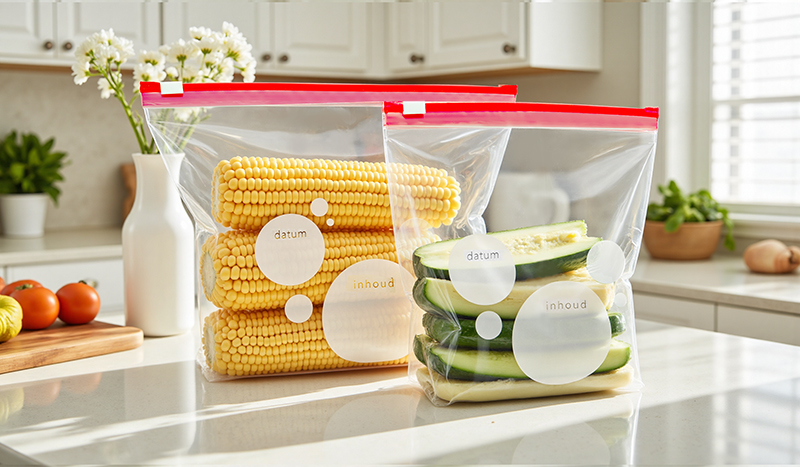
HD-SB001 slider bag: 100–1000 ml, 100% LDPE, specified with convenient sealing and pressure and water resistance, and listed for food and electronics packaging.
Why two sectors end up with two different slider bags
Sector fit in slider bags is not a marketing question. It is a specification question that usually appears late in the buying process, after material and compliance have already been agreed. A buyer who has confirmed 100% LDPE construction and the relevant food-contact documentation still has to answer two operational questions: how many millilitres the bag must hold, and how the closure must behave through repeated use and transit.
Food packaging operations optimise for repetition speed and hygienic handling. Staff and end users open and reclose the same pack many times, often with one hand, and the portion size is fixed by the recipe, the serving format or the retail unit. Electronics packaging operations optimise for protection: small, sensitive parts must stay clean, dry and accounted for during storage and shipment, and the bag may be opened and reclosed several times during kitting or inspection.
The practical consequence is that the same slider bag that satisfies one sector can add unnecessary constraint to the other. A capacity band that is generous for a snack portion wastes material on a 30 ml component bag; a closure rated for pressure and water resistance is more closure performance than a dry-food portion pack requires. Material and compliance are gate criteria both models already pass; capacity range and closure rating are the filters that actually separate them.
HD-ZB002 and HD-SB001: one material, two specifications
Taizhou Haida Plastic & Rubber Packaging Co., Ltd. — trading as Haida Packaging — is a flexible packaging manufacturer founded in 2003 in Taizhou, Jiangsu, China, producing zipper bags, single zipper bags and slider bags, with roughly 90% of output exported and Japan and Europe as its main markets. The company was originally established as a manufacturer of self-sealing and zipper bag series products and now runs OEM production with a monthly capacity of 900 tons.
Within that range, the two models relevant to this sector comparison are built from the same base material and differentiated by capacity and closure performance.
| Specification | HD-ZB002 | HD-SB001 |
|---|---|---|
| Product type | Slider Zipper Bag | Slider Bag |
| Material | 100% LDPE | 100% LDPE |
| Capacity band | 50–500 ml | 100–1000 ml |
| Stated closure feature | Slider design, easy to open and close | Convenient sealing, pressure and water resistant |
| Stated applicable industries | Household and kitchen; food packaging; daily supplies | Food; electronics packaging |
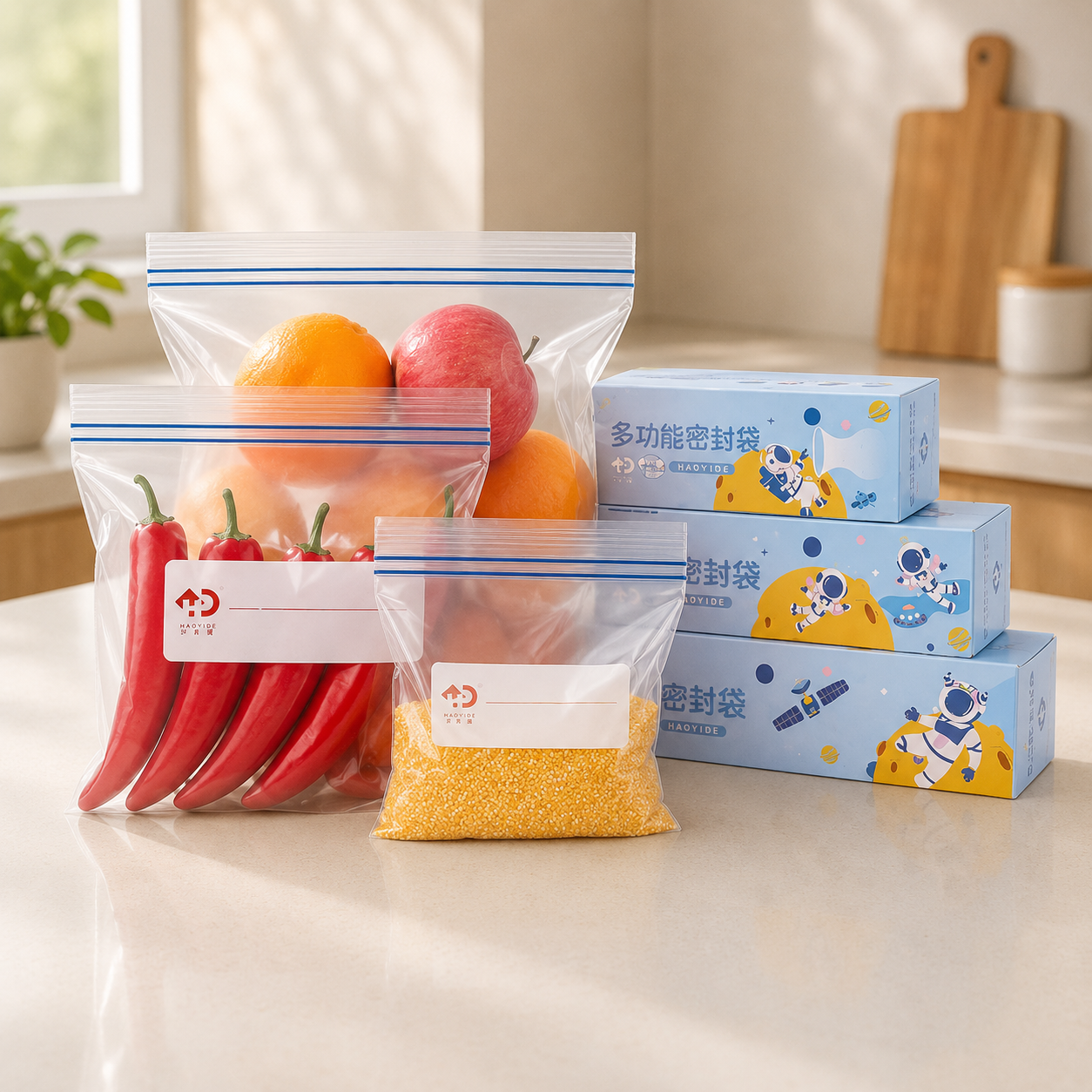
HD-ZB002 slider zipper bag: 50–500 ml, 100% LDPE, built around a slider that is easy to open and close, and listed for food packaging and daily supplies.
What the HD-ZB002 specification describes
The HD-ZB002 is a 50–500 ml slider zipper bag. Its defining feature is the slider: the user pulls a moulded slider along the closure track rather than pressing a profile closed along the whole length. That produces a repeatable, low-effort open and close action, which is the property food packaging teams tend to value most, because it reduces the time and dexterity required at the packing table and by the end user. The declared application areas are household and kitchen use, food packaging and daily supplies.
What the HD-SB001 specification describes
The HD-SB001 is a 100–1000 ml slider bag. Its defining features are convenient sealing and resistance to pressure and water. That is a different performance statement: the closure is specified not only for ease of use but for holding under load and resisting water ingress during handling and transit. The declared application areas are food and electronics packaging — a two-sector listing that reflects the wider capacity band and the more protective closure rating.
The shared technical base: LDPE and the slider closure
Because both models use 100% LDPE, buyers who need to declare material content or separate packaging streams can treat them as equivalent on that dimension. Low-density polyethylene is flexible, easy to seal by heat, and widely processed into reclosable bags. Its limitation, common to both models, is that a single-material LDPE film is not a high-barrier structure: prolonged aroma retention, oxygen-sensitive shelf life or vacuum-level exclusion of air are not properties that a plain LDPE slider bag is designed to deliver.
The slider closure itself is a mechanical part that rides on the zipper profile. Compared with a press-to-close profile, the slider produces a more consistent closure action at each use and reduces the chance that a section of the profile is left unfastened by a hurried operator. For food packaging, that consistency translates into fewer leakers and less rework at the packing line. For electronics packaging, it translates into a bag that can be opened for inspection and reliably reclosed, which is often the difference between a bag used once and a bag used as an internal handling container.
It is worth separating two claims that are often merged in supplier literature. “Pressure and water resistant”, as specified for the HD-SB001, describes the ability of the closed bag to withstand external pressure and resist water ingress under normal handling and transport conditions. It is not a claim of hermetic sealing, and it is not vacuum performance. Buyers who need vacuum sealing should look at a vacuum bag construction such as the Haida HD-VB001, which is vacuum-sealable and uses a PA+PE structure rather than 100% LDPE.
Food packaging: where the easy-opening slider earns its place
In food applications, the two variables that determine fit are portion size and the number of opening cycles the bag will see. A 50–500 ml band covers individual servings, portioned dry goods, snacks, sandwich-format packs and small ingredient packs. The easy open and close slider matters when the pack is opened repeatedly — by consumers in a household setting, or by staff pulling items from a bag during service.
Haida Packaging's project record in Japan supports this pattern. A catering and restaurant chain used Haida zipper bag products for takeaway and delivery packaging in high-volume orders over a project lasting 1–2 years, where the reported outcome was hygienic storage and easy sealing for staff. A food manufacturer in Japan used slider bag production for food packaging and portion control in a large-scale project, with custom sizes and logos, FDA/LFGB compliance and a leak-proof design; the reported outcomes were stable supply and improved packaging efficiency.
It is also worth noting, for honest sector mapping, that the larger HD-SB001 is listed for food as well as electronics, and a Japanese frozen food processor used the HD-SB001 for cold chain frozen food packaging in a large-scale project with bulk supply, reporting reduced product damage and improved shelf life. In other words, the split between the two models is a matter of best fit, not of one model being barred from food. Where a frozen or chilled application requires a documented low-temperature rating on the specification sheet, buyers should confirm that rating with the supplier, because the published HD-SB001 specification lists pressure and water resistance rather than a temperature range; Haida's HD-FB001 frozen food bag, by contrast, is specified as low temperature resistant to −40°C and oil-resistant.
Electronics packaging: where pressure and water resistance becomes the filter
Electronics and small-component packaging has three recurring requirements: protection from dust, protection from moisture, and a container size that matches the component or kit being handled. Capacity and closure rating therefore drive the choice more than print or presentation.
The HD-SB001's 100–1000 ml band covers small parts, accessory kits and sub-assemblies that would be lost inside a small food-portion bag, and its pressure and water resistant closure is the property that matters when bags are stacked, handled in bulk or exposed to humid transit conditions. Haida Packaging has supplied an electronics and small components client in Japan for dust-free and moisture protection packaging over a project lasting 2–3 years, with anti-static and moisture-proof features and custom sizes, reporting that the packaging protected sensitive components during transit and solved inadequate protection for sensitive electronics.
The 100–500 ml overlap: how to decide between the two models
Between 100 ml and 500 ml, both models qualify on capacity. In that overlap, the decision rules become simple:
- Decide on closure performance first. If the bag will be exposed to pressure in a packed carton, to humid conditions, or to repeated handling during kitting, the HD-SB001's pressure and water resistance is the specification that answers the requirement.
- Decide on opening frequency second. If the bag is opened and reclosed frequently by consumers or service staff, and the contents are dry or ambient, the HD-ZB002's easy open and close slider is the lower-complexity answer.
- Decide on the tail ends of the range last. Below 100 ml, only the HD-ZB002 band applies. Above 500 ml, only the HD-SB001 band applies.
- Decide on documentation before samples. Both models sit inside Haida's food-contact test scope, so the compliance file is the same starting point for either model.
Slider bags against traditional closures — and where the limits are
Slider bags are one option among several reclosable formats. Haida's range also includes the HD-SZB001 single zipper bag, specified with a standard single zipper and a temperature resistance of −20–120°C for food storage, and the HD-DZB001 double zipper bag, specified with a dual zipper for extra sealing, leak resistance and easy opening and closing in a 50–500 ml band.
| Format | Closing mechanism | Typical fit |
|---|---|---|
| HD-ZB002 | Slider, easy open and close, 50–500 ml | Food portions and daily-use packs opened frequently |
| HD-SB001 | Slider, convenient sealing, pressure and water resistant, 100–1000 ml | Larger food packs and electronics or small-component packaging |
| HD-SZB001 | Standard single zipper, −20–120°C, small/medium/large | Food storage and catering where a documented temperature range matters |
| HD-DZB001 | Dual zipper, leak-resistant, 50–500 ml | Applications prioritising extra sealing over slider convenience |
A press-to-close construction has no separate slider component, so it presents fewer moving parts and a simpler physical structure. A slider bag, by comparison, adds a moulded part that must be produced and assembled to the correct tolerance, which is why slider selection should always be validated on samples rather than on specification sheets alone. This is not a defect of the format; it is the reason slider bags carry a defined sampling step.
Three further limits apply to the models discussed here, and buyers should plan around them explicitly:
- Capacity ceilings and floors. The HD-ZB002 tops out at 500 ml and the HD-SB001 starts at 100 ml. Applications outside those bands — very small component bags or larger bulk packs — need a different model or a custom development.
- No published temperature range for either model. Where a documented operating temperature is a procurement requirement, the specification sheet of another model in the range is the appropriate basis: HD-FB001 for frozen applications (low temperature resistant to −40°C) or HD-ZB001 and HD-SZB001 for −20–120°C food storage.
- Closure performance is not a barrier property. Pressure and water resistance on the HD-SB001 should not be read as oxygen or moisture barrier performance, and it is not vacuum sealing.
Market context: why sector fit is becoming a specification question
Zipper bag demand is large and still expanding, and its centre of gravity sits in food. Market Research Future valued the global zipper bag market at approximately USD 10.34 billion in 2024 and projected USD 19.44 billion by 2035. Dataintelo estimates that food packaging accounts for roughly 39.2% of global zipper bag market revenue as of 2025, with strong adoption in frozen food and snack segments. The same source records that the subscription-box and meal-kit delivery sector surpassed USD 20 billion in 2024, which is a direct driver of custom-printed zipper bags used for ingredient portioning — an application that depends on exactly the portion-size and reopening behaviour the HD-ZB002 band addresses.
On the supply side, Towards Packaging identifies Asia-Pacific as the fastest-growing region for zipper bags in 2025, holding a significant share of manufacturing capacity. Market size estimates vary substantially by report scope — some track only retail food bags, others include industrial packaging — so buyers should treat headline figures as directional and confirm the scope of any figure they cite internally.
Electronics demand for flexible packaging follows a different mechanism. As component packaging moves through distribution and kitting, the need is for protective, resealable containment rather than for consumer presentation. That is why the same manufacturer can serve both sectors with two models differentiated by capacity and closure rating rather than by material.
Compliance as a shared gate for both sectors
For food-contact slider bags entering the European Union, the relevant framework includes Regulation (EC) No 1935/2004, Regulation (EU) No 10/2011 and the German LFGB provisions (Sections 30 and 31); for the United States, food-grade polyethylene resin composition and migration limits fall under FDA 21 CFR 177.1520. Retail supply chains commonly add social and quality audits on top of the food-contact testing.
Haida Packaging's compliance file covers these gate criteria and applies to both models discussed in this article:
| Document | Issuing body / standard | Identifier |
|---|---|---|
| SGS test report | SGS-CSTC Standards Technical Services Co., Ltd. Ningbo Branch; Regulation (EC) No 1935/2004, LFGB Sections 30 and 31, Regulation (EU) No 10/2011 | NGBHL2500156690 |
| BRCGS certification | LRQA; BRCGS Global Standard for Packaging Materials, A+ audit grade | BJG00002606/7506914 |
| amfori BSCI social audit | Bureau Veritas Hong Kong Limited; amfori BSCI Code of Conduct, Grade A (Excellent) | 25-0344964 |
| ISO 9001 quality management | ISO 9001:2015 | 15/25Q5282R31 |
Independent research covering reclosable zipper packaging identifies SC Johnson (Ziploc), Reynolds Consumer Products (Hefty / Fresh-Lock) and Amcor plc among the major global participants in the category, alongside the large base of regional and OEM manufacturers that supply private-label and industrial demand.
From evaluation to execution: a slider bag sourcing checklist
For buyers moving from evaluation into execution, the sequence that avoids rework is specification-first, sample-second, order-third:
- Fix the capacity band per SKU. Map every pack format to a millilitre band before choosing a model; this alone resolves most of the food-versus-electronics split between HD-ZB002 and HD-SB001.
- State the closure requirement in operational terms. “Easy to open and close” and “pressure and water resistant” lead to different models; describe the handling and transit the bag will actually see.
- Confirm applicable documentation. Match the compliance file to the destination market before sampling, not after.
- Run sample testing against agreed acceptance criteria. Haida's stated acceptance criteria are visual inspection, sample testing, and sealing and packaging check.
- Confirm commercial terms up front. Published terms for Haida OEM production are a minimum order quantity of 20,000 boxes, a production lead time of 35–40 days, delivery FOB Shanghai and 30/70 payment terms.
- Verify capacity and support before committing volumes. Monthly production capacity is 900 tons, and the company operates with a 20-engineer technical team.
- Agree the after-sales route. Support runs through email and WhatsApp with product guidance, storage and usage guidance, and replacement where quality issues are identified.
Customisation is available for logo, and quality control combines food safety compliance testing against FDA and LFGB standards with visual inspection. For buyers already past evaluation, the fastest route to a defensible decision is to specify one model per application band, request samples of both where the 100–500 ml overlap applies, and let sealing and handling results decide.
Future outlook
Two pressures are likely to keep shaping sector fit in slider bags. The first is portion and pack-size proliferation, driven by delivery formats and subscription-style ingredient kits, which pushes demand toward tightly defined capacity bands rather than a single all-purpose bag. The second is documentation: as retailers and brand owners extend audit requirements through their packaging supply chains, the ability to produce test reports and audit certificates that cover both food-contact and social compliance becomes a filter on supplier lists for food and non-food applications alike.
For electronics packaging, the practical direction is the opposite of consumerisation: more protective, more precisely sized containment, with closure performance and cleanliness specified in operational terms. A single 100–1000 ml slider bag model can serve both a chilled food pack and a small-component pack, but only when buyers specify which property is doing the work — capacity, sealing, or both.
Frequently asked questions
What is the difference between the HD-ZB002 and the HD-SB001?
Both are Haida Packaging slider bags made from 100% LDPE. The HD-ZB002 is a Slider Zipper Bag covering 50–500 ml, specified with a slider design that is easy to open and close, and listed for household and kitchen use, food packaging and daily supplies. The HD-SB001 is a Slider Bag covering 100–1000 ml, specified with convenient sealing and pressure and water resistance, and listed for food and electronics packaging. The functional difference is the capacity band plus the closure rating.
Are pressure and water resistant slider bags only for electronics packaging?
No. The HD-SB001's stated applicable industries are food and electronics packaging, and a Japanese frozen food processor has used it for cold chain frozen food packaging in a large-scale project with bulk supply, reporting reduced product damage and improved shelf life. The sector distinction is one of best fit: the wider 100–1000 ml band and the pressure and water resistant closure are the properties electronics and small-component packaging tends to require, while the HD-ZB002's easy-opening slider and 50–500 ml band suit frequent-opening food portion packs.
What compliance documents apply to these slider bags for EU and US food contact?
Haida Packaging holds an SGS test report (NGBHL2500156690) issued by SGS-CSTC Standards Technical Services Co., Ltd. Ningbo Branch, tested against Regulation (EC) No 1935/2004, LFGB Sections 30 and 31, and Regulation (EU) No 10/2011, plus BRCGS certification (BJG00002606/7506914) audited by LRQA at A+ grade, an amfori BSCI social audit report (25-0344964) issued by Bureau Veritas Hong Kong Limited at Grade A, and ISO 9001:2015 quality management certification (15/25Q5282R31). For US food contact, the applicable regulation for polyethylene resin composition and migration limits is FDA 21 CFR 177.1520, and the manufacturer performs food safety compliance testing against FDA and LFGB standards as part of quality control.
What are the minimum order quantity, lead time and delivery terms for OEM slider bags?
The stated OEM terms are a minimum order quantity of 20,000 boxes, a production lead time of 35–40 days, delivery on FOB Shanghai terms and 30/70 payment terms. Monthly production capacity is 900 tons. Acceptance criteria are visual inspection, sample testing, and sealing and packaging check. Logo customisation is available.
How should a buyer validate sealing performance before committing to volume?
Sealing and packaging checks, together with sample testing and visual inspection, form the stated acceptance criteria, so validation begins with samples run against those criteria rather than with a specification sheet. Buyers should also state the operational conditions the bag will face — stacking pressure, humidity during transit, or repeated opening during kitting — because the HD-ZB002 and HD-SB001 are specified for different closure performance, and the written acceptance criteria are the point at which that difference is verified.
For a full overview of models, materials and capacities, the Taizhou Haida catalogue (PDF) is available for download.