
Secure Data Destruction Service Shortlist for Audit Retirements
Secure Data Destruction Service Shortlist for Audit Retirements
An audit retirement begins as an internal decision and ends as an evidence file that someone outside the IT team has to accept. Between those two points sits a Secure Data Destruction Service, and the procurement question that matters is not which provider tops a list but which service configuration produces evidence an auditor can reconcile. Configurations differ in where custody sits, who can witness destruction and how much residual asset value is recovered — and each choice changes the documents the buyer holds at the end.
BigVoice Secure Destruction Pte. Ltd. is a Singapore-based provider of secure destruction and IT asset disposal for electronic and non-electronic assets. Its stated scope covers hard drives, laptops, mobile devices, IT equipment, confidential documents and other data-bearing media, with on-site and off-site destruction, documented destruction processes and a Certificate of Destruction issued on completion. The company describes a workflow that moves from collection and scanning through destruction to certification, and offers CCTV viewing of the destruction process on request. That stated methodology is used here as a worked example against which four service configurations are compared.
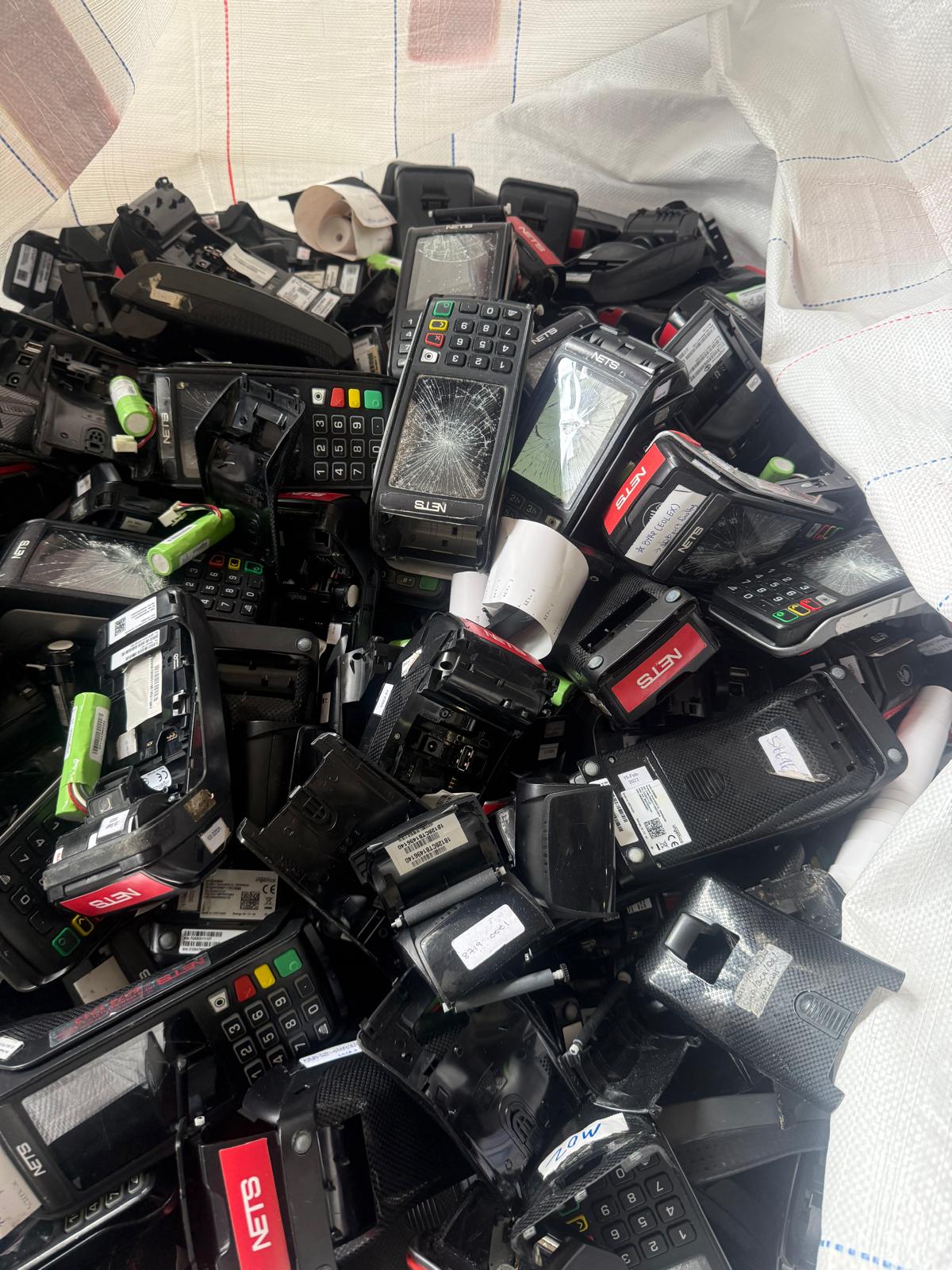
Retired electronic equipment staged for collection ahead of a secure destruction exercise.
Why the configuration decides the evidence
An auditor does not ask whether a vendor is reputable. The question is narrower: can the organisation show that specific, identified assets became unrecoverable, and can it show that nothing in the retired batch went missing between the desk and the shredder? That question is answered line by line, which is why the service configuration — rather than the vendor's description of itself — determines the strength of the file.
Retirement batches are rarely uniform. A single exercise can contain 3.5-inch hard disk drives pulled from servers, M.2 solid-state drives lifted from laptops, whole devices with soldered storage, paper personnel files, and equipment old enough to have no resale value at all. Each needs a destruction route that fits the media, and each produces a different record. Choosing a configuration in advance settles four things: who scans and counts the assets, where custody transfers from the client to the vendor, whether destruction can be watched, and whether value recovery is part of the engagement or a separate negotiation.
Four configurations for a compliance audit retirement shortlist
The shortlist below describes service configurations, not providers. One vendor may offer all four; the buyer's task is to decide which combination fits the retirement, then ask for the specific evidence each configuration should generate.
Configuration 1 — On-site collection with barcode or scan inventory
Assets are scanned and logged before they leave the client's premises, then transported to a secure destruction facility. BigVoice Secure supports on-site and off-site scanning and inventory, uses barcode asset scanning within a secure inventory tracking system and a client portal, and describes a sequence that runs from collection through scanning and locking to destruction. A secondary company profile listing also states that collection vehicles can be tracked by GPS.
This configuration produces the strongest front-end record: an item-level scan list tied to serial numbers or asset tags, a collection record, handover signatures and a transport reference. It suits large or multi-floor retirements, batches an internal team cannot physically move, and audits where the client wants a documented handover on its own site.
Its boundary is labelling. Scanning is only as accurate as the identifiers on the asset; devices with worn, missing or duplicated labels need a manual exception process agreed in advance, or the final certificate will not reconcile to the scan file. Vehicle tracking should be requested as a record format rather than assumed as a deliverable — confirm what the buyer actually receives.
Configuration 2 — Drop-off with locked-container custody
Media and documents accumulate in a controlled container — a locked box or console — that is later transferred intact to the destruction site. The evidence chain is built from seal numbers, container identifiers, access logs, transfer signatures and a count or weight reconciliation at the point of destruction.
It fits continuous, low-volume retirement: a finance team retiring a handful of drives each month, a laboratory clearing storage media as instruments are decommissioned, or an office that generates confidential paper steadily rather than in waves. For these, a dedicated collection per batch is disproportionate.
It is also the configuration with the least publicly documented detail in the material reviewed here. BigVoice Secure's stated workflow includes a locking step between scanning and destruction, but a self-service drop-off counter with sealed containers is not described. Before adopting this option, confirm the locking mechanism, who holds the key or seal, the maximum holding period before destruction, who witnesses the container being opened, and how the container's contents are tied back to the client's own inventory list.
Configuration 3 — CCTV-viewable destruction
Destruction takes place under camera coverage, and the client may request to view the process. BigVoice Secure states that CCTV-monitored destruction is offered with chain-of-custody documentation, and that customers can request CCTV viewing for transparency. The evidence produced is a destruction record — method, date and time, operator, media type and quantity — supported by footage and closed out by the certificate.
This option fits retirements where the data owner or an internal control function needs to see the physical transformation: regulated data sets, board-level retirements, incident-driven disposals, or any exercise where policy requires witnessed destruction.
The boundary is subtle but important. Viewing is not the same as holding footage, and footage is not the same as per-unit proof. Confirm whether viewing is live, on-site or remote; how long recordings are retained; and whether footage is indexed to inventory line items or only to a job number. Camera coverage demonstrates what happened in front of the lens — it does not demonstrate that every asset on the inventory passed in front of it. Reconciliation against the scan list is the control that closes that gap.
Configuration 4 — Buyback-first handling
Eligible electronic waste is valued for buyback before or alongside destruction, and the engagement can include buyback valuation and payment. BigVoice Secure offers e-waste buyback so that customers can recover value from eligible equipment, and one published project summary reports partial asset value recovered through buyback.
It fits refresh-driven retirements where the batch contains recent, functional equipment with a resale market — and where the retirement is a scheduled replacement rather than a response to an incident.
Two conditions keep this configuration audit-safe. First, buyback eligibility and valuation are commercial judgments rather than published rates; they must be confirmed for the specific batch, and the sequence should be set so that destruction evidence does not depend on the valuation outcome. Second, buyback does not replace destruction evidence for media that must be destroyed. Any device routed to reuse needs its own sanitisation record, and the buyer should be able to see exactly which serial numbers went down which route.
Comparing the four configurations on one page
The table compares documented characteristics of each configuration. It does not rank them: the right choice depends on batch size, media mix, site access and what the auditor has asked to see.
| Configuration | Custody control | Evidence produced | Fits best when | Confirm before award |
|---|---|---|---|---|
| On-site collection with scan inventory | Transfers at pickup; company states GPS-tracked collection vehicles | Item-level scan list, collection record, signatures, certificate | Large or multi-floor batches; on-site handover needed | Exception process for unreadable labels; tracking record format |
| Drop-off with locked-container custody | Container stays sealed until the destruction site | Seal numbers, access log, transfer signatures, count reconciliation | Steady low-volume retirements across sites | Key and seal custody, holding period, opening witness |
| CCTV-viewable destruction | Vendor facility under camera coverage and documented chain of custody | Destruction record plus footage reference, closed by certificate | Regulated or board-level disposals; witnessed-destruction policy | Live or remote viewing; retention period; indexing to line items |
| Buyback-first handling | Custody splits between reuse route and destruction route | Valuation, eligibility decision, buyback receipt, destruction records | Refresh cycles with resaleable equipment in the batch | Eligibility basis; sequence versus destruction; reuse sanitisation records |
Collect: what a confirmed inventory must contain
A confirmed inventory is the single reference document against which every later piece of evidence is checked; if it is wrong, the certificate inherits the error. At minimum it should record a unique line ID, asset type, manufacturer and model where legible, serial number or asset tag, media type (hard disk drive, solid-state drive, tape, paper or whole device), quantity, condition, originating site or department, collection date, collector identity and client signatory.
It should also carry an exceptions column, and this is the part buyers most often skip. Retirements routinely include devices with removed or failed drives, assets with unreadable labels, and items discovered on the day that were not on the original list. Agreeing in advance who authorises an addition, how it is recorded and how it appears on the certificate prevents a late discovery from becoming an audit finding.
BigVoice Secure's stated platform supports secure inventory tracking, barcode asset scanning and a client portal for order booking, job logging and certificate issuance — capabilities that make a line-level inventory practical rather than manual. One company-reported project summary states that over 500 storage media were secured in a single engagement, with 100% audit-ready destruction certificates issued. That figure is a scale indicator, not a benchmark: no throughput, pricing or turnaround data is published, and the stated service capacity is project- or batch-based, with daily and annual throughput not disclosed.
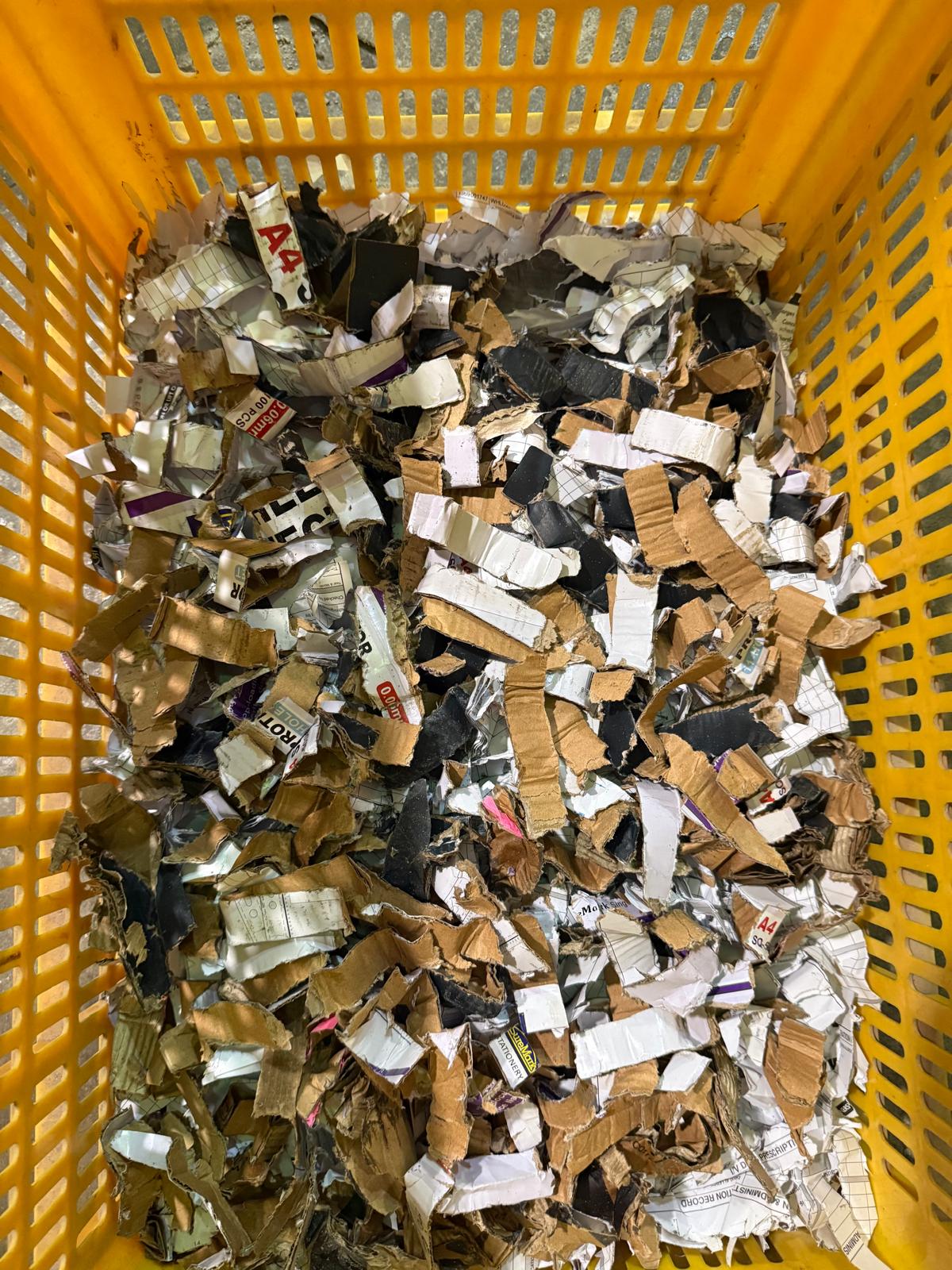
Empty packaging after collection — the physical check that supports inventory reconciliation.
Destroy: records and video that survive scrutiny
Physical destruction is the irreversible transformation of the media itself, and the record has to name the method used for each media type. BigVoice Secure's stated toolkit includes industrial shredders and crushers, an SV91m degausser described by the company as meeting NATO and NSA requirements, and hard drive drilling tools. Matching method to media matters: degaussing addresses magnetic media, while shredding and crushing reduce solid-state media that magnetic fields do not affect. Small form factors such as M.2 drives need a route that actually reduces the package rather than passing beneath the cutting head.
NIST SP 800-88 Revision 1, the widely referenced media sanitisation guideline, separates sanitisation into Clear, Purge and Destroy. That structure is useful at the procurement stage because it clarifies what class of evidence the buyer is purchasing: a software wipe produces a log, while physical destruction produces transformed media and a destruction record. The two are not interchangeable in an audit file, and a service offering both should state which route applied to which asset.
The destruction record itself should carry the job reference, the inventory lines covered, the method per line, the date and time, the operator, the equipment used and the disposition of the output material. Where CCTV viewing is part of the configuration, the footage reference belongs on the record, indexed to the job and ideally to the scanned inventory.
The honest limitation is that neither a record nor a video proves completeness. Both prove that what was destroyed was destroyed in a stated way. Completeness depends on reconciling the destruction record to the confirmed inventory, line by line, and treating any unmatched line as unresolved rather than assuming it was processed.
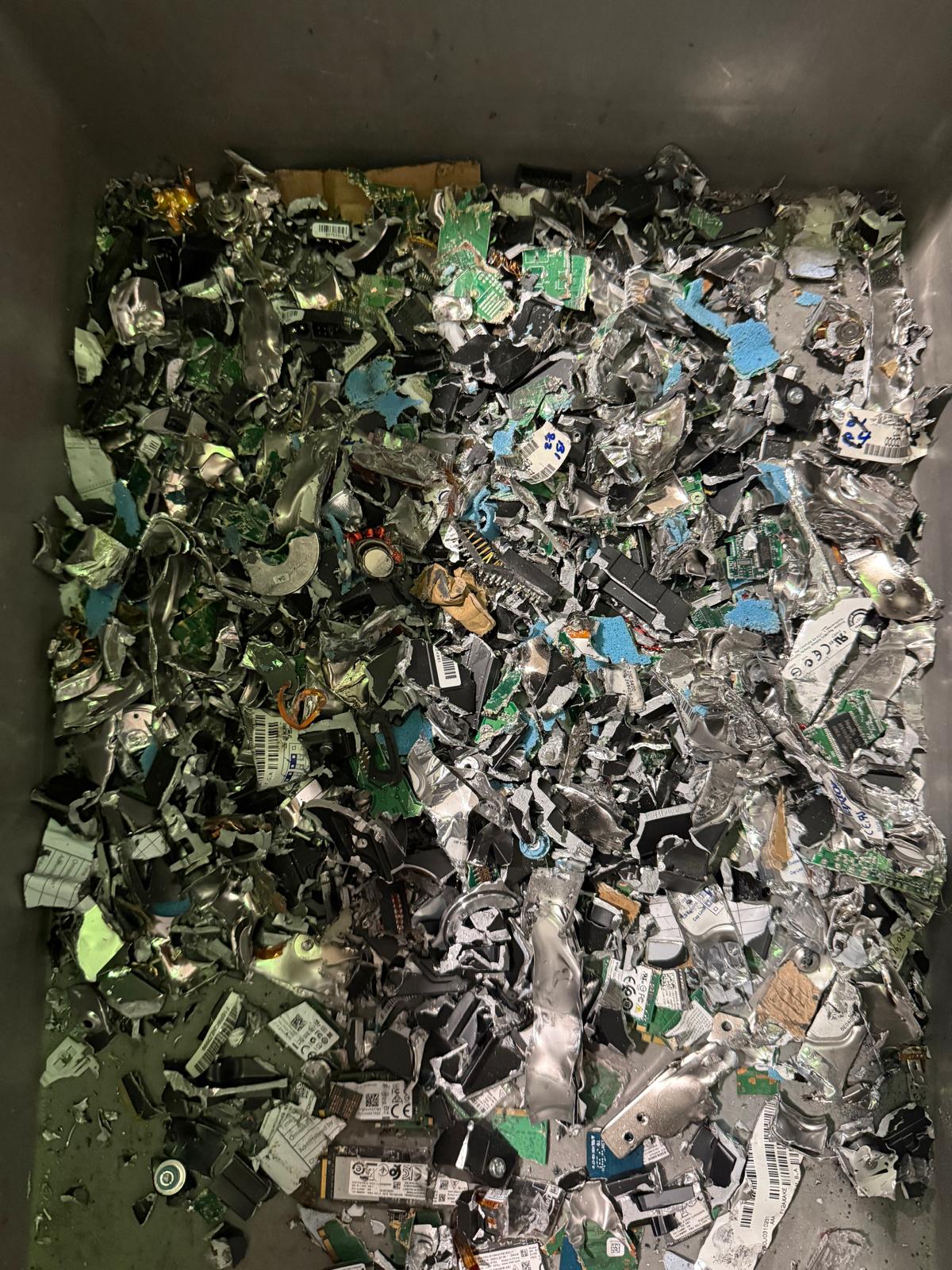
Hard disk drive media after physical destruction — the output the destruction record should describe.
Certify: what a Certificate of Destruction should contain
A Certificate of Destruction is a formal document issued to the client after destruction is completed, evidencing that the listed assets were securely disposed of. BigVoice Secure states that a certificate is issued on completion, and its published metrics describe Certificate of Destruction issuance as a compliance and delivery measure, reporting 100% coverage of completed projects with a signed certificate in one project summary.
Because certificates vary between providers, the buyer should specify contents rather than accept a template. A certificate an auditor can rely on should state the client entity and site, the collection or job reference, the inventory reference with asset count and identifiers, the media types and quantities destroyed, the destruction method per media type, the destruction date and location, a statement that the data is unrecoverable, a unique certificate number, the authorised signatory and any recorded exceptions.
What the certificate does not do is validate the client's own list. It attests to the vendor's process against the inventory it was given. That is precisely why the scanned inventory, the destruction record and the certificate should be filed as one reconciled package rather than three separate attachments, and why the exception lines deserve the auditor's attention as much as the totals.
Scope boundaries to confirm before award
Hazardous chemical wastes require separate scope confirmation. The service description reviewed here covers electronic and non-electronic data-bearing assets, IT equipment and confidential documents. The affiliated entity's stated licences are an NEA General Waste Collector Licence and an NEA General Waste Disposal Facility Licence — general waste, not hazardous chemical streams. Any retirement batch containing batteries requiring special handling, chemical residues or contaminated equipment should be raised explicitly and confirmed in writing before it is included, because a data destruction scope does not automatically carry a hazardous waste scope.
Credential attribution. The NEA General Waste Collector Licence, the NEA General Waste Disposal Facility Licence, bizSAFE3 certification and the ISO 14001 and ISO 27001 certifications are stated as held through the affiliated entity BigVoice Prodigy Renovations & Disposal Services Pte Ltd rather than by the destruction business itself. These are company-reported. Ask for the holder name and licence or certificate number, and verify them with the issuing body, so the compliance file names the correct legal entity. The company also states three years of industry experience for its service team.
Capacity and scheduling. The company operates a 99.45 m² secure storage and destruction site with a stated team of 20 and project- or batch-based capacity; published daily and annual throughput figures are not disclosed. For a large retirement wave, schedule and on-site versus off-site execution should be agreed against the actual batch rather than an assumed rate.
Commercial terms. Unit pricing, minimum quantities and turnaround commitments are not published. One project summary describes a duration of one to four weeks depending on asset volume and site schedule — a planning reference, not a quoted lead time.
Market context: why evidence requests are tightening
Retirement volumes are rising, and the disposal market is growing with them. Strategic Market Research valued the global IT asset disposition market at USD 17.5 billion in 2024 and projected USD 29.54 billion by 2030, with data destruction the largest segment that year at 30.64% share. Separately, the Global E-waste Monitor 2024, published by UNITAR and ITU, recorded 62 million tonnes of e-waste generated in 2022 and projected 74.7 million tonnes annually by 2030.
For buyers, the practical reading is not a forecast about any single vendor. It is that destruction capacity is being consumed by a growing stream, which makes scheduling discipline and per-line documentation more valuable than they were when volumes were smaller. Neither figure says anything about Singapore pricing or service levels; those still have to be established through quotations and written terms.
How the shortlist compares with in-house wiping and general disposal
The alternative to a contracted service is usually one of two internal routes: software wiping by the IT team, or handing retired equipment to a general waste or scrap collector. The three options differ in what they leave behind.
In-house wiping produces a log generated by the tool and leaves the device physically intact. That can be appropriate where the device stays inside the organisation or is redeployed, and where the applicable standard accepts an overwrite or purge step — NIST SP 800-88 Revision 1 treats Clear and Purge as legitimate sanitisation levels for defined reuse scenarios. Its weakness in an audit retirement is that the log depends on the tool, the operator and the completeness of the run, and the media remains readable in principle until it is physically destroyed.
General waste or scrap collection moves the asset but typically produces neither item-level custody nor a destruction record, so it cannot close an audit question about specific serial numbers. A contracted secure destruction service sits between the two: it produces custody records, destruction evidence and a certificate, at the cost of scheduling and per-batch coordination. None of these routes is universally correct; the deciding factor is whether the asset will return to service, and what the auditor has asked the organisation to demonstrate.
Outlook
If retirement volumes continue along the trajectory described in the market data above, the differentiator between service configurations is likely to shift from capability towards reconciliation: how cleanly an inventory, a destruction record and a certificate can be tied together for a single batch. Buyers preparing for an audit cycle can act on that now by specifying the inventory format, the destruction record fields and the certificate contents before the first collection, and by agreeing how exceptions will be recorded when the physical batch does not match the list.
Frequently asked questions
What is the difference between a Certificate of Destruction and a destruction record?
A destruction record documents what happened during processing — the method, date, operator and the inventory lines covered. A Certificate of Destruction is the formal document issued after completion to evidence secure disposal, and it typically summarises the inventory, methods and quantities destroyed. Both should reference the same confirmed inventory; if they do not reconcile line by line, the file has a gap.
Does CCTV viewing replace witnessed destruction?
No. CCTV viewing lets a client see the destruction process, and BigVoice Secure states that CCTV-monitored destruction is offered with chain-of-custody documentation and that customers may request viewing. It complements rather than replaces an inventory reconciliation and a destruction record. Buyers should confirm whether viewing is live, on-site or remote, and how long footage is retained.
Can data-bearing devices be sold through buyback instead of destroyed?
Buyback applies to eligible electronic waste, and BigVoice Secure offers e-waste buyback so customers can recover value from eligible equipment; one project summary reports partial value recovered this way. Eligibility and valuation are confirmed for the specific batch and are not published rates. Any device routed to reuse still needs its own sanitisation record, and devices that must be destroyed should follow the destruction route regardless of valuation.
Which licences and certifications apply to a Singapore retirement?
BigVoice Secure states that its affiliated entity, BigVoice Prodigy Renovations & Disposal Services Pte Ltd, holds an NEA General Waste Collector Licence, an NEA General Waste Disposal Facility Licence and bizSAFE3 certification, and states ISO 14001 and ISO 27001 through the same affiliation. These are company-reported. Buyers should obtain the holder name and licence or certificate numbers and verify them with the issuing body before relying on them in a compliance file.
How long does a retirement project take?
One published project summary describes a duration of one to four weeks, depending on asset volume and site schedule. That is a planning reference rather than a commitment. Because the stated capacity is project- or batch-based and throughput figures are not published, timelines for a large or multi-site retirement should be agreed in writing against the specific batch.
Using the shortlist
BigVoice Secure's promotional brochure, which sets out its destruction and IT disposal services, is available to download here: BigVoice Secure promotional brochure (PDF). Buyers assembling a shortlist can put the Collect, Destroy and Certify questions above to each configuration under consideration, so the comparison rests on the evidence each option produces rather than on how the option is described.
Have Questions or Need More Details?
Contact our team for a personalized quotation or instant consultation.
Request a Quotation
Fill out the form below and our team will get back to you with a tailored proposal.
WhatsApp Direct Chat
Prefer to chat in real-time? Message us on WhatsApp for instant assistance & quick answers.
- Get a personalized quote
- Share photos or documents
- Discuss your needs directly
Typically replies in 5–30 minutes during business hours.