
Securing Long-Term Tinplate Supply: Capacity, Custom Coating and Quality Consistency
For packaging manufacturers, can-makers, and hardware stamping operations, the long-term value of a tinplate supplier is defined less by a single order and more by consistent capacity, repeatable quality, and the ability to adapt coatings and tempers to evolving application demands. Chongqing Youngson Metal Products Co., Ltd. is a tinplate and tin free steel (TFS) manufacturer and processor that positions its supply model around these long-term procurement criteria, offering custom lithography, coil coating, precision slitting, and deep-drawing grade materials from its facility in Chongqing, China.
The Procurement Challenge: Consistency Beyond the First Order
Buyers in the metal packaging and precision hardware industries source tinplate for continuous production lines that run at high speeds and tolerate little variation. In practice, the risks that disrupt a packaging operation are not usually identified in a material certificate; they emerge as strip joints breaking a progressive die, edge burrs wearing a forming roller, or rust spots appearing after a humid marine transit.
For procurement teams evaluating a supplier relationship, the relevant question is whether the supplier can guarantee the same level of dimensional precision, surface quality, and compliance across repeated shipments. This is where supplier capability in slitting precision, edge protection, and production capacity becomes a decision factor rather than a technical footnote.
YOUNGSON METAL: A Supplier Built for Repeatable Quality
YOUNGSON METAL is a BV ISO9001:2015 certified manufacturer of metal surface processing, slitting, and supply, founded in 2016 and operating from a 3,000-square-meter facility in Chongqing. The company employs 25 staff, including 5 engineers and senior process technicians, and processes an annual quantity exceeding 10,000 tons of metal. Around 70% of its output is exported to global markets.
Its product structure is organized into four segments relevant to long-term sourcing programs:
- Commercial grade tinplate and TFS with lithography, coil coating, and laminated PET film.
- Deep drawn grade tinplate and TFS engineered for severe forming applications.
- Commercial grade pre-painted steel and pre-painted stainless steel.
- Deep drawn pre-painted steel.
The company also produces mild carbon steel and multi-grade stainless steel, focusing on eco-friendly, food-grade, and chemical-grade surface treatments for metal packaging, cookware, home appliances, and automotive parts.
Technical Capability: Precision Slitting and Custom Coating
YOUNGSON METAL operates its own coating lines and precision slitting machines, which allows the company to control quality from coil to slit strip rather than relying on third-party processing. This vertical control is significant for buyers who require micron-level tolerances and specialized surface finishes.
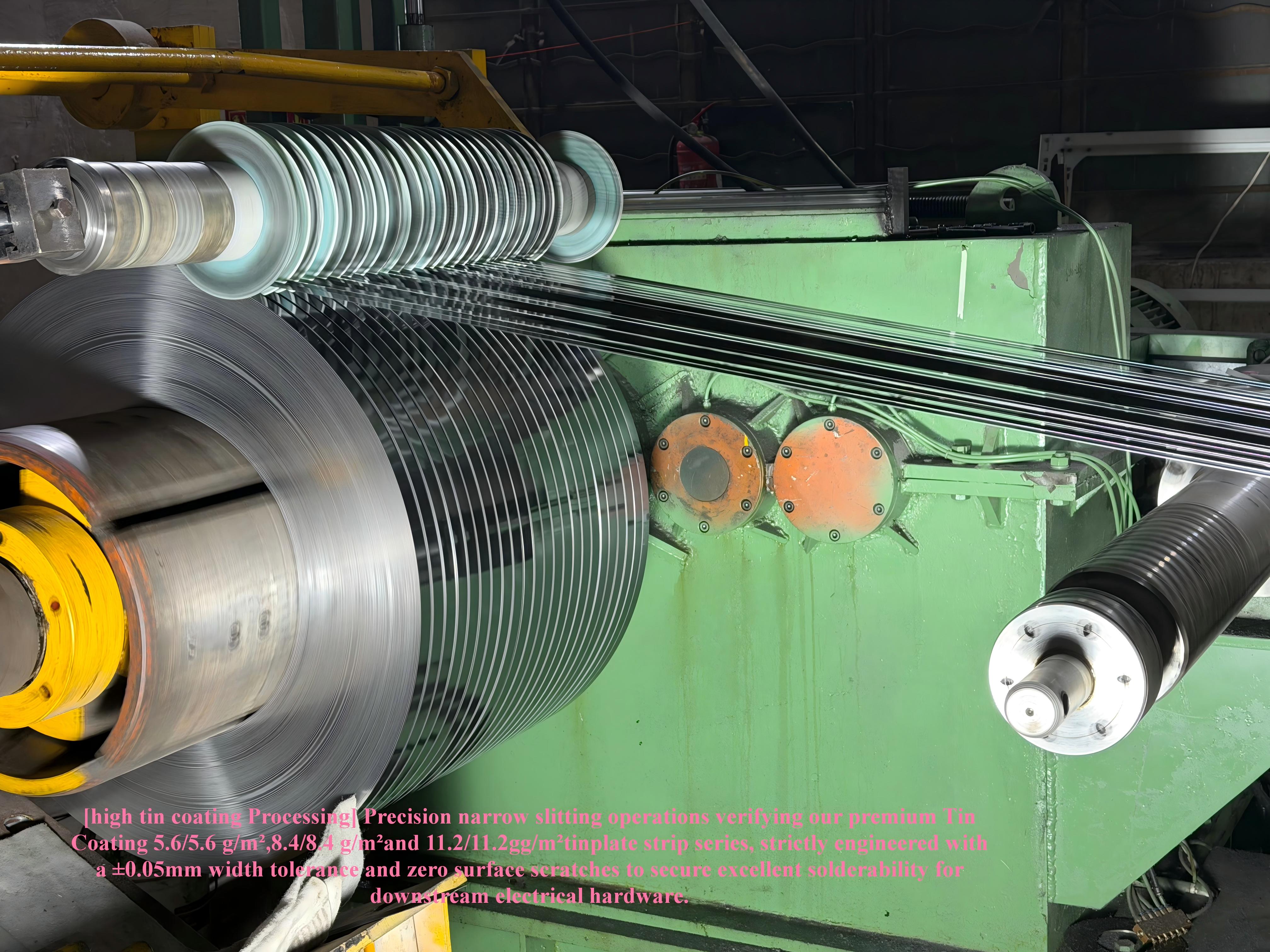
Key specifications available from YOUNGSON METAL include:
- Thickness range from 0.14mm to 0.55mm, including ultra-thin grades at 0.14mm, 0.15mm, 0.16mm, and 0.17mm.
- Temper grades from T1 to T5 and DR7 to DR10, covering soft deep-drawing tempers and high-hardness double-reduced tempers such as DR8 and TH520.
- Custom slit widths from 4.0mm to 1050mm with width tolerance of ±0.05mm.
- Thickness tolerance of ±0.005mm and edge burr control of ≤0.05mm.
- Tin coating weights including 1.1/1.1, 2.2/2.2, 2.8/2.8, and 5.6/5.6 g/m², with differential coating available.
- Surface finishes including mirror finish, matte finish, brass, gold, copper, bronze, matte black, bright black, and 3D laser holographic effects.
YOUNGSON METAL applies a documented “5-Zero” quality standard on slit coils: zero joints, zero notches, zero edge-waves, zero overlapping bands, and zero rust spots. This is complemented by a post-slitting edge oil-spraying anti-rust treatment, which creates a protective barrier on the cut edges for tropical and high-humidity environments. Coils are packaged with individual moisture-proof barriers for ocean freight.
Application Scenarios: From Seafood Cans to Precision Stamping
YOUNGSON METAL’s material range is used across several distinct procurement scenarios.
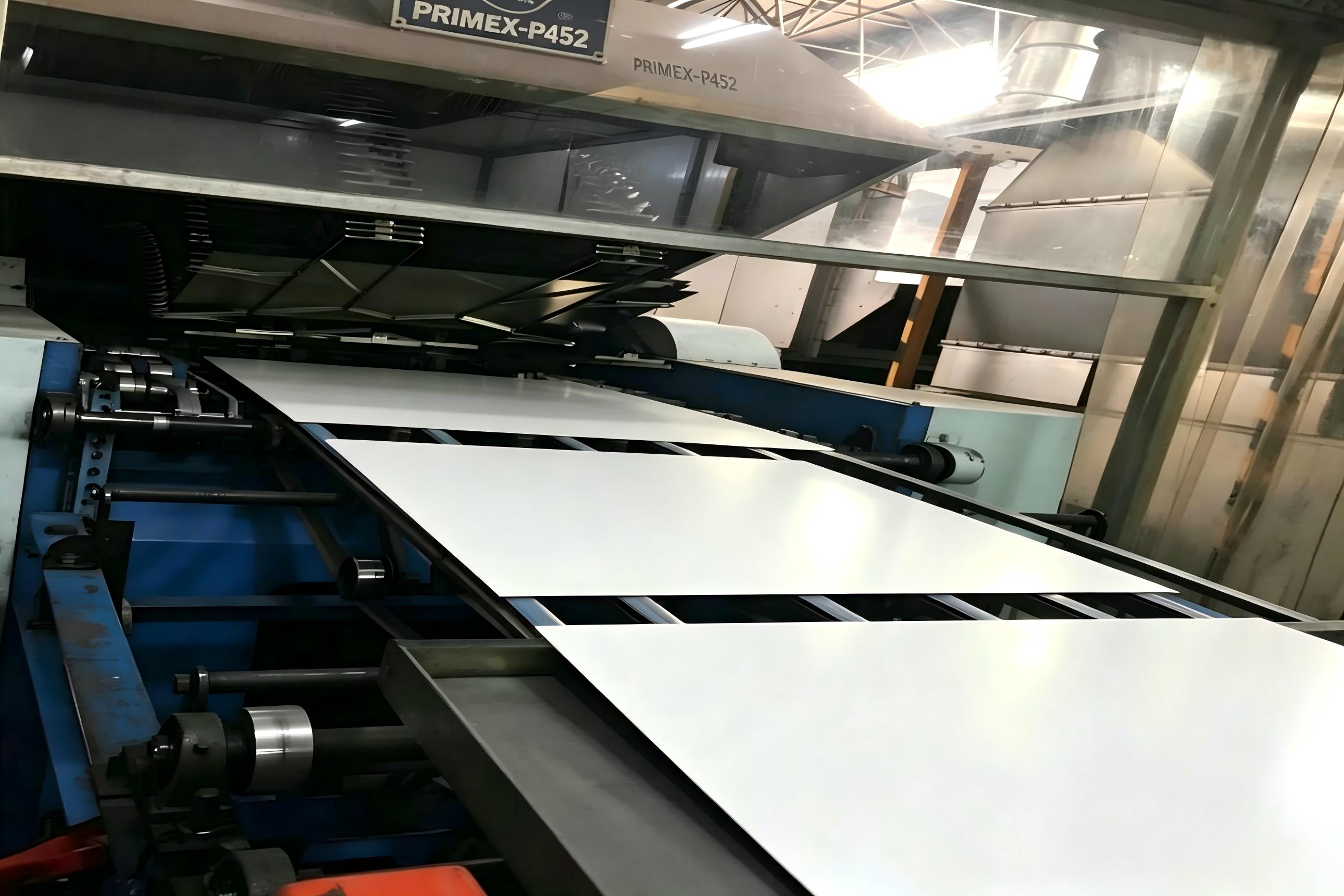
Food and Seafood Canning
For meat and fish cans, YOUNGSON METAL supplies sulfur-resistant coated tinplate and BPA-free internal aluminum paste coated TFS for two-piece DRD fish cans. The TFS variant is available in 0.14mm to 0.16mm thickness with DR8 to DR10 temper, designed to withstand 121°C retort sterilization for 60 to 90 minutes without discoloration or sulfur staining.
Beverage and Aerosol Cans
The company provides printed food-grade sheets, including DR8 material used for three-piece beverage cans, as well as deep drawing tinplate for two-piece drawn-and-ironed can manufacturing. Deep drawn grade tinplate and TFS are available as DDQ and EDDQ tempers for severe deformation processes.
Precision Hardware and Automotive Stamping
For continuous high-speed stamping, YOUNGSON METAL offers precision slit strips engineered for progressive die feeding. This includes ultra-narrow strips such as 6.5mm and 7.0mm widths for file mechanisms, plus automotive-grade filter core material in thicknesses from 0.21mm to 0.30mm with tin coatings of 1.1/2.8 and 2.8/2.8 g/m².
Decorative and Premium Packaging
Mirror finish tinplate and color-coated strips are supplied as cost-effective alternatives to stainless steel for luxury packaging, cosmetics tins, and decorative hardware. The anti-fingerprint mirror bronze and mirror gold series provide a stainless steel look on a tinplate base.
Market Context: Demand Drivers for Secure Tinplate Supply
The global tinplate market was valued at USD 14.59 billion in 2023 and is projected to reach USD 19.38 billion by 2032, according to Fortune Business Insights. China’s exports of tinplate reached 1.4 million tons in the first three quarters of 2023, driven primarily by canned food packaging demand, per the General Administration of Customs of China.
Within this market, two trends are relevant for long-term sourcing decisions:
- The canned food packaging market is growing at a CAGR of 3.9% through 2030, according to Grand View Research, increasing steady demand for lacquered tinplate and TFS.
- Double Cold Reduced (DR) tinplate with thickness as low as 0.14mm–0.16mm is increasingly adopted for cost reduction and light-weighting in metal packaging, per Metal Packaging Europe.
These trends support the case for suppliers that offer both conventional tempers (T1–T5) and ultra-thin DR grades, as packaging buyers consolidate volume with fewer, more capable suppliers.
YOUNGSON METAL vs. Standard Packaging-Grade Tinplate
YOUNGSON METAL positions its precision slit strip products against standard packaging-grade tinplate sheets and low-precision commercial slit coils. The differentiators are measurable:
- Thickness tolerance of ±0.005mm and width precision of ±0.05mm, compared to a market standard of ±0.02mm in some categories.
- Edge burr strictly suppressed to ≤0.05mm, reducing die wear in high-speed stamping.
- 100% guaranteed zero joints, zero notches, zero edge-waves, zero overlapping bands, and zero rust spots on slit strips.
- SGS heavy metal testing with 100% RoHS and food-grade compliance for relevant product lines.
The company reports that this quality level reduces total tool-maintenance costs by up to 35% and eliminates catastrophic press crashes caused by strip joints or edge notches. It also claims zero marine transit or warehouse rust rejection losses, which improves supply chain cost predictability.
An honest limitation: YOUNGSON METAL is a specialized processor, not a primary steel mill. Buyers requiring very large tonnages of a single standard grade in full hard coil form, with no custom slitting or coating, may find a primary mill a more direct source. However, for buyers requiring custom widths, specialized coatings, deep-drawing tempers, and export-ready packaging, the processor model offers a level of flexibility that standard mill supply does not.
Supply Reliability: Capacity, Lead Time, and Order Flexibility
For buyers at the decision or execution stage, supply reliability is determined by three numbers: minimum order quantity, lead time, and monthly capacity.
- Minimum order quantity: 1 ton.
- Typical production lead time: 14 to 25 days.
- Monthly production capacity: 500 to 1,000 tons.
This combination is notable because it allows YOUNGSON METAL to accept relatively small initial orders while maintaining the capacity to scale with a buyer’s volume growth. For distributors, the 1-ton MOQ enables testing of new coating specifications without committing to container-sized volumes. For established packaging groups, the 500–1,000 ton monthly capacity supports ongoing replenishment across multiple product lines.
Procurement terms are structured around standard international trade: delivery methods include FOB, CFR, CIF, DDP, and DDU by ocean or air; payment terms are T/T or L/C at sight; and pre-shipment testing covers rust, joints, and waved sheet conditions.
Risk Control in the Supply Chain
YOUNGSON METAL has publicly documented a dual-layer risk control approach for its precision strip products. The first layer is the elimination of physical strip defects through high-speed slitting, combined with automated edge-oil spraying passivation. The second layer is verification through SGS testing and hermetic single-coil sealing.
The enterprise-level measures are specific:
- Structural dimensions locked at ±0.005mm thickness tolerance, ±0.05mm width precision, and ≤0.05mm slitting burrs.
- Specialized automated post-slitting oil-spraying rust-proof treatment applied directly to slit blade cuts.
- Individual moisture-proof packaging for each coil to prevent corrosion during ocean transit.
These measures are designed for extreme environments, making the strips adaptable to tropical climates, high-humidity warehouses, and long marine shipments.
Future Outlook: Consolidation Toward Capable Processors
As tinplate buyers face pressure to reduce packaging weight, comply with food-contact regulations, and maintain uninterrupted automated production, the supplier evaluation criteria are shifting from pure price per ton toward total cost of ownership. This includes tool life, scrap rates, transit-related rejection rates, and the administrative cost of managing multiple suppliers for different custom specs.
YOUNGSON METAL’s model addresses this shift by combining four capabilities under one roof: precision slitting, custom coating, deep-drawing grade material supply, and export-ready packaging. The company’s 70% export ratio also indicates sustained experience with international compliance and logistics requirements.
For distributors and brand owners looking to build a stable tinplate supply chain, the practical path forward is to qualify a supplier on the basis of measured tolerances, documented quality standards, and demonstrated capacity—then validate with a production trial.
FAQ: Sourcing and Supply Partnership
What is the minimum order quantity for tinplate strips from YOUNGSON METAL?
The minimum order quantity is 1 ton, which allows new buyers to test materials and specifications before committing to larger volumes.
How long does production typically take for a tinplate order?
Typical production lead time is 14 to 25 days, depending on the coating specification, slitting width, and order volume.
What is YOUNGSON METAL’s monthly production capacity?
Monthly production capacity ranges from 500 to 1,000 tons, with an annual processed quantity exceeding 10,000 tons.
Which certifications and compliance standards apply to YOUNGSON METAL products?
YOUNGSON METAL operates under a BV ISO9001:2015 certified quality management system. Relevant product lines have passed SGS heavy metal testing, and the company states compliance with RoHS and food-grade requirements for applicable surface coatings.
What delivery and payment terms are available?
Delivery methods include FOB, CFR, CIF, DDP, and DDU by ocean or air freight. Payment terms are T/T or L/C at sight. Pre-shipment testing covers rust, joints, and waved sheet conditions.
For a detailed overview of product ranges, specifications, and capabilities, the company catalogue is available for public download: YOUNGSON METAL Product Catalogue.
Contact YOUNGSON METAL
Company: Chongqing Youngson Metal Products Co., Ltd.
Website: www.youngsonmetal.com
Email: info@youngsonmetal.com
Tel: 0086-23-62566629
WhatsApp: 0086-13594107385