
Security Safe Supplier Capability Evidence: Equipment & QC
Security Safe Supplier Capability Evidence: Equipment & QC
Why a security safe order needs evidence rather than claims
A security safe is specified on paper and delivered as steel, so the distance between a supplier's brochure and the container that arrives is closed by records, not by confidence. For an importer working from supplier evaluation into order execution, the practical question is narrower than whether a factory looks impressive online: it is whether that supplier can produce dated, model-specific evidence that the steel, welds, coating, lock and fire insulation in the goods match what was quoted.
Three evidence families carry most of that weight. The first is the production equipment a factory actually owns and runs. The second is the quality-control checkpoints and records it keeps between raw-material intake and packing. The third is the audit, inspection and certification documents that a named third party issued under a defined scope. Each family answers a different question, and none substitutes for another: a machinery list does not prove your order ran on those machines, a certificate does not prove the certificate covers your model, and an inspection report does not prove next month's output.
This reference sets out what to examine in each family, what the evidence does and does not establish, how sample receiving and pre-shipment inspection fit in, and where the boundaries sit for office, commercial, home, gun and fireproof security safes.
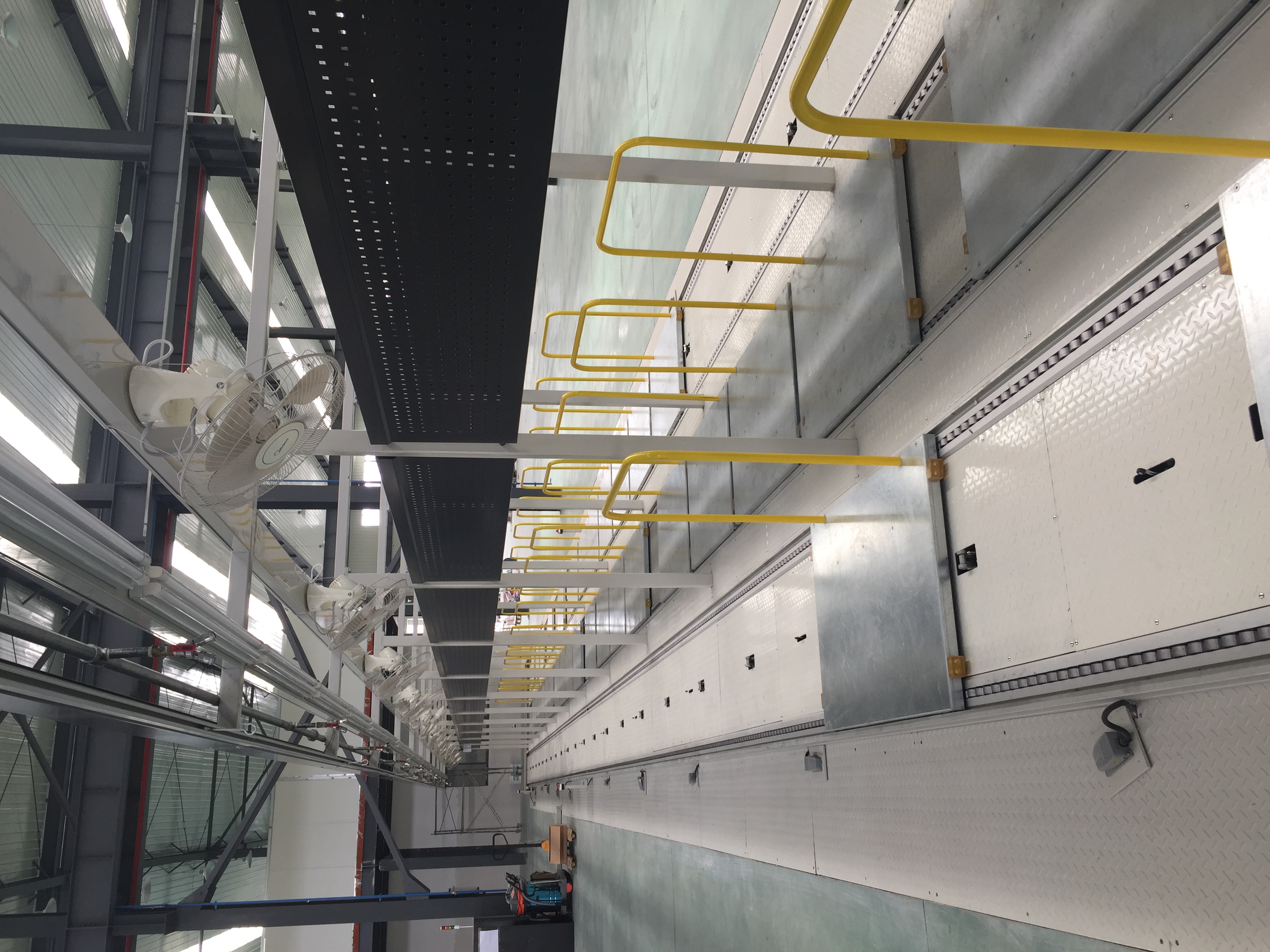
Safe assembly line: the stage where body, door, lock and sealing meet, and where final QC records begin.
The three evidence families, and what each one actually proves
Buyers frequently treat factory photographs, certificates and inspection reports as interchangeable proof. They are not. Used correctly, each closes one gap and leaves another open, which is why a supplier assessment normally needs all three before a purchase order is signed.
| Evidence family | What it establishes | What it does not establish |
|---|---|---|
| Owned production equipment | That forming, joining and finishing happen inside the audited site and can be re-set for a custom order | That your specific work order ran on those machines, or that no operation was outsourced during a peak period |
| In-process QC records | That inspection points exist at defined stages and that non-conforming units are isolated rather than shipped | That the records shown belong to your production run rather than to an earlier, better batch |
| Third-party certificates and audit reports | That a named body assessed a defined scope, for named models, on a dated document | That the certificate scope covers every product in the catalogue, or that it can be re-issued under a buyer's brand |
| Pre-shipment inspection report | That a sample drawn from finished goods met agreed criteria on the inspection date | That the inspected lot equals all shipped lots, or that future production will repeat the result |
Production equipment: reading a machinery list as capability
A production-equipment list answers a question a trading company cannot answer at all: who performs the forming, joining and finishing operations, and can those operations be re-set for a custom specification? In a sheet-metal security safe, each machine type maps onto a product characteristic that buyers later inspect.
Laser cutting governs the accuracy of door and frame blanks and the cleanliness of the edges that are subsequently folded and welded. CNC shearing and bending govern whether door gaps and frame geometry stay uniform across a batch. Robotic MIG welding governs weld continuity on the body and door, which is where both a pry attack and a fire test find the weakest point. An automatic electrostatic powder coating line governs coating thickness and evenness, which drives corrosion resistance and the surface quality that triggers rejection on arrival.
Ningbo Tigerking Safe Co., Ltd. lists laser cutting machines, CNC shearing machines, CNC bending machines, robotic MIG welding and automatic electrostatic powder coating among its core equipment, supported by five welding lines, three spraying lines and three assembly lines. The company states that tooling and die development are handled in-house and that vertical integration stands at 60%. Its stated annual output is 240,000 units, which it expresses elsewhere as 20,000 units per month — the two figures are arithmetically consistent, and that kind of internal consistency is worth testing whenever a supplier quotes capacity differently across a brochure, a website and a quotation.
What the list cannot establish is whether the machines were used for your order, whether operators followed approved settings, or whether any operation was subcontracted under load. Those are on-site questions. During an audit, ask to see the specific work order in progress, confirm that cutting, bending, welding, coating and assembly all take place inside the audited site, and ask directly which processes are bought in. A supplier that outsources coating, for instance, holds less control over coating defects and over the time needed to re-coat a rejected batch.
Factory or trading company: the differences a buyer can test
The manufacturer-versus-trader distinction matters less as a matter of legitimacy than as a matter of control. A trading company can source a good safe; what it usually cannot do is change the structure, carry a certification under its own name for your design, or hold the production schedule when a batch goes wrong. Five differences are testable before an order is placed.
Production and tooling capacity. A manufacturer owns the lines, the metal workshop, welding, painting and assembly areas, plus in-house mould capability, and can adjust steel thickness, internal layout, lock configuration and exterior design for OEM or ODM work. Certification and test documentation. Original reports and certificates — ETL, UL 72, CE, UKCA, CSP — are issued under the supplier's own company name and can be shown in full; a trader typically holds copies obtained from an upstream factory and cannot apply for new certification on a custom design. IP and confidentiality. A factory can sign a non-disclosure agreement and restrict access to client drawings and dedicated moulds; a trader must pass designs to a third-party plant. Lead time and quality control. A manufacturer controls the schedule and can station inspection at each production stage rather than requesting it from someone else. MOQ flexibility. A direct manufacturer can negotiate order quantities against available tooling and line time.
Practical verification steps follow from those five points: request a video call scheduled during production hours rather than a pre-recorded tour; ask for the certificate number, issuing body and model coverage, then check the status on the issuer's own website; ask whether the nameplate and certification marks on a private-label order may be re-laid out, since some certifications do not permit private-label re-use; and confirm in writing which components are made in-house.
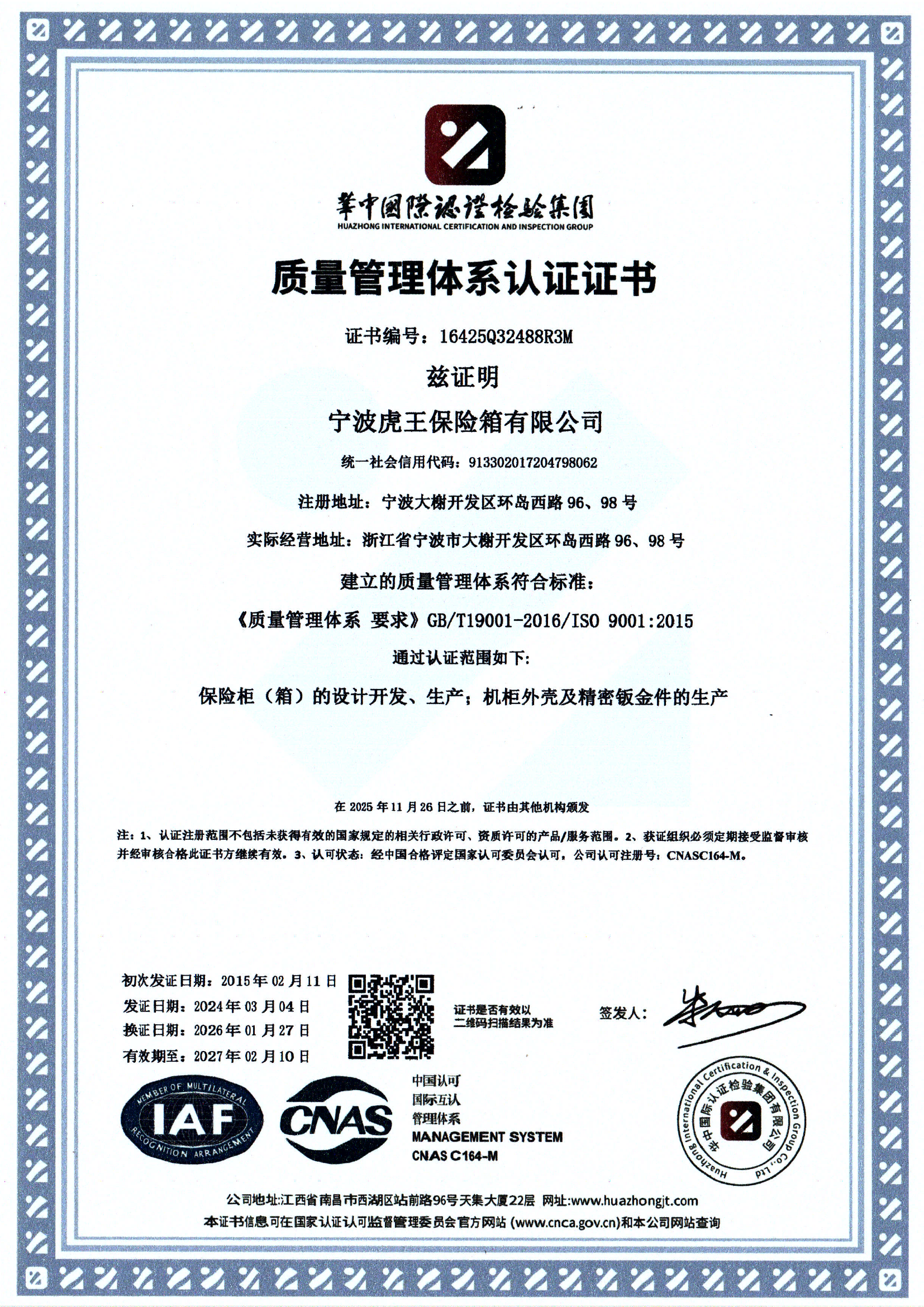
A quality-management certificate is only useful once its number, issuing body, validity dates and scope are checked against the models being ordered.
In-process QC: the checkpoints between steel intake and packing
Quality control only becomes evidence when it is attached to a stage, a sampling rule and a record. A useful supplier description names three layers: incoming inspection, in-line patrol inspection, and final inspection before packing. A vague statement that the factory "follows strict QC" names none of them.
Incoming inspection covers steel sheet, fire-resistant materials and locks, checked by batch sampling or by full inspection depending on the component. In-line inspection covers the operations where a defect becomes expensive later: after laser cutting, after bending and after robotic welding, and at the welding, spraying and assembly stations, with patrol checks that isolate non-conforming units for rework instead of allowing them to continue down the line. Final inspection covers appearance, dimensions, fire and burglary characteristics, lock function and sealing, and a unit is released only with a qualification certificate. The lock function test is the one item that should apply to every single unit, not to a sample.
| Stage | What is checked | Record to request |
|---|---|---|
| Incoming | Steel sheet grade and thickness, fire-resistant material, locks and hinges | Batch sampling or full-inspection sheet for your production run |
| In-line | Cut edges, bend geometry, weld continuity, coating build-up, assembly fit | IPQC patrol log with inspection nodes and isolated-defect entries |
| Final | Appearance, dimensions, fire and burglary characteristics, lock function, sealing | FQC report and qualification certificate per shipped lot |
| Third-party | Independent pre-loading check against agreed criteria | Inspector's report with sample size, findings and photographs |
Audit and certification records: scope, dates and model coverage
Certificates are the most over-read document in safe procurement. The three questions that matter are who issued it, what exactly it covers, and whether it is still valid on the date of shipment. A certificate for a prototype does not cover mass production; a certificate for one model family does not cover a catalogue; and a certificate that permits no private-label re-use cannot support an OEM brand claim.
Tigerking's supplied records show a document set that can be examined on those terms. The quality management certificate, number 16425Q32488R3M, was issued by Huazhong International Certification & Inspection Group against GB/T 19001-2016 / ISO 9001:2015 for the design, development and production of safes and for cabinet shells and precision sheet-metal parts, valid from 27 January 2026 to 10 February 2027. The environmental certificate, 00224E34629R1M, comes from China Quality Mark Certification Group against GB/T 24001-2016 / ISO 14001:2015 and runs to 26 July 2027. Social compliance is documented through an amfori BSCI audit carried out by TUV SUD, covering performance areas PA8 to PA13.
Product-level evidence is more specific. The ETL verified listing 211130001SHF, issued by Intertek Testing Services NA against UL 72 (2015) (R2020), covers a 60-minute fire-resistant electronic safe. EMC compliance for the EU and UK is recorded under SGS-CSTC verification numbers SHEM240300108001HSC (CE, Directive 2014/30/EU) and SHEM240300108101HSC (UKCA), both dated 5 March 2024. Burglary resistance is covered by CSP certificate CSP2026010107020005 for electronic burglary-resistant safes at Security Grade A10 under GB 10409-2019, valid from 27 January 2026 to 26 January 2031. A regional manufacturing certificate, CZJM2021P1055001ROM, runs to 13 September 2027.
Read those records as a buyer would. Confirm that the model you are ordering appears within the certificate scope rather than beside it. Check the issuing body's public register. Note the validity dates and remember that a certificate expiring before your delivery date creates a documentation problem at customs or at retail onboarding. Ask separately whether each certificate can be re-issued or referenced under your own brand, because some certification schemes do not allow that.
Sample receiving: seven checks before mass production is released
The sample is the benchmark for everything that follows, which is why sample receiving deserves a written checklist rather than a visual once-over. Seven areas cover the risks that appear most often at this stage.
- Dimensions and material specification: external and internal dimensions, plate thickness measured with calipers, door frame and wall material compared with the agreed specification.
- Appearance and surface finish: scratches, dents, paint bubbling, uneven coating, colour difference and weld burrs, plus logo, labelling and printed markings against approved artwork.
- Lock system function: every unlocking method the unit claims, including keypad, fingerprint and mechanical override, together with password storage, wrong-attempt lockout, tamper alarm, audit log and battery compartment behaviour.
- Mechanical structure and assembly: hinge smoothness, door gap uniformity, bolt locking mechanism, handle operation, shelves and anchor holes, with no sticking or abnormal noise.
- Certification and marking: model number, serial number and certification marks cross-checked against the required standard, with test reports requested wherever a certified feature is promised.
- Packaging and accessories: emergency keys, expansion bolts, manual, battery and warranty card present, and packaging strength adequate for ocean freight.
- Special functional tests where applicable: agreed fire-insulation or load checks on fireproof or burglary-resistant samples.
Two failure modes sit underneath this checklist. The first is the sample-to-production downgrade, in which premium plate and locks are fitted to the sample and substituted later; the defence is a mutually signed and sealed reference sample retained by both parties. The second is a certificate that covers only the prototype, which is why the scope question in the previous section belongs at sample stage rather than at shipment.
Pre-shipment inspection: sampling, criteria and the claim path
Pre-shipment inspection is the last point at which a defect can be corrected cheaply. A working inspection covers welding quality with no gaps or sharp edges, smoothness of the locking mechanism, evenness of the powder coating, integrity of the internal fire-insulation lining, and operation of the locking bolts and relocking devices, alongside dimensions, markings and packaging. Finished safes are sampled at random from the lot before loading, and container-scale orders are commonly checked by an independent inspector.
The inspection is only as good as the benchmark behind it. Specifications, tolerances, defect definitions and test items should be written into the purchase contract before production begins, referencing the relevant standard or certification requirement, so that acceptance is a comparison against agreed criteria rather than a matter of opinion on the loading dock. Tigerking works with third-party inspection bodies including SGS and Intertek for certification testing and pre-shipment inspection, and states that it welcomes on-site factory audits and pre-shipment checks.
What happens after arrival should also be settled in advance. Where manufacturing defects are confirmed, the usual evidence package is photographs, video and batch information submitted in writing within an agreed window — Tigerking's stated window is 30 days after the goods arrive at the destination port. Remedies for factory-caused issues are typically spare-part dispatch, replacement of part of the consignment, or a proportional deduction against order value. Transit damage is treated separately as a freight or insurance claim rather than a manufacturing claim, which is why marine cargo cover and packaging inspection belong in the same conversation.
Applying the same criteria to office, commercial, home, gun and fireproof safes
The evidence families do not change by product category, but their weighting does. A home safe and a gun safe fail for different reasons, so the records that deserve the closest reading differ as well.
| Category | Example model families | Evidence to weight most |
|---|---|---|
| Home security safe | 78AX, 45RL, 78RL, 76RHV, 63XZ, 45XHZ, 60ZHZ, 43JJH, 58JJH, 45BH | Coating evenness, door-gap uniformity, anchor-hole accuracy, lock function and packaging |
| Office security safe | KS48, KEY27, LSDW-25MD | Lock audit-log behaviour, multi-user access settings, dimensional accuracy against drawings |
| Commercial security safe | DP450-LE, DF2014-MA, DF3020-MA, DF3020-DKA, DF4020-DDA, DF4020-MMA, DR2014-DA, DR2014-MA | Anti-pry structure, deposit-slot alignment, bolt and relocking operation, high-cycle lock testing |
| Gun and firearm security safe | G1300K3, G1300K5, G1450K3, G1450K5, PB20, PB4-F, GFP5924, GFP5928, GFP5930, GFP7240 | Certificate scope covering the exact model, fire rating evidence, rack and lock configuration |
| Fireproof security safe | FPSD66, FPS60DF, FPSA60, FPSB60, FPSE60SP | Third-party fire test report for the ordered model, insulation continuity, sealing-strip integrity |
| Jewellery safe | 120FR, 150JGH, FPSC150 | Combined burglary and fire evidence, custom interior layout confirmation, hinge and drawer finish |
Customisation raises the evidence bar rather than lowering it. Tigerking supports dimension, colour, interior layout, lock type, panel branding and OEM labelling changes, with prototyping stated at 20–30 days and the full cycle running from concept and drawing through mould development, sampling and testing to mass production. Where a design deviates from a certificated model, the certificate may no longer apply to the delivered unit, and that has to be resolved before the order rather than discovered at the border.
What Tigerking's records show, and where the limits sit
Founded in 2000 and based in the Daxie Development Zone in Ningbo, Zhejiang, Ningbo Tigerking Safe Co., Ltd. describes itself as a manufacturer integrating R&D, production and sales, with 70% of output exported to North America, Europe, Southeast Asia, the Middle East and South America. Its portfolio covers fire-resistant, burglary-resistant, gun, commercial, office, hotel, home, jewellery, biometric and economy safes, and its engineering team of 10–15 staff covers structural design, mould design, electronic development and testing. Customer programmes described in the company's own records include distributor and retail orders in the range of 10,000 to 20,000 units per year for buyers in the United States, Europe, the Middle East and Australia, with a design service life target of ten years or more. Those programme descriptions are company-supplied commercial references, not independently audited outcomes.
The limits are equally concrete, and buyers should price them into the decision. Warranty coverage is described as applying to manufacturing defects in locks, welding and cabinet body, with exclusions for forced damage, incorrect installation, external impact, unauthorised disassembly and transit damage; support is spare-part based rather than on-site overseas repair. Warranty periods and service terms are not published in detail and are confirmed in the contract. Fire ratings apply to the specific certificated models and are stated by the company as ranging from 20 minutes to 2 hours, so the rating on a quotation must be matched to the certificate that covers that model. Lead times are quoted as approximately 25–30 days for simple items and 45–60 days for volume production, subject to order quantity and customisation, and batch ranges from 1–20 units upward are listed without a fixed minimum order quantity being published.
What belongs in the purchase contract
Evidence collected during evaluation has a short shelf life unless it is converted into contractual obligations. The items that repay the effort are: a specification annex stating plate thickness, dimensions, lock type and finish with tolerances; a list of certificates by number and model coverage; a sealed-sample clause naming the retained reference unit; an inspection-rights clause covering in-line access and pre-shipment sampling, with or without a third-party inspector; a change-control clause requiring written notice and re-testing before any structural or component substitution; a defect definition with the claim window; and a spare-parts schedule. Written terms displace verbal assurances, and they give a factory audit a benchmark to be measured against rather than a general impression to be formed.
Outlook: from brochure claims to dated records
The direction of travel in the security safe trade is toward documentation that a third party can check, driven by retail onboarding rules, insurance conditions and marketplace listing requirements rather than by fashion. In Tigerking's reading of the North American market, certification of the kind issued by recognised testing bodies has become a practical condition for mainstream retail channels, and buyers increasingly compare test reports rather than photographs. That is an assessment rather than a measured market statistic, but it points to a concrete expectation: suppliers that can produce certificate numbers, dated audit reports and lot-level inspection records on request will be easier to qualify, while those relying on generic capability language will face longer evaluation cycles. The condition attached to that outlook is straightforward — the records must remain valid on the shipment date and must name the models actually ordered.
FAQ
What production equipment should a genuine security safe factory own?
Core sheet-metal equipment includes laser cutting machines, CNC shearing, CNC bending, robotic or automated welding, and an electrostatic powder coating line, backed by in-house tooling and die development. The reason is structural: a safe's burglary and fire performance depends on door and frame accuracy, weld continuity, coating integrity and insulation continuity, so a factory that subcontracts forming, welding or coating holds less control over precisely the variables a buyer inspects. Equipment presence is verified on site by observing the work order in progress, watching the relevant machine run, and checking plate thickness with calipers against the agreed specification.
How can a buyer tell a safe manufacturer from a trading company before ordering?
Five testable differences separate them. A manufacturer owns production lines and tooling and can adjust steel thickness, internal layout, lock configuration and design for OEM or ODM work. It holds original certifications and test reports issued under its own company name, covering the models being ordered. It can sign confidentiality agreements and keep customer drawings and dedicated moulds in-house. It controls its production schedule and can place inspection at each stage. It can negotiate order quantities against owned tooling. A video call during production hours, a certificate number checked on the issuer's website, and a written statement of which processes are outsourced will normally settle the question.
Which QC checkpoints should exist during safe production, and what records prove them?
Three stages should be visible. Incoming inspection covers steel, fire-resistant materials and locks by batch sampling or full inspection. In-line inspection uses patrol checks at defined nodes — after laser cutting, after bending, after robotic welding and at the welding, spraying and assembly stations — with non-conforming units isolated and reworked. Final inspection covers appearance, dimensions, fire and burglary characteristics, lock function and sealing, with release only against a qualification certificate and a lock function test on every unit rather than a sample. The records to request are the sampling sheets, the patrol log for the current order, the final inspection report and the qualification certificate for the shipped lot.
What should be checked when receiving safe samples from a Chinese factory?
Seven areas cover the main risks: dimensions and material including plate thickness measured with calipers; appearance and finish including coating evenness, colour difference and weld burrs, with markings compared against approved artwork; lock function across every claimed unlocking method, plus password storage, wrong-attempt lockout, tamper alarm, audit log and battery compartment; mechanical assembly including hinge smoothness, door gap uniformity, bolts, handle and anchor holes; certification and marking, with test reports requested wherever a certified feature is promised; packaging and accessories; and any agreed fire or load test on fireproof or burglary-resistant units. The approved sample should then be sealed and retained by both parties as the mass-production benchmark.
What does pre-shipment inspection cover, and how are defects handled afterwards?
Pre-shipment inspection is random sampling of finished safes before loading, covering welding quality, lock and bolt operation including relocking devices, powder-coating evenness, integrity of the fire-insulation lining, dimensions, markings and packaging, with container-scale orders often checked by an independent inspector. Its value depends on acceptance criteria written into the contract beforehand. Where manufacturing defects are confirmed after arrival, the usual route is written notice within an agreed window — for Tigerking, 30 days after arrival at the destination port — supported by photographs, video and batch details, with spare-part dispatch, partial replacement or proportional deduction as typical remedies. Transit damage is handled as a freight or insurance claim rather than a manufacturing claim.
Reference documents
Company information, product families and certification details in this article are drawn from materials published by Ningbo Tigerking Safe Co., Ltd. The 2026 product catalogue, including model ranges and specification data, can be downloaded here: 2026 Tiger King catalogue (PDF).
Have Questions or Need More Details?
Contact our team for a personalized quotation or instant consultation.
Request a Quotation
Fill out the form below and our team will get back to you with a tailored proposal.
WhatsApp Direct Chat
Prefer to chat in real-time? Message us on WhatsApp for instant assistance & quick answers.
- Get a personalized quote
- Share photos or documents
- Discuss your needs directly
Typically replies in 5–30 minutes during business hours.