
Selecting Display Racks for Retail Projects: Matching Fixtures to Store Environments
Display rack selection in retail is a matching exercise rather than a simple product search. A floor standing display rack that works in a supermarket aisle may feel visually heavy in a sportswear boutique, and a lightweight acrylic counter top display rack supporting impulse purchases at checkout cannot hold seasonal stock or footwear. Buyers evaluating a retail project therefore need to think in terms of scenario fit: store format, product type, display duration, load capacity and visual identity.
This article maps display rack options to retail project conditions and uses Redman Corporation as a working reference. Redman Corporation is a custom POP display and store fixture manufacturer based in Zhangjiagang, China, founded in 2002. The company maintains integrated metal, wood, plastic, printing, painting, powder coating and packaging facilities, and it operates a warehouse in Los Angeles that supports assembly, packaging and drop-shipping for US programmes.
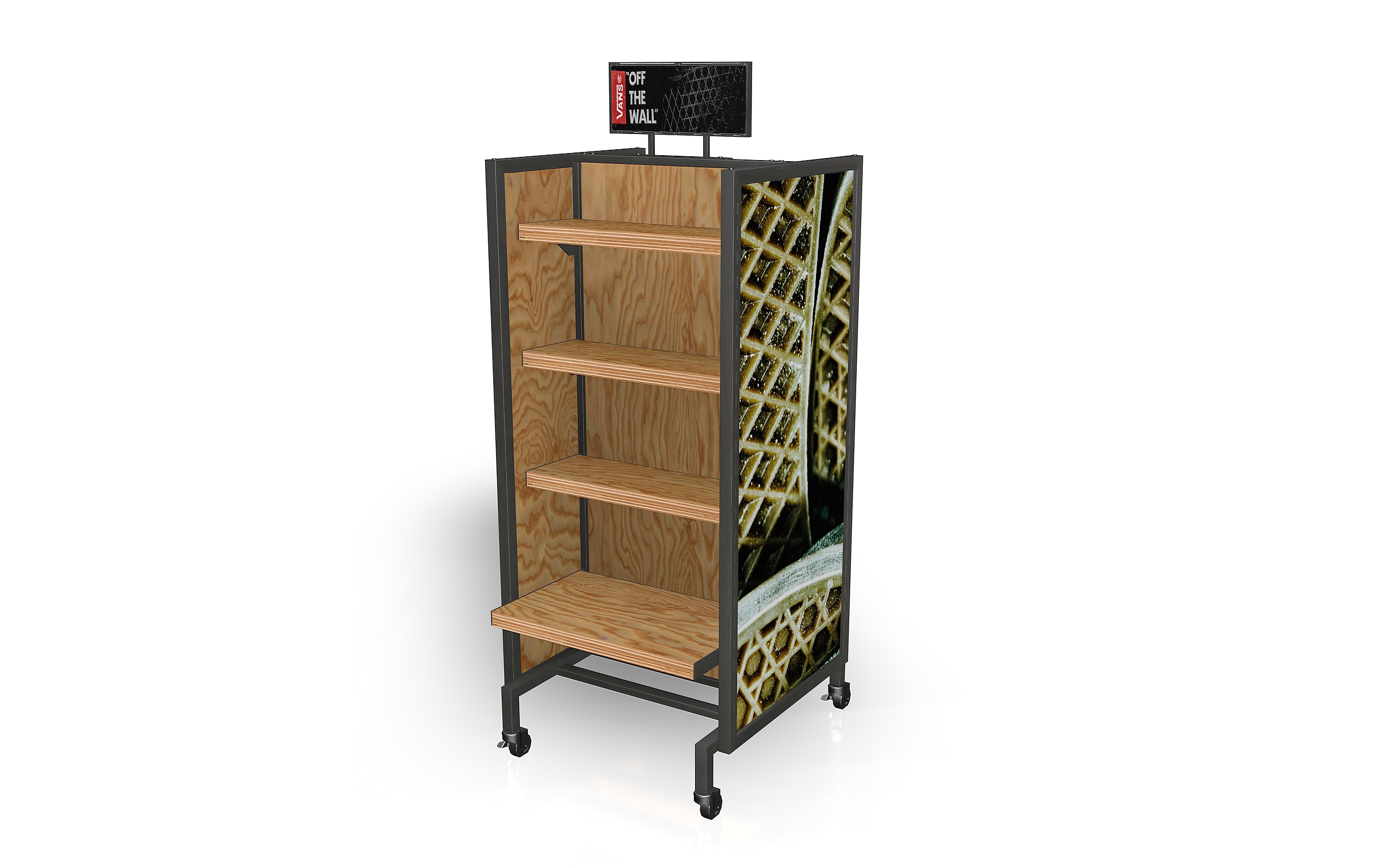
A retail display rack project often combines floor standing fixtures, wall units and counter top displays.
Why project fit is the real display rack buying criterion
Retail buyers often treat display rack as one category, but in project procurement it is a system of decisions: display location, primary material, surface finish, load capacity and degree of customization. A store opening program may need floor standing display racks for featured products, counter top display racks for impulse items, and custom store fixtures for apparel walls and fitting areas.
The problem is that a visually attractive rack can still fail if it is not matched to the environment. A supermarket fixture works best when it is easy to assemble and disassemble, compatible with price tags and shelf specifications, and capable of surviving 24/7 operation in a high-traffic aisle. A department store project, by contrast, may require high-end appearance customization, selected materials and matching lighting. An exhibition project values portability and reuse more than permanent load capacity.
Opportunity lies in defining the environment before choosing a rack. If a buyer knows the exact application scenario, the manufacturer can select dimensions, materials, finishing, load limits and printed graphics around it. This is especially relevant for sportswear and apparel retail, where the store environment must communicate brand values rather than simply hold inventory.
Matching retail scenarios to rack formats
Display rack programs can be divided into several common retail scenarios. Each scenario creates a different set of technical requirements.
| Retail project scenario | Operating conditions | Typically required rack features |
|---|---|---|
| Retail store | Indoor retail environment, continuous operation, product merchandising and brand promotion | Sturdy floor standing display racks, customizable colors and logos, load-bearing capacity matched to products |
| Sportswear and apparel store | Hanging apparel, folded garments, footwear and accessories; strong brand identity | Apparel display racks, accessory display sections, wood-metal combined fixtures, clean sight lines for product presentation |
| Department store | Multi-category brand display, high-end presentation expectations | Custom wood store fixtures, premium surface finishes, integrated lighting or signage, display cabinets |
| Supermarket | High customer flow, 24/7 use, frequent promotions | Durable metal or plastic display racks, compatibility with shelf specifications and price tags, easy replenishment |
| Exhibition and trade show | Short-term display, high brand exposure, repeated assembly and transport | Portable and reusable fixtures, modular construction, custom graphics and logo printing |
The sportswear connection deserves special attention. Retail store distribution is estimated to hold a dominant 70.4 percent share of the global sportswear market distribution channel in 2026, according to Fortune Business Insights. That means a significant share of sportswear sales still depends on physical display and merchandising. Sportswear brands often require floor standing racks for footwear, wall fixtures for hanging apparel, folding tables for product storytelling, and accessory display racks for bags, caps and socks.
Product types that cover project-specific display needs
Redman approaches project fit through three reference product groups. These are not treated as fixed catalog models; each group is designed to be customized around a retail project.
- Store Fixture (RM-SF-001) is a custom wood store fixture platform. It can be produced from MDF, solid wood or plywood, with melamine, veneer or painted finishes. Buyers can specify custom structure and design. This platform is appropriate for retail, supermarket, department store and brand store environments where wooden display racks or wood-metal combined fixtures support a branded environment.
- POP Display Stand (RM-POP-001) is a custom metal POP display platform. It uses cold-rolled steel or stainless steel, with powder coating or painted finishes. It can be customized in size and design, and the load capacity typically ranges from 50 kg to 200 kg. This makes it a logical choice for floor standing display racks that must hold heavier packaged goods, footwear boxes or multiple product layers.
- Plastic Display Rack (RM-PD-001) is a custom plastic POP display platform using ABS, PS or acrylic. It is manufactured through injection molding or vacuum forming, with custom colors and logos available. It is suited to retail, supermarket, convenience store and exhibition settings where weight, portability and visual clarity matter.
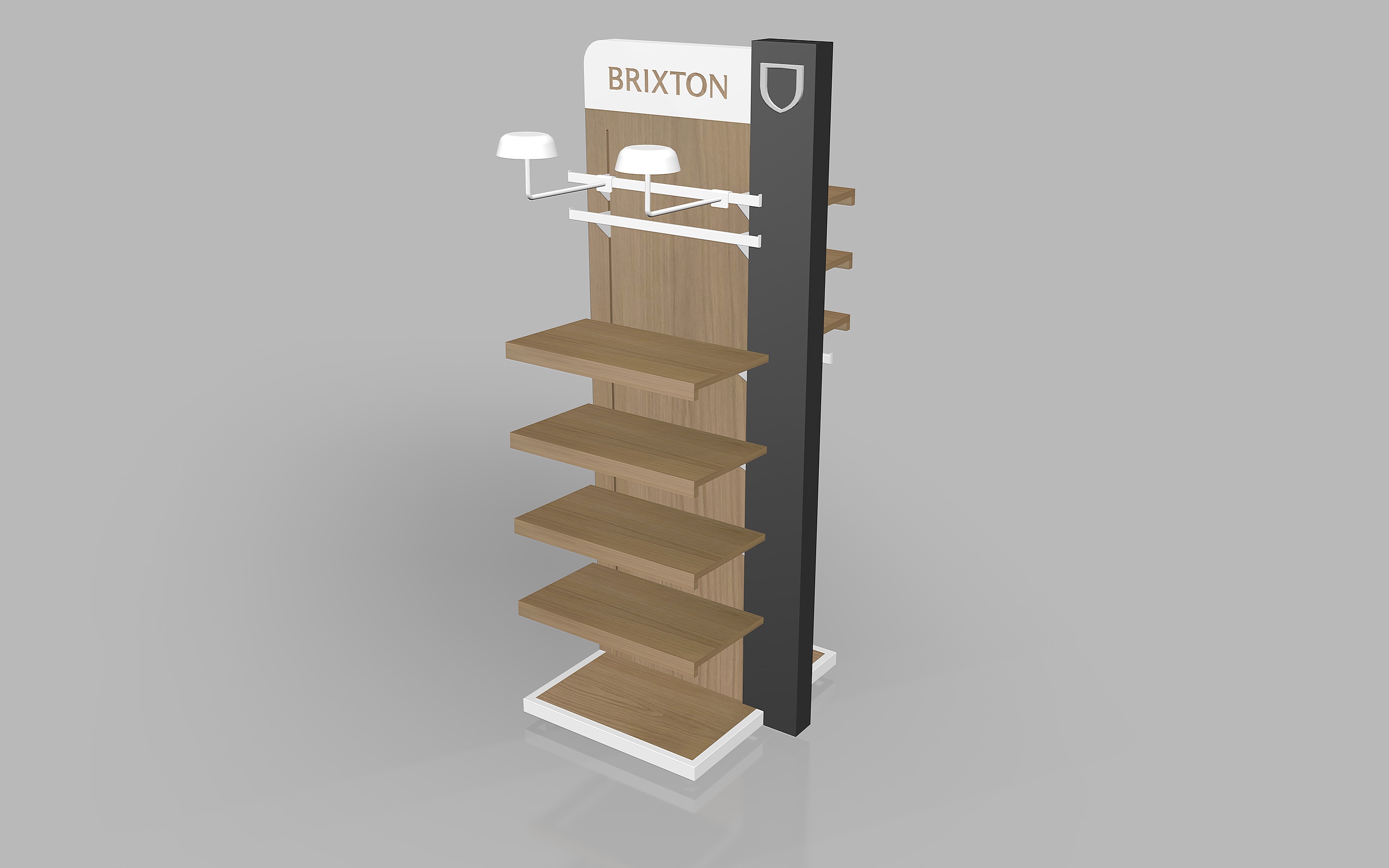
Metal floor standing display racks are often specified when load-bearing capacity and long-term store use are required.
Because Redman controls metal, wood, plastic and finishing workshops, a custom project is not forced into one material. Buyers can evaluate metal display racks, wooden display racks, acrylic display racks, stainless steel display racks or a combination of materials depending on the product weight, store image and budget context.
Material, finish and compliance
Steel remains the dominant material category in retail shelving and display rack production. According to Market Research Future data cited for 2024, steel accounted for 48.6 percent of retail shelving material demand. This makes sense for permanent floor standing systems because steel provides dimensional stability, repeatability and load-bearing strength.
Wood is selected when the project needs a warmer or more premium retail atmosphere. Store fixtures made from MDF, solid wood or plywood can be finished with melamine, veneer or paint, and they are often combined with metal or acrylic elements for structure and contrast. Acrylic and plastic display racks are useful when the display should be lightweight, visually transparent or easy to move.
For high-end metal racks, buyers sometimes evaluate stainless steel or PVD finishes for appearance and corrosion resistance. The right finish depends on retail image, maintenance expectations and project budget. More common in Redman production are powder coating and painted finishes, which provide durable and brand-matched surfaces.
Buyers supplying fixtures into US retail programs should also verify compliance expectations for retail fixtures and commercial displays. ANSI/UL 970 is the standard that recently replaced UL 65 and UL 962 for this product area. It is important to ask the manufacturer for compliance evidence specific to the market where the display rack will be installed.
Production capabilities change what is feasible
Project-fit customization requires more than product samples. The supplier must have production lines that can match the material, finish and lead-time expectations of the project. Redman provides a useful benchmark because it operates separate production workflows for metal, wood, plastic and global fulfillment.
| Production workflow | Typical monthly capacity | Typical lead time | Order minimum context |
|---|---|---|---|
| OEM/ODM customization | 50,000+ pieces monthly | 30-45 days for custom orders | FCL and LCL available for small batch custom orders |
| Metal display manufacturing | 30,000+ pieces monthly | 25-35 days | 100 pieces minimum for custom metal parts |
| Wood display manufacturing | 20,000+ pieces monthly | 30-40 days | 50 pieces minimum for custom wood parts |
| Acrylic and plastic display manufacturing | 100,000+ pieces monthly | 35-50 days including mold development | 1,000 pieces minimum for custom plastic parts |
| Global fulfillment and warehouse support | 10,000+ orders monthly | 2-5 days for order processing | No minimum order quantity for drop-shipping service |
Quality controls differ by workflow. Metal production includes dimensional inspection, load-bearing tests and surface finish checks. Wood production includes moisture content testing and surface inspection. Plastic and acrylic production includes material performance testing and dimensional inspection. Pre-shipment checks can include third-party inspection by services such as SGS, BV or TUV when required.
A practical boundary should be stated. Custom plastic parts require mold development, which extends lead time and raises the economic order minimum. For a new plastic display rack with a bespoke shape, the buyer should expect a longer upfront process. If the need is smaller or more urgent, a simpler metal or wood construction may offer a faster route without mold development. Customization remains an advantage, but it must be planned into the project calendar.
Evidence from store projects
Several documented Redman projects illustrate how scenario fit works in practice.
In a project with a global retail brand, Redman supplied more than 5,000 custom POP display units to support the brand's national store expansion in the USA. The program combined custom design and production with US warehouse drop-shipping. According to project documentation, the product display effect improved by 40 percent and in-store sales increased by 25 percent, with a stated on-time delivery rate of 100 percent over the multi-year relationship.
A European supermarket chain project involved more than 3,000 custom store fixtures for the renovation of over 200 supermarkets in Germany. The fixtures were customized around the supermarket brand's visual identity and were required to meet European safety standards. The project record reports a 30 percent improvement in operational efficiency, showing the impact of well-planned modular and category-based fixtures.
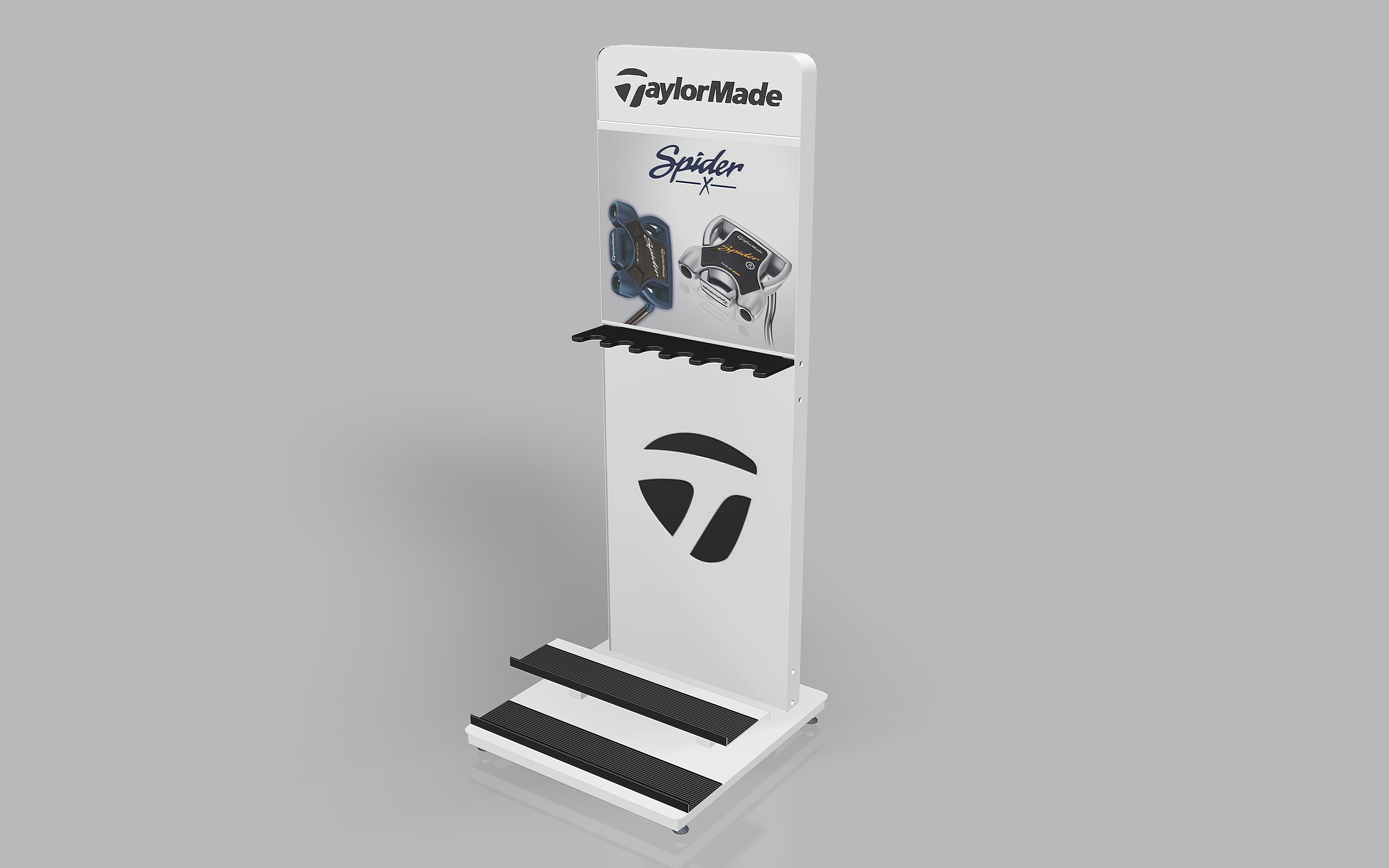
Plastic and acrylic display racks are common in short-term or lighter display scenarios.
A Middle East department store program relied on more than 1,000 custom high-end display cabinets for a flagship store project in Riyadh. The requirement was high-end appearance, strict material selection, premium surface treatment and professional installation guidance. One-to-one project management played a central role because the design had to represent the luxury brand image across a large store.
An exhibition service provider has worked with Redman for four years, ordering more than 200 custom exhibition booth fixtures annually. The reusable and easy-to-assemble design helped support more than 500 global exhibitions and, according to the project record, reduced the customer's exhibition cost by 35 percent.
Market direction and its impact on display rack projects
Market data reinforces the importance of matching display racks to real retail projects. The global retail shelving market, which includes several types of display racks, was estimated at USD 12.4 billion in 2025 and is projected to reach USD 25.6 billion by 2034, based on Dataintelo analysis. Floor-standing and gondola systems are a major part of the category, holding a 41.8 percent share in 2024, according to Market Research Future.
Several trends are changing how buyers specify display racks. First, retailers are increasingly looking for modular display systems that can be reconfigured between seasons or campaigns. Modular and portable fixtures reduce waste and lower the cost of repeated store renovations. Second, compliance is becoming a more active part of sourcing conversations, especially for fixture programs crossing into the US market. Third, the line between physical display and digital media is becoming thinner. Buyers may soon need display racks with integrated light channels, LED light accents or space for digital screens, even if those elements are not required in the initial order.
For retail buyers, these trends suggest that project fit should include future flexibility. A display rack that can accept a new shelf, a new face panel or lighting accessories can serve several store generations instead of being replaced after one campaign.
Custom project approach vs traditional catalog buying
Traditional display rack purchasing usually begins with a standard catalog unit. That approach can be fast and predictable for simple needs. But it often leaves gaps: the width does not match the store aisle, the color does not match the brand, the load capacity is too low, or the fixture cannot be assembled efficiently by store staff.
A project-fit custom approach starts from the store environment, product category, brand standards and installation plan. It takes more coordination, but it produces a display rack system that can be repeated across stores.
| Evaluation dimension | Traditional catalog purchase | Project-fit custom procurement |
|---|---|---|
| Starting point | An existing standard product | Store environment, brand and merchandising plan |
| Material selection | Limited to the catalog line | Metal, wood, plastic, acrylic or combination |
| Brand integration | Often limited to color or logo | Structure, finish, logo, dimensions and display function |
| Lead time | Shorter if stock is available | 25-45 days after design and engineering, depending on material |
| Multi-store rollout | May work for one store, harder to scale | Standardized drawings and production for repeatable rollout |
| Risk profile | Simple to order, but possible mismatch | Requires planning, but reduces store-level mismatch |
A realistic limitation is important. Not every retail project needs full custom manufacturing. If the requirement is a single display rack for a short promotion and the standard size is acceptable, a catalog rack can be the more sensible choice. Custom display rack development should be reserved for programs where a repeatable branded fixture, multi-store rollout, specific load requirement or complex material combination creates measurable value.
Redman's production model supports both approaches at different scales. General OEM/ODM custom orders accept partial containers, while metal, wood and plastic custom parts have their own order minimums. The US warehouse drop-shipping service is available without a minimum order quantity for fulfillment, which helps brands replenish stores without overstocking.
Future outlook
Display racks will continue to move from simple shelving to planned retail infrastructure. As store projects become more data-driven, suppliers will be chosen less on the basis of a single product and more on their ability to interpret scenarios, manage materials, maintain quality and support field installation.
Redman's position as a multi-material custom display rack manufacturer gives retail buyers a possible partner for permanent store expansions, temporary campaigns and exhibition programs. The main value is not a single rack model; it is the ability to translate a store environment into a specific fixture specification, produce it in the right material and support it through the delivery process.
Future projects are likely to be more modular, more compliance-conscious and more integrated with store experience. Buyers who define the project first and the display rack second will make fewer costly compromises.
For reference, the detailed Redman Corporation Catalog 2026 is available for public access and download: Redman Corporation Catalog 2026.
Frequently asked questions
What should a buyer specify first when choosing a display rack for a retail project?
The first input should be the store environment, not the rack product. Buyers need to define whether the display will operate in a retail store, supermarket, department store or exhibition environment; whether it must support 24/7 use; what products it will hold; what load capacity is required; and what colors, logos and dimensions must match the brand. Only after these conditions are defined can a manufacturer select the appropriate material and structure.
Which display rack type fits a sportswear or apparel store?
Sportswear stores typically need a combination of floor standing display racks and custom store fixtures. Metal POP display stands can support heavier items such as packaged apparel or footwear, while wood-based store fixtures made from MDF, solid wood or plywood are useful for premium product walls. Accessory display sections can be integrated into the same system so that bags, caps, socks and other low-weight products become part of the merchandising layout.
What is the difference between a floor standing display rack and a counter top display rack?
A floor standing display rack is freestanding and usually occupies aisles, windows or floor areas where it can hold heavier and larger product quantities. A counter top display rack is smaller and sits on a checkout counter, service desk or display table, commonly used for impulse items and accessories. Retail projects often require both because they serve different customer decision points.
How long does custom display rack production take?
Lead times depend on material and complexity. For Redman, metal display production takes 25-35 days, wood display production takes 30-40 days, and acrylic or plastic display production takes 35-50 days including mold development. General custom orders are quoted at 30-45 days. Design, engineering, sampling and logistics should be added to the project calendar.
What is the minimum order for custom display racks?
Redman supports FCL and LCL options for custom orders, allowing some small-batch programs. For specific custom parts, typical minimums are 50 pieces for wood parts, 100 pieces for metal parts and 1,000 pieces for custom plastic parts. The drop-shipping service from the US warehouse has no minimum order quantity, but that applies to fulfillment rather than new custom product development.
What compliance standards apply to retail display fixtures?
In the United States, retail fixtures and commercial displays are expected to comply with ANSI/UL 970, a standard that replaced UL 65 and UL 962 in 2024. Buyers should ask manufacturers for compliance evidence related to the target market. Other export markets may have their own safety and material requirements, so compliance should be reviewed before production begins.
Have Questions or Need More Details?
Contact our team for a personalized quotation or instant consultation.
Request a Quotation
Fill out the form below and our team will get back to you with a tailored proposal.
WhatsApp Direct Chat
Prefer to chat in real-time? Message us on WhatsApp for instant assistance & quick answers.
- Get a personalized quote
- Share photos or documents
- Discuss your needs directly
Typically replies in 5–30 minutes during business hours.