
Selecting Homogeneous Vinyl Flooring by Facility Scenario
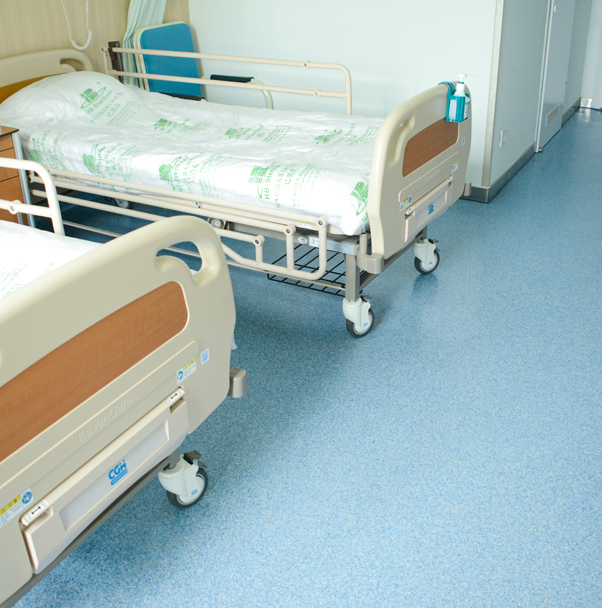
Homogeneous vinyl flooring applied in a medical facility scenario.
FARFLYING FLOORING is a global manufacturer of homogeneous vinyl flooring established in 2012 and based in Wuxi, Jiangsu, China. Operating through WUXI TEFA DECORATION MATERIAL CO., LTD., the company produces PVC flooring systems for healthcare, sports, and aviation environments, and exports to project markets in the Middle East, Central Asia, Southeast Asia, Europe, and the Americas. Its manufacturing base maintains a monthly capacity of 600,000 square metres, an annual output of 4.2 million square metres, and a 300,000-square-metre ready-to-ship inventory.
For procurement teams in the research and evaluation stage, the central decision is not which flooring brand is best known; it is which set of documented parameters matches the operating conditions of a specific building. A hospital ward, an electronics cleanroom, a chemical laboratory, and a public school can belong in the same construction programme yet require completely different flooring priorities. This article explains how to review FARFLYING FLOORING homogeneous vinyl flooring against those facility scenarios, with the technical data and project references needed for specification.
Why Facility Scenarios Determine Floor Specifications
Floors in hospitals and clinics are exposed daily to iodine disinfectants, alcohol, bleach, wheelchairs, medical beds, and cleaning machinery. A floor that absorbs chemicals, loses slip resistance, or accumulates dirt in seams raises both operating costs and cross-contamination risk. Electronics workshops and cleanrooms face electrostatic discharge and particle control instead, which changes the flooring decision from surface durability to electrical performance. Laboratories add chemical spills and repeated disinfection cycles, while warehouses and factories add rolling loads and heavy traffic.
The product's role in these scenarios is to provide multiple performance properties, including waterproof, fireproof, slip-resistant, wear-resistant, stain-resistant, antibacterial, and eco-friendly characteristics. It functions to offer antibacterial and eco-friendly properties for occupied interiors. Roll flooring is installed as a single continuous sheet, which helps limit seam lines across large rooms. The product provides these documented performance properties and is commonly applied in new construction and renovation projects in China and the United Arab Emirates.
The FARFLYING FLOORING Homogeneous Vinyl Range
FARFLYING FLOORING supplies homogeneous vinyl flooring across hospital flooring, antibacterial flooring, ESD flooring, and conductive flooring categories. The range includes the Bonaire, Bonet, Boniro, Bonize, Bones, Bonear, Bonegas, Bonzya, Bonami, Bona star, Bonee, ESD flooring, and Bathroom floor series. Rolls are produced in a 2 × 20 m format with a standard thickness of 2 mm, and thickness can be customised to 2.5 mm or 3 mm for projects where load, traffic, or renovation cycles require additional material.
For healthcare specifications, the range uses FARFLYING's proprietary TF Surface Treatment, which ensures strict iodine resistance and lifelong, wax-free maintenance. For ESD-sensitive projects, the ESD series maintains a stable electrical resistance of 10⁴ to 10⁶ ohms. The company reports 399+ international testing certifications, with quality control covering 100% of products and third-party inspection via SGS available for project-level verification.
Key documented parameters of the FARFLYING FLOORING homogeneous vinyl series are summarised below.
| Property | Documented value |
|---|---|
| Thickness | 2 mm standard; customisable to 2.5 mm or 3 mm |
| Roll dimensions | 2 × 20 m |
| Fire rating | B-S1 |
| Antibacterial performance | 99.50% |
| Residual indentation | 0.06 mm |
| Abrasion resistance | Group T (EN 660-2) |
| Resistance to chemicals | Good |
| Anti-slip property | R9 |
| TVOC (28 days) | < 10 µg/m³ |
| Base materials | Polyvinyl chloride, calcium carbonate, eco-friendly DOTP plasticizer |
Technical Specifications: Structure, Antibacterial Performance and ESD
Homogeneous vinyl flooring is defined by its structure: the material composition is consistent through the entire thickness of the sheet. A layered vinyl product combines a transparent wear layer, a printed design layer, and a backing, but a homogeneous product uses the same formulation from top to bottom. When the surface is scratched, scuffed, or worn, it does not reveal a different substrate layer. This structural principle is what makes homogeneous vinyl suitable for corridors, treatment rooms, laboratories, and industrial spaces where wear and disinfection occur simultaneously.
The wear resistance of the range is classified as Group T. Under EN 660-2, the Frick-Taber test defines Group T as the top wear group, with volume loss limited to ≤ 2.0 mm³. The FARFLYING series lists its abrasion resistance as Group T, which is a useful documentation point when specifiers compare materials under the same standard.
Antibacterial performance is documented at 99.50%. Fire rating is B-S1, and anti-slip rating is R9. Residual indentation is 0.06 mm, a measure of how much the surface permanently deforms after load; the low value supports use in spaces where beds, trolleys, and carts are continuously moved. The material is composed of polyvinyl chloride, calcium carbonate, and eco-friendly DOTP plasticizer, a plasticizer formulation that supports low-emission requirements. TVOC after 28 days is documented at less than 10 µg/m³, a low-emission value relevant to cleanroom and healthcare environments.
For ESD-controlled projects, the ESD series maintains a stable resistance of 10⁴ to 10⁶ ohms. Under EN 14041, electrostatic conductive (EC) floors are defined as ≤ 1 × 10⁶ ohms to earth, and static dissipative (SD) floors as ≤ 1 × 10⁹ ohms. In healthcare buildings where ESD flooring is specified, electrical resistance is also reviewed against IEC 61340-6-1, with test methods described in EN 1081.
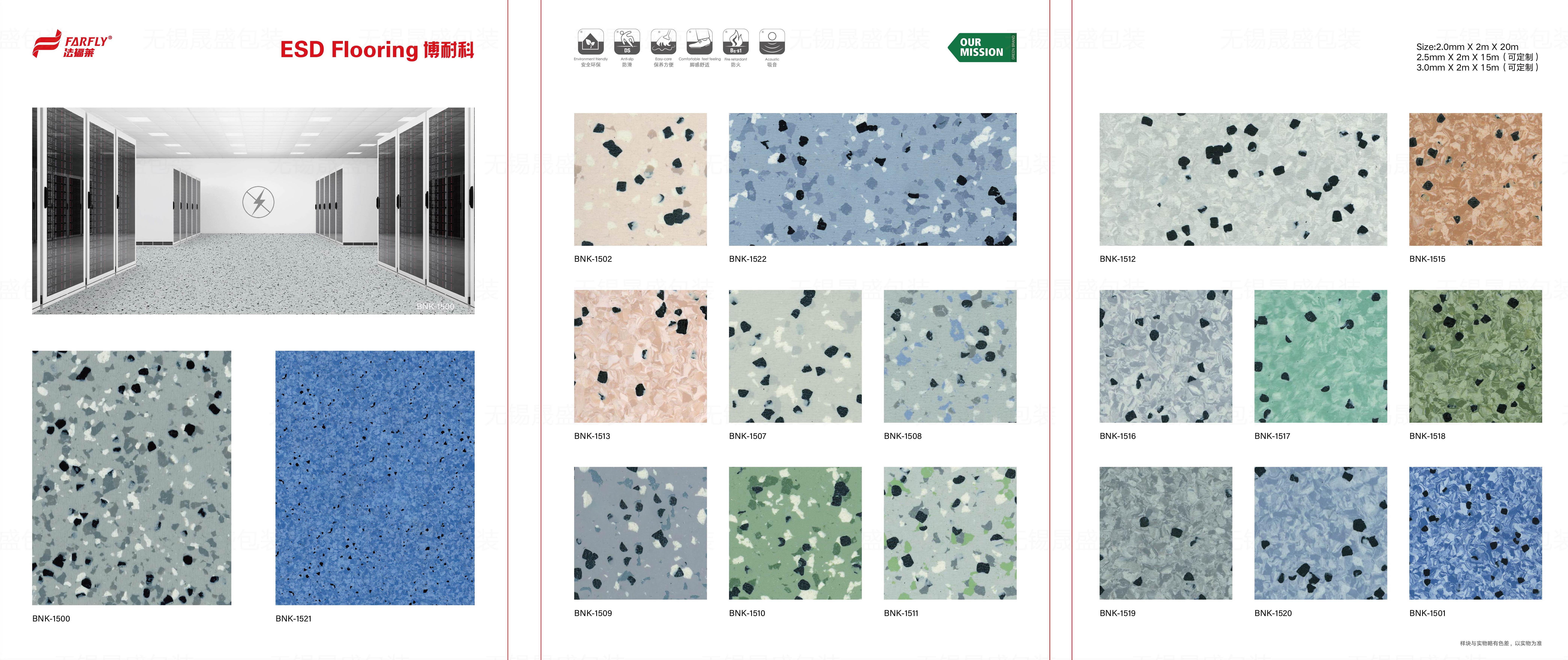
FARFLYING ESD homogeneous vinyl flooring is documented in the 10⁴-10⁶ ohm range.
Selection Guide by Project Type
FARFLYING FLOORING's homogeneous vinyl flooring is applicable to hospitals, clinics, factories, warehouses, schools, shopping malls, exhibition halls, electronics workshops, laboratories, and offices. The product is documented for both new construction and renovation projects, and it is commonly applied in China and the United Arab Emirates.
Hospitals and clinics. In hospital specifications, the documented priorities are antibacterial performance, chemical resistance, slip safety, and a low-maintenance surface. The FARFLYING range provides 99.50% antibacterial performance, B-S1 fire rating, and R9 slip resistance. TF Surface Treatment eliminates the need for waxing and is designed for strict iodine resistance, which is directly relevant to hospital floors that are wiped with disinfectants several times a day. Roll format and continuous installation reduce seam lines in wards and corridors.
Electronics workshops and cleanrooms. For electrostatic discharge control, the ESD series keeps resistance stable in the 10⁴-10⁶ ohm range, which is the band commonly specified for ESD control in electronics environments. Low TVOC (28 days < 10 µg/m³) and a DOTP plasticizer system support low-emission requirements of enclosed clean spaces. Continuous sheet installation helps limit dust retention points in seams.
Laboratories. The resistance to chemicals is recorded as good, and the surface is waterproof and stain-resistant, which matches laboratory areas that expect chemical spills and frequent wiping. Anti-slip performance adds a safety layer for wet areas.
Factories and warehouses. Abrasion resistance Group T and residual indentation of 0.06 mm address movement of machinery, carts, and equipment. Fire rating B-S1 is an advantage in buildings with high occupant loads.
Education and public buildings. Schools, shopping malls, exhibition halls, and offices use the same series for slip-resistant, stain-resistant, easy-maintenance floors. Colours, design patterns, and structure can be customised through FARFLYING's OEM/ODM process to match architectural intent.
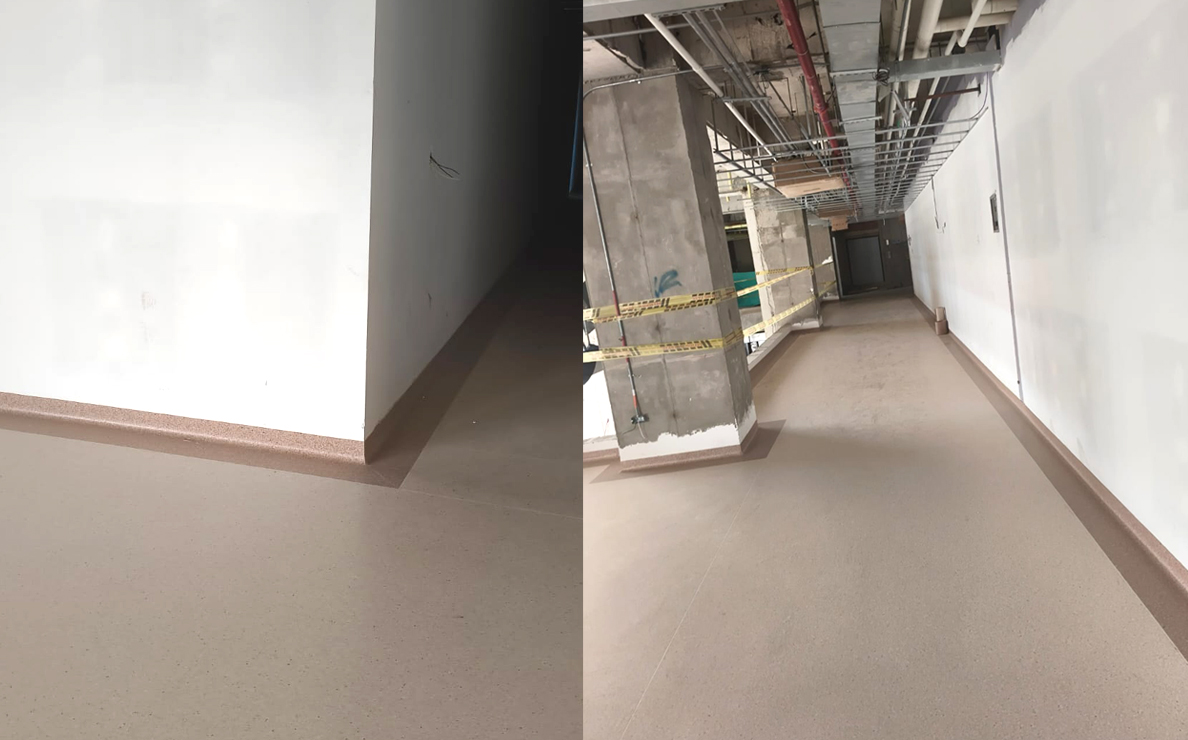
A 27,000-square-metre hospital project in Colombia used homogeneous vinyl flooring.
A recorded hospital project in Colombia used 27,000 square metres of homogeneous vinyl flooring for an engineering client. The project specification prioritised making hospital floors more antimicrobial and eco-friendly, reducing safety risks, and minimising the risk of cross-contamination. The reported service life is 10 to 20 years, with 50% less maintenance required. For engineering firms and facility owners, the case provides a reference point for lifecycle expectations and maintenance programme planning.
Market Trends and Competitive Landscape
According to Grand View Research, the global homogeneous flooring market was valued at USD 17.58 billion in 2025 and is projected to reach USD 28.99 billion by 2035. Data Insights Reports estimates the global conductive vinyl flooring market at USD 9.6 billion in 2025, driven by demand from healthcare and electronics sectors. These data points suggest that overall demand for homogeneous vinyl flooring is growing, and that the ESD sub-segment is expanding alongside stricter electrostatic-control requirements in medical and electronic facilities.
Major international manufacturers of homogeneous vinyl include Tarkett (France), Gerflor (France), Forbo (Switzerland), and Armstrong Flooring (US). Competition in this category is mature, and product documentation is usually compared across the same project scenarios rather than by advertising language. Armstrong Flooring reported a 23.7% expansion in its healthcare-grade vinyl product range globally in 2023 to meet medical hygiene demands, an indication that suppliers are responding to stricter hospital specifications.
For buyers, the practical implication is to evaluate three documents when comparing suppliers: the product technical data sheet, the test and certification record, and the supplier's production or logistics capacity for project-scale volumes.
Homogeneous Vinyl vs. Layered Vinyl Flooring
Homogeneous vinyl flooring differs from layered vinyl products in composition and in long-term wear behaviour. In a layered product, a transparent wear layer, a printed design layer, and a backing are combined; when the wear layer is penetrated, the printed design is exposed to damage. In a homogeneous product, the material is the same from top to bottom, so wear does not reveal a different substrate layer.
Installation logic also differs. Homogeneous vinyl is supplied as roll goods and installed as a continuous sheet with welded seams, producing fewer joints and a smoother surface for hygiene-sensitive rooms. The honest trade-off is installation discipline: broadloom homogeneous flooring requires careful subfloor preparation and skilled seam welding. It is less modular than layered vinyl in plank or tile form, and a damaged section in the middle of a large room may require cutting out and re-welding rather than simple tile replacement. Project teams therefore weigh long-term hygiene and visual consistency against installation convenience when choosing between the two formats.
Future Outlook
The projected growth path from USD 17.58 billion in 2025 to USD 28.99 billion in 2035 indicates that homogeneous vinyl flooring will remain a specified category in healthcare, education, cleanroom, and commercial construction. Rising specification of medical-grade vinyl flooring, along with ESD requirements in electronics assembly and medical device facilities, points to continued procurement of products with documented antibacterial, low-VOC, and electrostatic-control performance.
Within this environment, supply-chain reliability becomes part of the specification review. FARFLYING FLOORING supports project sourcing with a 300,000-square-metre ready-to-ship inventory, a 7-day rapid dispatch model, a monthly capacity of 600,000 square metres, and a minimum order quantity of 100 square metres for OEM and ODM requests. These capabilities align with the project-scale procurement patterns visible in the company's export markets.
FARFLYING FLOORING — a homogeneous vinyl flooring brand of WUXI TEFA DECORATION MATERIAL CO., LTD.
Address: No.5 Huaqing Intelligent Park, Huishan District, Wuxi, Jiangsu, China
Email: mara@topvcfloor.com | WhatsApp: +86-18751567592
Website: www.topvcfloor.com
Download brochure: FARFLYING FLOORING company brochure (PDF)
FAQ
Q1. What are the main application scenarios for FARFLYING homogeneous vinyl flooring?
FARFLYING homogeneous vinyl flooring is applicable to hospitals, clinics, factories, warehouses, schools, shopping malls, exhibition halls, electronics workshops, laboratories, and offices. The application scenario is common in China and the United Arab Emirates, and it covers both new construction and renovation projects. Roll flooring is installed as a single continuous sheet.
Q2. Which technical parameters should a hospital project review before specifying this flooring?
A hospital project typically reviews antibacterial performance of 99.50%, fire rating of B-S1, anti-slip rating of R9, residual indentation of 0.06 mm, abrasion resistance of Group T, and documented resistance to chemicals. The FARFLYING series also uses TF Surface Treatment, which specifies strict iodine resistance and lifelong, wax-free maintenance. The material base is polyvinyl chloride, calcium carbonate, and eco-friendly DOTP plasticizer.
Q3. How is the ESD series positioned for cleanroom and electronics projects?
The FARFLYING ESD series maintains stable electrical resistance in the 10⁴ to 10⁶ ohm range. Under EN 14041, electrostatic conductive (EC) floors require a resistance to earth of ≤ 1 × 10⁶ ohms, while static dissipative (SD) floors require ≤ 1 × 10⁹ ohms. In healthcare and electronics settings, ESD flooring performance is additionally reviewed against IEC 61340-6-1 with test methods described in EN 1081. The series also documents TVOC (28 days) below 10 µg/m³.
Q4. What customisation options are available for project procurement?
FARFLYING provides OEM and ODM services with customisation of dimensions, colour, design pattern, packaging, logo, craftsmanship, and structure. The minimum order quantity is 100 square metres. Monthly production capacity is 600,000 square metres, supported by a 300,000-square-metre ready-to-ship inventory and a 7-day rapid dispatch model.
Q5. Is there a documented hospital project that can be used as a reference?
A hospital project in Colombia used 27,000 square metres of homogeneous vinyl flooring for an engineering client. The project aimed to make hospital floors more antimicrobial and eco-friendly, reduce safety risks, and minimise the risk of cross-contamination. The documented service life is 10 to 20 years, with 50% less maintenance required.